Interview with John Pilger about his new film “Utopia”
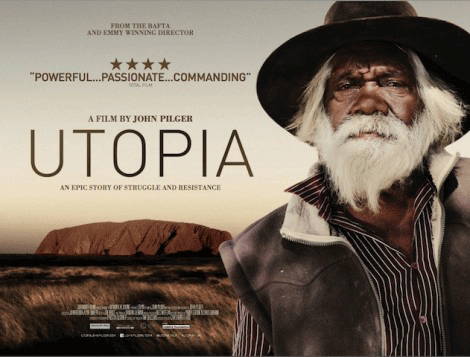 Utopia – a powerful film about the subjugation of Aboriginal First Australians 09/11/2013 An interview with the maker of Utopia, John Pilger John Pilger, the renowned investigative journalist and award winning film maker, has recently completed a new film, Utopia, which deals with the subjugation of the Aboriginal First Australians. Niall Mulholland interviews John about the film’s themes, followed with a review of Utopia. Socialistworld.net
Your new film, Utopia, is a powerful and harrowing look at the legacy of colonial genocide and successive government policies on Australia’s indigenous people. What made you return to this theme?…….. Continue reading
Ways to completely remove Murdoch spin from your computer
 Actually, I wouldn’t do this. I like to know what lies and hypocrisies are being pushed currently
How to block Murdoch Independent Australia, Torin Peel 3 November 2013 Sick of News Corp spin? Technology whiz Torin Peel explains how to erase Rupert Murdoch’s propaganda from your computer screens completely. IF YOU’RE ONE OF THOSE PEOPLE who simply won’t stand for Rupert Murdoch’s crap anymore, now might be the time to completely erase him from your computer screens for good. There are many ways to do this, and they’re remarkably simple.
If you’re ready to block News Corpse, the first way we can do this is using a plugin for Google Chrome. If you don’t use Chrome, I recommend you download it. It’s a lot faster and more modern than Internet Explorer. It’s also a lot easier to use and works better with most web pages, including websites like Twitter and Facebook.
The Google Chrome plugin is called Murdoch Block, and can be added to Chrome with relative ease through the Chrome extensions library…… http://www.independentaustralia.net/business/business-display/how-to-block-murdoch,5861
Mainstream media in Australia has brought about a public fog of ignorance about climate change
 If you believe that the main obligation of journalists is to the public right to know, the results of this study are truly alarming. Journalism is about reporting contemporary events as accurately as possible. There could be no better example of the importance of this than the reporting of climate science.
News Corp’s coverage seems to be more about production of ignorance than informing people so they can participate in debates about solutions. If people are confused or ignorant about potential threats, they cannot be expected to support action to confront them.
 Big Australian media reject climate science The Conversation, Wendy Bacon,1 November 2013, Australia has the most concentrated press ownership in the world. What does that mean for significant issues such as climate change?
In 2011 and 2012 we at the Australian Centre for Independent Journalism at University of Technology, Sydney collected data on climate science coverage in ten Australian newspapers. We published the results yesterday in a report: Sceptical Climate: Part 2.
We found that Australia’s concentrated newspaper ownership has a significant effect on how climate science is covered. One third of articles in Australia’s major newspapers do not accept the consensus position of climate science: that human beings are contributing to climate change.
That’s a very high level of scepticism when you consider that these stories are rejecting findings that over 97% of the world’s climate scientists support. Recently the International Panel on Climate Change found there was 95% certainty that people were contributing to climate change.
How did we decide what was sceptical? Continue reading
Letters editors will not print clear errors of fact from climate change deniers
Climate change: a note from our Letters editors http://www.smh.com.au/comment/smh-letters/climate-change-a-note-from-our-letters-editors-20131021-2vvjd.html October 21, 2013 Julie Lewis and Marc McEvoy Letters editors rarely make the news. This month the Los Angeles Times letters editor, Paul Thornton, did just that with a story on letters from climate-change deniers. He said he would not print letters that asserted “there is no sign humans have caused climate change” because “it was not stating an opinion, it’s asserting a factual inaccuracy”. This attracted headlines declaring “Los Angeles Times riles climate-change sceptics by banning letters”. Unsurprisingly, we’ve been asked how we treat letters from climate change deniers.
Herald editor-in-chief Darren Goodsir recently reiterated the paper’s stance on global warming. “The Herald believes unequivocally in human-induced climate change,” he told an audience at David Suzuki’s City Talk. “It is an established fact. What we are much more interested in is not the sideshow over whether this phenomenon exists or not, but on how it should be tackled.”
We do not ban writers whose views suggest they are climate change deniers or sceptics. We consider their letters and arguments. But we believe the argument over whether climate change is happening and whether it is man-made has been thrashed out extensively by leading scientists and on our pages and that the main debate now is about its effects, severity, and what society does about it.
Climate change deniers or sceptics are free to express opinions and political views on our page but not to misrepresent facts. This applies to all our contributors on any subject. On that basis, a letter that says, “there is no sign humans have caused climate change” would not make the grade for our page.
Politically biased media climate coverage is not a coincidence
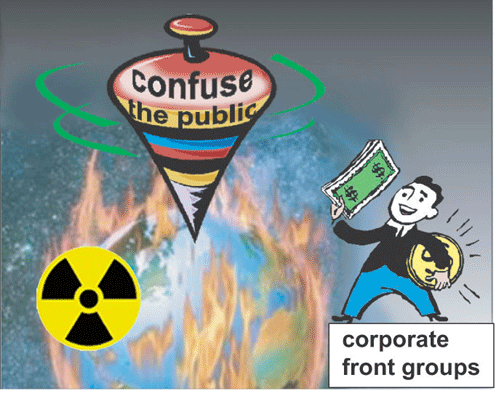 Let’s be honest – the global warming debate isn’t about science by Dana Nuccitelli Friday 4 October 2013 theguardian.comThe scientific evidence on human-caused global warming is clear. Opposition stems from politics, not science.The 2013 Intergovernmental Panel on Climate Change (IPCC) report states with 95 percent confidence that humans have caused most, and probably all of the rapid global warming over the past 60 years. Approximately 97 percent of climate experts and peer-reviewed climate science studies agree…….
Politically biased media climate coverage is not a coincidence
The scientific evidence is what it is, and it has no political bias. The same is not true of the media outlets that cover the topic. It’s not a coincidence that politically conservative tabloids and newspapers like the Daily Mail, Telegraph, Australian, and Wall Street Journal spend a disproportionate amount of time amplifying the voices of the less than 3 percent of climate contrarian scientists, as well as many non-scientist contrarians.
It’s certainly not the case that David Rose has some brilliant insight into the state of climate science that climate scientists don’t have. He and his fellow climate contrarians simply approach the question backwards. They start from their political ideological opposition to climate solutions and work backwards, seeking out cherry picked evidence to justify their predetermined conclusions, thus ignoring the 97 percent of inconvenient scientific evidence. This climate contrarianism ideological bias is illustrated in a new study, summarized by Graham Readfearn: Continue reading
How will Tony Abbott reward Rupert Murdoch for the election gift?
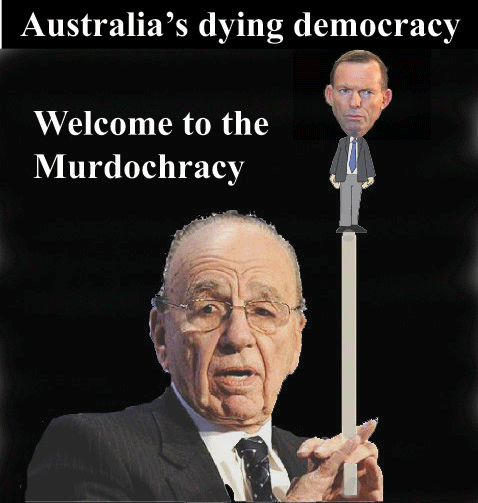 Reward and punishment: the making of media policy The Age October 2, 2013 Sally Young How will the government reward News Ltd for its wholehearted poll support? News Corp Australia (formerly News Limited) played an unusually active role during the election campaign in promoting a Tony Abbott-led Coalition government. The more cynical among us might be wondering then how long it will take for some form of quid pro quo to emerge in media policy.
……What News Corp did during the 2013 election campaign was unusual by Australian standards. We haven’t seen anything that aggressively partisan and directive since 1972 and 1975. ……hat might News Corp want from the government?
Any News Corp wish list will include ways to limit the ABC. Eighty years after the Lyons/Murdoch deals and in a new world of internet paywalls, the biggest newspaper group in the country still frets about competition from the ABC. Stopping the NBN and key recommendations from the Convergence Review can already be ticked off. But other desires may include watering down cross-media ownership rules and the anti-siphoning list that prevents Foxtel acquiring rights to televise certain sporting events, plus a crackdown on online piracy that infringes News Corp copyright.
The wish list might be larger and more ideological than mere commercial interests ………: http://www.theage.com.au/comment/reward-and-punishment-the-making-of-media-policy-20131001-2uqnz.html#ixzz2gbEFPL21
‘Pandora’s Promise’ – film that is stinking its way around Australia
 The nuclear advertising film ‘ Pandora’s Promise’ will be showing around Australia, and in Edinburgh and London in the next couple of weeks. It is largely funded by people from the pro nuclear Breakthrough Institute, including people like Bill Gates, who has his own nuclear power company Terra Power. It is directed by passionate nuclear enthusiast, Robert Stone, who does Q and A afterwards, and over-talks any critical questioners.
Weaknesses of this film include the way that it:
- mocks anti nuclear opinions as a bunch extremists and zealots. It makes no effort to portray any sensible opposing opinion.
- minimises the health effects of ionising radaiation with downright untruths, for instance, telling us only that Chernobyl killed 56 people. It leaves out that a United Nations World Health Organization agency predicts 16,000 more will die from Chernobyl cancers and that the European Environment Agency estimates 34,000 more. It omits that non-fatal thyroid cancer struck another 6,000, mostly children
- does not mention the crippling economics that is now closing nuclear plants in USA (Florida, Wisconsin and California), nor the imperative for tax-payer subsidy
- does not mention insurance: the nuclear industry, alone among industries is exempt from risk through USA’s Price Anderson Act, as well as every home owner’s insurance policy stating that this policy does not compensate you for any radiation damage from a nuclear power plant.
- avoids the economics of Small Nuclear reactors (SMRs) Even under the best of circumstances, there will be no SMR prototype for as long as a decade or more. There are serious questions over the economics of mass producing these, over their safety, and the huge costs of maintaining security over thousands of little nuclear reactors scattered around the land. None of this is discussed in the film.
- promotes Integral Fast Reactors (IFRs) – fast breeder reactors. but doesn’t mention the past failure of these, in USA , France (Super Phoenix) Japan (Monju), and their enormous cost.
- Dishonestly minimises the nuclear waste problems of IFR’s. Film does not explain that the final wastes, while smaller in volume, are far more radioactive and dangerous than existing nuclear wastes, and therefore require the same amount of storage space and security.
Rupert Murdoch’s newspaper The Australian misrepresented top scientist on climate change
Top physicist accuses The Australian newspaper of misrepresenting his climate change views Graham Readfearn 24 Sept 13 IN a column this week in The Australian, writer Gary Johns tried to argue that the science of human-caused climate change was “contentious”, that climate change might not be that bad and that we shouldn’t bother to cut down on emissions.
The Australian newspaper has a record for favouring climate science denialism and contrarianism above genuine expertise.
Columns and coverage like this come along in the pages of the Rupert Murdoch-owned press with such regularity that you might think [blush] that they’ve got some kind of an agenda. Honestly, you could really think that.
In the latest column – “Let’s get realistic about reducing carbon emissions” – Johns writes approvingly of a project called the Nongovernmental Panel on Climate Change (NIPCC) while finding disparaging remarks about the United Nations Intergovernmental Panel on Climate Change.
Johns doesn’t mention that the NIPCC is run by the fossil-fuel funded Heartland Institute in the United States, which advocates free market ideology within which businesses should be allowed to do pretty much whatever they like, such as using the atmosphere as a free waste dump.
But in one section of Johns’ column, he quotes and paraphrases Professor Richard Muller, a respected American physicist who was once sceptical of human-caused climate change. As reported in The Guardian and elsewhere, a couple of years ago Muller led a team based at the University of California which analysed more than 14 million temperature readings from 44,455 measuring sites from around the world going back to the mid 18th century.
Professor Muller found the world had warmed by 1.5C in the last 50 years and that burning fossil fuels and other human industrial processes were “almost entirely” the cause. Continue reading
Australia’s media economic writers bought by Rupert Murdoch
We really must talk about Murdoch’s tame economists http://www.independentaustralia.net/2013/politics/we-really-must-talk-about-murdochs-tame-economists/ 28 Aug 13 In Australia, to bludgeon his readers and viewers into believing the opposite of the truth, Murdoch has a battery of high profile economists fudging the numbers, says Alan Austin. THE WEAPONRY in Rupert Murdoch’s global arsenal includes paying corrupt police, illegal phone-tapping, fabricating malicious stories, lying to official inquiries and a range of other criminal activities.
In Australia, to bludgeon his readers and viewers into believing the opposite of the truth, Murdoch deploys other heavy artillery, including a battery of credentialled economists. Continue reading
Dick Smith got his nuclear energy costs wrong
Nuclear is the most expensive option when you take into account the external factors, followed by coal and coal seam gas. These external factors include devastating effects on health, agricultural output, land degradation, acid rain and the ability for us to feed ourselves, and of course in the case of the fossil fuels, climate change.
Already, in India and China renewables are either the cheapest form of new generation, wind is beating fossil fuels in Brazil and elsewhere. Even in Australia, wind and solar are considered the cheapest option for new capacity.
 Dick Smith wrong on energy costs – renewables are cheapest http://reneweconomy.com.au/2013/dick-smith-wrong-on-energy-costs-renewables-are-cheapest-34249 By Matthew Wright on 2 August 2013
I am from Energy security think-tank Zero Emissions and I wrote the Zero Carbon Australia Stationary Energy Plan which is briefly showcased during the film.
The stationary energy plan, the first of its kind to show that Australia could run on 100% renewable energy a combination of wind power, rooftop solar photovoltaic, and solar thermal with storage (featured in the film), along with a huge “mining” effort to find energy efficiency in housing, commerce and industry. It was a landmark that helped caused the Australian Energy Market Operator (AEMO), the organisation that runs Australia’s electricity supply, to write and publish this year its own plan and validate much of our work.
Whether you care about climate change or not, we’re moving rapidly away from coal because domestic and international banks, including the World Bank, will no longer invest in coal fired power. And a shift to gas would involve the burning of coal seam gas, due to a massive upswing in demand in Asia especially Japan the cost of gas here is becoming prohibitive. Continue reading
Sloppy science writing in Australia’s media
 The death of science journalism in Australia Independent Australia by MatthewDonovan 24 July, 2013 As the mainstream media struggles – particularly newspapers – the loss of journalists is a worrying trend; Noel Wauchope explains why she is most concerned about the loss of qualified science journalists. INVESTIGATIVE journalists would do well to investigate what is happening to science news writing in Australia…..
I knew that quality science journalism in Australia was dwindling. It took the most recent pro-nuclear advertorial in the Fairfax media to really wake me up to this. John Watson, ‘Senior writer’ at Fairfax Media, wrote an article entitled, Want to kill fewer people? Go nuclear…..
Why have The Age, Sydney Morning Herald and others sunk to this level of sloppy journalism?
Apart from the obvious fact they don’t want to offend their corporate backers, this kind of writing is symptomatic of what happens when you get rid of your qualified dedicated science journalists. Amongst the plethora of Fairfax journalists encouraged to depart their jobs were science editor Deborah Smith, health editor Julie Robotham, health correspondent Mark Metherell and environment reporter Rossyln Beeby.
That’s Fairfax. But what about the Murdoch media? The Murdoch media never had much of a problem in its coverage of science. The Australian blithely publishes science articles written by journalists who are clearly far from expert in the field of science.
This has been documented by Tim Lambert with his article, The Australian’s War on Science. In it he goes about scrutinising, in depth, writers such as Maurice Newman and Graham Lloyd.
The Australian did have one qualified science writer, Leigh Dayton. When she was sacked, the reason given by her editors was they: Continue reading
Trans Pacific Partnership talks focus on media control
 Big Media’s push for extreme new Internet censorship rules stalls secretive Trans-Pacific Partnership talks http://www.straight.com/news/402631/big-medias-push-extreme-new-internet-censorship-rules-stalls-secretive-trans-pacific-partnership-talks By David Christopher Big Media lobbyists and unelected bureaucrats are holding closed-door meetings in Malaysia this week, as they continue secret talks on the Trans-Pacific
  Partnership (TPP).
The TPP is a highly secretive and extreme trade deal being negotiated by Australia, Brunei, Canada, Chile, Japan, Peru, Malaysia, Mexico, New Zealand, the United States, Singapore, and Vietnam.
Reports from Malaysia indicate that the TPP talks are stalled over five key issues—including a key chapter on copyright and intellectual property rights that would censor and criminalize Internet use. Continue reading
Australian Labor and Liberal against Aboriginal Land Rights being enshrined in the Constitution
As far as I can see, corporate Australia will get its way, as usual, with a pretty meaningless and toothless reference to Aborignals in the Australian Constitution
 Major parties cool on ‘locking in’ land rights, ABC News 9 July 13 By Melanie Arnost The Federal Government and Opposition have both reacted coolly to a call from the Northern Land Council to have the Aboriginal Land Rights Act enshrined in the Australian constitution.
Land council chairman Wali Wunungmurra, speaking ahead of NAIDOC week’s celebrations of the Yirrkala bark petitions, said last week he wanted the act included in the constitution.
“(To) protect it from people watering it down, tearing it apart,” Mr Wunungmurra said…….The Yirrkala bark petitions were presented to Federal Parliament in 1963.
Mr Wunungmurra was one of 12 signatories to the petitions, which are credited with galvanising the land rights debate across Australia.http://www.abc.net.au/news/2013-07-08/cool-reaction-to-calls-for-land-rights-act-to-be-put-in-constit/4805192
“Plutonium Pollyanna” – a review of film “Pandora’s Promise”
Finally (as Beyond Nuclear and other watchdog groups have noted), relying on nuclear power to mitigate CO2-driven climate change is unaffordable and impractical since it would require putting a new reactor online every two weeks……
Ultimately, Pandora’s Promise comes across as a well-executed but disingenuous exercise in special pleading. Instead of devoting 89 minutes to honestly and fully assessing the pros and cons of renewable technologies alongside the risks and benefits of new, untried nuclear power systems,Pandora’s Promise promotes a narrow agenda. As a result, the film winds up as little more than a tunnel-vision exercise in “plutonium Pollyannaism.”
 Another Take on Pandora’s Promise EARTH ISLAND JOURNAL BY GAR SMITH – JUNE 28, 2013 Pro-nuclear power film obscures as much as it reveals You’ve got to give the producers of Pandora’s Promise credit for gumption. It takes a lot of chutzpah to release a pro-nuclear polemic in the wake of the triple meltdown in Fukushima, Japan. The film also suffered the ignominy of opening the same week that the owners of California’s troubled San Onofre Nuclear Generating Station announced the permanent shutdown of the facility’s two crippled reactors. Even the film’s title takes a bit of nerve; it was Pandora’s Box, after all, that unleashed a host of once-contained evils into the world.
So, given the extensive history of nuclear mishaps and near-catastrophes, how do the producers of Pandora’s Promise manage to spin their counter-narrative of a “safe, green” nuclear future? Basically by: (1) at first accepting the criticisms of traditional nuclear power and then (2) arguing that the solution lies in “new, improved” nuclear reactors. Like a smart defense attorney, director Robert Stone begins by admitting all of the defendant’s worst foibles up front, thereby depriving the prosecution of an opportunity to score points by revealing these issues later…….
The filmmakers pronounce the radioactive contamination “infinitesimal” and proclaim there has been “no evidence of medical consequences.” No citations are offered to support this positive conclusion. The fact that 40 percent of Fukushima’s evacuated children have subsequently developed thyroid abnormalities goes unmentioned.
Where Are the “Anti-nuclear Environmental Leaders”? Continue reading
Australia’s news media now toes the line for big business
The real, untarnished news is getting through to a greater number of people after decades of being deliberately distorted or discarded by the power of money. Mobile phones have worked communication miracles in many countries.
The importance of Australia’s September election is beyond any in the nation’s history. The power of money has strangled good national government before. It can also deny us the full power of the NBN at the very time when we will most need its maximum capabilities.
Big money versus good government Independent Australia, Australia’s September election is more important than any in the nation’s history, writes Rodney E. Lever, as big money tries to strangle a good government. 23 June 13 “……Now newspapers are dying. Propaganda rules our lives. Good honest journalists are losing their jobs. Editorials expressing proprietorial views are on the front page.…..In the past few decades, Australia’s newspapers have gradually been taken over by ignorant multi-millionaire proprietors with other interests, and now journalists are ordered to write stories to political requirements….
… Rupert Murdoch ‒ who claims to be a journalist ‒ is a fraud. He has never written anything, except on Twitter, reads little more than balance sheets and dictates terse letters. He shows up in the working areas of his newspapers only when cameras are around.
This is why Australian politics is in turmoil. People think they are being informed by what were once called “the mirrors of the world”. They are, in fact, reading manufactured pages of falsehoods and duplicity. On top of that, we are bombarded by mentally-deficient radio shock-jocks and screwed by much of the electronic media. Continue reading
1 This month

of the week – Australians for War Powers Reform (AWPR)
To see nuclear-related stories in greater depth and intensity
 Antinuclear