Assange’s Release: Exposing the Craven Media Stable
June 28, 2024 by: Dr Binoy Kampmark, https://theaimn.com/assanges-release-exposing-the-craven-media-stable/
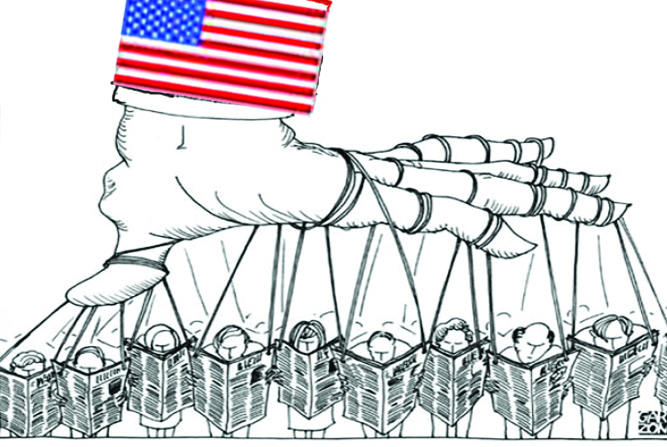
The WikiLeaks project was always going to put various noses out of joint in the journalistic profession. Soaked and blighted by sloth, easily bought, perennially envious, a good number of the Fourth Estate have always preferred to remain uncritical of power and sympathetic to its brutal exercise. For those reasons, the views of Thomas Carlyle, quoting the opinion of Edward Burke in his May 1840 lecture that “there were Three Estates in Parliament; but in the Reporters’ Gallery yonder, there sat a Fourth Estate more important far than they all” seem quaintly misplaced, certainly in a modern context.
The media response to the release of WikiLeaks founder Julian Assange from his scandalous captivity after pleading guilty to one count of conspiracy to obtain and disclose national defence information under the US Espionage Act of 1917 provides a fascinating insight into a ghastly, craven and sycophantic tendency all too common among the plodding hacks.
Take, for instance, any number of journalists working for the Australian Broadcasting Corporation, official national broadcaster and devotee of the safe middle line. One, a breakfast news anchor for the network’s meandering twenty-four-hour service, has a rather blotted record of glee regarding the mistreatment of Assange over the years.
Michael Rowland, torturously insipid and ponderously humourless, had expressed his inexpressible joy when the Ecuadorian government cut off Assange’s access to the Internet while confined to the country’s London embassy. “A big gold star to Ecuador,” he chirped on March 28, 2018. Andrew Fowler, another journalist and far more seasoned on the rise of WikiLeaks, reproached Rowland on Twitter, as the X platform was then called. “Why would silencing a fellow journalist be supported?” For Rowland, the matter was as clear as day. “That remains a disputed opinion, Andrew. Publisher and activist yes. But you put yourself in a small camp calling him a journalist.”
These points matter, because they go to the central libelling strategy of the US government’s prosecution so casually embraced by mainstream outlets. In such a generated smokescreen, crimes can be concealed, and the revealers shown to be those of bad faith. Labels can be used to partition truth, if not obscure it altogether: a publisher-activist is to be regarded more dimly than the establishment approved journalist.
The point was rather well made by Antony Loewenstein, himself an independent journalist keen to ferret out the grainier details of abusive power. When interviewed by none other than Rowland himself, he explained, with unflagging patience, the reasons why Assange and Wikileaks are so reviled by the orthodox scribblers of the Fourth Estate. WikiLeaks, he stated with salience, had confronted power, not succumbed to it.
Rowland could only reiterate the standard line that Assange had admitted guilt for a “very serious offence”, refusing to examine the reasons for doing so, or the implications of it. Again, the vulgar line that Assange had “put US lives at risk” with the WikiLeaks disclosures was trotted out like an ill-fed nag. Again, Loewenstein had to remind Rowland that there was no evidence that any lives had been exposed to harm, a point made in several studies on the subject from the Pentagon to the Australian Defence Department.
The tendency is pestilential. While more guarded in his current iteration as a professor of journalism, Peter Greste, formerly a journalist for Al Jazeera, was previously dismissive in the Sydney Morning Herald of Assange’s contributions as he was brutally evicted from the Ecuadorian Embassy in London. “To be clear, Julian Assange is no journalist, and WikiLeaks is not a news organisation.” An organisation boasting “the libertarian idea of radical transparency” was “a separate issue altogether from press freedom.
While approving the publishing activities centred on the release of the Collateral Murder video showing the killing of civilians including two Reuters journalists by Apache helicopters, and the release of the Afghanistan War Logs, the Iraq War Logs and “Cablegate”, Greste fell for the canard that the publisher did not redact names in documents to “protect the innocent” by dumping “them all onto his website, free for anybody to go through, regardless of their contents or their impact they might have had.”
There is no mention of the decrypting key carelessly included in WikiLeaks: Inside Julian Assange’s War on Secrecy by its bumbling authors David Leigh and Luke Harding, or the fact that the website Cryptome was the first to publish the unredacted files ahead of WikiLeaks. There is certainly no discussion of the extensive redacting efforts Assange had made, as many of his collaborators testify to, prior to the release in November 2010.
Writing on June 25 in The Conversation, Greste displays the emetic plumage of someone who has done an about face. “It is worth pausing for a moment to consider all Assange has been through, and to pop a bottle of champagne to celebrate his release,” he writes distastefully, also reflecting on his own carceral experiences in an Egyptian prison cell. He also claims that the role of WikiLeaks, in checking “the awesome power that governments wield”, should be celebrated, while stating, weakly, that he never believed that Assange should “have been charged with espionage.”
In such shifting views, we see wounded egos, cravenness, and the concerns about an estate whose walls had been breached by a usurping, industrious publisher. By all means use the spoils from Assange and his leakers, even while snorting about how they were obtained. Publish and write about them in the hope of getting a press award. Never, however, admit that Assange is himself a journalist with more journalism awards than many have had hot dinners. In this grotesque reality, we are now saddled with a terrifying precedent: the global application of a US espionage statute endangering journalists and publishers who would dare discuss and run material on Washington’s national security
Australia’s media on nuclear power – wading through the quagmire

First of all, I’d like to commend a top article, which analyses the political significance for Peter Dutton, of his extraordinary policy :
Patricia Karvelas: Peter Dutton’s nuclear energy plan breaks all the rules of policy making. Is it genius or career self-destruction?
More recent articles at https://antinuclear.net/2024/06/24/from-25th-june-the-most-recent-australian-nuclear-news/
Below is a list of news articles. Now I have not here included the pro nuclear propaganda ones, nor the ravings of the very right-wing shock jocks of commercial radio – such as Melbourne’s 3AW. But you can find all that stuff on mainstream, mainly Murdoch media. The ABC is doing its best to stay afloat and actually give the facts. I am sure that those brave female TV and radio voices are now under quite vicious attack – Patricia Karvelas, Sarah Ferguson and Laura Tingle
I will try to keep this list up-to date – but that is going to be a daunting task –
National politics Dutton’s plan to nuke Australia’s renewable energy transition explained in full . No costing, no clear timelines, no easy legal path: deep scepticism over Dutton’s nuclear plan is warranted Nuclear plan is fiscal irresponsibility on an epic scale and rank political opportunism. Dutton’s nuclear lights are out and no one’s home. Peter Dutton launches highly personal attack on Anthony Albanese, calling him ‘a child in a man’s body’ while spruiking his new nuclear direction. Peter Dutton vows to override state nuclear bans as he steps up attack on PM. Peter Dutton is seated aloft the nuclear tiger, hoping not to get eaten.
Local politics. Nuclear thuggery: Coalition will not take no for an answer from local communities or site owners.
Climate change policy. Peter Dutton’s flimsy charade is first and foremost a gas plan not a nuclear power plan. Coalition’s climate and energy policy in disarray as opposition splits over nuclear and renewables.
Economics Peter Dutton’s nuclear plan could cost as much as $600bn and supply just 3.7% of Australia’s energy by 2050, experts say . The insane amount it could cost to turn Australia nuclear – as new detail in Peter Dutton’s bold plan is revealed. Nuclear engineer dismisses Peter Dutton’s claim that small modular reactors could be commercially viable soon. Wrong reaction: Coalition’s nuclear dream offers no clarity on technology, cost, timing, or wastes. ‘Peter Dutton’s nuclear plan is an economic disaster that would leave Australians paying more for electrici.ty’. Dutton’s nuclear thought bubble floats in a fantasy world of cheap infrastructure. UK’s nuclear plant will cost nearly three times what was estimated.
Energy, Coalition won’t say how much nuclear power its plan will generate until after an election
Health Nuclear industry workers face significant, inevitable and unavoidable radiation health risks
Indigenous issues, How a British nuclear testing program ‘forced poison’ onto Maralinga Traditional Owners.
Technology. Dutton’s plan to build nuclear plants on former coal sites not as easy as it seems Over budget and plagued with delays: UK nuclear lessons for Australia.
Sabotaging renewables. There’s one real Coalition energy policy now: sabotaging renewables.
Secrecy. Port Augusta mayor and local MP kept in the dark about Liberal Coalition’s plant to site nuclear reactors there.
Site locations for reactors. Peter Dutton reveals seven sites for proposed nuclear power plants. Coalition set to announce long-awaited nuclear details.
Safety. Some of the Coalition’s proposed nuclear locations are near fault lines — is that a problem?
Spinbuster. It’s time to go nuclear on the Coalition’s stupidity. Ziggy Switkowski and another big nuclear back-flip . Does the Coalition’s case for nuclear power stack up? We factcheck seven key claims. A Coalition pie-in-the-sky nuclear nightmare.
Gina Rinehart and co are not the slightest interested in nuclear power plants. Goal is just – dig baby dig – coal, gas, uranium – forever. They can just keep mining forever, and funding the Liberal Coalition’s pointless nuclear mirage. Nobody’s really interested in super-expensive nuclear power plants, big or small. But while Australia is conned into believing that this nuclear power plan is actually real, well – it’ll keep on being dig baby dig. As Helen Caldicott once suggested – if these grasping oligarchs could put a blanket around the sun and sell holes – then they’d be interested in solar power,
Superficial coverage of Dutton’s nuclear policy does Australia a disservice
By Ernst Willheim, Jun 17, 2024, https://johnmenadue.com/superficial-coverage-of-duttons-nuclear-policy-does-australia-a-disservice/
Noel Turnbull correctly writes that media coverage of the federal opposition’s nuclear power proposal is superficial. There is a very wide range of as yet unanswered issues.
First, who will build and operate the proposed nuclear power stations.
Many years ago, when the Commonwealth proposed establishment of a nuclear power station, it settled on Jervis Bay because the ‘territories’ power in the Commonwealth Constitution gave the Commonwealth plenary power. The proposal was well advanced, and a large concrete platform was built, before the proposal was eventually abandoned because it proved to be uneconomic.
The opposition apparently contemplates location of nuclear power stations on the sites of disused coal fired power stations. Does the opposition believe the Commonwealth has constitutional power to establish and operate nuclear power stations in the States?
The States would of course have the constitutional power to establish nuclear power stations. Remember State electricity authorities used to be publicly owned before they were privatised. But has any of the States indicated any enthusiasm for establishing and operating nuclear power stations?
If the opposition doesn’t envisage either Commonwealth or State government involvement, do they envisage private enterprise.
There are many capable private operators around the world but I haven’t seen any evidence of private corporations clamouring for the right to build nuclear power stations in Australia. Could it be that the private sector understands that privately owned nuclear power stations in Australia would not be competitive, that is, they would not return a profit.
There remain a range of wider regulatory issues, who would be responsible for planning, oversight and safety. How would liability and insurance be handled. Would the opposition envisage that Australia should become a party to the Vienna Convention on Civil Liability for Nuclear Damage. What about safeguards. Would the opposition accept oversight by the International Atomic Energy Agency?
It is not clear that the opposition has addressed any of these issues.
ABC boss Kim Williams launches stunning attack on Peter Dutton’s nuclear power plan – just days after Laura Tingle said Australia is ‘a racist country’
Daily Mail, By PADRAIG COLLINS FOR DAILY MAIL AUSTRALIA, 13 June 24
ABC’s chairman Kim Williams has launched a blistering attack on Peter Dutton’s nuclear power plan, just days after 7.30 correspondent Laura Tingle was ‘counselled’ for her comments about the Coalition.
Speaking on a panel at Sydney‘s Vivid Festival on Wednesday night, Mr Williams said Mr Dutton’s nuclear policy was ‘absent any of the normal fabric of policy formulation’.
In comments reported by news website Crikey, the national broadcaster’s boss said the Coalition had announced the policy ‘as a sound bite, with no detail as to emissions targets’.
Mr Williams, who is not a journalist and therefore not subject to the ABC’s editorial guidelines, said he was ‘not being political’ and not ‘in any way … speaking for the ABC’.
‘I’m speaking as an Australian citizen, and I’m entitled, like any Australian citizen, to have a view as to the necessity of good public policy in our nation.’
…………………………………………………………………….Just hours before Mr Williams comments, Nationals leader David Littleproud said if the Coalition wins the next election and goes ahead with its nuclear plans, power plants will be in National Party seats.
Mr Littleproud said Australians would ‘know very soon the specific sites’ being proposed.
‘We’ve been very clear that they will be limited to where existing coal power stations are, so we don’t need the extra 28,000 of transmission lines to plug the renewables.
‘We’re clear, there are 12 to 14 existing coal-fired power stations across the country so we can limit to that,’ he told ABC breakfast.
But Mr Williams said the Coalition was not doing near enough to explain what its nuclear plans are.
He said in the past, governments published green papers, which were designed to generate discussion from all interested parties on major issues.
‘And then they published a white paper, which is an announcement of intended government direction from which debate would follow in the Parliament, and then legislation would appear,’ he said.
‘That was the traditional process for public policy formulation, particularly on critical matters such as energy policy. I think it’s a pretty good system.’
Mr Williams has stood by his comments, telling Crikey that he ‘was trying to be as careful as I can be but still answer the question’.
‘It wasn’t said in a sort of vigorous “I’m taking on the opposition here”, it was said as a commentary about public policy and public policy formulation and public policy process.’
An ABC spokesman told Daily Mail Australia: ‘The ABC Chair Kim Williams is not an ABC employee and is not directly involved in creating and publishing journalism.
‘Mr Williams declared he was making his observations as a private citizen.’
Mr Dutton has also been contacted for comment. https://www.dailymail.co.uk/news/article-13524723/ABC-boss-kim-williams-peter-dutton-nuclear-power-plan-laura-tingle.html—
Was ABC’s firing of Antoinette Lattouf influenced by a pro-Israel group? | Real Talk – Online.
23 Jan 2024 Real Talk
Australian-Lebanese presenter Antoinette Lattouf was fired by Australia’s ABC just three days after she started. It has now surfaced that her firing may have been orchestrated by a pro-Israeli WhatsApp group. Now she’s fighting back, and she joins us to speak about it on Real Talk online. (Note: After this interview was recorded, ABC issued a statement saying that Lattouf was not fired. Lattouf responded on Twitter, saying: “If I wasn’t sacked, what was it?”) #RealTalk is a Middle East Eye interview show hosted by Mohamed Hashem that delves into the stories and experiences of a diverse range of guests.
National Party threatens to tear up wind and solar contracts as nuclear misinformation swings polls
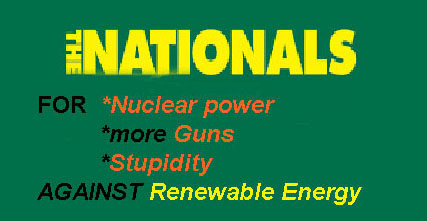
The campaign against renewables and for nuclear has been based around misinformation, both on the cost and plans of renewables and transmission, and on the cost of nuclear power plants, which have stalled around the world because of soaring costs, huge delays, and because no small modular reactor has yet been licensed in the western world.
That campaign has been amplified by right wing “think tanks” and ginger groups, and the Murdoch media, and largely reported uncritically in other mainstream media. It appears to be having some traction.
Giles Parkinson, Apr 23, 2024, https://reneweconomy.com.au/nationals-threaten-to-tear-up-wind-and-solar-contracts-as-nuclear-misinformation-swings-polls/
National leader David Littleproud has threatened to tear up contracts for wind and solar farm developments, in the latest broadside against large scale renewable energy from the federal Coalition.
The remarks – reported by the Newcastle Herald and later verified by Renew Economy via a transcript – were made in a press conference last week in Newcastle, when Littleproud was campaigning against offshore wind projects and outlining the Coalition’s hope that it could build a nuclear power plant in the upper Hunter Valley.
The Coalition has vowed to stop the roll out of large scale renewables, and keep coal fired power plants open in the hope that they can build nuclear power plants – recognised around the world as the most expensive power technology on the planet – some time in the late 2030s and 2040s.
No one in the energy industry, nor large energy consumers for that matter, are the slightest bit interested in nuclear because of its huge costs and time it takes to build, and because it would set back Australia’s short term emissions reductions.
But the comments about contracts are the most sinister to date, and reflect the determination of a party leader who just a few years ago described renewables and storage as a “good thing”, including the huge wind and solar projects that are being built in his own electorate, to destroy the renewables industry.
The Newcastle Herald asked Littleproud if an incoming Coalition government would consider “tearing up contracts” for renewable infrastructure contracts that had already been signed.
“Well exactly,” Littleproud said. “We will look at where the existing government took contracts and at what stage they are at.
“There are some projects on land that we will have to accept, but we are not going to just let these things happen. If that means we have to pay out part of the contracts, and we will definitely look at that. You’re not going to sit here and say today that we’re stopping it and then not following through.”
The federal government this week announced the biggest ever auction of wind and solar in Australia, seeking six gigawatts of new capacity that will be underwritten by contracts written by the commonwealth.
This will see at least 2.2 GW of new wind and solar sourced in NSW, at least 300 MW in South Australia, already the country’s leader with a 75 per cent share of wind and solar in its grid, and multiple gigawatts spread over other states.
However, the Coalition’s nuclear plans are already facing delays, having pulled back from a previous commitment to deliver the nuclear policy before the May 14 federal budget. It now only promises to release the policy before the next election, with Littleproud telling Sky News on Monday that the party “would not be bullied” into an early release.
One of the many problems with its nuclear strategy will be finding sites for the proposed power plants. The Coalition has targeted the upper Hunter as one site, but AGL, the owner of the site that houses the now closed Liddell and the still operating Bayswater coal generators, has said it is not interested because it is focused on renewables and storage.
Littlepround, however, said there are other sites in the area that could be used, although the Newcastle Herald said he declined to nominate those sites. Inevitably, they would require new infrastructure.
The campaign against renewables and for nuclear has been based around misinformation, both on the cost and plans of renewables and transmission, and on the cost of nuclear power plants, which have stalled around the world because of soaring costs, huge delays, and because no small modular reactor has yet been licensed in the western world.
That campaign has been amplified by right wing “think tanks” and ginger groups, and the Murdoch media, and largely reported uncritically in other mainstream media. It appears to be having some traction.
According to an Essential Media poll published in The Guardian on Tuesday, 40 per cent of respondents ranked renewables as the most expensive form of electricity, 36 per cent said nuclear, and 24 per cent said fossil fuels.
The poll also found a majority (52%) of voters supported developing nuclear power for the generation of electricity, up two points since October 2023, and 31% opposed it, down two points.
The most recent GenCost report prepared by the CSIRO and the Australian Energy Market Operator, like other international studies, says that nuclear power costs nearly three times more than renewables, even counting the cost of storage and transmissions.
However, the Coalition – with the support of right wind media and agitators – have led relentless campaigns against the CSIRO and AEMO, even though their nuclear costs were based on the only SMR technology that has gotten close to construction, before being pulled because it was too expensive.
The push to stop renewables comes despite reports from both AEMO and the Australian Energy Regulator that highlight how the growth in renewables has lowered wholesale power prices, despite extreme weather events and the impact of the unexpected outage of Victoria’s biggest coal generator.
The only state where wholesale electricity prices actually rose were in Queensland, which has the heaviest dependency on coal, although the state has just passed laws that lock in its 75 per cent emissions reduction target and its 80 per cent renewables target by 2030.
South Australia has already reached a 75 per cent wind and solar generation share in its grid, and aims to reach “net” 100 per cent by the end of 2027. It enjoyed the biggest fall in wholesale spot prices in the last quarter, which state minister Tom Koutsantonis said should be passed on to consumers.
“SA’s prices fell the most of any state, and the black coal dependent states of Queensland and NSW had the highest prices,” Koutsantonis said.
“These proven falls in wholesale prices are encouraging signs that we are on the right track. South Australia’s high proportion of renewables – which exceeded 75 per cent of generation in 2023 – is key to South Australian prices being far lower than the black-coal states of NSW and Queensland.
“Retail prices must fall because wholesale costs to retailers are going down.”
Former PM Paul Keating on a craven acceptance of US strategic hegemony in Asia
By Paul Keating, Apr 11, 2024 https://johnmenadue.com/a-craven-acceptance-of-us-strategic-hegemony-in-asia/
The Financial Review, if it wishes to remain relevant, requires a monster dose of reality – a de-lousing of its misplaced strategic ideology and its craven acceptance of US strategic hegemony in Asia, a region where not one US state resides.
In the mid-1980s, a young and enthusiastic Michael Stutchbury was a permanent attendee at my often two-hour press conferences as treasurer, drumming into the Canberra press gallery that the presence of large economic forces was more important and more newsworthy than the gallery’s normal diet of election speculation, leadership changes, tax cuts and cigarette prices.
And Michael lapped it up. He was an early graduate of my school of advanced economic and entrepreneurial thinking. And while he has become more conservative as he has become older, his stewardship of The Australian Financial Review provides an attestation that those economic lessons were an anchor, a ballast, for the wider presentation and contemporary dissertation of economic news and events.
In short, Michael’s close proximity to and at the reformation of the Australian economy in the 1980s and early 1990s has made his views and leadership on economic issues today to be of substantial national value. But economic insight is where Michael’s experience shutters. On foreign policy, as in The AFR View ‘‘JAUKUS shows Australia seeks security in Asia’’ (April 9), Michael is away with the pixies
– a sugar plum fairy in the Australian strategic fantasy.
And that fantasy goes to asserting that an Atlantic power, the United States, along with other Anglos, Britain and Australia, but topped up with some resentment sauce from Japan, in some way fashions a new Asia construct – a construct in which Australia is or can be part. Distorting my policy that Australia could find its security in Asia by being tied up and indentured to a particularly un-Asian bunch.
Unlike Europe, which after the Thirty Years’ War hit upon the Westphalian model of collective security among states of roughly equal size, Asia has always been a hierarchy of countries with China at its top. This remains the case today.
So, the policy of any nation, particularly a Pacific one, thinking it can deal with Asia by ignoring China or pretending it doesn’t exist or that it is in some way illegitimate, is a policy of fantasy. A policy of fools.
But if you are a sugar plum fairy, as in foreign policy Michael seems happy to be, you will believe almost anything. Like AUKUS nuclear subs will belong to Australia and be sovereign to it, despite US Deputy Secretary of State Kurt Campbell’s regular and blatant assertions that he expects the subs to be at the beck and call of the United States whenever it wishes to hop into China over Taiwan.
The Financial Review, if it wishes to remain relevant, requires a monster dose of reality – a de-lousing of its misplaced strategic ideology and its craven acceptance of US strategic hegemony in Asia, a region where not one US state resides.
First published in the Australian Financial Review, April 10, 2024.
Nuclear lobby manipulates ABC’s 7.30 Report

By Noel Wauchope | 11 April 2024, https://independentaustralia.net/business/business-display/nuclear-lobby-manipulates-abcs-730,18498—
An ABC report on nuclear energy presented a one-sided viewpoint, dominated by the pro-nuclear lobby, writes Noel Wauchope.
ON 4 APRIL, on ABC’s 7.30, regional affairs reporter Jane Norman presented a sort of debate on nuclear power for Australia. An accompanying article was also published on 2 April as a debate about ‘a generational divide’.
The show was quite gripping, with excellent visual snippets of Australia’s history of nuclear issues and promotional visualisation of the industry’s proposed new small modular reactors (SMRs).
The essence of this debate seemed to be that old people are inclined to oppose nuclear power, but young people see it as a new and valuable way to reduce carbon emissions and counter global heating.
In discussing the pros and cons of nuclear power, Norman, herself relatively young, mentioned some recent opinion polls in which public opinion was split, with younger Australians being more supportive of nuclear.
In opposition to nuclear, elderly Indigenous Aunty Sue Haseldine gave an intensely personal history, passionately setting out her concern for the environment and for the children of the future. We learned, as the programme went on, that older generations had been influenced by the history of past atomic tests in Australia, and by past accidents overseas, and had developed a distrust of nuclear power.
And, presently, the Liberal Coalition Opposition, led by Peter Dutton, is putting nuclear ‘at the centre of its energy policy’.
Moving on to those supporting nuclear power, Jane Norman interviewed the enthusiastic Helen Cook.
Cook is deeply involved in the pro-nuclear lobby as principal of GNE Advisory, whose website states:
‘Helen is recognised as a nuclear law expert by the International Atomic Energy Agency [and] the former Chair of the World Nuclear Association’s Law Working Group…’
She is definitely a nuclear promoter and a favoured speaker for the industry, along with luminaries such as Michael Shellenberger, Zion Lights and Dr Adi Paterson. She said that she had had trouble overseas trying to explain Australia’s ban against nuclear power, but now back in Australia, did not find negative attitudes towards it.
We then heard very limited support from the Grattan Institute‘s Tony Wood. He was clear that at present the economics for nuclear power are “terrible”, but said that SMRs could be an option for the future. (BHP, a big uranium miner, is a big backer of the Grattan Institute.)
The programme reinforced the message for small nuclear power, showing attractive graphics of SMRs prominently marked with text: ‘Reliable, cost-effective, clean and safe.’
Then came Mark Ho, nuclear engineer and president of the Australian Nuclear Association, on the need to overturn the legislation banning nuclear. Construction of SMRs would take from three to five years.
The International Atomic Energy Agency (IAEA) says that a country could go from considering nuclear energy to having nuclear energy in its power grid in ten to 15 years
Associate Professor Edward Obbard, the head of nuclear engineering at UNSW, was the final pro-nuclear expert. He explained that there is, among young people, very little opposition to AUKUS nuclear submarines. Younger generations regard climate change as the greatest threat, so nuclear could be one of the solutions. Obbard sees it as a moral case — an environmentally low-impact way to decarbonise.
Helen Cook has interesting insights. She says that Australia has expertise in nuclear power — a questionable claim when it is based on just the staff of one small research reactor. She argues that the USA, Japan and Ukraine have experienced severe nuclear accidents, yet have pledged to treble their nuclear energy production by 2050. One does wonder why.
This is problematic, as all three countries are burdened with nuclear waste and the industry now promises the reactors that might “eat the waste” (itself a dodgy claim). The UK government now admits that the nuclear weapons industry is the real reason for civil nuclear reactors. Her case for nuclear power for Australia seems to boil down to if others are doing this, so should we.
So we have on one side a little old (very articulate and eloquent) Indigenous lady, who probably does not have a university degree, let alone a big job in the industry, versus four “highly qualified” prestigious members of the pro-nuclear lobby.
I wrote to 7.30 suggesting a bit of genuine balance in this debate. I suggested for speakers the very well-informed Jim Green, of the international Nuclear Consulting Group and Friends of the Earth Australia, Dr Helen Caldicott, or Dave Sweeney of the Australian Conservation Foundation. But I now reflect that these might be a bit much for the ABC.
They might consider interviewing former nuclear supporters such as Ziggy Switkowski, Alan Finkel, or some more neutral experts like economist Professor John Quiggin or Jeremy Cooper.
Anyway, it’s the same old problem of false balance that has plagued the ABC in the past.
And there’s another dimension, now. The programme depicted Aunty Sue Haseldine as an admirable person, with genuine concern and emotion. But she hasn’t got the facts, the new young expert technical facts that appeal to today’s young people.
But 7.30 didn’t really present the facts. The gee-whiz SMRs are not new and young. They were tried out in the 1940s to 1960s but turned out to be uneconomic, time-consuming, gave poor performance and produced toxic wastes. The programme glossed over important issues such as waste problems, genuine study of the probable delays before SMRs could be operational, safety issues, risks of terrorism and weapons proliferation.
The ABC has a pretty noble history of tackling tough issues. And so does Sarah Ferguson, presenter of 7.30. I think they let us down this time and hope they will rectify this.
ABC interview- Sarah Ferguson and Tom O’Brien – a case study in exposing Trumpian-style deceptive spin
Greg Phillips 13 Mar 24
We need a proper transcript of this – Ferguson made a great point (11m25s) that Bill Gates said we should take advantage of our bountiful wind and solar potential. (Plus there are so many things that O’Brien said that I want to add to my “wacky nuclear predictions” file.) – Ferguson: I asked Bill Gates on this program whether Australia should get involved with nuclear energy – this was his answer – “Australia doesn’t need to get engaged on this, Australia should aggressively take advantage of Australia’s natural endowment to do solar and wind, that’s clear cut and beneficial to Australia”
Greg Phillips In the interview, Ted O’Brien employs logical fallacies to support the Coalition’s position on nuclear energy:
O’Brien appeals to the authority of experts and government agencies, such as ANSTO [Australian Nuclear Science and Technology Organisation], to support his argument for nuclear energy.
O’Brien presents a false dichotomy by framing the energy debate as a choice between nuclear energy and renewables, suggesting that nuclear is necessary due to the perceived failure of renewable energy targets.
O’Brien engages in ad hominem attacks by criticising the Labor Party’s energy policies and accusing them of lacking transparency and effectiveness, rather than directly addressing the interviewer’s concerns about nuclear energy.
O’Brien misrepresents the interviewer’s arguments by suggesting that they are arguing against the attractiveness of nuclear energy to investors, rather than questioning its feasibility and cost-effectiveness in the Australian context.
O’Brien selectively then cites examples of successful nuclear energy projects in other countries, such as Canada and the United States, while ignoring instances of cost overruns and delays in countries like the United Kingdom and France.
These logical fallacies detract from the soundness of O’Brien’s arguments and undermine the credibility of the Federal Coalition’s stance on nuclear energy.
Dead in the Water- The AUKUS Delusion

Australian Foreign Affairs – February 2024
The latest issue of Australian Foreign Affairs examines Australia’s momentous decision to form a security pact with the United States and the United Kingdom that includes an ambitious, expensive and risky plan to acquire nuclear-power submarines – a move that will have far-reaching military and strategic consequences.
Dead in the Water looks at whether the AUKUS deal will enhance or undermine Australia’s security as tensions between China and the US rise, at the impact on Australia’s ties with its regional neighbours, and at whether the submarines plan is likely to ever be achieved….. more https://www.australianforeignaffairs.com/
‘Mr Dutton is right’: Murdoch’s News Corp papers grant nuclear power glowing coverage

News Corp has done a climate turnaround, spruiking the Coalition’s new nuclear policy at every opportunity. But how much Kool-Aid have its reporters drunk?
DAANYAL SAEED, MAR 06, 2024, https://www.crikey.com.au/2024/03/06/news-corp-peter-dutton-nuclear-policy/
The Coalition’s solution to the climate crisis is set to be unveiled, with Peter Dutton reportedly planning to announce sites for a number of nuclear power stations, which would necessarily involve lifting Australia’s long-standing ban on nuclear power.
While the Coalition’s policy has been rubbished as “misinformed bulldust” by the likes of Andrew Forrest, a “dumb idea” by experts and “hot air” by the energy minister, the News Corp papers have been at the forefront of nuclear advocacy.
In the past month, The Australian has published a number of articles on nuclear power, with only one of its many op-eds (the aforementioned “hot air” piece by Energy Minister Chris Bowen) arguing in favour of Australia’s ban on nuclear.
Conversely, the paper has run several opinion pieces in favour of nuclear power, including two editorials advocating for its use, the most recent of which was published this morning.
The paper’s editorial on March 6 said it was “time for a properly costed plan on the nuclear option”, stating “Peter Dutton’s embrace of a nuclear option for consideration is worthwhile”.
“Dutton is right to develop a net-zero plan that includes nuclear,” the piece continued. “Refusing to lift the ban or even consider the issue … makes the federal government look out of touch with what is happening in the modern energy world.”
Crikey asked The Australian’s managing editor Darren Davidson on March 5 whether the paper had an editorial view on the merits of nuclear energy, and how it balanced any view it may have with the Coalition’s policy position, as well as any ethical obligations that may arise in its reportage. He declined to comment.
This morning’s editorial comes on the heels of one published on February 17 headlined “Nuclear option made easy by the renewables miscue”. It went on to describe nuclear power as “a logical option for emissions-free power”, a “sensible option”, but admitted it was “incendiary politics”
It rekindles the climate wars and undermines the certainty that is craved by business.”
Political editor Simon Benson has been responsible for much of this nuclear coverage, penning an op-ed on February 25 that argued the Labor government was “at risk of ending up on the wrong side of history in its fanatical opposition to nuclear power”.
Benson was also responsible for an exclusive, also published on February 25, that showed Newspoll data conducted for The Australian that showed 55% of Australian voters “supported the idea of small modular nuclear reactors as a replacement technology for coal-fired power”.
As early as February 15 Benson had insights into the Coalition’s policy, penning a piece titled “Liberals’ nuclear policy has potential to electrify”.
The Australian has also ran a number of opinion pieces over the past month in favour of the Coalition’s policy, including one by Peta Credlin headlined: “Liberal true believers stand firm against false net-zero gospel”.
However the paper also ran a piece by Sarah Ison on February 16 that highlighted one of the limits of the introduction of nuclear power in Australia. Ison interviewed Australian Industry Group climate change director Tennant Reed, who said that Australia may be waiting for more than 20 years for economically viable nuclear power.
The Show Trial against Julian Assange

If the US authorities succeed in convicting a journalist for exposing war crimes, this would have another serious consequence. In the future, it would become even more difficult and dangerous to expose the sordid reality of wars,
How US and British authorities are bending the law and undermining press freedom
FABIAN SCHEIDLER, FEB 24, 2024 ore https://fabianscheidler.substack.com/p/the-show-trial-against-julian-assange
“Those who tell the truth need a fast horse,” says an Armenian proverb. Or they need a society that protects the truth and its messengers. But this protection, which our democracies claim to offer, is in danger. As a journalist, Julian Assange has published hundreds of thousands of files documenting war crimes committed by the USA and its allies in Afghanistan, Iraq, Guantanamo and elsewhere. The authenticity of the documents is beyond question. However, none of the perpetrators have been brought to justice or convicted. In contrast, the messenger has been incarcerated in a high-security prison in London for five years with life-threatening health problems, having previously spent seven years locked up in the Ecuadorian embassy. He has been charged with no crime in the UK, in any EU country or in his home country of Australia. The only reason for his grueling deprivation of liberty is that the US government has initiated extradition proceedings accusing the journalist Assange of espionage, invoking a law dating back more than a hundred years to the First World War: the Espionage Act.
Never before has a journalist been charged under this law. The extradition process therefore sets a dangerous precedent. If it is successful, every journalist on Earth who exposes US war crimes would have to fear suffering the same fate as Assange. That would be the end of freedom of the press as we know it. Because it is based on the capacity to bring to light the dark sides of power without fear of punishment. Where this freedom is extinguished, it is not only the freedom of journalists that dies, but the freedom of us all: the freedom from the arbitrariness of power.
For this reason alone, this extradition process should never have been accepted by the courts in a functioning legal system. Julian Assange did not act as a spy in any way, but as a journalist and as such is subject to special protection. Incidentally, the key witness for the espionage charge was the notorious fraudster and convicted paedophile Sigurdur Ingi Thordarson, who admitted in 2021 that he had lied on behalf of the FBI and had been granted immunity from prosecution.
Let us imagine the case with reversed roles: Suppose an Australian journalist had published war crimes committed by the Russian military and intelligence services and sought protection in a Western European country. Would the courts seriously consider extradition proceedings to Moscow for espionage, especially if the key witness is a convicted criminal?
Assange is facing the absurd sentence of 175 years in the USA. It is to be feared that he will not survive the extremely harsh conditions in the notorious US prison system. For this reason, the London Magistrates’ Court initially halted his extradition in 2021. The US government then published a paper stating that Assange would not face solitary confinement. However, according to Amnesty International, this declaration is “not worth the paper it is written on”, as the non-binding diplomatic note reserves the right for the US government to change its position at any time. The Court of Appeal, however, found this paper sufficient to clear the way for extradition – a travesty of justice, as Amnesty noted.
The hearings, which took place on February 20 and 21 at the High Court in London and whose verdict is expected in March, are the last opportunity for Assange to obtain an appeal against this extradition decision. However, there is a high risk that the law will once again be turned on its head. As the investigative platform Declassified UK reports, one of the two judges, Jeremy Johnson, previously worked for the British secret service MI6, which is closely intertwined with the CIA and whose illegal activities came to public attention through the work of Julian Assange.
For Julian Assange, the trial itself has already become a punishment. Nils Melzer, the UN Special Rapporteur on Torture, concluded after detailed investigations that Assange had been subjected to systematic psychological torture for years. The fact that the US was prepared to go even further came to light in September of the same year: according to reports in the Guardian, senior intelligence officials, including the then head of the CIA and later Secretary of State Mike Pompeo, planned to kidnap and murder Assange in 2017.[v]
The background:
Wikileaks had published documents that year that became known as “Vault 7”. They show the CIA’s massive activities in the field of cyber warfare and prove how the secret service systematically and comprehensively intervenes in web browsers, IT systems in cars, smart TVs and smartphones, even when they are switched off. This was one of the most sensational revelations by Wikileaks since the leaks by Edward Snowden, who uncovered the massive illegal surveillance by the NSA. The CIA was not to forgive Assange for this coup and subsequently classified Wikileaks as a “non-state hostile intelligence service” – a momentous neologism that allowed journalists to be declared enemies of the state. After Pompeo became Secretary of State in 2018, the US government initiated the extradition proceedings. This move replaced Pompeo’s original kidnapping and killing plan, with the goal remaining the same: the destruction of an inconvenient journalist.
The revelations of whistleblowers such as Edward Snowden and Chelsea Manning and journalists such as Julian Assange have shown that in the shadow of the so-called war on terror, a vast parallel universe has emerged in recent decades that is obsessed with the illegal spying on its own citizens and the arbitrary imprisonment, torture and killing of political opponents. This world is largely beyond democratic control, indeed it is undermining the democratic order from within.
However, this development is not entirely new. In 1971, leaks revealed a secret FBI program for spying on, infiltrating and disrupting civil rights and anti-war movements, which became known as COINTELPRO. In the same year, the New York Times published the Pentagon Papers leaked by whistleblower Daniel Ellsberg, which showed that four successive US administrations had systematically lied to their citizens about the extent and motives of the Vietnam War and the massive war crimes committed by the US military. In 1974, Seymour Hersh revealed the CIA’s secret programs to assassinate foreign heads of state and the covert operation to spy on hundreds of thousands of opponents of the war, which ran under the code name “Operation CHAOS”. Driven by these reports, the US Congress convened in 1975 the Church Committee, which carried out a comprehensive review of the secret operations and led to greater parliamentary control of the services.
Julian Assange is part of this venerable journalistic tradition and has made a decisive contribution to its renewed flourishing. However, there is one important difference to the 1970s: Today, the most important investigative journalist of his generation is openly persecuted, criminalized and deprived of his freedom. When states declare the investigation of crimes to be a crime itself, society enters a dangerous downward spiral, at the end of which new forms of totalitarian rule can emerge. As early as 2012, Assange remarked, at the time with regard to the increasingly comprehensive surveillance technologies: “We have all the ingredients for a turnkey totalitarian state”.
If the US authorities succeed in convicting a journalist for exposing war crimes, this would have another serious consequence. In the future, it would become even more difficult and dangerous to expose the sordid reality of wars, especially those wars that Western governments like to sell as civilizing missions with the help of embedded journalists. If we do not learn the truth about these wars, it becomes much easier to wage them. Truth is the most important instrument of peace.
Julian Assange has not yet been extradited and sentenced. Over the years, a remarkable international movement has formed for his release and the defense of press freedom. Many parliamentarians around the world are also raising their voices. The Australian parliament, for example, supported by Prime Minister Anthony Albanese, passed a resolution by a large majority calling for Assange’s release. A group of over 80 members of the German parliament have joined in. However, the German government is still refusing to exert any serious pressure on Joe Biden’s government, which continues to persecute Assange. German Foreign Minister Annalena Baerbock, who as the Green Party’s candidate for chancellor had spoken out in favor of freeing Assange, has persistently avoided questions on the subject since joining the government. Her ministry has left questions from MPs about the case unanswered for months, only to then make elusive rhetorical excuses. The leading politicians of the governing German coalition, who like to loudly present themselves as the guardians of democracy and the rule of law, must finally take action in this case of political justice and unequivocally demand the release of Julian Assange before it is too late. However, this would require overcoming the cowering attitude towards the godfather in Washington and actually standing up for the much-vaunted values of democracy.
Cancelling the Journalist: The Australian ABC’s Coverage of the Israel-Gaza War
- January 18, 2024, by: Dr Binoy Kampmark, https://theaimn.com/cancelling-the-journalist-the-abcs-coverage-of-the-israel-gaza-war/#
What a cowardly act it was. A national broadcaster, dedicated to what should be fearless reporting, cowed by the intemperate bellyaching of a lobby concerned about coverage of the Israel-Gaza war. The investigation by The Age newspaper was revealing in showing that the dismissal of broadcaster Antoinette Lattouf last December 20 was the nasty fruit of a campaign waged against the corporation’s management. This included its chair, Ita Buttrose, and managing director David Anderson.
The official reason for that dismissal was disturbingly ordinary. Lattouf had not, for instance, decided to become a flag-swathed bomb thrower for the Palestinian cause. She had engaged in no hostage taking campaign, nor intimidated any Israeli figure. The sacking had purportedly been made over sharing a post by Human Rights Watch about Israel that mentioned “using starvation of civilians as a weapon of war in Gaza”, calling it “a war crime”. It also noted the express intention by Israeli officials to pursue this strategy. Actions are also documented: the deliberate blocking of the delivery of food, water and fuel “while wilfully obstructing the entry of aid.” The sharing by Lattouf took place following a direction not to post on “matters of controversy”.
Human Rights Watch might be accused of many things: the dolled up corporate face of human rights activism; the activist transformed into fundraising agent and boardroom gaming strategist. But to share material from the organisation on alleged abuses is hardly a daredevil act of dangerous hair-raising radicalism.
Prior to the revelations in The Age, much had been made of Lattouf’s fill-in role as a radio presenter, a stint that was to last for five shows. The Australian, true to form, had its own issue with Lattouf’s statements made on various online platforms. In December, the paper found it strange that she was appointed “despite her very public anti-Israel stance” (paywalled). She was also accused of denying the lurid interpretations put upon footage from protests outside Sydney Opera House, some of which called for gassing Jews. And she dared accused the Israeli forces of committing rape.
It was also considered odd that she discuss such matters as food and water shortages in Gaza and “an advertising campaign showing corpses reminiscent of being wrapped in Muslim burial cloths.” That “left ‘a lot of people really upset’.” If war is hell, then Lattouf was evidently not allowed to go into quite so much detail about it – at least when concerning the fate of Palestinians at the hands of the Israeli war machine.
What also transpires is that the ABC managers were not merely targeting Lattouf on their own, sadistic initiative. Pressure of some measure had been exercised from outside the organisation. According to The Age, WhatsApp messages had been sent to the ABC as part of a coordinated campaign by a group called Lawyers for Israel.
The day Lattouf was sacked, Sydney property lawyer Nicky Stein buzzingly began proceedings by telling members of the group to contact the federal minister for communication asking “how Antoinette is hosting the morning ABC Sydney show.” Employing Lattouff apparently breached Clause 4 of the ABC code of practice on impartiality.
Stein cockily went on to insist that, “It’s important ABC hears from not just individuals in the community but specifically from lawyers so they feel there is an actual legal threat.” She goes on to read that a “proper” rather than “generic” response was expected “by COB [close of business] today or I would look to engage senior counsel.”
-ADVERTISEMENT-
Did such windy threats have any basis? No, according to Stein. “I know there is probably no actionable offence against the ABC but I didn’t say I would be taking one – just investigating one. I have said that they should be terminating her employment immediately.” Utterly charming, and sufficiently so to attract attention from the ABC chairperson herself, who asked for further venting of concerns.
Indeed, another member of the haranguing clique, Robert Goot, also deputy president of the Executive Council of Australian Jewry, could boast of information he had received that Lattouf would be “gone from morning radio from Friday” because of her anti-Israeli stance.
There has been something of a journalistic exodus from the ABC of late. Nour Haydar, an Australian journalist also of Lebanese descent, resigned expressing her concerns about the coverage of the Israel-Gaza conflict at the broadcaster. There had been, for instance, the creation of a “Gaza advisory panel” at the behest of ABC News director Justin Stevens, ostensibly to improve the coverage of the conflict. “Accuracy and impartiality are core to the service we offer audiences,” Stevens explained to staff. “We must stay independent and not ‘take sides’.”
This pointless assertion can only ever be a threat because it acts as an injunction on staff and a judgment against sources that do not favour the accepted line, however credible they might be. What proves acceptable, a condition that seems to have paralysed the ABC, is to never say that Israel massacres, commits war crimes, and brings about conditions approximating to genocide. Little wonder that coverage on South Africa’s genocide case against Israel in the International Court of Justice does not get top billing on in the ABC news headlines.
Palestinians and Palestinian militias, on the other hand, can always be written about as brute savages, rapists and baby slayers. Throw in fanaticism and Islam, and you have the complete package ready for transmission. Coverage in the mainstays of most Western liberal democracies of the Israeli-Palestinian conflict, as the late Robert Fisk pointed out with pungency, repeatedly asserts these divisions.
After her signation Haydar told the Sydney Morning Herald that, “Commitment to diversity in the media cannot be skin deep. Culturally diverse staff should be respected and supported even when they challenge the status quo.” But Haydar’s argument about cultural diversity should not obscure the broader problem facing the ABC: policing the way opinions and material on war and any other divisive topic is shared. The issue goes less to cultural diversity than permitted intellectual breadth, which is distinctly narrowing at the national broadcaster.
Lattouf, for her part, is pursuing remedies through the Fair Work Commission, and seeking funding through a GoFundMe page, steered by Lauren Dubois. “We stand with Antoinette and support the rights of workers to be able to share news that expresses an opinion or reinforces a fact, without fear of retribution.”
Kenneth Roth, former head of Human Rights Watch, expressed his displeasure at the treatment of Lattouf for sharing HRW material, suggesting the ABC had erred. ABC’s senior management, through a statement from managing director David Anderson, preferred the route of craven denial, rejecting “any claim that it has been influenced by any external pressure, whether it be an advocacy group or lobby group, a political party, or commercial entity.” They would, wouldn’t they?
Australians Call to End Long Persecution of WikiLeaks’ Julian Assange.
ROBIN ANDERSEN, 25 Oct 23 https://fair.org/home/australians-call-to-end-long-persecution-of-wikileaks-julian-assange/
As WikiLeaks founder and Australian citizen Julian Assange has nearly exhausted his appeals to British courts against a US extradition order, Australia has ramped up its advocacy on his behalf. Six Australian MPs held a press conference outside the US Department of Justice on September 20 to urge the Biden administration to halt its pursuit of Assange (Consortium News, 9/20/23).
They came representing an impressive national consensus: Almost 80% of Australian citizens, and a cross-party coalition in Australia’s Parliament, support the campaign to free Assange (Sydney Morning Herald, 5/12/23). Opposition leader Peter Dutton joined Prime Minister Anthony Albanese in urging Assange’s release.
The day before, an open letter to the Biden administration signed by 64 Australian parliamentarians appeared as a full-page ad in the Washington Post. It called the prosecution of Assange “a political decision” and warned that, if Assange is extradited, “there will be a sharp and sustained outcry” from Australians.
Given what is at stake for freedom of the press in the Assange case, and the intensified pressure from Australia—a country being wooed to actively enlist in the US campaign against China by spending $368 billion on nuclear submarines and supersonic missiles (Sydney Morning Herald, 8/10/23)—we ought to expect coverage from the Washington Post, New York Times and major broadcast networks. But coverage of the press conference was virtually absent from US corporate media.
Prosecuting publishing
The US has been seeking to extradite Assange from Britain on charges relating to the leaking of hundreds of thousands of documents to international media in 2010 and 2011, many of which detailed US atrocities carried out in the Afghanistan and Iraq wars and other human rights violations, such as the torture of detainees at Guantánamo Bay (Abby Martin, 3/10/23).
In 2019, President Donald Trump’s administration brought Espionage Act charges against Assange for obtaining and publishing leaked documents, a dramatic new attack on press freedom (FAIR.org, 8/13/22). Assange could face 175 years in a supermax prison if convicted under the Espionage Act, “a relic of the First World War” meant for spies (American Constitution Society, 9/10/21), and not intended to criminalize leaks to or publications by the press. The Biden administration has rolled back much of the legal mechanism used by Trump to attack journalists, but President Joe Biden has reaffirmed the call to extradite Assange.
Assange also coordinated with international news outlets to publish other material known as Cablegate about the “inner-workings of bargaining, diplomacy and threat-making around the world” (Intercept, 8/14/23). Indeed, the New York Times (e.g., 11/28/10) published many articles based on the WikiLeaks documents, which had been sent to Assange by US army whistleblower Chelsea Manning.
US officials have repeatedly justified their case by charging that Assange put lives at risk; to date, no evidence has surfaced that any individuals were harmed by the leaks (BBC, 12/1/10; Chelsea Manning, Readme.txt, 2022). As the Columbia Journalism Review (12/23/20) admonished, don’t let the Justice Department’s
misdirection around “blown informants” fool you—this case is nothing less than the first time in American history that the US government has sought to prosecute the act of publishing state secrets, something that national security reporters do with some regularity.
US officials have repeatedly justified their case by charging that Assange put lives at risk; to date, no evidence has surfaced that any individuals were harmed by the leaks (BBC, 12/1/10; Chelsea Manning, Readme.txt, 2022). As the Columbia Journalism Review (12/23/20) admonished, don’t let the Justice Department’s
misdirection around “blown informants” fool you—this case is nothing less than the first time in American history that the US government has sought to prosecute the act of publishing state secrets, something that national security reporters do with some regularity.
In failing health after suffering a stroke, Assange has been held in London’s high-security Belmarsh Prison since he was removed from the Ecuadorian Embassy in April 2019. He had sought asylum at the embassy in London in 2012 to avoid being sent to Sweden for questioning over sexual assault allegations, because Sweden would not provide assurances it would protect him from extradition to the US. Sweden dropped charges against Assange in November 2019 (BBC, 11/19/19), after he was in British custody.
International condemnation
The Australian diplomatic mission coincided with the convening of the UN General Assembly in New York City, where President Lula da Silva of Brazil condemned the prosecution of Assange, offering yet another opportunity for US corporate media to cover the strong international opposition to Assange’s treatment.
A video (9/19/23) of Lula speaking at the opening of the UN General Assembly was widely circulated on social media. “Preserving press freedom is essential,” Lula declared. “A journalist like Julian Assange cannot be punished for informing society in a transparent and legitimate way.”
Former British ambassador Craig Murray commented about Lula’s reception at the UN (Twitter, 9/17/23):
It is really not normal for the hall at the UN General Assembly to break into this kind of spontaneous applause. The US has been losing the room internationally for a decade. The appalling treatment of Julian is a focus for that.
US media absence
Yet, with a few exceptions (Fox News, 9/20/23; The Hill, 9/21/23; Yahoo News, 9/21/23), none of this made the major US news outlets.
Over a week later, Business Insider (10/1/23) ran a long piece that featured an interview with Gabriel Shipton, Assange’s half-brother. It pointed out that Assange had become an obstacle to US plans to involve Australia in its aggression toward China, quoting the PM. But the piece also hashed through a number of long-debunked claims, including one that reminded readers that Mike Pompeo once called Assange “a fugitive Russian asset” (FAIR.org, 12/03/18; Sheerpost 2/25/23), and another that repeated US assertions that WikiLeaks releases would put the US at risk.
The New York Times has been conspicuously absent from the coverage of Assange. Though the Times signed a joint open letter (11/28/22) with four other international newspapers that had worked with Assange and WikiLeaks, appealing to the DoJ to drop its charges, the paper has remained almost entirely silent on both Assange and the issues raised by his continued prosecution since then.
As FAIR pointed out, during the Assange extradition hearing in London, the Times
published only two bland news articles (9/7/20, 9/16/20)—one of them purely about the technical difficulties in the courtroom—along with a short rehosted AP video (9/7/20).
There were no editorials on what the case meant for journalism. FAIR contributor Alan MacLeod noted that the Times seemed to distance itself from Assange and WikiLeaks, and its own reporting on the Cablegate scandal, coverage that boosted the papers’ international reputation.
Other opportunities for coverage have been missed by the Times. For instance, Rep. Rashida Tlaib wrote a letter (4/11/23), signed by six other members of the Progressive Caucus, calling for the DoJ to drop the charges against Assange. Tlaib cited support from the ACLU, Amnesty International, Reporters Without Borders, the Committee to Protect Journalists, Defending Rights & Dissent and Human Rights Watch, and many others, stating that his prosecution “could effectively criminalize” many “common journalistic practices.” The letter was covered by The Nation (4/14/23), the Intercept (3/30/23), Fox News (4/1/23), The Hill (4/11/23) and Politico (4/11/23), but the Times and other major newspapers were conspicuously silent.
When Assange lost his most recent appeal against extradition in June, a few outlets reported the news online (e.g., AP, 6/9/23; CNN, 6/9/23), but not a single US newspaper report could be found in the Nexis news database. (Newsweek‘s headline framed the news as a “headache for Biden”—6/8/23—rather than a blow for press freedom.) The Times only vaguely referred to the news (Assange “keeps losing appeals”) two weeks later in a feature (6/18/23) on the late whistleblower Daniel Ellsberg, who had criticized Biden’s decision not to drop the case against Assange.
The world is watching
A huge collective breath is being held as the world watches to see what will happen to Assange, the most famous publisher on the globe. Will he be returned to his country and his family by Christmas, as the Australian MPs have requested? Or will Britain and the US continue to slowly execute him?
Assange’s case is expected to be discussed during Prime Minister Albanese’s current visit to the US, which includes a state dinner hosted by Biden on October 25. MP Monique Ryan, part of the pro-Assange delegation, told news outlets: “Our prime minister needs to see this as a test case for standing up to the US government. There are concerns among Australians about the AUKUS agreement, and whether we have any agency” (Business Insider, 10/1/23).
As Common Dreams (9/19/23) quoted from the delegation’s letter:
We believe the right and best course of action would be for the United States’ Department of Justice to cease its pursuit and prosecution of Julian Assange…. It is well and truly time for this matter to end, and for Julian Assange to return home.
1 This month

of the week – Australians for War Powers Reform (AWPR)
To see nuclear-related stories in greater depth and intensity
 Antinuclear