The US Cries About War Crimes While Imprisoning A Journalist For Exposing Its War Crimes
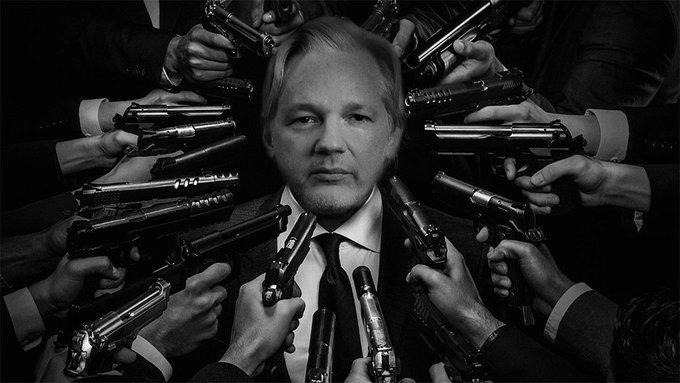
https://caitlinjohnstone.substack.com/p/the-us-cries-about-war-crimes-while?s=w. 20 Apr 22, In what his lawyers have described as a “brief but significant moment in the case,” a British magistrates’ court has signed off on Julian Assange’s extradition to the United States, bringing the WikiLeaks founder one step closer to a US trial under the Espionage Act which threatens press freedoms worldwide.
The extradition case now goes to UK Home Secretary Priti Patel for approval, which will likely be forthcoming as Patel is a reliably loyal empire manager. After that point, Assange’s legal team will be able to launch an appeal.
This is happening at the same time the United States and the United Kingdom are loudly demanding accountability for alleged war crimes by the Russian military in Ukraine, which is interesting because attempting to bring accountability for war crimes is precisely why Julian Assange is in prison.
“He is a war criminal,” President Biden said of Vladimir Putin following allegations of war crimes in Bucha, Ukraine earlier this month. “I think it is a war crime. … He should be held accountable.”
Biden: Putin should face war crimes trial for Bucha killings 4 April 2022
Wikileaks 5 April – 12 years ago today 5 Julian Assange published the Collateral Murder video detailing the gunning down of civilians, children & 2 Reuters journalists. Assange faces a 175 year sentence if extradited for revealing this and other war crimes
This is why the US government is trying to extradite Julian Assange: for revealing the US massacre of civilians, including two Reuters journalists in Iraq
And that’s all I’d like to say here today, really. That this discrepancy is very interesting.
I mean, can we take a moment to deeply appreciate the irony of this? Because it’s so obscene and outrageous it’s actually hard to take in unless you really let it absorb. The most powerful government in the world, which serves as the hub of the most powerful empire that has ever existed, is working to extradite a journalist for exposing its war crimes while simultaneously rending its garments over war crime allegations against another government.
I mean, damn. You would think a power structure that had recently been caught red-handed committing war crimes and is currently in the process of imprisoning a journalist for exposing those war crimes would at least have the sense not to yell too loudly about war crimes for a little while. But this is how confident the empire is in its ability to control the narrative.
Really take it in. Really digest it. The more you think about it, the freakier it gets. Not only is the empire persecuting a journalist for exposing its war crimes while at the same time demanding that others be held accountable for war crimes, it is also attacking the free press for reporting the truth about the powerful while at the very same time engaging in a massive propaganda operation which holds that it is involved in Ukraine to protect its freedom and democracy.
I mean, the gall. The absolute temerity. The balls on this empire, man.
I have said it before and I will say it again: Assange exposed many ugly realities about the powerful in his work with WikiLeaks, but everything that he has managed to expose thereafter simply by forcing them to prosecute him far surpasses the revelations in those publications.
If the highest form of journalism is exposing the darkest secrets of the most powerful people in the world, then Julian Assange is the highest form of journalist.
The Australian media colludes with USA, UK and Australian governments’ persecution ofJulian Assange -”Crikey journal” typifies this
Australian media must stand up for Assange’s freedom, https://independentaustralia.net/life/life-display/australian-media-must-stand-up-for-assanges-freedom,15918 By Matilda Duncan | 10 January 2022, For far too long the Australian media has remained silent in the face of Julian Assange’s persecution and that must change, writes Matilda Duncan.
LAST MONTH, Crikey’s legal correspondent Michael Bradley wrote a bizarre analysis of Julian Assange’s impending extradition to the U.S. without any regard for basic facts.
It’s worth examining, as it typifies the failures and absurdities of Australian press responses to Assange going back a decade — filled with lies, smears and false narratives that prevent the public from understanding the significance and substance of his case.
In writing about one of the gravest threats to press freedom in years, Bradley went as far as to include a cringeworthy – if not downright pernicious, given Assange recently suffered a stroke and is in precarious health – reference to a Monty Python quote being inscribed on Assange’s tombstone that ‘he’s not the Messiah, he’s a very naughty boy’.
You couldn’t make this stuff up.
In allowing his thoughts to remain mired in diversionary debates and myths about WikiLeaks and Assange, Bradley completely misses the point of the U.S. extradition case and fails to mention the dire threat to investigative journalism around the world it presents.
He does not confront or condemn the alarming legal precedent of the United States charging a foreign national, one of our citizens, with espionage under U.S domestic law — despite Assange not being a U.S. citizen and WikiLeaks not being a U.S.-based publication.
Bradley writes:
‘WikiLeaks broke new ground but mainly in volume and approach, not content.’
In 2010, Assange and WikiLeaks – in partnership with numerous mainstream media outlets, including The New York Times, The Guardian and Der Spiegel – published a curated cache of 250,000 diplomatic cables revealing the corruption and destruction of the Bush-era and early Obama-era wars, into which Australia so subserviently followed.
Without Assange’s work, numerous war crimes, mass surveillance schemes and unreported civilian casualties would have gone uncovered. In one year, he generated more consequential journalistic scoops confronting Western centres of power than the rest of the world’s news organisations combined.
Some of the information published by Assange has since become the subject of criminal investigations into the CIA and U.S. authorities before the International Criminal Court, which, as lawyers for Assange testified during his extradition hearing, is further evidence that the U.S. case against him is politically motivated.
Further, irrefutable illustrations of the significance of the “content” of Assange’s work can be found in comparisons between it and the lies and deceptions fed to the Australian population by this country’s press in the Iraq War years. Consider, as just one example of many, WikiLeaks’ publishing of the detainee assessment briefs and manual for Guantanamo Bay, where children as young as 15 were held, in contrast with the vapid first-hand account of the illegal prison presented by one of the Australian Broadcasting Corporation’s top foreign correspondents, Leigh Sales.
In 2007, Sales wrote of her second visit to Gitmo:
‘At the same time, my own eyes and ears led me to believe that Guantanamo wasn’t as barbaric as it was made out to be either. None of the detainees came running to the wire, begging for help to get out.’
One Guantanamo Bay prisoner has recently waived his right to appear in court on numerous occasions because he suffered “rectal damage” while in custody of the CIA that makes it too painful for him to sit.
According to Bradley, it’s Assange that’s the “problem”, not the CIA spying on Assange and planning to kidnap or assassinate him with the help of UC Global as he held political asylum inside the Ecuadorian Embassy. After UC Global installed microphones in 2017, all of Assange’s conversations were recorded, including those he had with his lawyers outlining his defence strategy for the current case against him.
This is likely a violation of attorney-client privilege in itself and might be reason enough to throw out the U.S. case against him.
Bradley wasted his words on puerile arguments about Assange being a “tarnished hero” instead of communicating the most pressing things to know about Assange: six of the 18 counts against him are Espionage Act charges that criminalise the obtaining of ‘national defense information’, something journalists that report on their governments do every day.
Ten other counts relate to the disclosure of national defense information. Again, a regular task for many journalists. One further ‘conspiracy to commit computer intrusion’ count relates to Assange allegedly offering to help Chelsea Manning crack a security code to help her avoid detection while she was obtaining U.S. Government documents.
This is a charge that amounts to an attempt to criminalise a journalist assisting a source to protect themselves, yet another activity that responsible journalists regularly engage in.
Even more terrifyingly, the case against Assange centres around “national defence information”, a nebulous term that might be applied to whatever information the U.S. Government so chooses. It doesn’t even have to be classified or top-secret information — much of the information leaked by Manning was unclassified and widely accessible to others in government.
It has been recognised with press awards around the world for over a decade now, including a Walkley, and exposed human rights abuses globally. It is plain wrong to say that Assange did not redact the information he released — the compelling eyewitness testimony from Mark Davis can directly attest to that.
Further, there is no evidence of anyone becoming endangered by his reporting. In fact a 2013 investigation by McClatchy found officials couldn’t point to any examples of lives being endangered by WikiLeaks and in 2010, Obama officials privately admitted that any damage from the leaks was “limited” and that their public comments about the leaks having “seriously damaged American interests” were intended “to bolster legal efforts to shut down the WikiLeaks website and bring charges against the leakers”.
‘Like anyone who attains the status of iconic mystery, Assange – not actually seen freely moving in public in a decade – has become less person and more mirror reflecting the meanings we choose to attach to him and his experiences. What he actually thinks is known only to him, and his lawyers presumably.’
Bradley was correct on one thing: using the word “mirror” in connection with Assange. This citizen of ours bravely risked his life and liberty to tell us ugly truths about U.S. imperial power and military machinery, which this country so strongly enables and supports.
He reflected right back at this country snippets of the destruction and mass civilian deaths we willingly participated in. His brave journalism exposed the bulk of our country’s media as the petty, unserious talking heads they are: journalists that don’t actually serve the public, but parrot the lies they are told by governments.
Contrary to what Bradley says, what Assange “actually thinks” has been well-documented for years now.
After seven years of arbitrary detention followed by three years of solitary confinement and other tortures in London’s Belmarsh Prison, Assange thinks of suicide constantly. That the U.S. is slowly killing this Australian journalist, partner and father before our eyes for exposing war crimes while the Australian Government does nothing and the majority of our press either remains silent or – when they say anything at all – write flippant and inaccurate stories about him demonstrates just how broken this country’s media is.
It shows how unaware we are of the press freedom we are about to lose and how deeply needed the work of Julian Assange and others of his ilk is.
Friendlyjordies allegations against Dutton met with silence.
Friendlyjordies allegations against Dutton met with silence, Independent Australia,
By Victoria Fielding | 7 March 2022 An exposé on Peter Dutton by independent journalist Friendlyjordies has been ignored by the mainstream media, writes Dr Victoria Fielding.
On Friday last week, independent investigative journalist, Jordan Shanks (Friendlyjordies), released an explosive video about one of the most powerful Ministers in the Morrison Government. Since then, the story has sunk without a trace. What is going on?
Is this the mainstream news media refusing to admit Friendlyjordies has beaten them to a scandal, or is Defence Minister Peter Dutton being protected from scrutiny by his mates in the media?
As of writing, over 300,000 people have watched the Friendlyjordies piece. The investigation intricately maps out some very specific allegations about the business dealings of Dutton’s friends, including sources alleging sex scandals, drugs and dodgy dealings in lucrative government contracts.
One of the people involved in the web of intrigue exposed by Shanks is Ryan Shaw, who up until Wednesday was the Liberal National Party’s candidate for the marginal seat of Lilley. Shaw, an Army veteran, has been campaigning in the seat for months, including with Prime Minister Scott Morrison.
The seat is held by Labor MP Anika Wells by the wafer-thin margin of 0.64 per cent. Not just any candidate gets placed in a must-win marginal seat. Shaw’s withdrawal, citing family and mental health issues, is a big loss to the L-NP considering they are left without a candidate weeks out from the Election and after the much-wasted investment of time and resources.
Although it is impossible to know exactly why Shaw withdrew, it is more than a little coincidental that the decision was made at the exact same time as Shanks and his team were questioning Shaw about his involvement with people in the incredibly suspect chain of events detailed in the video.
I’ve spent a lot of time around politics and I know a candidate doesn’t withdraw their cand
I’ve spent a lot of time around politics and I know a candidate doesn’t withdraw their candidacy over any small thing. The Friendlyjordies allegations, if they could be batted away, no doubt would have been to save Shaw’s position. Yet they weren’t.
But it isn’t just Shaw who had questions to answer over his association with people directly implicated by allegations in the explosive story. Peter Dutton is also associated with key players.
Not only does Dutton hold the powerful position of Minister for Defence, but he is also a contender for leader of the Liberal Party, should Morrison choose to step down after the Election. This scandal therefore has all the ingredients you would think the mainstream media would need to make it top priority for journalist follow up.
Senior Minister in the Morrison Government — check. A high profile candidate stepping down seemingly for no reason weeks out from the Election — check. Allegations of government contracts being used to enrich Liberal Party donors — check. Allegations of drug-fueled parties and drug-taking — check…………..
On Sunday, by chance, Peter Dutton was interviewed at length by David Speers on ABC’s Insiders program. It is true that there is much on the Defence Minister’s agenda, what with the war in Ukraine and the Queensland and NSW floods, but there was plenty of time for at least one question about the Shanks allegations in the video. The Minister is not meant to define the agenda of the interview; the whole point of such questioning is to hold the Minister to account. This opportunity was missed.
So, what makes this story so untouchable by mainstream journalists?…………………
Whatever role Dutton has played in this scandal, he should be answerable to the public. And if the news media refuses to even mention the story, let alone pressure Dutton to explain his involvement, then it is a very sad day indeed for democracy. https://independentaustralia.net/politics/politics-display/friendlyjordies-allegations-against-dutton-met-with-silence,16122
Caitlin Johnstone: Freedom & Democracy Via Censorship. Australian government and media join in

You’d think a free society would have no objection to people trying to learn about the other side of a war in which NATO powers very plainly had a hand in starting. By Caitlin Johnstone 4 Mar 22, Consortium News
CaitlinJohnstone.com Kremlin-backed media outlets have been banned throughout the European Union, both on television and on apps and online platforms. RT has lost its Sky TV slot in the U.K., where the outlet is also blocked on YouTube.
Australian TV providers SBS and Foxtel have dropped RT, and the federal government is putting pressure on social media platforms to block Russian media in Australia.
In the Czech Republic, Slovakia and Latvia, speaking in support of the Russian invasion of Ukraine will get you years in prison.
Twitter, historically the last of the major online platforms to jump on any new internet censorship escalation, is now actively minimizing the number of people who see Russian media content, saying that it is “reducing the content’s visibility” and “taking steps to significantly reduce the circulation of this content on Twitter.” This is exactly what I speculated might emerge after former Twitter CEO Jack Dorsey resigned in November, due to previous comments supporting the tactic of censorship-by-algorithm by his successor Parag Agrawal.
Twitter is also placing warnings labels on all Russia-backed media and delivering a pop-up message informing you that you are committing wrongthink if you try to share or even “like” a post linking to such outlets on the platform. It has also placed the label “Russia state-affiliated media” on every tweet made by the personal accounts of employees of those platforms, baselessly giving the impression that the dissident opinions tweeted by those accounts are paid Kremlin content and not simply their own legitimate perspectives. Some are complaining that this new label has led to online harassment amid the post-9/11-like anti-Russia hysteria that’s currently turning western brains into clam chowder
(Many Tweets quoted here)
This is all on top of all the other drastic escalations in censorship which came roaring in at the beginning of the Ukraine war, and I personally find it a bit scary how fast it’s all happening, how fine people are with it, and how much worse it seems likely to get.
Others agree.
“The purge of RT and other Russian media outlets in the US and Europe is 100% censorship,” tweets journalist Michael Tracey. “Go ahead and argue it’s justified, but at least don’t be a coward and admit you are advocating censorship.”
“The western world believes that it has a monopoly on what constitutes ‘political truth’ and that their ideological worldview is the only correct, valid and authoritative one,” writer and analyst Tom Fowdy observed. “They preach freedom of speech and the press to other countries, but exempt themselves from it.”
And I can’t help but find it odd that the fight for freedom and democracy should require such copious amounts of censorship. You’d think a free society would have no objection to people trying to learn the other side of the debate about a war which NATO powers very plainly had a hand in starting, rather than being forced to consume only Western mass media narratives which tell us this is happening exclusively because Russian President Vladimir Putin is evil and Hitlery and hates freedom…………..
It makes you wonder if we have foolishly consented to a reality where the most powerful people in the world get to control the information people consume in order to shut down dissent against a murderous and oppressive globe-spanning oligarchic empire.
And it kind of makes you wonder, as we watch the same empire that just destroyed Iraq, Libya, Syria and Yemen being entrusted to carefully navigate extremely delicate nuclear brinkmanship escalations without ending the world, if we might perhaps be better off with a lot more dissent, rather than a lot less. https://consortiumnews.com/2022/03/03/caitlin-johnstone-freedom-democracy-via-censorship/
The ABC is under the biggest attack in its history
The ABC is under the biggest attack in its history https://www.sarahhansonyoung.com/save_our_abc_petition?recruiter_id=759870
Our ABC is facing death by a thousand cuts – totalling over half a BILLION dollars – from the Liberals who can’t handle the public broadcaster doing its job and holding those in power to account. Sadly, our democracy is going to be far worse off for it.
Not only has the Morrison Government failed to restore the millions of dollars of funding they have cut from the ABC year after year, there is now no future funding for the Enhanced News Gathering program.
Our ABC is facing death by a thousand cuts – totalling over half a BILLION dollars – from the Liberals who can’t handle the public broadcaster doing its job and holding those in power to account. Sadly, our democracy is going to be far worse off for it.
Not only has the Morrison Government failed to restore the millions of dollars of funding they have cut from the ABC year after year, there is now no future funding for the Enhanced News Gathering program.
The ABC has been a vital source of information during the pandemic and helped save lives during the catastrophic summer bushfires immediately before that.
To do its job as the public expects, to continue producing the new Australians trust and the stories we love, the ABC must be well-funded.
The ABC needs allies, now more than ever.
Information wars: are we getting a fair view of China’s treatment of Uyghurs?
Information wars: are we getting a fair view of China’s treatment of Uyghurs?
MICHAEL WEST MEDIA|By Michael Sainsbury|February 3, 2022 ”……………………..
The Five-Eyes/China Propaganda War,
There is a propaganda war. It pits the China Communist Party against the West, led by the Five Eyes – the US, UK, Canada, Australia and New Zealand. To these we can also add Japan and South Korea, China’s mutually wary north Asian neighbours.
The latest battle in the war is being fought here in Australia over the Australian Strategic Policy Institute’s report Uyghurs for Sale: ‘Re-education’, forced labour and surveillance beyond Xinjiang. Its main theme is the re-education camps in Xinjiang and subsequent sending Uyghurs out for what it describes as forced labour in factories in the east of China in tough conditions, although they are paid rather than enslaved.
Considering that many of these factories are used by well-known Western clothing and retail brands, the report has sent shockwaves through the industry, with some withdrawing work from these factories.
Lawyer and activist Jaq James has prepared a lengthy rebuttal. Her paper, The Australian Strategic Policy Institute’s Uyghurs for Sale Report: Scholarly Analysis or Strategic Disinformation?, offers as a detailed unpicking ASPI’s reporting as loose/fudged and often second and third hand, as well as resulting in Uyghurs losing their jobs.
| Lead author on ASPI’s report is analyst, journalist and comedian Vicky Xu. Xu and her work have received widespread publicity in mainstream media. Yet the coverage has been devoid of scrutiny. Scrutiny has come however in independent media, particularly in John Menadue’s Pearls and Irritations, which has run stories by Jaq James and others questioning Xu’s claims. The biggest problem with both the reports is a lack of context…………https://www.michaelwest.com.au/information-wars-are-we-getting-a-fair-view-of-chinas-treatment-of-uyghurs/ |
Channel 10’s ”The Project” did have the guts to show Australia the Kimba nuclear waste dump story
How happy was the nuclear lobby, to keep this under wraps from the Australian public.!
In typical form, the nuclear lobby chooses a rather remote small rural community, and then blankets thenm with propaganda from ANSTO and any other pro nuclear institution they can find. Only the pro nuclear spin got to that community.along with lovely financial ”incentives”.
In the current floods, no media mention is made of the clear threats to a Napandee nuclear waste dump, from flooding – to add to the other threats, such as the ruination of the local agricultural reputation.
Only Channel 10 has had the guts. And I write as a person who is biased against the commercial TV channels. Always a fan of the ABC – I now see it as a rather timourouis organisation, always in dread of having their funding cut – as the Scott Morrison government continues in the good old Liberal tradition of death to the ABC by a thousand cuts.
The past decade has seen stunning change. The next 10 years will be breathtaking

the share of renewables in January, 2022, in Australia’s main grid is 34.4 per cent. Wind and solar alone account for 28 per cent. Solar accounted for 12.6 per cent of generation over the last 12 months, and will now likely deliver half of all generation by 2050 – not three per cent.
That 1.5°C is the only target that really matters. The federal Coalition government insists we need new technology to get us there. But nearly all the tools we will need are already at our disposal. The only thing missing, at least at the federal level, is leadership. And in a few months’ time, at the next federal election, there will be an opportunity to get that right.
The past decade has seen stunning change. The next 10 years will be breathtaking, https://reneweconomy.com.au/the-past-decade-has-seen-stunning-change-the-next-10-years-will-be-breathtaking/ Giles Parkinson 30 January 2022.
They said it couldn’t be done. There was no way Australia could reach 20 per cent renewables by 2020, we were told. And yet we did. And then we were told there was too much wind and solar. Now it is clear there is not nearly enough.
It is now exactly a decade since the RenewEconomy website appeared and published its first articles. Australia, at the time, was yet to build its first large-scale solar farm; the carbon price had not yet been put in place, the finishing touches were being put on a re-booted renewable energy target and the Clean Energy Finance Corporation, and geothermal and solar thermal were supposed to be the next big thing.
At the time, the transition to a grid dominated by wind and solar appeared as some sort of flight of fancy.
Sure, some utilities like Origin spent tens of millions on solar and geothermal technologies, before throwing billions into LNG. The then chief executive of AGL, Michael Fraser, used to indulge our questions with responses such as “seeing it’s you guys, I guess we better talk about solar.” A few months later, AGL spent billions becoming the biggest generator of coal in the country and the biggest emitter. It is still trying to find a way out of that mess.
But there was no doubt that many legacy utilities could already see what was coming and how much was at stake. The small amounts of rooftop solar in the grid were already pointing to a future of deep duck curves and negative prices, and the incumbents used their regulatory and political influence to fight furiously against any moves to encourage rooftop solar or energy efficiency. Some of them still are.
Big business didn’t want the Clean Energy Finance Corporation (CEFC) to intervene in the market, because they wanted new technologies to be kept in the lab. Some still do. The coal lobby was arguing that it shouldn’t be expected to invest in carbon capture and storage because it was clearly not commercial, and wouldn’t be for another couple of decades. It’s too late for coal, but now the gas and oil industry are trotting out a similar argument.
In the month that RenewEconomy first published, with a team of just two (myself and still deputy editor Sophie Vorrath), there was a negligible amount of renewables in the grid – an average of 4.6 per cent over the month of January, 2012. Most of it was hydro. The official forecasts were equally dismissive – a federal government white paper predicted that solar, might, at best deliver 3 per cent of generation by 2050, or one per cent by 2030.
RenewEconomy, even in those early days, sensed that the transition might go a lot quicker than that. Firstly, because it needed to, secondly because it was clear it would be supported by great licks of capital, and thirdly because learning curves pointed to a future of low cost renewables.
Fast forward a decade and the share of renewables in January, 2022, in Australia’s main grid is 34.4 per cent. Wind and solar alone account for 28 per cent. Solar accounted for 12.6 per cent of generation over the last 12 months, and will now likely deliver half of all generation by 2050 – not three per cent.
That transition has brought extraordinary change. Coal fired power stations, if they couldn’t before, now see the writing on the wall and are preparing for closure, although they are still using their regulatory and political clout to make the case for one more major handout as the transition accelerates around them.
South Australia, thanks to its good resources and a government that made it clear it would welcome investment in renewables, leads the way with the a world-topping 62.5 per cent share for wind and solar (as a percentage of local demand) in the last 12 months.
South Australia has already delivered a week long period where wind and solar delivered more than local demand, and it is expected to reach “net 100 per cent” renewables (calculated over a year), well ahead of the official state target of 2030.
Remarkably, that net 100 per cent renewables will come from wind and solar only. It will be an extraordinary achievement and the knowledge gained from operating such a system will set a blueprint for the world to follow.
Yes, it will rely on storage, demand management, links to other states for exports and some imports, and some fossil fuel generation in wind and solar droughts, but having a gigawatt-scale grid in a modern economy meet the equivalent of 100 per cent of its demand over a year will be extraordinary.
And as stunning as the last decade has been, the next decade could be breathtaking because the market is now looking at green exports, in the form of electricity and hydrogen and ammonia, and green manufacturing, which can all focus their demand on when the sun shines and the wind blows. As the big utilities now admit, you can say goodbye to “baseload”.
As we look to the next decade, it is clear that coal generation may have disappeared from NSW by 2032, and fossil fuel cars will make up only a tiny fraction of new vehicle purchases. The share of renewables in the grid will be well above 80 per cent and could be heading towards 100 per cent.
Just to be clear on that point, the Australian Energy Market Operator expects the share of renewables to be around 80 per cent by 2030 according to what the overall industry considers to be the new “most likely” scenario, known as “step change.”
Crucially, mainstream politics is embracing it. Labor’s emissions targets, still well short of what’s needed for 1.5°C, assume an 82 per cent share of renewables in the main grid by 2030. Even the federal Coalition is dialing in a 69 per cent share of renewables in its woefully inadequate emissions targets.
Australian billionaires such as Andrew Forrest and Mike Cannon-Brookes have already helped change the public discourse on the green energy transition, and if their bold plans – and those of others – come true, Australia will be an exporter of green hydrogen, green ammonia, green electricity, and green materials in the form of steel and other manufactured products.
Continue readingDoes Channel 10’s ”The Project” have the guts to tell the truth about the government’s planned Kimba nuclear waste dump?

You would have thought, with the present flooding of the Kimba area, and indeed, of much of Northern South Australia, that concern about planning a nuclear waste dump there would be an ‘‘urgent item of news”
Indeed, Channel 10’s ”The Project” had 2 hours of interview s about the dump sll ready.
In a rare media event, they had interviewed No Dump advocates Kimba farmers Peter & Sue Woodford & Barngarla Traditional Owner Jason Bilney
Of course they’d also interviewed pro-dumpers.
But anyway, Channel 10 decided that this matter is not ”urgent” – and it’s gone on the back burner.
But instead, they’ve managed to put a reassuring spiel from The Australian Radioactive Waste Agency, (just in case the wider world in Australia might get a bit worried about the situation)
- Roni Skipworth, No nuclear waste dump anywhere in South Australia , 31 Jan 22, Was told today the Interviews Peter and Sue were involved with was 2 hours long and was suppose to be shown tonight on the Project though they got a message saying they will view it later in the week as an urgent report needed to go first.
- Let’s see how long they take to telecast it and also they just didn’t interview the Woolfords from No Nuclear Waste Dump on Agriculture Land. They interviewed the Yes Group also where Ramsay visited Kimba as well to put his bit in. Be interested to see what replaced the time slot tonight. This interview should had happened 6 years ago not just now!
- https://www.facebook.com/groups/1314655315214929—
Is US extradition inevitable for Julian Assange? | The Stream
Aljazeera English, 14 January 2022, It’s been more than a decade since the website WikiLeaks released hundreds of thousands of classified documents and videos – some of which revealed possible US war crimes. Now WikiLeaks founder Julian Assange has one more chance to appeal a UK ruling that would allow him to be extradited to the US.
Last month, a UK High Court ruled that Assange could be extradited to the US to face charges of hacking and violating the US Espionage Act. The ruling goes against a lower court that previously said harsh US prison conditions would endanger Assange given his worsening mental and physical health.
Assange’s legal team has since filed an appeal to Britain’s Supreme Court, but in order for the appeal to be considered, it must be deemed of “general public importance”.
n 2019, the Trump administration indicted Assange for violating the US Espionage Act on counts related to the WikiLeaks release of secret US military documents and diplomatic cables. The US argues the release of classified information put the lives of American allies in danger.
Twenty-four civil liberties and press freedom groups, including the ACLU, Human Rights Watch, PEN America and Reporters Without Borders have called on the Biden administration to stop its prosecution against Assange. In a joint letter to the US Justice Department, they argue that Assange’s prosecution could set a precedent that would harm press freedom and the safety of journalists reporting on national security issues.
Assange spent seven years in refuge at the Ecuadorian Embassy in London and was eventually arrested in 2019. Last week, Assange’s supporters marked his 1,000th day of imprisonment at London’s Belmarsh high security prison.
In this episode of The Stream, we’ll discuss the outlook for Assange’s case and its broader implications for press freedom worldwide.
Australian government and Labor opposition ignore the suffering of Julian Assange. Can they afford to, as election looms?
If he dies, his death will have been caused by, among others, politicians in Australia who have the diplomatic power to bring him home,” Pilger said.“Scott Morrison, in particular, will have Julian’s life and suffering on his hands, along with those in the Labor opposition who have kept a cowardly silence.
Independent MP Andrew Wilkie, among others, has said that Scott Morrison must urge the US and Britain to release Assange and let him return to Australia.
the “noise” in parliament combined with more public awareness of Assange’s dire state may present a headache for the government as polls loom.
Saving Julian Assange, Last week, the British High Court ruled that Julian Assange can be extradited to face charges in the United States. His fiancée, Stella Moris, vows to continue the fight alongside his network of supporters. By Amy Fallon. https://www.thesaturdaypaper.com.au/news/politics/2021/12/18/saving-julian-assange/163974600013099?fbclid=IwAR2dLaNxKG0FTyBvywjYpL_HpxPb8RWA6rF0mQwIE-X8Pnd8TMbAzkWed2Y#mt This week, Stella Moris said she and Julian Assange still intended to marry in the new year, although they have not set a date. She is currently speaking to the prison about arrangements. Moris hopes it will be a ceremony attended by close family and friends, with their children, Gabriel, 4, and Max, 2, taking part.
“The High Court ruling has made things even more precarious than before,” she tells The Saturday Paper.
“But that has only strengthened our determination to celebrate what is constant and certain in our lives – our love and support for each other.”
Moris is a South-African born lawyer and an activist in her own right. Her family were involved in the anti-apartheid battle. After the British High Court ruled that her fiancé could be extradited to the United States, her response was simple: “We will fight.”
“History will not spare them if we lose a man who is not only innocent of any crime but a genuine hero in the extraordinary public service he has performed for millions of people.”
She sees the case in these terms: “Every generation has an epic fight to fight, and this is ours, because Julian represents the fundamentals of what it means to live in a free society.”Last week’s decision was made after two of Britain’s most senior judges ruled Assange, earlier deemed a suicide risk, had received assurances from the US that he would not face the strictest measures before a trial or once convicted. They found a lower court had erred in offering him protection.
“That risk is in our judgement excluded by the assurances which are offered,” one of the judges, Lord Burnett, said. “It follows that we are satisfied that, if the assurances had been before the judge, she would have answered the relevant question differently.”
British Home Secretary Priti Patel must now approve Assange’s extradition. Lawyers for the 50-year-old are appealing the decision. Subsequent hearings are likely to raise the issue of free speech, which campaigners say is at the heart of the case involving the Walkley Award-winning journalist.Many around the world are now calling on the Australian government to intervene and save Assange’s life before it’s too late.
“There seem to be no limits to the savagery of the Anglosphere – US, UK, Australia – in exacting revenge for the crime of informing the population of what the powerful want to conceal,” the intellectual and activist Noam Chomsky later told The Saturday Paper.
He urged followers of Julian Assange, wanted by the US for breaking espionage laws after publishing hundreds of thousands of Afghanistan and Iraq war logs and diplomatic cables, to “get organised”.
“And act,” added Chomsky, because there was “not much time”.
Another two to three years may drag on before the extradition is resolved. Australian journalist John Pilger, who described Assange as “frail and skeletal” the last time he hugged his friend in 2020, said the fact he was still alive was remarkable.
Last weekend’s revelation, that Assange had suffered a stroke in October, didn’t shock the veteran reporter. A month earlier, a Yahoo News report revealed that the CIA allegedly planned to assassinate Assange.
“If he dies, his death will have been caused by, among others, politicians in Australia who have the diplomatic power to bring him home,” Pilger said.“Scott Morrison, in particular, will have Julian’s life and suffering on his hands, along with those in the Labor opposition who have kept a cowardly silence. History will not spare them if we lose a man who is not only innocent of any crime but a genuine hero in the extraordinary public service he has performed for millions of people.”
To Gabriel Shipton, Assange’s brother, Julian, is a “bad dancer” with a “dorky sense of humour”. But, he says, “he is very sweet with his children, very good with kids, and a very principled man”.
Shipton produced the recent documentary Ithaka, which tells the story of Gabriel and Julian’s father’s struggle to have Assange freed.“Often people lose sight that these are actual real people involved, not just a head on a screen, or a headline, that this is a person’s father, brother, partner,” Shipton says. “Once people find out about how tragic the actual injustice that Julian suffered [is], and through no fault of their own his family are suffering, they’re quite confronted that they’ve allowed it to carry on for as long as it has.”
Shipton concedes the fight is just as much or even more political than legal, and others echo this. “There is no doubt that [this] aggressive and relentless pursuit is driven by the US security and defence state,” said Greg Barns, a barrister and adviser to the Australian Assange campaign.
A bipartisan Australian Parliamentary Friends of the Bring Julian Assange Home group comprises 25 senators and MPs, but was adding “about one member or so monthly”, says Shipton. In the past week, Deputy Prime Minister Barnaby Joyce has spoken out against Assange being sent to the US. Independent MP Andrew Wilkie, among others, has said that Scott Morrison must urge the US and Britain to release Assange and let him return to Australia. The opposition has urged the government to encourage the US to close the matter, although it has not elaborated on what it means by this.According to Kellie Tranter, a Maitland-based lawyer, human rights activist, researcher and former WikiLeaks Party candidate, the “noise” in parliament combined with more public awareness of Assange’s dire state may present a headache for the government as polls loom.
“If the level of interest keeps increasing, the government may feel obliged to act as the Howard government did in the case of David Hicks,” she says, referring to the former Guantánamo Bay detainee. “The last thing the government wants is this case soaking up oxygen in place of its policies. It’s public criticism, which is exactly what they wanted to avoid in the case of Hicks.”Tranter points out that progressive campaign group GetUp! played a critical role in Hicks’s repatriation by making his detention by the US an election issue, mobilising public opinion against his mistreatment. They may be the only organisation capable of doing the same in this case, she said. GetUp! said they had no comment on Assange.
In Britain, Assange has admirers from all walks of life. Sadia Kokni, 40, is British-born with African, Indian and Middle Eastern heritage and the managing director of a cosmetics company. Despite having a disability, she attends twice-weekly protest vigils at the Australian high commission with “Team Assange”, comprising about 50 people, including bus drivers, graphic designers, nurses and artists.
“I campaign for nothing, I only campaign for Julian,” Kokni says. “Unlike when people campaign against a war – it’s a nation against a nation – when it comes to Julian it’s the most powerful nation in the world against one man and he’s exposing the atrocities of global governance and things that every living person should be aware of.”
Although Kokni acknowledges Assange’s predicament could be treated with greater urgency by the British parliament, she also feels disbelief over Australia’s inaction.“They could be doing a lot more, Australia. I find it ridiculous,” she said, singling out the high commissioner, George Brandis. “Brandis – what is he actually doing? Has he written any letters?”
The Australian high commission in Britain did not respond to requests for comment.
A free press, a free Julian Assange – would be the best gift for the world

Assange facing extradition to US: where is the outrage?
“How can it be fair, how can it be right, how can it be possible, to extradite Julian to the very country which plotted to kill him?”
Assange facing extradition to US: where is the outrage? https://redflag.org.au/article/assange-facing-extradition-us-where-outrageTom Gilchrist11 December 2021
The US government has won its appeal against Wikileaks founder Julian Assange, with the UK’s High Court overturning an earlier decision to block Assange’s extradition to the US. The case will now be sent back to the Magistrates Court with instructions to allow the UK Home Secretary Priti Patel to approve or deny the extradition request.
This is a massive blow to press freedom. Assange faces one charge of conspiracy and 17 espionage charges, begun by the Trump administration but continued by the Biden administration. These 17 espionage charges relate to the publication and release of secret government documents, a crucial right for serious journalists trying to hold governments to account. As a statement from Wikileaks in response to the ruling puts its, Assange is “accused of publishing true information revealing crimes committed by the US government in the Guantanamo Bay detention camp, Iraq, and Afghanistan, and details of CIA torture and rendition”.
For telling the truth about these war crimes Assange has faced a decade long campaign of persecution. As Amnesty International’s Europe Director Nils Muižnieks said in response to the High Court decision: “The US government’s indictment poses a grave threat to press freedom both in the United States and abroad. If upheld, it would undermine the key role of journalists and publishers in scrutinising governments and exposing their misdeeds, and would leave journalists everywhere looking over their shoulders.” Muižnieks has labelled the decision a “travesty of justice”.
In the earlier decision in January which blocked Assange’s extradition, District Judge Vanessa Baraitser ruled that the harsh conditions of the US prison system would put Assange at an unreasonable risk of suicide. The High Court has allowed the appeal against this decision on the basis of various “assurances” given by the US government to Assange. These included assurances that he would not be subjected to Special Administrative Measures which restrict contact with the outside world, and that he would be allowed to serve his sentence in Australia if the Australian government made such a request.
These assurances, however, come with caveats. The US government has said that they must be allowed to hold Assange in these restrictive conditions if they fear he could be responsible for a “breach” of “national security”. As Muižnieks argues “The fact that the US has reserved the right to change its mind at any time means that these assurances are not worth the paper they are written on”.
Earlier this year an investigative report from Yahoo! News revealed that leading figures in the US government had discussed the possibility of kidnapping or assassinating Assange during the seven years he was taking refuge in the Ecuadorian embassy in London. Over the last decade it has subjected Assange to a campaign of persecution which Nils Melzer, the United Nations special rapporteur on torture, says amounts to psychological torture. The idea that this same government is now able to give assurances that it cares about the health and safety of Assange is absurd. As Stella Moris, Assange’s partner, says “How can it be fair, how can it be right, how can it be possible, to extradite Julian to the very country which plotted to kill him?”
Moris is a part of Assange’s legal team and says they will be appealing the decision. Such an appeal would be heard by the UK Supreme Court. Assange, meanwhile, remains imprisoned indefinitely in a maximum-security UK prison.
As one of the world’s most high-profile political prisoners, and an Australian national, the Australian media and government might be expected to be up in arms over the plight of Assange. But the shameful lack of concern about his fate persists. Loyalty to the US empire, and willingness to cover up its many crimes, comes first for Australian capitalism.
Senate inquiry calls for royal commission-like probe into Australia’s media diversity.

Australia has one of the world’s most concentrated media ownership markets with seven of the 12 national or capital city daily newspapers owned by Murdoch’s News Corp, according to a recent fact check.
That’s nearly 60 per cent of the metro and national print media market.
Senate inquiry calls for royal commission-like probe into Australia’s media diversity, Matthew Elmas, Dec 9,
A Senate inquiry has called for a royal commission-like probe into the the concentration of media ownership in Australia and whether a new independent press regulator is needed.
Handing down the findings from a year-long probe into media diversity on Thursday, the Environment and Communications Committee found Australia’s media laws are “weak, fragmented and inconsistent”.
Backing calls from former prime minister Kevin Rudd, the Labor and Greens majority committee recommended “a judicial inquiry, with the powers of a royal commission”.
It would consider whether a new independent media regulator was needed to “harmonise news media standards and oversee an effective process for remedying complaints”.
“Large media organisations have become so powerful and unchecked that they have developed corporate cultures that consider themselves beyond the existing accountability frameworks,” the inquiry report said.
The inquiry also urged the government to guarantee sustainable and adequate funding for public broadcasters the ABC and SBS.
Australia has one of the world’s most concentrated media ownership markets with seven of the 12 national or capital city daily newspapers owned by Murdoch’s News Corp, according to a recent fact check.
That’s nearly 60 per cent of the metro and national print media market.
The government has yet to formally respond to the report. But in a sign it might dismiss the recommendations, Liberal senator and committee deputy chair Andrew Bragg published a statement on Thursday calling the report a “shameless political stunt which should not be taken seriously”………
If the Morrison government resists pressure to create a Murdoch royal commission then Labor and the Greens could take the proposal to the upcoming federal election.
Opposition senators strongly supported the probe in Thursday’s report……….
The committee seized on News Corp’s coverage of the climate crisis as an example of media concentration damaging Australian politics.
……. The committee also highlighted YouTube’s recent ban of News Corp’s Sky News channel as evidence the empire is responsible for spreading misinformation.
“The YouTube ban on Sky News over the publication of public health misinformation highlighted that there is an issue when a private company is able to act swiftly to protect the public from misinformation but the ACMA, the media regulator is not,” https://thenewdaily.com.au/finance/finance-news/2021/12/09/murdoch-royal-commission/

1 This month
To see nuclear-related stories in greater depth and intensity
– go to https://nuclearinformation.wordpress.com/


 Antinuclear