HISTORY FELLOWSHIP WINNER TO EXPLORE HOW SOUTH AUSTRALIANS MOBILISED AGAINST URANIAM MINING IN THE ’70s
History Council of South Australia, 19 December 2025
Adelaide historian Dr Nicholas Herriot has been awarded the prestigious 2026 History Council of South Australia Fellowship for his project “Leave it in the Ground: South Australia, Uranium, and the Atomic Age”.
The project, which was the unanimous winner in a strong field of ten nominations, will investigate how South Australians mobilised against uranium mining and grappled with the promise and peril of the atomic age, focusing on the 1970s and early 1980s – a period of intense political controversy.
Dr Nicholas Herriot is an early career researcher specialising in Australian labour, environmental and social movement history. He teaches history at the University of Adelaide and serves on the executive of the Labour History Society (South Australia).
Supported by the State Library of South Australia, the $2000 History Council Fellowship is open to all Australians exploring South Australian history, and aims to foster research that deepens our understanding of the state’s past and its contributions to wider histories. The annual winner also receives 10 hours of library research support, library space and the use of a computer.
History Council of South Australia president Prof Matthew Fitzpatrick said the judges were impressed with Dr Herriot’s plan to explore the legacies of anti-nuclear campaigns in shaping contemporary debates about energy, sovereignty and environmental justice.
“The project is both topical and timely, resonating with current explorations into alternative energies and about the power of protest,” Prof Fitzpatrick said.
“By illuminating these aspects of our recent past, the research will help contextualise ongoing concerns about nuclear policy and environmental responsibility and highlight the library’s rich collections as vital resources for understanding the state’s unique identity.
Prof Fitzpatrick said the state library’s commitment to preserving and sharing the state’s documentary heritage contributed significantly to the success of the awards, and the advancement of historical research. He also thanked the Marsden Szwarcbord Foundation for its continued support.
State Library of South Australia director Megan Berghuis said she appreciated how Dr Herriot’s project would draw on the library’s extensive archival holdings, including oral histories, activist ephemera and rare periodicals.
Marsden Szwarcbord Foundation director Dr Susan Marsden AM said she was impressed by Dr Herriot’s intention to situate local activism within national and transnational networks.
‘Disarm now’: Anti-nuke advocate’s message to world leaders at Pine Gap protest.

Following the breakdown of a nuclear treaty, an antinuclear advocate wants world leaders to hear a message she’s made from the doors of a top secret Territory spy base.
12 Aug 25,https://www.ntnews.com.au/journalists/gera-kazakov
An antinuclear ambassador for a Nobel prize winning group has delivered a message to world leaders at the edge of a Red Centre spy base, days after Russia pulled out of an arms treaty following an American missile test in the Top End.
ICAN ambassador Karina Lester was one of a dozen demonstrators who gathered at the edge of the Pine Gap Joint Defence Facility restricted area on Sunday, where she told world leaders to “disarm now” when speaking with this masthead.
“Get rid of your weapons. Lets fund and focus on world peace, not arm up and test missiles,” she said.
Ms Lester’s visit to the border of the Pine Gap restricted zone on Hatt Rd comes a day after she gave a speech at the sixth Yami Lester memorial event in Alice Springs – an event named after her father.
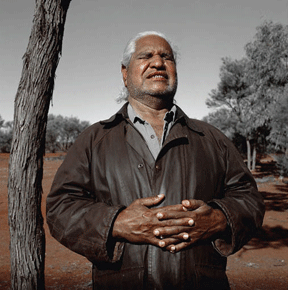
Mr Lester, a Yankunytjatjara elder who died in 2017, was blinded by the British nuclear tests in northern South Australia in the 1950s.
He was blinded as a child, and spent his life advocating against nuclear weapons – a mantle his daughter has taken up with ICAN, who won a Nobel Peace Prize in 2017 for their antinuclear advocacy.
The group got to the edge of the Pine Gap restricted at about 4.30pm Sunday, where they were again met with a police blockade at where the restricted zone begins.
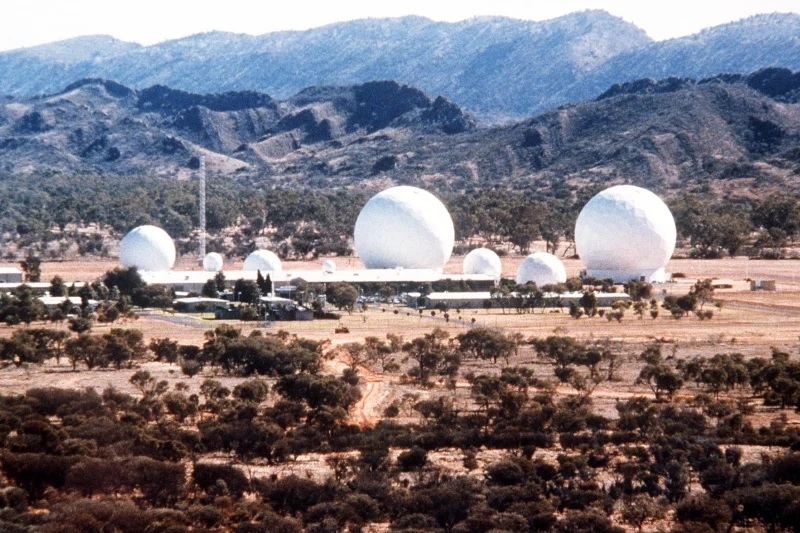
Two unmarked Toyota LandCruisers followed the convoy to their meeting place, and a police drone was also observed overhead.
The group heard from speakers who opposed the US-run base, with members of the crowd holding signs reading “Yankee go home” while others held Palestinian flags.
At the conclusion of the demonstration, the group gathered for a photo and chanted “land back, close Pine Gap” while various media outlets filmed and photographed them.
Federal NSW Greens senator David Shoebridge was also billed to be at the Pine Gap demonstration on Sunday, but pulled out due to covid, this masthead understands.
The Greens defence and foreign affairs spokesman said the political party has opposed the US-run base “for decades” but did not comment on why he was unable to come on Sunday when asked by this masthead.
10 reasons why nuclear energy is a bad idea for Australia
There’s a lot of information and disinformation out there on nuclear energy. These are my 10 reasons why nuclear energy would be a bad idea for Australia
By Arthur Wyns, University of Melbourne, https://pursuit.unimelb.edu.au/articles/10-reasons-why-nuclear-energy-is-a-bad-idea-for-australia 16 April 2025
As always seems to be the way, energy and climate policy is proving to be an area of contention between the major parties in Australia’s 2025 election.
One issue that’s provoked a lot of discussion and confusion is the Liberal-National Coalition’s proposal to build seven nuclear power plants across Australia.
It’s a controversial idea that’s opposed by Labor, the Greens, many independent MPs and some Liberal groups.
Both the Climate Change Authority and Australia’s Commonwealth Scientific and Industrial Research Organisation (CSIRO) concluded that the deployment of nuclear energy in Australia would significantly increase the country’s energy prices and cause us to miss our climate change targets.
1. Too expensive
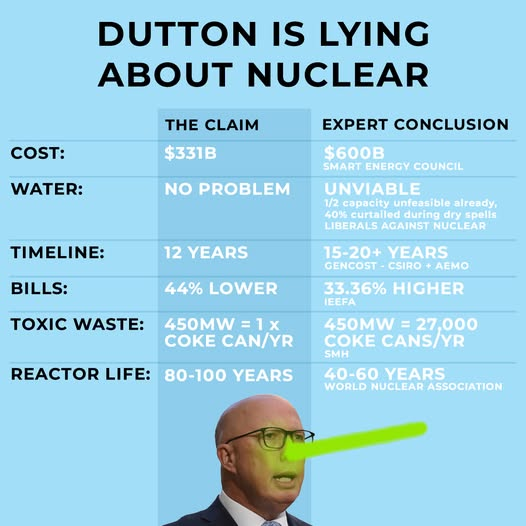
It’s extremely expensive to build and operate nuclear power plants anywhere in the world. Independent analysis by the Institute for Energy Economics and Financial Analysis (IEEFA) found that building nuclear power in Australia could see average household electricity bills rise by $AUD665 a year.
Estimates by CSIRO and the Australian Energy Market Operator (AEMO) for the 2024-2025 GenCost Report also found renewables are the cheapest option for any new electricity generation.
2. Too slow
Even if we drop everything else and throw all our weight behind nuclear energy, it wouldn’t play a role in Australia’s energy grid for more than a decade.
It took an average of 11 years to build the nuclear reactors that came online around the world in 2023 – largely in countries with a well-established nuclear industry, like China.
In Australia, CSIRO estimates it would take at least 15 years before we’d reach the first nuclear generation.
3. Too risky
Nuclear accidents are rare but they have devastating consequences.
The Chernobyl disaster in 1986 and the Fukushima disaster in 2011 contaminated large areas and continue to impact the health of hundreds of thousands of people. Both disasters caused a rise in anti-nuclear sentiments in the Australian public.
They also led to the majority of German citizens supporting an end to nuclear power in the country, with the three last remaining nuclear power plants in Germany taken offline in 2023.
4. Hard to build
Nuclear power stations are huge and complicated infrastructure projects that almost never stay on schedule.
The UK’s Hinkley Point C nuclear plant construction is now running 14 years late and is costing three times more than it was estimated: a whopping $AUD90 billion.
Smaller nuclear power plants, known as Small Modular Reactors (SMRs), have been proposed as an alternative, but there are no known commercial SMRs operational anywhere in the world.
The only company to have a small modular nuclear power plant approved in the US has since cancelled its first project due to rising costs.
5. Produces nuclear waste
Once in operation, nuclear reactors continuously produce radioactive waste. Generally, this waste is buried underground, where it remains radioactive for thousands of years.
Australia already produces a relatively small amount of low-level radioactive waste for some medical and research activities.
However, Australia currently doesn’t have any waste storage facilities to process high-level radioactive waste that would be produced by nuclear reactors – and recent efforts to build the country’s first radioactive waste storage facility have failed.
6. Uses lots of water
Nuclear reactors need to be cooled constantly, which requires high volumes of water.
It might not make sense to switch to a water-intensive energy source in the driest inhabited continent in the world, which is already facing increasing droughts and extreme heat.
Even countries like France and Sweden – with dramatically cooler climates compared to Australia – are increasingly being forced to shut down their nuclear power plants during warm periods when their cooling water heats up.
This means they then have to import energy from neighbouring countries.
7. No energy security
Australia’s remaining coal-fired power stations are old and increasingly breaking down, with over 60 per cent of our coal-generating capacity now more than 40 years old.
Even in the most optimistic scenarios, nuclear power is unlikely to come online before 2040, by which time all of Australia’s coal plants will have retired, according to the National Electricity Market.
In other words, the timelines for a coal-to-nuclear transition don’t add up.
Extending the life of these ageing coal-power plants would mean spending billions to prop up coal rather than investing in updating the electricity grid and expanding more cost-effective and readily available forms of energy like renewables.
8. No expertise
While nuclear generation is well established in many countries, it has never been deployed in Australia.
We currently lack the trained workforce and technical capability required for building a large-scale nuclear reactor.
Any attempt to go nuclear would leave Australia reliant on foreign companies and expertise. This is something we’re seeing play out in building and maintaining the nuclear submarines Australia agreed to host as part of the AUKUS deal.
In comparison, the renewable energy industry already creates more than 25,000 local jobs in Australia and this is expected to grow.
9. We’ll miss our climate goals
While nuclear energy is a form of low-emissions energy in many countries with established pre-existing nuclear facilities, focusing on the development of new nuclear energy in Australia is a diversion from taking real climate action.
Australia’s Climate Change Authority (CCA) recently released a detailed analysis concluding that a nuclear pathway for Australia would result in an additional two billion tonnes of greenhouse gas emissions.
It would extend the use of some coal-fired generators, slow down the uptake of clean technologies, and obstruct existing national plans to deliver 82 per cent renewable electricity by 2030.
10. Illegal in Australia
In the late 1990s, the Australian Federal Government introduced several new laws banning nuclear energy, including the National Radiation and Nuclear Safety Act (1998).
This Act prohibited the development of any new nuclear power sites in Australia.
The Commonwealth Environment Protection and Biodiversity Conservation Act (1999) also introduced rules preventing the construction or operation of any facilities that generate nuclear power.
Building nuclear reactors is currently illegal in every Australian state and territory.
Ultimately, pursuing a lengthy, expensive and potentially harmful energy source is a misguided step for Australia, particularly when we have all the resources and potential to make us a renewable energy superpower.
Arthur Wyns is a research fellow at Melbourne Climate Futures, University of Melbourne. He has written widely on climate change and global health issues, and regularly advises national governments and UN agencies. In 2023-2024, Arthur was the senior health advisor to the government of the United Arab Emirates as the host of the COP28 UN climate conference. He was a climate change advisor to the World Health Organization during 2019-2023, where he represented WHO at the UN climate negotiations, authored several UN reports on climate change and health, and acted as WHO’s speechwriter on climate change. Arthur is an editor of the Journal of Climate and Health and sits on the editorial board of ClimaHealth, the knowledge platform of the WHO-WMO Joint Office for Climate and Health.
Community groups furious Coalition nuclear plan would go ahead even if locals oppose it
Critics of policy say residents should be ‘very angry’ they will not be able to veto generators in their towns despite promise to consult them.
Tory Shepherd, 13 Apr 25, https://www.theguardian.com/australia-news/2025/apr/13/community-groups-furious-coalition-nuclear-plan-would-go-ahead-even-if-locals-oppose-it
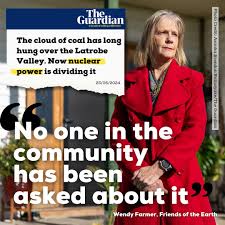
There is a “growing backlash” to the Coalition’s nuclear plan, with community groups furious at the lack of consultation and angered that the policy would not give local communities the power of veto and that nuclear plants would be built regardless of local opposition.
Opponents say the pro-nuclear lobby group Nuclear for Australia has been hosting information sessions but that it makes it overly difficult for people to attend and ask questions, and is not able to answer those questions that are posed.
Wendy Farmer, who has formed an alliance of the seven regions affected by the Coalition’s pledge to build nuclear reactors on the site of coal-fired power stations, says Australians should be “very angry” that they will not be able to veto any planned nuclear generators in their towns despite the Coalition’s promise to carry out a two-and-a-half-year consultation.
She refuses to call the policy a “plan” because of that lack of consultation. “They haven’t even looked at these sites,” she said.
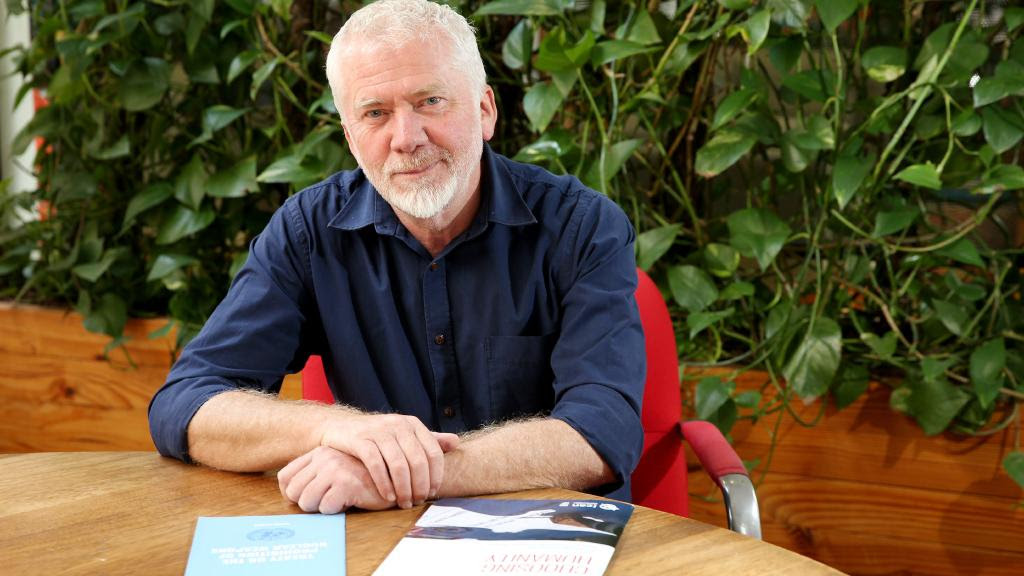
Dave Sweeney, the Australian Conservation Foundation’s nuclear free campaigner, says it is “more con than consultation”. And he says in his many years in nuclear-free campaigns he has never seen so many sectors – including unions, state leaders, energy producers, businesses and protest groups – aligned against nuclear.
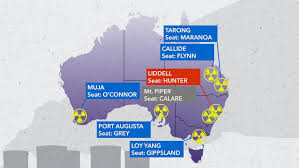
The Coalition has pinpointed Tarong and Callide in Queensland, Liddell and Mount Piper in New South Wales, Loy Yang in Victoria, and small modular reactors (SMRs) in Port Augusta in South Australia and Muja, near Collie in Western Australia.
It says the $331bn nuclear plan will make electricity cheaper, while critics have called its costings a “fantasy”.
The Liberal party did not respond to questions about the lack of consultation and lack of veto power.
The alliance said there “has been no consultation or free prior and informed consent from traditional custodians”.
“You never asked locals if they want nuclear reactors in their back yards, instead you threaten compulsory acquisition and federal overrides with no right to veto,” it said in a petition to the Coalition.
It said the plan was a “distraction” designed to “create false debate” when communities are already transitioning away from fossil fuels to renewable energy.
Jayla Parkin, a Collie resident and community organiser for Climate Justice Union, said pro-nuclear information sessions had not provided any answers and had tried to stop First Nations people from entering.
Nuclear for Australia has held two information sessions with “expert speakers” in the town.
One elder was “devastated” after initially being refused entrance to a meeting last year, Parkin said. “She wanted to get the information,” Parkin said. “Not everyone is simply for nuclear or against. We are for being informed on what’s going to happen.”
At a January meeting, elders were told they couldn’t go in because of something wrong with their registrations, which Parkin then sorted out. Once inside, she said questions had to be submitted via an app.
Not a single question could be answered … like ‘Where is the water coming from?’, ‘How will this benefit Collie?’, and ‘Where are you going to store the radioactive waste?’” she said.
Since then, the community had heard nothing, she said.
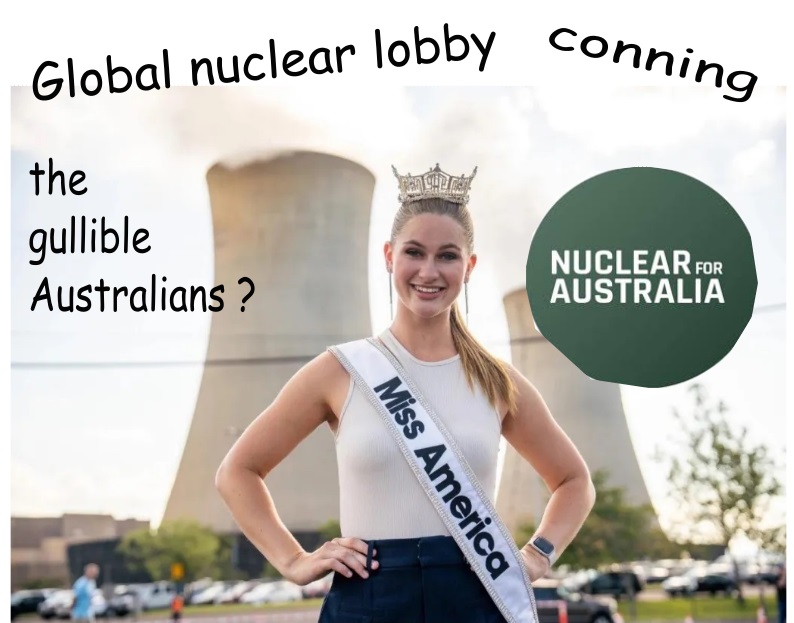
Nuclear for Australia, founded by Will Shackel and boasting the entrepreneur Dick Smith as a patron, describes itself as a grassroots organisation with no political affiliation.
Information sessions have featured Grace Stanke, a nuclear fuels engineer and former Miss America who says being called “Barbenheimer” is one of her favourite compliments.
Shackel told SBS that Nuclear for Australia Google people when they try to register for the sessions.
“If we believe that someone is a known protester … someone who could cause a physical threat to people in there, we will not allow them in,” he said.
Farmer, also the president of Voices of the Valley, said Nuclear for Australia was “silencing people” by only allowing questions through an app and filtering them.
Nuclear for Australia has also taken out ads in local newspapers claiming 77% of coal jobs are transferable to nuclear plants and that nuclear workers are paid 50% more than other power generation-related jobs.
The fine print shows those claims come from a US nuclear industry lobby organisation and refer to the situation in the US.
Farmer said that, “adding insult to injury”, the advertisements misspell Latrobe Valley as La Trobe Valley and, in one case, an ad aimed at Latrobe was put in an SA newspaper.
“Regional communities are desperate for jobs now,” Farmer said. “Nuclear is not the answer.”
Protesters heckled the opposition leader, Peter Dutton, for not meeting with the community when he visited Collie in October last year.
“Collie doesn’t like it when people like that come to our town and hide,” Parkin said. “People have questions … at least openly answer them.”
In Perth last week Dutton was asked about criticism from Collie residents that he hadn’t heard their concerns about nuclear power and whether he would commit to visiting the town during the election campaign.
“I’ve been to Collie before,” he said. “There are seven locations around the country, and I won’t be able to get to all of them.”
Those communities knew the Coalition was offering them “the ability to transform”, he said.
Greg Bannon is from the Flinders Local Action Group, which was formed to oppose plans to build a nuclear waste dump in SA.
He said the community had not heard much apart from a February information session held by Nuclear for Australia. He said there were concerns about the safety of any power plant and the impact on the local environment. “Port Augusta … is probably the most stupid place to put a nuclear power station in the world,” he said, pointing to the unique nature of Spencer Gulf and its flat “dodge” tides.
“Any leakage … the water would end up in the top end of the gulf, with only one place to go, through Port Lincoln, the fish nurseries, the mangroves … only 50km further south is Point Lowly near Whyalla, where the annual migration of the southern giant cuttlefish occurs, which is a unique event in the world,” he said.
The other point, Bannon said, was that the region had already transitioned away from baseload power to renewables.
Guardian Australia has approached the Coalition and Nuclear for Australia for a response.
Tom Venning was preselected to replace retiring MP Rowan Ramsey in Grey, the federal electorate that Port Augusta sits within. He said he supported the policy as part of a “credible path to net zero” and that if the Coalition formed government there would be a two-and-a-half-year community consultation and an independent feasibility study.
“I’m committed to keeping my community fully informed and involved,” he said, adding that he would take any concerns seriously and would work with local leaders and the energy minister to address them.
Sweeney said the Coalition already appeared to be backing away from its commitment to nuclear and appeared reluctant to bring it up.
On Friday Dutton said people would flock to nuclear if they subsidised it but that they could “subsidise all sorts of energies”.
“I don’t carry a candle for nuclear or any other technology,” he said.
Farmer said: “There is a growing backlash.
“We are keeping it as a hot topic – because the Coalition doesn’t want to talk about nuclear, we will.”
The Lizard’s Revenge
topnrosdeS146ag, https://www.facebook.com/profile.php?id=100064594993745
Anti-nuclear activists target BHP headquarters and block Collins St to mark the 14th anniversary of the Fukushima nuclear disaster.
Just after 10am today around 20 anti-nuclear activists dressed in white radioactive suits used barrels marked with the radioactive symbols and a car decorated with anti-nuclear statements to block the BHP head office. Inside the car a man in his 60s
secured himself to the steering wheel using a bike lock.
The Desert Liberation Front, who organised the protest highlighted the relationship between uranium mined by BHP and the Fukushima disaster:
“BHP makes its billions from destroying the planet and it is not only complicit in Fukushima by supplying the uranium but is part of the push for nuclear power in Australia, a plan that puts all of us and our planet in danger of another Fukushima.”
“The 14th anniversary of the Fukushima nuclear disaster comes at a time in Australia when the Liberal Party is attempting to dress up nuclear power as safe and the Labor Party is continuing with its commitment to AUKUS, a plan that will not only bring nuclear subs to ports around the country but will also result in nuclear waste dumps on sacred land.”
“We call on all political parties and private companies operating in this country to commit to banning the mining of uranium and the banning of all forms of nuclear power, both for weapons of war and as a false alternative to renewable energy.”
‘Don’t want nuclear power’: Wild scenes as protestors storm Perth’s CBD during inquiry into nuclear energy.
Wild scenes have erupted in one Aussie city’s CBD as protestors stormed the area during an inquiry into nuclear energy – with one protest leader calling it a “front” for the “fossil fuel industry”.
Emma Kirk, news.com.au December 18, 2024 -NewsWire
Wild scenes have erupted in Perth’s CBD after protestors attempted to crash an inquiry into nuclear power being held in the city.
Members from Nuclear Free WA, community groups and the public provided evidence to the inquiry on Tuesday, but it was not open to everyone.
Nuclear Free WA convener Liam Lilly said the Perth protest was an opportunity for people who could not attend the inquiry to have their voices heard in opposition to nuclear power in Australia.
Protestors were allegedly blocked from entering an inquiry held in the southwest town of Collie earlier this year, where a nuclear energy power station has been proposed.
Mr Lilly said it showed how much of a democratic process and the type of democratic values the proponents of the proposal were trying to push.
“They are just trying to bury opposition to these proposals and not have a fair democratic process in that regard,” he said.
“We do not want nuclear power in WA, we have better options in renewables.
“We also have great concerns about the longevity of waste products which remain radioactive for tens of thousands of years, if not hundred thousands.
“Unfortunately, the Coalition want to go ahead with nuclear.” Mr Lilly said in the time it would take Australia to move towards nuclear energy the climate crisis would be exacerbated.
“This is just a front for the coalition to extend the life of the fossil fuel industry,” he said……………………………………..
Climate Change and Energy Minister Chris Bowen said Australia needed new, cheap power now, not expensive power in 20 years.
“Ageing, expensive and unreliable coal plants are closing and we have to fill the gap. Dutton’s nuclear scheme would have us short on power for two decades – a sure-fire recipe for rolling and expensive blackouts,” he said. https://www.news.com.au/national/western-australia/dont-want-nuclear-power-wild-scenes-as-protestors-storm-perths-cbd-during-inquiry-into-nuclear-energy/news-story/4ac311659be07d70160723983dc08b0b
Folly of Fission Impossible exposed by the fiscal facts
The Age 15th Dec 2024 , Ian Walker, Leonay
I worked in the nuclear energy business in England in the 1960s and I have monitored disappointment after disappointment for the past 50 years (“Coalition nuclear plan a risk to growth”, December 14). The Fast Breeder reactors haven’t worked. The Tokamak “Donut” fission reactor was abandoned by Harwell (in Britain) in the 60s only to be “invented” by the Russians in the 70s. It’s still failing to make progress. There have been many proposals to improve reactor efficiency, none of which have won universal acceptance. Small modular nuclear power plants are still in development, by fewer participants. They might work one day; let’s hope it’s before Earth’s supply of uranium runs out in 80 years’ time.
Tony Lewis, Mount Victoria, I have an array of solar panels on my roof, rated at 13,000 watts. The total cost of such panels, including all wiring and electronics, is $10,000 in today’s prices. That is $800 per kilowatt. The CSIRO estimates the capital costs of a 2200Mwe nuclear power station, in the range of one of Peter Dutton’s nuclear power stations, is $7675 to $12,500 per kilowatt. That is a minimum of a 10-fold increase in costs over what Australians will now pay for their rooftop solar panels. I pay no electricity bills and the 13,000 watts of panels also charges my EV for free.
Nuclear power stations have huge running costs. Rooftop solar panels have zero running costs for a life span of at least 25 years. We can now run not only our homes but our cars for zilch. Will Chris Bowen stop telling the public the costs of nuclear power are twice as expensive than solar? For domestic purposes nuclear power is at least 10 times more expensive.
Wind, solar, and hydro energy are cheap and proven and they are being adopted on a worldwide scale. Cost reductions continue to happen. These investments should last, with maintenance, for four billion years. A good battery changes everything. Put your money on the vast amount of research achieving a battery breakthrough.
Margaret McDonald, Deakin (ACT), Australia is one of the driest places on earth, with erratic or inadequate rainfall and devastating droughts. Nuclear power plants require enormous amounts of water to function. The examples that are being talked about at the moment are all located in the northern hemisphere in countries like Canada and Britain, where lack of water is not an issue. Where is the water going to come from? Which farmers are going to lose their water allocation? Which towns are going to have their water supply reduced? None of these issues are being addressed.
Robyn Lewis, Raglan, Dutton predicts Australia will need less electricity in 2050 than the government is planning for. If the nuclear plan goes ahead, Australians will be using candles because they will not be able to afford to turn the lights on. The exorbitant cost will probably mean higher taxes and bigger power bills.
Paul Fletcher, Berowra, We know the installation of solar-generated electricity is accelerating as we head towards 2030. What will be the financial impact of the Coalition’s nuclear energy plan on the 4 million (or so) domestic homeowners with existing solar generation systems? A nuclear power generation plant has to be operational about 90 per cent of the time. Which I presume means that 90 per cent of the operational time, each nuclear plant must be able to sell all of its electricity to paying consumers. Does the Coalition propose to block our solar-generated electricity exports to the grid during the day and take away the rebates we currently get from our exports to the grid? It appears quite clear the Coalition is proposing that all solar from households will be switched off by the grid operators in each state during the peak solar generation hours during the day. That will affect our solar investments. https://www.theage.com.au/national/nsw/folly-of-fission-impossible-exposed-by-the-fiscal-facts-20241215-p5kygj.html
Jabiluka uranium mine lease not renewed in decision heralded as ‘huge win’

NT government opts not to grant 10-year lease after considering wishes of Indigenous people and federal government advice
Australian Associated Press, Fri 26 Jul 2024, https://www.theguardian.com/australia-news/article/2024/jul/26/jabiluka-uranium-mine-lease-not-renewed-in-decision-heralded-as-huge-win?CMP
The lease on the Northern Territory’s Jabiluka uranium mine will not be renewed, months after its remote surrounding area was granted new protections.
Energy Resources Australia (ERA) had applied for a 10-year lease renewal on the Jabiluka uranium mine, but was knocked back on Friday.
The NT mining minister, Mark Monaghan, said the decision to not renew was based partially on advice from the federal government.
“We have gone through a thorough process to ensure that all stakeholder views have been considered in this decision,” he said.
“The federal government advice, along with the wishes of the Mirarr people, were critical to this process and outcome.”
The Northern Territory government declared special reserve status over the Jabiluka area, which is in the surrounds of Kakadu national park, in May.
This prevents any future applications for the grant of a mineral title over the Jabiluka area once the current lease ceases on 11 August.
The Australian Conservation Foundation welcomed the decision, calling it a “huge win” for traditional owners.
“This decision allows a line to be drawn under the divisive era of uranium mining in Kakadu,” a statement read.
“This is a responsible decision that ends the threat that has hovered over this very special place for four decades.”
Mirarr people have long opposed any mining in the area, holding protests in the late 1990s and early 2000s when more than 5,000 people travelled to Kakadu to prevent uranium mining at Jabiluka.
Energy Resources of Australia, a subsidiary of the Rio Tinto Group, has been contacted for comment
Unanimous trade union opposition to Dutton’s nuclear plans

Jim Green, 1 July 24
Here’s a list of unions that endorsed a 2019 statement opposing nuclear power in Australia:
Australian Council of Trade Unions, Tasmanian Unions, Unions ACT, Unions WA, Unions SA, Unions NT, Victorian Trades Hall Council, Australian Education Union, Australian Manufacturing Workers Union, Australian Nursing and Midwifery Federation, Australian Services Union, Communication Workers Union, Electrical Trades Union, Independent Education Union (Vic – Tas), Maritime Union of Australia, National Union of Workers, United Voice, and the United Firefighters Union.
And the AWU and MEU are opposing Dutton’s nuclear plans (see below)… the only two unions previously supporting nuclear power.
Seems there is now 100% trade union opposition to nuclear power in Australia?
Undermining the frequent claim from Dutton and Ted O’Brien that ‘high energy IQ’ workers at coal plants will support nuclear power.
Two Labor-aligned unions accused of ‘backflipping’ on their ‘long held’ support for nuclear energy after Coalition policy announcement
Two Labor-aligned unions have been slammed for “backflipping” on their “long held” support for nuclear energy after they attacked the opposition’s nuclear policy despite recently calling on state and federal governments to back nuclear.
Two Labor-aligned unions accused of ‘backflipping’ on their ‘long held’ support for nuclear energy after Coalition policy announcement
Two Labor-aligned unions have been slammed for “backflipping” on their “long held” support for nuclear energy after they attacked the opposition’s nuclear policy despite recently calling on state and federal governments to back nuclear.
Sky News, 1 July 24, , 2024
Two Labor-aligned unions have been accused of “backflipping” on their “long-held” support for nuclear energy, after they attacked the Coalition’s proposal to build nuclear plants on the sites of aging coal plants.
Both the Australian Workers Union and the Mining and Energy Union (formerly the CFMEU’s mining and energy division) have long records of supporting nuclear energy, with the head of the AWU lobbying the government to lift the ban on nuclear as recently as December last year.
Despite this, both the AWU and MEU condemned the Coalition’s nuclear policy after the opposition revealed the seven sites where it is proposing to build nuclear reactors to replace aging coal-fired power plants……..
While neither the AWU or MEU reacted to the policy with images of toxic wastelands, both unions were quick to attack the policy.
The AWU hit out at the Coalition’s plans in a social media message posted just hours after the announcement, describing it as a “half-baked fantasy” that will “slam the brakes on our energy transition and put our industries in peril”.
“The Coalition must give up its nuclear dreaming and back the Future Gas Strategy,” AWU national secretary Paul Farrow was quoted as saying in the post.
In follow up posts the powerful union – which is aligned with Labor’s right faction – followed up with posts stating that this mean “investing now in firmed renewables backed up with gas.”
“It doesn’t mean sitting on our hands for decades to pay more for nuclear if and when it finally arrives,” the AWU post said.
“This proposal has no interest in solving real challenges faced by industry and workers today. Energy is not a political football: it’s our livelihoods. We deserve so much better.”………………………………….
The MEU also attacked the Coalition’s nuclear policy, despite years of advocating for nuclear as a solution to impending job losses from the closure of coal-fired power plants.
In a media release put out on June 19, the MEU described it as a “distraction” that would fail to provide jobs for workers in coal-fired plants before they shut down.
“Now is not the time for distractions. We need to be acting to deliver an orderly transition that focuses on jobs, economic activity in affected regions and positive social outcomes for affected workers while we still have the chance,” MEU General Secretary Grahame Kelly said.
The Independent and Peaceful Australia Network (IPAN) steps up drive to keep U.S. military expansion out of Australia

By Bevan Ramsden | 26 October 2023 https://independentaustralia.net/politics/politics-display/ipan-steps-up-drive-to-keep-us-military-expansion-out-of-australia,18020
The Independent and Peaceful Australia Network (IPAN) has produced a petition opposing the Force Posture Agreement (FPA) which is enabling U.S. militarisation of Australia in preparation for the U.S. to support/launch war from the Australian continent against China.
The e-petition to Parliament is an instrument for peace calling for the termination of the FPA.
It can be signed HERE.
The devastation of war, currently in Ukraine and in Palestine, confronts us on TV on a daily basis. All peace-loving people cry out for a ceasefire on both war fronts to enable, hopefully under United Nations auspices, conferences of all affected parties to find solutions that meet the security needs of all parties and free non-combatants from the horrors of war.
But concern about these wars should not blind us to the preparations for war occurring on our own continent under the auspices of the United States and with the enthusiastic complicity of successive Australian governments.
When defence matters are discussed, much is made of the U.S.-Australia alliance. But when the U.S. militarisation of Australia is considered, the alliance pales into insignificance compared to the U.S.-Australia FPA. It emerged as a concept from former President Barack Obama’s “Pivot to Asia” of the U.S. armed forces, in which he announced the stationing of U.S. marines in Darwin each year to train for war with our Defence Force.
The “Pivot” was a strategy designed to “contain” China and maintain U.S. hegemony in the Asia/Pacific area. President Obama’s concept was enthusiastically received by all politicians of both major parties.
Subsequently, the Gillard and Abbott Governments, in conjunction with their U.S. defence counterparts, produced a greatly expanded concept, the FPA, providing “an operational posture” for U.S. forces in Australia, a gateway for U.S. militarisation of Australia. It was signed by the Abbott Government and the United States Government in 2014.
The FPA:
- facilitates the stationing in Darwin, for six months each year, of up to 2,500 U.S. Marines; they are trained and equipped for immediate deployment and while in Australia, train for war in exercises with the Australian Defence Force. They are not under the control of the Australian Government. They are under the control of the U.S. Indo-Pacific Command;
- facilitates unimpeded access to Australia’s airfields and airport facilities for U.S. fighter planes and bombers including the stationing of up to six B-52 bombers at RAAF Base Tindall. B-52 bombers were used to devastate Vietnam in that war and some are capable of carrying nuclear weapons;
- facilitates unimpeded access to Australia’s seaports for U.S. naval vessels including their nuclear submarines at HMAS Stirling in WA;
- facilitates the establishment of storage facilities for aircraft fuel, spare parts and munitions under U.S. military control. This includes huge fuel storage facilities at East Arm, Darwin and logistics facilities for storage of equipment, munitions and spare parts at Bandiana in Victoria;
- opened the door for the embedding of U.S. military intelligence operatives within the Australian defence intelligence organisation now called the Combined Intelligence Centre — Australia; and
- under the FPA, a U.S. command centre has been established in Darwin to control U.S. aircraft operations and another command centre in Darwin to control U.S. marine operations.
In short, the U.S. could launch and control military operations from Australia.
I have stressed the words “unimpeded access” because they are the words used in the Agreement.
Article IV of the FPA states:
…United States Forces and United States Contractors shall have unimpeded access to and use of Agreed Facilities and Areas for activities undertaken in connection with this Agreement.
Australia hereby grants to the United States operational control of Agreed Facilities and Areas…
Part 4 of Article VII states:
‘As mutually determined by the Parties, aircraft, vehicles, and vessels operated by or for United States Forces shall have access to aerial ports and seaports of Australia and other locations, for the delivery to, storage and maintenance in, and removal from the territory of Australia of United States Forces’ prepositioned materiel.’
Activities under Article IV include:
‘…training, transit, support, and related activities; refuelling of aircraft; bunkering of vessels; temporary maintenance of vehicles, vessels, and aircraft; temporary accommodation of personnel; communications; prepositioning of equipment, supplies, and materiel; deploying forces and material; and such other activities as the Parties may agree.’
Summing up, the FPA, with the enthusiastic support of the Australian Government, is facilitating increased U.S. militarisation of Australia to support U.S. military operations in the Indo-Pacific from which it could launch or support a war against China. This has been done with the agreement of both major political parties.
The FPA lasts 25 years from the date of signing but has a clause facilitating termination if either party gives one year’s notice.
IPAN is campaigning to have this FPA terminated. This would be a strong step in the direction of keeping Australia out of another U.S. war. And this time, one which would have a catastrophic impact on the Australian people.
If you wish to join this campaign, IPAN has a parliamentary e-petition which is open until 15 November 2023 for signature and it can be accessed by using your mobile phone and this QR code. [on original] #nuclear #antinuclear #NoNukes
Protesters call on Labor to protest Fukushima nuclear waste dumping
Jim McIlroy, Gadi/Sydney, September 18, 2023 https://www.greenleft.org.au/content/protesters-call-labor-protest-fukushima-nuclear-waste-dumping
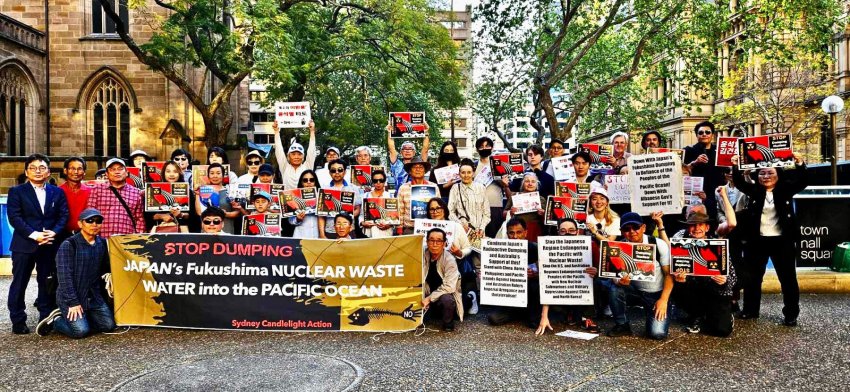
Protesters took a stand against the dumping of Fukushima’s nuclear waste into the Pacific Ocean on September 16. The action was organised by the Sydney Candlelight Action (SCA), based in the Korean community, and was part of a global day of action.
Speakers from the Korean community and other groups condemned the Japanese government and called for international pressure to stop further dangerous radioactive contamination.
Vivian Pak from the Candleight Alliance called on the Prime Minister and environment minister to oppose Japan’s decision.
She also condemned the South Korean government for “not only assisting Japan over the dumping of the nuclear contaminated water but also actively encouraging the ultra right-wing government of Japan to increase its military presence in the region”.
Peter Boyle from Socialist Alliance condemned Labor for endorsing the dumping of the Fukushima nuclear waste as “safe”.
The Australian Embassy in Tokyo even staged a “Fukushima fish and chips” dinner as a public relations stunt in support of the nuclear wastewater release.
Boyle said the Australian government was a “bad Pacific neighbour” because it is undermining a nuclear-free Pacific by supporting the dumping of nuclear waste, dumping nuclear waste on Aboriginal land and entering the AUKUS nuclear submarine deal.
Katti Jisuk Seo, a Korean-German who now lives here, said while enjoying her first scuba dive on the Great Barrier Reef the news about the toxic waste came through.
“Japan is sending its radioactive waste on a trip around the world,” she said.
“Japan plans to release 1.3 million tons of radioactive contaminated wastewater into the ocean over the next decades: that’s enough to fill at least 500 Olympic-sized swimming pools.
“From the Pacific it will reach beaches and seas globally, entering fish, marine plants, other sea creatures and mammals throughout the marine food chain. Via evaporation, through rainfall, it will find its way back onto the lands across our planet.”
David Rho, the rally MC, called on the Japanese government to “accept an independent assessment of the Fukushima wastewater, and to release the true test result”. He said AUKUS represented further nuclear escalation in the region and must be opposed.
Opposition to Aukus – especially from New Zealand, but also from Australia and the Pacific, and across the political spectrum

Military Initiative by Australia, the United Kingdom and the United States (AUKUS) is Another Major Step in Prospective War on China
Covert Action Magazine, By Murray Horton, June 29, 2023
“………………………………………………“We Are Not at War, But Neither Are We at Peace”
New Zealanders may not have appreciated the degree of militarization in Australia, much more so than here. AUKUS should jolt us out of any complacency about what is going on with our nearest neighbor—it is preparing for war. Australian media commentary at the time of the AUKUS launch made that clear. “The monumental price tag of the AUKUS pact has made it clear. We are not at war, but neither are we at peace…”
“Almost $A400b, even over three decades, is not peacetime spending in anyone’s book—a fact Government ministers concede privately. Rather, we are navigating a dangerous and unpredictable new grey zone of superpower rivalry between China and the United States. It’s a contest in which we are poised to be a central player despite our geographical isolation and relatively small population.”
“Accepting such a role will require tough spending decisions the nation as a whole is not yet ready to confront. Already, Opposition Leader Peter Dutton is flagging his willingness to support reduced spending on the National Disability Insurance Scheme to pay for the submarine programme. Other unsettling trade-offs will need to be discussed. Even in the short term, before the big bills start arriving, difficult calls will have to be made….This is because…it will cut $A3b from existing defence programmes…This is likely to anger other branches of the military, such as the Army, while the Navy is lavished with money.”[2]
Albanese tried to put a positive spin on it,……………………………………..
Criticism from Inside the Political Elite
Pleasingly, AUKUS was not unopposed among Australia’s political elite (or, at least, former leading members of it). Paul Keating, who was Labor Prime Minister from 1991 to 1996, really put the boot into the good submarine AUKUS and all who sail in her. He did so in a March 2023 speech, the day after the AUKUS announcement. “Former prime minister Paul Keating has launched an extraordinary attack on the Albanese government over its adoption of the AUKUS pact, accusing it of making the worst foreign policy decision by a Labor government since the attempted introduction of conscription in World War I.”
“He said signing up to AUKUS had broken Labor’s long ‘winning streak’ on foreign policy over the past century and was a ‘deeply pathetic’ moment in the Party’s history. ‘Falling into a major mistake, Anthony Albanese, befuddled by his own small-target election strategy, emerges as prime minister with an American sword to rattle at the neighbourhood to impress upon it the United States’ esteemed view of its untrammelled destiny…’”
“‘Naturally, I should prefer to be singing the praises of the government in all matters, but these issues carry deadly consequences for Australia and I believe it is incumbent on any former prime minister, particularly now, a Labor one, to alert the country to the dangerous and unnecessary journey on which the Government is now embarking.’”
“‘This week, Anthony Albanese screwed into place the last shackle in the long chain the United States has laid out to contain China…I don’t think I suffer from relevance deprivation, but I do suffer concern for Australia as it most unwisely proceeds down this singular and dangerous path,’ he said.”
“Keating presented a largely benign view of China’s rise, saying it was ‘not the old Soviet Union’ and was ‘not seeking to propagate some competing international ideology’ to the United States. The fact is China is not an outrider,’ he said. ‘China is a world trading state—it is not about upending the international system,’”
“Keating said: ‘Every Labor Party branch member will wince when they realise that the party we all fight for is returning to our former colonial master, Britain, to find our security in Asia—236 years after Europeans first grabbed the continent from its Indigenous people. That of all things, a contemporary Labor government is shunning security in Asia for security in and within the Anglosphere’”[3]
Nor was Keating alone in his criticism from within the elite. “The Australian National University’s Hugh White, an emeritus professor of strategic studies, unleashed a quite extraordinary criticism of Australia’s nuclear submarine plan…Professor White, a former deputy secretary of the Defence Department, said Australia was not only going to ‘hand over some serious dollars’ to the US but also pay with ‘a promise’ to enter any future conflict with China.’”
“‘This is a very serious transformation of the nature of our alliance with the United States,’ White said in an interview recorded for the ANU’s politics podcast Democracy Sausage. ‘The US don’t really care about our submarine capability—they care deeply about tying Australia into their containment strategy against China.’”
“White said he couldn’t see why the US would sell its own submarines—of which they have fewer than they need—unless it was absolutely sure Australia’s submarines would be available to it in the event of a major conflict in Asia. He said a war between America and China over Taiwan would be ‘World War III’ and have a ‘very good chance’ of being a nuclear conflict.”
“‘Australia’s experience of war [is] shaped by the fact that we’ve tended to be on the winning side, but there is no reason to expect America to win in a war with China over Taiwan,’ he warned. He suggested there was also a high chance the AUKUS deal could fall over under [sic] a future American administration and a worsening strategic environment.”
“White said there were cheaper, quicker, less risky and less demanding ways for Australia to get the submarines it needed, labelling the AUKUS plan a waste of money that ‘doesn’t make sense. There’s going to be no actual net increase in the number of submarines available until well into the 2040s, even if it goes to plan—which it probably won’t,’ he said.”[4]……………………………………………………………………………………………………………………………………………………………………..
Former New Zealand Prime Ministers from Rival Parties Dissent
When AUKUS was first announced in 2021, New Zealand, which was not invited to join, simply confined itself to saying that nuclear-powered submarines would not be allowed into New Zealand territorial waters, or ports, because of our nuclear-free law dating back to the 1980s. So, the issue flew below the radar (or sailed under the water, to put it more appropriately). However, once AUKUS really kicked off in March 2023, debate and disquiet started in New Zealand.
Helen Clark was the Labour Prime Minister (1999-2008) who has dined out for 20 years on having refused to let New Zealand join the U.S., UK and Australia in the illegal and disastrous 2003 invasion of Iraq (in all other aspects Clark was a very loyal servant of the U.S.). She came out quickly and said that New Zealand is better off outside AUKUS (the word she used was “entanglement”).
She was not alone as the only former New Zealand Prime Minister to criticize it. “…[F]ormer National prime minister Jim Bolger [1990-97] participated in a forum about New Zealand’s foreign policy in Wellington, in which he is reported by the Herald’s Audrey Young to have criticised the Australian submarine buy up as ‘beyond comprehension’ because of the cost and the damage to peace in the Pacific region.”
“Bolger said that New Zealand certainly doesn’t want any such submarines, and challenged proponents of the AUKUS deal to defend it: ‘If you can find any Australian official who can explain why they need nuclear-powered submarines, come and tell me. I’d like to know.’ And Young reported Bolger asking rhetorically, ‘How mad are we getting?’ She says ‘he spoke with despair about the near-daily threats of nuclear war, which had the potential to destroy the planet.’”[7]
Opposition Across the Political Spectrum
“As part of the AUKUS deal Western Australia will play host to US and UK nuclear submarines from 2027. With nuclear-capable American B52 bombers and thousands of American marines rotating through the Northern Territory, Australia is lining up as a loyal lieutenant to the United States in the Pacific and would be expected to fight should war break out.”
“Would New Zealanders fight in a war between the nuclear superpowers? While we aren’t required by treaty obligations to act if America or Taiwan are attacked we are if Australia is. It is not an exaggeration to say Australia could be a target in a future war and already the country has been threatened with missile attacks in that scenario.”
“The risks of New Zealand being dragged in are real. Unlike in Australia, the conversation in New Zealand has been much more muted with limited discussion on the likelihood of war. Why aren’t we talking about it? New Zealand is in a difficult situation contemplating conflict between our largest trading partner and traditional security partner.”
“We weren’t invited to join AUKUS and Australian nuclear submarines won’t be allowed to berth here under our nuclear-free legislation. That same legislation sees New Zealand as only a friend and not an ally of the United States, but we are increasingly acting like we are an ally. In the years since New Zealand’s principled decision not to join the invasion of Iraq we have become more enmeshed with the United States defence apparatus.”
………………………………………………………………………………………………….. “New Zealanders need to talk more about the risks, our decision-makers need to explain why New Zealand is aligning more closely with the United States military and as a sovereign country we have to ask are we acting independently or as a cog in a machine? Our role could be focused on reducing tensions, finding solutions and building trust. War is never inevitable.”[8]
Former politicians across the spectrum have come out against AUKUS. For example, Richard Prebble, one-time Labour Cabinet Minister and later ACT Party founder and Leader.
He is currently a relentless right-wing critic of the current Labour government. His take on AUKUS is the classic mercantilist one. “China is New Zealand’s biggest trading partner. This country has joined China’s Belt and Road initiative. China has signed a free trade agreement with New Zealand, something the U.S. Senate refuses to consider.”
“Foreign Minister Nanaia Mahuta has warned that New Zealand’s exports to China could be caught up in a ‘storm,…………….. New Zealand’s exporters are only too aware of their dependency. There is no other obvious alternative to the New Zealand-China trade.”
“New Zealand has no territorial disputes with China. When we recognised the Government of China 50 years ago, we acknowledged Taiwan is part of China. Paul Keating and Helen Clark are correct. New Zealand’s strategic interest is in the peaceful resolution of conflicts with China rather than sleepwalking into anti-Chinese alliances.”[9]
Academic Skepticism
Leading academic Robert Patman spelled it out in an article entitled “Why New Zealand Should Remain Sceptical About AUKUS.” He wrote that “the basic problem facing AUKUS is that it is based on a binary assumption that the fate of the Indo-Pacific will be largely shaped by the outcome of U.S.-China rivalry and, in particular, by the capacity of America and its closest allies to counterbalance Chinese ambitions in the region.”[10]
“Such a perspective is problematic on a number of counts. First, it exaggerates the influence of great powers in the 21st century in a large, diverse region like the Indo-Pacific. The region contains 60% of the world’s population including significant economic players like Japan, South Korea and fast-growing economies such as Vietnam and India.”
“Second, AUKUS does not factor in the Indo-Pacific and European nations’ quite distinctive security and economic interests in countering China. While countries like Malaysia, Indonesia and Vietnam and EU states like Germany and France are deeply worried about China’s forceful diplomacy in the Indo-Pacific, they remain sceptical that a security arrangement involving three English-speaking states, two of whom have baggage in the region, is an adequate response.”
“Third, China’s global ambitions are very real, but they should not be over-hyped. AUKUS states depict China as a ‘systemic threat’ and, according to US Secretary of Defence Lloyd Austin, the ‘only competitor out there with both the intent to reshape the international order and, increasingly, a power to do so.’ Really?…”
“Fourth, the provision of nuclear-powered submarines to Australia has raised very real fears in the Indo-Pacific about nuclear proliferation. In 1995, ASEAN [Association of Southeast Asian Nations] member states signed the Treaty of Southeast Asia Nuclear Weapon-Free Zone (SEANWFZ). Furthermore, Singapore is now the only ASEAN state yet to sign or ratify the Treaty on the Prohibition of Nuclear Weapons (TPNW), a diplomatic initiative heavily promoted by New Zealand.”
………………………………………………………………………. New Zealand remains sceptical that China is a systemic threat to US dominance, sees a good fit between its non-nuclear security policy and the Indo-Pacific region, and views detachment from AUKUS as both consistent with the goal of diversifying New Zealand’s trade ties and building a diplomatic network of like-minded states to strengthen the international rules-based order through measures like UN Security Council reform.”
Madness to Support U.S. War Against China
Mike Treen, veteran union leader and left-wing activist, put it all very succinctly in an article in the Daily Blog on April 21, 2023. He wrote: “The US is going to war against China because it is losing the international economic competition that previously enabled its military and economic bullying to dominate the globe. The empire is in slow decline.”[11]
“China’s extraordinary rise as an economic powerhouse over the past few decades means that it is now the top international trading partner for 120 countries. This has given the world the freedom to act in ways they have never before—politically and economically.
………………………………………………………………………………. “New Zealand was wrong to join the war against Afghanistan. We were wrong to join the occupation of Iraq. We were wrong to become an ‘observer’ at NATO. And it would be foolish and dangerous to become a participant in any way with the AUKUS military provocation against China. New Zealand should be a neutral power that offers medical aid to the world not a tiny jumped-up militarised puppet of the US empire like Australia has become.”
Defence Minister Tempted by AUKUS
The AUKUS carrot that is being dangled in front of New Zealand and Defence Minister Andrew Little is keen to take a bite……………………………………………………..
But Not PM or Minister of Foreign Affairs
However, both the Prime Minister, Chris Hipkins, and the Minister of Foreign Affairs, Nanaia Mahuta, have since “dismissed suggestions the Government has shown interest in joining aspects of the pact.”
Mahuta made a May 2023 speech stressing that New Zealand’s nuclear-free position is a “cornerstone of our independent stance” ………………………
AUKUS Causing Alarm in the Pacific.
“[T]he Pacific Islands Forum warns ‘AUKUS will bring war much closer to home and goes against the Blue Pacific narrative on nuclear proliferation and the cost to climate change.’ Forum secretary-general Mark Brown said AUKUS would heighten geopolitical tensions and disturb the peace and security of the region.”…………………………………………………………………….
New Zealand Needs to Be Aware of War Drums Next Door
…………………………. New Zealand is actively supporting Ukraine in its war against Russia. There is an irony in our government being so invested in a war, and its attendant geopolitics, on the other side of the world while, right next door to home, our Aussie Big Brother is making a major push toward war via AUKUS and accompanying militarization.
………Make no mistake—AUKUS is a major lurch toward war with China and it is unfolding before our eyes.
The Australian peace movement is waging a vigorous and very active campaign against AUKUS. Independent and Peaceful Australia Network (IPAN) https://ipan.org.au/
References:………………………………………………………..
Port Kembla May Day march rejects AUKUS nuclear submarine base plan
Peter Boyle, Pip Hinman, Port Kembla, May 6, 2023
Thousands of trade unionists (including many members of the Australian Labor Party) and anti-war activists marched through Port Kembla on May 6 to reject the plan to site the AUKUS nuclear-powered submarine base in that town.
The Wollongong May Day march was held in Port Kembla as a symbolic launch of a mass campaign of “feet in the streets” to stop this nuclear military madness, South Coast Labour Council secretary Arthur Rorris told the marchers.
Port Kembla no place for a nuclear subs base, say local campaigners
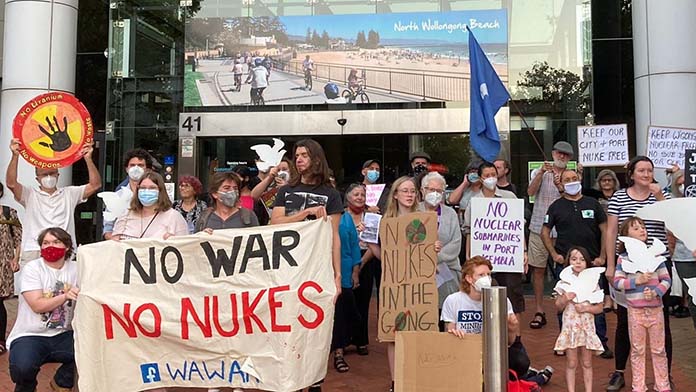
Activists in Wollongong are organising against plans for nearby Port Kembla to host the East Coast base for the AUKUS nuclear submarines. Solidarity spoke to Alexander Brown from Wollongong Against War and Nukes about local opposition and how unions have dedicated this year’s May Day march to opposing the plan
The cost is around $10 billion for an East Coast submarine base. The Treasurer says they can’t afford the $24 billion required to increase Centrelink payments above poverty levels and yet they can afford to spend $10 billion on a war base. And that’s a small part of the overall $368 billion dollars for AUKUS. It’s a gross waste of money.
The strategic justification for it doesn’t make any sense. That’s being picked apart even within the Labor Party by people like Paul Keating and Bob Carr. We’re now seeing current sitting MPs start to express criticism. The submarines may arrive in between ten to 30 years, when their supporters in ASPI and the Sydney Morning Herald say we’re about to have war with China in the next three years. If so the subs are not going to be much use.
More importantly, it’s a ridiculous approach to peace making in the region to say we will arm ourselves to the teeth and that will deter China. China and its regime have many problems but they’re not a military threat to Australia now and they’re unlikely to be in the future. And if these subs are supposed to be to defend shipping, we are shipping most of our exports to China anyway, so who are we defending it against?
We need to build people-to-people solidarity with ordinary people in China to ensure peace and democracy in the whole region—not get drawn into a US provocation and starting a regional arms race.
What kind of actions have you taken to build opposition?
When Scott Morrison suggested that Port Kembla could be a site for an East Coast submarine base there was a protest called by the Student Association at Wollongong University, and different groups and individuals including unions and local councillors came to that.
We started organising a dedicated campaign group called Wollongong Against War and Nukes (WAWAN) and held a successful rally about a year ago to support the local council renewing the declaration of Wollongong as a nuclear free zone, which goes back to 1980.
We held a public meeting with former Greens Senator Scott Ludlam and the South Coast Secretary of the Maritime Union.
We had a rally here two weeks ago, because some local business interests held a defence industry conference and want to build a war industry down here.
This year when the Labor government so fully endorsed continuing AUKUS, after I think many people hoped they might back away, it created shock.
Then there was also a report in the ABC that Port Kembla was firming up as the most likely location for the submarine base. So the campaign has really picked up in the last two months.
The local South Coast Labor Council endorsed a motion to oppose having a nuclear base here.
Unions like the maritime union have put a lot of work into trying to plan for a renewable energy industry here to survive the big shocks that are coming in terms of the decline of coal and steel. They’re interested in expanding offshore wind and potentially green steel through hydrogen.
WAWAN has a community meeting in Port Kembla on 29 April, and we are calling for everyone who can get there to come and support the South Coast May Day march on Saturday 6 May, which will include opposition to the nuclear base alongside the slogan of “Peace, Jobs and Justice”.
Wollongong and Port Kembla steel works have been hotbeds of militancy since the beginning of last century and that tradition continues. The Dalfram dispute in the 1930s saw waterside workers refuse to load pig iron bound for Japan, because they knew that it would be used to make bombs and bullets for the Japanese invasion of China. Pig iron exports to Japan more or less stopped after that struggle.
In the Vietnam War there was a strong movement here and in the 1980s the anti-nuclear movement was really big in Wollongong and the unions were a major part of that. A lot of people in Wollongong have seized the opportunity to say that fighting unionism needs to look beyond the workplace at the environment that workers are going to be living in and creating.
We are wasting money and resources on the defence industry when we could be spending that money on addressing climate change and jobs through a Green New Deal.
Unions back renewable energy jobs over nuclear subs
The South Coast Labour Council, which represents unions in and around Wollongong, is opposing the submarine base as a threat to alternative jobs in the area.
Port Kembla has been assessed as an ideal spot for offshore wind developments, due to wind conditions, grid connections and the working harbour. The area is one of the NSW government’s priority Renewable Energy Zones, with at least two companies already carrying out scoping work for multi-billion dollar offshore wind projects.
Even NSW Ports and the Port Kembla Chamber of Commerce have warned that the Outer Harbour site is needed for wind turbine assembly as well as a new container port, and should not be taken by defence. This is also the likely site for the submarine base. Even the two offshore wind projects already proposed would create thousands of jobs in construction as well as over 500 ongoing jobs.
March against the nuclear base in Port Kembla
12pm Saturday 6 May, Wentworth St, Port Kembla, more details here
Sign up for travel from Sydney here
Opposition grows to nuclear submarines in Port Kembla
by Owen Marsden-Readford https://redflag.org.au/article/opposition-grows-nuclear-submarines-port-kembla, Wednesday, 19 April 2023

Last year, as part of the AUKUS pact, Liberal Prime Minister Scott Morrison announced plans for a new submarine base on Australia’s east coast. The Labor government that succeeded Morrison’s has said it will stick with this plan.
There is increasing speculation that the site for the base will be Port Kembla, a southern suburb of Wollongong in the Illawarra region of the NSW south coast. While Labor insiders have claimed a final decision won’t be made until after the next federal election, the ABC recently reported that, according to “defence, government and industry figures”, Port Kembla “is now the strongly favoured option” for its deep port and proximity to other military bases and Australia’s lone nuclear reactor at Lucas Heights.

The plan has received support from some local business figures, and the University of Wollongong is deepening its already extensive ties with the military-industrial complex in anticipation. Among the wider community, however, opposition is growing.
Several unions have already come out against the proposed base. The New South Wales Teachers Federation passed a motion at its March council meeting:
“Continuing reports that Port Kembla is being considered as the site for a nuclear submarine base is of deep concern for our public education communities. While governments appear ever ready to commit huge amounts of public revenue on military expenditure there remains a serious underfunding of public pre-schools, public schools, TAFE and higher education, and other areas of the public sector.”
The Kiama council also passed a motion opposing a submarine base at Port Kembla. Even the Dapto and Port Kembla branches of the Labor Party have passed oppositional motions. Socialist students in the Wollongong Undergraduate Students’ Association have passed motions opposing the nuclear submarines, the AUKUS pact and the Australian government’s war drive.
Importantly, the South Coast Labour Council has called for this year’s May Day rally to be held in Port Kembla on Saturday, 6 May, to oppose the planned base. Council secretary Arthur Rorris told the Sydney Morning Herald, “If they want to turn our harbour into a nuclear parking lot, we will fight them tooth and nail”. There will even be a solidarity action held in San Francisco outside the Australian consulate.
Wollongong Against War and Nukes (WAWAN)—a campaign group formed last year—has held a series of protests against AUKUS. The most recent, on 4 April, drew more than 80 people in opposition to the Illawarra Defence Industry Conference—a gathering of war hawks and military profiteers.
Socialist and WAWAN activist Luke Hocking said in a speech at the protest, “If we are all committed to building this movement … then we can make something that can physically get in the way of their plans. And the more of us there are, the better we will be able to do that”. WAWAN will be holding a community forum in Port Kembla on Saturday, 29 April, and is planning further protests.
The Illawarra has a proud history of working-class anti-imperialism. We should look to these traditions as we set out to build resistance to the planned submarine base, the AUKUS pact and the militarism of the Australian ruling class and its US and British allies.
1 This month

of the week – Australians for War Powers Reform (AWPR)
To see nuclear-related stories in greater depth and intensity
 Antinuclear