AUKUS, Congress and Cold Feet
May 31, 2023, Dr Binoy Kampmark, https://theaimn.com/aukus-congress-and-cold-feet
The undertakings made by Australia regarding the AUKUS security pact promise to be monumental. Much of this is negative: increased militarisation on the home front; the co-opting of the university sector for war making industries and defence contractors; and the capitulation and total subordination of the Australian Defence Force to the Pentagon.
There are also other, neglected dimensions at work here: the failure, as yet, for the Commonwealth to establish a viable, acceptable site for the long term storage of high-grade nuclear waste; the uncertainty about where the submarines will be located; the absence of skills in the construction and operational level in Australia regarding nuclear-powered submarines; and, fundamentally, whether a nuclear-powered Australian-UK-US submarine (AUKUS SSN) will ever see the light of day.
One obstacle, habitually ignored in the Australian dialogue on AUKUS, are the rumbling concerns in the US itself about transferring submarines from the US Navy in the first place. These concerns are summarised in the Congressional Research Service report released on May 22, outlining the background and issues for US politicians regarding the procurement of the Virginia (SSN-774) submarine. “One issue for Congress is whether to approve, reject, or modify DOD’s AUKUS-related legislative package for the FY2024 NDAA [National Defense Authorization Act] sent to Congress on May 2, 2023.” This includes requested authorisation for the transfer of “up to two Virginia-class SSNs to the government of Australia in the form of sale, with the costs of the transfer to be covered by the government of Australia.”
A laundry list of concerns and potentially grave issues are suggested, and the report is clear that these are not exhaustive. They are also bound to send shivers down the spine of the adulatory Canberra planning establishment, so keen to keep Washington interested. There is, for instance, the question as to whether the transfer of the Virginia-class boats should be authorised as part of the 2024 financial year, or deferred “until a future NDAA.”
There is also the matter about how many submarines should be part of the request, whether it remains up to two as per the current request, or larger numbers. With those numbers also comes the dilemma as to what vintage they will be: those with less than 33 years of expected service life, or newly minted ones with the full 33-year period of operational service. (We can already hazard a guess on that one.)
The issue of cost also looms large. What will Australia, for instance, pay for the Virginia-class vessels, and furthermore, the amount that would be needed as “a proportionate financial investment” in Washington’s own “submarine construction industrial base.” Such a potentially delicious state of affairs for US shipbuilders, who will be receiving funds from the Australian purse to accelerate ship-building efforts.
Other issues suggest questions on operational worth. What would, for instance, be the “net impact on collective allied deterrence and warfighting capabilities of transferring three to five Virginia-class boats to Australia while pursuing the construction of three to five replacement SSNs for the US Navy.” The transfer of US naval nuclear propulsion technology would come with its “benefits and risks” and should also be cognisant of broader implications to US relations with countries in the Indo-Pacific, not to mention “the overall political and security situation in” in the region.
The report takes note of sceptics who claim this “could weaken deterrence of potential Chinese aggression if China were to find reason to believe, correctly or not, that Australia might use the transferred Virginia-class boats less effectively than the US Navy would.” This is a rather damning suspicion. Will Australian sailors either have the full capacity and skills not only to use the weaponry in their possession, but actually comply with US wishes in any deployment, even in a future conflict?
-ADVERTISEMENT-
The report is particularly interesting from the perspective of assuming that Australia will retain sovereign decision-making capacity over the use of the vessels, something that can only induce much scoffing. “Australia might not involve its military, including its Virginia-class boats, in US-China crises or conflicts that Australia viewed as not engaging important Australian interests.” On that score, the report notes remarks by Australia’s Defence Minister Richard Marles made in March 2023 that are specifically underlined to concern Congress. Of specific interest was the claim that “no promises” had been made by Australia to the United States “that Australia would support the United States in a future conflict over Taiwan.”
This is a charming admission that members of the US Congress may well be pushing for a quid pro quo: we authorise the boat transfer; you duly affirm your commitment to shed blood with us in the next grandly idiotic battle.
There is also a notable pointer in the direction of whether an individual SSN AUKUS should even be built. Sceptics, it follows, could argue that it would be preferable that US nuclear submarines “perform both US and Australian SSN missions while Australia invests in other types of military forces, as to create a capacity for performing other military missions for both Australia and the United States.”
This is exactly the kind of rationale that will confirm the holing of Australian sovereignty, not that there was much to begin with. But those voices marshalled against AUKUS will be able to take heart that Congress may, whatever its selfish reasons, be a formidable agent of obstruction. President Joe Biden, his successors, and the otherwise fractious electoral chambers certainly agree on one thing: America First, followed by a gaggle of allies foolishly holding the rear.
Scott Morrison issues blanket denial on nuclear submarine questions
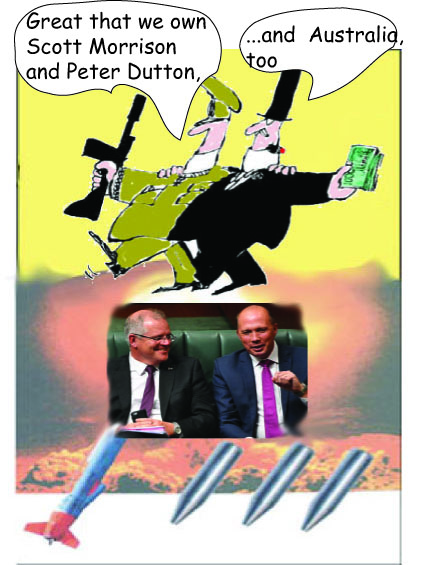
The former PM answered with an emphatic ‘No’ when asked if he knew of links between powerful lobbyists and the AUKUS deal.
DAVID HARDAKER Crikey, 31 May 23 |
| “Former prime minister Scott Morrison has denied knowing of links between conservative lobbyists the Crosby Textor group (C|T Group) and the giant US company General Dynamics, which builds nuclear-powered submarines.“He has also denied knowing that General Dynamics was the lead constructor for the US Navy’s fleet of nuclear-powered submarines as he pondered cancelling Australia’s contract for conventional submarines in favour of nuclear-powered submarines. And he denied speaking about the nuclear-powered submarine option with his principal private secretary Yaron Finkelstein , who left C|T’s Australian operations to join Morrison’s staff in 2018.”………… https://www.crikey.com.au/2023/05/31/scott-morrison-denial-nuclear-submarine-questions-aukus/?utm_campaign=crikeyworm&utm_medium=email&utm_source=newsletter |
Aukus ‘expensive’ and not ‘easy to replicate’, Australian officials told foreign diplomats
Exclusive: Documents obtained by Guardian Australia show Australia attempted to reassure countries amid nuclear proliferation concerns
Daniel Hurst, Guardian 29 May 23
Australian officials have told foreign diplomats that the Aukus submarine plan is “expensive” and not “easy to replicate”, as part of an effort to play down concerns about the risks of other countries racing to do the same, a newly released tranche of documents reveals…..
Briefing notes obtained by Guardian Australia under freedom of information laws lay bare the arguments the government is using to defend and explain Aukus to foreign diplomats posted to Canberra………………………………………
China’s mission to the UN said in March that “two nuclear weapons states who claim to uphold the highest nuclear non-proliferation standard” – the US and the UK – “are transferring tons of weapons-grade enriched uranium to a non-nuclear-weapon state”.
The new documents show that many of the answers given by Australian officials at the Aukus briefings aimed to reassure countries about nuclear non-proliferation issues.
The first assistant secretary of Dfat’s Aukus taskforce, Sarah deZoeten, told those in attendance that Australia would retain control of operational waste and spent fuel.
…………………………. Aukus is novel because it will be the first time a provision of the Nuclear Non-Proliferation Treaty regime has been used to transfer naval nuclear propulsion technology from a nuclear weapons state to a non-weapons state……………………………. https://www.theguardian.com/world/2023/may/30/aukus-expensive-and-not-easy-to-replicate-australian-officials-told-foreign-diplomats
Transferring US nuclear subs to Australia far from smooth sailing
26 May 2023 | Andrew McLaughlin Riotact,
A report prepared for Congress on the US Navy’s Virginia Class nuclear-powered attack submarine (SSN) procurement program has highlighted what issues need to be considered and overcome to allow the transfer of US submarines to Australia.
Under Pillar 1 of the AUKUS construct with the US and UK which was announced by the leaders of all three countries in March, Australia is slated to receive between three and five Virginia class nuclear-powered submarines to begin replacing its own Collins Class conventional submarines from 2032.
After this, Australia plans to switch submarine classes and acquire eight SSN-AUKUS submarines under a cooperative program with the UK from 2041……………………………….
The report says Congress needs to consider several factors relating to the legislation, including whether the legislation needs to be considered under the 2024 National Defense Authorization Act (NDAA) or can be deferred, whether the authorisation should be provided for just the first two boats or can be expanded to up-to five SSNs, and when the SSNs would be removed from US Navy service to prepare for the transfer.
While this seems to confirm Australia will receive former US Navy SSNs instead of new-build boats, the report also asks Congress to consider whether that would be the case, whether new-build boats could be made available, or a combination of the two.
It says Congress should also decide, apart from the cost of the submarines, how much of a “proportionate financial investment” Australia will be required to make into US shipyards to expand the US’s submarine industrial base. Despite a plan for two Virginia boats to have been built per year since 2011, this has not been achieved due to ongoing workforce and materials issues, made worse in recent times by the COVID-19 pandemic………………..
The ability of the US shipyards to ramp up sufficiently to cover the sale of Australian boats appears to be somewhat questionable. ……………………………
The report further asks Congress to consider what will be “the net impact on collective allied deterrence and warfighting capabilities of transferring Virginia Class boats to Australia while pursuing the construction of replacement SSNs for the US Navy”.
It points out that supporters of transferring SSNs to Australia rather than keeping them in US Navy service might argue that “the deterrent value of introducing SSNs to Australia’s navy would be greater than the deterrent value of keeping those SSNs in US Navy service because a newly created force of Australian SSNs would present China with a second allied decision-making centre for SSN operations in the Indo-Pacific, which would complicate Chinese military planning”.
Conversely, it says opponents of the proposed transfer might argue that “it could weaken deterrence if China were to find a reason to believe, correctly or not, that Australia might use [its] Virginia-class boats less effectively than the US Navy would have, or that Australia might not involve its military … in a US-China crises or conflicts that Australia viewed as not engaging important Australian interests”.
As if to support this viewpoint, it points out that “Australian Defence Minister Richard Marles in March 2023 reportedly confirmed that, in exchange for the Virginia-class boats, Australia’s government made no promises to the United States that Australia would support the United States in a future conflict over Taiwan”. https://the-riotact.com/transferring-us-nuclear-subs-to-australia-far-from-smooth-sailing/664701
Stella Assange at Sydney rally: “It’s not just Julian who has lost his freedom, but all of us”
The whistleblower noted the comments of Australian Labor Party Prime Minister Anthony Albanese, who has made extremely tepid statements expressing “concern” over Assange’s plight. Albanese has said that “enough is enough” in relation to the Assange case. He claims to have made private representations to the US and British governments on behalf of Assange, but has stopped far short of any public demand for the Australian journalist’s freedom.
Albanese has recently hinted at the prospect of a plea deal in the Assange case. Kenny forcefully rejected this course. “Is there a Hicks solution? Why should there be? He has not committed any crime. He should not be forced to plead to anything. We need our prime minister to stand up, not just say ‘enough is enough.’”
Oscar Grenfell@Oscar_Grenfell, 24 May 2023
Some 800 people attended a protest in Sydney yesterday morning demanding the immediate freedom of imprisoned WikiLeaks publisher Julian Assange. People came from across New South Wales and from around the country to attend the rally, which was one of the largest demanding Assange’s freedom yet, despite being held on a weekday.
Speaking at the demonstration, Stella Assange, Julian’s wife, declared that the protesters were “at the forefront of a global movement for justice. A global movement that converges on one man, but the meaning of which goes far beyond Julian’s freedom. It’s not just Julian who has lost his freedom, but all of us. Because in order to keep Julian in prison, they have had to corrupt their own rules and their own principles.”
Stella, visiting Australia for the first time, noted that her tour had initially been planned to coincide with a scheduled visit of US President Joe Biden. He had been set down to attend a summit of the warmongering and anti-China Quadrilateral Strategic Dialogue this week in Sydney.
Biden cancelled, however Stella proceeded with the visit. She explained the crucial importance of the fight within Australia to securing her husband’s freedom. Assange is detained in Britain and faces extradition to the US, where he would be tried on Espionage Act charges carrying 175 years imprisonment for exposing American war crimes.
Assange is an Australian citizen. Stella explained: “Julian’s case is a case of global importance. But you guys are at the centre of it because Julian is an Australian, he’s a country boy, and he’s from this country. That means that the key to securing Julian’s release lies with you.”
Assange’s supporters in Australia were part of a “global movement” involving millions of people all over the world, she said. There is a growing recognition, internationally, that “he’s in prison because he exposed the crimes of others. No decent human being will ever tolerate that. The only people whose interest remains Julian’s imprisonment, are the ones who are guilty and implicated in those crimes.”
Within Australia, there had been a “sea change.” Only a few years ago, there had been “radio silence” on Assange’s case. But increasingly it was being discussed in the media, as well as by official politicians. This, Stella stressed, was a consequence of the demands made by ordinary people and a protracted grassroots campaign.
This fight had to be deepened, she said. “You guys need to shout louder, fight harder, put the pressure on each of your representatives, make Julian’s situation visible everywhere, every day, on your cars, on your shirts. Every day you tell all your friends, you talk about it with your family… Make sure Julian remains top priority until he steps out of that prison. I think we’re near, we can achieve this together.”
Stella noted that it was her first time in Australia, but it would not be her last. “I will come back here, home with Julian, and our kids who are Australian citizens will come home too.”
John Shipton, Assange’s father, placed the persecution of Assange within a broader context. Brown University, in the United States, had recently published a report showing that there had been 4.5 million deaths in the Middle East following the 2003 invasion of Iraq. An earlier document, from the same institution, estimated that the predatory US-led wars in the region had displaced 38 million people.
Speaking of those US interventions Shipton condemned a “hegemon standing in a river of blood.” He emphasised the striving of ordinary people for “justice” and “humanity,” which would ultimately be victorious. Assange’s case and the fight for his freedom were integral to this broader struggle.
Gabriel Shipton, Assange’s brother, said: “If anything is to be taken from Julian’s persecution, it is that it has mobilised people all around the world… The fight gives meaning to Julian’s work. It has brought us all together here to fight for something that is so important to our Western democracies and that’s a free press. How can we make decisions about what our governments do in our name if we don’t know? It’s not possible.”
David McBride addressed the protest. A former Australian army lawyer, he faces life behind bars for blowing the whistle on Australian war crimes in Afghanistan. They included verified murders of civilians and prisoners and other violations of international law. For these offenses, McBride, the man who exposed them, is the first to face court proceedings.
“There’s a good chance that even though I reported murders and cover-ups, that I’m going to go to jail for the rest of my life… It’s not something I hang my head about. It’s something I’m proud of… We need to stand up, the future of the planet depends on it.”
The whistleblower noted the comments of Australian Labor Party Prime Minister Anthony Albanese, who has made extremely tepid statements expressing “concern” over Assange’s plight. Albanese has said that “enough is enough” in relation to the Assange case. He claims to have made private representations to the US and British governments on behalf of Assange, but has stopped far short of any public demand for the Australian journalist’s freedom.
McBride responded: “I say this to Anthony Albanese. Enough of you saying ‘enough is enough.’ It means nothing. Imagine if I had witnessed war crimes in Afghanistan, witnessed murder and cover-up… and all I said to them is ‘enough is enough.’ It’s not enough.” McBride called for Albanese to “step up to the plate” and secure Assange’s unconditional freedom.
Stephen Kenny, Assange’s Australian lawyer, issued the same demand. Kenny represented Australian citizen David Hicks, who was rendered to the American military prison in Guantánamo Bay as part of the “war on terror.” Hicks was eventually freed and returned to Australia, as the result of a powerful campaign led by his father Terry Hicks. David Hicks had been compelled to sign a plea deal, despite having committed no crime.
Kenny noted the parallels. “Like David Hicks, Julian Assange has not committed any crime at all. So why is he in jail?” The editors of other major publications, who were involved in WikiLeaks’ 2010 and 2011 releases, for which Assange is being prosecuted, remain at liberty. This, Kenny explained, made clear that the case against Assange was political and required a political solution.
He outlined some of the abuses of the British judiciary. This included placing Assange in a glass box at the back of his courtroom during the first extradition proceedings, denying him the right to participate in his own case. Assange’s lawyers, moreover, had filed their latest appeal in November. The British judges merely need to determine whether he has an arguable case, a process which Kenny said should take several days or at most a week. But six months on and this task has not been completed.
Albanese has recently hinted at the prospect of a plea deal in the Assange case. Kenny forcefully rejected this course. “Is there a Hicks solution? Why should there be? He has not committed any crime. He should not be forced to plead to anything. We need our prime minister to stand up, not just say ‘enough is enough.’”
The rally raised several political issues. Many of the speakers, importantly, emphasised the decisive role of mobilising ordinary people in the fight to free Assange.
Inevitably, the statements of Albanese and other Labor representatives have generated some hope within the Assange camp. But there is no indication, whatsoever, that Albanese is fighting for Assange’s freedom, behind closed doors or anywhere else. This week he refused to even meet with Stella Assange. Albanese was part of the Gillard Labor government, which in 2010 and 2011, played a central role in the initial stages of the persecution of Assange…….. https://www.wsws.org/en/articles/2023/05/25/rgzp-m25.html?fbclid=IwAR1yfKnxx-_FuaTf0qdcSzFjaiYawdDU8YzVOUBFX5GT0RrBI6gj61xvWCE
Hundreds rally against state government’s proposed increases to penalties for protesting
About 500 people have marched through the Adelaide CBD rallying against proposed changes to the state’s protest laws.
The state government proposed changes to laws that would strengthen penalties for obstructing public places in response to Extinction Rebellion protests last week.
A climate change protester was charged with obstructing a public place after she abseiled down Morphett Street bridge with a rope and was suspended over North Terrace, causing traffic delays.
Another four protesters were charged with offences, including property damage, after allegedly throwing paint at the Santos building.
The proposed changes to the Summary Offences Act — backed by the state opposition — would mean anyone who “intentionally or recklessly engages in conduct that obstructs the free passage of a public place” would face possible three months jail or a $50,000 fine.
Currently, there is no option for jail time and the maximum fine is $750.
“One of the amendments that I’m moving will be to add in a sunset clause to this bill so that it expires in 12 months time.
“We are also adding in a clause requiring a review after a 12-month period and I’ll also be introducing a reasonableness test so that people who are caught under this bill will have a possible defence.”
About 80 community groups, including Amnesty International Australia, have signed a letter calling on the government to withdraw the bill.
The organisations listed their support in a full-page advertisement taken out in Friday’s edition of The Advertiser titled Protect Our Right to Protest — Before It’s Too Late, which was authorised by the South Australian Council of Social Service.
‘Almost wartime measure’
The Law Society of South Australia and the South Australian Bar Association have also jointly written a strongly worded letter to the Attorney-General outlining a long list of concerns about the proposed new laws.
………………………………………. The legal bodies raised concerns about the legal wording of the proposed reforms which would significantly shift the onus of proof for the offence of obstructing a public place.
“The effect is that a person only has to turn their mind to the possibility that an obstruction will occur, even though the consequence is entirely unintended, to be found guilty of the offence,” the letter states………………………….. more https://www.abc.net.au/news/2023-05-26/hundreds-protest-against-anti-protest-laws/102396520
Australian Prime Minister Albanese refuses to meet with Assange’s wife
Oscar Grenfell@Oscar_Grenfell, 22 May 2023, WSWS,
Asked by independent MP Andrew Wilkie why he would not meet with Mrs Assange, Albanese brushed aside the question, declaring: “Who I meet with is determined by the priorities that my office has.”
Over the past month, Albanese has met with a multitude of business tycoons. He attended the wedding of right-wing radio shock jock Kyle Sandilands, alongside a convicted drug dealer and reputed crime boss. Most recently, Albanese fawned over US President Joe Biden in Tokyo on the weekend. Biden is overseeing the attempt to extradite Assange from Britain, and imprison him for 175 years for exposing American war crimes.
Albanese proclaimed in parliament, he was not interested in meeting Assange’s wife, which he said would be akin to a “demonstration” and “grandstanding.” Albanese sought to dress up the refusal by reiterating vague comments that “enough is enough” in relation to the Assange case, and he cannot see that anything is served by the WikiLeaks founder’s continued incarceration.
While Albanese claims he has made this position clear to the US administration, there is no evidence of that, including in extensive correspondence obtained under freedom of information requests between various American and Australian government bodies. Labor continues to give carte blanche to the very administration seeking Assange’s destruction.
The obvious question is: if Albanese won’t even meet with Assange’s wife, a basic act of respect and courtesy that he has extended to thousands of others over the course of his year in office, why would anyone think the prime minister is waging a fight for the imprisoned Australian journalist’s freedom behind closed doors?
As part of her visit to Australia, Stella Assange yesterday addressed the National Press Club in Canberra.
The speech was a powerful plea for Assange’s freedom, an exposure of the draconian conditions under which he is detained in Britain’s maximum-security Belmarsh Prison and a clear outline of the fundamental issues of democratic rights at stake in the attempted prosecution of her husband.
Stella noted a groundswell of support for Assange. She stated: “I would like to thank the overwhelming dedication of the Australian people, who have brought about a sea change in awareness and solidarity for Julian’s plight. This unity in support for my husband is a source of enormous encouragement for our family. It nurtures Julian’s ability to continue on.”
She added: “The reality is that to regain his freedom, Julian needs the support of his home country. This is a political case, and it needs a political solution.”
In discussing her presence in Australia, and also what she speaks about with her husband, Stella stressed Assange’s connection to Australia. He had been raised in the country, and had shared his extensive memories, from surfing in Byron Bay, to beekeeping in Melbourne’s Dandenong Ranges and riding a horse in the New South Wales Northern Rivers.
“That’s how I imagine Julian when he is free,” she said………………………..
Stella outlined the draconian security procedures required for her and her two children to visit their father. They had to pass innumerable checkpoints, searches and scans for their visits. The children had only ever seen their father in the inhospitable prison visiting room. For the elder of the two, now six years old, “Prisons feature in his dreams and his nightmares.”
Turning to the case, Stella stated: “A 175 year sentence is a living death sentence. A prospect so desperate that the English court found that it would drive him to take his own life, rather than live forever in hell. We must do everything we can to ensure that Julian never, ever, sets foot in a US prison. Extradition in this case is a matter of life and death.”
She explained: “For most people, Julian is a symbol. A symbol of staggering injustice, because he is in prison on trumped up charges for exposing the crimes of others. A symbol because he faces a bewildering 175 year sentence for publishing the truth. A symbol of a sophisticated form of state violence dressed up in complexity and indirection that not even Franz Kafka could have imagined.
“For the press and the public, Julian’s case is the most brutal attack on press freedom that the Western world has seen in the last 70 years. A foreign government is using the political offences in its statute books to indict a foreign national abroad, because of what he or she published in a different country.
“Accurate, damning publications exposing their war crimes. If sovereignty is to mean anything, if jurisdiction is a proper legal and political reality, the case against Julian cannot be understood as anything other than an absurdity.”
Despite the dire threat to press freedom, the address was largely subjected to a media boycott. Only a handful of nationally-recognised journalists attended. Several prominent publications sent junior staff, fresh out of university, armed only with arrogance and obnoxious questions based on the slanders that have been used to attack Assange.
The shameful display underscored the fact that broad sections of the official media function as nothing more than state propagandists. While they are cheering on each new step in Australia’s integration into the US preparations for war with China, this corrupted layer is hostile to a genuine journalist who exposed war crimes………………………………………. https://www.wsws.org/en/articles/2023/05/23/gavm-m23.html?fbclid=IwAR180uIICBGtiZ8Fb3gyk6bwi2YScNh7OxnAQDK0979TWB0XNzNFuUBpSso
60 Minutes Australia Keeps Churning Out War-With-China Propaganda
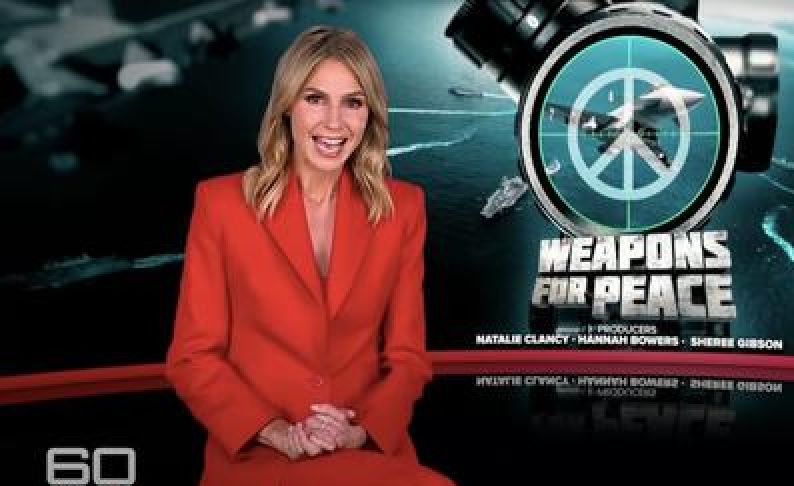
Australians are particularly vulnerable to propaganda because Australia has the most concentrated media ownership in the western world, dominated by a powerful duopoly of Nine Entertainment (who airs 60 Minutes) and the Murdoch-owned News Corp. This vulnerability is being fully exploited as the time comes for the western empire to beat the war drums against China.
CAITLIN JOHNSTONE, MAY 25, 2023 https://caitlinjohnstone.substack.com/p/60-minutes-australia-keeps-churning?utm_source=post-email-title&publication_id=82124&post_id=123620142&isFreemail=true&utm_medium=email
60 Minutes Australia has been playing a leading role in saturating Australian airwaves with consent-manufacturing messaging in support of militarising to participate in a US war against China. A segment they ran a year ago is titled “Prepare for Armageddon: China’s warning to the world,” and features an image of Xi Jinping overlaid with war planes and explosions and captioned “POKING THE PANDA”. Another from a year ago is titled “War with China: Are we closer than we think?” Another from ten months ago is titled “China’s new target in the battle to control the Pacific.” Another from six months ago is titled “Inside the battle for Taiwan and China’s looming war threat.” Another from two months ago is titled “Is the Navy ready? How the U.S. is preparing amid a naval buildup in China.”
All of these segments have millions of views on YouTube alone. Now this past weekend 60 Minutes Australia has aired back-to-back segments titled “The real Top Gun: US military in heated stand-off with China” and “Five countries secretly sharing intelligence say China is the No.1 threat,” both of which are as jaw-droppingly propagandistic as anything I’ve ever seen.
“It might sound like twisted logic, but military forces everywhere argue that the greater the firepower they possess, the greater the chance of maintaining peace,” opens 60 Minutes Australia’s Amelia Adams. “In other words, massive weaponry is the best deterrent to war. Right now the theory is being tested like never before, and much of it is happening in Australia’s backyard, the Indo-Pacific region. The United States wants the world, and more particularly China, to know of its increasing presence there, and to do that it’s putting on a spectacular show.”
What follows is 19 minutes of overproduced footage displaying this “massive weaponry” while Adams oohs and ahhs and gives slobberingly sycophantic interviews to US military officials.
“There’s something utterly mesmerising about the F-35 jet,” Adams moans. “The sound, the heat, and the power put this supersonic stealth fighter in a league of its own.”
“Colonel these are some very impressive machines you’re in charge of!” she gushes to an officer on an aircraft carrier.
“Yes ma’am,” the colonel replies.
Jesus lady, do your orgasming off camera.
Contrast this glowing ecstatic revelry with Adams’ open hostility later in the segment toward a Chinese think tanker named Henry Wang, claiming that he was trying to “rewrite history” for dismissing panic about a Chinese military buildup by pointing out (100 percent correctly) that China is spending a lower percentage of its GDP on its military than western nations.
“Every command, every maneuver, is being fine-tuned on this vast blue stage, where China has proven to be a bad actor, playing a long game of intimidating Pacific nations,” Adams proclaims over helicopter footage of US war ships. “But the US and its allies aren’t having it, bolstering their defenses — and it’s an impressive display.”
I defy you to find me footage more brazenly propagandistic than this, from any point in history. This is supposed to be a news show, run by people who purport to be journalists, yet they’re engaging in propaganda that looks like it came from a Sacha Baron Cohen spoof of a third world dictatorship.
As I never tire of pointing out, the claim that the US has been militarily encircling its number one geopolitical rival defensively is the single dumbest thing the empire asks us to believe these days. The US is surrounding China with war machinery in ways that it would consider an outrageously aggressive provocation if the same thing were done in its neck of the woods, which means the US is plainly the aggressor in this standoff, and China is plainly reacting defensively to those aggressions.
While the first segment unquestioningly regurgitates Pentagon narratives and gives supportive interviews to military officials, the second segment unquestioningly regurgitates talking points from the western intelligence cartel and gives supportive interviews to Five Eyes spooks.
“Showing off deadly weaponry in massive war games is a tactic China and the United States both use to try to avoid full-on combat,” says 60 Minutes Australia’s Nick McKenzie in introduction. “But the truth is the two countries, as well as other nations including Australia, are already battling it out in an invisible war. There are no frontline soldiers but there are significant skirmishes. Until now these conflicts have been kept quiet, but key members of a secretive alliance of top cops from Australia, the United States, the United Kingdom, Canada and New Zealand are about to change that.”
“Their group is called the Five Eyes, and tonight they want you to know what they see,” says McKenzie, which is the same as saying “We’re telling you what the Five Eyes intelligence agencies told us to tell you.”
McKenzie literally just assembles a bunch of Five Eyes officials to tell Australians that China is bad and dangerous, and then disguises the western intelligence cartel advancing its own information interests as a real news story.
“There is one threat that alarms our partners more than any other,” McKenzie says over dramatic music, asking “Which state actor is the key threat to democracy in Australia and amongst the Five Eyes partners?” and presenting a montage of western intelligence operatives answering (you guessed it) China.
“The Americans describe a growing menace on our doorstep flowing from China’s increasing influence in the region,” McKenzie says, before asking an American official, “Do you see the Chinese state preying on Pacific island nations?”
“I believe so, yes,” the official responds.
Western journalism, ladies and gents.
Australians are particularly vulnerable to propaganda because Australia has the most concentrated media ownership in the western world, dominated by a powerful duopoly of Nine Entertainment (who airs 60 Minutes) and the Murdoch-owned News Corp. This vulnerability is being fully exploited as the time comes for the western empire to beat the war drums against China.
We keep being hammered by this narrative that “massive weaponry is the best deterrent to war,” when all facts in evidence say the exact opposite is true. It was the military encroachment against Russia and the conversion of Ukraine into a NATO military asset which provoked Putin to invade Ukraine, and all the militarization against China that we are seeing is only inflaming tensions and making war more likely.
And, I mean, of course it is; even a casual glance at the Cuban Missile Crisis reveals that powerful nations don’t take kindly to having menacing forces placed near their borders. So much of the propaganda indoctrination we’re subjected to in the 2020s revolves around convincing people to believe that Russia and China should react completely differently than the way the US would react if foreign proxy forces were being amassed along its borders.
So yes, Amelia Adams, claiming that aggression and militarism is the best path toward peace is absolutely “twisted logic”. It is as twisted as it gets. Because it is false. This is obvious to anyone who hasn’t yet been successfully indoctrinated into this omnicidal belief system.
We need to do everything we can to fight against this indoctrination now, because if we wait until the war actually starts it will likely be too late to resist.
Government introduces Bill to exempt nuclear submarines from crucial environmental protection acts.
Government seeks to make nuclear submarines more hazardous
Independent Australia, By Bevan Ramsden | 23 May 2023,
New legislation seeks to exempt nuclear power plants onboard submarines from crucial environmental protection acts, writes Bevan Ramsden.
THE GOVERNMENT has a bill before Parliament which, if passed, would exempt nuclear power plants on nuclear-propelled submarines from the requirement of two other acts: the Australian Radiation Protection and Nuclear Safety Act 1998 and the Environment Protection and Biodiversity Conservation Act 1999.
The bill is called the Defence Legislation Amendment (Naval Nuclear Propulsion) Bill 2023. The amendments involve inserting an additional paragraph in parts of each act to exempt ‘a naval nuclear propulsion plant related to use in a conventionally-armed, nuclear-powered submarine’ from the requirements in the parts of either of those acts which refer to nuclear power plants.
This must be of considerable concern to the Australian community as it is totally illogical to make a distinction between the nuclear plant providing the power to propel “conventionally-armed, nuclear-powered submarines” and that of a land-based nuclear power plant in relation to controls and protections as it is indeed still a nuclear power plant.
The nuclear power plant on board a submarine needs the same or more requirements for control and protection as a nuclear power plant on land. Indeed, the uranium to be used in these proposed SSN submarines is enriched to the level that is used in nuclear weapons.
It also presents more danger than conventionally uranium-fired nuclear power plants to the naval staff operating inside a nuclear-propelled submarine as they live and work in very close proximity to the nuclear power plant powering the submarine. When in port, residents in the vicinity of the port are potentially exposed to the toxic impact of possible radiation leaks from the submarine’s nuclear power plant.
To pass these amendments exempting nuclear power plants on board a nuclear-propelled submarine from the requirements of these two acts would be a betrayal by Parliament of its responsibilities to the naval staff operating the submarines and to the wider Australian public, especially those in proximity to the ports which service nuclear-powered submarines.
The Federal Parliament has never had the opportunity to vote on Australia joining the trilateral AUKUS security treaty through which the nuclear-powered submarine technology is to be transferred to Australia.
Nor has it had the opportunity to vote on the decision for Australia to buy/acquire nuclear-propelled submarines.
Here is one, possibly the only, opportunity for Parliament to vote on an aspect of the nuclear-propelled submarine procurement and step in and take some responsibility in maintaining the controls and protection of the nuclear power plant on board a submarine by not exempting it from the requirements of these two acts.
The Senate has referred this bill to the Senate Foreign Affairs, Defence and Trade Legislation Committee for review and report by 9 June 2023. Submissions can be made to it by 26 May. As many submissions as possible should be made to this committee urging that it recommend opposition to these amendments……………………………………..more https://independentaustralia.net/politics/politics-display/government-seeks-to-make-nuclear-submarines-more-hazardous,17538
Property values in Kimba? Not so good, since the town agreed to host a nuclear waste dump.
Paul Waldon 23 May 23
When the fear of nuclear waste came to Kimba, the nuclear coterie commission a report.
“Points of claim taken from, The University of Queensland, final report November 2018.”
• Value in the residential housing market has fallen by 30-40% over the past 5 years
• As of July 2018, 35 residential properties were listed for sale compared with an historical average of 10-15.
• Perceptions are that not many people are moving to Kimba from outside the wider region.
• The rental market is currently stagnant, with local landlords indicating a reduction of over 10- 20% in weekly rental rates required to attract tenants
• No new residential housing construction has occurred in the past 3 year
This is a sign of a town floundering, a town dying, a town with no future as long as it embraces the ideal of nuclear waste.
AUKUS may turn out to be the largest financial swindle perpetrated by the United States and the United Kingdom against Australia and other Asia Pacific nations

Now, it appears that Australia is becoming yet another naval base for the deployment of US and British fleets in the Asia-Pacific Region, including the basing of US nuclear submarines in 2026, without any hope of restoring economic ties with China and, consequently, the prior level of welfare in the near future. This is in addition to paying “compensation” under the guise of investing in unfeasible defense plans.
https://journal-neo.org/2023/05/20/aukus-may-turn-out-to-be-the-largest-financial-swindle-perpetrated-by-the-united-states-and-the-united-kingdom-against-australia-and-other-asia-pacific-nations/ 20.05.2023 Author: Bakhtiar Urusov
Equipment for the country’s ground forces “arrives with depressing regularity,” years behind time, and substantially over budget, according to a report issued on April 19 by the British Parliament’s Budgetary Control Committee. For instance, the programs, which provide new Ajax armored fighting vehicles and Morpheus tactical communication and information systems, have faced significant difficulties. According to the MPs’ assessment, the issue is made worse by underfunding of the defense budget expenditures and the pound’s declining purchasing value in relation to the dollar.
Ten days later, on April 28 this year, the Royal Navy informed the public about the decision to decommission the HMS Prince of Wales aircraft carrier, launched just four years ago (in 2019), to be used as a donor for spare parts for the HMS Queen Elizabeth aircraft carrier of the same class. According to the Royal Navy, the $3.72 billion aircraft carrier has docked more frequently than it has participated in naval operations, and the most recent maintenance cost $42 million.
This dispiriting news came just a month after the leaders of the US, the UK, and Australia had disclosed their ambitious long-term plans to build a nuclear-powered submarine fleet for Canberra on the basis of British technology, which will cost the Australian budget $245 billion.
When it comes to extremely sophisticated projects like nuclear submarines, it seems inconceivable that the parties involved would be so irresponsible as to neglect to evaluate the contractors’ capacity to meet their obligations. Still, if you trust the claims made by senior US, British, and Australian officials, the opposite is true in the case of AUKUS. Canberra would never have consented to work together on submarine design and construction with Great Britain’s waning technological strength otherwise. The example of the HMS Prince of Wales aircraft carrier shows that not only is Great Britain unable to complete a big naval project, but it is also facing significant technological difficulties in order to satisfy present ambitions for defense construction and equipment upgrades.
In the realm of economic crime, assigning work to a contractor who is known to be unable to perform is fraud, money laundering, or corruption.
In the context of Anglo-Saxon big politics, this appears to be retaliation against a certain sector of Australia’s elites for Canberra’s departure from a coordinated approach to restrain the PRC back in the day. This is primarily about the carefree era when Australia and China’s trading and economic relations remained unbroken, providing Canberra with significant revenue from exports to the PRC of a wide range of items, from wine and agricultural products to hard coal and other minerals.
Now, it appears that Australia is becoming yet another naval base for the deployment of US and British fleets in the Asia-Pacific Region, including the basing of US nuclear submarines in 2026, without any hope of restoring economic ties with China and, consequently, the prior level of welfare in the near future. This is in addition to paying “compensation” under the guise of investing in unfeasible defense plans.
All nations, including India, Japan, the Republic of Korea, New Zealand, and some ASEAN members that have been invited to participate in the AUKUS, should take a closer look at this alliance.
Bakhtiar Urusov, a political observer, exclusively for the online magazine “New Eastern Outlook.”
‘Extremely difficult’ for nuclear energy to ever have a future in Australia- says Secretary of pro nuclear union
Outgoing Australian Workers Union national secretary Daniel Walton says he has witnessed “the pressures businesses have been under” with energy for the last decade……….
He said he has tried to take a “pragmatic view to finding energy solutions”.
“I think for nuclear, as much as I saw it as a fantastic opportunity, I think it’s genuinely going to be extremely difficult for it to ever have a future in Australia.” https://www.skynews.com.au/business/energy/extremely-difficult-for-nuclear-energy-to-ever-have-a-future-in-australia/video/ca2d728160fae4f6faa9e9956bca5b71
Government gutted as PwC, Big 4 pick up $1.4b a year for giving advice

I did read where Australia’s Defence Minister Richard Marles was actually thanking PWC for their advice in the AUKUS deal to purchase nuclear submarines. But unfortunately now I cannot find that anywhere on the Internet
by Michael West | May 22, 2023 | What’s the scam? https://michaelwest.com.au/government-gutted-as-pwc-big-4-pick-up-1-4b-a-year-for-giving-advice/
The Centre for Public Integrity has published analysis of political donations and government contract work for Big 4 firms EY, KPMG, Deloitte and PwC. What’s the scam?
The scam is legalised corruption on an industrial scale, a $1.4b a year scale. In Booming Business for Big Four Comes At a High Cost, the Centre has issued a tight bit of analysis but nothing we haven’t been rabbiting on about for years: rising donations, surging income from the outsourcing of government.
The Centre labels the return of billions in consulting work in return for millions in donations the “Return on Investment”. Say no more … except that one thing missing is here that the Big4 are partnerships, opaque structures which means they have no responsibility to disclose anything about their financials.
The government could insist they incorporate. It could whack a withholding tax on them which could withhold tax in the event of mischief, it could stop them buying lawyers to use ‘legal professional privilege’ to stonewall the Tax Office in litigation. And much more. It could act decisively on the PwC scandal. Has the Commonwealth DPP been briefed as to charges for the dozens of partners involved in selling Commonwealth secrets to multinational tax avoiders?
Albanese urged to take stand against nuclear weapons during G7 summit in Hiroshima

International Campaign to Abolish Nuclear Weapons wants Labor to send a ‘message to the region’ and sign and ratify a treaty to impose a ban on atomic weapons
Guardian Daniel Hurst 19 May 23
Anthony Albanese is being urged to take a firm stand against nuclear weapons when he attends the G7 summit in Hiroshima this weekend.
The prime minister has been invited to attend the summit in Hiroshima, which along with Nagasaki was devastated by the US atomic bombing in the closing stages of the second world war.
Albanese is due to arrive in the city on Friday afternoon and will join the mayor of Hiroshima for a visit to the Peace Memorial Park, including the ruins of the former industrial promotion hall now known as the A-bomb dome.
A Nobel prize-winning group, the International Campaign to Abolish Nuclear Weapons (Ican), has written to Albanese to urge him to make good on Labor’s promise to join a new treaty to impose an outright ban on nuclear weapons.
The party platform said a Labor government would sign and ratify the treaty, after taking account of factors including the need to work to achieve universal international support.
Ican cited Albanese’s speech championing the treaty in 2018 when he denounced nuclear weapons as “the most destructive, inhumane and indiscriminate weapons ever created”.
“At the 2018 National Labor Conference, you showed what strong leadership on this issue looks like,” said the letter from the co-chairs of Ican Australia, Dr Margaret Beavis and Associate Prof Marianne Hanson.
“You now have the unique responsibility to show the world once again what leadership on this critical issue looks like.
“We urge you to take the opportunity to advance Australia’s position on this treaty when you visit Hiroshima.”
The letter argued the acquisition of nuclear-propelled, conventionally armed submarines under Aukus “sharpens the need for a binding and permanent commitment that Australia will not possess, host or assist with the use or threat of use of nuclear weapons now or in the future”.
The Treaty on the Prohibition of Nuclear Weapons (TPNW) is a relatively new treaty that imposes a blanket ban on developing, testing, stockpiling, using or threatening to use nuclear weapons – or helping other countries to carry out such activities.
The TPNW now has 92 signatories, 68 of which have formally ratified it. But it is opposed by the United States and other nuclear weapons states, which argue it is out of step with international security realities.
The former Morrison government said the treaty’s terms were inconsistent with Australia’s obligations under the US alliance.
In November, the US embassy in Canberra warned that the TPNW “would not allow for US extended deterrence relationships, which are still necessary for international peace and security”.
Talei Mangioni, 29, who is a PhD candidate at the Australian National University’s School of Culture, History and Language, addressed a youth summit in Hiroshima late last month. She hopes Albanese makes progress on the issue.
The Ican Australia board member said she was touched to hear directly from hibakusha (survivor) Keiko Ogura about the “invisible scars” of the 1945 bombing and about visits to Japan by Pacific activists in the 1980s.
“At the moment Australia is really out of step with the rest of the region,” said Mangioni, who is of Fijian and Italian descent and whose research focuses on the Nuclear Free and Independent Pacific Movement.
“Most Pacific countries have either signed or ratified the Treaty on the Prohibition of Nuclear Weapons. If he were to commit to the TPNW, I think it would send a great message to the region. The nuclear test legacy is a very serious issue in the Pacific and also for Aboriginal communities in Australia.”
During the Albanese government’s first year in office, Australia has taken some cautious steps to engage with the TPNW, including sending a backbencher as an observer to the first meeting of the parties in Vienna last June.
Australia followed that up by shifting its position at a UN committee in October to “abstain” after five years of actively opposing the treaty under the Coalition.
But Albanese and senior ministers have avoided giving a clear timetable for joining the TPNW……………………………… https://www.theguardian.com/australia-news/2023/may/19/albanese-urged-to-take-stand-against-nuclear-weapons-during-g7-summit-in-hiroshima
1 This month
25 October – Film –Britain’s Nuclear Bomb Scandal: Our Story – part of the Adelaide Film Festival,
Screening and Conversation
A screening of Britain’s Nuclear Bomb Scandal: Our Story (2024) followed by a talk with 2026 Bettison and James Awardee and Tradtional Owner Karina Lester in conversation with Simone Tur.
When: Sun 25 Oct, 12:00pm-Screening, 1:15pm-Talk
Where: The Mercury
Free admission, register below by clicking on BUY TICKETS and select free event tickets, at end of web page:
https://www.adelaidefilmfestival.org/program/2026/britains-nuclear-bomb-scandal-our-story
.

Australians deserve the truth
about
AUKUS – https://aukuspublicinquiry.com/

PETITION – To: Prime Minister Anthony Albanese and the Australian Labor Government

of the week – Australians for War Powers Reform (AWPR)
To see nuclear-related stories in greater depth and intensity

