Greens support Barngarla people’s opposition to Kimba radioactive waste dump set to open after 2030

ABC North and West SA / By Nicholas Ward https://www.abc.net.au/news/2023-04-21/greens-affirm-nuclear-dump-opposition-at-kimba-visit/102252440
Greens senators travelled to Kimba on South Australia’s Eyre Peninsula this week to hear from farmers and First Nations groups opposed to the national radioactive waste management facility proposed at Napandee.
Key points:
- Calls are growing for the federal government to drop court action against a First Nations group opposing a nuclear dump
- The local Native Title chair says the government is “not being truthful” about listening to Aboriginal voices
- Greens senators say intermediate-level waste must stay at Lucas Heights until a permanent storage solution is found
SA senator Barbara Pocock said the federal government’s process to determine the site for permanent low-level and temporary intermediate-level waste storage was flawed.
“It didn’t listen to First Nations people, it hasn’t listened to local farmers in the community, and it’s not an appropriate site for intermediate-level waste coming out of Lucas Heights [in Sydney],” Senator Pocock said.
“It results in the double-handling of highly toxic intermediate-level waste, which will be temporarily stored at Kimba, and future generations are going to have to find a long-term solution.
“Bearing in mind the history of nuclear testing in our state, it’s especially important that we … can find a safe long-term solution, not a temporary solution.”
Calls to listen to Aboriginal voices
Jason Bilney is chair of Barngarla Determination Aboriginal Corporation (BDAC), which is fighting the federal government in court to block the current proposal.
He said the government’s continued legal action showed a lack of commitment to listening to Aboriginal voices.
“They’re breaking First Nations hearts by continuing down this path of the Liberals and outspending us 4: 1 in court to put a nuclear waste dump on our country,” Mr Bilney said.
“What does that say about the Statement from the Heart, let alone constitutional recognition?
“It’s about truth-telling and yet they’re not being truthful about listening to our voice.”
Mr Bilney welcomed the senators’ visit to Kimba and said proponents of the waste dump needed to speak honestly about its impact on Barngarla culture.
“It’s always good to come out on country and actually see for themselves where the site is and meet us on country. It’s a very positive step,” he said.
‘Don’t need a court to tell us’
BDAC holds native title over large areas of the Upper Spencer Gulf and Eyre Peninsula, including around Kimba, but not at the specific location of the proposed radioactive storage site at Napandee.
The Greens’ spokesperson for First Nations, Science and Resources, Senator Dorinda Cox, said that did not delegitimise Aboriginal concerns about its placement.
“The Barngarla people have stories, know the songlines, know the importance of birthing places, know the importance of country and practice of their culture in a very strong and traditional way still,” Senator Cox said.
“I don’t think we need a court to tell us that, and unfortunately that is a process they are pushed into.
“There was no free, prior, informed consent.”
Waste at Kimba ‘not expected before 2030’
The Australian Radioactive Waste Agency (ARWA) is overseeing site preparation works at Napandee, while awaiting final approvals to begin construction of the waste facility.
“Construction of the facility can only commence after all necessary siting, construction, nuclear, and environmental regulatory approvals are received,” an ARWA spokesperson said.
“The facility is not expected to be operational before 2030.”
Nuclear power too costly for Australia’s net zero future

Nuclear power plant costs need sharp fall to help Australia reach net zero target, a study finds. By NICK EVANS, RESOURCE WRITER 19 Apr 23 more https://www.theaustralian.com.au/business/renewable-energy-economy/nuclear-power-plant-costs-need-sharp-fall-to-help-australia-reach-net-zero-target-a-study-finds/news-story/d62e6d66e4fa17fba73fd794bf4c37ea 19 Apr 23
The price of building nuclear power plants would need to fall dramatically for it to find a place in Australia’s decarbonisation strategy, and carbon capture will need to play a major role in the nation’s net-zero economy alongside a staggering increase in the rate of renewable energy generation.
Those are among the findings of final modelling in a major expert study of Australia’s path to net zero carbon emissions, conducted by interdisciplinary teams from the University of Melbourne, The University of Queensland, Princeton University’s Andlinger Centre for Energy and Environment, and Nous Group.
The expert group, Net Zero Australia, will release its final modelling on Wednesday, saying the country needs to triple the capacity of the National Electricity Market by the end of the decade to be on track to reach the commitment of being net zero by 2050.
Net Zero Australia released its interim modelling in August last year, after a multi-year effort to model Australia’s possible paths to a near-zero carbon economy, which suggested the country will require wind and solar capacity worth 40 times the capacity of the current NEM to achieve the goal.
Robin Batterham, emeritus professor of engineering at the University of Melbourne – and Australia’s former chief scientist – chaired the steering committee and told The Australian the new figures incorporated the potential use of nuclear power, as well as forecast changes in the cost of installing wind and power generation, to reach its new conclusions.
Among those are the conclusion that nuclear power will have little or no role to play unless costs of building and operating plants fall by at least 30 per cent from current “international best practice”, and the build out of renewable energy generation is significantly constrained – by any one of a range of factors, including policy settings, supply chain issues, or simply the time taken to win environmental and other permits.
“Even if you took the lowest costs that are currently being built in the world now, which is the Korean (reactors) in the Middle East, and then knock 30 per cent off them, nuclear only just gets a look in if you really constrain the renewables build,” he said.
The South Korean-led construction of the Barakah nuclear power plant in Abu Dhabi built four reactors, collectively with a nameplate generation capacity of about 5400MW. Initially tipped to cost $US20bn ($30bn) and be fully operational by 2020, its full cost is now estimated at about $US24bn – and the plant did not have its first unit supplying power until 2021.
Professor Batterham said the updated modelling – intended to be updated on an ongoing basis – also factored in substantial cost inflation in the Pilbara and other parts of northern Australia, downgrading the likely size of solar energy installations, and increasing the proportion of energy expected to be generated by offshore wind farms, particularly in the nation’s southern waters.
“This is quite a message to the states because it says you don’t have to change the numbers much to shift the opportunities around quite a bit,” he said.
But the size of the task in front of the country is still staggering, according to Net Zero Australia’s modelling.
Australian projects will need to attract up $7 trillion-$9 trillion worth of investment to decarbonise the nation’s own electricity market and replace existing export products, and grow renewable energy generation by about 40 times the current NEM generation capacity.
Under the most aggressive renewable energy scenario modelled by Net Zero Australia, the country’s total domestic energy costs would fall from just under 9 per cent of GDP to about 7 per cent by 2050.
And the skilled workforce needed to install and run new generation assets, transmission lines, and associated decarbonisation efforts will need to double to at least 200,000 people by 2030 and reach 700,000-850,000 – most with technical skills – by 2060.
Continue readingOpposition grows to nuclear submarines in Port Kembla
by Owen Marsden-Readford https://redflag.org.au/article/opposition-grows-nuclear-submarines-port-kembla, Wednesday, 19 April 2023

Last year, as part of the AUKUS pact, Liberal Prime Minister Scott Morrison announced plans for a new submarine base on Australia’s east coast. The Labor government that succeeded Morrison’s has said it will stick with this plan.
There is increasing speculation that the site for the base will be Port Kembla, a southern suburb of Wollongong in the Illawarra region of the NSW south coast. While Labor insiders have claimed a final decision won’t be made until after the next federal election, the ABC recently reported that, according to “defence, government and industry figures”, Port Kembla “is now the strongly favoured option” for its deep port and proximity to other military bases and Australia’s lone nuclear reactor at Lucas Heights.
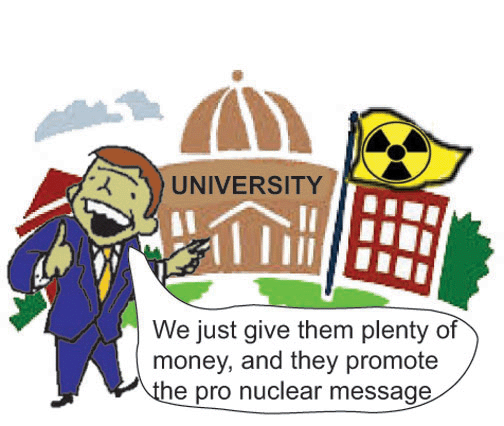
The plan has received support from some local business figures, and the University of Wollongong is deepening its already extensive ties with the military-industrial complex in anticipation. Among the wider community, however, opposition is growing.
Several unions have already come out against the proposed base. The New South Wales Teachers Federation passed a motion at its March council meeting:
“Continuing reports that Port Kembla is being considered as the site for a nuclear submarine base is of deep concern for our public education communities. While governments appear ever ready to commit huge amounts of public revenue on military expenditure there remains a serious underfunding of public pre-schools, public schools, TAFE and higher education, and other areas of the public sector.”
The Kiama council also passed a motion opposing a submarine base at Port Kembla. Even the Dapto and Port Kembla branches of the Labor Party have passed oppositional motions. Socialist students in the Wollongong Undergraduate Students’ Association have passed motions opposing the nuclear submarines, the AUKUS pact and the Australian government’s war drive.
Importantly, the South Coast Labour Council has called for this year’s May Day rally to be held in Port Kembla on Saturday, 6 May, to oppose the planned base. Council secretary Arthur Rorris told the Sydney Morning Herald, “If they want to turn our harbour into a nuclear parking lot, we will fight them tooth and nail”. There will even be a solidarity action held in San Francisco outside the Australian consulate.
Wollongong Against War and Nukes (WAWAN)—a campaign group formed last year—has held a series of protests against AUKUS. The most recent, on 4 April, drew more than 80 people in opposition to the Illawarra Defence Industry Conference—a gathering of war hawks and military profiteers.
Socialist and WAWAN activist Luke Hocking said in a speech at the protest, “If we are all committed to building this movement … then we can make something that can physically get in the way of their plans. And the more of us there are, the better we will be able to do that”. WAWAN will be holding a community forum in Port Kembla on Saturday, 29 April, and is planning further protests.
The Illawarra has a proud history of working-class anti-imperialism. We should look to these traditions as we set out to build resistance to the planned submarine base, the AUKUS pact and the militarism of the Australian ruling class and its US and British allies.
Penny Wong’s World View: AUKUS All The Way

Australian Independent Media, April 19, 2023, Dr Binoy Kampmark
If anyone was expecting a new tilt, a shine of novelty, a flash of independence from Australian Foreign Minister Penny Wong’s address to the National Press Club on April 17, they were bound to be disappointed. The anti-China hawks, talons polished, got their fill. The US State Department would not be disturbed. The Pentagon could rest easy. The toadyish musings of the Canberra establishment would continue to circulate in reliable staleness.
In reading (and hearing) Wong’s speech, one must always assume the opposite, or something close to it. Whatever is said about strategic balance, don’t believe a word of it; such views are always uttered in the shadow of US power. From that vantage point, Occam’s Razor becomes a delicious blessing: nothing said by any Australian official in foreign policy should ever be taken as independently relevant. Best gaze across the Pacific for confirmation.
………….. Like a lecture losing steam early, she finally gets to the point of her address: “how we avert war and maintain peace – and more than that, how we shape a region that reflects our national interests and our shared regional interests.” It does not take long to realise what this entails: talk about “rules, standards and norms – where a larger country does not determine the fate of the smaller country, where each country can pursue its own aspirations, its own prosperity.”
That the United States has determined the fate of Australia since the Second World War, manipulating, interfering and guiding its politics and its policies, makes this statement risible, but no less significant. We are on bullying terrain, and Wong is trying to pick the most preferable bully.
She can’t quite put it in those terms, so speaks about “the regional balance of power” instead, with Australia performing the role of handmaiden. ……..
It takes one, obviously, to know another, and Senator Wong, along with Prime Minister Anthony Albanese, have shown little resistance to the very binary concept they supposedly repudiate. Far from opposing it, we might even go so far as to see their seduction by US power as a move towards the unitary: there is only one choice for the Canberra cocktail set.
……… Wong is keen to point the finger to one great power’s behaviour: unstainable lending, political interference, disinformation, reshaping international rules and standards.
Finally, the dastardly feline is out of the bag – and it is not the United States. “China continues to modernise its military at a pace and scale not seen in the world for nearly a century with little transparency or assurance about its strategic intent.”
….
Assange imprisonment has gone on for too long: Foreign Minister Penny Wong
Bendigo Advertiser, By Andrew Brown, April 17 2023
Foreign Minister Penny Wong has called for the extradition case against Julian Assange to come to an end.
Senator Wong said the legal case and imprisonment of the WikiLeaks co-founder has been going on for too long.
Mr Assange has been imprisoned in the UK for more than four years and faces extradition to the US on espionage charges.
Appeals to stop his extradition are currently before the UK courts.
Speaking at the National Press Club, Senator Wong said the government would continue to press for Mr Assange’s release…………………………………
Last week, almost 50 Australian MPs and senators signed a letter to US Attorney-General Merrick Garland urging him to end the pursuit of the WikiLeaks co-founder.
Advocates have urged for Prime Minister Anthony Albanese to raise the issue of Mr Assange during upcoming meetings with US President Joe Biden and UK Prime Minister Rishi Sunak. https://www.bendigoadvertiser.com.au/story/8161607/assange-imprisonment-has-gone-on-for-too-long-wong/?src=rss
The dangerous one is the U.S. -not China

As for Taiwan, let’s remember that the international community recognises Taiwan as part of China and Taiwan has no seat by itself in the United Nations.
By Colin Mackerras, Apr 16, 2023 https://johnmenadue.com/the-dangerous-one-is-the-u-s/
The implication of AUKUS is that China constitutes a danger to Australian security. It borders on official Australian policy that China is an aggressive power bent on domination. But the history of the People’s Republic suggests its military is for defence, not aggression and that the cases where it has used external military force are very few. Under Xi Jinping it may be assertive and keen to extend influence, especially economic, but it shows no signs of political/military aggression. On the contrary, it is the U.S. that constantly uses external military force and is bent on maintaining domination at all costs.
It was less than a year after the birth of the People’s Republic of China (PRC) on 1 October 1949 that the Korean War broke out. Korean history of the first years after World War II is too complex to pursue here. But essentially no sooner was Korea independent of a defeated Japan in 1945 than a divided country emerged, with the U.S. setting up the Republic of Korea (South Korea) on 15 August 1948 and the Democratic People’s Republic (North Korea) following on 9 September. Under U.S. dominance, it was the south that moved first formally to divide the country.
When the north attacked the south in June 1950, the U.S. got the United Nations to intervene under its own American leadership. China became involved only in October 1950, after the U.S. actively threatened to move north to invade the fledgling PRC. Yet, at U.S. behest, China was condemned for aggression.
Let’s be very clear: the U.S. was the first foreign power to be involved in this war, not China. After a truce reached in 1953, Chinese troops withdrew fully from the north by 1958, while American troops remain in the south to this day. The dangerous one is the U.S., which assumes its God-given right to control the world, not China. There is no peace treaty covering Korea to this day.
Following the Korean War, China has only rarely been involved in wars outside its own borders. In 1962, it fought a brief border war with India, but it is important to note that the rights and wrongs of this are extremely controversial. Although the Western media reported almost entirely India’s version of events, scholars such as the late Neville Maxwell (1926-2019) and Gregory Clark have shown convincingly that China had a perfectly respectable case.
The most recent time China sent troops to attack another country was in Vietnam in February and March 1979 in response to Vietnam’s invasion of Cambodia. During this very brief war, China made no attempt to take the capital or to change the Vietnamese government. It withdrew unilaterally.
In short, the longest war since 1949 to see Chinese troops fight outside their borders is still the Korean war. It was unfairly condemned of aggression by the first foreign power to participate in the war, with the U.S. version of events sticking for decades because of its world power.
Since the Korean War, the U.S. continues to be involved in numerous wars, Vietnam, Iraq, Afghanistan, among others, with Australia simply taking part to follow the boss. What’s striking is that the U.S. has lost these wars and ended up withdrawing humiliated. The U.S. has attempted to invent an ideological justification but frequently been attacked by protests from within its own borders. It has also been involved in proxy wars, some such as the present Ukraine war large in scale.
In contrast to China, the U.S. has hundreds of military bases outside its own borders and has installed numerous governments in foreign countries replacing those that don’t conform to its ideology it calls “democracy”.
Many in the West assume that under Xi Jinping China has become an aggressive nation, even if it was not before. It is true China is much more assertive in world affairs. But I see no sign that China has become aggressive. It shows no sign of wanting to use its armed forces outside its own territory.
As for Taiwan, let’s remember that the international community recognises Taiwan as part of China and Taiwan has no seat by itself in the United Nations. The U.S. may be goading China to retake Taiwan with violence, but has not succeeded up to now. China’s policy is now, and has always been, that it wants to reunify the country by retaking Taiwan, but it wants peaceful reunification, using force only as a last resort.
China extends its influence through trade and investment. We know that its Belt and Road Initiative has expanded China’s economic and to some extent political influence throughout Central Asia, Africa and Latin America, and even the South Pacific. We even hear increasing reports of China’s replacing the U.S. dollar as the reserve currency by trading in the Chinese yuan and other currencies.
Western countries, especially the U.S., express alarm at the increase of Chinese influence and have taken increasingly severe measures to thwart it. However, what the Chinese have not done is establish military bases, overthrow local regimes or even try to spread their ideology to those countries with which they trade. In this sense they are far less dangerous than the U.S.
Xi Jinping talks of a common shared future of humanity, not of dominance. Western commentators tend to assume that’s just words, and really he hides deception and conquest in his heart. I don’t see the evidence for that.
What China wants, and what seems to me in China’s interests, are two things. One is to protect China against external attack. The other is a multipolar world, in which China is one of the important poles. It does not want or aim for a Chinese-dominated unipolar world. True, it is becoming involved in the Middle East and in peace processes to an unprecedented extent, at the same time as the U.S. is in decline relative to China (and other countries). Personally, I can’t see why it should not. As a great civilisation, it has a right to extensive influence. Influence is quite different from dominance.
The U.S. currently assumes it is number 1. Its main aim is to retain that position. Its policies are geared to that end, to keep China down. What alarms the U.S. is China’s success. How can a country so recently impoverished and backward actually be prosperous enough to enjoy a life expectancy at birth longer than the U.S.? (World Bank data for 2020 have China at 78, and the U.S. at 77).
The way Australia has submitted itself to this dangerous and untrustworthy country, the U.S., is shameful. Our track-record of blindly following allies into wars that don’t concern us is unworthy of the independent country we should be and aspire to be.
Australia’s 9 news papers gave Navy chief a platform for a resounding attack the doubters on AUKUS nuclear submarine
‘Hand-wringers’ under attack as Navy chief and Nine round on AUKUS doubters
Australia’s chief of Navy believes AUKUS is one of the country’s greatest nation-building projects. And Nine papers were happy to give him a rooftop to shout from.
Crikey, DAVID HARDAKER, APR 17, 2023
The Nine mastheads have continued their full-throated backing of all things AUKUS, allotting prime weekend front-page space to Australia’s chief of Navy Mark Hammond, who — blow me down — laid out why the nation must get behind the Navy’s submarine project.
In a tour de force of military reasoning, the 37-year Australian Defence Force veteran also picked up some of the talking points advanced by the political class to defend the $368 billion decision sprung on the nation just a few weeks ago.
Hammond lamented that AUKUS was not being hailed as one of the great nation-building projects, such as the Snowy Mountains Hydro-Electric scheme. ……………. (registered readers only)
Western Australian company to build low-level radioactive waste facility – Kimba dump a decade away – now irrelevant?

GREEN LIGHT FOR FIRST NUCLEAR WASTE STORAGE
Tellus, March 16, 2023
Australia’s first purpose-built low-level radioactive waste facility has been granted final approval in Western Australia ……
The Australian has confirmed that the WA government has granted a final approval licence to Australian firm Tellus Holdings to store low-level radioactive waste at a repository in Sandy Ridge, 240km northwest of Kalgoorlie, which could take hundreds of thousands of tonnes of stored waste from around the country.
………….The Sandy Ridge repository will be the country’s first commercial facility to be licensed in Australia to take low-level radiological waste and store it in a stable geological repository, and is one of only a handful of its types in the world.
It is also licensed to take low level radioactive waste from the Lucas Heights reactor in Sydney, as well as from defence facilities.
The commonwealth’s own proposed radioactive waste facility, Kimba in South Australia, is estimated to be at least a decade away from being constructed.
The licence approval, following agreement with traditional owners, will see it remediate contaminated oil and gas infrastructure, end-of-life mines and also deal with Australia’s massive stockpile of low-level radioactive waste from nuclear medicine, including diagnostic, treatment, research and other industries.
The near-surface geological repository will also be licensed to take low-level radioactive waste generated in the processing of critical minerals, which is estimated to eventually generate millions of tonnes of waste every year, as well as radioactive waste from the dismantling of offshore oil and gas rigs, which is estimated to cost more than $40bn.
The site is located in one of the most geologically stable zones in the world with the company claiming it was one of the “safest places” in Australia to store hazardous and low-level radioactive waste.
It is not licensed to take the high-level nuclear waste that would be produced by the need to one day dispose of nuclear reactors from submarines. However, the company said it could contribute its geological expertise and knowledge as the commonwealth begins a search for a geologically safe location for this purpose.
According to the Australian Radioactive Waste Agency, the country’s stockpile of radioactive waste is spread across more than 100 locations around Australia, including science facilities, universities and hospital basements – and is increasing.
Tellus chief executive Nate Smith told The Australian the site would provide a critical link in developing Australia’s first multibillion-dollar hazardous waste industry………………..
Sandy Ridge was granted approval in 2021 to take class V hazardous waste.
However, the McGowan government only granted final approval in January this year for the facility to take low-level radioactive waste as well, following a review by WA’s Radiological Council which advises the minister for health. – https://tellusholdings.com/green-light-for-first-nuclear-waste-storage/?fbclid=IwAR3P1lFgTT4rlThFKGWfB9yd-U8bFu6wrsrRTkBUNk4E7oNfzVW9J3p33Iw
The Australian
By Simon Benson
16 March 2023
Rex Patrick on AUKUS submarines: “an astonishingly bad deal”

by Rex Patrick | Apr 14, 2023 https://michaelwest.com.au/rue-britannia-britannia-and-rue-aukus-subs/
The Defence Department has outdone itself with the AUKUS submarine project. In Paul Keating’s words, “it’s the worst deal in all history”. That’s not just because of the staggering $386 billion price tag, but because of the form the program is to take. Former submariner Rex Patrick looks at the most astonishingly irrational part of the announcement.
Our senior Defence bureaucrats, both uniformed and civilian, have a remarkable but unexplainable knack when it comes to acquiring new equipment. When simplicity confronts them, they always find some way to make it complex. In the face of something manageable, they’ll always find a way to make it unmanageable. SNAFU is the order of the day.
But, for Defence, it’s all OK – the admirals, air marshals, generals and top level public servants are immune from the consequences of failed procurement – no matter how big the disaster. No-one’s ever been fired from Defence for stuffing up an equipment purchase; after all, the wasted money is not theirs, it’s mine and yours.
Looking at the AUKUS plan, which some are now labelling USUKA [pronounced “you sucker”] after Paul Keating called it “the worst deal in all history,” Australia will initially acquire three second-hand but proven and highly capable Virginia Class submarines, but then jump off that safe pathway to a high-risk program involving a country that has a track record of being late, and over budget, on its past and current submarine programs.
It’s just reckless.
Virginia submarines, what we could do
The Virginia Class nuclear attack submarine is sea proven but also an evolving design. It’s even fitted with the combat system and weapons that we already have on our Collins Class submarines, or will acquire.
AUKUS is a bad deal. It comes at eye-watering cost, has huge opportunity costs and effectively puts all our Defence eggs in one basket.
It’s not going to deliver a capability within an even remotely sensible time frame either to help deter, let alone fight in, the very conflict Defence purports we need it for.
But if I put that aside and just went along with the whole thing, I’d advise that we could, and should, buy three US built Virginia Class submarines and then build our own, effectively providing the third Virginia shipyard (there are two shipyards in the US, both struggling with capacity).
That’s of benefit to us, and to the US, who would enjoy a surge build capability through us.”
But instead, we will pay to increase US industrial capability and then turn to the British.
Not a shadow of its old self
“Rule Britannia, Britannia rules the waves. Britons never, never, never shall be slaves.” It’s a song derived from a 1730s poem.
But like the billowing gowns and petticoats that were worn over dome-shaped panniers by women of the 1730s, “Rule Britannia” is no longer in fashion.
The Royal Navy is not even a shadow of its old self. The French Navy and Spanish Armada outnumber Royal Navy frigates and destroyers 32 to 18. Admiral Horatio Nelson would be turning in his grave.
And to make matters worse, the “great” left “Great Britain” soon after Brexit.
(Not so) Astute submarines
Back to the topic at hand, Britain’s recent submarine projects have been project management cluster fiascos.
The Royal Navy’s current Astute class nuclear-powered attack submarine program was approved by the British Government in 1997. Three boats were to be built for £2.6 billion, with the first boat to be in service in 2005. The first boat went in the water five years late, in 2010, and the first three boats blew out in cost by £1.9 billion. And by the way, the UK contracted the US submarine company, General Dynamics Electric Boat, to help them sort out some ‘issues’ within the Astute project in 2004.
Starting with approval for a fourth boat in 2007, the program has grown to seven boats all up. The last four “Batch II” boats were supposed to cost £5.7B but are now expected to total £6.7 billion. The latest boat, HMS Anson, was delivered 25 months late.
Dreadnought submarines
The parallel Dreadnought nuclear ballistic missile submarine is on track. On track to be late and over budget.
The Ministry of Defence established its Future Submarine Integrated Project Team in October 2007. The initial approval of the program was in May 2011, with an estimated cost for four submarines of between £11 and £14 billion. The first submarine was intended to be in service in 2028.
The most recent cost estimate for the four ballistic missile platforms is £31 billion. Bizarrely, as the program has advanced, less seems to be known about the in-service date. No-one is saying when the first boat will arrive, other than “some time in the 2030s.”
Refits and retirements
The first of the Royal Navy’s current nuclear ballistic missile submarines, HMS Vanguard, has just come out of refit. The refit was programmed for three years and was to cost around £200 million. It took seven long years and around £500 million. Nearly one quarter of Vanguard’s service life will have been spent in dock undergoing repairs and maintenance.
Earlier this year, a public scandal erupted when it was revealed that the lead contractor had concealed broken bolts in the submarine’s reactor compartment.
In terms of programmatic failure, even more disturbing is the state of dismantling retired Royal Navy nuclear submarines.
The first ever British nuclear-powered submarine, HMS Dreadnought, entered service 60 years ago and served for 17 years. For the last 43 years, it’s been sitting alongside a wharf in the UK. It’s not been dismantled. But neither have any of the other 21 retired Royal Navy nuclear-powered submarines.
It’s a national disgrace. The National Audit Office examined the issue in 2019 and estimated that the cost of maintaining these retired submarines alongside various docks had exceeded £500 million, and the total cost of dismantling the retired and in-service submarines would likely exceed £7.5 billion. Perhaps this will be covered by the AUKUS overheads.
Nuclear disaster
The state of Britain’s submarine enterprise is nothing short of a disaster. And yet the Australian Department of Defence thinks that for the next fifty years, maybe longer, we should hitch ourselves to the clapped out wagon that is Britain’s submarine construction industrial base.
Paul Keating had it right about the AUKUS strategic architecture. Instead of moving forward with focus on a relevant local team like the QUAD (Australian, India, Japan and the United States), we’re committing to a subordinate role with our US ally and an Anglosphere arrangement that’s a hangover from the former, now almost forgotten, British empire.
Yet it’s all “keep calm and carry on” in the Australian Department of Defence. They have no need to worry because all the bigwigs will have retired and moved onto highly paid consultancies and ‘think tanks’ before the proverbial hits the fan.
Pretty much the same goes for the few, timid, politicians who’ve signed off on all this, a gargantuan splurge of taxpayers’ dollars, because they’re all fearful they might be accused of being “weak on defence” if they don’t swallow the Department’s nuclear Kool Aid.
I guess I’ll just keep going to bed each night worrying about the Defence of Australia. Not about some country invading us, but by how much of my money, and your money, the Department’s going to waste tomorrow, next week, next year and for decades to come.
Weapons-makers set to gain more influence in defence operations

Global weapons companies could be more deeply integrated into Australian military operations after legislative reforms. This comes on top of public unease about Australia’s independence under AUKUS.
MICHELLE FAHY, APR 14, 2023 https://undueinfluence.substack.com/p/weapons-makers-set-to-gain-more-influence?utm_source=post-email-title&publication_id=297295&post_id=114686170&isFreemail=true&utm_medium=email
Activity in the defence domain has reached peak overload. On top of AUKUS and the submarines, the high-level nuclear waste dump, the Defence Strategic Review, and a slew of multi-billion-dollar arms procurements, the Defence Department is also undertaking consequential reform of the Defence Act 1903 and related legislation. In March, Defence published a consultation paper on the reforms calling for public feedback. The deadline for submissions is Friday 21 April.
Among other things, the reform initiatives foreshadow a more deeply integrated involvement by the globally dominant US arms industry in Australia’s defence and national security establishment, including military operations, especially in the modern ‘warfighting’ domains of cyber and space. This is a profoundly consequential proposition that demands careful consideration.
Notice of the intended reforms was quietly released by the defence portfolio’s junior minister, Matt Thistlethwaite, just days before the Albanese-Biden-Sunak AUKUS extravaganza in San Diego. Saturation media coverage and ongoing analysis of that event has kept the intended reform of Australia’s defence legislation out of the spotlight. This confluence in timing was likely intentional. As a result, much of the limited time granted to the public to consider and prepare submissions has already elapsed.
The public needs to pay attention now because the bipartisan-lockstep nature of defence ‘debate’ in Australia makes it probable that once the legislative amendments hit parliament they will zip through both houses into legislative reality with far less scrutiny than they demand.
The government says legislative reform is necessary to ‘better position the Australian Defence Force (ADF) as an agile, integrated, warfighting enterprise’. The reforms are also intended to create a ‘technology-neutral’ legislative framework.
The consultation paper outlines three key initiatives:
- support the full range of military activities and capabilities required to defend Australia and its national interests
- design the law for seamless interoperability with international allies and partners
- improve the security of Australia’s military capabilities, tangible and intangible.
The terms ‘integrated’, ‘seamless interoperability’, and ‘interchangeability’ appear throughout. The word ‘partner’ is used frequently and is undefined. It is often unclear to which type of entity it refers: foreign governments, foreign militaries, foreign intelligence services, or local or foreign arms industry entities. These distinctions are important, especially in a public consultation document, and the fact that they often aren’t clear creates considerable ambiguity.
Defence poses ten consultation questions for consideration. An important one is hinted at and needs to be made plain: What does the public think about the deeper integration of profit-making multinational weapons companies into Australian military operations across the breadth of operational domains, including cyber and space?
The AUKUS agreement is causing significant public unease about Australia’s ability to act independently of our major allies, and the loss of sovereignty this entails. Two former prime ministers have also expressed publicly their concerns about this. The shape of the proposed legislative reforms, the ambiguities in the consultation paper, and the muted manner of the document’s release add further cause for concern.
Worth adding in this futuristic context is the rapid development and significant funding of lethal autonomous weapons, occurring largely out of public view. (For the uninitiated, lethal autonomous weapons, known colloquially as ‘killer robots’, require no meaningful human involvement in the ‘kill chain’.) As yet, there is no international legal framework regulating their development or use. Such is the future we face.
If the above is not warning enough, we need only reflect on the US government’s outsourcing to defence contractors (and here) of parts of its morally bankrupt drone assassination program which has killed large numbers of civilians, including children, and instilled an abiding fear of clear skies in the populations of multiple countries. Pine Gap, part of the United States’ global surveillance network, has played a facilitative role in these killings.
This surely provides all the evidence we need that more time – and a vastly more transparent and genuine process of engagement – is needed from Defence for the public to consider and respond to its proposed initiatives for reform.
Download Defence’s consultation paper. Lodge your submission by 21 April.
This piece first appeared at John Menadue’s Pearl & Irritations on 14.4.23.
Monica Leggett, in a powerful Submission, calls on all Australian MPs to reject nuclear power

Environment and Other Legislation Amendment (Removing Nuclear Energy Prohibitions) Bill 2022 Submission 134
My first employment, after completing my PhD in surface physics from Southampton
University, was to work as a research officer at Berkeley Nuclear Research Laboratories.
These were located adjacent to the Berkeley Nuclear Power Station. This gave me a lifelong interest in the industry and the controversies associated with it.
I find it hard to believe that the issue of Nuclear Power in Australia has come back to the
Senate. From an energy point of view it is unbelievable that a country with such
abundant sources of renewable energy should even contemplate using nuclear energy.
Nuclear power is the most expensive, inflexible, complex and socially problematic source
of energy. All that massive infrastructure with its associated safety and security
measures built just to boil water.
Re-engineering a nuclear bomb to generate heat in a controlled and safe manner may
have been an extraordinary feat of engineering and optimism in the 1950s, but technology
has moved on. Nuclear Power is an inappropriate, unnecessary and potentially
dangerous choice for Australia for the reasons outlined below.
1 Too slow and too expensive
Nuclear power has never been cheap despite the initial vision of nuclear energy as “too
cheap to meter”. It has very large upfront costs, is plagued by delays and cost over-runs.
While the costs of renewables are decreasing, the cost of nuclear is increasing.
The high profile and controversial nature of nuclear power would divert attention, funds
and focus from renewables to nuclear. The world cannot afford any more delays in
reducing carbon dioxide emissions.
2 Lessons from recent world-wide extreme weather events
The impacts of global warming can no longer be dismissed as a future problem. Records
are now being broken on a regular basis. The last two years have been particularly brutal
with extreme temperatures, intense wild fires, droughts and floods across the world.
Using only historic data to predict future weather is no longer sufficient. This would have
a very major impact on site selection, the safe operation and emergency planning for any
nuclear power plant.
3 Unacknowledged social impacts
The presence of a nuclear power station in an area would alter the risk profile of the area
for those in the vicinity and pose an additional psychological stress on residents. In
addition to bush fire and flood preparedness plans, residents would need to have nuclear
accident preparedness plans. These are not necessarily compatible. Local authorities
would need response plans for minor and major nuclear accidents.
If the power plant site is in a country area, which is likely, then there is an additional
problem. Country areas, in WA for example, rely on a large volunteer component in fire
and ambulance services. Will volunteers wish to serve in an area which includes a
Nuclear Power Station? How will they be protected? How will they be trained?
4a Adverse environmental impacts – normal operation
The environmental case for nuclear power appears to be based on its low carbon dioxide
emissions while operating without incident, compared to the carbon dioxide emissions
from a fossil fuel plant. This is correct but incomplete. It compares one yet-to-be-built
working nuclear power plant with an operating fossil fuel power plant. But their life cycles
are very different. The public relations material ignores some or all of the emissions from
the following:
- Site preparation
- Construction
- Water supply
- Storage of spent fuel rods
- Decommissioning including the treatment of the highly radioactive pressure vessel
and shielding (while the reactor is operating, the fuel vessel and shielding are
constantly under neutron bombardment from the core, hence becoming highly
radioactive). - Long term storage and monitoring of radioactive waste.
4b Adverse environmental impacts – accidents
In the case of a major nuclear accidents (e.g. Chernobyl and Fukushima) all energy
benefits while operating became insignificant compared to the energy used to deal with
the aftermath of the accident. These include the energy costs of making the reactor safe
and monitoring it for an innumerable years, site and area rehabilitation, relocating
residents and broader health costs.
The probability of a weather related nuclear accident has been made greater by the
changes in climate with extreme weather events more likely.
Accidents release radioactive isotopes into the environment. These can expose plants
and animals to external radiation. If ingested, then they can be absorbed into body tissue
and irradiate the body from inside.
Our environment is under enormous threat from human impact and climate change. It
does not need another threat.
5 Security issues
The war in Ukraine has brought into sharp focus, the reality of having a nuclear power
station in a country when under attack . It is not an asset that adds to a country’s
security, so why would we choose to have nuclear power stations that we do not need?
In addition, the presence of enriched uranium in the country broadens the range of
possible terrorism threats. Extra security then becomes an added expense for the
taxpayer.
6 Ethical issues – intergenerational equity and resource sharing
Should a nuclear power station be built and assuming the station is accident free, then
the current population would get the advantage of the power generated. Future
generations would be bequeathed the costs. They would inherit responsibility for decommissioning (if not already done) looking after the waste, maintaining its security
from terrorists and monitoring containment, all the while living with the impacts of climate
change. This lacks intergenerational equity and is not acceptable.
Uranium is a finite resource. As world citizens with an abundant supply of renewables,
we should not be using Uranium for our power. Uranium should be reserved for countries
that have few or no alternatives.
If we with our enormous renewable resources choose to use nuclear, what message
about renewables are we sending to our Pacific neighbours? What message does it send
about our concern for their wellbeing if they could be down-wind from a possible nuclear
accident?
7 Conclusion
Nuclear Power is an inappropriate and unnecessary choice for Australia. It fails on
economic, social, and environmental grounds and is ethically indefensible. I call upon all
politicians to reject nuclear power https://www.aph.gov.au/Parliamentary_Business/Committees/Senate/Environment_and_Communications/Nuclearprohibitions/Submissio
Professor George W Burns Submission to Senate – Keep the Nuclear Prohibitions, in the immediate and long-term interests of all Australians… and of the planet
Environment and Other Legislation Amendment (Removing Nuclear Energy Prohibitions) Bill 2022 Submission 127
I am deeply concerned about the proposed Removing Nuclear Energy Prohibitions Bill
Australia needs effective climate action but nuclear power would slow the transition to a low-carbon
economy. It would increase electricity costs and unnecessarily introduce the challenges and risks
associated with high-level nuclear waste management and the potential for catastrophic accidents,
with profound intergenerational implications for Australians.
My concerns as an Australian citizen are that:
Nuclear is the most expensive energy option.
Nuclear is slow. It can take decades to build and would require a decade or more to develop the
legislative framework.
Nuclear is dangerous. Either through human error, disaster, or as a military target the catastrophic
consequences of a nuclear disaster would permanently pollute.
Nuclear is unwanted. There is long standing popular opposition to nuclear power in Australia
because of the issues above as well as the unsolved problem of nuclear waste and the link to nuclear
weapons
Alternatives like renewables, storage and energy efficiency are faster, cheaper, more deployable and
enjoy much more public support
I trust the Inquiry will act in the immediate and long-term interests of all Australians…and of the
planet. https://www.aph.gov.au/Parliamentary_Business/Committees/Senate/Environment_and_Communications/Nuclearprohibitions/Submissio
Friends of the Earth comments accuse the Australian Government Industry Department of blatant racism in its Kimba nuclear waste dump plan.

Comments on: Guidelines for the content of a Draft EIS National Radioactive Waste Management Facility, SA EPBC 2021/9128 April 2023
RIGHTS OF TRADITIONAL OWNERS
Recommendation #1: The Guidelines must require the proponent (the Australian Government Department of Industry, Science and Resources) to explain how the nuclear dump/store proposal complies with the United Nations Declaration on the Rights of Indigenous Peoples, in particular Article 29.2:
“States shall take effective measures to ensure that no storage or disposal of hazardous materials shall take place in the lands or territories of indigenous peoples without their free, prior and informed consent.”
Of course it is common knowledge that the proposal is a gross violation of Article 29.2 and that the nuclear dump/store is unanimously opposed by Barngarla Traditional Owners. Nevertheless, the proponent must be asked to explain its position and its crude racism.
Recommendation #2: The list of documents in section 3.5.1 of the Guidelines should also include the United Nations Declaration on the Rights of Indigenous Peoples.
Recommendation #3: The Guidelines mention a “process for ongoing consultation with FirstNations people”. The proponent should be required to declare whether or not it reservesthe right to ignore the rights, interests and recommendations of the Barngarla Traditional Owners in future just as it has ignored and overridden unanimous Barngarla opposition to the nuclear dump/store proposal.
Recommendation #4: The proponent should be required to discuss the adequacy of the
National Radioactive Waste Management Act (NRWMA) and in particular to provide
justifications for each of the following provisions of the Act:
- The nomination of a site for a radioactive waste facility is valid even if Aboriginal
Traditional Owners were not consulted and did not give consent. The NRWMA states that
consultation should be conducted with Traditional Owners and consent should be secured ‒
but that the nomination of a site for a radioactive waste facility is valid even in the absence
of consultation or consent. - The NRWMA has sections which nullify State or Territory laws that protect the
archaeological or heritage values of land or objects, including those which relate to
Indigenous traditions. - The Act curtails the application of Commonwealth laws including the Aboriginal and Torres
Strait Islander Heritage Protection Act 1984 and the Native Title Act 1993 in the important
site-selection stage. The Native Title Act 1993 is expressly overridden in relation to land
acquisition for a radioactive waste facility.
Recommendation #5. The proponent should be required to explain why it rejects the SA
Government’s policy that Traditional Owners should have a right of veto of nuclear waste
sites. SA Labor’s Deputy Leader (and now Deputy Premier) Susan Close noted in September
2020 that: “South Australian Labor is calling on the Federal Government to halt its plans to
dump nuclear waste at Kimba. … SA Labor has consistently expressed its concerns about the
site selection process and the lack of consultation with native title holders. … This was a
dreadful process from start to finish, resulting in fractures within the local community over
the dump. The SA ALP has committed to traditional owners having a right of veto over any
nuclear waste sites, yet the federal government has shown no respect to the local
Aboriginal people.”
FEASIBLE ALTERNATIVES
Recommendation #6. The Guidelines should require discussion on the ‘feasible alternative’
of targeting states/territories which do not have legislation prohibiting a nuclear
dump/store such as the one proposed. The current proposal requires the Commonwealth to
override the SA Nuclear Waste Storage (Prohibition) Act 2000.
Recommendation #7. The Guidelines state that the no-action alternative should be
discussed “if relevant”. The term “if relevant” should be removed and the proponent should
be required to discuss the no-action alternative since it is in fact a viable alternative.
Recommendation #8. The Guidelines should explicitly require the proponent to consider the
option of abandoning the plan to store intermediate-level waste (ILW) and Kimba since an
overwhelming majority of ILW is currently store at ANSTO’s Lucas Heights site with no
practical or legal obstacles to ongoing storage. The plan to move ILW to Kimba is absurd: it necessarily entails double-handling; and it entails moving waste from a site with strong
security and an abundance of nuclear experts to a site with weaker security and a dearth of
nuclear experts … for no reason whatsoever let alone a good, compelling reason.
It should be noted here that ARPANSA plans separate assessments of the proponent’s plans
for disposal of lower-level wastes and storage of ILW. Further, in its March 2022 Regulatory
Assessment Report approving ANSTO’s new ILW Storage Facility at Lucas Heights to 2037,
the ARPANSA CEO states that a “clear net benefit must be provided by the licence applicant
to support a licence application”. It is implausible that the proposal to move ILW from Lucas
Heights to Kimba would meet this net-benefit criterion. Thus DCCEEW must be alert to the
misinformation and obfuscation that the proponent may present to justify ILW storage at
Kimba instead of Lucas Heights, and DCCEEW must ensure a full evaluation of alternatives to
ILW storage at Kimba.
Recommendation #9. Further to the above recommendation, the proponent should be
required to consider the option of abandoning plans for ILW storage at ANSTO and instead
working on a consolidated plan for deep underground disposal (or deep borehole disposal)
of both ILW as well as high-level nuclear waste from nuclear submarines.
TRANSPORT OF SPENT FUEL REPROCESSING WASTES
Recommendation #10. The proponent should be required to thoroughly consider
transportation of waste products arising from reprocessing of spent research reactor fuel.
There is no logical reason or justification for this omission
Universities and the AUKUS Military-Industrial Complex
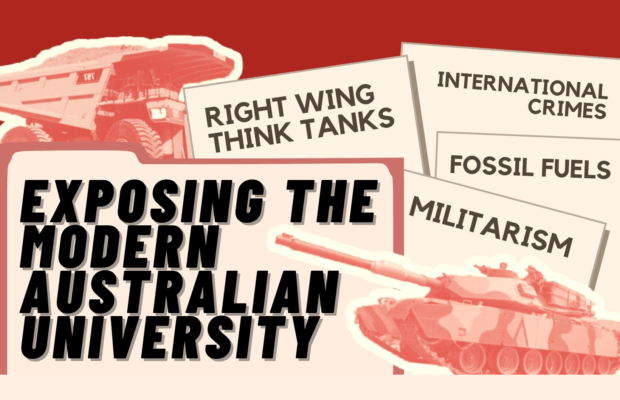
Last year, the submission of Universities Australia to the Defence Strategic Review was almost begging to link universities with the defence needs of the country. All the Defence Department and Australian Defence Forces needed to do was ask.
How fortunate, then, that AUKUS came bumbling along.
April 12, 2023, by: Dr Binoy Kampmark, https://theaimn.com/universities-and-the-aukus-military-industrial-complex/
Here they go. Vice-chancellors, university managers, and creatures with titles unmentionable and meaningless (deputies, semi-deputies, sub-deputies), a whole cavalcade of parasitic creatures in need of neutering, keen to pursue another daft idea. Australian universities do not want to miss out on the military-industrial-education complex, whatever its imperilling dangers. With the war inspired AUKUS security pact, which promises the stripping of the Australian budget to the tune of $AUD 368 billion over the course of three decades, a corrupt establishment promises to get worse.
The AUKUS distraction could not have come at a better time. The tertiary sector in Australia is becoming increasingly cadaverous, marked by cost-cutting, rampant casualisation and heavy teaching and workloads for those battling away in the pedagogical trenches.
In a recent piece by Guardian Australia’s higher education reporter, an academic, who preferred to remain anonymous fearing institutional retribution, likened the modern Australian university to a supermarket. Students were the customers filing through the self-checkout counters; the staff, increasingly rendered irrelevant, were readily disposable.
The stories have been familiar for years, even as the offending by university management continues unabated: tutors being paid insufficiently to read and grade work adequately; virtually non-existent job security; the suppression of academic freedom and criticism of ghastly management practices. Given the pathological secrecy under which universities work under, essential data shedding light on class sizes, staff-student ratios, and contracts with private business interests, is virtually impossible to attain.
But despite the Australian university sector proving unsustainable, unprincipled, and ungainly, individuals such as Catriona Jackson, the CEO of Universities Australia, are on the hunt for new frontiers.
Last year, the submission of Universities Australia to the Defence Strategic Review was almost begging to link universities with the defence needs of the country. All the Defence Department and Australian Defence Forces needed to do was ask.
As the Australian Financial Review reported at the time, “The universities need to be prepared to respond in an adaptable and efficient manner to a clear demand signal from defence in terms of workforce needs – both skills and numbers – as well as technology and hardware needs.”
How fortunate, then, that AUKUS came bumbling along. For Jackson, principles in education are less important than inflated commercial opportunities or, to use her lingo, commercialisation. Distant from the process of learning itself, unaware of the delivery of courses and the classroom, she sees this war making security pact as packed with promise. “It’s workforce, workforce, workforce,” she sloganeered to her Sky News host Kieran Gilbert. “It’s not just nuclear physicists we need, although we do need some of those and it’s a very specialist profession. Almost every area of human endeavour we need a capacity uplift, so engineers, doctors, nurses, psychologists, pretty much everyone.”
Evidently hearing the war jingles around the corner, Jackson is journeying to Washington for meetings with national security officials from the US State Department and National Science Foundation. It is her hope that the number of Australian university partnerships will be expanded, “with more than 10,000 formal partnerships already in place with fellow institutions around the world.” The message she takes to the US capital will, however, be focused on “developing the capability [of Australian universities] to deliver the project, including through the provision of skilled workers and world-class research and development.”
Certain publications have also exuded jingoistic cheer on the new role of Australia’s tertiary sector. The Australian, one of Rupert Murdoch’s premier rags of froth and bile, is ever reliable in this respect. The paper’s higher education editor, Tim Dodd, in a March contribution [paywalled], posed two questions to those in the university sector: Had Australian universities ever played such a vital role in national defence as they would be likely to do over the next two decades in building nuclear-powered submarines? Would they even want to be involved?
Throughout his piece, Dodd seems to think that a university system untethered to the defence establishment is a morally questionable thing. In doing so, he betrays his ignorance of those wise words from US Democratic Senator J. William Fulbright, who warned that “in lending itself too much to the purposes of government, a university fails its higher purposes.”
Dodd can merely observe that, “In the post-war period universities were still not critical to defence programs.” AUKUS and the nuclear submarine program had changed matters. “Australia is now embarking on an enormous program to build, operate and maintain nuclear-powered submarines and a clear goal is sovereign capability.” All in all, it was “a critical national priority that universities are right to give their full support to. Their backing is critical.”
Leaving aside such platitudinous nonsense as “sovereign capability” – the technology, expertise, control and guidance over this new promised machinery will always be directed from Washington – the sentiments are clear. The military-industrial-university complex is a matter to be celebrated. There are, for instance, “other parts of AUKUS” that will involve “our top universities” in such areas as “advanced research cyber security, artificial intelligence and quantum technologies.”
Bizarrely, Dodd gets the question about academic freedom the wrong way around: that expressing a choice in favour of the blatant war drumming of AUKUS is something that should be one for academics. If he had any idea about despotic university environments, he would be aware that academics, whatever they agree with, will have little say in the matter. Distant, estranged managements, unaccountably enthroned in administrative towers, will be making such decisions for them; the only real free expression will be exercised by those opposing the measure.
Former Pacific leaders blast Australia over nuclear powered submarine deal
https://www.abc.net.au/pacific/programs/pacificbeat/aukus-pacific/102211602 13 Apr 23, A group of former Pacific leaders have blasted Australia’s nuclear-powered submarine deal with the United States and the United Kingdom.
Marshall Islands’ Hilda Heine, Palau’s Tommy Remengesau, Tuvalu’s Enele Sopoga Kiribati’s Anote Tong say the “staggering $368 billion” allocated for the deal flies in the face of Pacific island countries which are crying out for support for climate change.
They accuse Australia and its two allies of triggering an arms race and demonstrating a complete lack of recognition for the climate change security threat faced by the island nations.
Former Kiribati President Anote Tong said Australia and its allies need to do more consultations with the Pacific before the plan develops further.
1 This month
25 October – Film –Britain’s Nuclear Bomb Scandal: Our Story – part of the Adelaide Film Festival,
Screening and Conversation
A screening of Britain’s Nuclear Bomb Scandal: Our Story (2024) followed by a talk with 2026 Bettison and James Awardee and Tradtional Owner Karina Lester in conversation with Simone Tur.
When: Sun 25 Oct, 12:00pm-Screening, 1:15pm-Talk
Where: The Mercury
Free admission, register below by clicking on BUY TICKETS and select free event tickets, at end of web page:
https://www.adelaidefilmfestival.org/program/2026/britains-nuclear-bomb-scandal-our-story
.

Australians deserve the truth
about
AUKUS – https://aukuspublicinquiry.com/

PETITION – To: Prime Minister Anthony Albanese and the Australian Labor Government

of the week – Australians for War Powers Reform (AWPR)
To see nuclear-related stories in greater depth and intensity

