Federal govt accepted Queensland’s “NO” to nuclear dump. Why not South Australia’s?
 Kazzi Jair No nuclear waste dump anywhere in South Australia, 19 Dec 20, https://www.facebook.com/groups/1314655315214929
Senator Rex Patrick contests Freedom of Information refusal about nuclear waste plan

Rex Patrick to ask SA Civil and Administrative Tribunal to reverse nuclear FoI refusal
An SA Senator will ask a court to decide whether his call for information on a nuclear waste facility should have been granted. Advertiser –Matt Smith, December 16, 2020 –
South Australian senator Rex Patrick will tackle State Government lawyers after a Freedom of Information request concerning a nuclear waste facility was refused.
He will fight to overturn the decision in the SA Civil and Administrative Tribunal over what he describes as “a lack of transparency”.
Senator Patrick, pictured, said his FOI request was met with a “highly unusual” reminder from the Crown Solicitor’s office that if he were to fight the decision and lose he would be liable for costs.
He had asked for correspondence between Energy and Mining Minister Dan van Holst Pellekaan and the Federal Government concerning the establishment of a National Radioactive Waste Management Facility in SA.
“FOI in SA is a farce. Late responses, cavalier exemption claims, delayed review processes and now threats if you push a request beyond the control of the very government department seeking to hide information,” he said.
A government spokesman said: “While it would not be appropriate to comment on matters currently before SACAT, it’s worth noting that the tribunal and only the tribunal makes a determination on whether costs are awarded, and can do so if satisfied that there are statutory grounds to do so.
No decision has been made in this matter and, as such, no application for costs has been, or can be, made at this time.”
It was revealed this week that reviews of FOI requests are taking more than six months to
complete. SA Senator Rex Patrick takes nuclear FOI ‘farce’ to court | The Advertiser (adelaidenow.com.au)
See Senator Rex Patrick’s Face Book page post:
https://www.facebook.com/193047494589008/posts/836162363610848/
MINISTER DAN van HOLST PELLEKAAN RESORTS TO THREATS WHEN ASKED TO BE TRANSPARENT
In response to a request for transparency, Minister Dan van Holst Pellekaan has outrageously instructed the Crown Solicitor to threaten me with costs.
Everything the SA Government does it does for public purpose and using SA taxpayer’s money. As such, South Australians are entitled to see all that the State Government does, admittedly with some exceptions.
I asked Minister van Holst Pellekaan’s office to provide me with correspondance between the State and Federal Government on the proposed National Radioactive Waste Management Facility at Kimba, using SA Freedom of information laws. At first he failed to respond to the request in the timeframe required by the law, then he made a decision that hid (presumably embarrassing) information from me.
I have asked SACAT, the State’s independent umpire, to review the Minister’s decision. Minister van Holst Pellekaan has now threatened me with “costs” if I proceed. That prompts two questions: 1) what’s he trying to hide and 2) if he’s prepared to threaten a senator seeking transparency, how would he treat a regular South Australian that reasonably requested information from him?
Ranger Danger: Rio Tinto Faces Its Nuclear Test in Kakadu Uranium
|
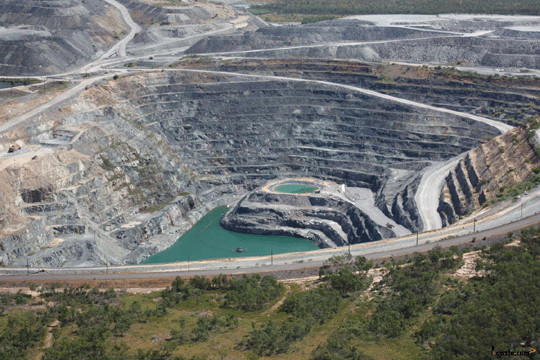
Ranger Danger: Rio Tinto Faces Its Nuclear Test in Kakadu Uranium Mine, https://sei.sydney.edu.au/opinion/ranger-danger-rio-tinto-faces-its-nuclear-test-in-kakadu-uranium-mine/ Rebecca Lawrence and Dave Sweeney report on growing concerns over the potential failures of the rehabilitation plan for the Ranger mine in Kakadu National Park. By Rebecca Lawrence, Senior Research Fellow, Sydney Environment Institute and Dave Sweeney, Australian Conservation Foundation, 16 December 2020 In the 1950’s uranium mining began in the Alligator Rivers and Kakadu regions in the Top End of the Northern Territory. Since then, the Kakadu uranium story has generated heartache and headlines but it is set to soon come to an end with the closure of the Ranger uranium mine in early January 2021. The story is now moving from one of contest over the impacts of mining to one of concern around the adequacy of rehabilitation. Australia has a notorious record when it comes to mine rehabilitation. Many mines are simply abandoned, and those that are rehabilitated often fail, which means complex and on-going monitoring and management is usually required. In many cases, mining companies and their shareholders are long-gone and it is usually Indigenous communities who are forced to live with toxic legacies and left to fight for governments to finance the clean-up with tax-payer money.
Yet, there are alarming signs we may be headed that way. Significant and crucial knowledge gaps remain around the closure and rehabilitation of the Ranger mine. Despite the looming closure date, mine operator Energy Resources Australia (ERA) is still unable to answer many key questions. For example, ERA has still not completed modelling of the pathways and volumes Another key omission in the mine closure plan is the absence of any substantive social impact research. There is no attention paid to how Aboriginal people have been impacted by uranium mining in Kakadu, or any assessment of how they may be impacted the mine closure. This omission constitutes a profound social injustice and is demonstrably inconsistent with both international best practise and contemporary community expectation. ERA is part of the global Rio Tinto group. Rio, who own 86% of ERA, has been called out for its destruction of ancient Aboriginal heritage and sites at Juukan Gorge in the Pilbara region of West Australia. As the main shareholder in ERA at Ranger, there is a real risk that Rio will also fail at Ranger if they don’t get the rehabilitation right and put in place secure financing for perpetual care and maintenance of the Ranger site post-closure. There is a requirement that the company must isolate large volumes of radioactive mining tailings for 10,000 years, but how can that be done without any funds earmarked for monitoring or post-closure management? The Commonwealth government was the key driver behind opening the Ranger Uranium mine in the early 1980s and yet as closure approaches, they are virtually absent. There is no clear regulatory process for how rehabilitation and post-closure monitoring will be financed or enforced. A successful rehabilitation is dependent upon the Commonwealth Government keeping ERA and Rio Tinto accountable and honest. Despite reassuring rhetoric no mining company will do that on their own – for too many the triple bottom line remains measured in pounds, dollars and euros. The Commonwealth Government needs to step up and ensure that the Kakadu environment and its people are protected and that a dual World heritage listed region is given the attention and focus it deserves and needs. A further key constraint on the likely success of the clean up and closure of Ranger is the unrealistic timeframe that has been mandated for rehabilitation. Ranger is the longest running uranium mine in Australia. It was imposed against the explicit opposition of the region’s Mirarr Traditional Owners and for forty years has conducted deeply contested operations in a monsoonal tropical environment. And not just any tropical environment – the mine is an industrial zone surrounded by Australia’s largest national park – Kakadu. Kakadu National Park is a dual World heritage listed area that is recognised for both its cultural and natural values and properties. The Ranger site is required to be rehabilitated to a standard where it could be incorporated into this unique environment. This is a very high bar to clear and Rio Tinto currently have a very short run-up. The rehabilitation period extends only from January 2021 to January 2026. Five years is simply not enough time to make meaningful and lasting repair to a heavily impacted landscape. As a result, the rehabilitation approach is being increasingly driven by short-cuts and bad decisions, rather than taking the time needed to get it right. The Mirarr people and an increasing number of civil society and wider stakeholders and commentators are urging both the Commonwealth and the company to extend this set period of works to better reflect the complexity of the rehabilitation challenge and to increase the likelihood of a successful result. The closure and clean up of Ranger is a critical test of the commitment, competence and credibility of Rio Tinto and the Commonwealth. Both parties have a responsibility to address decades of environmental damage and community disruption. Without more clarity, funding, time and transparency the future of Kakadu cannot be assured. And this is too high a price to pay. There are many eyes from across Australia and around the world that are focussed on the Ranger rehabilitation and near enough is not good enough. The challenge is clear and considerable – and now it needs to be met. Rebecca Lawrence and Dave Sweeney are part of an expert group who have authored the report, Closing Ranger, protecting Kakadu, released by the Sydney Environment Institute, the Australian Conservation Foundation, the Mineral Policy Institute and the Environment Centre NT. Access the report here. |
|
Unfinished Business: Rehabilitating the Ranger Uranium Mine
|
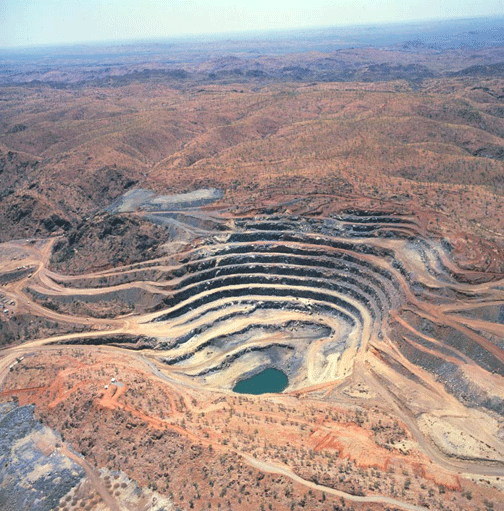
Unfinished Business: Rehabilitating the Ranger Uranium Mine https://sei.sydney.edu.au/publications/ranger-uranium-mine-report/ May 2019 Four decades of imposed uranium mining and milling by Energy Resources of Australia (ERA) and Rio Tinto is about to end at the Ranger uranium mine in Kakadu, leaving a heavily impacted site that requires extensive rehabilitation. Long contested by the area’s Traditional Aboriginal Owners, the Mirarr people, the mine site is completely surrounded by the dual World Heritage listed Kakadu National Park.This report is an independent assessment of the rehabilitation and mine closure process to date. It explores some of the concerns and constraints surrounding the rehabilitation and makes recommendations that seek to address these in order to improve the chances of the successful closure and rehabilitation of the Ranger Project Area.
The background research to this report was funded by FORMAS, the Swedish Research Council for Sustainable Development. Authors: Rebecca Lawrence and Dave Sweeney, Australian Conservation Foundation. |
|
The Usual Suspects: oil and gas majors star in Australian tax heist
The Usual Suspects: oil and gas majors star in Australian tax heist, Michael West 16 Dec 20,
Angus Taylor’s rescue package for the oil industry is a testament to governments getting gamed by large corporations. The latest Tax Office transparency data shows oil and gas juggernauts are Australia’s biggest tax cheats, again, yet now they are crying for public subsidies – and getting them – to prop up their oil refineries. Michael West reports on the good and the bad in multinational tax dodging land.
2020 in Australia – a successful year for resistance to nuclear pollution

DAVE SWEENEY | Nuclear Free Campaigner, Australian Conservation Foundation | www.acf.org.aua 15 Dec 20,
A year ago today the then federal resources/radioactive waste Minister Matt Canavan read the room in the Flinders Ranges and stated: “I will no longer consider this site an option for the facility”. https://www.minister.industry.gov.au/ministers/canavan/media-releases/national-radioactive-waste-management-facility-wallerberdina
Viva!! This decision was a great tribute to Adnyamathanha, the FLAG crew and wider community resistance.
In the year since
- Canberra has turned to Kimba where they are facing a stiff fight and have failed in an attempt to rewrite the laws to remove people’s right to legally challenge the waste plan
- SA Labor, Unions SA and many more civil society groups and state and national voices have come on board against the waste plan
- The Australian Human Rights Commission acknowledged the three sisters – Vivianne and Regina McKenzie and Heather Stuart as Human Rights Heroes for their radwaste efforts
- ARPANSA – the federal nuclear regulator – has confirmed that Australia’s worst waste can securely remain at Lucas Heights ‘for decades”
- Matt Canavan is gone and we have a new Minister – the sixth in as many years – if radioactive waste had the same longevity as federal ministers it wouldn’t be an issue.
- Collectively we are stalling the deeply flawed federal plan and shifting the story from the search for a postcode to the need for a credible process
Congratulations to all those who successfully defended the Flinders – and strength to those now actively contesting the dodgy Kimba plan.
Law and Disorder: The case of Julian Assange
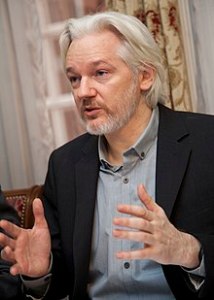 In the case of Julian Assange, what is on trial is nothing less than our right to know what is done by governments in our name, and our capacity to hold power to account.
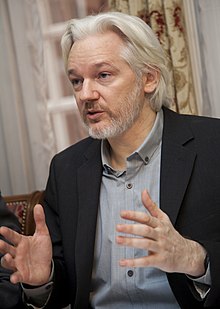
What kind of law allows pursuit of charges under the 1917 United States Espionage Act — for which there is no public interest defence — against a journalist who is a foreign national?
The closing argument of the defence in the extradition hearing of WikiLeaks founder and publisher Julian Assange has been filed. For this and other reasons it is apposite to consider the authority invested in the law before which, in democratic societies, we are ostensibly all equal.
In fact, notwithstanding the familiar claims of objectivity (and as `everybody knows’ in Leonard Cohen’s famous lyric) the reality is somewhat different. Jokes about the law attest to this:
‘One law for the rich…’
‘Everyone has the right to their day in court — if they can pay for it’
‘What’s the difference between a good lawyer and a great one? A good lawyer knows the law. A great lawyer knows the judge’
The term ‘legal fiction’ calls into question the relationship between law, objectivity, and truth. On the one hand, law is the essential pillar of a functioning society. On the other, it is replete with anomalies both in conception and execution. To what extent can these perspectives be reconciled? High stakes are attached to this question.
Questioning claims of objectivity in the context of law.
The end of the uranium mining era leaves Jabiru with some social and housing problems
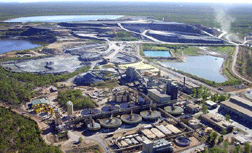 NT mine closure has Jabiru community anxious about an uncertain future, and some are already leaving, https://www.abc.net.au/news/2020-12-13/nt-jabiru-housing-uncertainty-as-uranium-mine-end-nears/12975950, By Matt Garrick
Packing her life away into boxes and preparing to shift out of her small Northern Territory town has had an emotional impact on Denise House — but it’s not the feeling she expected.
Key points:
- The Ranger uranium mine will cease operations on January 9
- Dozens of mining families are expected to leave town in coming months
- Future rental prices and the standard of the town’s housing remains “unknown”
“It’s funny because I don’t feel like I’m leaving yet, although we know we are. There’s a date, we’ve already got our flights booked and everything,” Ms House said.
“But I’m sure there will be tears.”
The House family is among an exodus of families preparing to up stumps and leave Jabiru — a mining town on the edge of Kakadu National Park with a population of just over 1,000 people — as mining operations officially cease on January 9, 2021.
The vision is for Jabiru to eventually be turned into an Indigenous-run tourism town and service hub.
The entity set up to help handle the transition, Jabiru Kabolkmakmen Limited (JKL), is among those conceding the town faces a huge challenge in the coming year. Continue reading
Far from “broad community consent”- nuclear waste dump plan for Kimba South Australia.
Key points:
- A nuclear waste storage facility has been proposed for Napandee near Kimba on the Eyre Peninsula
- One Nation doesn’t think the Barngarla people were given enough of a voice in SA’s nuclear debate
- Federal Government wants to legislate the site, meaning the decision wouldn’t be subject to a judicial review
The proposed facility which would house Australia’s low and intermediate-level waste — which comes from medicine — has been earmarked for a farm near Kimba on the Eyre Peninsula.
The Government wants to legislate the farm as the site for the facility, meaning the decision would not be subject to a judicial review.
There was hope the matter would be resolved before the end of the parliamentary year, however that failed to eventuate.
Labor and One Nation oppose the legislation, saying the resources minister already has powers to select a site, adding that a judicial review had merit.
The Greens also oppose the legislation………
The debate surrounding the facility has been a hot-button topic in Kimba for the past five years, with locals saying they will experience another anxious Christmas.
Farmer Jeff Baldock owns Napandee, the 160-hectare property where the Government wants to put the facility.
He said his frustration levels were growing…….
Mr Baldock said having the facility at Kimba would provide future generations with a different industry in which to work besides agriculture. ……
He said it had been a long process but one that “needs to happen because of the nature of what’s being proposed”.
“It’s all about fairness for people, not only those opposed to it, but those that live outside of the Kimba boundary who were denied a vote,” he said.
To have senators not happy with the current legislation, I think it is a positive thing because in the end, this is forever this facility, it’s going to be 100 years.”
Mental health
Mr Woolford said the wellbeing of people impacted by the process had been forgotten.
“There’s no doubt that’s why people have left and some people are considering leaving now,” he said.
“They don’t want to live by a nuclear facility.
“The Government don’t seem to care about the mental wellbeing of people in this town.
“We’re going to keep standing our ground and oppose this because of how unfair this process has been.” https://www.abc.net.au/news/2020-12-11/one-nation-says-not-enough-consultation-kimba-nuclear-facility/12971036
Australian Government Productivity Commission Report fails to realise the complexity of environmental problems in uranium mining
Mia Pepper, Conservation Council of Western Australia, (CCWA) 10 Dec 20, The Productivity Commission Report has been released.
The CCWA had put in a detailed submission on uranium – in response to the Minerals Council of Australia attempts to reduce federal oversight of uranium mine projects. The overall terms for the PC report was to identify best practice regulation – while removing impediments to investment. (emphasis on removing impediments to investment – sigh).The short take home message for us: is that the Productivity Commission (PC) echoes calls, initially made through the EPBC Act Review process, that ARPANSA become the regulator for uranium mines, removing the need for EPBC approvals.This is narrow – it suggests the only problems or issues with uranium mines are related to radiation – the issues are much more complex and need environmental regulators not just radiation expertise.There is pressure from MCA and AMEC to remove the ‘nuclear trigger’ because they say it impacts on Rare Earths and Minerals sands assessments and approvals – this didn’t get much traction by the PC but was a segue to supporting calls that ARPANSA become the federal regulator and remove the need for the Environment Department to asses or approve uranium project.This fits with the larger Federal government agenda to remove federal approval requirements through setting up bilateral agreements with all the states and territories to defer powers to the State governments to both assess and approve projects that trigger federal intervention – like all uranium mines do. This is coming up before the Senate – but a majority of senators are set to block this and are calling for the Federal Government to release the final EPBC review report.The long version with extracts from the PC report: Continue reading

Australia is “rapidly” moving towards a hotter, drier climate

Climate change predictions: Average temps to increase, rainfall to decrease
It seems our already warmer days are only going to get hotter as weather experts paint a grim picture of Australia’s climate in the future. https://www.dailytelegraph.com.au/technology/climate-change-predictions-average-temps-to-increase-rainfall-to-decrease/news-story/c09593fdeb48648c8bfea031bbe7beea
Emily Cosenza, December 9, 2020
NCA NewsWire Australia is “rapidly” moving towards a hotter, drier climate, with average temperatures to continue on an upwards trajectory and rainfall being predicted to gradually decline in parts of the country.Climate change was a major theme in the Bureau of Meteorology’s State of the Climate 2020 biannual report as weather experts demonstrated how the country’s climate had changed since records began in 1910.
CSIRO senior research scientist Dr Michael Grose said weather trends seen in the past were very likely to continue in the future, including warmer temperatures and sea levels rising.
“Heavy rainfall – that‘s the hourly to daily intense downpours – is likely to become more intense through time, partly because that’s just what happens with a warmer atmosphere,” Dr Grose said.
“Unfortunately, that longer fire season with an earlier start and more days of dangerous fire weather is predicted to continue.
We’re heading towards what Australia would have experienced – or the equivalent for Australia – if global warming reached the 1.5 degree and 2 degree global warming level since pre-industrial, (and) we’re heading towards those quite rapidly.” ……..
“What’s really important in the report, and as we’ve seen in past reports, is that we’re experiencing climate change now, and it’s impacting on our community, many industries and other sectors as well,” Dr Bettio said.
She said some temperatures in the warmer months of 1916-89 were seen less than 1.8 per cent of the time but are now presenting more than 12 per cent on the time. “That 1 degree doesn’t sound like a big number, but it’s really impacting on that extreme heat that we experience
Michele Madigan sets former Minister Christopher Pyne straight on nuclear waste dump plan
 Funny how after all this time – since 1998 as he acknowledges, former Minister Christopher Pyne (Advertiser 7th December) has not yet caught up with the fact that the federal nuclear waste dump is not just’ a low-level nuclear waste facility.’ Over 90% of the waste measured in radioactivity in fact is intermediate level waste which will remain radioactive for an unimaginable10,000 years. I’d say that will probably be for every generation of South Australians to come.
Australia’s Liberal and National Parties got their arithmetic wrong on nuclear waste dump opinion polls
LIBS NATS FAILED MATHS, Kim Mavromatis, 8 Dec 20, Where did these people go to school? – I expect they failed maths because they can’t do % sums.

452 in favour of the dump from 824 eligible Kimba voters = 54.85% of the Kimba community.Not 62%.And Barngarla Native Title Holders, who were deliberately left out of the Kimba ballot,had their own vote : 0 in favour of the dump from 209 eligible voters.Combined Kimba and Barngarla votes = 43.75% in favour of the dump from eligible voters, Does Not equate to Broad Community Support.No mention by Pyne that the Govt want to dump radioactive Spent Nuclear Fuel, and reprocessed SNF on SA farmland that is 10,000 x more radioactive than uranium ore.No mention by Pyne that the Dump legislation removes Judicial Review – no rights of appeal or independent scrutiny.No mention by Pyne that all SA surveys consistently overwhelmingly Do Not support the dump on SA farmland near Kimba.And Christopher, my mum died of an inoperable brain tumour 2 years ago – using nuclear medicine as an excuse to dump radioactive nuclear waste on SA farmland is BS.Why on earth would you knowingly dump radioactive nuclear waste on SA Farmland????
Analysing Christopher Pyne’s article enthusing about proposed Kimba nuclear waste dump
Examining Pyne’s article in The Advertiser – Outdated leftie ideas let nuclear option go to waste. G. Bannon 8 Dec 20
Pyne claimed to be in the thick of things with Nick Minchin in 1998 whenHoward was wanting to get a dump established. There are so many things wrong with his article, – (but if you try to address every single one no one would ever listen to you.
He knows how many jobs they were talking about in his day but says there will be 45 jobs during construction and 25 permanent jobs. When he was involved they were talking about 5 jobs – we’ve all heard that blow out to 15, then 45 and then more than 45. 25 permanent jobs are not part of the current script! Does that 25 including the Agency in Adelaide and does it include the 12/15? security guys as well as the nuclear physicists in white overalls driving all the forklifts?
* He doesn’t mention Intermediate Level Wastes (ILW)
* He wonders where in the world those opposing the dump think
Australia’s waste should go. I haven’t heard one person who opposes the
dump say Australia’s waste should go somewhere else.
* He thinks it’s a “no brainer” that the waste should go in “Outback
South Australia”. Kimba is remote, but it’s cleared, developed, settled and populated – it’s not “Outback”. Woomera might be getting closer to “Outback”. He doesn’t mention that.
* He reckons those opposing the dump have “outdated leftie ideology”
and Penny Wong “should be putting Kimba above kale” (Good, funny old Pyney -It’s such a clever line he says it twice)! I wonder how the kale harvest went at Kimba this year? I assume that big shed by the road, just before you get into Kimba, stores all the bales of kale to feed those leftie,
Greenie, tree-hugging, NIMBY activists!
* He, Pitty, Rowan and all their mates just want to get this done! Its
hung around too long. “It’s time” (sounds like a Labor slogan from the
past, doesn’t it?) to make the hard decisions. I say always be very wary of
people who want to push you into making quick decisions! What’s the saying?
– “Decide in haste, repent at leisure!”
* He says it is a $200 million project and says the community will
benefit by $31 million. We know the breakdown – $20 million for the
Community Benefit Programme, $8 million ($2 million/year for 4 years) to
assist businesses to take part in construction and $3 million for Indigenous training and engagement: 20 + 8 + 3 = $31 million – Who or what gets the remaining $169 million?
* He reckons that a dump in Kimba “would be preferable to the more
than 40 sites in the CBD”, then says that the Bill might be defeated by “not in my backyard NIMBYism”. He lives in Adelaide and wants the stuff to go to Kimba – Not In His Back Yard!

The Bill for the Napandee nuclear waste dump won’t be passed next year, either
National Radioactive Waste Management Amendment (Site Specification, Community Fund and Other Measures) Bill 2020

Peter Remta 7 Dec 20, It is now quite clear that the government will not bring on the bill in the Senate sitting this week as it would be defeated and will wait until next year’s resumption before deciding what to do.
Obviously Pitt believes this will give him ample time to bring the opposing Senate cross benchers to accept the legislation but this I suggest is a forlorn hope
However none of this will overcome the inherent problems with the government’s proposals for Kimba as they cannot be cured by legislative action
This will still be the same situation irrespective of reliance on the existing or the new legislation since the problems are so basic and arise under a widely and strictly adhered to international regime dealing with nuclear safety which is beyond the legislative competence of the federal parliament
It has been put to me that if this situation had arisen in Europe and even in the United States it would already be subject to heavy litigation in superior courts – perhaps we are not as strong in our democratic principles as we are lead to believe
1 This month.
20 September –National Day of Action in Melbourne on the International Day of Peace


Help Aunty Sue Protect Her Land and Sacred Sites From Destructive Rocket Testing.
.

Australians deserve the truth
about
AUKUS – https://aukuspublicinquiry.com/

PETITION – To: Prime Minister Anthony Albanese and the Australian Labor Government

of the week – Australians for War Powers Reform (AWPR)
To see nuclear-related stories in greater depth and intensity
 Antinuclear