Senate Debate on Nuclear waste dump Bill postponed till at least February 2nd 2021
 Kazzi Jai, NoNuclear Waste Dump Anywhere in South Australia, 7 Sec 20
Senate again postpones discussion on contentious nuclear waste Bill.

Discussion of the contentious Bill to impose nuclear waste dump at Napandee, South Australia, has once again been postponed in the Australian Senate.
it might re-emerge next week (last Senate sitting for the year) or next year (Senate sits early February), or perhaps the government will reassess it’s approach … which would probably mean nominating the Kimba site using existing legislation
Australian government struggles to impose nuclear waste dump in small South Australian agricultural area
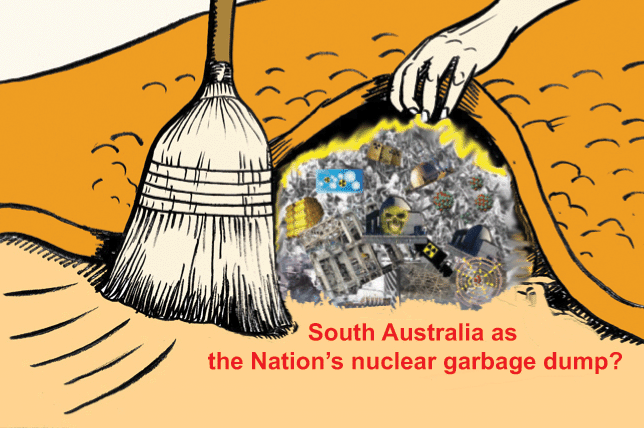 ‘Need a resolution’: Government fights opposition to toxic waste dump plans, Brisbane Times, By Rob Harris, December 1, 2020 A likely Senate roadblock to establish a radioactive waste dump in regional South Australia could be used by the Morrison government as a trigger to go to an early election as it prepares to bring the issue to a vote in the coming days.
The contentious proposal would finally establish a low- and medium-level nuclear waste facility at Napandee, a farm on South Australia’s Eyre Peninsula, after 40 years of public debate about the disposal of such materials………..
Kimba mayor Dean Johnson and community members met with Opposition Leader Anthony Albanese and Prime Minister Scott Morrison on Monday to stress the town wanted everything that came with the National Radioactive Waste Management Facility……..
The plan has been criticised by the traditional owners of the region, the Barngarla, who were not included in the vote because it was limited to those living in the Kimba Council area.
The group later challenged the ballot under the Racial Discrimination Act in the Federal Court but it was dismissed.
The Australian Conservation Foundation has also criticised the process, claiming it would lead to potentially dangerous waste management, including trucking radioactive waste from Lucas Heights in Sydney through regional communities and dumping it on South Australian farmland.
“This is actively opposed by many in the wider region, including the Barngarla Traditional Owners who have been consistently excluded from the consultation process,” veteran anti-nuclear campaigner Dave Sweeney said.
Labor will seek to amend the laws so that the minister responsible, Resources Minister Keith Pitt, can use existing powers to nominate any site under the current legislation. Labor says the changes would still give the local community access to a significant community fund on offer and would ensure the decision be subject to a judicial review………
A bill which is rejected twice by the Senate – with a period of at least three months between each attempt – hands the government the opportunity to dissolve both houses of parliament and head to an election ahead of schedule.https://www.brisbanetimes.com.au/politics/federal/need-a-resolution-government-fights-opposition-to-toxic-waste-dump-plans-20201201-p56jhs.html
Australia joins with USA to get hypersonic missiles
 Australia Teams Up With U.S. To Get Hypersonic Missiles For Its Super Hornets In Five Years Australia Teams Up With U.S. To Get Hypersonic Missiles For Its Super Hornets In Five Years
Plans call for the rapid prototyping of a new air-breathing long-range missile for the Royal Australian Air Force. The Drive, THOMAS NEWDICK. NOVEMBER 30, 2020 Australia is gearing up to start testing a new air-launched hypersonic missile “within months.” Details of the joint U.S.-Australian program are still emerging but point to a multi-million-dollar effort to develop an air-breathing, long-range missile that could ultimately be carried by a range of Royal Australian Air Force aircraft. The new weapon is due to be formally announced tomorrow and prototypes are being developed together with the United States under the Southern Cross Integrated Flight Research Experiment, or SCIFiRE. Hypersonic weapons are generally understood to be capable of flying at least five times the speed of sound, giving them faster response time for striking critical targets and making them much harder to defend against than their slower counterparts
The new weapon is due to be formally announced tomorrow and prototypes are being developed together with the United States under the Southern Cross Integrated Flight Research Experiment, or SCIFiRE. Hypersonic weapons are generally understood to be capable of flying at least five times the speed of sound, giving them faster response time for striking critical targets and making them much harder to defend against than their slower counterparts……
While Australia has apparently struck a new deal with the United States regarding SCIFiRE in the last few days, this program dates back as long as 15 years. It has included joint research on hypersonic scramjets, rocket motors, sensors, and advanced manufacturing materials.
In the past, The War Zone has examined previous U.S. and Australian hypersonic experiments, including the Hypersonic International Flight Research Experimentation (HiFIRE) program, which you can read more about here. A U.S. Air Force contract announcement as long ago as 2008 indicated that one of the aims of the HiFIRE program was to gather information that could be “applicable to the design of next-generation high-speed strike weapons.”……..
While the initial focus of the SCIFiRE work seems to be firmly on an air-launched missile for the RAAF, Australia is also looking to develop hypersonic weapons for launch from the ground or from warships, and it’s possible that a family of weapons may eventually be developed for different launch platform applications. …….. https://www.thedrive.com/the-war-zone/37875/australia-teams-up-with-u-s-to-get-hypersonic-missiles-for-its-super-hornets-in-five-years
|
|
Defence Minister Linda Reynolds announces hypersonic missiles for Australia

Australia to begin testing hypersonic missiles within months, The Age, By Anthony Galloway, December 1, 2020 Australia will begin testing hypersonic missiles that can travel at least five times the speed of sound within months under a new agreement with the United States to develop prototypes of the next-generation weapons…….
The Australian government will now begin talking with Australian industry about rolling out a range of technologies to bring the hypersonic missiles from the testing phase to the production line for the Royal Australian Air Force.
Defence will not reveal the estimated cost of developing the new hypersonic missiles but it is expected to run into billions of dollars. A total of $9.3 billion was earmarked in this year’s Force Structure Plan for high-speed long-range missile defences.
Under the plan, the hypersonic missiles would be carried by the RAAF’s existing arsenal of aircraft including the Growlers, Super Hornets, Joint Strike Fighters and Poseidon surveillance planes. The missiles could also be attached to unmanned aircraft such as the new Loyal Wingman drones.
The Australian Defence Minister said the experiments with the US would include demonstrations to show how the weapon performs in operational conditions, which would then inform future purchases.
“Developing this game-changing capability with the United States from an early stage is providing opportunities for Australian industry,” she said…..
Michael Kratsios, the Acting Under Secretary for Research and Engineering for the US’s Department of Defence, said the agreement was “essential to the future of hypersonic research and development, ensuring the US and our allies lead the world in the advancement of this transformational war-fighting capability”. ….. https://www.theage.com.au/politics/federal/australia-to-begin-testing-hypersonic-missiles-within-months-20201130-p56j5a.html
Australian taxpayers now splurging bigtime on weapons
 “Mind-boggling” waste revealed in the record rise in weapons spending, Michael West Media, by Brian Toohey | Nov 30, 2020 Australian governments and their defence leaders, with help from lobbyists, choose immensely complex, overpriced and overmanned weaponry. Wasteful spending has to end, writes Brian Toohey. “Mind-boggling” waste revealed in the record rise in weapons spending, Michael West Media, by Brian Toohey | Nov 30, 2020 Australian governments and their defence leaders, with help from lobbyists, choose immensely complex, overpriced and overmanned weaponry. Wasteful spending has to end, writes Brian Toohey.
With the blow-out in the budget expected to hit nearly $1 trillion by 2023-24 as a result of the pandemic, one would think the Federal Government would crack down on wasteful spending. But when it comes to defence spending, too much is never enough. Budget papers show defence funding will grow by a staggering 9.1% in real terms to $42.7 billion this current financial year. But much of the extra money will be wasted – yet again. There’s the official cost to build nine Hunter class frigates, which has gone from $30 billion in 2016 to $45.6 billion in 2020. Then there’s the army’s new Infantry Fighting Vehicles, estimated to cost a “mind-boggling” $18–27 billion. The mid-point estimate for the cost of each vehicle is $50 million………. But the worst financial and capability disaster is the building of 12 ludicrously expensive Attack class submarines. Changes to the unique French design are not finished; the first boat is unlikely to be operational until the late 2030s and the last until well after 2050; and they will be obsolete before delivery. The costs do not stop there. Because the existing Collins class is due to start retiring in 2026, these delays will create a capability gap that will have to be closed by spending $15 billion to $30 billion to keep subs going. The current plan is to integrate Australia’s new submarines with US submarines in the South China Sea where an accidental, or deliberate, incident could spark a full-scale war, unless all sides make a strenuous effort to ease tensions. Australia would be better off scrapping the $90 plus billion Attack class and getting a version of the advanced medium-sized submarines the Singapore Navy is buying from Germany, the world’s biggest maker of quality conventional submarines. https://www.michaelwest.com.au/mind-boggling-waste-revealed-in-the-record-rise-in-weapons-spending/ |
|
|
No uranium or thorium mining for Victoria
 Victoria blocks prospect for uranium mining, Australian Mining, Salomae Haselgrove
According to the report, the current Australian market for uranium or thorium products is receiving enough supply via international imports and the Lucas Heights open-pool Australian lightwater (OPAL) reactor in Sydney.
“In this report, the committee makes no recommendations and does not take a strong position on nuclear power as an alternative energy source in Australia and particularly in Victoria,” the committee stated…..
The committee is not convinced that uranium and thorium exploration activities are economically or technologically viable in Victoria.
This was backed up by comments from the Medical Association for Prevention of War (Australia) infectious diseases physician Tilman Ruff, who said export earnings did not even cover employment costs for miners.
“The industry has for over a decade never cracked close to $1 billion a year in export income,” Ruff said.
“They are a relatively small cohort. It employs, on the most recent estimates I have seen, a maximum of about 700 people.”
From the three operational uranium mines in Australia – Olympic Dam and Four Mile in South Australia and Ranger in the Northern Territory, which is closing in January – all uranium products are exported.
At present, the assessment and approval process for ministerial permission to develop a uranium mine takes at least three years.
With Victoria’s solid uranium mining ban, the Minerals Council of Australia stated that “Victoria effectively sends a message there is no point in investors considering Victoria in relation to uranium”…. https://www.australianmining.com.au/news/further-uranium-mining-unlikely-to-be-taken-up-in-australia/
The Australian government”s intimidation of whistleblowers – the torture of Julian Assange
Torture of Julian Assange by Australian governments sends powerful message to whistleblowers, Michael West Media by Lissa Johnson | Nov 26, 2020
Australia has used a range of torture techniques against Julian Assange, writes Dr Lissa Johnson. Governments have isolated and demonised him; flatly rejected evidence of ill-treatment; refused to respond to specific allegations; and divested themselves of any responsibility. Leaders can’t, or won’t, accept the difference between psychological torture and ‘a legal matter’.
Julian Assange has set a number of firsts for Australia, including:
- The first Walkley award winner whose journalism has attracted a possible 175 years in US prison.
- The first journalist to be prosecuted as a spy by the US government, under its 1917 Espionage Act.
- The first citizen of an ostensibly democratic state (Australia) whom a UN official has found to be the target of a campaign of collective persecution and mobbing by other so-called democratic states.
As the UN Rapporteur on Torture, Nils Melzer, observed:
In 20 years of work with victims of war, violence and political persecution I have never seen a group of democratic states ganging up to deliberately isolate, demonise and abuse a single individual for such a long time and with so little regard for human dignity and the rule of law.
As part of this mobbing and collective persecution, Assange is the first Australian journalist to be tortured for journalism in the UK.
On 9 May 2019, Professor Melzer visited Assange in Belmarsh prison, accompanied by two medical experts specialising in the assessment and documentation of torture. On 31 May, Melzer reported that they had found Assange to be suffering all symptoms typical of prolonged exposure to psychological torture.
On 1 November 2019, Melzer warned that, unless the UK government urgently changed course, it may soon end up costing his life.
What torture?
Julian Assange is being held in ‘Britain’s Guantanamo’, Belmarsh prison, a high-security facility designed for those charged with terrorism, murder and other violent offences. He has been held in solitary confinement for 22 to 23 hours a day.
He knows that US-aligned security contractors have written in emails that he will make a nice bride in prison, and needs his head dunked in a full toilet bowl at Gitmo. He knows he is headed for life in US supermax prisons, where prisoners are held in perpetual solitary and chains.
‘If this man gets extradited to the United States, he will be tortured until the day he dies’, Profesor Melzer has cautioned.
To heighten the torment, Assange has been prevented from preparing his defence against extradition in violation of his human rights as a defendant.
He has been granted negligible access to his lawyers and is prevented from researching his own defence. The only purpose is to render him helpless, intensifying his trauma.
A Message from the Australian Government
Assange’s experience sets an example to anyone thinking of airing the dirty secrets of those in power: the genuinely dirty secrets, such as wantonly slaughtering and torturing innocent people and covering it up.
Like all public torture, it sends a message to onlookers: this could happen to you.
And the message from the Australian government to any Australian journalists looking on? You’re on your own.
The US government is seeking to retrospectively apply its own Espionage Act to non-US citizens in foreign lands, while simultaneously withholding the free speech protections of its Constitution. The upshot would be that non-US citizens, and non-US journalists, would be vulnerable to prosecution wherever they may be, whenever the United States saw fit.
Should a host country oblige, that journalist’s only hope would be the protection of their own government. And the message from the Australian government? Not a chance.
A climate of consent
But can the government do anything to stop the torture of Assange in the UK? Or are its hands tied?
Australia ratified the Convention Against Torture in 1989. It therefore has a positive duty to take ‘effective legislative, administrative, judicial and other measures to prevent acts of torture’ of its citizens. According to the Federal Attorney-General’s website, however, that duty applies to ‘territories within Australia’s jurisdiction’.
So who is responsible for protecting Australian citizens from torture overseas?
Australian officials can raise concerns with their overseas counterparts when they are concerned about gross violations of citizens’ rights as happened in the cases of Melinda Taylor, James Ricketson, David Hicks and Peter Greste.
They could also make a submission to the Committee against Torture that a state is ‘not fulfilling its obligations under this Convention’.
n Assange’s case, however, the government has opted for ‘consent and acquiescence’ under Article 1 of the convention. Consent and acquiescence is listed alongside inflicting and instigating torture as part of the very definition of torture.
‘Standard’ fare
DFAT representatives say repeatedly that Assange’s treatment In the UK is perfectly normal. ‘Standard’. ‘No different’ from the treatment of other UK prisoners. Routine, in other words. Nothing to see here.
When reminded that Assange had been handcuffed 11 times, stripped naked twice and moved between five holding cells after the first day of his extradition hearing, a DFAT representative described this as ‘standard prison to court and court to prison procedure’.
What the official failed to explain is that treatment is only ‘standard’ and normal for prisoners charged with terrorism or other violent offences.
It is not remotely normal for journalists with no criminal history, and no history or risk of violence, to be detained under the most punitive conditions that UK law enforcement has to offer.
As an exercise in “consent and acquiescence” DFAT representatives performed their duties well.
Sanitising, normalising language minimises and trivialises abuse………….
‘Not our responsibility’ has been the Australian government’s refrain. Australian government officials ‘don’t provide running commentaries on legal matters before the courts in other parts of the world’, asserted the Foreign Minister.
Australia is ‘not a party to the legal proceedings in the United Kingdom’, stressed a DFAT official when asked why Australia had not intervened in Assange’s case during Senate Estimates. ‘We have no standing in the legal matter that is currently before the courts.’
Perhaps the Australian government doesn’t understand the seriousness of the abuses taking place in the UK. Perhaps ministers and their advisors are unaware of the difference between psychological torture and a ‘legal matter’. Psychological torture is, after all, not commonly well understood.
It is possible that the Australian government merely fails to grasp the gravity of ignoring Professor Melzer’s warnings. However, when the group Doctors for Assange wrote to the Australian government in December 2019, they detailed the medical and psychological basis of their concerns for Assange’s life and health…………..
New normal in Australia?
Assange is not the first person in Australia to be subjected to torture and other cruel, inhuman or degrading treatment. Australia’s abuse of asylum seekers and refugees has been found to violate the Convention Against Torture. Aboriginal Australians, among the most incarcerated groups on earth, have been dying in custody, buried under acquiescent consent, for decades, and historically for hundreds of years.
The Human Rights Measurement Index 2019 has given Australia a 5.5 out of 10 rating for ‘freedom from torture’, noting, ‘Torture is a serious problem in Australia … a large range of people [are] at particular risk of torture or ill-treatment, with Aboriginal people and Torres Strait Islanders at the top of the list’…….
Through sending a message to journalists worldwide by torturing Assange, the abusive licence deployed against other persecuted groups is being expanded to take in journalism. The targeting of journalists around the world matters because journalists cut across the acquiescence and consent, remove the deadbolt on the torture chamber door, turn down the music, and expose what is going on inside. Every persecuted and abused group or person needs them, to break the cycle of violence by breaking the silence.
We do torture here. It is our problem. In Julian Assange’s case, the biggest problem appears to be that torturing journalists is becoming the new normal in Australia.
This edited extract is reproduced from A Secret Australia: Revealed by the WikiLeaks Exposés, edited by Felicity Ruby and Peter Cronau, Monash University Publishing, December 2020. https://www.michaelwest.com.au/torture-of-julian-assange-by-australian-governments-sends-powerful-message-to-whistleblowers/
“Traceability” and Nuclear waste on agricultural land?
 Kazzi Jai From Keith Pitt’s facebook page today – 28/11/2020...”With more consumers wanting to know where their produce comes from, a new Federal funding round is available to enhance traceability.
Applications are open now for Round 2 of the Traceability Grants Program and close on January 21, 2021.” more https://www.agriculture.gov.au/market-access-trade/traceability-grants-program?fbclid=IwAR2ngI3mkhJIpwfguNAM4rheSiggOmYPgn4BLE34TL76CNFgjCBuuBZErj0
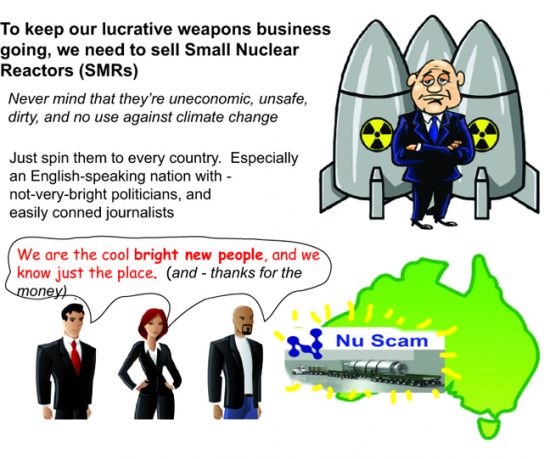
Corrupt spinning of Small Nuclear Reactors -Australia beware – theme for December 2020
With the financial collapse of the nuclear industry, and with the Nuclear Weapons Ban Treaty coming into force soon, the nuclear lobby is pitching a pack of lies, as it desperately promotes Small Nuclear Reactors (SMRs.).
Australia is not immune to this corrupt spin. Indeed, Australia is a sitting duck
Australian children targetted for propaganda by the weapons industry
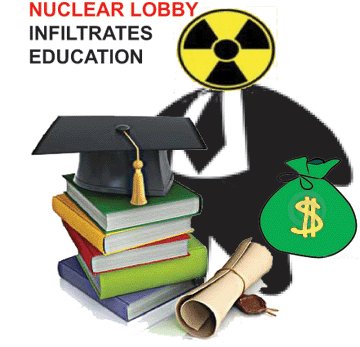 education https://www.michaelwest.com.au/reputation-laundering-weapons-companies-now-infiltrating-schools-to-promote-education/, by Michelle Fahy | Nov 27, 2020 A Lockheed missile blows up a bus full of Yemeni children; in Australia Lockheed Martin gains kudos by sponsoring the National Youth Science Forum. BAE Systems sponsors underprivileged kids in Australia while being complicit in the killing of thousands of needy children in Yemen. All you see in industry marketing pitches is euphemism, with nary a mention of the word “weapons”. Michelle Fahy reports.
The UK’s largest weapons-maker, BAE, is working inside Saudi Arabia supporting Saudi-United Arab Emirates military operations in Yemen, a war that has killed or injured tens of thousands of civilians, including thousands of children.
Meanwhile in Australia, BAE sponsors The Smith Family’s STEM education program for under-privileged children.
Flagrant hypocrisy? Welcome to the weapons business.
Then there’s Lockheed Martin, the world’s largest weapons-maker, also raking in billions from the Yemen war. A Lockheed missile blew up a bus full of Yemeni school children in 2018, killing at least 29 kids and injuring dozens more. Back in Australia, Lockheed was cultivating kudos with kids as major sponsor of the National Youth Science Forum, a registered charity.
US missile-making giant Raytheon also continues to supply the Saudi-UAE coalition, despite evidence of numerous attacks with Raytheon missiles that targeted and killed civilians, including children. No mention of that in Australia. Instead, Aussie school kids had fun hanging out with the young Australian snowboarding paralympian Raytheon hired to front the launch of its Maths Alive! STEM program.
The French company supplying Australia’s new submarines, Naval Group, is at the centre of multiple corruption scandals globally, some of which involved murder. That hasn’t stopped Naval promoting itself as a model future employer, with the help of Port Adelaide footy heroes, to 90,174 kids in 329 South Australian schools since 2017.
And let’s not forget the list of sponsors of the Australian War Memorial, Legacy, Invictus Games and Soldier On, which include numerous weapons-making corporations.
There’s a name for this cynical behaviour: reputation laundering. And nearly every weapons company is doing it.
Promoted as innovators
The world’s weapons producers have taken with gusto to promoting themselves as innovators in science, technology, engineering and maths (STEM). Military industry has adopted the STEM mantra to target children and young people as future employees, usually with the willing partnership of respected educational institutions. Many, if not most, Australian universities now have joint agreements, strategic partnerships or some other form of collaboration with the weapons industry.
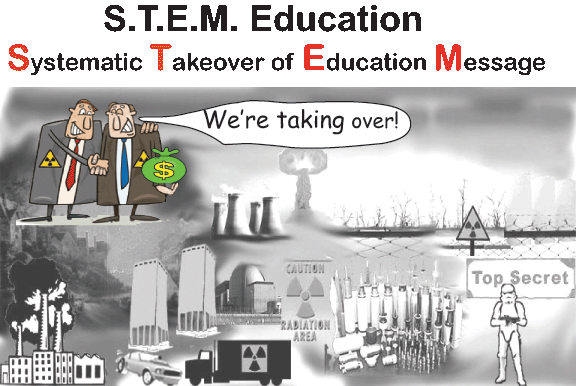
The sales pitch is, join us for an exciting and challenging high-tech career in science. This enthusiastic support of STEM serves two purposes: reputation laundering is one, the other is as a recruitment drive. STEM provides a socially acceptable way to promote the weapons industry to children, and parents, as a potential employer.
There’s nothing wrong with promoting STEM education, or seeking new employees. The issue is the way these companies are now targeting children as young as primary school age, with the full support of government. (eg. The MD of weapons-maker Saab Technologies is on the South Australian education board.) The problem is the spin and glamour applied to increased militarism, with pertinent information omitted from the marketing. Warfare isn’t mentioned, for starters.
There’s nothing about how the kids will use their STEM education to enhance the ‘lethality’ of their employer’s products. Or about a future where employees have eliminated the need for human involvement in the ‘kill chain’ by creating autonomous robotic devices to make those decisions. (This is not science fiction, these research and development programs are already under way.) Working on nuclear weapons isn’t discussed, either.
You won’t find the underlying arms manufacturing realities in the STEM marketing by weapons giants. In fact, you’ll be hard pressed to find the word “weapons” at all.
A world of euphemism
Instead, you’ll enter a world of euphemism: “high end technology company”, “leading systems integrator”, “security and aerospace company”, “defence technology and innovation company”. It’s also a fair bet you’re reading weapons company marketing if you see the phrase “solving complex problems”. Especially if there’s mention of working to make the world safer and more secure.
The following are a few examples of many in which multinational weapons corporations are co-opting organisations of good purpose in Australia.
BAE and The Smith Family
BAE operates inside Saudi Arabia, training Saudi pilots, maintaining Saudi’s BAE-supplied fighter jets, and supervising Saudi soldiers as they load bombs onto the planes. Indiscriminate bombing, a well-known feature of the Yemen war, has killed or injured tens of thousands of civilians, including children.
BAE has earned £15 billion from sales to the Saudis since 2015 when the Yemen war started. A BAE maintenance employee was quoted last year saying, “If we weren’t there, in 7 to 14 days there wouldn’t be a jet in the sky.”
BAE’s role in helping the Saudis prolong the world’s worst humanitarian crisis in Yemen has been pointed out more than once to The Smith Family since news broke of its sponsorship by BAE. Understandably, The Smith Family has responded defensively along the lines that critics are trying to steal an education from needy Australian children.
But what about the tens of thousands of needy children starved, maimed, and killed on the other side of the world? BAE Systems has given The Smith Family a mere $100,000 – about 0.3% of The Smith Family’s $36.3 million in non-government fundraising income.
Cheap reputational PR for a company that has gained tens of billions of dollars in defence contracts in Australia, while facilitating war crimes elsewhere.
Raytheon and Maths Alive!
Raytheon has marketed this program to children across America, the Middle East and Australia. Raytheon’s intention? To reach children at an early age and create a “healthy pipeline” from primary education, through secondary, to tertiary studies, to secure its future workforce.
The then Assistant Minister for Defence David Fawcett lent his support to the 2018 Australian launch of Maths Alive!, telling media: “I welcome the ongoing commitment by Raytheon to engage young Australians by helping them visualise what a career in science or engineering might look like.”
Lockheed Martin and National Youth Science Forum
The National Youth Science Forum was created by Rotary, which remains involved. The forum, now run by a board chaired by former senator Kate Lundy, has several programs, the flagship program being for Year 12 students interested in science.
Each year about 600 students complete the program, which exposes students to various career pathways in science. Since Lockheed started as major sponsor in 2015, students visit Lockheed Martin laboratories and speak with Lockheed staff as part of the program. (Watch a short video here from Lockheed’s website with some students.)
The National Youth Science Forum’s website does not mention Lockheed’s dominant influence as the world’s No. 1 weapons manufacturer or its significant role in producing nuclear weapons. Lockheed’s role in civil sectors is covered, however this work constitutes a minor aspect of its business. The most recent information from Stockholm International Peace Research says 88% of Lockheed’s revenue comes from arms sales.
Lockheed Martin and the Gallipoli Sponsorship Fund
This year Lockheed Martin became the first corporate partner of the Gallipoli Scholarship Fund. This partnership includes the new $120,000 Lockheed Martin Australia Bursary for the educational benefit of descendants of Australian veterans.
One of the aims of the Gallipoli Scholarship Fund is to contribute “to the future security of our nation and our national values of democracy, freedom, and the rule of law”.
Nuclear weapons will become illegal under international law in January 2021 when the new UN treaty prohibiting them comes into force. The world’s nine nuclear-armed countries haven’t signed it – nor their hangers-on, including Australia – so it won’t apply to them. But two-thirds of the world’s countries (including New Zealand) did vote to bring the treaty into being, banning the world’s worst weapons of mass destruction, and setting a new global norm.
Professor Ramesh Thakur, Director of the Centre for Nuclear Non-Proliferation and Disarmament at the Australian National University, has said, “The ban treaty embodies the collective moral revulsion of the international community.”
The awkward truth is that the Gallipoli Scholarship Fund’s new corporate partner, Lockheed Martin, is one of the largest nuclear-weapons-producing companies on the planet. Lockheed is all set to provide its 12 bursaries from now through to the end of 2023.
Such are the ethical dilemmas these weapons corporations create for organisations doing good work that are in need of funding.
Morally indefensible positions
Such sponsorships might appear less self-serving if weapons companies behaved consistently, and stopped supplying weapons to war criminals. Claiming they are just doing the bidding of the US or UK governments in supplying the Saudis, as these companies have, is not a morally defensible position, particularly in the face of evidence of ongoing war crimes in Yemen.
Similarly, claims that they are committed to serving the national interest might be more believable if they ceased bribing and scamming their way into the next arms deal, or concocting endless ways to extend and inflate government contracts and invoices for their own corporate financial benefit, blatantly siphoning funds from the public purse.
Victorian Government Inquiry confirms that there is no future in nuclear power
 Inquiry confirms there is no future in nuclear, Mirage News 27 Nov 20, The Victorian Greens have said Parliament’s recently tabled report into nuclear power has confirmed what they’ve known all along: that there is no future in nuclear.The Greens say they expect this to be the last time Victorian Parliament has to consider nuclear, and say nuclear power must remain buried in the last century where it belongs.
Leader of the Victorian Greens, Samantha Ratnam, said she had serious concerns about Parliament wasting valuable time and resources on an inquiry into nuclear power, and that those concerns were confirmed today despite the nuclear industry trying to convince the committee otherwise.
She added that nuclear power was expensive and water hungry, and had failed at every attempt to become a viable industry in Australia.
All around the world, nuclear power plant proposals are falling over before they even begin.
It’s clear that nuclear power is the past, and renewable energy is the future. Solar and wind power with storage can meet all our energy needs without the need to dig up and manipulate dangerous nuclear material…… https://www.miragenews.com/inquiry-confirms-there-is-no-future-in-nuclear/
Australian government’s Bill to weaken Environmental Law will be rejected in the Senate
 Key crossbench senators say they won’t support bid to change Australia’s environment laws
The Coalition plan to hand development approval powers to the states hits a further roadblock after Senate inquiry, Guardian, Graham Readfearn, @readfearn 27 Nov 20,
A Morrison government plan to change Australia’s environment laws to allow development approval powers to be handed to the states has hit a further roadblock, with three key crossbench senators saying in a report they will not support them.
The crossbenchers’ opposition means that, together with Labor and the Greens, the Morrison government’s laws would be voted down in the Senate.
But one crossbench senator told Guardian Australia he could change his mind once he had seen details in documents that the government has so far withheld.
A rushed Senate inquiry into the controversial changes delivered four reports late Friday, with Labor, the Greens and a crossbench group all confirming their opposition.
The government had gagged debate to push the legislation through the lower house – a move that outraged the Greens and Labor.
A final report from a major review of the Environment Protection and Biodiversity Conservation (EPBC) Act, carried out by Prof Graeme Samuel, was handed to the environment minister, Sussan Ley, in early November.
That report supported a move to devolve powers to the states, even though Guardian Australia has revealed the government was making moves to devolve powers months before the Samuel review.
Samuel’s interim report, released in July, found the environment was in unsustainable decline and the EPBC Act was not fit-for-purpose.
In their dissenting report to the inquiry, the crossbench senators Rex Patrick, Jacqui Lambie and Stirling Griff said they could not support the bill while key information was withheld……… https://www.theguardian.com/australia-news/2020/nov/27/key-crossbench-senators-say-they-wont-support-bid-to-change-australias-environment-laws
Victorian Inquiry finds nuclear power costly and risky
 Inquiry confirms nuclear energy’s [‘proven risks’] https://www.miragenews.com/inquiry-confirms-nuclear-energy-s-proven-risks/ A Victorian parliamentary inquiry has found nuclear power is ‘significantly more expensive than other forms of power generation’ and remains economically unviable without subsidies.
The inquiry has confirmed nuclear energy’s ‘identified and proven risks’.
The Australian Conservation Foundation (ACF) welcomed comments made at the tabling of the inquiry that the Victorian government has an ‘unequivocal commitment’ to retain the state’s long-standing nuclear ban.
The upper house inquiry into the prospects for nuclear power and uranium mining in Victoria has found:
- Nuclear energy is ‘significantly more expensive than other forms of power generation’ (finding 3) and without subsidies, a nuclear power industry is economically unviable in Australia (finding 5).
- Supposed advantages to nuclear energy put forward by nuclear proponents are speculative and do not outweigh the identified and proven risks (finding 9).
“This long-standing protection has served Victoria well and its retention is prudent and positive.
“ACF welcomes comments by inquiry member Nina Taylor that the Andrews Government has an ‘unequivocal commitment’ to retain the nuclear ban.
“Nuclear power is high cost and high risk and a distraction from the real energy choices and challenges we face. Our energy future is renewable, not radioactive.”
Inquiry confirms nuclear energy’s ‘proven risks’
Inquiry confirms nuclear energy’s ‘proven risks’
A Victorian parliamentary inquiry has found nuclear power is ‘significantly more expensive than other forms of power generation’ and remains economically unviable without subsidies.
The inquiry has confirmed nuclear energy’s ‘identified and proven risks’.
The Australian Conservation Foundation (ACF) welcomed comments made at the tabling of the inquiry that the Victorian government has an ‘unequivocal commitment’ to retain the state’s long-standing nuclear ban.
The upper house inquiry into the prospects for nuclear power and uranium mining in Victoria has found:
- Nuclear energy is ‘significantly more expensive than other forms of power generation’ (finding 3) and without subsidies, a nuclear power industry is economically unviable in Australia (finding 5).
- Supposed advantages to nuclear energy put forward by nuclear proponents are speculative and do not outweigh the identified and proven risks (finding 9).
“In 1983 the Cain state Labor government introduced the Nuclear Activities (Prohibitions) Act which prohibits uranium mining, nuclear power and waste facilities in the state,” said ACF campaigner Dave Sweeney.
“This long-standing protection has served Victoria well and its retention is prudent and positive.
“ACF welcomes comments by inquiry member Nina Taylor that the Andrews Government has an ‘unequivocal commitment’ to retain the nuclear ban.
“Nuclear power is high cost and high risk and a distraction from the real energy choices and challenges we face. Our energy future is renewable, not radioactive.”
A broad coalition of faith, union, environmental, Aboriginal and public health groups, representing millions of Australians, last year declared nuclear power has no role in Australia’s energy future and is a dangerous distraction from the pressing climate challenges. Their united statement demonstrates widespread community opposition to nuclear power.
1 This month.
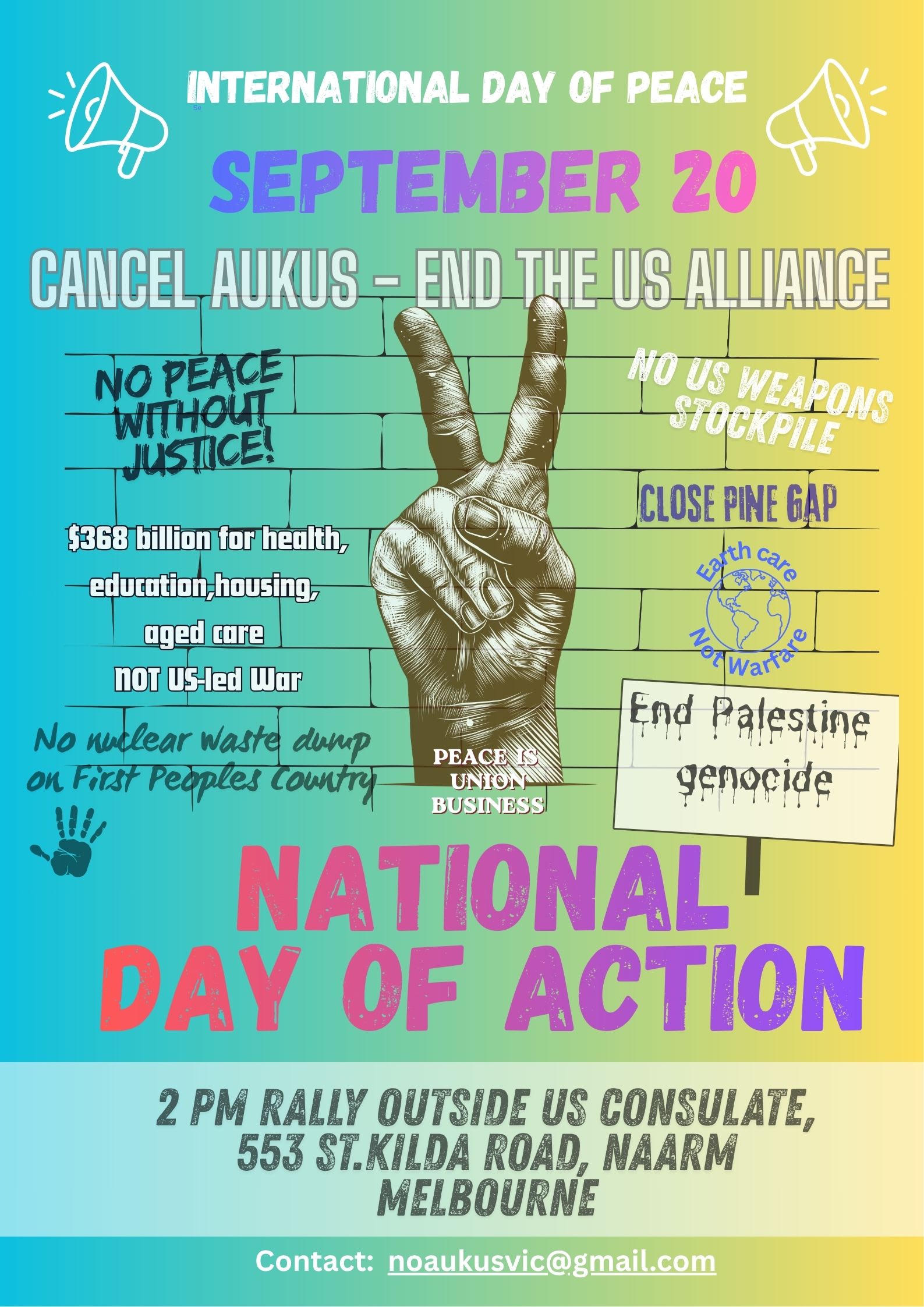
20 September –National Day of Action in Melbourne on the International Day of Peace

Help Aunty Sue Protect Her Land and Sacred Sites From Destructive Rocket Testing.
.

Australians deserve the truth
about
AUKUS – https://aukuspublicinquiry.com/

PETITION – To: Prime Minister Anthony Albanese and the Australian Labor Government

of the week – Australians for War Powers Reform (AWPR)
To see nuclear-related stories in greater depth and intensity
 Antinuclear