Australian government completely inept in selecting Kimba nuclear waste dump

Relief in Kimba, that Labor and crossbench Senators want a fair process on nuclear wastes
 No Radioactive Waste Facility for Kimba District– 14 Nov 20 · We are reassured by this week’s events that there are still many in Australian politics who believe in a fair process. The lack of support from Labor and crossbench Senators for the Government’s proposed Bill to legislate Kimba as the chosen site for the national radioactive waste dump is certainly a relief to us.
The Australian government can still bully its way to imposing a Kimba nuclear waste dump
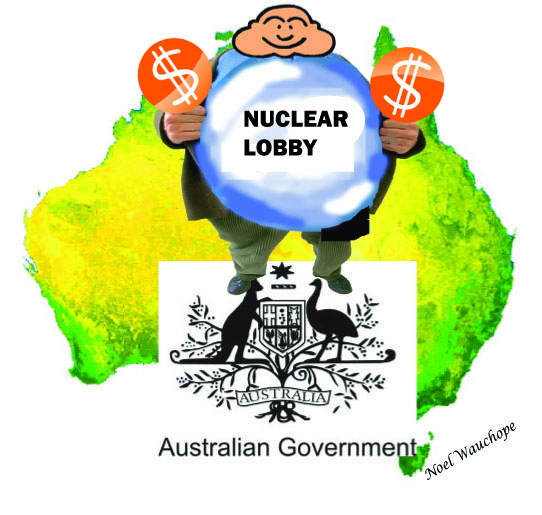 Today the Advertiser reports that the federal government does not have the numbers to get the draconian, racist National Radioactive Waste Management Bill passed in the Senate. Labor and most or all of the crossbench Senators oppose the Bill.
Senate dumps on the Australian government’s radioactive waste plan
 Senate dumps on government’s radioactive waste plan
The federal government should drop its plans for a national radioactive waste facility in regional South Australia after One Nation joined Labor, the Greens and others on the Senate crossbench in rejecting the government’s proposal for a site near Kimba.
One Nation confirmed it will not support the federal government’s bill to remove the right of affected communities to legally contest the decision to make Kimba the site for a radioactive waste facility and is instead seeking ‘to make the right decision for future generations’.
With Labor, the Greens, other crossbenchers and now One Nation opposed, the government appears to lack the numbers in the Senate to advance the plan.
“The federal plan is politically divisive, technically deficient and increasingly uncertain,” said the Australian Conservation Foundation’s nuclear campaigner Dave Sweeney.
“It has failed the test in the broader community and now also in Canberra.
“The government’s proposal is based on excluding people from consultation and review processes. It is based on the heavy handed overriding of legal principles and the unnecessary double handling of long-lived intermediate level waste.
“Access to a day in court is a fundamental democratic right that should not be jettisoned – especially on an issue with such significant and lasting impacts as radioactive waste.
“Many state and national civil society groups, Aboriginal and professional groups, the South Australian Upper House, SA Labor and Unions SA opposed the government’s approach.
“The government should now stop playing politics and start paying attention.
“This waste lasts longer that any politician and needs to be responsibly managed.
“We need a new approach that is based on evidence, inclusion and respect.”
Further information, context or comment: Dave Sweeney on 0408 317 812
Read ACF’s 3-page background brief on the federal radioactive waste plans
Australian govt’s Kimba nuclear waste dump plan will be torpedoed in the Senate
 Pauline Hanson’s One Nation torpedoes Kimba nuclear waste dump in SA, Claire Bickers, Federal Politics Reporter, The Advertiser, November 11, 2020
Pauline Hanson will torpedo the Federal Government’s bid to build a radioactive waste dump in regional South Australia.
The One Nation leader, who aims to win a seat in SA at the next federal election, has confirmed she will not back legislation to build the nuclear waste storage site at Napandee farm, near Kimba.
Without One Nation’s two crucial votes – and Labor, the Greens, and independent senator Rex Patrick not backing the Bill – the government does not have enough votes for it to pass parliament without changes.
Senator Hanson told The Advertiser she had serious concerns about the process to select Napandee, the level of community support, the waste site being built on farming land, and the facility storing intermediate radioactive waste above ground.
“I want to make the right decision, not for the interim, I want to make the right decision for future generations,” Senator Hanson said.
“I’m not going to be badgered or pushed into this.
“It’s about looking after the people of SA, but also the whole of Australia.”
Senator Hanson said One Nation wanted to win a seat in SA at the next election, and she hoped South Australians would take into account her strong stance on the waste site.
One Nation adviser Jennifer Game, who ran as the party’s SA Senate candidate at the 2019 election, has been leading research and consultation on the Kimba site.
“I think the government has rushed the decision to have it there,” Senator Hanson said.
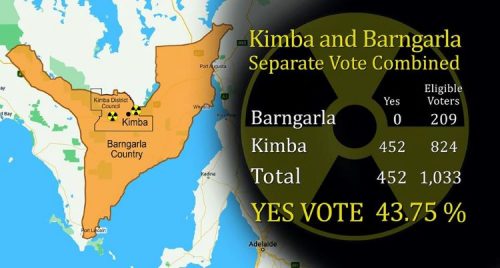
Almost 62 per cent of 734 Kimba residents supported the facility in a postal vote in 2019 but Senator Hanson said locals had indicated to the party that closer to half of the town did not support the facility.
The region’s native title holders, the Barngarla people, were also not given a say in the official vote.
Senator Hanson was concerned other locations that may be suitable were not investigated, such as an old mining site in Leonora, in Western Australia, which may be able to store the waste underground.
“We don’t know what the future is going to hold, we don’t know if war is going to touch our shores,” she said.
“Do we really want a facility that is above ground that could be problems further down the track, if anything happens?”…https://www.adelaidenow.com.au/news/south-australia/pauline-hansons-one-nation-torpedoes-kimba-nuclear-waste-dump-in-sa/news-story/9043c46fa44ecd8a1b4e46be111745f3
Karina Lester speaks out: ”Traditional owners’ voices not heard and rights stripped over nuclear waste dump”
”Traditional owners voices not heard and rights stripped over nuclear waste dump”
 Extract:
Chairperson of Yankunytjatjara Native Title Aboriginal Corporation (YNTAC) Karina Lester says, “The two key issues that I’m quite concerned about are the lack of consent from the traditional owners; and that they want to take away judicial review. No Barngarla person or anyone in that Kimba region can take it to the courts for it to be properly heard. That’s a given right for any Australian; to take an issue through a judicial process and they’re now trying to shift the goalposts away from Aboriginal people and people from the Kimba region so it can’t be challenged.”
Four Aboriginal groups submitted their concern about the lack of Indigenous community engagement in the consultation and selection process, as well as potential violation of those communities’ rights, these were the Yankunytjatjara Native Title Aboriginal Corporation (YNTAC), Tjayuwara Unmuru Aboriginal Corporation (TUAC), De Rose Hill-Ilpalka Aboriginal Corporation (DRHIAC) and the First Nations of South Australia Aboriginal Corporation (FNSAAC).
They acknowledged that the specified site has significance for a wider group of Aboriginal People than just the Barngarla, and that the proposed use is a matter of significance for Aboriginal People right across the state.
“They’ve been saying that this is just a Barngarla issue, just a Kimba issue – but it’s not. No, this is an issue for First Nations people everywhere. We need to stand in solidarity and send a strong message as the First Nations people of South Australia to say that no dump is wanted in our state,” said Ms Lester, who is the daughter of anti-nuclear and Indigenous rights advocate, Yami Lester.
“We have been pressured to be the ‘solution’ to waste management; it’s not been clear why the Federal Government keeps coming back to our state. I think that’s part of the problem.
“The process has been flawed from the very beginning. The risk is that if we open the door to this, we could well be opening the door to a permanent solution here in SA. Why put a temporary solution here when the facility says they can keep storing it at Lucas Heights in Sydney?
“There’s so much history of Aboriginal people’s activism against this in South Australia. For it to come back to our state, after leaving our state so many years ago, it feels like an ongoing generational battle for us to put an end to this issue in South Australia.”
Sneator Sam McMahon going all out for Small Nuclear Reactors

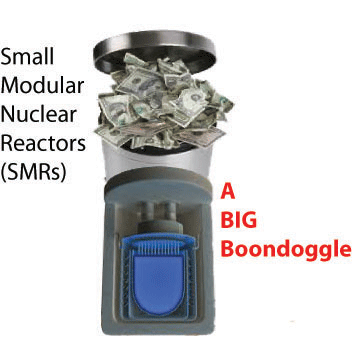
Senator McMahon is looking beyond currently commercialised nuclear technology, to Small Modular Reactors (SMRs). None of these exist in service anywhere in the world and as the WNISR2020 report points out, will cost more per kilowatt than conventional nuclear energy – and beyond a few prototypes SMRs are unlikely to come into play.
So, as renewables are perceived to be expensive when backed by storage, the solution is to shoot for a technology that may never hit prime time and even if it does, will be even more expensive than conventional nuclear, push up energy prices and erode carbon mitigation outcomes?
Perhaps channelling Senator Matt Canavan, this is some of what the senator had to say about renewables in late October:
“Renewables are the dole bludgers of the energy mix,” said Senator McMahon. “They are a great hoax perpetrated by the industry on the gullible.” Continue reading
Previous Chief Scientist not a fan of Small Nuclear Reactors
 Dr Finkel said it was “hard to see” small nuclear modular reactors being ready before 2040, and even after that Australia would have to monitor commercial installations overseas before allowing the technology.
“So, is it something we should be looking at hard at the moment? I am certainly not looking at it intensely at the moment,” he said. https://www.smh.com.au/politics/federal/gas-critical-for-renewable-energy-future-chief-scientist-says-20200212-p54026.html?fbclid=IwAR00ucWlw1Lsq_gNEPkPQ8ru301_hEmu9gXMxdG3CunZHBXyf_zE4E9QB3E
Since Penny Sackett, Australia’s Chief Scientists have moved further towards the extractive industries

above – new Chief Scientist Cathy Foley
Penny Sackett, Chief Scientist 2008 – 2011, was the first and clearest voice to speak out on climate change.
Then we had Ian Chubb, who was a lot quieter about this.
Then we got Alan Finkel, – who agreed that climate change was a threat, but thought that gas was a big solution. However, he was very luke warm about nuclear power
Now we get Cathy Foley, a physicist with a background in the minerals industries, who talks about “no single solution” and ”a “whole range” of solutions ”. Could that mean carbon capture, and small nuclear reactors? Watch this space.
Uncertainty over Kimba nuclear waste dump as farmers go to Canberra to oppose it
|
Kimba nuclear debate set to continue, Eyre Peninsula Tribune, Alisha Fogden, 9 Nov 20,
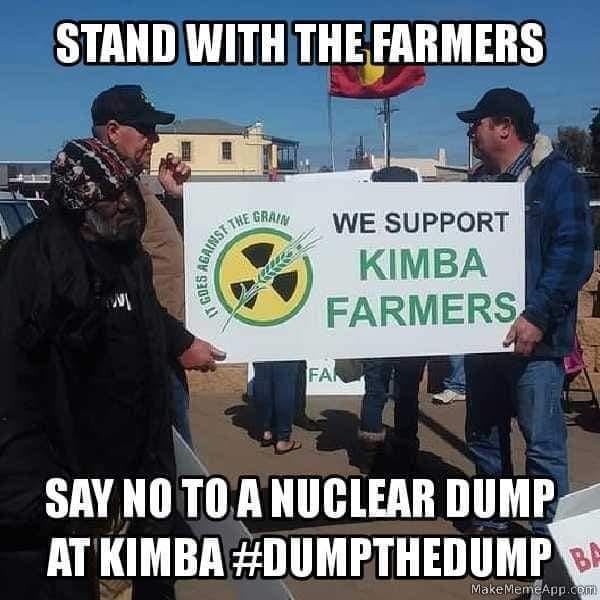
A group of Kimba farmers and community members travelled to Canberra this week to meet with the Labor Party, The Greens and cross-bench Senators “to put a face to those directly impacted by the proposed legislation to name Kimba as the site for Australia’s radioactive waste dump”.
No Radioactive Waste on Agricultural Land in Kimba or SA Committee secretary Toni Scott said the government process to site the facility in Kimba over the past five years had been “unfair, manipulative and completely lacking in transparency”. “We are extremely concerned that the government’s proposed legislation, currently awaiting Senate consideration, intentionally removes our right to contest the decision and denies basic protections,” she said.
“Productive farming land in Kimba is not the best, or even the right, place for our nation’s radioactive waste. We urge the federal government to review their selection process, rather than trying to force this decision through parliament.” The trip follows a visit by Federal Resources Minister Keith Pitt to the Kimba region last week, where he said he remained confident the federal government would get their legislation for the facility through the upper house when the Senate resumed this week. This is despite Labor withdrawing its support for the bill at the ‘eleventh hour’ and further dissenting reports from The Greens and Independent Senator Rex Patrick………https://www.eyretribune.com.au/story/7005850/group-push-nuclear-rethink/ |
|
|
Senator Sam McMahon enthuses about Generation IV nuclear reactors for the Northern Territory
“In fact, when it comes to emissions, reliability and power output, nuclear is a clear winner.
“These facts are true of existing nuclear power stations, however, it is the emerging Generation IV nuclear reactors that I believe should be given greater consideration.”…….
“Currently, there are no SMR’s in service anywhere in the world but there are several projects being developed in Europe, China and the USA. The Australian Nuclear Science and Technology Organisation monitors advances in the various technologies and regularly reports on its findings. Australia is in a position to not only observe and learn, but also to contribute to this growing body of knowledge and technology.
“The NT is uniquely positioned to benefit from a nuclear industry in Australia, should we decide to go down that path.” https://www.goulburnpost.com.au/story/7004671/nuclear-must-be-part-of-debate-on-australias-future-energy-needs-mcmahon/?cs=9397
Australian government ponders nuclear submarines
Why indeed! I would venture that there hasn’t been a detailed discussion of nuclear propulsion around the Australian cabinet table since the nuclear crisis in ANZUS in 1984, in which New Zealand cast away the alliance over the vastly improbable risk that a US warship might sneak a nuclear weapon into Auckland Harbour. I was closely involved in the defence white papers produced in 2000 and 2016 and had a ringside seat at the 2009 white paper. To my knowledge, nuclear propulsion wasn’t part of any formal cabinet consideration. The 2009 white paper quickly dismissed any interest—‘The Government has ruled out nuclear propulsion for these submarines’—at the same time as it stressed the importance of range and ‘prolonged covert patrols over the full distance of our strategic approaches and in operational areas’.
At a major maritime conference in 2019, the chief of navy, Vice Admiral Mike Noonan, tentatively ventured the thought that a slow build of 12 boats might allow nuclear propulsion to be considered at a later stage (‘A change in the propulsion system for the Attack-class submarines; it’s something that will no doubt be discussed over the next 30 years, bearing in mind that by the time we deliver No. 12 it will be 2055’), but the government quickly said that this wasn’t under consideration. In fact, there doesn’t appear to be a strong constituency for nuclear propulsion inside the navy, which is still culturally an organisation built around surface ships. The wider defence organisation has the Attack-class project to deliver, which is complex enough without adding a major new challenge to master nuclear propulsion.
Parliament is filled with many MPs on both sides of politics who will privately advocate for nuclear propulsion but publicly shy away from discussing the capability. The fear is that it isn’t possible to build a bipartisan consensus for nuclear propulsion in ways that prevent one side of politics rejecting the idea, leaving the other side with a potential political liability.
That was certainly the outcome of the 2019 House of Representatives Standing Committee on the Environment and Energy review of the future of nuclear technology in Australia. Government members of the committee recommended ‘adopting a strategic approach to the possibility of entering the nuclear energy industry’. This was countered with a Labor Party dissenting report claiming that ‘There is simply no case for wasting time and resources on a technology that is literally the slowest, most expensive, most dangerous, and least flexible form of new power generation.’
Nuclear propulsion for submarines wasn’t considered, but it’s clear at least in the short term that there’s no prospect for bipartisan cooperation on this issue………
The strategic ground is changing quickly under our feet, and those developments might, in future, force a more urgent government consideration of the submarine capability Australia needs. The 2016 white paper pointed to the need to keep the submarine capability under examination, stating that a review would be needed ‘in the late 2020s to consider whether the configuration of the submarines remains suitable or whether consideration of other specifications should commence’…….. https://www.aspistrategist.org.au/why-didnt-australia-consider-nuclear-propulsion-for-its-new-submarines/
Australia’s freedom of information system hides climate documents
 Australia’s government agencies increasingly refusing environment-related FOIs, audit finds . Australian Conservation Foundation also finds growing delays in processing requests by departments and agencies. Guardian, Christopher Knaus, 9 Nov 20,Australia’s freedom of information system is increasingly hiding documents about climate and other environmental issues from the public, a trend driven by skyrocketing refusal rates, widespread delays and rising costs, an audit has found.
The audit, conducted by the Australian Conservation Foundation (ACF), examined five years of FOI requests for environment-related documents across federal and state departments and agencies.
It found the number of outright refusals for environment-related documents has more than doubled, from 12% to 25%, while the number of requests granted in full has dropped from 26% to 16%.
Delays in processing environment-related FOI requests were widespread, the audit found, with 60% of requests late by more than a month and 39.5% by more than two months.
The cost of processing environment-related FOIs was double the average, and lengthy review processes, which often took more than a year to complete, were becoming “a key tool for denying access to information”.
“It appears from our audit that environmental information is even more odiously inaccessible than other information subject to the [Freedom of Information] Act,” the ACF’s audit said.
ACF’s democracy campaigner, Jolene Elberth, said the findings of the audit should be a “wake-up call” to anyone who cares about transparency.
“Serious systemic flaws in our system are frustrating efforts to protect our precious natural ecosystems and tackle the climate crisis,” Elberth told the Guardian………
The Office of the Australian Information Commissioner’s (OAIC) latest annual report shows delays, complaints and refusals are all increasing over time.
Complaints about the FOI system increased by 79% in a single year, according to the OAIC’s annual report.
Practical refusals – used if a request is deemed to take too much time or effort to process or if documents cannot be found – went up by 71% in 12 months.
Delays are growing more protracted.
Last financial year, about 79% of all FOIs were processed in the time required by law. The year before it was 83% and in 2017-18 it was 85%.
In some government agencies, only 50% of FOI requests are being processed within the lawful timeframe, including the prime minister’s office, the office of the environment minister, the Australian Radiation Protection and Nuclear Safety Agency, the Australian Sports Anti-Doping Authority, Sports Australia, the Australian federal police, the Australian Broadcasting Corporation, the office of the infrastructure minister and Norfolk Island Regional Council.
Delays at the Department of Home Affairs, which receives by far the most FOI requests, have also increased…… https://www.theguardian.com/australia-news/2020/nov/09/australias-government-agencies-increasingly-refusing-environment-related-fois-audit-finds
New chief scientist says climate change has “no single solution” — RenewEconomy

This is a real worry. Cathey Foley has a background in the minerals industry. The ”no single solution” could be code for including gas, carbon capture, nuclear….
Australia’s new chief scientist, Cathy Foley, says climate change is a problem with “no single solution,” and one of the world’s greatest challenges. The post New chief scientist says climate change has “no single solution” appeared first on RenewEconomy.
New chief scientist says climate change has “no single solution” — RenewEconomy

Farmers to Canberra, to protest the law that forces a nuclear dump on Kimba’s agriculutral land
We are members of the Kimba community and proud and productive grain farmers who have travelled to Canberra to meet with Labor, Green and cross-bench Senators to put a face to those directly impacted by the proposed legislation to name Kimba as the site for Australia’s radioactive waste dump.
In our view the process the Government has employed to site this facility in Kimba over the last five years has been unfair, manipulative and completely lacking in transparency.
We are extremely concerned that the Governments proposed legislation currently awaiting Senate consideration intentionally removes our right to contest the decision and denies basic protections .
It is clear that productive farming land in Kimba is not the best, or even the right place for our nations radioactive waste. We urge the federal government to step back and review their selection process rather than continue trying to force this decision through via Parliament.
Quotes can be attributed to Toni Scott – Secretary, No Radioactive Waste on Agricultural Land in Kimba or SA Committee Media Contact – Kellie Hunt – 0428 572 411
1 This month.
20 September –National Day of Action in Melbourne on the International Day of Peace


Help Aunty Sue Protect Her Land and Sacred Sites From Destructive Rocket Testing.
.

Australians deserve the truth
about
AUKUS – https://aukuspublicinquiry.com/


PETITION – To: Prime Minister Anthony Albanese and the Australian Labor Government

of the week – Australians for War Powers Reform (AWPR)
To see nuclear-related stories in greater depth and intensity
 Antinuclear