Antarctica – global heating and nuclear issues – theme for September 20
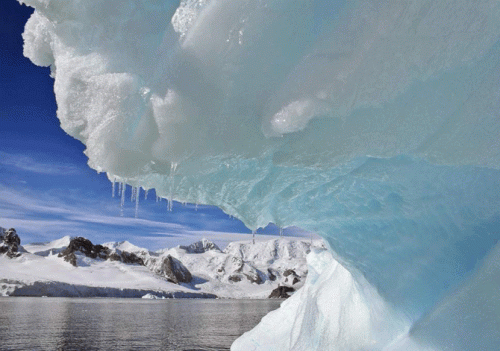
Antarctica is not in the news as much as the Arctic is, But global heating is affecting Antarctica too, and Antarctica has its nuclear issues.
Antarctica has made headlines several times this year due to extremely warmer than usual temperatures. It has been steadily heating up for decades. Antarctic ice shelves have lost nearly 4 trillion metric tons of ice since the mid-1990s, scientists say. Ocean water is melting them from the bottom up, causing them to lose mass faster than they can refreeze. As ice shelves melt, they become thinner, weaker and more likely to break. When this happens, they can unleash streams of ice from the glaciers behind them, raising global sea levels. Antarctica is also losing ice from melting ice sheets, and chunks of ice falling from glaciers.
Less studied than the Arctic region, Antarctic is now being investigated by Australian researchers, using robots to gather data from difficult to reach underwater areas. Satellite monitoring confirms the shelves’ melting trend.
Nuclear issues. From 6,000 nautical miles away, uranium mining in Australia is polluting the Antarctic. After 1945 atomic bomb testing sent radioactive pollution to the South Pole, as well as to everywhere else on the planet.
USA operated a small nuclear power plant at Antarctica’s McMurdo Sound. It was known as “nukey poo” because of its frequent radioactive leaks. It had 438 malfunctions – nearly 56 a year – in its operational lifetime, including leaking water surrounding the reactor and hairline cracks in the reactor lining. The emissions of low level waste water where in direct contravention of the Antarctic Treaty, which bans military operations as well as radioactive waste in Antarctica. After the reactor was closed down, the US shipped 7700 cubic metres of radioactive contaminated rock and dirt to California. Many USA naval workers there developed cancers.
Today, small nuclear reactors similar to this one, are being touted for remote areas in Australia and other countries. The history of this one in Antarctica, and 7 others elsewhere, was one of malfunctions, and closing down within a few years. This does not augur well for the small nuclear reactors being promoted today.
Australia’s Dept of Industry hiding the facts on choice of Kimba nuclear waste site
 Kazzi Jai No Nuclear Waste Dump Anywhere in South Australia, 22 Aug 20,
 FRIDAY NIGHT QUIZ QUESTION: How many times did the DIIS quote this EXACT SAME STATEMENT in their “Answers to Questions Notices” tabled recently for the Senate Inquiry?….more https://www.facebook.com/groups/1314655315214929/
Adam Bandt urges another Labor-Greens coalition for climate action
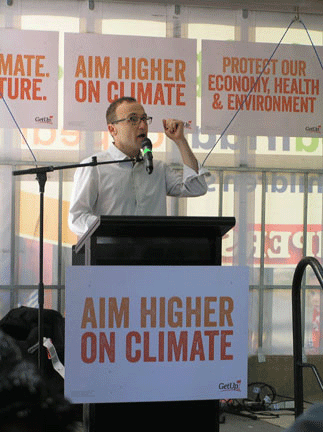 Adam Bandt urges another Labor-Greens coalition for climate action, https://www.theage.com.au/politics/federal/adam-bandt-urges-another-labor-greens-coalition-for-climate-action-20200820-p55nrc.html, By Rob Harris, August 21, 2020 —Greens leader Adam Bandt will mark 10 years since his party signed a deal to prop up the Gillard government by flagging he would be willing to again form a power-sharing deal with Labor to combat climate change.The Melbourne MP will use his address to the Greens National Conference on Saturday to urge Labor leader Anthony Albanese to commit to acting on carbon pollution by again entering into progressive pact
Labor is currently locked in a fierce internal battle over its support for coal and gas production as it wrestles with three successive election losses and poor results at the polls last year in resource-rich regional Queensland seats.
Veteran frontbencher Joel Fitzgibbon warned on Thursday his party could soon split in two, arguing it is struggling to be “all things to all people” across its inner city and regional voter bases.
Mr Bandt will tell his party faithful that it was only with the Greens holding the balance of power in both the House of Representatives and the Senate which led to “world leading climate action with a price on carbon”.
“In recent Australian history, there is one indisputable fact. The only time that climate pollution meaningfully dropped is when the Greens shared power,” Mr Bandt says in a draft copy of the speech.
“When the Greens, Labor and independents worked cooperatively and shared power like we did in 2010, we got a lot done.
As Liberal and Labor rush once more to give tax cuts to millionaires while embracing coal and gas, it is clear that Greens sharing power is the pathway to change.
Mr Bandt will also use the speech to say the climate deal reached with the Gillard government was stronger and more effective in reducing carbon emissions than the Rudd government’s scheme it blocked in the Senate.
Warning of a federal election within 12 months, Mr Bandt will say the path to climate policy progress was to put the Greens into shared power through a hung parliament.
Mr Bandt said the carbon tax legislation by Labor in 2010 with the backing of the Greens was “well-designed” and it reduced pollution for the first time in Australian industrial era history.
He will promise to “hammer” a straightforward message between now and the next election that the “only way to get real change is to vote for it and give the Greens shared power”.
“Many look longingly to New Zealand, where Jacinda Ardern leads a progressive multi-party government with Greens support, and wonder if it could happen here,” he will say.
Mr Albanese on Thursday said Labor had continually evolved and a modern party with “any self-respect” would be attempting to mitigate the effects of climate change.
In a rebuke to Mr Fitzgibbon, he said the issue of climate change was not a matter of geography because “wherever people live, they’re impacted by climate change”.
“Were about also holding the government to account. Putting forward an alternative agenda for the nation,” he said.
Slowing of population growth could be a good thing for Australia
Learning to live with less, Online Opinion,
Population growth has been a mantra of our property industry for as long as I can remember. And once again there are predictions of a surge in growth, driven (this time) by people allegedly fleeing Victoria. However, there are good reasons to think this may not happen, and that we may need to prepare for an extended period of minimal growth. This may not be a bad thing. One of the first things to understand about our recent rates of actual and predicted future population growth is that they have been extraordinary in terms of the actual numbers and also in terms of the rate (speed) of growth. On a global scale, our forecast rates of population growth in major cities exceeded many leading world cities and was on a par with places like Shanghai and Beijing. In just 15 years, Brisbane, Sydney and Melbourne were predicted to grow by around a third – roughly three times the rate of growth of cities we often like to compare ourselves with like Copenhagen (for some reason), Los Angeles, San Francisco, London or Paris. Given we started this forecast period with widely acknowledged urban infrastructure deficits (failing to keep up with population growth in the past), how we were supposed to not make the problem worse with these rates of growth is something smarter people than me might like to explain. Let’s just say the Chinese do things very differently so we can’t use Shanghai or Beijing as comparisons. These predicted rates of growth were driven by three components: international migration (net overseas migration or ‘NOM’); interstate growth (net interstate migration or ‘NIM’) and natural growth (more births over deaths). And all three now look severely compromised by the policy responses intended to manage Covid……….. each of three sources of population growth looks challenged in a post Covid Queensland, for the next few years at least. Less NOM, fewer NIM and less breeding. Is this such a bad thing though? Provided we continue with infrastructure projects, it could allow the State to begin to close the infrastructure gap which has widened significantly in recent decades. The pressure is everywhere to see – rising congestion, hospital waiting lists, rising school class numbers, and hostility to development generally. If Covid forces a breather on the rapid rates of population growth we’ve been used to, perhaps it will mean we can actually enhance our quality of life and standards of amenity in the process? It’s also worth keeping in mind that there are many global examples of low growth cities and regions which remain highly attractive and economically prosperous. The surplus of demand by people wanting to live and work there, relative to supply (deliberate limits on housing supply and population caps) invariably makes these very expensive real estate markets, completely unaffordable for many. But from a selfish property market point of view, they are still viable markets for development and redevelopment. Locally, think Noosa. Being horrendously expensive for residential or commercial property hasn’t stopped some of our other property markets before? https://www.onlineopinion.com.au/view.asp?article=21069&page=2 |
|
Reject the racist, undemocratic National Radioactive Waste Management Amendment Bill
|

Conflict of interest in Kimba Community Liaison Officer’s connection to nuclear waste dump push
 Kazzi Jai, Fight to Stop a Nuclear Waste Dump in South Australia, 20 Aug, 20
Here is what the Community Liaison Officer job was meant to entail: Job Description……”The Community Liaison Officer will represent a project, through consultation activities including meetings with members of the public, information sessions, and presentations. The Officer must possess local knowledge and be of an approachable demeanor to ensure meaningful engagement with all interested community members.”
Desired Skills and Abilities:…..”Ability to be approachable by all members of the Kimba community, regardless of their views on the Project, to provide information about the Project in a professional and independent manner.”
This really in fact comes as no surprise, given what actually happened in Hawker at the SAME time with THEIR Community Liaison Officer! – Submission 109 of previous Inquiry*
*Senate Committee Inquiry on Selection Process for Nuclear Waste Dump Site, August 2018 https://www.aph.gov.au/Parliamentary_Business/Committees/Senate/Economics/Wastemanagementfacility/Submissions
Pointless: Removal of New South Wales Uranium mining ban, as uranium glut continues, and nuclear industry declines
Nuke South Wales?, ACF, Dave Sweeney, 20 Aug 20,
The proposed removal of a long-standing and popular ban on uranium mining in New South Wales is empty gesture politics that flies in the face of community interest and market reality, the Australian Conservation Foundation (ACF) said.
The global uranium price remains depressed following the Fukushima nuclear disaster and is not likely to recover.
“The nuclear power age is winding up, so it makes no sense for NSW to jump aboard a sinking ship,” said ACF nuclear campaigner Dave Sweeney.
“The ban is popular and has served NSW well, providing policy certainty and avoiding the radioactive waste and legacy mine issues affecting other places, including Kakadu, where a massive $1 billion clean-up is underway at the former Ranger mine.
“This is empty gesture politics that could lead to lower tier and inexperienced mining companies cutting corners and increasing environmental and community risk.
“This poorly conceived plan puts political posturing above community benefit and could lead to increased pollution and risk for NSW communities and environment for scant gain.
“NSW’s energy future is renewable, not radioactive – this tired political fix is no substitute for a credible and effective energy policy.
“Deputy Premier Barilaro might see this as in the Nationals’ interest, but it is certainly not in the national interest.”
In November 2019 the CEO of the world’s largest uranium miner, Canadian company Cameco, stated, “Not only does it not make sense to invest in future primary supply, even the lowest-cost producers are deciding to preserve long-term value by leaving uranium in the ground.”
The global market is over supplied as existing producers exit or defer projects and higher-grade uranium ore deposits remain in the ground across Australia and around the world.
For context or comment contact Dave Sweeney on 0408 317 812
Uranium mining to become legal in NSW, as govt supports OneNation in nuclear push.
Uranium Mining. NSW govt to support One Nation in Nuclear Push. Daily Telegraph, 19 Aug 20,
Uranium mining looks set to become legal in NSW after a deal was struck between Premier Gladys Berejiklian and Deputy Premier John Barilaro to get it through cabinet. … (subscribers only) NSW to start mining uranium after agreement on plan to lift ban [$]
.
Military to Weapons Sales – Professor Peter Leahy and the revolving door
Professor Peter Leahy AC Australian Defence Force | Military | Revolving Doors, Michael West Media, 19 Aug, 20
Lieutenant-General Peter Leahy retired from the Australian army in July 2008 having concluded his 37 year military career with six years as Chief of Army. Within a year he was on the boards of Codan and Electro Optic Systems (EOS). More recently, EOS has been exporting its weapon systems to Saudi Arabia and the United Arab Emirates while the Yemen war has raged despite multiple reports of war crimes by these countries and a situation in Yemen which the UN has called the world’s worst humanitarian catastrophe.
Current Positions
Public
Professor and foundation director, National Security Institute, University of Canberra (7.10.08–present^)
^ Website accessed 10.08.20
Corporate
Member, Advisory Board, WarpForge Limited ([??]–present^)
Director, Citadel Group (28.6.14*–present^; including as Chair from 12.11.19)
Director, Electro Optic Systems (4.5.09*–present^)
Director, Codan Limited (19.9.08*–present^)………. https://www.michaelwest.com.au/peter-leahy/
BHP’s Uranium mine Olympic Dam makes a financial loss for second year running
 Olympic Dam records a second financial year loss, of US$79 million on revenue of US$1.46 billion in 2019-20. Giving a total three-year loss of approx. US$100 million on revenues of approx. US$4 billion, with last profit in 2017-18 fin yr of only US$39 million. Olympic Dam records a second financial year loss, of US$79 million on revenue of US$1.46 billion in 2019-20. Giving a total three-year loss of approx. US$100 million on revenues of approx. US$4 billion, with last profit in 2017-18 fin yr of only US$39 million.
Olympic Dam Mining revenues are at approx. only 2.5 per cent of total BHP corporate revenues, Not very convincing… Olympic Dam reports $US79 million loss, is on the lookout for new leader Olympic Dam’s turnaround story is not yet complete, with BHP’s mega mine posting another loss for the past financial year as it starts the hunt for a new leader. Cameron England, Business Editor, The Advertiser August 18, 2020 The Olympic Dam mine in South Australia’s Far North has increased its full year loss and is on the lookout for a new leader, global miner BHP has announced. In reporting its full year results, BHP said Olympic Dam, which produces copper, uranium, gold and silver, had made a full year loss before interest and tax of $US79 million, on revenues of $US1.463 billion. This is up from a loss the previous financial year of $US58 million on revenues of $1.351 billion. The mine last reported a profit, of $US39 million off revenues of $US1.255 billion in 2017-18, and has for many years underperformed in comparison with BHP’s high-margin assets such as Western Australian iron ore……… BHP also announced Laura Tyler – asset president Olympic Dam since 2018 – would be promoted to chief technical officer, and a new leader would be sought for the mine……. “A replacement for the Asset President Olympic Dam will be the subject a future announcement.’’In the interim, Justin Bauer, currently general manager surface development & planning, will become acting asset president…….. But the company is yet to give solid commitments around timelines, financial investments and job numbers for the expansion, as it continues work on internal feasibility studies. |
International Lawyers Make Urgent Appeal to British Government- not to extradite Julian Assange

|
ASSANGE EXTRADITION: International Lawyers Make Urgent Appeal to British Government Consortium News August 16, 2020, An array of international lawyers have written to the British prime minister, foreign secretary, secretary of state for justice and home secretary outlining his illegal treatment and demanding Julian Assange’s release. LAWYERS FOR ASSANGE Independent international legal observers of
the proceedings in the case of Julian Assange Open Letter to the UK Prime Minister Mr Boris Johnson, the Lord Chancellor and Secretary of State for Justice Robert Buckland QC, the Secretary of State for Foreign Affairs Dominic Raab and UK Home Secretary Priti Patel.Dear Prime Minister,
Dear Lord Chancellor and Secretary of State for Justice, Dear Secretary of State for Foreign Affairs, Dear Home Secretary, We write to you as legal practitioners and legal academics to express our collective concerns about the violations of Mr. Julian Assange’s fundamental human, civil and political rights and the precedent his persecution is setting. We call on you to act in accordance with national and international law, human rights and the rule of law by bringing an end to the ongoing extradition proceedings and granting Mr. Assange his long overdue freedom – freedom from torture, arbitrary detention and deprivation of liberty, and political persecution. A) ILLEGALITY OF POTENTIAL EXTRADITION TO THE UNITED STATES Extradition of Mr. Assange from the UK to the U.S. would be illegal on the following grounds: 1. Risk of being subjected to an unfair trial in the U.S. Extradition would be unlawful owing to failure to ensure the protection of Mr. Assange’s fundamental trial rights in the U.S. Mr. Assange faces show trial at the infamous “Espionage court” of the Eastern District of Virginia, before which no national security defendant has ever succeeded. Here, he faces secret proceedings before a jury picked from a population in which most of the individuals eligible for jury selection work for, or are connected to, the CIA, NSA, DoD or DoS.[i]Furthermore, Mr. Assange’s legal privilege, a right enshrined in Art. 8 European Convention on Human Rights (ECHR) and long recognised under English common law, was grossly violated through constant and criminal video and audio surveillance at the Ecuadorian embassy carried out by the Spanish security firm, UC Global. This surveillance was, according to witness testimony, ordered by the CIA and has triggered an investigation into the owner of UC Global, David Morales, by Spain’s High Court, the Audiencia Nacional.[ii] The surveillance resulted in all of Mr. Assange’s meetings and conversations being recorded, including those with his lawyers. …………… The UN Model Treaty on Extradition prohibits extradition if the person has not received, or would not receive, the minimum guarantees in criminal proceedings, as enshrined in Art. 14 of the International Covenant on Civil and Political Rights (ICCPR).[v] 2. The political nature of the offence prohibits extradition. The U.S. superseding indictment issued against Mr. Assange on the 24 June 2020 charges him with 18 counts all related solely to the 2010 publications of U.S. government documents. The publications, comprising information about the wars in Iraq and Afghanistan, U.S. diplomatic cables and Guantanamo Bay, revealed evidence of war crimes, corruption and governmental malfeasance.[vi]Charges 1-17 are brought under the Espionage Act 1917, which, in name alone, reveals the political and antiquated nature of the charges…………. several U.S. government officials have at various times ascribed motives “hostile” to the U.S. to Mr. Assange, an Australian citizen.[viii]. The UK-U.S. Extradition Treaty, which provides the very basis of the extradition request, specifically prohibits extradition for political offences in Art. 4(1). ……….. Furthermore, there is broad international consensus that political offences should not be the basis of extradition.[ix] …………. 3. Risk of torture or other cruel, inhuman or degrading treatment or punishment in the U.S. The United Nations Special Rapporteur on Torture and Other Cruel, Inhuman or Degrading Treatment or Punishment (“the UN Rapporteur on Torture”), Professor Nils Melzer, has expressed with certainty that, if extradited to the U.S., Mr. Assange will be exposed to torture or other cruel, inhuman or degrading treatment or punishment. Similar concerns have also been raised by the UN Working Group on Arbitrary Detention, and Amnesty International has recently restated its concerns in relation to the unacceptable risk of mistreatment.[x] The detention conditions, and the draconian punishment of 175 years, in a maximum security prison, which Mr. Assange faces under the U.S. indictment, would constitute torture or other cruel, inhuman or degrading treatment or punishment, according to the current UN Rapporteur on Torture and according to the consistently expressed opinion of his predecessor, as well as of NGOs and legal authorities.[xi]…………….. Under the principle of non-refoulement, it is not permissible to extradite a person to a country in which there are substantial grounds forbelieving that they would be subjected to torture. This principle is enshrined in the 1951 UN Convention Relating to the Status of Refugees, specifically Art. 33(1) from which no derogations are permitted. Also relevant are Art. 3(1) UN Declaration on Territorial Asylum 1967, Art. 3 of the Convention against Torture and Other Cruel, Inhuman or Degrading Treatment or Punishment (CAT), and Art. 2 of the Resolution on Asylum to Persons in Danger of Persecution,………… B) VIOLATIONS OF THE FREEDOM OF THE PRESS AND THE RIGHT TO KNOW Counts 1-17 of the indictment under the Espionage Act violate the right to freedom of expression, the right to freedom of the press and the right to know………………
The UN Rapporteur on Torture has reported, and continues to report, on the treatment of Mr. Assange as part of his United Nations mandate. On 9 and 10 May 2019, Prof. Melzer and two medical experts specialised in examining potential victims of torture and other ill-treatment visited Mr. Assange in Her Majesty’s Prison Belmarsh (“HMP Belmarsh”). The group’s visit and assessment revealed that Mr. Assange showed “all symptoms typical for prolonged exposure to psychological torture, including extreme stress, chronic anxiety and intense psychological trauma.”[xxiv] The UN Rapporteur on Torture concluded “Mr. Assange has been deliberately exposed, for a period of several years, to persistent and progressively severe forms of cruel, inhuman or degrading treatment or punishment, the cumulative effects of which can only be described as psychological torture”………………. We call on the UK government to take immediate action to cease the torture being inflicted upon Mr. Assange, to end his arbitrary and unlawful detention, and to permit his access to independent medical diagnosis and treatment in an appropriate hospital setting. That doctors, their previous concerns having been ignored, should have to call on governments to ‘End torture and medical neglect of Julian Assange’ in The Lancet is extremely worrying.[xxxvii] D) VIOLATIONS OF THE RIGHT TO A FAIR TRIAL We condemn the denial of Mr. Assange’s right to a fair trial before the UK courts. This right has been denied as follows. 1. Judicial Conflicts of Interest Senior District Judge (Magistrates’ Courts) Emma Arbuthnot, who as Chief Magistrate oversees Mr. Assange’s extradition proceedings, has been shown to have financial links to institutions and individuals whose wrongdoings have been exposed by WikiLeaks, the organisation which Mr. Assange founded.[xxxviii] This seemingly clear conflict of interest was, however, not disclosed by the District Judge. District Judge Arbuthnot did not recuse herself and was permitted to make rulings to Mr. Assange’s detriment, despite the perceived lack of judicial impartiality and independence. District Judge (Magistrates’ Courts) Michael Snow has further exhibited bias and unprofessionalism by participating in the defamation of Mr. Assange’s character, labelling the multi-award-winning public interest publisher and Nobel Peace Prize Nominee a “narcissist who cannot get beyond his own selfish interests” in response, ironically, to Mr. Assange’s legal team raising what were patently legitimate concerns regarding bias in the proceedings.[xxxix] 2. Inequality of Arms Mr. Assange has been denied time and facilities to prepare his defence in violation of the principle of equality of arms which is inherent to the presumption of innocence and the rule of law…………… 3. Denial of the defendant’s ability to properly follow proceedings and direct his legal team Mr. Assange and his lawyers have repeatedly informed the Court of his inability to properly follow proceedings, to consult with his lawyers confidentially and to properly instruct them in the presentation of his defence due to his being prevented from sitting with them and being confined to a bulletproof glass box. The arrangement has forced Mr. Assange to resort to waving to get the attention of the judge or the people sitting in the public gallery, in order to alert his lawyers who are seated in the courtroom with their backs to him…………. 4. Refusal to address mistreatment of the defendant Mr. Assange’s lawyers informed the Court that during a single day, on 22 February, prison authorities handcuffed him 11 times, placed him in 5 different cells, strip-searched him twice, and confiscated his privileged legal documents. Overseeing the proceedings, District Judge Vanessa Baraitser explicitly refused to intervene with prison authorities claiming that she has no jurisdiction over his prison conditions…………… We remind the UK government that the right to a fair trial is a cornerstone of democracy and the rule of law. It is a basic human right enshrined in Art. 10 UDHR, Art. 14 ICCPR, Art. 6 ECHR and Art. 6 HRA. These provisions, along with long-standing common law principles, demand a fair and public hearing before an independent and impartial tribunal, the presumption of innocence until proven guilty, the right to be informed promptly and in detail of the nature and cause of the charges, the right to be provided with adequate time and facilities for the preparation of one’s defence, and the right to have the ability to communicate with one’s counsel. For all these reasons we respectfully request that the UK government bring an end to the U.S. extradition proceedings against Mr. Assange and ensure his immediate release from custody. Yours sincerely, Lawyers for Assange ………… (15 collective signatories – international legal organisations) Individual signatories 1555 https://consortiumnews.com/2020/08/16/assange-extradition-international-lawyers-make-urgent-appeal-to-british-government/?fbclid=IwAR0oFpG84PRDIyQ-OOgQmPj3iye_UsgOIro8-VYn2_Z6HQdkrB8ERQvV4KY |
|
17 August: The Senate Nuclear Waste Inquiry- Public Hearings go Secret
This is my impression of events

Remembering Hiroshima and Nagasaki – and celebrating the Global Nuclear Ban Treaty
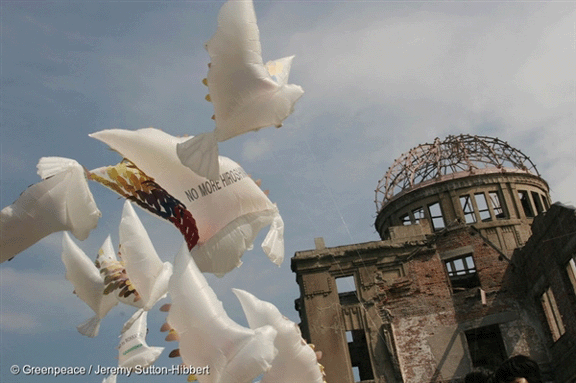
August 6th and August 9th are the days that remind us of the horror of nuclear weapons. The failing and desperate nuclear industry would like us to forget about Hiroshima and Nagasaki. They’d like us to swallow their spin about new small nuclear reactors. (But new small nuclear reactors are just the latest gimmick to support the nuclear weapons industry, and put a friendly mask on it. They really have no other purpose.)
 In this time of pandemic and global heating, Biden’s USA, Putin’s Russia, and other nations, are putting obscene amounts of money into nuclear weapons. The U.N.’s Treaty on the Prohibition of Nuclear Weapons (passed by a vote of 122-1-1 at the United Nations in 2017) is looking ever more rational and necessary. It entered into force on 22 January 2021.
“The pandemic has taught us that all the world’s great needs and threats are linked. By reallocating bloated military spending and reorienting nations to resolve conflict through peaceful negotiation, people and governments throughout the world can more easily tackle the enormous economic and civil injustices that give rise to conflict and fuel the fire of climate change. Each victory in each arena must be used to feed progress elsewhere if humanity is to survive this century.
As we remember the victims of the atomic bombings and hear the stories of the survivors, we realize more than ever: we are all in this together. ” – Michael Christ, Executive Director, International Physicians for the Prevention of Nuclear War
Senate Nuclear Waste Inquiry gets vague and incomplete answers from Department of Industry
It is difficult to understand why important legislation now before Parliament should include or involve information that cannot be publicly disclosed as this is completely counter to the open and uninhibited nature of parliamentary business and the inquiry committee would at the very least be given a summary of the suppressed information which could then be dealt with by the privileges committee.
If it is being suggested that legal privilege is needed with respect to a judicial review preventing the development of the facility then surely this must be part of the legislative process in dealing with the bill since one of the central issues is eliminating any rights of judicial or administrative review
Peter Remta, 13 Aug 20, My comments on some of the written answers by the department to the questions put on notice at the Senate committee hearing on 30 June 2020.
SENATE COMMITTEE INQUIRY – NATIONAL RADIOACTIVE WASTE
MANAGEMENT AMENDMENT (SITE SPECIFICATION, COMMUNITY FUND AND OTHER MEASURES) BILL 2020
Answer to Question by Senator Hanson-Young:
Question: What does ANSTO understand is the proportion of your waste that would make up what is stored at the Kimba site?
Answer:
As per the Australian Radioactive Waste Management Framework dated April 2018, it is anticipated that the wastes resulting from ANSTO’s operations anticipated that the wastes resulting from ANSTO’s operations and nuclear medicine production will account for approximately 78 per cent* of all wastes that would be managed at the National Radioactive Waste Management Facility(NRWMF).
*This figure is subject to revision as more information becomes available…….
Answers to Questions 4, 5 and 6 by Senators McAllister and Patrick:
From the rather vague and incomplete answers to the specific questions posed by Senator McAllister it appears that the bill for amending the present legislation was hastily put together with little time for proper planning.
It is easier to fully quote the parts of the department’s answer:
Over the life of the program the department has briefed respective Ministers on risks to the National Radioactive Waste Management Facility development associated with judicial review.
On 31 July 2019, the department provided a brief to the former Minister for Resources and Northern Australia, the Hon Matthew Canavan, which also noted the potential to specify a site in the National Radioactive Waste Management Act 2012 (the Act).
On 20 August 2019 the Minister wrote to the Prime Minister seeking amendments to the National Radioactive Waste Management Act 2012 (the Act).
On 21 and 22 August 2019, at community forums in Kimba and Hawker, Minister Canavan indicated that Parliament would have a role in the site selection decision making process.
On 30 September 2019, the Prime Minister responded to the Minister’s letter of 20 August 2019. On 17 October 2019 and on 4 November 2019, the department provided further briefs to the Minister on potential amendments to the Act.
On 8 November 2019, the Minister wrote to the Prime Minister seeking policy authority to develop legislative amendments.
The answer then went on to say that it was the practice not to disclose information about the business of the cabinet and that certain sensitive information contained in some documents to be given to the committee on a confidential basis which would not be in the public interest to reveal and has therefore been redacted
It is difficult to understand why important legislation now before Parliament should include or involve information that cannot be publicly disclosed as this is completely counter to the open and uninhibited nature of parliamentary business and the inquiry committee would at the very least be given a summary of the suppressed information which could then be dealt with by the privileges committee.
If it is being suggested that legal privilege is needed with respect to a judicial review preventing the development of the facility then surely this must be part of the legislative process in dealing with the bill since one of the central issues is eliminating any rights of judicial or administrative review
The forums on 21 and 22 August last year only dealt with ensuring that the government’s grants would be paid direct to the communities and not the state government as this was a major concern to the members of both communities,
To protect their position Minister Canavan undertook to enshrine the the grants payments to the communities through appropriate legislative action but there was nothing along the lines suggested by the department’s answer.
From the totality of all that has been said or done by the department and ANSTO it is quite clear that they want to pursue their own means of identifying an appropriate site and method for the permanent disposal of the local intermediate level waste. Continue reading
Torres Strait Islanders claim climate change affects their human rights – Australia govt tries to stifle their claim
Australia asks UN to dismiss Torres Strait Islanders’ claim climate change affects their human rights
Complaint argues Morrison government has failed to take adequate action on emissions or adaptation measures, Guardian, Katharine Murphy Political editor 14 Aug 20 The Morrison government has asked the human rights committee of the United Nations to dismiss a landmark claim by a group of Torres Strait Islanders from low-lying islands off the northern coast of Australia that climate change is having an impact on their human rights, according to lawyers for the complainants.
The complaint, lodged just over 12 months ago, argued the Morrison government had failed to take adequate action to reduce emissions or pursue proper adaptation measures on the islands and, as a consequence, had failed fundamental human rights obligations to Torres Strait Islander people.
But the lead lawyer for the case, Sophie Marjanac, says the Coalition has rejected arguments from the islanders, telling the UN the case should be dismissed “because it concerns future risks, rather than impacts being felt now, and is therefore inadmissible”.
Marjanac said lawyers for the commonwealth had told the committee because Australia is not the main or only contributor to global warming, climate change action is not its legal responsibility under human rights law.
“The government’s lawyers also rejected arguments that climate impacts were being felt today, and that effects constituting a human rights violation are yet to be suffered”.
A spokesman for the attorney general, Christian Porter, said submissions to the human rights committee were not publicly available……
Lawyers for the islanders have alleged that the catastrophic nature of the predicted future impacts of climate change on the Torres Strait Islands, including the total submergence of ancestral homelands, is a sufficiently severe impact as to constitute a violation of the rights to culture, family and life.
The challenges associated with sea level rise in the Torres Strait have been well documented. A report from the Climate Council on the risks associated with coastal flooding notes that Torres Strait Island communities are extremely low-lying and are thus among the most vulnerable in Australia to the impacts of climate change.
The report concludes the shallowness of the strait “exacerbates storm surges and when such surges coincide with very high tides, extreme sea levels result”. It cites sea level data collected by satellite from one location in the Torres Strait between 1993 and 2010 that indicated a rise of 6 mm per annum, “more than twice the global average”,
Although the report notes this was a single dataset, low-lying islands in the Pacific – and Torres Strait islands such as Masig and Boigu – are likely to be at the forefront of forced displacement. Some forecasts have predicted up to 150 million people could be forcibly displaced by climate change by 2040 – larger than the record number of people already forced from their homes globally.
The non-profit group ClientEarth is supporting the complaint. A spokesman for the group said: “It is shameful that Indigenous communities on Australia’s climate frontline are being told that the risk of climate change to their human rights is merely a future hypothetical issue, when scientists are clear these impacts will happen in coming decades”.
“Climate change risk is foreseeable and only preventable through immediate action in the present. States like Australia have legal duties to protect the human rights of their citizens”. https://www.theguardian.com/australia-news/2020/aug/14/australia-asks-un-to-dismiss-torres-strait-islanders-claim-climate-change-affects-their-human-rights
1 This month.
20 September –National Day of Action in Melbourne on the International Day of Peace


Help Aunty Sue Protect Her Land and Sacred Sites From Destructive Rocket Testing.
.

Australians deserve the truth
about
AUKUS – https://aukuspublicinquiry.com/
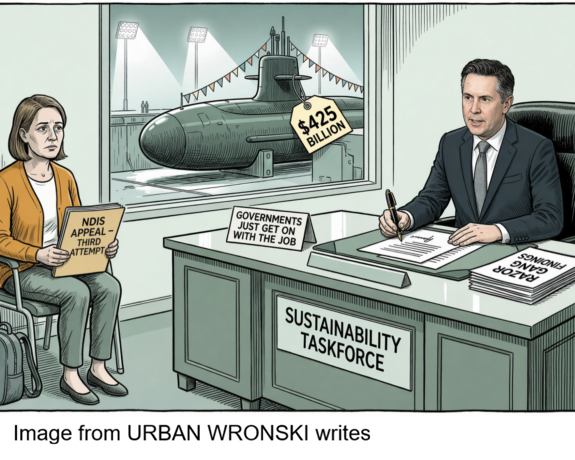

PETITION – To: Prime Minister Anthony Albanese and the Australian Labor Government

of the week – Australians for War Powers Reform (AWPR)
To see nuclear-related stories in greater depth and intensity
 Antinuclear