Peter Remta: Misleading and inaccurate information provided by authorities on National Radioactive Waste Management
 Peter Remta – submission to Senate Committee on National Radioactive Waste Management Amendment (Site Specification, Community Fund and Other Measures) Bill 2020 [Provisions] Submission 65
“………. EXPLANATORY MEMORANDUM The explanatory memorandum accompanying the Bill simply repeats many of the
inaccurate and misleading comments and information provided by the Department of Industry Innovation and Science and ANSTO to the communities of the initially accepted sites in South Australia since the beginning of the nomination process under the existing legislation.
………I must stress that the serious and unacceptable manner in which quite inaccurate information has been disseminated on behalf of the government on such an important issue both now and during the nomination and selection process has only caused more concern and community dissension and I suggest will lead to a greater general apprehension of starting a nuclear industry in Australia
Explanatory memorandum assertions :
1. While the concept of a single and purpose-built nuclear waste facility is a desired objective as outlined at the start of the explanatory memorandum it will be difficult to achieve as is now proposed.
To begin with it is wrong to say that this facility will support nuclear science and technology since it fails to meet the safety prescriptions for a facility of that nature.
It is also wrong to link the provision of nuclear medicine to the proposed storage and disposal of waste at the facility as the various entities generating waste from medical and research activities will continue relying on their own disposal methods and will not necessarily use a government run business for that purpose.
2. Most importantly it is a totally false and misleading proposition to suggest that the failure to establish the facility as proposed by the government will somehow lead to a reduction in nuclear medical services and treatment and the government should quickly correct that serious misconception since this has been a rather distressing concern for the community at Kimba and generally. It is therefore disingenuous to give that impression that this will be a central
facility for all nuclear waste in Australia.
3. While existing waste is held in numerous locations around the country there is no legal or other requirement that this waste would be disposed of at the facility and it is therefore disingenuous to give the impression that this will
be a central facility for all waste in Australia.
4. The reference to meeting with the international obligations under the Joint Convention4 ignores the safety code requirements promulgated some 12 years later under which it would be very difficult to establish the proposed
facility.
5. The suggestion of acquiring additional land for such things as all weather road access is only another example of the intrinsically unsuitable nature of the chosen site and the lack of planning and the necessary technical knowledge for construction of the facility.
6. The process of identifying a suitable location being a 40 year effort again shows the inability of the government or simply ignores that the current process in a proper manner only began after 2012 under the existing legislation.
7. To suggest proper and successful consultations with community members is a test of normal intelligence having regard to the strong and spirited opposition to the facility from the outset by the community generally and the fact that a concerned Aboriginal group has litigated its opposition to an appeal to the Federal Court5 and may now resort to a referral to the United Nations Human Rights Council.
8. The financial aspects of the government’s proposals lack frankness and justification when it has been claimed variously that the amount so far spent in selecting the site is $55 million or $85 million over the past five years but with a constant refusal to provide any details as to how that money has been spent or applied.
Surely there should be proper public disclosure of this quantum of expenditure when compared to the usual outcry where there is only a fraction of that amount involved if there is no reasonable explanation given. Moreover this should be gauged against the persistent refusal of the government to pay for an independent assessment and scrutiny of its
proposals by the members of the Kimba community who oppose the facility.
9. The statement as to compatibility with human rights is again with respect rather nonsensical when the government was incapable of holding a proper and valid ballot (albeit through the District Council of Kimba) which totally ignored the inclusion of an opposing argument contrary to the recognised and applicable principles of human rights. That ballot and the previous one as well as some claimed community surveys failed to meet the principles of informed consent which places a high standard of compliance on both the government and the District Council.
This becomes even worse by excluding the Aboriginal peoples from the ballotIf the government were genuine then it should hold another ballot with a more appropriate and wider base for voting and with the prior provision of all pertinent
information including the arguments or case against the facility. This goes back to providing a proper assessment and scrutiny of the government’s proposals by the opposing members of the Kimba community which has never been
the case.
Regrettably the compatibility statement is more prescriptive in its content instead of actually dealing with the facts of the situation and circumstances that occurred and which have been presented in the statement in a most favourable light for the government. when under the most basic of constitutional and democratic rights they
should have been included in that process…………
Sections on NAPANDEE FINANCIAL ASPECTS INFORMATION, BALLOTS, and INFORMED CONSENT LEGAL ACTIONS MANAGEMENT of FACILITY INTERNATIONAL OBLIGATIONS TECHNICAL ASSESSMENT [these will be published here separately, later]
…. CONCLUDING COMMENTS aand RECOMMENDATIONS Continue reading
Dianne Ashton on Government untrustworthiness – the rushed, unethical decision on nuclear waste site
Dianne Ashton to Senate Committee on INQUIRY INTO NATIONAL RADIOACTIVE WASTE MANAGEMENT
FACILITY Submission No 63
Herewith is my submission and reasons for opposing the establishment of a National Radioactive
Waste Management Facility in South Australia.
Having been a part of the Barndioota Consultative Committee for the four years it was operational,
prior to a decision being made by the Government as to the proposed site of a Facility, I questioned
the trustworthiness of the Federal Department (DIIS at the time), the lack of ethics when it came to
Consultation and the reason why South Australia was chosen for a proposed NRWF when, clearly
South Australians are patently against having nuclear waste stored in the state.
South Australians voted against a High Level Nuclear Waste Facility being built in South Australia.
Unfortunately had DIIS been patient until that decision was made, they would have realised that
their hope of the long term Intermediate Level Nuclear Waste (ILW) in a High Level Facility in South
Australia was nothing more than a pipe dream. Unfortunately this decision by South Australians, left
DIIS in the unenviable position of looking for a temporary place to store this highly dangerous waste.
To store ILW temporarily above ground for up to 100 years or more, is not a good decision, which is
now what is intended at the proposed NRWMF.
ll that withstanding, the whole process which was undertaken by DIIS to find the proposed site for
a NRWMF in Australia was flawed in so many ways. If DIIS had actually undertaken the process with
World’s best practice in mind, the outcome may have been very different.
A NRWMF would have been chosen, but only after deep consultation with the neighbours, standing
council and community members of the area. The consultative process would have been a two way
process, information being given from all sides of the situation and then discussed. If there were
divisive issues the aim would have been to build greater connections and understand between
community members, because the notion of “divide and conquer” does not belong in community
engagement. This is not what happened, trust was not built, divide and conquer abounded and
information was the only means forward according to DIIS. Also continuity of engagement would
have been important instead of around 25 staff members leaving the team during the process.
Surveys would be been well thought out and extensively conducted instead of hurried and rushed
with flawed results. DIIS did not do enough to fully engage the community and work with them in an
ethical manner to bring the process to an amenable conclusion. This created mistrust of DIIS and
their process.
If the proposed site at Kimba goes ahead without full scrutiny of the process which put it there, it
will be a sad day for any future proposed facilities, as a wonderful opportunity to all work
collaboratively will have gone missing and will continue to be absent, until there is a new approach
to the process.
Covid 19 is paving the way for change in Australia for the better. The government is called to be
acting on behalf of the people (taxpayers) not on behalf of itself. Let’s hope we can all wake up
before it is too late.
Australian Law on radioactive waste to be changed in order to prevent any judicial review!
 Declaration and Legislation of Selected Site
At the time the Minister announced that the Napandee site had been identified, we were surprised and
confused that this decision was not declared as per the requirements of the Act. It is now clear that the reason
for this is the Ministers decision to amend the Act to specify the selected site. This is extremely concerning to us,
as it is our understanding that the decision to directly legislate the selected site will effectively remove the
opportunity for any judicial review of the site selection, and there appears to be no other justification to do so.
submissions were received in total, and that, in total, 94.5 of these opposed the siting of the facility in Kimba.
These appear to have been all but ignored in the Minister, in favour of multiple survey results from the same
focus group living or operating businesses based within the District Council.
the members of the Kimba, Eyre Peninsula and SA community who are opposed to the siting of the National
Radioactive Waste Management Facility on Farming land in South Australia.
Government has undertaken to site the National Radioactive Waste Facility in Kimba and we would like to thank
the Committee for their time and efforts in undertaking this inquiry.
particularly for those who do not support the siting of the facility in the Kimba district. We have had no goal or
prize in sight, only the onerous task of proving our opposition.
fuelled by the actions of the Department in their quest to establish support for the facility. There are many
examples of how this is process has been unfair and wrong, and we appreciate the opportunity to put forward
some important facts from our perspective.
The finding by former Minister Matthew Canavan that broad community consent for this facility exists in Kimba,
a basis on which this Bill rests, is tenuous at best. The path that the Federal Government took to making this
finding has been a long road of propaganda, manipulation and promises, and is now completely lacking
justification at its conclusion for the decision made.
Small Modular Nuclear Reactors included in Morrison govt’s energy plan?
 New nuclear technologies to be examined in planning Australia’s energy mix, The government is looking at incorporating ‘emerging nuclear
Small modular reactors ‘have potential’, investment roadmap discussion paper says, Guardian, Katharine Murphy Political editor @murpharoo, Thu 21 May 2020
The Morrison government has flagged examining “emerging nuclear technologies” as part of Australia’s energy mix in the future in a new discussion paper kicking off the process of developing its much-vaunted technology investment roadmap.
Facing sustained pressure to adopt a 2050 target of net zero emissions, pressure it is continuing to resist, the government plans instead to develop the roadmap as the cornerstone of the Coalition’s mid-century emissions reduction strategy.
The new framework will identify the government’s investment priorities in emissions-reducing technologies for 2022, 2030 and 2050, although the paper makes clear the government will only countenance “incentivising voluntary emissions reductions on a broad scale” – not schemes that penalise polluters.
The discussion paper to be released on Thursday floats a range of potential technologies for future deployment, including small modular nuclear reactors. It says emerging nuclear technologies “have potential but require R&D and identified deployment pathways”.
While clearly flagging that prospect, the paper also notes that engineering, cost and environmental challenges, “alongside social acceptability of nuclear power in Australia, will be key determinants of any future As well as championing the prospects for hydrogen, the paper also flags the importance of negative emission technologies, including carbon capture and storage, as well as soil carbon and tree planting.
This week the government has signalled its intention to use the existing $2.5bn emissions reduction fund to support CCS projects – a move championed by Australia’s oil and gas industries. The new paper says the geo-sequestration of carbon dioxide “represents a significant opportunity for abatement in export gas” – nominating the Gorgon project as a case in point. Growth in emissions in Australia is largely driven by fugitive emissions from the booming LNG export sector.
The paper does acknowledge that solar and wind – renewable technologies – are now “projected to be cheaper than new thermal generation over all time horizons to 2050”. But it adds a caveat, contending that “the cost of firming is still a major issue, and will require much more work”……. https://www.theguardian.com/australia-news/2020/may/21/new-nuclear-technologies-to-be-examined-in-planning-australias-energy-mix
Minerals Council of Australia keen to keep Australia’s environmental law the same, (or make it even worse)
May 19, 2020 The fossil fuel lobby, led by the Minerals Council of Australia, seem pretty happy with the current system of environment laws. In a submission to a review of the Environment Protection and Biodiversity Conservation (EPBC) Act, it “broadly” supports the existing laws and does not want them replaced.True, the group says the laws impose unnecessary burdens on industry that hinder post-pandemic economic recovery. It wants delays and duplication in environmental regulation reduced to provide consistency and certainty.
But for the fossil fuel industry to broadly back the current regime of environmental protection is remarkable. It suggests deep problems with the current laws, which have allowed decision-making driven by politics, rather than independent science.
So let’s look at the resources industry’s stance on environment laws, and what it tells us.
Cut duplication
The Minerals Council’s submission calls for “eliminating or reducing duplication” of federal and state laws.
The fossil fuel lobby has long railed against environmental law – the EPBC Act in particular – disparaging it as “green tape” that it claims slows projects unnecessarily and costs the industry money.
On this, the federal government and the mining industry are singing from the same songbook. Announcing the review of the laws last year, the government flagged changes that it claimed would speed up approvals and reduce costs to industry.
Previous governments have tried to reduce duplication of environmental laws. In 2013 the Abbott government proposed a “one-stop shop” in which it claimed projects would be considered under a single environmental assessment and approval process, rather than scrutinised separately by state and federal authorities.
That proposal hit many political and other hurdles and was never enacted. But it appears to remain on the federal government’s policy agenda.
It’s true the federal EPBC Act often duplicates state approvals for mining and other activities. But it still provides a safety net that in theory allows the federal government to stop damaging projects approved by state governments.
The Commonwealth rarely uses this power, but has done so in the past. In the most famous example, the Labor party led by Bob Hawke won the federal election in 1983 and stopped the Tasmanian Liberal government led by Robin Gray building a major hydroelectric dam on the Gordon River below its junction with the Franklin River.
The High Court’s decision in that dispute laid the foundation for the EPBC Act, which was enacted in 1999.
In 2009 Peter Garrett, Labor’s then-federal environment minister, refused the Queensland Labor government’s proposed Traveston Crossing Dam on the Mary River under the EPBC Act due to an unacceptable impact on threatened species.
The Conversation put these arguments to the Minerals Council of Australia, and CEO Tania Constable said:
The MCA’s submission states that Australia’s world-leading minerals sector is committed to the protection of our unique environment, including upholding leading practice environmental protection based on sound science and robust risk-based approaches.
Reforms to the operation of the EPBC Act are needed to address unnecessary duplication and complexity, providing greater certainty for businesses and the community while achieving sound environmental outcomes.
But don’t change the current system much
Generally, the Minerals Council and other resources groups aren’t lobbying for the current system to be changed too much.
The groups support the federal environment minister retaining the role of decision maker under the law. This isn’t surprising, given a succession of ministers has, for the past 20 years, given almost unwavering approval to resource projects.
For example, in 2019 the then-minister Melissa Price approved the Adani coal mine’s groundwater management plan, despite major shortcomings and gaps in knowledge and data about its impacts.
Independent scientific advice against the mine over the last ten years was sidelined in the minister’s final decision.
Countless more examples demonstrate how the current system works in the favour of mining interests – even when the industry itself claims otherwise.
The Minerals Council submission refers to an unnamed “Queensland open-cut coal expansion project” to argue against excessive duplication of federal and state processes around water use.
I believe this is a reference to the New Acland Coal Mine Stage 3 expansion project. I have acted since 2016 as a barrister for a local landholder group in litigation against that project.
When approached by The Conversation, the Minerals Council did not confirm it was referring to the New Acland project. Tania Constable said:
The case studies were submitted from a range of companies, and are representative of the regulatory inefficiency and uncertainty which deters investment and increases costs while greatly limiting job opportunities and economic benefits for regional communities from mining.
The New Acland mine expansion is on prime agricultural land on the Darling Downs, Queensland’s southern food bowl. Nearby farmers strongly opposed the project over fears of damage to groundwater, the creation of noise and dust, and climate change impacts.
But the Minerals Council fails to mention that since 2016, the mine has been building a massive new pit covering 150 hectares.
When mining of this pit began, the mine’s expansion was still being assessed under state and federal laws. Half of the pit was subsequently approved under the EPBC Act in 2017.
But the Queensland environment department never stopped the work, despite the Land Court of Queensland in 2018 alerting it to the powers it had to act.
Based on my own research using satellite imagery and comparing the publicly available application documents, mining of West Pit started while Stage 3 of the mine was still being assessed under the EPBC Act. And after approval was given, mining was conducted outside the approved footprint.
Despite these apparent breaches, the federal environment department has taken no enforcement action.
The Conversation contacted New Hope Group, the company that owns New Acland mine, for comment, and they refuted this assertion. Chief Operating Officer Andrew Boyd said:
New Hope Group strongly deny any allegations that New Hope Coal has in any way acted unlawfully.
New Acland Coal had and still has all necessary approvals relating to the development of the pit Dr McGrath refers to. It is also not correct to say that the Land Court alerted the Department of its powers to act with regards to this pit.
The Department is obviously aware of its enforcement powers and was aware of the development of the pit well before 2018. Further, the Land Court in 2018 rejected Dr McGrath’s arguments and accepted New Acland Coal’s position that any issues relating to the lawfulness of the pit were not within the jurisdiction of the Land Court on the rehearing in 2018.
Accordingly, the lawfulness of the pit was irrelevant to the 2018 Land Court hearing.
Dr McGrath also fails to mention that his client had originally accepted in the original Land Court hearing (2015-2017) that the development of the pit was lawful only to completely change its position in the 2018.
State and federal environmental laws work in favour of the fossil fuel industry in other ways. “Regulatory capture” occurs when government regulators essentially stop enforcing the law against industries they are supposed to regulate.
This can occur for many reasons, including agency survival and to avoid confrontation with powerful political groups such as farmers or the mining sector.
In one apparent example of this, the federal environment department decided in 2019 not to recommend two critically endangered Murray-Darling wetlands for protection under the EPBC Act because the minister was unlikely to support the listings following a campaign against them by the National Irrigators Council.
Holes in our green safety net
Recent ecological disasters are proof our laws are failing us catastrophically. And they make the mining industry’s calls to speed-up project approvals particularly audacious.
We need look only to repeated, mass coral bleaching as the Great Barrier Reef collapses in front of us, or a catastrophic summer of bushfires.
Read more: Environment laws have failed to tackle the extinction emergency. Here’s the proof
Both tragedies are driven by climate change, caused by burning fossil fuels. It’s clear Australia should be looking to fix the glaring holes in our green safety net, not widen them.
National Radioactive Waste Management Facility (BRWMF) under scrutiny – fact checking
 Kazzi Jai shared a link. No Nuclear Waste Dump Anywhere in South Australia May 19
“Did you know? ANSTO only manages about 45% of the low level radioactive waste in Australia. Australia’s radioactive waste is stored in over 100 locations such as science facilities, hospitals and universities. The NRWMF will enable Australia’s radioactive waste to be consolidated into a single, purpose-built facility.”
No references, no figures – NADA for this assertion!
Sooooooo….who IS being “economical” with the truth …when you have this statement, which was quoted from a hardcopy report by the DIIS published April 2018? ……..“States and territories are responsible for managing a range of radioactive waste holdings, accounting for about one per cent of total radioactive waste holdings in Australia.”??????????????????? (Page 7 in link below)
And there is a nifty little table WHICH SPELLS OUT EXACTLY HOW MUCH LOW AND INTERMEDIATE LEVEL WASTE IS FOUND AROUND AUSTRALIA INCLUDING ANSTO! (Page 4 for those interested in the link below!)
Do not have ANY idea how NRWMF got 45% even from the table given by DIIS in the hardcopy report!
Another case of “1 in 2” ACCORDING TO ANSTO becoming suddenly “2 in 3” ACCORDING TO NRWMF ????
NRWMF MUST BE CONSISTENT IN THEIR REPORTING…AND MORE IMPORTANTLY REFERENCE IT!
Two places, Lucas Heights + Woomera, = 90%+ of Commonwealth holdings PLUS Dept of Defence has maybe another 3%… so 3 of the ‘100+ sites’ have 93+% of the proposed volume.
PS the NRWMF has blocked me from posting scientific facts & commentary on their FB page….
If you want I can pm you the original details of Fisherman’s Bend AND St Mary’s waste ….and in that document it clearly states that only 200 of the 9726 drums from Fisherman’s Bend were radioactive as deemed by the Road Transport Act. But because of public concern – in Melbourne, Victoria and the wider Australian community – it was ALL classified as Radioactive! THAT is why..surprise, surprise…after the “temporary” two/three year storage promise which became 25 years, it is “suddenly” found that a LOT of the drums are not radioactive! That’s because they never were!! But they do contain asbestos…
The Mt Mary Defense Base is different….but is only 10 cubic metres in volume
Rose Costelloe submission – Kimba traditional Aboriginal area not suitable for nuclear waste dump
 due diligence means our government and you as our elected representatives of different communities, including Aboriginal communities, that exist here and which elected you to your positions, need to carefully consider the least possible risk in creating a nuclear waste dump within Australia.
Rose Costelloe National Radioactive Waste Management Amendment (Site Specification, Community Fund and Other Measures) Bill 2020 [Provisions] Submission 78 I am writing to vigorously oppose the creation of a nuclear waste dump at the site you are considering in South Australia.
My first reason for opposing it is that the plan is to situate the dump on land traditionally owned by the
Barngala Aboriginal people who also oppose this plan.
I would say here, if you are serious about creating a nuclear waste dump in our country, you must plan to situate
it in the middle of one of the largest cities in Australia: Melbourne or Sydney. In that way you will ensure that
the utmost safety precautions are implemented at the outset. They will be then be closely monitored and
maintained with all due diligence forever.
It is very clear to me that we are fallible human beings – and I am one of them. We are not very good at caring
for dangerous substances in our midst or at anticipating what lies ahead of what appear to be clever plans made
without consideration of future risks. The demise of the Fukushima nuclear power plant in the face of a tsunami
is the most spectacular of these recent failings. Five Mile Island and Chernobyl are dreadful catastrophes
involving nuclear material from the not too distant past.
I will not dwell here on the life expectancy of nuclear matter including waste. There are more eloquent and
learned submissions covering these hard cold facts Continue reading
Regina McKenzie comments on Felicity Wright’s submission about the National Radioactive WAste Dump
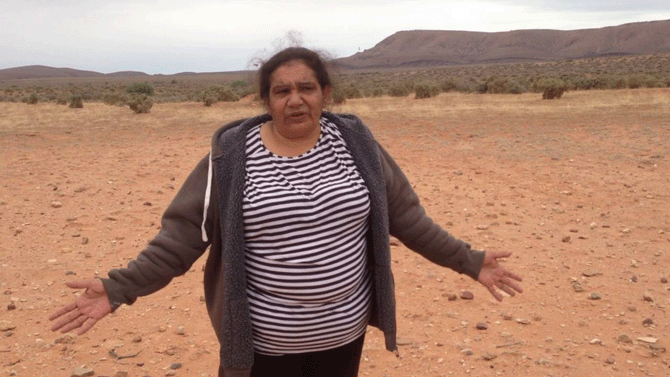 Regina McKenzie It not only aged me, but I have a horrible sickness due to the horrible stress and the personal attacks , this will stay with me, might even be the cause to blow my candle out, I watch Kimba with a sad heart, knowing all the heartache and the tremendous weight on the people’s back , Felicity Flowerdew that’s a strong letter from a strong woman, who I am proud to say is my friend https://www.facebook.com/groups/1314655315214929/4288145791199185/?comment_id=4290354100978354¬if_id=1589981324123690¬if_t=group_comment
Leaked plan for huge gas subsidies
Felicity Wright: appalled at effect on Aboriginal communities of decision on National Radioactive Waste Dump Site

Felicity Wright – Submision to Senate Committee on National Radioactive Waste Management Amendment (Site Specification, Community Fund and Other Measures) Bill 2020 [Provisions] Submission 98
I am a resident of the Eyre Peninsula. Whilst the bulk of this email has been taken from the ACF template I
confirm that I endorse the contents fully. As an ally and advocate for Indigenous peoples for more than 30 years
I was appalled at the terrible toll fighting the nuclear waste facility in the Flinders Ranges took upon my friends.
I watched one of my closest friends visibly age as she surrendered her art practice and her enjoyment of life to
dedicate herself to challenging it.
It does not escape my attention that the Eyre Peninsula is a significant distance from the east coast and few
politicians would be familiar with the area. Neither would their electorates, therefore it looks like a convenient
location to store something highly problematic.
I have deep concerns about the federal governments proposed changes to the National Radioactive Waste
Management Act. The government has not made a clear case about the need for the planned national facility at Kimba and the process has been restricted and inadequate.
In particular, I am concerned that the planned changes:
• restrict or remove options for judicial review of the government’s site selection under current laws
• unreasonably reduce the rights and options of the Barngarla Traditional Owners and other directly
impacted parties and have not been made with proper consultation
• exempt key environmental and cultural heritage protection laws from being used.
• fail to make any clear or compelling radiological or public health case for doubling handling the long-lived
intermediate level waste (ILW) at significant public expense
• do not provide any certainty about the long-term management of Australia’s radioactive waste
• are not consistent with international best practice in relation to siting, community consultation or
procedural fairness around radioactive waste
• do not recognise or respect long standing South Australian legislation prohibiting any federal radioactive
waste facility
Against the current context of uncertainty and disruption due to the impact of Covid 19 the further uncertainty
and contest generated by the federal government’s approach to radioactive waste is not helpful or justified.
I urge the Committee not to support the proposed changes to the current legislation and instead call for a
dedicated comprehensive review of management options in order to best realise responsible radioactive waste
management in Australia.
Terry Schmucker- unfairness of community funding for nuclear dump has split the local community
It is on advice from the Kimba consultative committee that the existing funding boundary has been set. The promise of many millions of dollars isolated to one particular local government area has changed our community and the way it works. This has also extended to communication and consultation……
I ask also that funding amounts allocated to different council areas be set in law to protect vulnerable neighbourhoodslike ours from bullying and manipulation.
Terry Schmucker. SUBMISSION TO: SENATE ECONOMICS LEGISLATION COMMITTEE
Inquiry into the National Radioactive Waste Management Amendment (Site Specification,
Community Fund and Other Measures) Bill 2020 [Provisions] Submission 92
I would like to put forward my views on some of the impacts this has had on my
neighbourhood and the flaws in the process that have not been addressed. This Bill should not
be accepted as there remain many unanswered questions about naming Napandee as the site.
Firstly, to limit community funding to one particular local government area will harm the
community and put the Radioactive Waste Management Facility at odds with local residents.
I live in a neighbourhood that has our land areas also known as hundreds split in half by two
local government jurisdictions; Kimba and Wudinna District Councils.
The hundreds of Cootra and Koongawa have a long and proud history of working together
and the majority of people here have descended from the original pioneers with a strong
sense of community that came from the history of schooling, socialising, and sporting clubs
covering different local government areas. Continuation of this community spirit is still most
evident in the current Koongawa sports club and the Cootra volunteer CFS brigade. Members
come from both council districts; however the majority of support comes from outside the
Kimba district. For example our CFS brigade responds to incidents in the area around or near
the proposed waste facility and it will again in the future. The majority of brigade members
will not receive any or little support from the community funding if it is limited to just the
Kimba council area.
Our neighbourhood borders the waste site at Napandee and some of my neighbours who live
in the Wudinna district are physically closer to the waste site than the Kimba township. I
have personally brought this to the attention of Minister Canavan, the Department and the
Kimba council, but with no results. I believe vested interests have excluded us from this
process. If our neighbourhood had been given an equal status in the vote we would likely
have a different result. This was the case at Hawker where the vote extended to a 50 km
radius around the waste site as well as the council area. The selected site at Napandee site is
not at Kimba and is offset within the council area.
Before the consultative committee member application process closed, my questioning
prompted the Department to announce that applicants from outside of the council area would
also be accepted. This created a fair bit of confusion and the nominations closed three days
later as scheduled. No extension was given and all the members appointed to the consultative
committee are only from within the Kimba district council area except for the independent
chairman who is not a local. This was the beginning of a bias towards our neighbourhood that
didn’t exist before.
Sue Woolford recommends the Canadian model for selecting a Nuclear Waste Facility Site

I would like to draw the committee’s attention to the Canadian leading example which has
empowered communities to self-nominate for assessment in a long-term process called
“Adaptive Phase Management”2 ensuring trust is being gained in communities prior to any
final site selection for radioactive waste disposal in a deep geological repository over a long
established timeline.
I could not support the proposal as it stands.
The Kimba District Council has not done its due diligence to request an an independent risk analysis for the people it
represents
Sue Woolford SUBMISSION TO SENATE ECONOMICS LEGISLATION COMMITTEE
RE: Inquiry into the National Radioactive Waste Management Amendment (Site
Specification, Community Fund and Other Measures) Bill 2020 [Provisions] Submission No 91
I would like to put forward my personal views on how acceptance of this Bill would be doing
an injustice to the responsible management of radioactive waste in Australia.
I am critical of this current process but not the value of nuclear medicine and the need to
find the right long term solution to benefit all Australians. I have advocated for a fair and
transparent process that instils trust in the public domain and believe that the National
Radioactive Waste Management Act 2012 and this Bill need to have proper assessment to
deliver to all Australians a morally and legally acceptable Act with lessons learnt.
The government department responsible have initiated a consultation and site selection
process under the current Act but have not truly engaged meaningfully with all
stakeholders. Standards have not conformed alongside the principles of the International
Association for Public Participation1 (IAP2) and the spectrum of public participation which is
used internationally.
I believe if more of these principles were applied to provide objective information and listen
to feedback then the key challenges to site the nations radioactive waste into a central
location with community confidence would be taken to a new level of credibility and
assurances. My submission deals with finding the right solution instead of a second rate
option in my hometown.
Currently, I don’t believe the National Radioactive Waste Management Act 2012 has
allowed for the best and safest sites to be voluntarily put forward. The extinguishment of
Native Title holder’s rights and the Commonwealth having the authority to override states
and territories has only confirmed that the Australian example is inconsistent with world’s
best practice and is an abominable act that takes away rights of review to ensure a fair and
transparent process. Continue reading
Australian govt and ERA squabble over monitoring of Ranger uranium clean-up
|
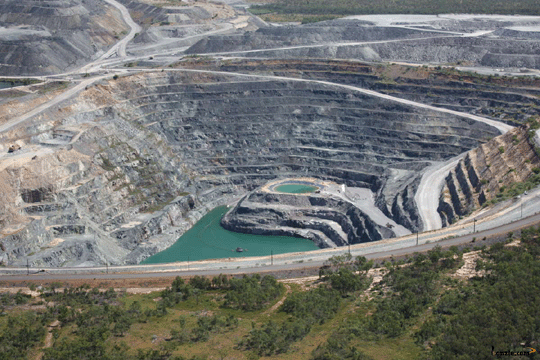
Ranger Mine locked in stoush over funding for Kakadu uranium rehabilitation monitoring https://www.abc.net.au/news/2020-05-19/nt-kakadu-uranium-stoush-ranger-mine-rehabilitation/12260130 By Jane Bardon,
The Federal Government is locked in a stoush with the company mining uranium on the edge of the Northern Territory’s Kakadu National Park over whether it will continue to fund monitoring of the site’s rehabilitation. Energy Resources of Australia (ERA) has flagged it wants to pull out of paying $2.5 million a year for the Supervising Scientist Branch independent monitoring agency, which it funds with the Commonwealth, at the end of June.
Community members of ERA’s independent technical consultation committee, including Dr Gavin Mudd, an Associate Professor of Environmental Engineering at RMIT University, have been told by the Supervising Scientist Branch its future research is in doubt because of the funding uncertainty. “That funding is no longer guaranteed for next year is a major concern,” Dr Mudd said. “This work is needed to give us confidence that what is done at Ranger actually works, including the restoration of ecosystems, how stable the landform is, the radioactivity and the surface and groundwater water quality issues.” Dr Mudd said failures in the rehabilitation of other Northern Territory uranium mines, including Rum Jungle near Bachelor, have demonstrated that there will need to be monitoring for decades after Ranger’s closure. ERA, which is owned by Rio Tinto, has been forced to close the mine by 2021 after a series of uranium leaks and spills into the Alligator Rivers system during its 35 years of operations. The company has promised the mine site will be returned to a pristine state, suitable for inclusion in the Kakadu World Heritage park by 2026, and that monitoring by the Supervising Scientist will prove that. The Federal Government provides three-quarters of the Supervising Scientist’s $8 million annual operating budget. ERA told the ABC it hasn’t made a final decision on the funding. “There has been no decision that ERA’s contribution would cease. But a spokesman for the Federal Environment Minister told the ABC the Government felt it was “unfortunate that ERA is choosing to dispute its ongoing contribution under the Deed”. “The role of the Supervising Scientist ensures the unique environment of Kakadu National Park, its Indigenous culture and its stunning wildlife are protected from the effects of uranium mining within that rehabilitation process and into the future,” he said. “The Commonwealth view is that ERA needs to continue to make an appropriate contribution to support ongoing research during the rehabilitation phase of the mine to ensure there are no shortfalls.” The spokesman added that the Minister Sussan Ley has asked the Environment Department to mediate with ERA to try to resolve the dispute. |
|
The Morrison government manipulates, to paint the coal industry as “clean” and “renewable”

The Clean Energy Finance Corporation has this awkward word “Clean”
The Australian Renewable Energy Agency has this awkward word “Renewable”
How can the those agencies put coal into those categories? With some difficulty.
My heart goes out to them, -like those poor gardeners in “Alice in Wonderland” – forced to paint red all the white roses , lest the Queen should cut off their heads.
Government looks to carbon capture for climate action, The Age By Mike Foley, May 19, 2020 The Morrison government is considering legislative changes to allow its clean energy agencies to fund carbon capture and storage from fossil fuel projects in a bid to unlock $2 billion of private investment to reduce greenhouse gases.
Energy and Emissions Reduction Minister Angus Taylor has accepted 21 of the 26 recommendations from an independent panel reviewing the $2 billion Emissions Reduction Fund, including all those relating to carbon capture and storage.
The panel, chaired by former Business Council of Australia president Grant King, said the government would attract more private investment in the Emissions Reduction Fund if legislation were amended to “enable a method to be developed for carbon capture and storage”.
The King report also recommended an “expanded, technology-neutral remit” for the Clean Energy Finance Corp (CEFC) and the Australian Renewable Energy Agency so they too could attract more private investment in a wider range of technologies outside renewables, such as coal or gas-fired power incorporating carbon capture and storage. This would be a significant change to the remit of the agencies, which were set up to promote the development of renewable wind and solar supplied to the electricity grid.
Carbon capture and storage, which has not yet been successfully implemented on a commercial basis, involves capturing carbon dioxide from industrial processes and transporting it to a suitable storage site for safe, long-term storage deep underground.
Mr Taylor said emissions reduction policy driven by “technology not taxes” would attract significant private investment.
“The government will target dollar-for-dollar co-investment from the private sector and other levels of government to drive at least $4 billion of investment that will reduce emissions across Australia,” he said in a statement accompanying the report’s release.
The Climate Solutions Fund was set up in 2015 with $2.5 billion funding under the Abbott government as an alternative to a carbon tax. It pays polluters to employ cleaner technologies and funds carbon capture through tree planting, soil carbon sequestration on farms and energy efficient systems in commercial properties, as well as methane capture from landfill and waste management.
Last year, the Morrison government topped up the fund with another $2 billion and rebadged it the Climate Solutions Fund. To date, it has issued 450 contracts to abate a cumulative 190 million tonnes of carbon at a total cost of $2.3 billion, or an average of $12 a tonne of carbon…….
Current legislation prohibits CEFC from investing in carbon capture and storage. But changing the legislation would enable the $1 billion Grid Reliability Fund to invest in new gas, hydrogen and coal projects relying on carbon capture.
….
Morrison govt plans to direct climate action measures to promote coal industry
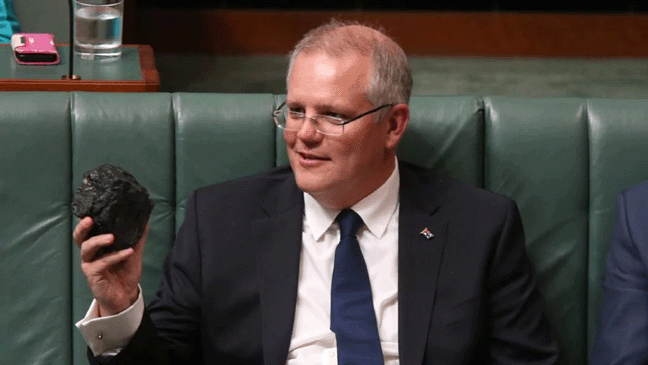 Coalition reveals new emissions reduction measures, including paying polluters to stay under cap
Morrison government also plans to allow businesses to bid for carbon capture projects via the $2.55bn emissions reduction fund Guardian Adam Morton Environment editor @adamlmorton 19 May 2020
Big polluters will be able to earn revenue by emitting less than their allocated limit under new emissionsThe Morrison government has promised new measures to reduce greenhouse gas emissions, including introducing an incentive scheme to allow big industrial polluters to earn revenue by emitting less than an agreed limit.
It also plans to allow businesses to bid for funding from its main climate policy, the $2.55bn emissions reduction fund, for projects that capture emissions and either use them or store them underground.
Angus Taylor, the energy and emissions reduction minister, said the government had agreed to 21 of 26 recommendations in a review headed by former Business Council of Australia president Grant King, who was charged with coming up with new ways to cheaply cut emissions.
The appointment in October of the panel of business leaders and policy experts was not publicly announced, and was seen by observers as an effective concession the emissions reduction fund, now rebadged as a climate solutions fund, was failing to cut national pollution………
Recommendations agreed by the government included allowing carbon capture and storage projects to qualify under the fund, a step the government said it had began consulting with industry on last month.
In a shift likely to be criticised by clean energy advocates, the government gave in-principle support for two agencies, the Australian Renewable Energy Agency (Arena) and the Clean Energy Finance Corporation (CEFC), to be given a “technology neutral remit” to support “the widest possible range of technologies that reduce emissions”. The Greens previously accused the government of planning changes to the CEFC to allow it to fund more fossil fuel projects……
Recommendations agreed by the government included allowing carbon capture and storage projects to qualify under the fund, a step the government said it had began consulting with industry on last month.
In a shift likely to be criticised by clean energy advocates, the government gave in-principle support for two agencies, the Australian Renewable Energy Agency (Arena) and the Clean Energy Finance Corporation (CEFC), to be given a “technology neutral remit” to support “the widest possible range of technologies that reduce emissions”. The Greens previously accused the government of planning changes to the CEFC to allow it to fund more fossil fuel projects…….https://www.theguardian.com/environment/2020/may/19/coalition-reveals-new-emissions-reduction-measures-including-paying-polluters-to-stay-under-cap
1 This month.
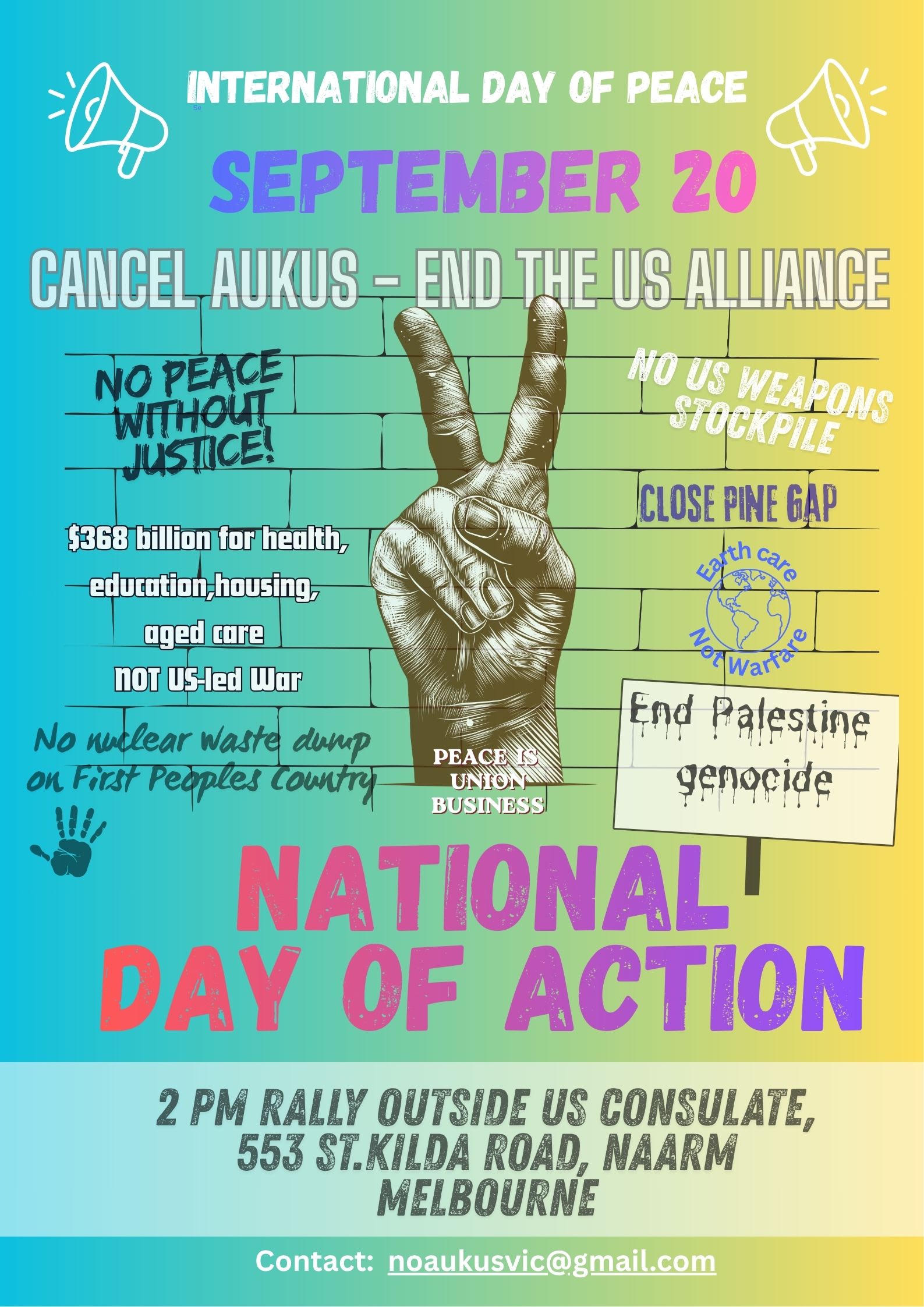
20 September –National Day of Action in Melbourne on the International Day of Peace

Help Aunty Sue Protect Her Land and Sacred Sites From Destructive Rocket Testing.
.

Australians deserve the truth
about
AUKUS – https://aukuspublicinquiry.com/

PETITION – To: Prime Minister Anthony Albanese and the Australian Labor Government

of the week – Australians for War Powers Reform (AWPR)
To see nuclear-related stories in greater depth and intensity
 Antinuclear