John Barilaro got it so wrong about Britain and small nuclear reactors
|
Electrical Review 4th May 2020
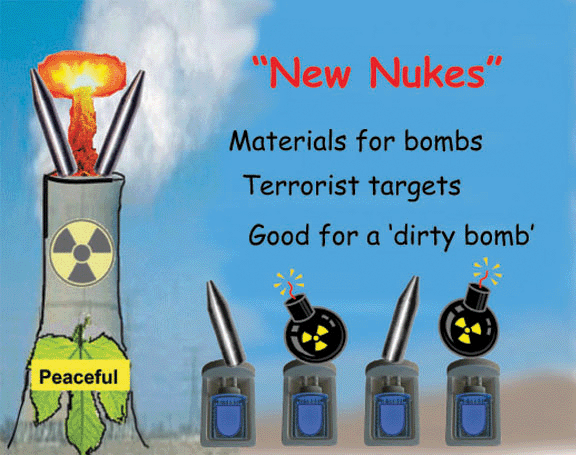 I have to conclude that the Deputy Premier of New South Wales, John Barilaro, is a remarkable clairvoyant. He has announced unequivocally on Australian media that Rolls Royce is set to build up to 15 new small-size nuclear reactors in Britain over the next nine years. I have to conclude that the Deputy Premier of New South Wales, John Barilaro, is a remarkable clairvoyant. He has announced unequivocally on Australian media that Rolls Royce is set to build up to 15 new small-size nuclear reactors in Britain over the next nine years.Strange this. Just 18 months ago, according to the Financial Times, Rolls-Royce was preparing to shut down altogether its R&D project to develop small modular nuclear reactors, unless the British government agreed to an outrageous set of demands and subsidies. Granted the Johnson government has bunged them a few million to keep the R&D going.
But there is as yet no sign of anything being oven-ready to come to the marketplace, let alone 15 up and running. But there remain some rather disturbing connections between small reactor projects and nuclear weapons proliferation. And Rolls-Royce does offer up one of the most glaring examples. Part of the company’s current sales pitch to the British government includes the argument that a civil small-reactor industry in the UK “would relieve the Ministry of Defence of the burden of developing and retaining skills and capability” for its weapons programme. It may be true. But it is not really Atoms for Peace, , is it? https://electricalreview.co.uk/features-mm/13082-mystic-meg-from-down-under |
|
New climate models suggest that Australia could reach 7C temperature rise by 2100
Just how hot will it get this century? Latest climate models suggest it could be worse than we thought, The Conversation, May 18, 2020 , Michael Grose, Climate Projections Scientist, CSIRO, Julie Arblaster, Associate Professor, Monash University Climate scientists use mathematical models to project the Earth’s future under a warming world, but a group of the latest models have included unexpectedly high values for a measure called “climate sensitivity”.
Climate sensitivity refers to the relationship between changes in carbon dioxide in the atmosphere and warming.
The high values are an unwelcome surprise. If they’re right, it means a hotter future than previously expected – warming of up to 7℃ for Australia by 2100 if emissions continue to rise unabated.
Cameron and Toni Scott: brief but compelling critique of National Radioactive Waste Management
 Cameron and Toni Scott – to Senate Committee on
National Radioactive Waste Management Amendment (Site Specification, Community Fund and Other Measures) Bill 2020 [Provisions] Submission 82
We are active residents of the Kimba Community and are involved with many community organisations within
the town. We own and operate a farming business and have 3 small children.
Over the past 5 years my husband and I have been involved with this process as direct neighbours of the first
round of nominations at Kimba. We have found the process inconsistencies extremely frustrating and stressful.
I ask that you please take our views and recommendations into consideration and I would be happy to be
called as a witness to provide further information in the form of a hearing.
Ballot figures were manipulated to justify broad community support.
– Voting boundaries were restricted and disregarded active members of our community who live within
close proximity to Kimba and Napandee site.
– Submissions from locals living alongside site but outside council boundary were ignored or considered
not relevant for the Minister to report on.
– 94.5% of all submissions received were opposed to the siting of this facility in Kimba.
– Petitions were not reported in Ministers announcements.
– Doubling handling of ILW waste is unnecessary, costly and
– Farming land is not a suitable location for radioactive waste
We recommend that the Government please further investigate options of more suitable land that could
potentially permanently dispose of both LLW and ILW radioactive waste to rule out double handling and
separating the waste.
We also recommend that the Department and Minister Canavan’s figures used to justify Broad Community
Support be looked at in depth, as it is so important that a site such as a National Radioactive Waste Facility
which would be a permanent fixture of our Community does in fact have the broad community support
required for a successful outcome.
Marty and Rachel Yates: the wrong nuclear dump process- individuals nominate their own land for their own personal gain
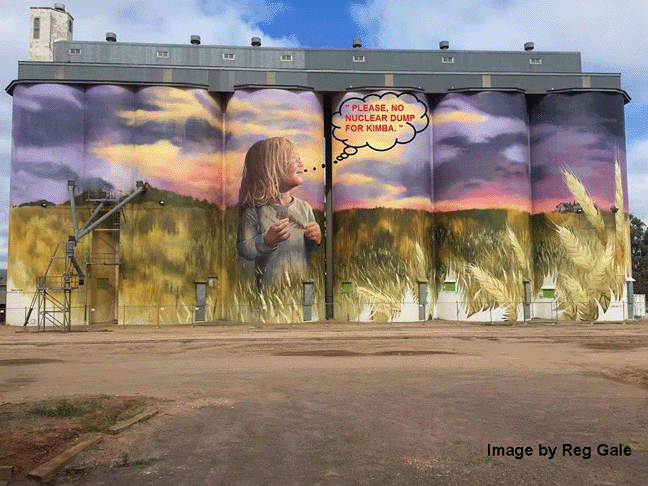
The current process where individuals nominate their own land for their own personal gain and then seek community support is completely backwards and does nothing but cause angst and divide communities.
We recommend the Committee:
Withdraw or reject the Bill on the grounds that neighbour support has not been met. The 100%
direct neighbour support is based on just two landowners as the majority of the land
surrounding the Napandee site is owned by the nominator themselves. Almost half of the
neighbours within the 5km radius to this site remain opposed. This does not constitute broad
neighbour support.
As farmers and neighbours to the selected site, it is of deep concern that radioactive waste could
be allowed to jeopardise Kimba and the Eyre Peninsula’s agricultural industries. The entire Eyre
Peninsula is very proud of its clean and green image, however, if a nuclear waste dump is
constructed in Kimba, no matter which way you look at it, the Eyre Peninsula will never be able to
lay claim to this image again. Clean and green does not go together with nuclear/radioactive
waste.
Marty & Rachel Yates – to Senate Committee on National Radioactive Waste Management Amendment (Site Specification, Community Fund and Other Measures) Bill 2020 [Provisions] Submission 90
We are very close neighbours to the Napandee site and are active members of the Kimba
community where we continue to live, farm and raise our young family. We are third generation
farmers and completely devastated with the news that Napandee has been selected as the site to
host the National Radioactive Waste Management facility (NRWMF) because this means the
facility will be forced upon us. We would never ever choose to live near a radioactive waste dump.
Our small country town has been targeted since 2015 when Rowan Ramsey initiated the proposal
that his property in Kimba could host the national radioactive waste facility. Since then, our once
close knit community has been torn apart by a flawed process that has been designed to divide
and conquer with the promise of jobs and money. The damage caused by this process is real and
will be lasting.
It has been extremely difficult and stressful five years for us. We have done our utmost to
request a fair, open and transparent process but instead have been presented with a very one
sided affair where the goal posts have constantly moved.
We were neighbours to the original nominated site at Cortlinye which was removed, along with
Pinkawillinie, from the process in 2016 due to lack of community support. To our dismay, a group
of locals did not accept this decision and in early 2017 proceeded to nominate two more sites in
Kimba. One called ‘Napandee’ and one called ‘Lyndhurst’. Despite being told by the Department of
Industry Innovation and Science (DIIS) that this would never come back to Pinkawillinie, it did,
because Napandee is located in the Hundred of Pinkawillinie. We now find ourselves even closer
neighbours to the Napandee site than we were to Cortlinye. We have continually stated our
opposition as neighbours but because we don’t share a fence it feels like we don’t really matter.
As farmers and neighbours to the selected site, it is of deep concern that radioactive waste could
be allowed to jeopardise Kimba and the Eyre Peninsula’s agricultural industries. The entire Eyre
Peninsula is very proud of its clean and green image, however, if a nuclear waste dump is
constructed in Kimba, no matter which way you look at it, the Eyre Peninsula will never be able to
lay claim to this image again. Clean and green does not go together with nuclear/radioactive
waste.
Only 4.5% of South Australia is arable land. There is so much unproductive land in the whole of
Australia that would be a more suitable option than farming land to store radioactive waste. This
is where the current process falls down because it only allows nominations from volunteer
landowners so even though there may be better options out there, this process won’t allow them
to be considered because they have not volunteered.
We find it staggering that Kimba was allowed to re-enter the process after initially being removed
due to lack of community support but the Leonora nomination was not accepted even though they
say they are able to provide a final deep burial site for Australia’s most toxic waste which would
completely remove the need to double handle the waste and save many tax payer dollars. Continue reading
The push to weaken Australia’s law regulating the uranium industry, in the review of Environmental Protection and Biodiversity Conservation (EPBC) Act

Uranium, extinction, expedited approvals and extreme risks: the need for stronger environmental laws, https://www.onlineopinion.com.au/view.asp?article=20887
| By Mia Pepper – 14 May 2020 |
This year a Review Committee is examining the cornerstone of Australia’s environmental laws – the Environmental Protection and Biodiversity Conservation (EPBC) Act 1999. This review comes hot on the heels of three inquiries into nuclear power driven by conservative politicians and pressure from the nuclear lobby. This cohort are pushing for the removal of laws banning nuclear power, a push the current federal government has already ruled out.
They are also pushing to weaken regulatory requirements for uranium mine assessments through the EPBC Act. There is currently no national prohibition on uranium mining, but prohibitions exist in Victoria, NSW, Queensland, WA, Tasmania and Victoria. SA and the NT have a long and contested history of supplying uranium to fuel nuclear power plants overseas. Uranium from SA and the NT fuelled the Fukushima reactor during the 2011 meltdowns, fires and explosions ‒ a discomforting legacy given that there was ample evidence long before the Fukushima disaster of corruption and inadequate safety standards in Japan’s nuclear industry.
Following the Fukushima disaster the UN Secretary General advised that Australia have “an in-depth assessment of the net cost impact of the impacts of mining fissionable material on local communities and ecosystems.” No such assessment has been carried out. Worse still, the appointment of a former uranium mining company executive to the EPBC Review Committee suggests that there may be some support within the government for a weakening of uranium mining regulations rather than the necessary strengthening.
The reality of uranium mining in Australia has been one of leaks, spills, accidents, license breaches and a failure to rehabilitate. Of the 15 uranium mines that have operated, just two are still mining (Olympic Dam and Beverley Four Mile), one is preparing for closure (Ranger), another is preparing for a second round of rehabilitation failing previous attempts (Rum Jungle), three are on life support in extended care and maintenance; and the remaining sites are all contaminated and require ongoing monitoring and maintenance at the expense of taxpayers.
That track-record strongly suggests the need for greater scrutiny and a strengthening not a weakening of regulations. Proposed changes by the nuclear industry include changing the definition of ‘nuclear actions’ in the EPBC Act to remove the “mining and milling” of uranium. The impact of this would reduce requirements for whole-of-environment assessments for uranium projects and reduce federal oversight. Existing processes desperately need improvement given recent failures around transparency, upholding principles and objects of environmental laws, political influence in decision making, expedited process and unfounded exemptions.
The Ranger uranium mine in the tropical NT, owned by Rio Tinto and operated by ERA, will begin rehabilitation in 2021, a project set to cost in excess of $1 billion. There are ongoing concerns about the funding and adequacy of the proposed rehabilitation. Meeting the regulatory requirement to secure radioactive wastes and other toxins from the environment for 10,000 years is inherently difficult, not least because there is a long history of routine, daily leakage of large volumes of contaminated liquid.
Not far from Ranger, the government-owned Rum Jungle mine has been leaking radioactive and acidic materials into the East Branch of the Finniss River since it was closed in 1971. The NT government has released new plans to remediate the site which is likely to cost in excess of $300 million, but there is still no commitment from the NT or Federal governments to fund this important work.
The legacy threats from uranium mines are unlike the threats from other mines and a repeated failure to contain this waste suggests that mining uranium should be banned, or at the very least have the strictest possible regulations.
There are many other examples of industry and regulatory failure. At the former uranium mine at Radium Hill in SA, the tailings dam was shoddily constructed and was not capped when the mine closed. The Port Pirie uranium treatment plant in SA is still contaminated over 50 years after its closure. SA regulators failed to detect a mining exploration company’s dumping of low-level radioactive waste in the Arkaroola Wilderness Sanctuary. At the Beverley Four Mile in-situ leach uranium mine in SA, contaminated wastewater is routinely dumped in groundwater ‒ a process permitted by regulators who should know better.
In yet another regulatory failure, BHP’s proposal for a new tailing’s facility at its Olympic Dam copper/uranium mine in SA has been fast-tracked without requirements for federal approval. The decision not to assess the new tailings dam came after the Australian National Committee on Large Dams gave three existing tailings dams at Olympic Dam a risk ranking of ‘extreme’ – this ranking is given to tailings facilities that if failed would cause the death of over 100 people. The independent review of tailings followed the Samarco tailings disaster in Brazil, a joint venture project between BHP and Vale, which killed 19 people. The new proposed tailings should be assessed to determine the risk and likelihood of failure; instead, the facility has been fast-tracked avoiding scrutiny under the EPBC Act.
Cameco’s proposed Yeelirrie mine in WA provides another example of unseemly haste and unseemly exemptions. The WA EPA recommended that Yeelirrie not be approved because of the likelihood the mine would cause multiple species extinctions. Despite this recommendation the former State Environment Minister approved the mine weeks before losing his seat and the Liberal party lost Government in the 2017 WA election. In a similar scenario, the mine was given federal approval on the eve of announcing the 2019 federal election. That federal approval followed direct lobbying of Ministers and the Department and resulted in a set of conditions that no longer require the company to prove the mine won’t cause species extinction.
A 2003 report by the federal Senate References and Legislation Committee found “a pattern of underperformance and non-compliance” in the uranium mining industry and it concluded that changes were necessary “in order to protect the environment and its inhabitants from serious or irreversible damage”. The same could be said now. Subsequent reviews of uranium mining regulations in Queensland, WA and Canada identify unique risks with uranium mining and calls for improved and increased regulations that meet those specific challenges and risks.
The push from the industry to weaken regulations should be wholeheartedly rejected and instead the EPBC Committee could consider advice from former UN Secretary General to hold an “in-depth” assessment of the uranium sector and its impacts.
The torture that awaits Julian Assange in the US.
 From the frying pan into the fire. The torture that awaits Julian Assange in the US.https://www.thecanary.co/uk/analysis/2020/05/10/from-the-frying-pan-into-the-fire-the-torture-that-awaits-julian-assange-in-the-us/
Tom Coburg 10th May 2020 WikiLeaks founder Julian Assange is currently held in Belmarsh prison awaiting hearings that could see him extradited to the US to face prosecution for alleged espionage-related offences.
Award-winning US journalist Chris Hedges described the torture that would await Assange in the US prison system, adding “they will attempt to psychologically destroy him”. If extradited, Assange would likely be detained in accordance with ‘Special Administrative Measures’ (SAMs). One report equates this to a regime of sensory deprivation and social isolation that may amount to torture.
Journalists speak out
US journalist Chris Hedges spoke about the treatment Assange is likely to receive in the US. He argues that the US authorities will “psychologically destroy him” and that conditions imposed could see him turned into a ‘zombie’ to face life without parole:
Australian journalist John Pilger agrees:
If Julian is extradited to the US, a darkness awaits him. He’ll be subjected to a prison regime called special administrative measures… He will be placed in a cage in the bowels of a supermax prison, a hellhole. He will be cut off from all contact with the rest of humanity.
From the frying pan…
Assange is already in a precarious position, alongside all other UK prisoners. Belmarsh is a high-security Category A facility and, as with all other prisons in the UK, inmates there are at risk to infection from coronavirus (Covid-19).
On 28 April, the BBC reported that there were “1,783 “possible/probable” cases of coronavirus – on top of 304 confirmed infections across jails in England and Wales”. Also that there were “75 different “custodial institutions”, with 35 inmates treated in hospital and 15 deaths”.
Vaughan Smith, who stood bail for Assange, reported that the virus was “ripping through” Belmarsh:
We know of two Covid-19 deaths in Belmarsh so far, though the Department of Justice have admitted to only one death. Julian told me that there have been more and that the virus is ripping through the prison.
Assange has a known chronic lung condition, which could lead to death should he become infected with coronavirus. Assange’s lawyers requested he is released on bail to avoid succumbing to the virus, but that request was rejected.
As for the psychological effects of segregation, a European Committee for the Prevention of Torture and Inhuman or Degrading Treatment or Punishment report argued that it can “can have an extremely damaging effect on the mental, somatic and social health of those concerned”.
…and into the fire
It’s likely that Assange will be placed under SAMs if he is extradited to the US. The Darkest Corner, a report authored by the Allard K. Lowenstein International Human Rights Clinic and The Center for Constitutional Rights, describes how SAMs work.
In its summary, the report explains that:
SAMs are the darkest corner of the U.S. federal prison system, combining the brutality and isolation of maximum security units with additional restrictions that deny individuals almost any connection to the human world. Those restrictions include gag orders on prisoners, their family members, and their attorneys, effectively shielding this extreme use of government power from public view.
It continues:
SAMs deny prisoners the narrow avenues of indirect communication – through sink drains or air vents – available to prisoners in solitary confinement. They prohibit social contact with anyone except for a few immediate family members, and heavily regulate even those contacts. And they further prohibit prisoners from connecting to the social world via current media and news, limiting prisoners’ access to information to outdated, government-approved materials. Even a prisoner’s communications with his lawyer – which are supposed to be protected by attorney-client privilege – can be subject to monitoring by the FBI.
It ominously adds that: “Many prisoners remain under these conditions indefinitely, for years or in some cases even decades”. Moreover, these conditions can be used as a weapon to force a prisoner to plead guilty:
In numerous cases, the Attorney General recommends lifting SAMs after the defendant pleads guilty. This practice erodes defendants’ presumption of innocence and serves as a tool to coerce them into cooperating with the government and pleading guilty.
The report provides further details on how SAMs incorporate sensory deprivation and social isolation measures that “may amount to torture”. Also, it argues that the SAMs regime contravenes both US and international laws.
ECHR article 3
Should the UK courts agree to extradite Assange, he could face months, if not decades, of psychological torture. However, Article 3 of the European Court of Human Rights states clearly: “No one shall be subjected to torture or to inhuman or degrading treatment or punishment”. Under that article, the US extradition request should be rejected by the UK courts.
For a publisher to be subjected to such a nightmare scenario would be intolerable.
Australian Radiation Protection and Nuclear Safety Agency now has the chance to prove they put health and safety first
James Shepherdson No Nuclear Waste Dump Anywhere in South Australia , 13 May 20, This should be a huge opportunity for arpansa to step up and prove to the Australian people that they really are going to put public safety at the forefront of their decision and reject any licence application for the temporary secondary storage of intermediate level waste . If not one can only conclude that they are just as corrupt as our pollies ,not independent at all and prepared to ignore what they themselves claim to be world’s best practice https://www.facebook.com/groups/1314655315214929/
A Covid-19 Green Recovery for Australia
Seizing the moment: how Australia can build a green economy from the Covid-19 wreckage, As the government prepares plans for economic recovery, investors and green groups alike say this is a once-only opportunity to move towards zero emissions
This is the first a new series, The Green Recovery, looking at the environmental challenges of a post-pandemic world, Guardian, by Adam Morton 13 May 20 There is a growing case that recovery from the coronavirus offers Australia a chance to succeed where it has failed for more than a decade: to break away from the climate wars and head in a new direction.
Here and overseas, the idea of helping jumpstart an economic rebuild after the pandemic-forced shutdown by also tackling the other great existential challenge of the time is gaining currency across the political spectrum.
It has been supported not just by climate activists and conservationists, but by industry, banks, energy companies, unions and major investors.
Kristalina Georgieva, the head of the International Monetary Fund, articulated the push in late April while addressing the heads of 30 countries at the annual Petersberg Climate Dialogue. She rejected the suggestion that the health crisis and the economic crash caused by the “great lockdown” that followed meant steps to fight the climate crisis should be paused.
“Nothing is further from the truth,” she said. “We are about to deploy a massive fiscal stimulus which can help us address both crises at the same time.
“If this recovery is to be sustainable – if our world is to become more resilient – we must do everything in our power to promote a green recovery. In other words, taking measures now to fight the climate crisis is not just a ‘nice-to-have’. It is a ‘must-have’ if we are to leave a better world for our children.”
Implicit in Georgieva’s call is that this may be a one-off opportunity to reduce greenhouse gas emissions and avoid what scientists warn would be a catastrophe for vast swathes of the planet.
Others agree. The German government has called for recovery programs to invest in future-proof jobs that would cut emissions, rather than return to business as usual. Britain has proposed an accelerated take-up of green technologies, saying it could have a profound impact on “our societies’ future sustainability, resilience and, ultimately, wellbeing”.
The idea of a green stimulus has been supported by governments in countries as diverse as Pakistan, Portugal, Canada and the United Arab Emirates, backed by major business energy giants including BP and Shell, and promoted by the World Bank, which has published a series of blog posts with detailed suggestions of how to respond.
Significant money supports this stance. Global investor groups representing members responsible for more than $55tn in assets warned governments to avoid focusing on short-term, big-emitting projects when backing clean growth, which could create jobs while improving things that have a less obvious monetary value – such as clean air. Again, the opportunity borne from crisis was central to the message. “The path we choose in the coming months will have significant ramifications for our global economy and generations to come,” the groups said in a statement……
States lead, federal government drags its feet
In Australia, the discussion about a green recovery did not begin as urgently as elsewhere, reflecting perhaps the country’s notoriously difficult climate politics and a media tendency to treat climate as a second-order issue unless it is the subject of a political fight.
That began to change last week. Industry groups the Smart Energy Council and Clean Energy Council hosted online summits on green recovery themes with attendances in the thousands. Speaking at both, Innes Willox, the chief executive of the Australian Industry Group, said recovery from the Covid-19 pandemic and setting a path for net zero were overlapping issues that should be dealt with together to boost growth.
The AIG is among a number of Australian interest groups, research organisations and experts working on what a sustainable rebuild could look like, built on evidence that renewable energy is now the cheapest source to invest in.
Just as striking as Willox’s call was that, across the two summits, every state and the ACT was represented either by a premier, energy minister or, in Tasmania’s case, state-owned clean energy agency. Queensland’s Annastacia Palaszczuk spoke about the potential to develop a battery manufacturing industry and claimed green hydrogen resources would eventually surpass the state’s liquefied natural gas exports. South Australia’s energy minister, Dan van Holst Pellekaan, praised his Labor predecessors for helping develop the state into a world leader in renewable energy generation (while taking a swipe at them over cost) and said he hoped the state would run on 100% clean electricity before 2030.
Fellow Liberal Matt Kean, from New South Wales, said his government was considering its electricity strategy and net zero plan in the wake of the pandemic to see what measures could be brought forward to support the economy. He said they would be subject to three tests: “Will they deliver decarbonisation? Will they deliver jobs? And will they deliver faster economic growth?”
On Thursday, the Tasmanian Liberal government went further, launching a draft renewables energy action plan for reaching 200% renewable energy generation by 2040, a goal that means the creation of a vast clean export industry. The state’s energy minister, Guy Barnett, said the shift to renewable energy was more important than ever in the wake of the pandemic.
“As a result of Covid-19, there are unprecedented challenges facing Australian households and industries. By seizing Tasmania’s immense potential, renewable energy can grow our economy, attract investment, create jobs and support Australia’s transition to renewable supply,” he said………
Practical solutions on the horizon
Environment Minister Sussan Ley not to support protection of Murray-Darling river systems
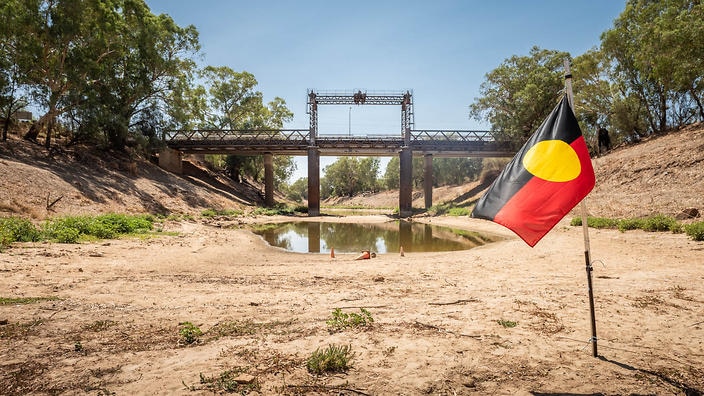
Murray-Darling systems not assessed for endangered listing after officials warned Coalition would not  support it
FoI documents reveal struggling systems were ‘clear candidates’ for protection but Sussan Ley ‘unlikely to support’ it, Guardian, Lisa Cox, Wed 13 May 2020 Struggling river and wetland systems in the Murray-Darling Basin were not assessed for listing as critically endangered after officials warned the Morrison government would not support protecting them.
Environment department staff said the two ecological communities were “clear candidates” for assessment for a critically endangered listing, documents released under freedom of information show. But the environment minister, Sussan Ley, was “unlikely to support” their inclusion on the 2019 list of species and habitats under consideration for protection, they told the threatened species scientific committee.
The department also told the committee the work required to do the assessment would have “significant resource implications”.
The two communities are known as the “wetland and inner floodplain of the Macquarie Marshes”, and the “Lower Murray River and associated wetlands, floodplains and groundwater systems from the junction of the Darling River to the sea”.
Both were listed as critically endangered by then environment minister Mark Butler in the final days of the Labor government in 2013.
After the Coalition won government, both listings were disallowed under the new environment minister, Greg Hunt. It followed a campaign against the critically endangered listings by the National Irrigators Council.
Humane Society International, the organisation behind the nomination that led to the 2013 listings, renominated the river and wetlands systems for assessment for a critically endangered listing last year.
In a briefing to the threatened species scientific committee, officials said a tool the department used for conservation assessments had ranked the two communities as the highest priorities from a conservation perspective among a group of five ecological communities nominated for listing in 2019.
But neither made it on to the proposed priority assessment list, which is given to the environment minister to consider before they determine the nominations that will make it on to the final list.
The briefing to the committee is the same document that led to Guardian Australia last week revealing the government had stopped listing major threats to species under national environmental laws…….
Labor’s environment spokeswoman, Terri Butler, said it was “outrageous” the Morrison government had not followed scientific advice. She said the government was attempting “to influence the outcomes of scientific processes designed to protect our environment”.
Richard Kingsford, the director of the Centre for Ecosystem Science at the University of New South Wales, said the scientific research on the two communities showed both had high levels of biodiversity and were degrading significantly as a result of reduced flooding.
“The question would be: why were they ruled out at that first step?” he said…… https://www.theguardian.com/environment/2020/may/13/murray-darling-systems-not-assessed-for-endangered-listing-after-officials-warned-coalition-would-not-support-it
13 top Australian non government organisations say that the Kimba nuclear waste dump plan is illogical
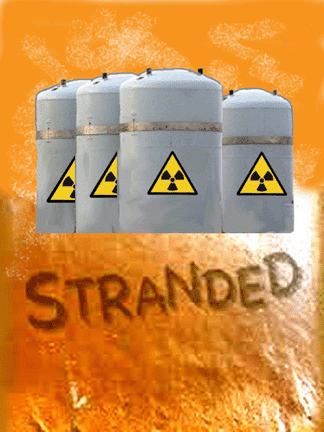
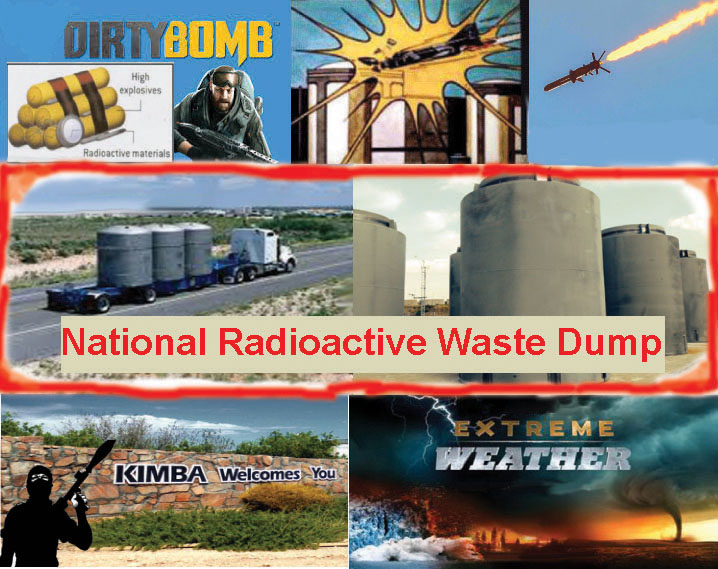
There is no logic behind the proposal to move intermediate-level waste from interim above-ground storage at Lucas Heights to interim above-ground storage at the Kimba site. The proposed double-handling is illogical, it exposes communities to unnecessary risk, and ARPANSA’s Nuclear Safety Committee has indicated that it is not consistent with international best practice.
[ The group makes 10 excellent RECOMMENDATOINS to the Senate Committee]
Joint NGO Submission to the Senate Economics Legislation Committee Inquiry into National Radioactive Waste Management Amendment (Site Specification, Community Fund and Other Measures) Bill 2020 Submission 101
The National Radioactive Waste Management Amendment Bill amends the National Radioactive Waste Management Act to specify a site near Kimba in South Australia for a nuclear waste ‘facility’ ‒ a repository for low-level waste and an above-ground ‘interim’ (indefinite) store for long-lived intermediate-level waste.
The Bill is deeply flawed and should be rejected. Further, the existing Act is deeply flawed and should be repealed Continue reading
Catholic Religious Australia (CRA) question government’s plan for nuclear waste dump near Kimba, South Australia
Time for action over proposed nuclear dump, https://thesoutherncross.org.au/opinion/2020/04/24/time-for-action-over-proposed-nuclear-dump/ Michele Madigan April 24, 2020
The reality is that over 90 per cent of the waste, measured by radioactivity, is intermediate long-lived waste including the nuclear spent fuel rods and also the parts of the previous nuclear reactor.
The Barngala initiated a legal action protesting their exclusion. Sadly their appeal has recently been denied. As Barngarla Traditional Owner Jeanne Miller laments, Aboriginal people with no voting power are put back 50 years, ‘again classed as flora and fauna’.
With Pope Francis’s designation of practical Care for Earth as the 8th Beatitude, a wonderful Lenten/post-Lenten penance might be a concerned letter to alert an Opposition or cross bench SA senator at Parliament House, Canberra 5600. The Senate vote is likely at the end of June.
Australia listened to the science on coronavirus. Imagine if we did the same for coal mining
 Australia listened to the science on coronavirus. Imagine if we did the same for coal mining The Conversation, Matthew Currell Associate Professor in Environmental Engineering, School of Engineering, RMIT University, Adrian Werner, Professor of Hydrogeology, Flinders University, Chris McGrath, Associate Professor in Environmental and Planning Regulation and Policy, The University of Queensland, Dylan Irvine, Senior lecturer in hydrogeology, Flinders University -12 May 20,
We interrogated scientific evidence available to governments and Adani over almost a decade. Our analysis shows governments failed to compel Adani to fully investigate the environmental risks posed by its water plans, despite concerns raised by scientists.
There is also evidence the government approval decisions were influenced by the political climate and pressure exerted by members of government.
Our findings come as the Morrison government conducts a ten-yearly review of the Environmental Protection and Biodiversity Conservation (EPBC) Act. It is critical these laws – Australia’s most important environmental legislation – are reformed to put rigorous, independent science at the core.
Advice ignored
In mid-2019, the federal and Queensland governments approved groundwater management plans for Adani’s Carmichael coal mine. It granted the company unlimited access to groundwater in central Queensland’s Galilee Basin.
We and other experts warned the mine threatens to damage aquifers, rivers and ecosystems – in particular, the Doongmabulla Springs Complex. This system contains more than 150 wetlands which support rare plant communities found nowhere else on earth.
The springs are of major cultural significance to the Wangan and Jagalingou people.
We analysed the full suite of evidence on the groundwater plans from agencies and scientists with expertise in hydro-geology. The evidence, provided to state and federal environment ministers, spanned almost a decade and included at least six independent scientific reviews.
The evidence highlighted major shortcomings, and gaps in knowledge and data. For example – ………
Once-in-a-decade chance
Our analysis exposes flaws in how evidence informs major government decisions. It also shows why reform of the Environmental Protection and Biodiversity Conservation Act is so urgent.
The laws are currently under review. Many reputable organisations and scholars have proposed ways the legislation can better protect the environment, increase its independence from government and put science at the core.
Independent scientific committees, such as the federal IESC, are commissioned by governments to advise on mining proposals. We suggest such committees be granted greater powers to request specific data and studies from mining companies to address knowledge gaps before advice is issued.
Alternatively – or in addition – a new independent national commission should be established to oversee environmental impact assessments conducted by mining and other development proponents.
This commission should be empowered to interrogate and resolve key scientific uncertainties, free from political interference. Its recommendations to government should take into account a wide range of expert advice and public feedback.
This would not only improve the evidence base for decisions, but may also speed up assessments – ensuring more effective resolution of uncertainties that often lead to protracted conflict and debate about a mine’s impacts.
Such reform is urgently needed. Australia is suffering unprecedented water stress, environmental harm and declining trust in government.
Australian governments listened to the science when it needed to flatten the curve of COVID-19. The same approach is needed if we’re to preserve the places we love and the ecosystems we depend on. https://theconversation.com/australia-listened-to-the-science-on-coronavirus-imagine-if-we-did-the-same-for-coal-mining-138212
Australia is uniquely placed to be able to reinvigorate manufacturing through renewable energy
 Powering onwards: Australia’s opportunity to reinvigorate manufacturing through renewable energy https://apo.org.au/node/303735 8 MAY 2020 Dan Nahum Centre for Future Work
Not only are we able to power an expanded manufacturing sector using renewables, but it is cheaper to do so than to continue down the path of an energy grid that favours and subsidises coal and gas. These economic advantages in turn can expedite a broader economic rebalancing, away from extraction towards production, in which value-added manufactures increasingly supplant the export of raw materials in our economic mix. This will be good for Australia’s economy—and for the world’s emissions.
This paper compiles evidence to demonstrate that Australia can achieve the continuation and resurgence of a vibrant, competitive manufacturing sector based on the even faster development of renewable power. To do this, the paper:
- reviews the strategic importance of, and opportunities presented by, manufacturing
-
- discusses Australia’s competitive advantage in renewable energy
- shows that, based on the government’s own figures, renewables are already cheaper than coal—and quickly getting cheaper
- debunks claims about the unreliability of renewables relative to more traditional energy sources
- identifies examples where renewable power is already in use, or could be put to use, in manufacturing and industrial processes, and instances where we can use our natural and manufactured inputs to add further value to these renewables
- examines international evidence showing that there is no connection between reliance on fossil fuels and success in global manufacturing trade
- presents a range of recommendations for government action to capitalise on the opportunity of renewable energy for revitalising Australian manufacturing.
Minerals Council of Australia wants radiation risks to be discounted in Environmental Protection and Biodiversity Conservation Act
 Coronavirus: cut green tape delay on projects, miners say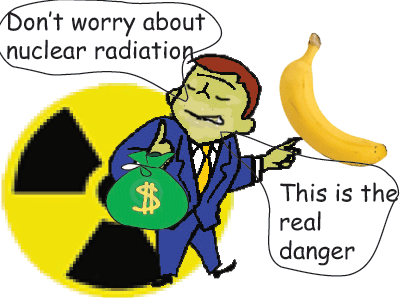
Australia’s six peak mining and resources groups are pushing for a major overhaul of environmental laws, calling for the removal of “unnecessary duplication and complexity” to provide greater certainty for businesses.
In a joint submission to the independent review of the Environment Protection and Biodiversity Conservation Act, led by former Australian Competition & Consumer Commission chair Graeme Samuel, the mining sector warns companies are facing delay costs of up to $1m a day.
Minerals Council of Australia chief executive Tania Constable said Australia was facing an unprecedented economic and social threat from the COVID-19 pandemic, arguing reforms of the EPBC Act would help reduce delays in project approvals and fast-track projects.
Environment Minister Sussan Ley last month flagged reforms to the EPBC and the government’s commitment to cut green tape to “get rid of unnecessary delays”.
Professor Samuel will deliver an interim report by June and a final report by October. “We are getting congestion out of the system and we will continue to do so as the economy comes through the COVID-19 crisis,” Ms Ley said.
The MCA submission, co-signed by the NSW Minerals Council, Queensland Resources Council, the Chamber of Minerals and Energy of Western Australia, South Australian Chamber of Mines and Energy and the Tasmanian Minerals, Manufacturing and Energy Council, suggest four key points to improve the EPBC.
These include eliminating or reducing duplication and ensuring consistency between federal and state-territory processes, reducing delays in assessment and approval processes, improving certainty for businesses and ensuring better “fit-for-purpose regulation”.
Assessing regulatory duplication and uncertainty, the ’ submission ranks NSW and Victoria lower than less mature mining jurisdictions, including PNG and the Democratic Republic of Congo.
Ms Constable said “pragmatic and considered policy reform can build a stronger minerals industry for a faster and more durable post-COVID-19 recovery”.
“When mining projects can take more than a decade to deliver, it’s clear better regulation can help deliver Australia’s economic recovery without compromising our precious environment,” she said.
“Reform to the act is long overdue to address unnecessary duplication and complexity.”
Ms Constable said a one-year delay to a project can reduce its net present value by 10 to 13 per cent per year. “For large mining projects (with a value from $3bn to $4bn), delay costs can be up to $1m per day,” she said. “Significant growth in regulation across all levels of government including the EPBC Act has not led to better environmental outcomes.”
The groups want uranium mining, milling decommissioning and rehabilitation removed from the definition of nuclear actions under the act, to help unlock the mineral sands industry. The EPBC trigger has captured non-uranium projects, including mineral sands, rare earths and base metals, where naturally occurring radioactive material may be present.
Ms Constable said Australia had the world’s largest mineral sands deposits, offering significant “opportunities for growth and jobs”. “Heavy mineral sands such as rutile, ilmenite (titanium) and zircon are essential inputs to everyday life including paint, medical implants and ceramics.”
“Many of Australia’s mineral sands deposits also contain monazite and xenotime, which are sources of the rare earth elements used in smart phones and computers, as well as medical devices.’’
‘under cover of coronavirus’ New South Wales govt approves US company to mine coal beneath a Sydney drinking water dam
|
Woronora reservoir, an hour’s drive south of the CBD, is part of a system which supplies water to more than 3.4 million people in Greater Sydney. The approval will allow Peabody Energy to send long wall mining machines 450 metres below the earth’s surface to crawl along coal seams directly below the dam. Dr Kerryn Phelps says the fact the decision was made “under the cover of coronavirus” is “unfathomable”. NSW has spent 12 of the last 20 years in drought, with record low rainfall plunging much of the state into severe water shortage last year. “We know about the potential for catastrophe,” Dr Phelps told 9News.com.au. “We just cannot let this [decision] go unchallenged.” The former president of the Australian Medical Association may seem an odd figure to lead opposition to a mining project, but Dr Phelps takes what she calls a broad view on health. She grew up on Sydney’s North Shore when koalas still lived in family backyards and has witnessed firsthand the affects human populations have on the natural world. She has also seen, as a doctor, how the degradation of the nature impacts human health. In her role as City of Sydney councillor, Dr Phelps introduced a motion to the council calling on the NSW Minister for Planning and Public Spaces, Rob Stokes, to reverse the approval. “We can’t simply risk the water supply in one part of Sydney, without considering the repercussions for the rest of the state and country,” Dr Phelps said. “We have to make a stand now. If not now, then when?” Chain reactionOn the evening of April 6 this year, the City of Sydney council almost unanimously passed Dr Phelp’s motion calling for the approval to be reversed, prompting mayor Clover Moore to send Mr Stokes a strongly worded internal letter. In it, she described the minister’s decision as “scandalous”. Sutherland Labour Party councillor Ray Plibersek says the move also led Sutherland Shire Council to pass a similar motion urging the decision be reconsidered. “We’re very concerned,” Cr Plibersek told 9News.com.au. “There’s been evidence of damage to the water table… and despite assurances from mining companies, there is a threat to a crucial resource – water.” Sutherland Shire and Wollongong, which both have more than 200,000 residents, share the Woronora special catchment area, the rivers and rivulets passing from one jurisdiction to the next. They share the water within it too – the reservoir supplies 100 per cent of the drinking water……….. https://www.9news.com.au/national/coal-mine-under-greater-sydneys-woronora-drinking-water-reservoir-approved-during-coronavirus-pandemic/d3e51de8-f370-4fcf-b4f8-7f62be1c24c7
|
|

1 This month.
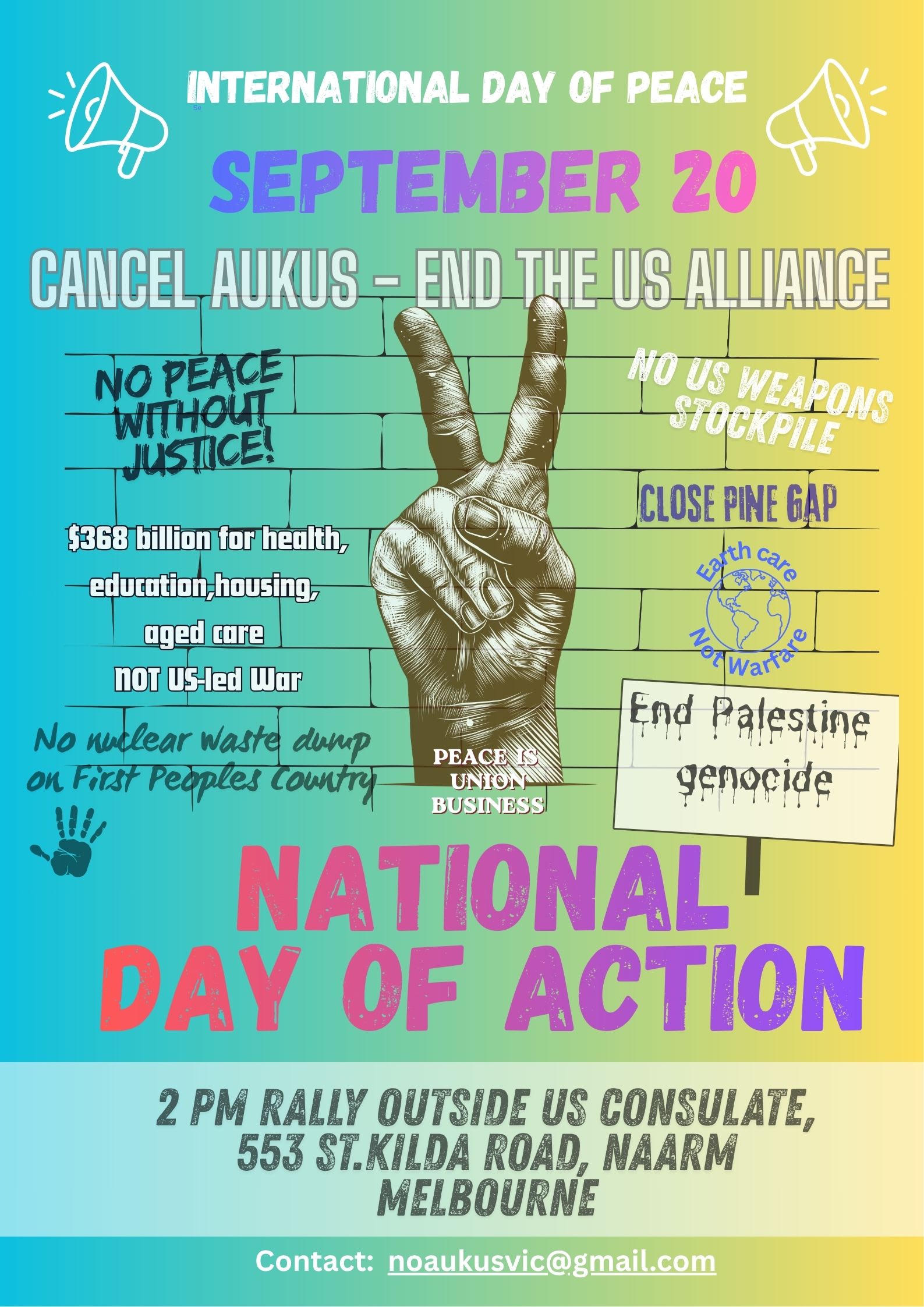
20 September –National Day of Action in Melbourne on the International Day of Peace

Help Aunty Sue Protect Her Land and Sacred Sites From Destructive Rocket Testing.
.

Australians deserve the truth
about
AUKUS – https://aukuspublicinquiry.com/


PETITION – To: Prime Minister Anthony Albanese and the Australian Labor Government

of the week – Australians for War Powers Reform (AWPR)
To see nuclear-related stories in greater depth and intensity
 Antinuclear