Liberal Party misinformation on climate change
 Notorious climate denier Craig Kelly at it again, Independent Australia, By Steve Bishop | 19 January 2020, Official figures reveal the Liberals’ foremost climate change denying MP, Craig Kelly, resorted to lies and misinformation to dispute factual evidence in his presentation to a Sky News program.Kelly and other MPs such as George Christensen, have helped sabotage the Federal Government’s climate change policy to a point where it is viewed as the worst in the world.
Just examine the absurd whoppers Kelly told in claiming most of the U.S.’s hottest years on record had occurred in the 1930s.
He used these lies to justify an even bigger lie: Here’s a transcript of Kelly’s snake-oil claims:
……… The United States’ climate records are kept by the National Oceanic and Atmospheric Administration (NOAA).
I have searched the records, which go back to 1895, and can find no statistics to support Kelly’s claims.
The only set of figures which bear any resemblance to Kelly’s fake news are for one-off freak temperature extremes in each state……….
All Australians should be concerned by Kelly’s lies because he has the personal backing of Prime Minister Scott Morrison, who intervened before the last election to ensure the climate change denier was selected as the candidate for Hughes.
This gives Kelly credibility with the ridiculous right of the party when coal-loving Morrison, as PM, has to appeal to a broad church….. https://independentaustralia.net/politics/politics-display/notorious-climate-denier-craig-kelly-at-it-again,13501
Australia led the world in climate action, in 2012 with the Gillard Labor government
Who to Blame for Australia’s Bullshit Approach to Climate Change https://www.vice.com/en_au/article/dygvjy/who-to-blame-for-australia-coal-mining-lobbyists-fires-bushfires-bullshit-approach-to-climate-change
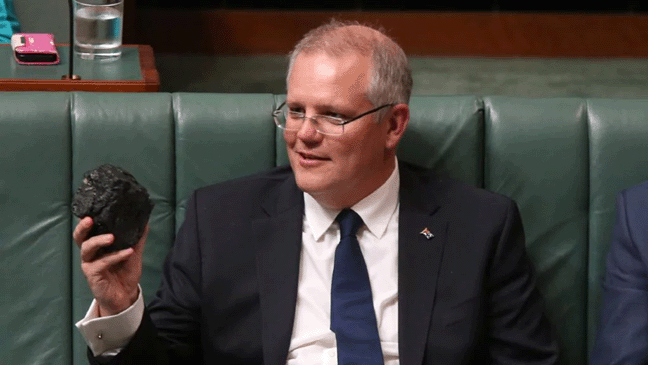 Look these coal lobbyists in the eye. Remember their names. By Royce Kurmelovs, 16 January 2020,
Now people are asking: “why?”
The answer, for many, is that we’ve begun a long and unnerving slide into a world of supercharged weather. The CO2 humanity had been pumping into the atmosphere for decades is now affecting our seasons in precisely all the ways we were warned. For Australia, that means hotter summers with less rainfall, which is exactly what 2019 delivered.
Australia just sweltered through its hottest year on record with temperatures averaging 1.52C above the 1961—1990 average, according to data from the Bureau of Meteorology. This came after an unprecedented period of drought across much of the country’s east, which unsurprisingly led to widespread fires.
But even if the science is clear, the reality seems lost on those who hold the country’s highest political offices. When confronted with the suggestion his government was not acting in a meaningful way on climate change, Prime Minister Scott Morrison has simply said he “did not accept that” and insisted, like his Minister for Emissions Reduction Angus Taylor, that Australia has been “doing its part”.
he truth is that Australia is the fourth largest coal producer in the world, and has relied on tricky accounting practices to book progress toward reducing its carbon emissions while actually doing the bare minimum.
Because of this, Australia was recently rated 57th on a list of countries for its handling of climate change—placing it just slightly above Iran with its oil-dependent national economy.
 And yet just eight years ago, Australia was leading the world on climate change action. In 2012 we’d achieved what many pundits believed was a political impossibility. Australia had levied a tax on carbon that forced an almost immediate drop in the country’s CO2 emissions. That was until a new conservative government took power and repealed the carbon tax a short two years later.
Experienced physicist doubts the value of small modular nuclear reactors for Australia
 Despite a good safety record, nuclear power is not straight forward, THE AUSTRALIAN, Leslie Cook 20 Jan 2020
As a physicist with the British Atomic Energy Authority in the 1960s, I remember the scale and complexity of the task and the breadth of expertise required in science, engineering and regulation, even if an existing design is used.
This simply does not exist in Australia. Nor does the necessary construction capacity — and the thought of the CFMEU controlling concrete pours of 18,000 cubic metres is daunting. Small modular reactors exist only on paper at present and will also require infrastructure. , https://www.theaustralian.com.au/commentary/letters/despite-a-good-safety-record-nuclear-power-is-not-straight-forward/news-story/eb791793ea9751dc3a905a7869687e01
PM under pressure as Coalition changes tune on climate change
PM under pressure as Coalition changes tune on climate change , Daily Telegraph , 19 Jan 2020
Prime Minister Scott Morrison could be facing a cabinet revolt on climate change with the horror bushfire season sparking new calls for action from his own top-ranking MPs…. (subscribers only)
Scott Morrison probably intransigent on climate policy
 If the bushfires won’t force climate policy change, we need to circumvent Scott Morrison. Guardian, Lenore Taylor The cabal of Coalition denialists calling the shots are still impervious to facts. But it’s not yet time to despair @lenoretaylor, Fri 17 Jan 2020 It’s time to face a dreadful truth. If this bushfire crisis, this nation-wide trauma, can’t loosen the denialists’ grip on Coalition climate policy, then maybe nothing will.
That would mean everyone sifting through Scott Morrison’s verbiage for signs that he might really be intending to change direction is searching in vain, because he’s just trying to talk himself out of political trouble.
It would mean everyone patiently pointing out that the prime minister could quite easily “evolve” his current policies into something that actually reduced Australia’s greenhouse emissions could save their breath, because that isn’t the kind of evolution he is considering.
And it would mean there’s no point reprising the facts, that Australia’s emissions are flatlining, not falling, that we could seize an economic advantage in a low-carbon world and at the same time help the globe avoid the all too obvious costs of inaction. The Coalition cabal who apparently still call the shots thinks climate science is “voodoo”. They’re impervious to facts. They are already threatening, via anonymous quotes to the Australian, to “blow the place up”. Again. Just like they’ve been blowing up national climate action for more than a decade.
And as this week’s Guardian Essential poll showed, despite the widespread sense that the fires are a tipping point, despite global outrage at the self-defeating stupidity of our policies, despite the world’s largest fund manager ditching thermal coal, despite the wave of grief and anger from around the world – even from James Murdoch – it’s still not clear that Australian public opinion will force this government to change.
Sure, Morrison’s mishandling of this crisis has cost him. His overall approval ratings have dived but his numbers have held fairly steady in his base. The strategists – who always pay more heed to those numbers than to other benchmarks, like, say, a country in ashes – no doubt believe that, with enough confusing obfuscation about “meeting and beating” targets, enough revising of the figures, enough serious practical efforts to help burnt-out communities, and just enough rhetoric conceding the reality of global heating, all will be well in time, without promising to do anything about it. All will be well for the poll numbers that is. Not for the nation.
This is not, repeat not, an argument for abandoning the arguments in favour of climate action. It is not a counsel to cop out in despair. …………
Maybe, under the current political pressure, something will give. But we’ve been fooled before and there’s no time to be fooled again. So that means it’s time to think of ways around the federal Coalition’s intransigence, because those deniers will never be swayed, and we can’t allow them to dictate our future. https://www.theguardian.com/australia-news/2020/jan/17/if-the-bushfires-wont-force-climate-policy-change-we-need-to-circumvent-scott-morrison
Much of Australia might simply become too hot and dry for human habitation
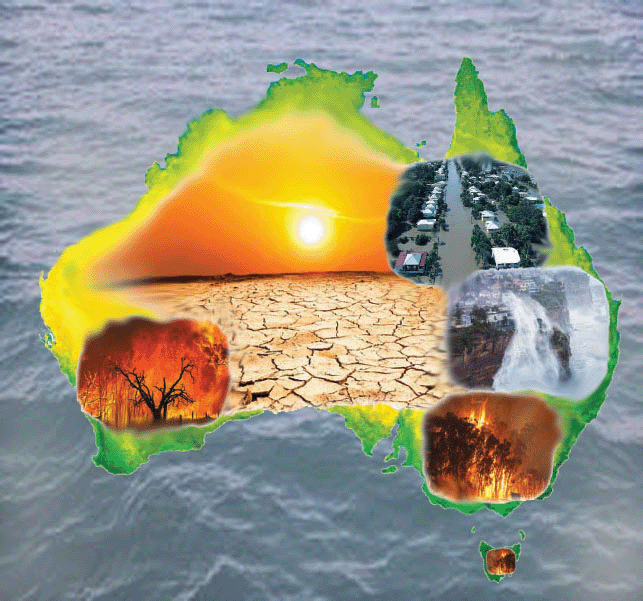 Australians ‘may become climate refugees’ as global temperatures soar: US expert, https://www.sbs.com.au/news/australians-may-become-climate-refugees-as-global-temperatures-soar-us-expert Australians ‘may become climate refugees’ as global temperatures soar: US expert, https://www.sbs.com.au/news/australians-may-become-climate-refugees-as-global-temperatures-soar-us-expertA visiting US climatologist says it’s “conceivable that much of Australia simply becomes too hot and dry for human habitation”. As global temperatures soar, Australia could become so hot and dry that the country’s residents could become climate refugees, US climatologist and geophysicist Michael Mann says. Australia is in the midst of one of its worst fire seasons on record, with bushfires burning since September and claiming nearly 30 lives, killing more than a billion animals and razing forests and farmland the size of Bulgaria. Some fires were so monstrous that they created their own weather pattern causing dry lightning and fire tornadoes as a three-year drought left woods tinder-dry. “It is conceivable that much of Australia simply becomes too hot and dry for human habitation,” Dr Mann, who is director of the Earth System Science Center at Pennsylvania State University, told Reuters. “In that case, yes, unfortunately, we could well see Australians join the ranks of the world’s climate refugees.” Climate refugees, or environmental migrants, are people forced to abandon their homes due to change in climate patterns or extreme weather events. Dr Mann, the recipient of last year’s Tyler Prize for Environmental Achievement, is on a sabbatical in Australia where he is studying climate change. The co-founder of the award-winning science website RealClimate.org said the brown skies over Sydney in recent days were a result of human-caused climate change led by record heat and unprecedented drought. The remarks resonate with his peers who published a review of 57 scientific papers suggesting clear links. Climate change has led to an increase in the frequency and severity of what scientists call “fire weather” – periods with a high fire risk due to some combination of higher temperatures, low humidity, low rainfall and strong winds, the review found. Prime Minister Scott Morrison has repeatedly said his government would “meet and beat” a 26 per cent global emissions reduction target agreed in Paris, albeit with a caveat that such goals should not come at the cost of jobs and the economy. Dr Mann, the author of four books including The Madhouse Effect, said Australia could still “easily achieve” the target by shifting towards renewable energy. “It’s possible to grow the economy, create jobs, and preserve the environment at the same time. These are things that all Australians could embrace,” he said. “They just need a government that’s willing to act on their behalf rather than on behalf of a handful of coal barons.”
|
|
The prosecution of Julian Assange – a travesty of justice
|
The international witch-hunt of Julian Assange, World Socialist Website, Eric London and Thomas Scripps, 14 January 2020 The prosecution of WikiLeaks founder Julian Assange at London’s Westminster Magistrates Court is a travesty of justice that will forever stain the governments of the United States, the United Kingdom, Australia, Sweden and Ecuador, as well as all the individuals involved.Appearing alongside Assange in court Monday morning, Assange’s attorneys revealed that they had been given only two hours to meet with their client at Belmarsh prison to review what lawyer Gareth Peirce called “volumes” worth of evidence.
Expressing the practiced cynicism of British class justice, District Judge Vanessa Baraitser said this was “not an unreasonable position,” citing a lack of space in the prison interview room. With the bang of her gavel, Baraitser sent Assange back to his dungeon at Belmarsh, where he awaits his February extradition hearing under conditions UN Rapporteur Nils Meltzer has called “torture.” At this stage in the near decade-long international witch-hunt of Assange, nobody should be surprised by such shameless lawlessness on the part of the world’s most powerful governments. Ever since Swedish, British and American prosecutors conspired in 2010 to issue a warrant for Assange’s arrest in connection with an investigation into bogus sexual misconduct allegations, these “advanced democracies” have trampled on their own laws and traditions, subjecting the journalist to a pseudo-legal process that would have been deemed unfair even by the standards of the Middle Ages. Monday’s mockery of justice is an escalation of the attack on Assange’s right to counsel. It takes place after the Spanish newspaper El País published a detailed account of how a security firm, UC Global, secretly spied on Assange’s privileged discussions with his lawyers and fed the illegally obtained surveillance to the CIA. UC Global also shared footage from cameras it installed throughout the Ecuadorian Embassy in London, where Assange was forced to seek refuge from 2012 to 2019 to avoid US extradition. El País’ reporting showed that UC Global recorded every word Assange spoke and live-streamed these conversations to the CIA. o 2019 to avoid US extradition. El País’ reporting showed that UC Global recorded every word Assange spoke and live-streamed these conversations to the CIA. Despite the support of a criminally compliant media, it is becoming increasingly difficult for the US and British governments to downplay the profoundly anti-democratic precedents they intend to set through the Assange prosecution. In an opinion article published Monday in the Hill, titled “Will alleged CIA misbehavior set Julian Assange free?” American attorney James Goodale wrote a scathing attack on the CIA’s spying on Assange’s privileged attorney-client communications. Goodale is among the most prominent and well respected attorneys in the US, best known for representing the New York Times when the newspaper was sued by the Nixon administration for publishing the Pentagon Papers in 1971. The Pentagon Papers were leaked by RAND Corporation analyst Daniel Ellsberg, who has also called for the release of Assange and whistleblower Chelsea Manning. The Pentagon Papers revealed how the US government for years lied to the public in expanding the Vietnam War, which led to the deaths of 55,000 US soldiers and 3 million Vietnamese people. Their publication triggered an explosion of public anger and fueled anti-war protests. Goodale wrote: “Can anything be more offensive to a ‘sense of justice’ than an unlimited surveillance, particularly of lawyer-client conversations, livestreamed to the opposing party in a criminal case? The alleged streaming unmasked the strategy of Assange’s lawyers, giving the government an advantage that is impossible to remove. Short of dismissing Assange’s indictment with prejudice, the government will always have an advantage that can never be matched by the defense.” Goodale explained that “the Daniel Ellsberg case may be instructive.” Ellsberg, like Assange, was prosecuted under the Espionage Act for leaking documents to the Times and the Washington Post. During the trial, Nixon’s “plumbers” broke into the office of Ellsberg’s psychiatrist and wiretapped his phone. In that case, Judge William Matthew Byrne ruled that the surveillance had “incurably infected the prosecution” and dismissed the charges, setting Ellsberg free. Goodale wrote that “for similar reasons, the case against Assange should be dismissed.”……https://www.wsws.org/en/articles/2020/01/14/pers-j14.html |
|
|
Australia’s fire-driven storms are pumping smoke into the stratosphere
Blazes across the country in the past few weeks have been so intense they have generated their own weather. They create rising air mixed with ash and smoke that results in thunderstorm clouds above the fires called pyrocumulonimbus (pyroCbs).
Some of these are strong enough and rise high enough to have channelled smoke into the stratosphere, a plume of which has crossed the Atlantic Ocean in an eastward direction. NASA says this plume has now made a full circuit around the Earth. There were at least 20 pyroCbs between 28 and 31 December, and more on 4 January, some of which injected smoke into the stratosphere.
The scale of the smoke in the stratosphere has now been calculated by David Peterson at the US Naval Research Laboratory, who is presenting his preliminary findings to the American Meteorological Society at a meeting in Boston later today.
“It’s very likely on a volcanic scale,” he says. “The big thing here is really the impact that this is having on the stratosphere.” Although not of the scale of the 1991 eruption of Mount Pinatubo, the largest in modern history, the effect is similar to a more moderate eruption, Peterson says.
In 2017, Peterson found that Canadian wildfires put as much smoke as a volcano into the stratosphere. He is now working to apply the same technique to the Australian fires and thunderstorms. “At this point I can tell you that this event is one of the largest, it’s very near the top. I can’t say for sure if it’s the biggest,” he says, in terms of the amount of smoke injected into the stratosphere.
While it is well known that a volcanic eruption can put enough aerosols into the atmosphere to have a cooling effect, the different chemistry of pyroCbs means the impacts of the fires on global temperatures aren’t yet entirely clear.
They may have a warming or cooling effect, and it isn’t known how long the smoke will persist at heights of between around 10 and 50 kilometres high, which is roughly where the stratosphere starts and finishes. Peterson says the biggest question is what role proyCbs are playing in the climate system. Some of the smoke plumes are also getting high enough to affect the ozone layer.
We may have answers to some of these unknowns soon though, thanks to NASA flying a plane earlier this year through the upper level of a pyroCb generated by US wildfires. “It wasn’t as massive as these Australia plumes but fortunately at an altitude the aircraft could get to it,” says Peterson. The resulting direct observations of the chemistry will, along with satellite measurements, help unlock the answers.
Alan Robock at Rutgers University in New Jersey says any potential cooling effect from the bushfire smoke is unlikely to be huge at a global level, but could cause cooling of several degrees Celsius at a local level. If the Australian pyroCbs produce twice as much smoke as those from Canada in 2017, “it still would not be a large or long-lasting impact on climate,” he says.
However, the smoke can persist in the stratosphere for half a year or longer, as at such heights it can be heated by the sun and lofted even further up, prolonging its lifetime.
“This is the same process we have modelled in our studies of the climatic consequences of nuclear war in which much more smoke from burning cities and industrial areas would be lofted into the stratosphere and last for years,” says Robock. As such, analysis of the smoke from the bushfires could help improve simulations of the impact of nuclear Armageddon.
Our knowledge of pyroCbs is at an early stage. These thunderstorms and the smoke they put into the stratosphere have only been detectable via satellite instruments since the early 2000s, and previously were thought to be the result of volcanic eruptions, until analysis traced them back to wildfires.
World Economic Forum focusses on climate change, Australia snubs the Forum
|
Australia snubs Davos session on Australian fires https://www.politico.eu/article/australia-snubs-davos-session-australian-fires/
A new report, meanwhile, found that the Top 5 global risks are all climate-related. By RYAN HEATH 1/15/20 That marks “the first time in the survey’s history that one category has occupied all five of the top spots,” according to Børge Brende, the WEF’s president.
The WEF surveyed 1,047 members of its networks — 44 percent were from climate-conscious Europe — and asked them to rate 30 possible risks. The organization is so alarmed at governments and companies failing to heed its climate warnings that it decided to invite climate activist Greta Thunberg back to its stage next week, and has begun sharing her slap-downs of global leaders through its official channels. While the WEF survey was concluded October 22, before the worst of the Australian fire season, those fires have brought the three biggest overall risks identified by the WEF to the world’s attention: extreme weather, climate policy failure and biodiversity loss. The fires have decimated an area twice the size of Belgium and killed millions of animals, putting Australia in the Davos firing line next week. There’s only one problem: Canberra isn’t playing ball. The WEF session on the Australian fires doesn’t include any Australian speakers.
|
|
|

Australian Nuclear Technology and Science Organisation, (ANSTO), jumps on the bushfire propaganda bandwagon
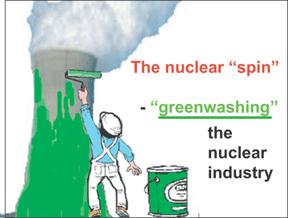
Today, 15 January, there was a ’round table” meeting, (I think in Canberra) of “top scientists” on the urgent need to develop new bushfire adaptation and mitigation techniques.
And guess who’s at the top of the list in these TOP SCIENTISTS ON CLIMATE CHANGE. Why, none other than The Australian Nuclear Technology and Science Organisation, (ANSTO)
Of course, ANSTO is prominent in promoting the lie that nuclear power is the solution to climate change. They’ve put in submissions to parliamentary inquiries, You can bet that they’ve got one in now, to the Victorian Inquiry (submissions close 28 February.) One must admire the timing of the nuclear lobby’s manipulations, and the speed with which they are jumping on the bushfire-fix bandwagon.
New short films show the shocking impact of nuclear waste plan on the Kimba community
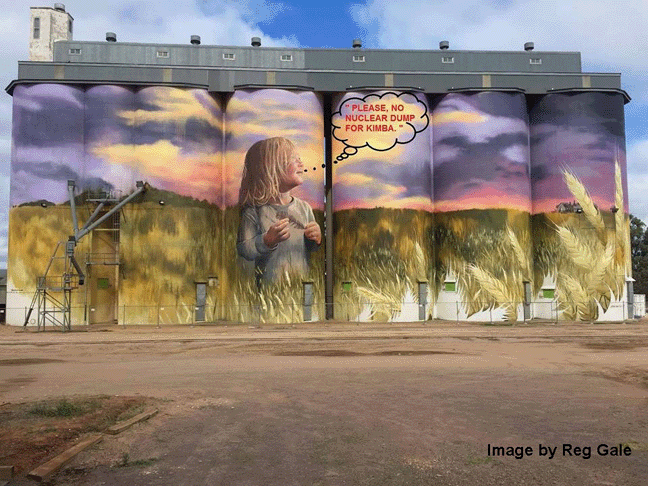
The stories of Kimba farming families and local townspeople opposed to the proposed National Radioactive Waste Management Facility in the district have had their story documented in a message to wider Australia.
Port Pirie filmmaker Kim Mavromatis has released a series of mini-documentaries over the past three months telling the stories of communities impacted by the four-year process to determine whether the facility had broad community support at Kimba or Hawker.
Mr Mavromatis said he had been following the debate around both the waste facility and the SA nuclear fuel cycle process, and he believed the communities involved were only given one side of the story throughout consultation.
“At the end of the day… the government weren’t doing the right thing by the people,” he said.
He said as a member of the Port Pirie community he had also been concerned that his community, which could potentially see the waste transported through their town or port, had not had the same opportunity for consultation as the Kimba and Hawker communities who late last year participated in community ballots to measure support for the proposal.
In one of Mr Mavromatis’s videos, Kimba locals and members of the No Radioactive Waste Facility for Kimba District group spoke about why they remained opposed to the proposal, and the impact the years of uncertainty and community debate has had on them personally.
Among those featured were neighbours of the proposed sites.
Secretary of the group Toni Scott said through the years they had discussed ways of getting their message out to a wider audience, and while it was difficult for many to tell their story there were still many people across the wider Eyre Peninsula and the state who needed to know what was going on as a final decision looms.
“We’re at the stage now where we really want to create as much awareness as we can,” she said.
“We’re hoping people can relate to it.”
Many of the interviewees featured are visibly emotional in the film, which Mrs Scott said was an unintentional outcome of individuals being encouraged to share their stories openly.
“Those raw emotions just came out… I think it’s important for people to see that and realise how affected members of our community actually are,” she said.
Mr Mavromatis said it was “shocking” to see first-hand the impact on the community.
“It’s their livelihood, it’s their future, it’s their kids’ future and it’s permanent,” he said.
The filmmaker has also created a documentary about the impact of the process on the Barngarla people, who in an independent ballot last year voted 0% in favour of the facility.
Mr Mavromatis said the lack of genuine engagement with the traditional owners, who are native title holders of areas neighbouring both proposed sites, was a “total disgrace.”
A rally is planned for Kimba on February 2, with Kimba community members encouraging the wider state to join them.
“We are asking people from Eyre Peninsula and SA to join us in a peaceful protest so the minister (Resources minister Matthew Canavan) can get the message that Kimba is not the right place and farming land is not the right place,” Mrs Scott said.
The video series can be found at vimeo.com/mav17557967.
Scandalous that the Australian government plans a nuclear waste dump on our precious, scarce, agricultural land
 earth would you think Agricultural farmland is a good place to dump radioactive nuclear waste ?????? ARPANSA (the regulator) don’t think so – they state in their own guidelines and Site Selection Criteria, that the proposed Radioactive Nuclear Waste Dumps should not be placed on Agricultural land, in the immediate vicinity of land with significant Natural Resources, or Outdoor Recreational use???
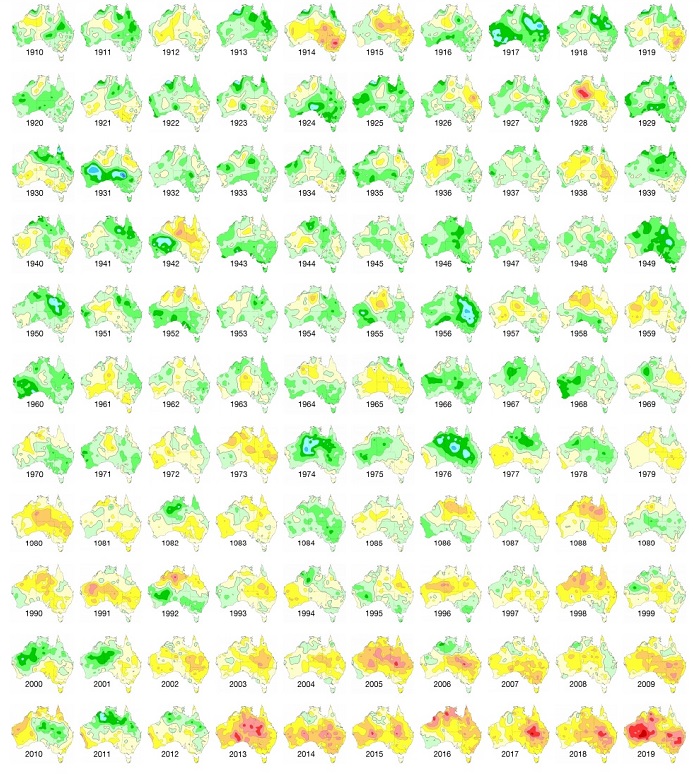
Bureau of Meteorology chart shows how temperatures have soared in Australia over the past century
|
Key points:
A chart produced by the bureau and updated with 2019 figures (shown above) displays a stark transformation over the past century. It shows the anomaly of mean temperature for each calendar year from 1910 to 2019, compared to the average over the standard reference period of 1961–1990. The colours range from dark blue (more than 3 degrees Celsius below average), through blues and greens (below average), yellow and orange (above average), and then brown (more than 3C above average). “Australia’s climate has warmed by more than a degree since 1910, which means very warm years like 2019 are now more likely to occur,” said Karl Braganza, the bureau’s head of climate monitoring.
Dr Braganza said alongside warmer temperatures, we were also seeing a trend in recent decades towards drier winter and spring seasons in some parts of the country. Andrew Watkins, manager of long-range forecasting at the bureau, said the hot 2019 — which had an average mean temperature 1.52C above average — was front of mind for many. “It was the talking point of all last year,” he said. “All the states and territories were in the top handfuls of temperature. Hot everywhere, pretty much. “Almost by definition if they’re records they are unusual.” The bureau has also produced another chart showing rainfall in each year since 1900. [on original]…..https://mobile.abc.net.au/news/2020-01-14/bureau-of-meteorology-chart-shows-how-temperatures-soared/11857404
|
|

Coalition right wing unhappy, as moderate Liberals seize on PM Morrison’s comments about cutting emissions.
 Coalition MPs split over Scott Morrison’s apparent shift on climate policy, Moderate Liberals seize on PM’s comments to argue the government will do more to cut emissions but conservatives push back, Guardian Sarah Martin 13 Jan 2020 Chief political correspondent Moderate Liberals have seized on Scott Morrison’s apparent shift on climate change policy to argue the government will do more to cut emissions, as some conservatives push back against any “symbolism” that could damage the economy.
In a sign of the challenge facing the prime minister as he seeks to “evolve” climate change policy, government MPs have split over the prime minister’s comments on the weekend that the Coalition wanted to reduce emissions “even further” than current commitments.
While saying Australia’s 2030 emission reduction targets remain government policy, Morrison said he wanted to do “better” and would only rely on the use of carryover credits from the Kyoto protocol if needed.
Australia is the only country relying on carryover credits to meet its Paris 2030 target of 26% to 28% of 2005 levels by 2030, which critics say do not represent the cuts required to limit global warming to as close to 1.5C as possible.
Katie Allen, the Liberal MP for the Victorian seat of Higgins, welcomed Morrison’s remarks, telling her constituents that she would be a “strong voice” in the party room for stronger action on climate change…….
The self-styled modern Liberal MP Tim Wilson also endorsed Morrison’s comments, saying the commitment at the last election to “cut emissions, but not jobs” was a baseline for action.
“The prime minister has rightly identified there’ll be more evolution of policy to cut emissions, but not jobs, and I look forward to contributing to that important evolution,” Wilson told Guardian Australia.
Dave Sharma, the MP for Malcolm Turnbull’s former seat of Wentworth, said he was “pleased to hear” Morrison’s comments on the importance of responding to climate change and promoted the government’s plan to “continue to evolve our policies with a view to reducing our emissions further”…..
But as moderates welcomed the shift, conservative MPs were warning against a change in policy.
The Queensland Nationals MP Llew O’Brien told the Courier Mail that if Australia went beyond its current commitments, it would be “pure symbolism at the expense of the economy”.
The former Nationals leader Barnaby Joyce also issued a thinly veiled warning that the government risked a backlash in the bush if it moved to ramp up emission reduction targets……..
The divide comes as Morrison insists the role of climate change is “not in dispute” within his ranks, despite several MPs denying the role of a warmer planet as an underlying cause of the severe bushfire season.
The Nationals MP George Christensen was the latest to promote his view that climate change was not a factor, telling his supporters on Facebook that climate change is not “a bogey man who can go around lighting bushfires”…..
The Liberal MP Craig Kelly last week caused a storm of controversy after appearing on UK television to argue that there was “no link” between climate change and Australia’s drought.
Following the appearance, Morrison told his MPs that backbenchers should not do any international media interviews. https://www.theguardian.com/australia-news/2020/jan/13/coalition-mps-split-over-scott-morrisons-apparent-shift-on-climate-policy
Australia can have zero emissions and still profit from minerals, says Ross Garnaut
 Australia can have zero emissions and still profit from minerals, says Ross Garnaut, ABC NEWS BREAKFAST BY PATRICK WOOD 13 Jan 2020 Australia could have avoided the scale of the devastating bushfires, Professor Ross Garnaut has said as he warned the situation would continue to worsen if there wasn’t global action on climate change, something he said didn’t have to come at the expense of the economy.Key points: Australia can have zero emissions and still profit from minerals, says Ross Garnaut, ABC NEWS BREAKFAST BY PATRICK WOOD 13 Jan 2020 Australia could have avoided the scale of the devastating bushfires, Professor Ross Garnaut has said as he warned the situation would continue to worsen if there wasn’t global action on climate change, something he said didn’t have to come at the expense of the economy.Key points:
The economist said he “strongly endorsed” Prime Minister Scott Morrison’s focus on reducing emissions without damaging the economy, and believed Australian industries could still reap the benefits of the country’s mineral resources in a zero-emissions world. As this bushfire season has claimed lives and thousands of homes, Professor Garnaut has become a focus on the debate around climate change and the Government’s response.That is because in 2008 he conducted a widescale review into the impact of climate change on Australia and its economy, and came to a conclusion: the nation would face a more frequent and intense fire season by 2020. As that prediction comes to pass, the Prime Minister is facing renewed scrutiny on the Government’s climate change policy and whether it will change due to the fires……..
Professor Garnaut said the bushfire crisis could have been avoided if Australia, as part of a global effort, had “done a lot more much earlier”. “The tragedy has been building over a long time,” he said. “Things will continue to get worse … until the world has zero net emissions of greenhouse gases.” In this zero-emissions world, Professor Garnaut argued Australia could be a world leader by processing its minerals locally using renewable energy. “I think the point about avoiding cuts to the economy is a sound one,” he said in response to the Prime Minister’s interview. “The way you make steel in a zero-emissions economy is using renewable energy to make hydrogen, to make steel, instead of using coal.
The way you make aluminium in a zero-emissions world economy is to use renewable energy to turn bauxite and aluminium oxide into aluminium metal. “Australia is by far the biggest exporter of aluminium ores and iron ores, [and] when the world is producing aluminium and iron without emissions, we’ll be the place that’s done. So it will be positive for the economy. “So I strongly endorse the Prime Minister’s focus on getting to zero emissions without damaging our economy. It can do us a lot of good.” Carbon pricing ‘faster and cheaper’The question of how Australia reduces its emissions is still up for debate. He said policies would continue to evolve but did not outline specific plans. Professor Garnaut said putting a price on carbon was a good option, but one he acknowledged was not going to happen with the current Government. “We would have got to low emissions much more cheaply if we’d had an economy-wide carbon price, but you can get there without a carbon price,” he said. “For the time being we have to make progress without a carbon price. We can do that. “We would make faster and cheaper progress later on if later we adopted a carbon price.”He said the current fires could also prompt a shift in the way the country tackled climate change. “My reading of the complex electoral arithmetic of the last election is that on balance the electorate was favouring stronger action on climate change,” he said. “Not in every place. The coal-producing areas in the Hunter Valley and up the Queensland coast were very nervous. “We have to show those communities that there are alternatives … [that] those places can do very well in the zero-emissions economy of the future. “But we’ve actually got to develop the programs that have them doing very well.” https://mobile.abc.net.au/news/2020-01-13/ross-garnaut-on-bushfires-scott-morrison-climate-change/11861846 |
|
1 This month.
20 September –National Day of Action in Melbourne on the International Day of Peace


Help Aunty Sue Protect Her Land and Sacred Sites From Destructive Rocket Testing.
.

Australians deserve the truth
about
AUKUS – https://aukuspublicinquiry.com/

PETITION – To: Prime Minister Anthony Albanese and the Australian Labor Government

of the week – Australians for War Powers Reform (AWPR)
To see nuclear-related stories in greater depth and intensity
 Antinuclear