It is a big MISTAKE to equate COAL MINING with jobs
It is a big MISTAKE to equate COAL MINING with jobs
 1. Australian Tourism employs 10 times more Australians than does mining
2. There are job vacancies in the setting up and maintaining renewables
3. Australia has an opportunity to Lead the World manufacturing and building the equipment and technological infrastructures and components required to set up renewable and sustainable community and economy e.g.. Let’s build Australian Made solar panels instead of importing them
4. Build our own iron ore processing plants run by green hydrogen/hydro/wind/solar/ To make aluminium Keeping profits and jobs in Australia
5. Build sustainable industry, farming, tourism, land management, water management and houses, towns and cities, Leed the world in recycling and green energy transport solutions Manufacture electric cars, buses, commercial vehicles There are so many jobs to be had and created in zero emissions
The world would flock here and pay us to advise and share our sustainable progressive technology and solutions
6. Eco tourism would not only create even more jobs for Austalians boosting the industries that benefit ie. restaurants, bakeries, farmers etc The tourism industry would bring even more billions of $$$$ into Australia
When traditional Aboriginal owners are included in the vote, support for Kimba nuclear waste dump drops to 43%
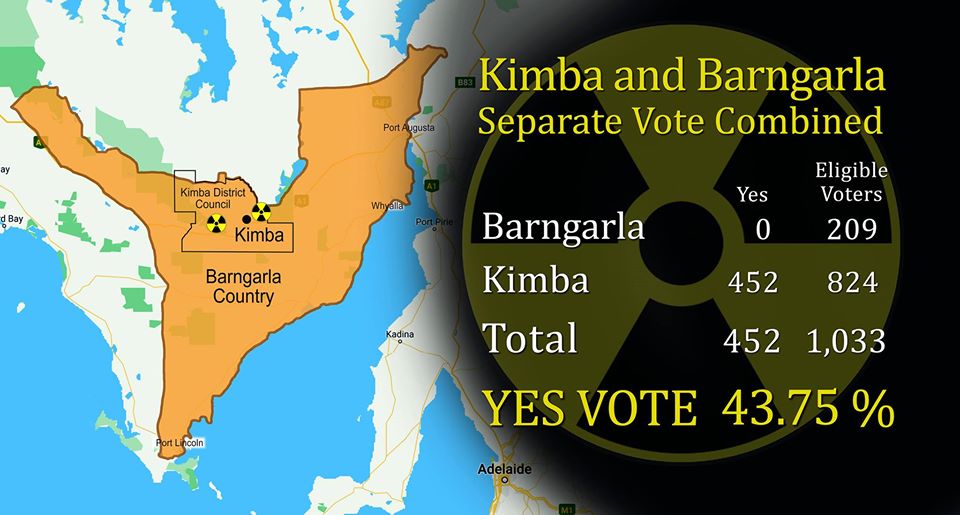
“Barngarla Speak Out” : vimeo.com/382855709
“SAVE SA Farmland – Kimba, Eyre Peninsula” : vimeo.com/381938156
Climate protests in London, Berlin, Madrid, Copenhagen and Stockholm target Australian government
Climate action protesters angry over Australia’s bushfires rally across Europe https://mobile.abc.net.au/news/2020-01-11/scott-morrison-labelled-laughing-stock-europe-climate-protests/11859988 BY EUROPE CORRESPONDENT BRIDGET BRENNAN AND ROSCOE WHALAN IN LONDON
Thousands of people have taken part in demonstrations across Europe, taking aim at what they say is the Australian Government’s lack of action on climate change during the bushfire crisis.
- Demonstrations organised by Extinction Rebellion were held in London, Berlin, Madrid, Copenhagen and Stockholm
- The protesters called for stronger action on climate change in response to the Australian bushfires
- Protesters in London rallied outside Australia House, while protesters chanted outside the Australian embassy in Berlin
Protesters stopped traffic in London and turned out at rallies in Berlin, Madrid, Copenhagen and Stockholm to show their support for victims of the disasters.
At the Strand in London, hundreds gathered outside Australia House, where the High Commission of Australia is located, calling for stronger action on climate change as part of a protest organised by Extinction Rebellion.
Anne Coates travelled from Sheffield, north of London, to attend the rally.
She began to cry when she spoke about watching the effect of the disaster on people who had lost relatives and homes.
“It’s just too much for your heart. You just can’t live with it. It just gets worse and worse every day,” she said.”Absolutely devastating to watch it. It’s like hell. And it seems like governments around the world are in a race to drag us down to hell.”
She said Prime Minister Scott Morrison was “a laughing stock around the world”.
“We’re absolutely furious with him. And I don’t know what’s it going to take. Governments should be listening,” she said.
Many people wore koala hats to represent the massive loss of wildlife in New South Wales, Victoria and South Australia.
Fi Radford from Bristol carried a sign which said “koalas not coal”.
“We’re here to say to the Australian people, challenge your Government on the evidence they’re giving you,” she said.
“Australia, you are custodians of precious species that exist nowhere else in the world. Overturn your Government, they’re leading you to destruction.”
Among the protesters were some of the tens of thousands of Australians living in London.
Harley McDonald-Eckersall from Melbourne said she had been watching on in horror at what has been unfolding in Australia.“It’s been so horrible being away … Australians are extraordinarily resilient — like our First Nations people who have survived genocide and are still caring for the environment,” she said.
Australian Dylan Berthier said he believed the catastrophic conditions in Australia were a wake-up call for the world.
“I think a crisis of this magnitude is a global crisis. I think world leaders have a responsibility to call on the Australian Government to enact new policy that will actually prevent this from happening in the future,” he said.
In Germany, protesters chanted outside the Australian embassy in Berlin.
One man carried a sign which read “Aloha from Berlin” in reference to Mr Morrison’s maligned trip to Hawaii when the bushfires were burning in December.
The climate action group Extinction Rebellion organised the protests across Europe.
Bushfires ‘a warning to the whole world’: UK politicians
The bushfire emergency has been front-page news in the UK for weeks — and has forced Tourism Australia to temporarily pull its new $15 million advertising campaign, fronted by Kylie Minogue.
When the UK Parliament returned earlier this week, Speaker Lindsay Hoyle said what had been happening in Australia should act as a “wake-up call for the world”.
Last year, the Conservative Government in the United Kingdom passed legislation to reach net-zero carbon emissions by 2050 — one of the most ambitious targets set by a major economy.
But many environmental groups have said 2050 is not soon enough.
Labour leadership contender Clive Lewis told the House of Commons: “So as Australia burns, as millions in African states face climate-driven famine, and floods have swept the north of England, will this Government give a damn about this existential threat and act, not posture?”
Shadow Foreign Secretary Emily Thornberry, who is vying to become the new opposition leader, has criticised the Morrison Government.
“I hope that the horrendous wildfires in Australia, brought on by record temperatures, with such devastating impacts for the human and animal populations in New South Wales, will not just wake up Scott Morrison’s Government to its wilful inaction over climate change, but serve as a warning to the whole world,” she said.
Earlier this week, outspoken British television presenter Piers Morgan cut short an interview with Liberal MP Craig Kelly on Good Morning Britain.
Climate change and global warming are real and Australia is right now showing the entire world just how devastating it is,” he said.
“And for senior politicians in Australia to still pretend there’s no protection is absolutely disgraceful.”
In an address to Vatican diplomats this week, Pope Francis also criticised climate inaction.
“Many young people have become active in calling the attention of political leaders to the issue of climate change. Care for our common home ought to be a concern of everyone,” he said.
“Sadly, the urgency of this ecological conversion seems not to have been grasped by international politics, where the response to the problems raised by global issues such as climate change remains very weak and a source of grave concern.”
Dramatic drop in P.M. Scott Morrison’s popularity, over his climate stance
|
Appearing on Insiders on Sunday morning, Mr Morrison said it was his “intention to meet and beat” Australia’s 2030 commitment to cut emissions 26 to 28 per cent on 2005 levels. And he left the door slightly ajar to cut more emissions if needed.
It’s a small but significant step considering just weeks ago Mr Morrison said he saw no need to change his climate policies. In another move to show it is helping the environment, the Morrison government will on Monday announce it is pledging $50 million to help protect wildlife and fauna impacted by bushfires. Could it signal that the bushfire disaster has finally woken the government up to do more to acknowledge and fight manmade climate change? Experts aren’t holding their breath. And now the polls indicate the PM has some work to do to persuade voters amid fury over Mr Morrison’s bushfire response. The latest Newspoll figures show Mr Morrison’s approval rating has plunged and Labor leader Anthony Albanese is now the preferred leader. Mr Albanese leads the Liberal leader 43 to 39 per cent, according to the survey results released on Sunday night. Labor is in front 51-49 on a two-party-preferred basis in the poll conducted for The Australian, a significant turnaround from early December when results showed the coalition led 52-48. Support for the Greens rose one point to 12 per cent, while One Nation lost ground, falling one point to four per cent. Meanwhile, scientists say Mr Morrison’s mea culpa on his holiday and hint on climate policy shift are nowhere near the strong response needed to show the government is going to commit to any meaningful change in their climate response. Lesley Hughes, a professor of biology at Macquarie University and a climate councillor at the Climate Council of Australia, said the government’s targets are so “weak” that it means little when the PM promises to meet or beat them. “It’s like saying I want a 20 per cent pass rate on my exam. So we met those targets because they were so low,” Professor Hughes told The New Daily. Meeting the 2030 Paris targets would rely heavily on including emissions reductions from the previous international agreement, the Kyoto protocol. “The best analogy I’ve heard – and it’s not mine – but it’s like saying I got a really good mark on my kindergarten colouring test and I want to use that to pass my university test now,” Professor Hughes said. On top of the targets being criticised as too low, the UN reported last year that Australia was not even on track to meet them. “There has been no improvement in Australia’s climate policy since 2017 and emission levels for 2030 are projected to be well above the target,” the report found. Central to the government’s climate plan is the Emissions Reduction Fund, which was allocated an additional $2 billion to purchase about 100 million tonnes of emissions from businesses between 2021 and 2030. While the framework of the ERF has been praised, the OECD said in a 2019 report it would need to be scaled up to meet the Paris targets. Australia is part of a growing cohort of G20 countries that are falling short. This will have dire consequences for our environment and economy, Professor Hughes said. If we do meet our 26 per cent reduction, it is not enough if you multiply that on a global scale to stop us from getting to three degrees of warming,” she said. “This fire season has been with just one degree of warming. Just imagine three times – what that means. That’s what we’re talking about.” Coal: Australia’s kingOpposition leader Anthony Albanese has said the government is “refusing to act” on climate change, but he has also backed coal exports……. https://thenewdaily.com.au/news/national/2020/01/13/scott-morrison-insiders-climate-change/ |
|
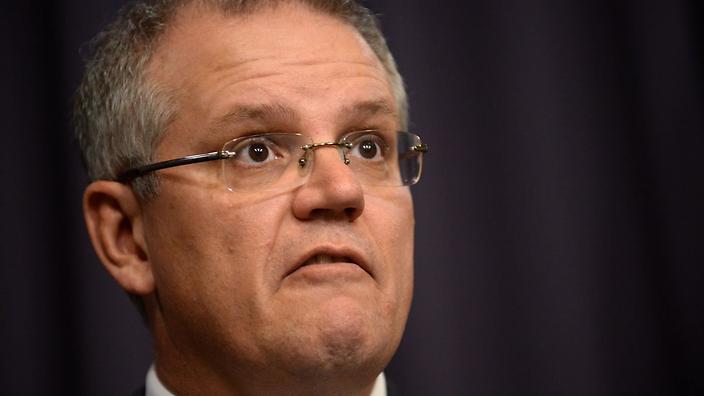
Australia’s costly failure to address global warming risk mitigation
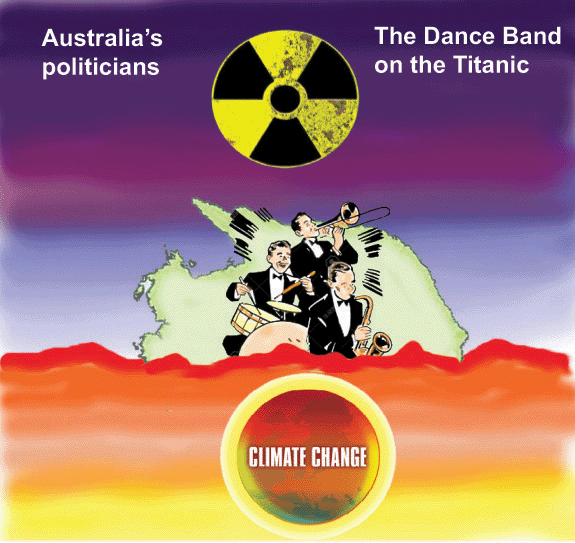 Paul Richards 13 Jan 2020, Failing to address global warming risk mitigation was always going be costly.
The sooner there is something started, the less it will cost.
From this perspective, the cost has already been far too high;
• 27 human deaths and
• 2,000 homes have been destroyed across
• 103,000 sq km [10.3 million hectares] burned out where a
• 1 billion wild mammals, birds and reptiles have perished
Bushfires started in late September 2019, and it will go until early April 2020, and that is just one extreme type of climate change event.
Massive fires merge across the New South Wales – Victoria border
Dry heat, shifting winds and powerful gusts fanned more than 100 blazes devouring drought-parched bushland throughout southern NSW overnight, as the East Ournie Creek and the Dunns Road fire zones came together north of Mount Kosciuszko on Friday evening, near the village of Tooma.
Meantime, the Morton fire in the Southern Highlands near Bundanoon was upgraded to emergency warning level about 1am on Saturday as north and north-westerly winds gave way to a strong southerly change. ……
North and north-westerly winds gave way to a southerly change overnight, which combined with merging fires, provided additional challenges from multiple entry points. Mr Clark said they were “expecting fires to potentially spread in two directions overnight”.
“What we’re really seeing with a number of these fires merging is a number of small fires started by lightning strikes, across the landscape. And as they grow, we see fires merging,” RFS spokesman Anthony Clark said.
“It provides a challenge for firefighters as when they merge, it increases the size and opens up more uncontained perimeter.”
Early on Saturday, more than 2500 firefighters were battling 147 blazes in NSW, as the bushfires crisis escalated across four states. More than 60 of those NSW fires were uncontained.
Residents were also fleeing fire fronts tearing through parts of eastern Victoria and Kangaroo Island off South Australia, where crews faced rising winds, bone-dry bushland and blistering temperatures. Also homes in Perth were under threat…….
Winds gusting up to 90km/h swept through the state later in the evening. Temperatures soared past 40 degrees in inland areas, while the RFS warned large blazes in the south-east could spread under worsening conditions, or shoot off embers that might create spot fires.
The blustery conditions were expected to bring mixed fortunes for firefighters overnight – dropping temperatures on the ground while making blazes more unpredictable after dark…… https://www.smh.com.au/national/nsw/fires-on-the-nsw-and-victorian-border-likely-to-merge-as-winds-worsen-20200110-p53qby.html
The impact of bushfires on drinking water, rivers and fish
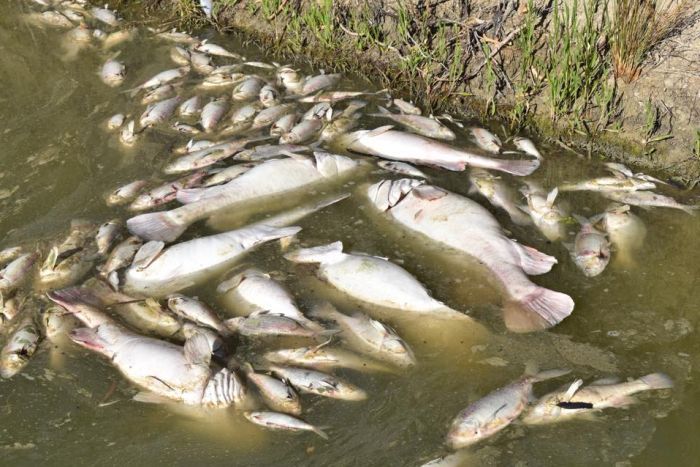 Our drinking water, rivers and fish will all feel the impact of bushfires, experts warn, ABC Science, By Jo Khan, 9 Jan 2020, Our drinking water, rivers and fish will all feel the impact of bushfires, experts warn, ABC Science, By Jo Khan, 9 Jan 2020,
When it rains after bushfires, the consequences stretch way beyond temporary relief for those on the front line — and scientists are warning of potentially dire impacts on our waterways.
They say the aftermath of the current fires could bring devastation to freshwater animals and plants, as well as drinking water catchments. This is because, while it may or may not help firefighters themselves, rain inevitably washes the ash and eroded soil from burnt forests into rivers and streams, shifting the bushfire impact to our crucial freshwater ecosystems. Waterways can also suffer immediately in a fire just from the temperature increase, according to Ross Thompson from the University of Canberra. “In one of the streams we worked on in Victoria, the Black Saturday fire got so hot that the stream boiled,” Professor Thompson said. Even if water doesn’t boil (which effectively sterilises it), many animals can’t withstand the sudden increase in temperature, and die. But it’s the longer term effects that have scientists really worried. Rain washes ash into waterwaysRain events after bushfires can transfer huge amounts of ash, burnt material, soil and dead animals into our rivers and lakes. There will be an increase in nutrients because there’s lots of phosphorous and nitrogen in ash,” said Professor Thompson, a freshwater ecologist who has studied water catchments after the 2003 fires in the ACT and the 2009 Black Saturday fires in Victoria. “You also see more sediment because trees are falling down and the river banks are getting knocked around.” As the water fills up with fine sediment and foreign, nutrient-rich material, the water quality can drop very quickly — and stay that way for a long time. “We’re still seeing higher sediment loads coming out of the Cotter River catchment and those fires were more than a decade ago,” Professor Thompson said. Freshwater animals lose oxygenAs soon as a fire has passed and the ash settles on rivers and lakes, bacteria in the water will start consuming the carbon in that ash. In the process of breaking down the carbon, the bacteria will also consume the dissolved oxygen in the water. The more carbon, the more oxygen will be taken out of the system. And most animals and plants can’t survive in such a low-oxygen environment, as was seen in the Murray Darling Basin last summer. “The the risk is we will see big fish kill events even in some of the larger rivers,” Professor Thompson said. “Even if the fires didn’t burn immediately adjacent to the river.” Changes in the turbidity, or amount of sediment in the water, is another factor that can threaten aquatic species. “We see a loss of a lot of invertebrates that rely on really stony streams, because the sediment and ash smothers the rocks and it changes the habitat.” Rescuing fish from ‘water like licorice’………..Drinking water quality affectedChanges to the insects and other invertebrates in an ecosystem, along with the influx of nutrients from the ash, can result in the growth of cyanobacteria — commonly known as blue-green algae (but it’s not actually algae). Cyanobacteria produce chemicals which may cause a range of water quality problems, starting with poor taste and odour, according to Stuart Khan, an urban water management expert at the University of New South Wales………. “Of more concern is that cyanobacteria can produce chemicals that are really quite toxic,” Professor Khan said. https://www.abc.net.au/news/science/2020-01-09/freshwater-ecosystems-water-catchment-bushfire-impact/11850826?pfmredir=ms |
|
|
The vastly different way that bushfires are experienced by Aboriginal people
The fact is, the experience of Aboriginal peoples in the fire crisis engulfing much of Australia is vastly different to non-Indigenous peoples.
Colonial legacies of eradication, dispossession, assimilation and racism continue to impact the lived realities of Aboriginal peoples. Added to this is the widespread exclusion of our peoples from accessing and managing traditional homelands. These factors compound the trauma of these unprecedented fires.
As Australia picks up the pieces from these fires, it’s more important than ever to understand the unique grief Aboriginal peoples experience. Only through this understanding can effective strategies be put in place to support our communities to recover.
Perpetual grief
Aboriginal peoples live with a sense of perpetual grief. It stems from the as-yet-unresolved matter of the invasion and subsequent colonisation of our homelands…….
Aboriginal people have watched on and been ignored as homelands have been mismanaged and neglected.
Oliver Costello is chief executive of Firesticks Alliance, an Indigenous-led network that aims to re-invigorate cultural burning. As he puts it:
Since colonisation, many Indigenous people have been removed from their land, and their cultural fire management practices have been constrained by authorities, informed by Western views of fire and land management……
Aboriginal peoples’ cultural identity comes from the land.
As such, Aboriginal cultural lives and livelihoods continue to be tied to the land, including landscape features such as waterholes, valleys and mountains, as well as native animals and plants.
The decimation caused by the fires deeply impacts the existence of Aboriginal peoples and in the most severe hit areas, threatens Aboriginal groups as distinct cultural beings attached to the land. As The Guardian’s Indigenous affairs editor Lorena Allam recently wrote:
Like you, I’ve watched in anguish and horror as fire lays waste to precious Yuin land, taking everything with it – lives, homes, animals, trees – but for First Nations people it is also burning up our memories, our sacred places, all the things which make us who we are………
Resilience in the face of ongoing trauma
The long-term effects of colonisation has meant Aboriginal communities are (for better or worse) accustomed to living with catastrophic changes to their societies and lands, adjusting and adapting to keep functioning.
Experts consider these resilience traits as integral for communities to survive and recover from natural disasters……..
If agencies and non-government organisations responsible for leading the recovery from these fires aren’t well-prepared, they risk inflicting new trauma on Aboriginal communities.
The National Disability Insurance Agency offers an example of how to engage with Aboriginal people in culturally sensitive ways. This includes thinking about Country, culture and community, and working with each community’s values and customs to establish respectful, trusting relationships.
The new bushfire recovery agency must use a similar strategy. This would acknowledge both the historical experiences of Aboriginal peoples and our inherent strengths as communities that have not only survived, but remain connected to our homelands.
In this way, perhaps the bushfire crisis might have some positive longer-term outcomes, opening new doors to collaboration with Aboriginal people, drawing on our strengths and values and prioritising our unique interests. https://theconversation.com/strength-from-perpetual-grief-how-aboriginal-people-experience-the-bushfire-crisis-129448?utm_medium=email&utm_campaign=The%20Weekend%20Conversation%20-%201504914324&utm_content=The%20Weekend%20Conversation%20-%201504914324+CID_6dc5e263c454601de4049d9ca867c3a7&utm_source=campaign_monitor&utm_term=Strength%20from%20perpetual%20grief%20how%20Aboriginal%20people%20experience%20the%20bushfire%20crisis
Thousands protest in Sydney and other cities, against govt inaction on climate change
Protesters chanted, “Hey hey, ho ho ScoMo has got to go” as speakers climbed Town Hall’s side steps, and later moved on to “The liar from the shire, the country is on fire”.
She was given a move-on order by police while protesting outside Kirribilli House last September. Her hope is that Friday’s protest will create change……….
Protests also took place in other Australian capital cities. https://www.smh.com.au/environment/climate-change/sydney-cbd-climate-protest-attracts-thousands-20200110-p53qhq.html?promote_channel=edmail&mbnr=MTM2NDAwMjM&eid=email:nnn-13omn655-ret_newsl-membereng:nnn-04%2F11%2F2013-news_pm-dom-news-nnn-smh-u&campaign_code=13INO009&et_bid=292
The $billions cost of Australia’s climate disasters
Australia’s bushfires to cost billions as climate risks rise Climate Home News 07/01/2020, Australian government announces national bushfire recovery fund, as cost of natural disasters expected to rise in coming years, By Chloé Farand
Bushfires ravaging Australia are expected to cost billions of dollars in recovery efforts and the nation’s bills for tackling natural disasters risk soaring in coming decades with worsening climate change.
Record-breaking temperatures and severe droughts have fuelled the fires which have burnt millions of hectares across the country. At least 24 people and hundreds of thousands of animals have been killed.
Data from the Australian government Bureau of Meteorology shows December’s mean temperature was 3.21C warmer than the average for the month. Ed Hawkins, a professor of climate science at the University of Reading, said the country’s mean December temperature had warmed about 1.4 times faster than the global annual average temperature over the past century.
But pro-coal Prime Minister Scott Morrison has denied the link between climate change and the unprecedented intensity of bushfires across the country, describing it as “misconstrued”.
The costs of wildfires is difficult to estimate due to the indirect costs such as the destruction of wildlife and the environment, damage to public health and harm to tourism.
Swiss Re, one of the world’s largest insurance companies, found direct economic losses only represent a fraction of the true economic impact, which can span years.
Across the world, the economic cost of wildfire has increased in recent decades. In 2017, direct economic losses from wildfires amounted to $21bn worldwide – up from $6bn in 2016, according to Swiss Re
The costs of wildfires is difficult to estimate due to the indirect costs such as the destruction of wildlife and the environment, damage to public health and harm to tourism.
Swiss Re, one of the world’s largest insurance companies, found direct economic losses only represent a fraction of the true economic impact, which can span years.
Across the world, the economic cost of wildfire has increased in recent decades. In 2017, direct economic losses from wildfires amounted to $21bn worldwide – up from $6bn in 2016, according to Swiss Re. https://www.climatechangenews.com/2020/01/07/australias-bushfires-cost-billions-climate-risks-rise/
Independent Australia on the Coalition’s toxic denial of climate change
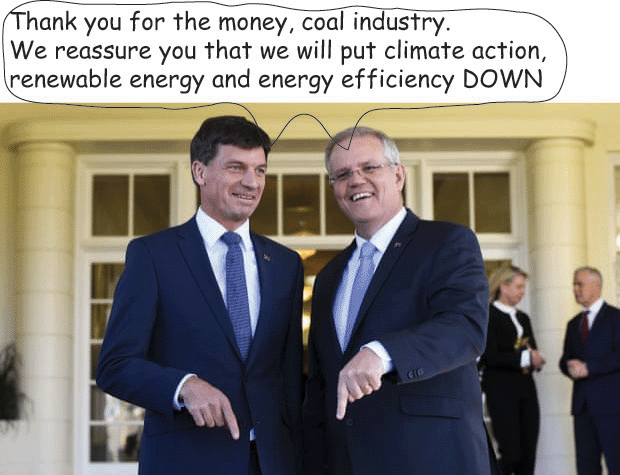 The Coalition’s toxic denial of climate change is destroying us, Independent Australia, By Lyn Bender | 10 January 2020 It was our government’s denial of climate change that has brought so much destruction upon our country, writes Lyn Bender.
AS AUSTRALIA MOURNS enormous losses and experiences the dread and terror of this ferocious summer, the culture of denial attempts to assert itself in this new landscape. The professional denialists continue to promote their toxic climate lies.
Prime Minister Scott Morrison is their klutz villain who seeks to deceive, as the climate reveals its fury.
Perhaps this is the time that we may at last defeat toxic denial. …..
Scott Morrison does not seem to accept the science of the times. If he understands the science, then his response to our climate crisis is homicidal.
Morrison wants to continue to consummate his love affair with coal, even though it means the destruction of our nation and the planet.
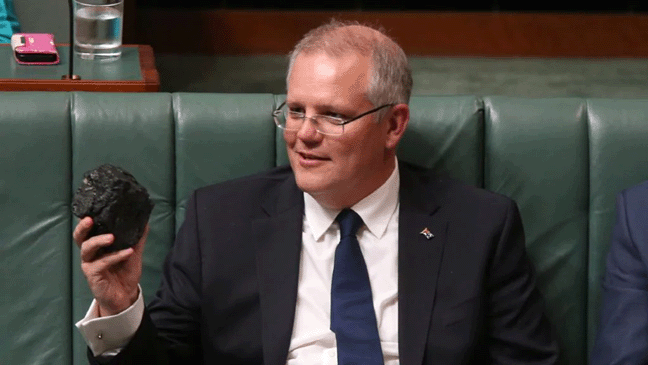
In May 2019, enough voters were in denial of the urgency of climate change to facilitate the election of a climate-denying government. Morrison showed us what he was made of when he fondled a lump of coal in the House of Representatives. It had been lacquered into cleanliness.
“Don’t be afraid, don’t be scared,” he mocked. “This is coal,” Morrison bellowed. He laughed as his sycophantic frontbenchers handled the gleaming black lump with glee.
Optimism is not the same as pretending in the face of evidence to the contrary that all will be well. That kind of optimism exists in the realm of charlatans or fools.
Morrison had a Happy New Year’s Eve party and photoshoot with the cricket team. “Life, as usual, continues” was the message. As people died, houses burned, ecosystems and millions of native animals are incinerated, the Prime Minister was having his summer of beach and cricket. It was like a crass tourism promotion.
This is the bizarre game that the denialist team has been playing for many years. As the planet hotted up and the science grew more insistent of our need to act, the denial team was in full throat. As the birds were silenced, the usual suspects became more shrill in their squawking.
There are too many to name but here are a few of those seated at the have-a-sham table:
- Alan Jones;
- Ray Hadley;
- Steven Price;
- Peter Gleeson;
- Peta Credlin;
- Chris Kenny;
- Andrew Bolt;
- Terry McCrann;
- Rupert Murdoch;
- Ian Plimer, as reported on Media Watch; and
- the Institute of Public Affairs, a pseudo think tank that promotes denial in the interests of its mining founders.
The Government is staffed by saboteurs of climate action. Angus Taylor, the Minister for Energy and Emissions Reductions, has voiced opposition to the U.N. climate processes. Australia, along with Brazil and Saudi Arabia, pushed for a very disappointing outcome at the recent Climate Summit at Madrid. Angus’s performance was slammed by climate scientist Will Steffen. Former Deputy Prime Minister Barnaby Joyce is awaiting divine intervention for the drought, rather than government intervention. As the former Drought Envoy, Joyce failed to produce a single report. https://independentaustralia.net/politics/politics-display/the-coalitions-toxic-denial-of-climate-change-is-destroying-us,13477
Climate change Australia, and the bizarre state of our national political conversation
it apparently isn’t OK to simply say that clearly the climate has changed (even to say that without saying because it’s due to, you know, climate change).
It’s hard not to listen to these interviews [with Scott Morrison] though, and get the sense that he is rattling off an alibi; that he remains on the defensive.
|
|
In the face of a bushfire catastrophe, our national conversation is still run by politics https://www.abc.net.au/news/2020-01-11/australia-bushfire-crisis-just-dont-mention-climate-change/11857590b By Laura Tingle The Eyre Highway reopened on Friday after being closed for 12 days because of bushfires.You might not have driven on the Eyre Highway. But if you want to take the long route north via Kununurra, it is the only sealed highway linking eastern Australia with Western Australia.
The Kings Highway is expected to be closed for most of January. That’s the highway that links Canberra with the south coast. Parts of that road are said to have just melted down the steep sides of Clyde Mountain in fires that have burnt virtually all of the bush from Braidwood to Batemans Bay. Many communities across the country have been told to boil their drinking water because of contamination linked to bushfires — either by ash, such as in Tenterfield, or by the mixing of water supplies during firefighting, as has happened on the NSW south coast. And that’s the case for the communities that have not simply just run out of water. There are concerns that Sydney’s water supply could be severely affected in months to come if the ash from huge areas of burnt out bush around Warragamba Dam, which provides 80 per cent of Sydney’s water, runs into the dam after heavy rainfall. The bizarre state of our national conversationIt’s hard to take pictures of closed highways, or compromised water supplies. But these examples give just some idea of the knock-on effects of fires like those we have seen this catastrophic summer. Continue reading |
Bushfires – a serious danger to transporting nuclear wastes from Lucas Heights to Kimba

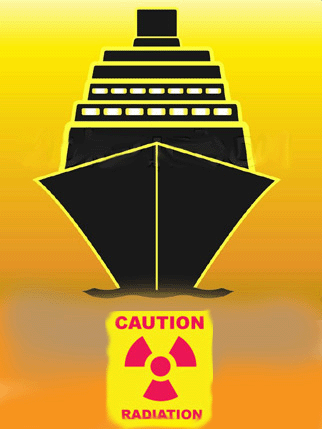
Transporting nuclear wastes across Australia in the age of bushfires, Independent Australia, By Noel Wauchope | IN 2020, the final decision on a site for Australia’s interim National Radioactive Waste Facility will be announced, said Resources Minister Matt Canavan on 13 December.
He added: I will make a formal announcement early next year on the site-selection process.”
With bushfires raging, it might seem insensitive and non-topical to be worrying now about this coming announcement on a temporary nuclear waste site and the transport of nuclear wastes to it. But this is relevant and all too serious in the light of Australia’s climate crisis.
The U.S. National Academies Press compiled a lengthy and comprehensive report on risks of transporting nuclear wastes — they concluded that among various risks, the most serious and significant is fire:…..
Current bushfire danger areas include much of New South Wales, including the Lucas Heights area, North and coastal East Victoria and in South Australia the lower Eyre and Yorke Peninsulas. If nuclear wastes were to be transported across the continent, whether by land or by sea, from the Lucas Heights nuclear reactor in Sydney to Kimba in South Australia, they’d be travelling through much of these areas. Today, they’d be confronting very long duration, fully engulfing fires.
Do we know what route the nuclear wastes would be taking to Kimba, which is now presumed to be the Government’s choice for the waste dump? Does the Department of Industry Innovation and Science know? Does the Australian Nuclear Science and Technology Organisation (ANSTO) know? Well, they might, but they’re not going to tell us.
We can depend on ANSTO’s consistent line on this :
‘In line with standard operational and security requirements, ANSTO will not comment on the port, routes or timing until after the transport is complete.’
That line is understandable of course, due to security considerations, including the danger of terrorism.
Spent nuclear fuel rods have been transported several times, from Lucas Heights to ports – mainly Port Kembla – in great secrecy and security. The reprocessed wastes are later returned from France or the UK with similar caution. Those secret late-night operations are worrying enough, but their risks seem almost insignificant when compared with the marathon journey envisaged in what is increasingly looking like a crackpot ANSTO scheme for the proposed distant Kimba interim nuclear dump. It is accepted that these temporary dumps are best located as near as practical to the point of production, as in the case of USA’s sites.
Australians, beset by the horror of extreme bushfires, can still perhaps count themselves as lucky in that, compared with wildfire regions in some countries, they do not yet have the compounding horror of radioactive contamination spread along with the ashes and smoke.
Fires in Russia have threatened its secret nuclear areas……
Many in America have long been aware of the transport danger:
The state of Nevada released a report in 2003 concluding that a steel-lead-steel cask would have failed after about six hours in the fire and a solid steel cask would have failed after about 11 to 12.5 hours. There would have been contamination over 32 square miles of the city and the contamination would have killed up to 28,000 people over 50 years.
The State of Wyoming is resisting hosting a nuclear waste dump, largely because of transportation risks as well as economic risks. In the UK, Somerset County Council rejects plans for transport of wastes through Somerset.
In the years 2016–2019, proposals for nuclear waste dumping in South Australia have been discussed by government and media as solely a South Australian concern. The present discussion about Kimba is being portrayed as just a Kimba community concern.
Yet, when the same kind of proposal was put forward in previous years, it was recognised as an issue for other states, too.
Most reporting on Australia’s bushfires has been excellent, with the exception of Murdoch media trying to downplay their seriousness. However, there has been no mention of the proximity of bushfires to Lucas Heights. As happened with the fires in 2018, this seems to be a taboo subject in the Australian media.
While it has never been a good idea to trek the Lucas Heights nuclear waste for thousands of kilometres across the continent – or halfway around it by sea – Australia’s new climate crisis has made it that much more dangerous. Is the bushfire apocalypse just a one-off? Or, more likely, is this nationwide danger the new normal? https://independentaustralia.net/environment/environment-display/transporting-nuclear-wastes-across-australia-in-the-age-of-bushfires,13465
Australia stuck in the climate spiral – producing pollution, burning from pollution
|
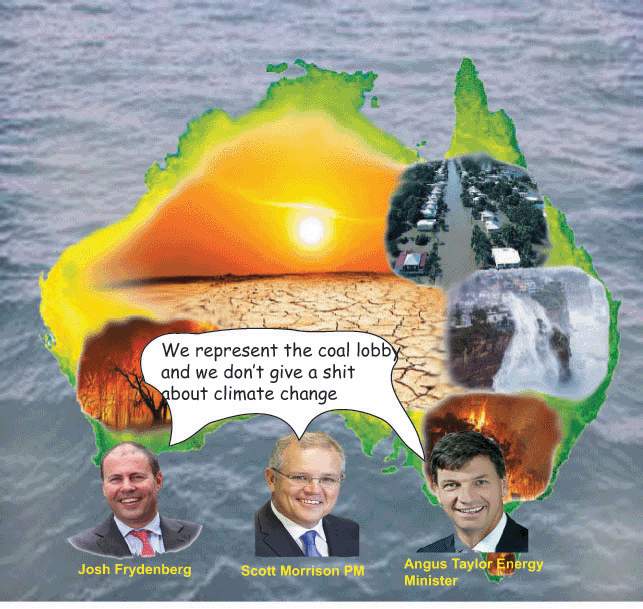
Australia Will Lose to Climate Change https://www.theatlantic.com/science/archive/2020/01/australia-caught-climate-spiral/604423/ Even as the country fights bushfires, it can’t stop dumping planet-warming pollution into the atmosphere.
ROBINSON MEYER
JANUARY 4, 2020 .Australia is caught in a climate spiral. For the past few decades, the arid and affluent country of 25 million has padded out its economy—otherwise dominated by sandy beaches and a bustling service sector—by selling coal to the world. As the East Asian economies have grown, Australia has been all too happy to keep their lights on. Exporting food, fiber, and minerals to Asia has helped Australia achieve three decades of nearly relentless growth: Oz has not had a technical recession, defined as two successive quarters of economic contraction, since July 1991. But now Australia is buckling under the conditions that its fossil fuels have helped bring about. Perhaps the two biggest kinds of climate calamity happening today have begun to afflict the continent.
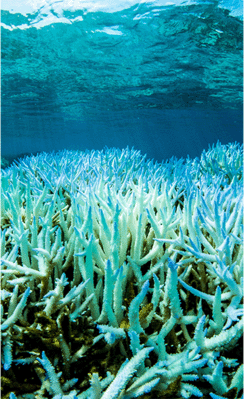
Meeting such a goal will require a revolution in the global energy system—and, above all, a rapid abandonment of coal burning. But there’s the rub. Australia is the world’s second-largest exporter of coal power, and it has avoided recession for the past 27 years in part by selling coal. Though polls report that most Australians are concerned about climate change, the country’s government has so far been unable to pass pretty much any climate policy. In fact, one of its recent political crises—the ousting of Prime Minister Malcolm Turnbull in the summer of 2018—was prompted by Turnbull’s attempt to pass an energy bill that included In fact, it is unprecedented. This season’s fires have incinerated more than 1,500 homes and have killed at least 23 people, Prime Minister Morrison said on Saturday.* There were at least twice as many fires in New South Wales in 2019 as there were in any other year this century, according to an analysis by The New York Times. Climate change likely intensified the ongoing epidemic: Hotter and drier weather makes wildfires more common, and climate change is increasing the likelihood of both in Australia. Last year was both the hottest and driest year on record in the country. Perhaps more than any other wealthy nation on Earth, Australia is at risk from the dangers of climate change. It has spent most of the 21st century in a historic drought. Its tropical oceans are more endangered than any other biome by climate change. Its people are clustered along the temperate and tropical coasts, where rising seas threaten major cities. Those same bands of livable land are the places either now burning or at heightened risk of bushfire in the future. Faced with such geographical challenges, Australia’s people might rally to reverse these dangers. Instead, they have elected leaders with other priorities. Australia will continue to burn, and its coral will continue to die. Perhaps this episode will prompt the more pro-carbon members of Australia’s Parliament to accede to some climate policy. Or perhaps Prime Minister Morrison will distract from any link between the disaster and climate change, as President Donald Trump did when he inexplicably blamed California’s 2018 blazes on the state’s failure to rake forest floors. Perhaps blazes will push Australia’s politics in an even more besieged and retrograde direction, empowering politicians like Morrison to fight any change at all. And so maybe Australia will find itself stuck in the climate spiral, clinging ever more tightly to coal as its towns and cities choke on the ash of a burning world.
|
|
|
Australia needs to talk about, and plan for, our climate-changed future
Catherine Ryland, an urban planner and a bushfire-resilience expert, would like to see more conversation around the idea of planned retreat—rebuilding in low-risk locations, reducing development in high-risk areas, and even relocating existing, unaffected communities, which she describes as the “biggest, bravest, boldest step.”
|
Above – evacuation by sea, from bushfire area How Long Will Australia Be Livable? Facing a future of fire, drought, and rising oceans, Australians will have to weigh the choice between getting out early or staying to fight. The Atlantic BIANCA NOGRADY, JANUARY 7, 2020 “……Australians pride themselves on being battlers, on facing down terrible odds and triumphing against whatever this land of droughts and flooding rains—and bushfires—can throw at us. Yet one of the single most defining moments in modern Australian nationhood was actually a retreat. In one of the greatest military-campaign failures of World War I, the Australian and New Zealand Army Corps—the ANZACs—staged an ingenious escape from the shores of Gallipoli in 1915 after a bitter, futile eight-month battle with Ottoman forces. “This is our Gallipoli; this is our bushfire Gallipoli,” says David Bowman, a professor of environmental change biology at the University of Tasmania. He’s talking about the bushfires that began in the spring of September 2019, that have burned in every state and territory, that have claimed at least 24 lives, that have destroyed nearly 1,800 homes, and that have turned more than 8.4 million hectares of land into lifeless charcoal. They have led to one of the largest peacetime evacuations in Australia’s history, as fire authorities in two states instructed tens of thousands of holidaymakers and residents to remove themselves from the path of several flaming juggernauts. In an echo of the Gallipoli retreat, thousands had to be rescued from beaches by the Australian navy and air force. In the face of these unprecedented fires, Australians appear to be listening less to the inner voice of the Aussie battler, and instead heeding the pleas and warnings of fire authorities.
“This is our Gallipoli; this is our bushfire Gallipoli,” says David Bowman, a professor of environmental change biology at the University of Tasmania. He’s talking about the bushfires that began in the spring of September 2019, that have burned in every state and territory, that have claimed at least 24 lives, that have destroyed nearly 1,800 homes, and that have turned more than 8.4 million hectares of land into lifeless charcoal. They have led to one of the largest peacetime evacuations in Australia’s history, as fire authorities in two states instructed tens of thousands of holidaymakers and residents to remove themselves from the path of several flaming juggernauts.
In an echo of the Gallipoli retreat, thousands had to be rescued from beaches by the Australian navy and air force. In the face of these unprecedented fires, Australians appear to be listening less to the inner voice of the Aussie battler, and instead heeding the pleas and warnings of fire authorities.Eleven years ago, the mind-set of bushfire response was different. Before the devastating Black Saturday bushfires in the southeastern state of Victoria, which killed 173 people over two cataclysmic days in 2009, the accepted wisdom on bushfires was “stay and defend, or leave early.” After Black Saturday, a new category of bushfire warning was introduced, labeled “Code Red” in Victoria, and “Catastrophic” in New South Wales. The unambiguous message of the new warning was “for your survival, leaving early is the only option.”……
what happens after the fires have passed through, and Australians return to either their intact homes or smoking ruins, dead cattle, a blackened moonscape where crops once grew? The lucky ones give thanks and get on with their life. The unlucky ones grieve, rage, shake their fist at Fate—and defiantly rebuild on the same ground. The battler spirit triumphs again, but for how long? Continue reading
|

1 This month.
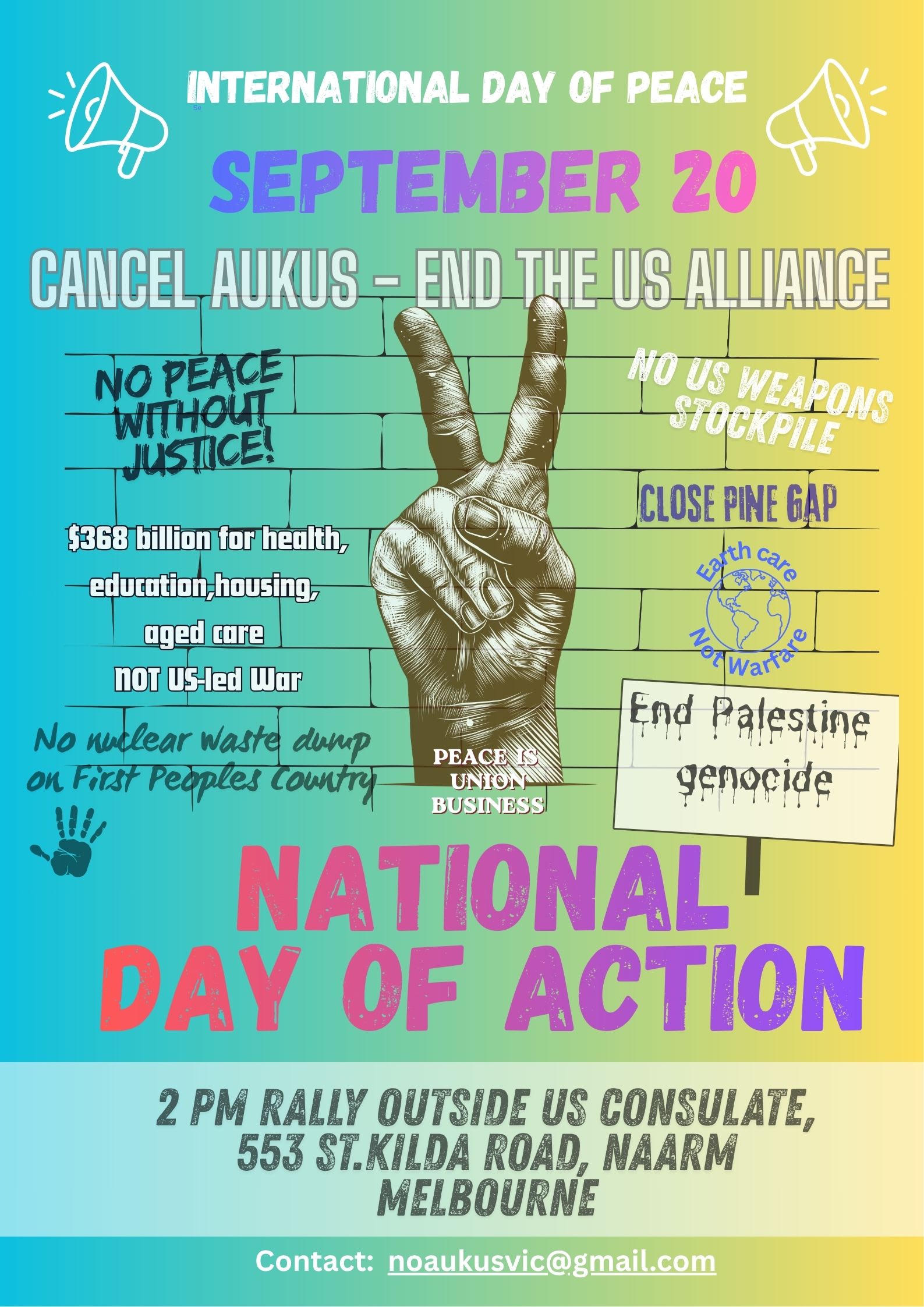
20 September –National Day of Action in Melbourne on the International Day of Peace

Help Aunty Sue Protect Her Land and Sacred Sites From Destructive Rocket Testing.
.

Australians deserve the truth
about
AUKUS – https://aukuspublicinquiry.com/
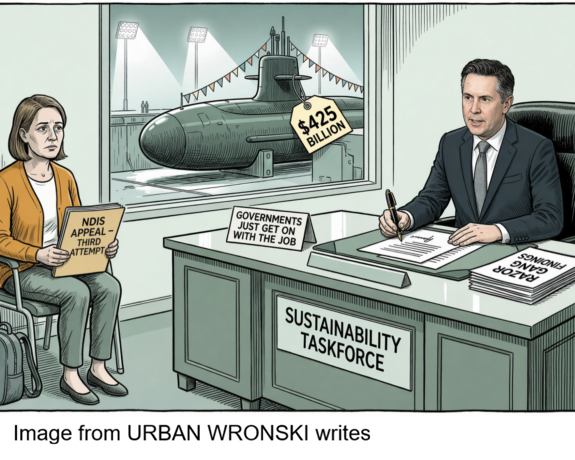

PETITION – To: Prime Minister Anthony Albanese and the Australian Labor Government

of the week – Australians for War Powers Reform (AWPR)
To see nuclear-related stories in greater depth and intensity
 Antinuclear