Climate change, bushfires, and Australia’s lack of climate policy
|
The link between climate change and our bushfire holocaust, New Daily, Michael Crooks-15 Dec 19, On December 10, an Liberal MP bucked a trend: he put climate change and the eastern Australian bushfire crisis in the same sentence.“These bushfires have been caused by extreme weather events … the exact type of events scientists have been warning us about for decades that would be caused by climate change,” said NSW Environment Minister Matt Kean at the Smart Energy Summit in Sydney, where he pushed for the nation to be more reliant on renewable energy.
“We cannot allow ideology and politics to get in the way of … the health of our planet for generations of Australians.” Climatologists worldwide agree that the perilous journey of climate change is underway, unfolding in Australia as hotter summers, bleached tropical reefs and, according to some, the bushfires still raging in NSW and Queensland……. Is climate change causing the current bushfires?It’s hard to say definitively, according to the scientists TND interviewed. “The answer is probably yes,” said Dr Floris van Ogtrop, an environmental scientist at the University of Sydney. “We will most likely experience longer and more intense droughts as the climate warms. And hotter, dryer conditions lead to increased bushfire risk.”….. Is Australian policy behind the rest of the developed world with regards to reducing greenhouse emissions?Yes, according to a new report co-prepared by think tanks the NewClimate Institute, the Climate Action Network and Germanwatch. “Australia is one of the largest exporters of fossil fuels in the world,” said Prof Hughes. “So it’s not just what we burn, it’s what we ship off elsewhere. “We have some of the best renewable resources anywhere. We have no excuse.”…..https://thenewdaily.com.au/news/national/2019/12/14/bushfires-climate-change-or-not/
|
|
|
Australia’s rainforests used to be too wet to burn. Not now.
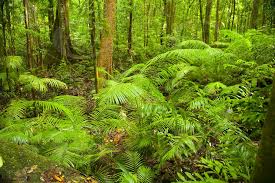
Scientists thought Australia’s rainforests were too wet to burn – then climate change hit, SBS News visits the Paluma Range National Park in Queensland to see firsthand how the trees and species inhabiting the area have been impacted. SBS NEWS, BY RACHEL CARY 15 Dec 19,
The Great Barrier Reef is currently the poster child for the impacts of climate change, but just inland from the coast, Queensland’s rainforests are being hit just as hard.
Forests that were once considered too wet to burn are more increasingly doing exactly that.
Professor Steve Williams from James Cook University has been observing the Paluma Range National Park, near Townsville, for 25 years. In that time, he says the area has changed a lot.
That’s not really that normal,” Professor Williams says.
“We were right on the edge, so that’s kind of within the range of possibility, but it’s basically a sign of what’s been happening and a sign of what’s to come.”
The Australian Conservation Foundation says rainforests were once considered too wet to burn.
Its CEO Kelly O’Shanassy says the Paluma Range National Park rainforest isn’t the only one now affected.
“Just in the last few years, we’ve seen rainforests in northern Australia burning,” she says.
“In the last few weeks we’ve been seeing rainforest in Queensland and New South Wales burning and a few years ago we saw very wet forests in Tasmania burning.”…….
The Wet Tropics Management Authority says climate change is the biggest threat to rainforests.
It released a climate adaption plan earlier this year and is calling for urgent action from governments and communities to limit climate change impacts.
The ACE says if we lose the rainforests it will severely impact the ecosystem.
“Rainforests are like the air conditioners for our planet,” Ms O’Shanassy says.
“Rainforests attract water so they attract rain for our planet.” ……
Professor Williams fears a longer drier dry season will see more fires impacting the Paluma Range National Park.
“Rainforests have been mostly considered to be fireproof, but if you get a long enough dry season that’s dry enough… and especially if you combine that with the impacts of a cyclone… then you’ve got the possibility of really severe fires going through.
“That’s a complete game-changer”. HTTPS://WWW.SBS.COM.AU/NEWS/SCIENTISTS-THOUGHT-AUSTRALIA-S-RAINFORESTS-WERE-TOO-WET-TO-BURN-THEN-CLIMATE-CHANGE-
Is the Minister Against the Environment, Angus Taylor, really bad at arithmetic, or just a liar?
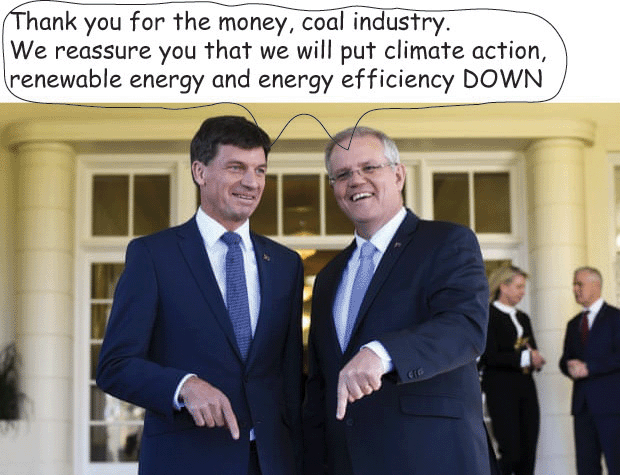 Angus Taylor spotted fiddling more figures, New Daily, 15 Dec 19 Angus Taylor spotted fiddling more figures, New Daily, 15 Dec 19The Minister for the Environment and Energy, Angus Taylor, seems to have a problem with numbers, whether it’s the Sydney City Council’s travel budget or what year Naomi Wolf was at Oxford. His latest figure fiddling though is much bigger and more serious than either of those embarrassments. And it’s possibly more absurd. At the COP25 climate summit in Madrid last week, Mr Taylor was pushing the government line that Australia would meet and exceed its Paris agreement to reduce greenhouse gas emissions by 26 per cent from 2005 levels by 2030 – “in a canter”, according to Prime Minister Scott Morrison. But all the while, Mr Taylor had a graph from his department showing the claim was, shall we politely say, “false”. Without much fanfare, the Department of Environment and Energy earlier this month published its annual emissions projections. At the core of the report is the accompanying graph of Australia’s emissions of millions of tonnes of CO2-equivalent from 1990 projected out to 2030. Blind Freddy can see the government’s forecast reduction from nearly 600Mt in 2005 to 511Mt in 2030 does not represent 26 per cent. It’s actually less than 15 per cent. But with Mr Taylor’s talent for figure fiddling, the sun rises in the west, bears no longer defecate in the woods, and somehow less than 15 per cent is turned into more than 26 per cent. Because he says so. Blind Freddy can see the government’s forecast reduction from nearly 600Mt in 2005 to 511Mt in 2030 does not represent 26 per cent. It’s actually less than 15 per cent. But with Mr Taylor’s talent for figure fiddling, the sun rises in the west, bears no longer defecate in the woods, and somehow less than 15 per cent is turned into more than 26 per cent. Because he says so.\The government attempts this particular distortion of reality by claiming “carry-over credits” from overachieving in the previous Kyoto agreement reached in 1997. (That ‘overachievement’ was totted up primarily in LULUCF – “land use, land use change and forestry” – an area particularly prone to creative accounting as it involves such things as promising not to clear bush at some stage in the future.) How inconvenient that the government’s graph, including buying some for LULUCF, goes back to 1990 and shows our emissions reduction from then, or from the 611Mt peak in 2006, is still less than 15 per cent. [graph on original] The government’s claim is an international joke. What’s worse is that the Madrid meeting was supposed to be about moving the needle on from the Paris agreement. Salient nations were supposed to be able to feel the heat, smell the smoke, see the glaciers melt and therefore work to achieve more than Paris. Instead, Mr Taylor led Australia as one of the recalcitrant countries sabotaging that reasonable aim. And claiming black was white, or at least that coal isn’t a problem, wasn’t the Environment Minister’s only fiddle. He also declared that Australia is backing an unprecedented wave of clean energy investment. Well, yes – and no. Australia is enjoying a surge in clean energy generation investment this year, but then it falls away quite rapidly, as shown in another graph, this time by the construction industry analysts at Macromonitor. [graph on original] Macromonitor reckons the next clean energy investment boom doesn’t kick in until the middle of the decade when the need for storage – pumped hydro, batteries – is more acute. … https://thenewdaily.com.au/news/politics/australian-politics/2019/12/16/angus-taylor-emmissions-numbers/ |
|
Scott Morrison, comfy in his Morrison bubble, trashes Environment Department
 Morrison torches Environment Department, Independent Australia, By Stephen Saunders | 15 December 2019, For a time, Arts and Environment were in the same federal department. Both functions have taken a hit, in Scott Morrison’s Christmas departmental reshuffle.
Australia’s first federal Environment Department debuted 1971. The function has carried forward to this day, under varying departmental banners. Since 1993, “Environment” (or “Sustainability, Environment”) has always been the leading item in a departmental title.
Not any more. “Busting” congestion, blindsiding the public service, Morrison has reversed recent history. The Environment function of the previous Environment and Energy Department goes into the Agriculture Department. It’s never been parked there before. The Industry Department mops up most of Energy and Climate.
Apparent wins there, for fossil fuels and land conversion. And never mind the fire and smoke. Brand-new Environment chief David Fredericks has been recycled as Industry chief…….
With endless growth running the show, the Department has won battles and lost wars. Our first State of the Environment report surfaced in 1986. When you decode the polite language of the scientific committees, successive reports reveal steady decline up to 2016.
It’s simplistic to say, but the Department has prospered more under Labor……
In his [Morrison’s] inflated opinion, ministers can always be relied on to “set the policy direction” correctly. As they surround themselves with increasingly docile public service chiefs.
On top of all this, he cashiers the Environment Department. And puts Energy and Climate under Industry. His religion and ideology seem to be clobbering reason and science.
Labor’s bulldog adherence to Big Coal and Big Australia undermines their credibility to oppose environmental overreach. Still, Morrison’s arrogance might come back to bite him.
Over its first 30 or 40 years, the Federal Environment Department attracted a keen cadre of officials, whose commitment and knowledge could be turned to disparate environmental issues at short political notice. They had notable successes and signal failures. But their relationships with ministers held more nuance than the feudal deference that Morrison now demands.
You can’t throw the switch, to recharge independent and vigorous environment policy advice at a moment’s notice. Rationally speaking, we need those skills, more than ever.
Weather, rain and fire are visibly different, within our own short lifetimes. Environment and growth problems have never been more obvious. The environment has returned to the public consciousness bigtime.
The “bubble” isn’t around Canberra. It’s around Morrison himself. Sure, the weakened Environment and Climate bureaus will have to answer, to him and his ministers. The physical environment may not be so obliging. https://independentaustralia.net/environment/environment-display/morrison-torches-environment-department,13415
Scott Morrison and Liberals recommended lifting Australia’s ban on nuclear power
|
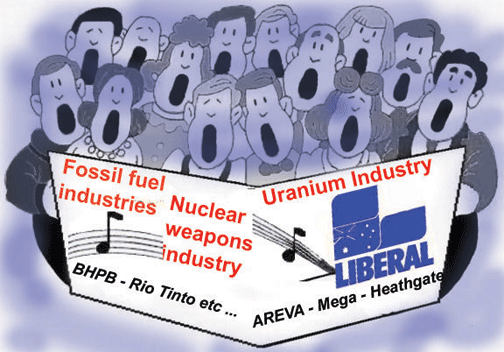
Josh Burns Fight To Stop Nuclear Waste Dump In Flinders Ranges SA, 13 Dec19 Today, Scott Morrison and his Government MPs ignored the experts and recommended lifting the bipartisan ban on nuclear energy in Australia.
I’ve been part of the Parliamentary Inquiry into nuclear energy for the past few months. The overwhelming evidence said that Australia should not move towards this expensive and dangerous technology. Instead of actually creating a national energy policy, Scott Morrison is now looking at a location near you to build Australia’s first nuclear power station https://www.facebook.com/groups/344452605899556/ |
|
Relief for Flinders Ranges as Minister Matt Canavan scraps nuclear waste plans for Wallerberdina
|
Nuclear waste plans for Wallerberdina Station in Flinders Ranges scrapped after community ballot, ABC North and West SA
By Gary-Jon Lysaght , Angela Smallacombe and Shannon Corvo 13 Dec 19, The Flinders Ranges will no longer be considered a potential site for a nuclear waste facility.
Key points:
The Federal Government was considering Wallerberdina Station, near Hawker, for a facility that would permanently store low-level nuclear waste and temporarily store intermediate-level waste. Hawker, along with other Flinders Ranges communities were given the opportunity to vote on whether they supported the facility. That ballot showed 454 votes opposing the facility and 408 supporting it. That represented a 52-48 split. “While the community ballot was just one of many measures I am considering, I have said that achieving at least a majority level of support was a necessary condition to achieving broad community support,” Resources Minister Matt Canavan said.
“I especially want to thank the communities of Hawker and Quorn for their patience and resilience through this process. They are a fantastic community that I have had the privilege to know better through this process.” ‘The result we were hoping for’ Greg Bannon lives at Quorn and has been a vocal opponent of the facility for the past four years. He said it was a “huge relief” the facility would not go ahead near Hawker. “It puts an end to four years of argument and debate and trying to make the case to preserve the Flinders Ranges,” he said. “It’s been a long process but in the end, we got the result we were hoping to.
“We’ve always said that the process was wrong, that it’s not fair to do this, to make one small community make the decision for the whole of Australia’s nuclear waste.”……. Kimba votes in favour The Flinders Ranges was only one of two sites being considered for the facility.The other one was Kimba, on the Eyre Peninsula. That town had a similar ballot, which found more than 60 per cent of voters were in favour of the facility going ahead. Mr Canavan said a final decision on where the facility would go would be made in 2020.
|
|
Labor leader Anthony Albanese dismisses nuclear ambitions as a fantasy
|
A 230-page report released on Friday by chairman of the parliament’s energy committee and Liberal MP Ted O’Brien said nuclear energy should be considered as part of Australia’s future energy mix.
The government-dominated committee called for further work on nuclear technology and the partial lifting of the current moratorium on nuclear energy to allow for “new and emerging nuclear technologies”…….
A dissenting report by Labor MPs said there was no economic case for pursuing nuclear energy and safety issues had not been addressed.
“Nuclear power has never overcome the dangers that we have seen played out around the world time after time,” Mr Albanese told reporters on Friday after finishing off his week-long trip to Queensland. https://www.9news.com.au/national/nuclear-ambition-a-fantasy-albanese-says/00946ea2-8c16-45ba-b76d-5c36c8de5785#close
|
|

Energy and Emissions Reduction Minister Angus Taylor rejects call for partial lift of nuclear power
 Taylor rejects call for partial lift of nuclear power ban, https://www.smh.com.au/politics/federal/taylor-rejects-call-for-partial-lift-of-nuclear-power-ban-20191213-p53jsf.html By Mike Foley Taylor rejects call for partial lift of nuclear power ban, https://www.smh.com.au/politics/federal/taylor-rejects-call-for-partial-lift-of-nuclear-power-ban-20191213-p53jsf.html By Mike Foley
December 13, 2019 Energy and Emissions Reduction Minister Angus Taylor has poured cold water on calls to partially lift Australia’s moratorium on nuclear power to allow investigation of emerging technologies.
A Coalition-dominated parliamentary inquiry found next-generation technologies such as small modular reactors should be explored by experts for use in Australia. “If we’re serious about reducing greenhouse gas emissions, we can’t simply ignore this zero-emissions baseload technology,”committee chairman and LNP MP Ted O’Brien said. “Australia should say a definite ‘no’ to old nuclear technologies but a conditional ‘yes’ to new and emerging technologies such as small modular reactors.” But Mr Taylor said the government had “no plans” to lift the moratorium, which has been maintained by Labor and Coalition governments since 1998. “Any changes to the moratorium would need bipartisan support and broad community acceptance,” he said. The House of Representatives’ Standing Committee on the Environment And Energy acknowledged public controversy around the nuclear debate in the title of its report – Not without your approval: a way forward for nuclear technology. “Rather than a total and immediate lift of the moratorium, only a partial lift for new and emerging technologies is proposed, subject to the results of a technology assessment and a commitment to community consent as a condition of approval for nuclear facilities,” it said. Labor committee members issued a dissenting report saying there was “no basis” for lifting the prohibition and no need for additional investigations into the science or economics of nuclear energy. Macnamara MP Josh Burns said it was “madness” to consider nuclear power given small reactors were not yet available, renewable energy was becoming cheaper and existing technology would need to be located in populated areas.
The only technology that is available now is the large nuclear reactors, which require an abundance of water to keep the reactors cool. And the only viable water supply is along the coastline,” Mr Burns said. “Australian experts have warned against being the first country to buy new nuclear technology. We don’t have the capability for nuclear energy now. We need to upskill and that comes with serious risk and cost. To do that with technology where we’re not confident in the safety would be negligent.” Australian Conservation Foundation spokesman David Sweeney said lifting the ban would start a “conga line of supplicants to Canberra promising low carbon energy and seeking high public subsidy”. |
|
Prudent nuclear ban should remain: ACF
 Prudent nuclear ban should remain: ACF, https://www.miragenews.com/prudent-nuclear-ban-should-remain-acf/ 13 Dec 19, Australia’s bipartisan, long standing and prudent prohibition on nuclear energy should remain in force as it stands.
In response to the release of the House of Representatives standing Committee on Environment and Energy’s report into the prerequisites for nuclear energy in Australia, the Australian Conservation Foundation’s (ACF) Nuclear Free Campaigner, Dave Sweeney, said:
“ACF strongly holds that the bipartisan, long standing and prudent prohibition on nuclear energy in Australia should remain in force as it stands.
“From the heartland to the harbour, the terrible drought and bushfires we are experiencing leave no doubt that Australia must quickly transition away from climate-wrecking fuels like coal, oil and gas.
“The Australian Energy Market Operator’s roadmap for the efficient development of the National Electricity Market makes it clear that Australia’s energy transition is heading towards small and large-scale renewables.
“Australia’s long standing, sensible moratorium on nuclear energy, enacted by John Howard, does not preclude discussion or debate on nuclear. There has been plenty of both.
“But while no commercial operator will touch nuclear, the moratorium remains important as it prevents a reckless government pouring public money into this economically and environmentally risky industry.
“Australians know nuclear reactors overseas cost a fortune, take decades to build and come with the possibility of disastrous accidents and the certainty of eternal radioactive waste.
“Cheap, clean, safe reactors don’t exist outside the minds of nuclear true believers. Flirting with nuclear is no basis for a credible national energy policy.
“The climate crisis we are living through is too serious and too urgent to fiddle at the margins with nuclear.
“We need to avoid the distraction of a nuclear cul de sac and take the renewable path.
“Australia’s future is renewable, not radioactive.”
In September a broad coalition of faith, union, environmental, Aboriginal and public health groups, representing millions of Australians, issued a strong statement opposing nuclear power.
Residents vote against nuclear waste dump near Hawker in South Australia
|
Residents vote against nuclear waste dump near Hawker in South Australia
Green groups say 52% vote against federal government facility should rule out region as potential site, Guardian, Australian Associated Press, Thu 12 Dec 2019 Residents in South Australia’s Flinders Ranges have voted narrowly against having a nuclear waste dump in their region.About 52% of the people who took part in the ballot voted against the federal government’s facility being established on land near Hawker. The result came after a similar poll of residents on SA’s Eyre Peninsula voted almost 62% in favour of the dump being built on one of two sites near Kimba. The federal government is yet to respond to the poll, but environmental groups said it should rule out the Flinders Ranges as a potential dump site. Australian Conservation Foundation campaigner Dave Sweeney said the result came amid clear opposition from regional pastoralists and the area’s native title holders. “There is no broad community support for a national radioactive waste facility in the Flinders Ranges,” Sweeney said. The Friends of the Earth said it was time for the federal government to abandon the dump plan altogether. “The government has previously stated that 65% would be a figure that would indicate the broad community support they need to select a site,” spokeswoman Mara Bonacci said. “These ballot results show that the minister does not have that support.”…… The community ballots are not binding on the government, which has promised to provide financial incentives to the community around the selected site. https://www.theguardian.com/australia-news/2019/dec/12/residents-vote-against-nuclear-waste-dump-near-hawker-in-south-australia |
|
|
250m tonnes of CO2 emitted from Australia’s bushfires
Australia’s bushfires have emitted 250m tonnes of CO2, almost half of country’s annual emissions. Forest regrowth can reabsorb emissions from fires but scientists fear natural carbon ‘sinks’ have been compromised, Guardian,Graham Readfearn @readfearn, Fri 13 Dec 2019
Bushfires in New South Wales and Queensland have emitted a massive pulse of CO2 into the atmosphere since August that is equivalent to almost half of Australia’s annual greenhouse gas emissions, Guardian Australia can reveal.
Analysis by Nasa shows the NSW fires have emitted about 195m tonnes of CO2 since 1 August, with Queensland’s fires adding a further 55m tonnes over the same period.
In 2018, Australia’s entire greenhouse gas footprint was 532m tonnes of carbon dioxide equivalent.
Experts say the pulse of CO2 from this season’s bushfires is significant, because even under normal conditions it could take decades for forest regrowth to reabsorb the emissions.
But scientists have expressed doubt that forests already under drought stress would be able to reabsorb all the emissions back into soils and branches, and said the natural carbon “sinks” of forests could be compromised.
The figures were provided to Guardian Australia by Dr Niels Andela, a scientist at the Nasa Goddard Space Flight Center and a collaborator in the Global Fire Emissions Database……….
Prof David Bowman, a fire ecologist at the University of Tasmania, said that under normal conditions the regrowth would reabsorb the CO2. But he said the ongoing drought, combined with climate change, meant conditions were not normal.
“Drought-stressed trees recover less well – carbohydrates reserves are exhausted – and under climate change tree growth may be slow and fires more frequent, meaning less tree biomass and even loss of forest cover.
“This is a nasty negative feedback cycle of a biosphere carbon sink becoming a source [of carbon].” https://www.theguardian.com/environment/2019/dec/13/australias-bushfires-have-emitted-250m-tonnes-of-co2-almost-half-of-countrys-annual-emissions
Kimba now the likely site for nuclear waste dump
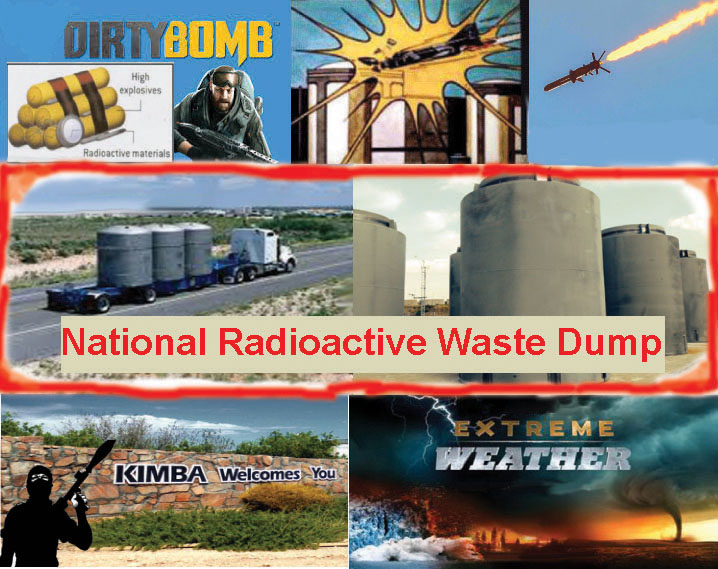
Resources Minister Matt Canavan says after a ballot of local residents voted narrowly against hosting the facility, the site near Hawker is no longer an option.
More than 860 people cast a ballot in the poll with 454, or just under 53 per cent, voting against establishing the dump on Wallerberdina Station.
“This ballot does not demonstrate a sufficient level of support and I will no longer consider this site an option for the facility,” Canavan said in a statement on Friday.
A similar poll conducted on Eyre Peninsula recently returned a 62 per cent vote in favour of the idea, with two sites near Kimba in the running.
Australian Conservation Foundation campaigner Dave Sweeney said the Hawker result also came amid clear opposition from regional pastoralists and the area’s native title holders………https://indaily.com.au/news/2019/12/13/kimba-firms-as-nuclear-dump-site-after-hawker-vote/
Even within a pro nuclear propaganda article, admission that renewables are a better bet
|
“…… Roger Dargaville, a Senior Lecturer in Resources Engineering with the Department of Civil Engineering at Monash University, is more confident of the standalone capability of renewables. In 2018, the proportion of Australia’s total electricity generated from renewables passed 20 per cent for the first time, with clean energy contributing 21.3 per cent of total electricity generation. This was an increase compared to 2017, when renewables were responsible for 17 per cent of total electricity generation. And there’s more in the pipeline. “As we approach the 2020 renewable energy target of at least 33,000 GWh per year, we have seen a rush of new projects. After that, most of the states have renewable targets of 50 per cent or more that, combined with the continuing falling prices of PV, should lead to a continuation of the trend.” Dargaville said many published studies already show that 100 per cent renewable systems are technically achievable, cost-effective and reliable, without having to resort to nuclear power….” Australia’s review of its energy mix resurrects the nuclear power debate, by Create Digital, 10 Dec 19 |
|
Rio Tinto appeals Takeovers Panel decision on uranium miner ERA
Rio Tinto appeals Takeovers Panel decision on uranium miner ERA, THE AUSTRALIAN, NICK EVANS, RESOURCE WRITER, 13 Dec 19,
 Rio Tinto has appealed a Takeovers Panel decision preventing it from taking complete control of uranium miner ERA, as the fallout from the company’s hard-ball tactics to fund the clean-up of the Ranger uranium mine continues.
The Takeovers Panel handed dissident ERA investor Richard Magides a moral victory on Wednesday, declaring ERA’s decision to accept a Rio offer to underwrite a $476m equity issue was made in “unacceptable circumstances”…...(subscribers only)
Coalition MPs squabble over climate science as Australia burns
 , New Daily, Daniel McCulloch 13 Dec 19, Nationals deputy leader Bridget McKenzie has blasted an “irrational” state colleague for daring to link the NSW bushfires to climate change.
Their ugly public stoush has dragged on for several days.
He inflamed the internal spat after suggesting he would rather listen to climate scientists than the federal frontbencher on the effects of global warming.
But Senator McKenzie said “I actually have a science degree – I am one of the few in parliament that does”.
1 This month.
20 September –National Day of Action in Melbourne on the International Day of Peace


Help Aunty Sue Protect Her Land and Sacred Sites From Destructive Rocket Testing.
.

Australians deserve the truth
about
AUKUS – https://aukuspublicinquiry.com/

PETITION – To: Prime Minister Anthony Albanese and the Australian Labor Government

of the week – Australians for War Powers Reform (AWPR)
To see nuclear-related stories in greater depth and intensity
 Antinuclear