MP Sonja Terpstra and Victoria’s Labor government stand by existing bans on nuclear activities
 Sonja Terpstra, State Labor Member for Eastern Metropolitan Region “….The Victorian Government and I do not support the state parliamentary inquiry into the use of nuclear energy. We stand by our existing ban on nuclear power and are committed to retaining the Victorian Nuclear Activities (Prohibitions) Act 1963.
It makes no sense to construct nuclear power stations in Australia. They present significant community, environmental and health risks, not to mention the ongoing and yet unsolved problem of the disposal of nuclear waste. Instead through the Victorian Labor Government’s ambitious Victorian Renewable Energy Target, we are giving the renewable energy sector the confidence needed to invest in the clean energy projects and jobs that are crucial to our future….”
New political party Reform WA wants nuclear power as an option for Western Australia
New political party Reform WA wants nuclear power as an option for Western Australia
Just 413 people can make the decision on storage of Australia’s nuclear waste
 Tim Bickmore shared a post.No Nuclear Waste Dump Anywhere in South Australia, 27 Oct 19,
Only 413 people (50%+1 of 825) could determine the location of Australia’s entire radioactive waste stockpile for the duration of an unknown potential number of centuries.
That’s democracy for ya…..
Have you posted your ballot paper back yet? As of this morning the Australian Electoral Commission advised us that they have received 569 ballot papers (69.13%). Please be aware that whilst the closing date for the ballot is Thursday the 7th November 2019 at 10am, adequate time needs to be allowed to ensure your ballot reaches Adelaide and is included in the count by the above date and time. https://www.facebook.com/groups/1314655315214929/
240 conservation scientists call on Australian government to strengthen environmental protection laws
Letter by 240 leading scientists calls on Scott Morrison to stem extinction crisis, More than 240 conservation scientists sign open letter warning PM that 17 Australian native species face extinction in next 20 years. Guardian, Adam Morton Environment editor @adamlmorton, Mon 28 Oct 2019 More than 240 conservation scientists have called on Scott Morrison to drop his opposition to stronger environment laws and seize a “once-in-a-decade opportunity” to fix a system that is failing to stem a worsening extinction crisis.
With the federal government due to this week announce a 10-yearly legislated review of the Environmental Protection and Biodiversity Conservation (EPBC) Act, the scientists have signed an open letter to the prime minister urging him to increase spending and back laws to help protect the natural world from further destruction.
The letter says three native species have become extinct in the past decade and another 17 could follow in the next 20 years. More than 1,800 Australian plants and animals are formally listed as threatened with extinction, but the scientists say this is an underestimate.
“Our current laws are failing because they are too weak, have inadequate review and approval processes, and are not overseen by an effective compliance regime,” the scientists say.
“Since they were established (in 1999), 7.7m hectares of threatened species habitat has been destroyed. That’s an area larger than Tasmania. Meanwhile, the number of extinctions continue to climb, while new threats emerge and spread unchecked.”
Environmental law was a point of difference at this year’s election, with Morrison pledging to limit “green tape” that he said cost jobs while Labor promised a new environment act and a federal environment protection authority.
Lesley Hughes, a distinguished professor of biology at Macquarie University, member of the Wentworth Group of Concerned Scientists and a signatory to the letter, said environmental protections had been consistently wound back over the past decade, most often by conservative governments.
She said it was having a significant impact, pointing to the 2016 state-of-the-environment report that found Australia was facing multiple environment changes and lacked a national policy that established a clear vision for the protection and sustainable management of the country’s natural heritage.
She also cited a WWF assessment that ranked eastern Australia as one of the world’s top 11 deforestation hotspots. Australia was the only developed country on the list.
“It’s a very grim picture,” Hughes said. “This letter is a pre-emptive strike to say this is an opportunity to do it better, this is not an opportunity to weaken and dilute the existing weak laws.”
Morrison’s pledge not to increase environmental laws came as a United Nations global assessment found biodiversity was declining at an unprecedented rate, with one million species across the globe at risk of extinction and human populations in jeopardy if the trajectory was not reversed.
The environment minister, Sussan Ley, said the review of the EPBC Act was an independent process that would encourage submissions from a wide variety of perspectives……. https://www.theguardian.com/environment/2019/oct/28/toughen-environmental-laws-to-stem-extinction-crisis-scientists-tell-morrison
85 fires burning across New South Wales
 Warnings issued as dozens of bushfires burn across New South Wales, Almost 1200 firefighters are tackling large bushfires on the NSW mid-north coast among scores of blazes around the state. SBS, 27 Oct 19,
Warning levels for two bushfires on the NSW mid-north coast have been increased to watch and act, with close to 1200 firefighters battling 85 blazes around the state.
An out-of-control blaze in the Darawank area, north of Forster-Tuncurry, has burnt more than 2300 hectares, the NSW Rural Fire Service said.
Fire activity has increased under the influence of erratic winds, it said in a statement on Sunday afternoon. The fire has crossed The Lakes Way and is burning towards Failford, where smoke and ashes may be encountered.
“There are a number of small active areas throughout the fireground,” NSW RFS said.
“Firefighters and aircraft continue work to slow the spread of the fire.”
The blaze is producing large amounts of smoke……..
At midday some 85 fires were burning across the state with 45 not contained.
Nearly 1200 firefighters are working to contain the fires, NSW RFS said.
Embers from the Tuncurry blaze travelled kilometres ahead of the fire front on Saturday, creating spot fires in suburban backyards and the headland at Forster Main Beach……https://www.sbs.com.au/news/warnings-issued-as-dozens-of-bushfires-burn-across-nsw
A new court order is being abused in order to harass a journalist
YOU CAN’T HANDLE THE TRUTH! Media’s dwindling role in Democracy Panel
 Toxic “Safety” orders the latest tool to shut down free speech https://www.michaelwest.com.au/toxic-safety-orders-the-latest-tool-to-shut-down-free-speech/, by Michael West — 25 October 2019 It’s #YourRightToKnow. There are many ways to silence the media: persecution of whistleblowers, defamation threats, contempt of court claims, lobbying of media bosses by powerful interests, injurious falsehood claims, the government’s draconian secrecy laws and police raids on journalists. Michael West reports on the latest abuse against free speech.
Today we can unveil yet another threat to freedom of speech: the Personal Safety Intervention Order (PSIO), a court order which is intended to help victims of domestic violence but instead is being abused as a tool to harass journalists, namely Sandi Keane, Editor of this publication.
It’s #YourRightToKnow. There are many ways to silence the media: persecution of whistleblowers, defamation threats, contempt of court claims, lobbying of media bosses by powerful interests, injurious falsehood claims, the government’s draconian secrecy laws and police raids on journalists. Michael West reports on the latest abuse against free speech.
Today we can unveil yet another threat to freedom of speech: the Personal Safety Intervention Order (PSIO), a court order which is intended to help victims of domestic violence but instead is being abused as a tool to harass journalists, namely Sandi Keane, Editor of this publication.
There have been some reports about the abuse of Personal Safety Intervention Orders in Victoria by those seeking malicious revenge. The editor of this journal, Sandi Keane, is believed to be the first journalist to be silenced in this way. She’s attended court seven times after receiving two Orders and has been threatened with a third. “An Intervention Order is now a sure fire way to shut down a story,” says Keane. “Getting an Intervention Order in Victoria is instant and cost-free (no lawyer required).”
The two essential criteria are for applicants to claim they have been threatened and are suffering mental stress as result.
An Interim Order will be issued immediately against anyone in Australia.
Sandi Keane says the applicants lied about the threats but no evidence was needed until the Final Contested Hearing some 12-18 months later.
The effect on public interest reporting therefore is chilling as most news is time-critical, so by the time the story might eventually be published, its news value might have evaporated.
There are no consequences for abusing the legal system and costs cannot be claimed by the Respondent in the proceedings.
The Applicant can also manipulate the date of the final hearing as a magistrate will only set a date for the Final Hearing if both sides have had a chance to get a lawyer; are ready for the hearing; or agree to the date.
Furthermore, court reporters cannot report on an Intervention Order unless they withhold the name of the court and names of the relevant parties.
So, not only does an Intervention Order trump an Injunction in the High Court with all its attendant costs and adverse publicity, it also ticks the Suppression Order box.
Yet the sting in the tail is that, from the date of the Interim Order, all references to the “protected person” must be deleted from any media site including social media (Condition 10).
Journalists can forget about getting another colleague to publish the story as this is prohibited under Condition 8.
Breaching the order risks a criminal conviction or prison sentence.
Journalists union, the Media Arts and Entertainment Alliance (MEAA), has met with the Victorian Attorney General with the hope of amending the Personal Safety Intervention Order Act to protect freedom of the press. In a letter to the Chief Magistrate, the MEAA wrote:
“This is a dangerous assault on press freedom, has a chilling effect on legitimate journalism in the public interest and undermines the public’s right to know.”
Editor’s Note:
Sandi Keane’s investigation was into the fraudsters operating in the pedigree dog industry. She was successful in contesting one of these orders. The unsuccessful Applicant in this case had served a jail sentence for fraud and was also found guilty of arson. The other applicant also has a conviction for fraud. These two people have taken out five PSIOs of which we know. The others were granted against people who had taken legal action against them, made an official complaint or given evidence against them.
The rise of PSIOs, and their abuse, coincides with the rise in other forms of suppression of free speech in Australia, by all three branches of government: the judiciary, the executive and the legislature.
It’s time to enshrine free speech in the constitution such as is the case in the US. You can take action to stand up for your right to know. Check out MEAA’s Take Action site here.
Attorney General Christian Porter backs laws that restrict journalists’ reporting
|
Material from raid on journalist’s home ‘may be used to prosecute’, The Age, By Dana McCauley October 25, 2019 — Attorney-General Christian Porter has launched an extraordinary intervention in a High Court case over raids by Australian Federal Police (AFP) on News Corp journalist Annika Smethurst’s home, asking the court to block a move to destroy material that may be used for future prosecution.
Mr Porter, who has sought to reassure media companies fighting for press freedom that he is “seriously disinclined” to approve prosecutions over public interest journalism, said in a joint submission to the court that the AFP was still weighing up whether to refer the matter to prosecutors. “If charges are laid, the data seized from Ms Smethurst’s phone may well be important. In those circumstances, the court should not order that the data be destroyed,” Mr Porter’s joint submission with the Australian Federal Police said. “It should leave it to the trial judge in any future criminal prosecution to determine whether that material will be admitted.” Australian media outlets – including Nine, publisher of The Sydney Morning Herald and The Age – have united with a ‘Right to Know’ campaign to warn against growing censorship, calling for reforms to shield whistleblowers and journalists from prosecution. Mr Porter has asked the court to uphold the validity of the AFP raid warrant and secrecy laws that restrict journalists’ reporting, which News Corp and Ms Smethurst are challenging. AFP officers raided Ms Smethurst’s home in June over a story published in the Sunday Telegraph a year earlier, in which she reported on a government plan to allow the Australian Signals Directorate to spy on Australian citizens for the first time. News Corp and Ms Smethurst argue the raid breached the implied freedom of political communication in Australia’s Constitution because the prohibition on publishing classified information was not limited to “inherently harmful” disclosures and gave the government “unconstrained discretion” to protect information, even if it was “merely embarrassing”…….. The Parliamentary Joint Committee on Intelligence and Security inquiry into press freedom will report at the end of November……… On Friday, the information watchdog launched an investigation into the Home Affairs department’s compliance with freedom of information laws after it emerged the department was failing to release documents within the legal deadline in one out of four cases. https://www.theage.com.au/politics/federal/material-from-raid-on-journalist-s-home-may-be-used-to-prosecute-20191025-p534cr.html |
|
Farmers, traditional owners and ratepayers unite in anti-nuclear rally,

The rally began in Gladstone Square, before stopping outside Stuart MP Dan van Holst Pellekaan’s office to deliver a letter from Green’s senator Sarah Hansen Young.
Kimba resident Terry Schmucker owns a farm in Cootra, close to the proposed Napandee site on the Eyre Peninsula.
“The decision to put radioactive waste on farmland is wrong,” Mr Schmucker said.
“Farmland is valuable. If you take out as little as 160 hectares, that’s still farmland that’s gone and that’s along with the mining that’s happening, that’s along with urban sprawl, that’s a long with everything … We need to protect our farmland.”
Grains and oilseeds are Australia’s largest category of food exports, representing 24 per cent of total agricultural exports.
Strict industry guidelines make Australian growers highly competitive internationally, while also supplying high-quality products for domestic consumption……..
“We are also pretty isolated on grain marketing and we grow really good produce but the buyers don’t want to pay us a good price, so they will use any excuse to discount us. All they have got to say is that there’s radioactive waste right next to us, here’s $50 a tonne less.
“So whether it actually affects our produce is not actually the important bit, it’s all in the head for people who wind us down and bargain with us on price.”
Adnyamathanha woman Vivienne McKenzie also attended the rally, speaking on behalf of traditional owners in the Flinders Ranges.
Wallerberdina station near Barndioota in the Flinders Ranges is one of the three remaining potential sites for the National Radioactive Waste Management Facility.
The Seven Sisters songline, one of the most significant creation tracks throughout Australia, runs nearby this site.
Songlines explain the laws desert people live by, the origins of country and are a crucial element of Aboriginal culture.
“It’s a very, very important site for the women The Seven Sisters is because that is the first storyline up there in the Flinders Ranges that’s been recorded anywhere and it was tabled in the state parliament of South Australia,” Ms McKenzie said.
“Its like if you have a book and someone rips a page out, it takes away from the story that you’re given.
“It’s desecration, and we are trying to preserve those songlines for generations to come. “The Adnyamathanha people aren’t recognised in their own Country, they can’t even get a vote.” https://www.transcontinental.com.au/story/6456928/farmers-traditional-owners-and-ratepayers-unite-in-anti-nuclear-rally/
South Australian Labor comes out swinging against nuclear waste dump selection process
|
Deputy Opposition leader slams federal government’s nuclear waste site selection process, Transcontinental, Amy Green 25 Oct 19,
“We are utterly opposed to the process,” says Deputy Leader of the Opposition Susan Close regarding the current federal approach to a national radioactive waste facility in regional South Australia. “We understand there is a need to do something with Australia’s domestic waste but they have gone about it so badly that they have put the community off. “They haven’t done the due consideration that they ought to be doing of what the possibilities physically are.” At a recent state conference, the South Australian Labor Party adopted a policy contesting the federal government’s site nomination and selection process. They have called for full transparency, broad public input and best practice technical and consultative standards.
Ms Close condemned the federal government’s current approach to building a potential facility at sites in Kimba and Hawker. “It is a federal issue but we just have a view about it that they have gone about it in an appalling way,” Ms Close said. “They get to make the decision, we don’t have have any capacity even if we were in government to do anything, but what they have done is asked landholder if anyone wants to have this and left the Aboriginal community out. “For some reason, the only three sites they are looking at are in South Australia which is very strange.” Federal Minister for Resources Matt Canavan said thethree potential sites in South Australia were all voluntarily nominated and the facility will only be built where a community broadly supports it…….. Premier Steven Marshall has maintained a stance that radioactive waste management is a federal issue and the state government has remained quiet during the drawn out process. With community ballots now underway in the District Council of Kimba, and one scheduled later this year for the Flinders Ranges Council, Ms Close has accused the Marshall government of being “asleep at the wheel”……. “This is just part of a pattern that the Marshall Liberal government doesn’t seem prepared to have any kind of argument with the commonwealth govt and that is to the detriment of South Australia’s interest.” The Transcontinental reached out to the state government for comment, but did not receive a reply. https://www.transcontinental.com.au/story/6454080/state-labor-party-weighs-in-on-nuclear-debate/ |
|
Radioactive liquids in Olympic Dam waste pools are killing native birds
Olympic Dam Alert: BHP propose a major new Evaporation Pond 6 for radioactive acid liquor wastes that will continue deaths of hundreds of birds each year
The federal government are inviting comments on BHP’s “Olympic Dam Evaporation Pond 6 EPBC Act Referral 2019/8526” (scroll down to Date of Notice 21/10/2019).
Public submissions are only open until cob Monday 4th Nov 2019, see info on how to do so at end of this e-mail.
Please consider making a brief submission, key Recommendations are provided below, along with a Background Briefing Paper and a feature press article “BHP vs Birds”.
For info see “Migratory Birds at Risk of Mortality if BHP Continues Use of Evaporation Ponds” a 3 page Briefing written by David Noonan for the ACF, Friends of the Earth and Conservation SA (30 June 2019), at https://nuclear.foe.org.au/wp-content/uploads/ODM-Migratory-Birds-BHP-Evaporation-Ponds.pdf
see “BIRDS VS BHP: Evaporation ponds at BHP’s Olympic Dam mine are killing hundreds of birds” article in The Advertiser 10 July 2019
Can the Australian government impose a nuclear waste dump on South Australia?

Under section 109 of the Australian Constitution, if a state parliament and the federal Parliament pass conflicting laws on the same subject, then the federal law overrides the state law. Section 122 of the Constitution allows the federal Parliament to override a territory law at any time
|
Tim Bickmore Fight To Stop Nuclear Waste Dump In Flinders Ranges, 26 Oct 19, SA Despite this reference to the Federal Act over-riding State laws; however there may be constitutional grounds rendering the FA invalid ie State’s Rights are enshrined in the Constitution & there is no provision for, nor mention of radioactive waste or nuclear power.
This deficiency was recognised decades ago [1959] as described by former WMC ODM exec Richard Yeeles (also adviser to 2 State Premiers inc current one) to the NFCRC….
“… Pointing to ‘other aspects of the application of nuclear science which put beyond all doubt the national character of the health and safety problems to which they give rise,’ the Committee raised the scenario that ‘it would be possible for dangers to health to occur in one state which would affect another state,’ such as ‘the spread of radioactive materials following a disaster.’ It also instanced, with considerable foresight as subsequent events would confirm, that ‘disposal of radioactive waste is an important problem demanding strict control. Waste from one state may need to be stored in another.’ In conclusion, the Committee advised the Government and the Parliament that: In the interests of health and safety, complex uniform regulations, standards and conditions are necessary in relation to the construction of reactors, operation of reactors, processing of fuel elements, use of isotopes, transport of radioactive material and the technical, industrial and medical standards of persons engaged. To facilitate such arrangements, ‘any doubts would be removed by an express power with respect to nuclear energy’ to be provided for in the Australian Constitution. – Report of the Joint Committee on Constitutional Review, November 1959.The advice of the Joint Committee on Constitutional Review to amend the Australian Constitution to facilitate the development of a national nuclear industry was not taken up by the Menzies Government, or any subsequent federal administration.” p20 http://nuclearrc.sa.gov.au/…/Richard-Yeeles-19-05-2015.pdf https://www.facebook.com/groups/941313402573199/ |
|
The failure of nuclear reprocessing and the “Plutonium Economy”
|
No one on the planet has been able to run unspent nuclear fuel through twice, and make it economically viable, let alone the countless times needed to make it ecologically viable.
It costs more to run unspent fuel through once more than to • mine uranium, There is little to NO CHANCE of doing that again, and again. Business history shows this wasn’t possible when; • uranium was at its peak in price in 1980 2019, about to enter the third decade of the 21C, where commodities exchanges show nuclear fuel it is; • LOWEST PRICE than in all of economic history, and yet it still can’t compete with any other energy sources. Nuclear apologists are a joke, delusional. The nuclear sales executives of the nuclear estate have been busy rebranding, white and greenwashing their product is ever since Ronald Reagan announced The Plutonium Economy failed. In point of fact, carbon fuel, gas spinning a turbine, has been producing cheaper energy fully levelized for three decades than any nuclear reactor. As carbon fuel, gas reached parity with nuclear on an LCOE basis, in the late 1980s and that’s when our LNG investment spending kicked off in Australia. Large scale • solar PV and late last decade on an LCOE basis. For this whole decade these; • renewable systems |
|
Why we can’t trust Scott Morrison – his REAL climate policy
to cut a long story short, Morrison has signed a document with Pacific leaders, with the “family”, that suggests we are as one when it comes to managing the risks of climate change, yet in reality we have very different policies, goals and objectives.
It pays to remember things like this when our prime minister asks you to trust him.
 Scott Morrison’s climate pact with the Pacific ‘family’ exposes the hollowness of his words, One small exchange in Senate estimates has exposed the measurable gap between the prime minister’s rhetoric and actions, Guardian, Katharine Murphy Political editor, @murpharoo 24 Oct 19,“………. Morrison wants one thought to penetrate the great national switch-off: he wants voters to trust him. He wants voters to believe he is a man of his word, that he means what he says, and follows through on commitments. It seems an audacious strategy for a leader in an age when people are inclined to think all politicians stink, but that’s what Morrison wants. Scott Morrison’s climate pact with the Pacific ‘family’ exposes the hollowness of his words, One small exchange in Senate estimates has exposed the measurable gap between the prime minister’s rhetoric and actions, Guardian, Katharine Murphy Political editor, @murpharoo 24 Oct 19,“………. Morrison wants one thought to penetrate the great national switch-off: he wants voters to trust him. He wants voters to believe he is a man of his word, that he means what he says, and follows through on commitments. It seems an audacious strategy for a leader in an age when people are inclined to think all politicians stink, but that’s what Morrison wants.
Trust. With that thought in mind, it was interesting this week to watch one small exchange in Senate estimates exposing a measurable gapbetween the prime minister’s rhetoric and actions. Readers will remember Morrison took some heat at the Pacific Islands Forum earlier in the year when he presented as insufficiently empathetic about the threat the climate emergency posed to the region. There were some harsh words. But at the end of the day, despite all the thundering and virtue signalling on the greatness of coal, Australia signed on to a communique that was actually pretty forward leaning on climate change. As I noted at the time, despite all the arm twisting in Tuvalu, Morrison did, in the end, sign up to a statement that committed Australia to pursuing efforts to limit global warming to 1.5C, and to produce a 2050 strategy by 2020 – no small things. This 2050 strategy, the statement said, “may include commitments and strategies to achieve net zero carbon by 2050”. Navigating that harmonious landing point with Pacific leaders was, presumably, an important gesture for an Australian prime minister fond of calling his counterparts in the region “family”. But Labor’s Senate leader, Penny Wong, during this week’s Senate estimates hearings, decided to do a little bit of due diligence about what Australia had actually signed up to at the Pacific Islands Forum, and whether we actually meant it. With foreign affairs department officials arrayed before her, Wong asked first whether or not Australia had sought any reservations or exceptions to the PIF communique (which just means did we opt out of any part of the statement). Kathy Klugman, the official responsible for Pacific strategy, said no exceptions had been sought. When it came to the PIF communique, Australia was all in. Having established that we were all in, Wong professed some curiosity that the Morrison government had signed a communique declaring that a “climate change crisis” was facing Pacific Island nations, when the Coalition rejects that language at home as alarmism. Were we on board with that bit – the climate crisis? Klugman replied that Australia had signed the declaration and “we associate ourselves with all parts of it, including that part”. Wong then asked whether the government agreed that emissions needed to be reduced to net zero by 2050 in order to achieve the goals articulated in the PIF declaration. Things then got a bit stickier. Clare Walsh, a deputy secretary of the department, joined the conversation. Walsh noted that achieving net zero emissions by 2050 was “an aspiration by some countries”. But the Australian government had not signed on to that “in terms of its domestic application”, she said. Wong then translated. So we’ve associated ourselves with that objective internationally in this communique, but would not take the requisite action domestically? Walsh ploughed on. She said the PIF declaration recognised the importance of that issue to the Pacific and recognised net zero by 2050 as a “commonly referenced target – but it isn’t one that Australia has signed up to domestically, no”. Wong then wondered why Australia had signed up to a document which said pursuing global efforts to limit global warming to 1.5C above pre-industrial levels was “critical to the security of our Blue Pacific” when Australia’s domestic emissions reduction targets – the ones we’ve signed on to as part of the Paris agreement – were not consistent with achieving the 1.5C objective. Was the government planning to increase the level of ambition to square those circles, Wong wondered? “There is no change to the government’s policy senator,” noted the foreign minister, Marise Payne, who was at the table. Wong evidently thought she’d reached the moment to deliver the moral of the story. “So we go along to the PIF and tell them we think 1.5C is important but we are not prepared to put targets on the table that are anywhere near consistent with it – just so we are clear about what we are doing,” she said. Payne replied that Wong could “put it in those terms” but the government had been very clear it was persisting with the policies it took to the election. So, to cut a long story short, Morrison has signed a document with Pacific leaders, with the “family”, that suggests we are as one when it comes to managing the risks of climate change, yet in reality we have very different policies, goals and objectives. It pays to remember things like this when our prime minister asks you to trust him. https://www.theguardian.com/australia-news/2019/oct/26/scott-morrisons-climate-pact-with-the-pacific-family-exposes-the-hollowness-of-his-words |
|
Climate change and the prospects this year for the Darling River
|
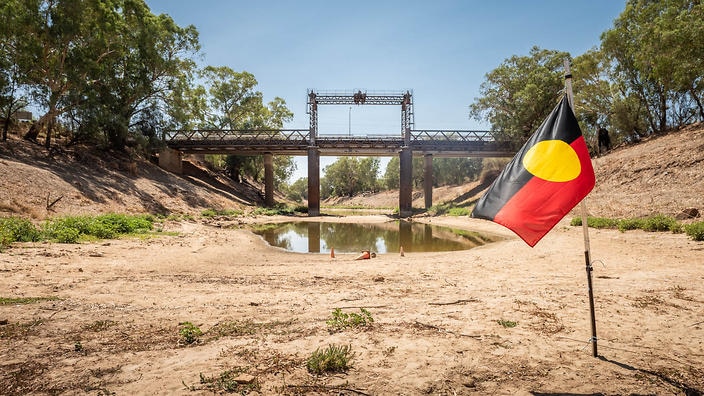
Summer outlook ‘dire’ for Murray-Darling, Brisbane Times, Matt Coughlan, October 25, 2019 The head of the Murray-Darling Basin Authority has warned of dire conditions across the crucial river system with the situation expected to worsen during a hot and dry summer.MDBA chief executive Phillip Glyde said the most critical situation was in the drought-ravaged northern basin where some water storages are as low as “one or two per cent”.
“Conditions are dire in the north,” he told a Senate estimates hearing in Canberra on Friday. Total storage in the basin is at 39.7 per cent with the southern basin at 44 per cent. While not as dire, if there is no significant rainfall in winter and spring next year, the southern basin’s water resources will also be severely limited,” Mr Glyde said. The Bureau of Meteorology found the 33 months between January 2017 and September this year were the driest average on record across the basin. The bureau has also forecast low flows for the rest of spring and summer, with a warm and dry pattern likely to continue through to January. “These conditions continue to place immense pressure on communities, industries and the environment,” Mr Glyde said………. The bureau has also forecast low flows for the rest of spring and summer, with a warm and dry pattern likely to continue through to January. “These conditions continue to place immense pressure on communities, industries and the environment,” Mr Glyde said……… Nationals senator and committee chair Susan McDonald said the Murray-Darling Basin was probably Australia’s most important issue. https://www.brisbanetimes.com.au/politics/federal/summer-outlook-dire-for-murray-darling-20191025-p5346u.html |
|
Angus Taylor repeats misleading claim on carbon emissions yet again
|
Angus Taylor repeats misleading claim on carbon emissions yet again https://www.abc.net.au/news/2019-10-24/zombie—angus-taylor-emissions-abatement-kyoto-protocol/11630780
RMIT ABC Fact Check
Posted Thu at 9:21am As the nation continues to grapple with drought and unseasonably early bushfires, climate change remains a point of political focus. The Morrison Government has repeatedly claimed the Coalition — through its own hard work — turned around Australia’s poor record on greenhouse gas emissions that it says was inherited from the former Labor government. The latest Coalition MP to make such a claim is Energy Minister Angus Taylor.
Senior Coalition figures, including Prime Minister Scott Morrison, have made similar claims on numerous occasions. Why this claim is misleadingFact Check previously examined this claim and found it to be misleading. Among other things, the so-called emissions “deficit” referred to by Mr Morrison was taken from an October 2012 report, and merely represented a forecast of the greenhouse gas reductions needed to hit Australia’s 2020 target at that time. Soon after the Coalition came to office, it became apparent that emissions under Labor’s carbon tax had been lower than expected in a report released in September 2013, which superseded the 2012 report. Government officials also for the first time factored in a significant “carryover” from the overachievement of Australia’s 2012 target. Since then, emissions have been lower than anticipated as a result of soaring power prices, the states’ adoption of renewable energy and the closure of coal-fired power stations, including Victoria’s Hazelwood plant. The bottom line is, when it comes to achieving Australia’s 2020 Kyoto target, the Coalition actually “inherited” a relatively strong position from Labor. In 2013 and 2014, when Labor’s carbon tax was still in force, Australia was significantly ahead of the target for those years. Over time, as emissions under the Coalition have steadily risen, the gap between actual emissions and the target has gradually narrowed. As experts noted in our previous fact check, the Coalition’s “direct action” fund did achieve some abatement at a reasonable price, but a comparatively modest amount. For these reasons, Fact Check judges the claim repeated by Mr Taylor this week once again to be misleading. |
|
1 This month.
20 September –National Day of Action in Melbourne on the International Day of Peace


Help Aunty Sue Protect Her Land and Sacred Sites From Destructive Rocket Testing.
.

Australians deserve the truth
about
AUKUS – https://aukuspublicinquiry.com/
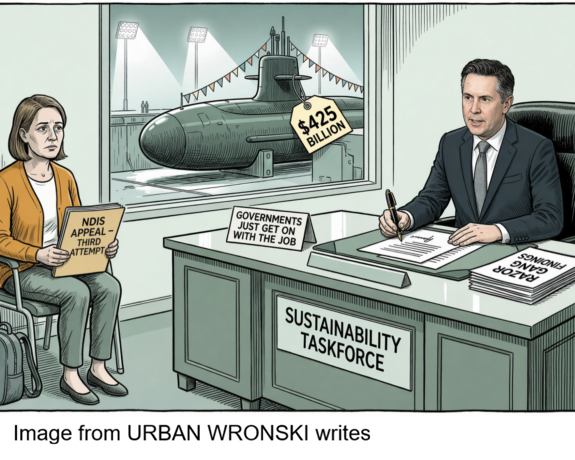

PETITION – To: Prime Minister Anthony Albanese and the Australian Labor Government

of the week – Australians for War Powers Reform (AWPR)
To see nuclear-related stories in greater depth and intensity
 Antinuclear