Coal from six biggest miners in Australia produces more emissions than entire economy
 Big emitting companies should be held responsible for the burning of their coal overseas, report says Adam Morton Environment editor, Guardian, @adamlmorton, Fri 1 Nov 2019 Coalmining in Australia by the nation’s six biggest coal producers ultimately results in more greenhouse gas emissions each year than the entire domestic economy.In the latest report to estimate the role fossil fuel businesses play in driving the climate crisis, researchers from the University of New South Wales calculated the total emissions from the coal and gas produced by Australia’s top carbon companies, from extraction to the resources being burned for energy, mostly overseas.
They found the top six coal producers – BHP Billiton, Glencore, Yancoal, Peabody, Anglo American and Whitehaven – were in 2018 linked to 551m tonnes of carbon dioxide released into the atmosphere. Total emissions from all activity within Australia were 534m tonnes.
When the list was expanded to include Australia’s 10 biggest carbon producers, adding Chevron, Woodside, ExxonMobil and Santos, the combined emissions from their products was found to be 670m tonnes a year, equivalent to that from about 75% of global air traffic.
The UNSW report follows the Guardian’s global series The Polluters, which revealed 20 fossil fuel companies including BHP could be directly linked to more than one-third of all greenhouse gas emissions in the modern era. In Australia, it found a wave of planned developments by major fossil fuel companies across the north would significantly increase the amount of coal and gas the country planned to sell into Asia and could push the Paris climate agreement goals further beyond reach.
The report’s lead author, Jeremy Moss from the UNSW Practical Justice Initiative and a professor of political philosophy, said there was a clear case that big emitting companies, which the report calls “carbon majors”, should be held responsible for the consequences of their products……. https://www.theguardian.com/australia-news/2019/nov/01/six-biggest-coalminers-in-australia-produce-more-emissions-than-entire-economy
Hotter and drier- Australia’s weather records set to be broken this year

Australia’s annual heat records may melt after hot and dry October, The 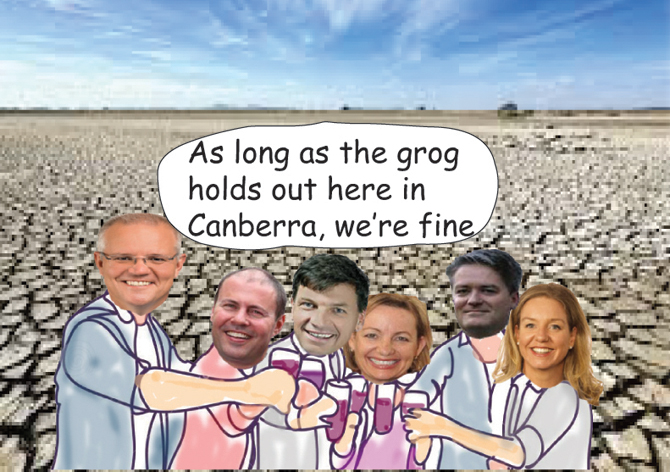 Age, Peter Hannam, November 1, 2019 Almost the whole Australian mainland is likely to have a warmer and drier than normal final two months of the year, boosting the odds that 2019 will be the country’s hottest on record.
Nationally, maximum temperatures last month were almost 3 degrees above the 1961-90 average used by the Bureau of Meteorology, making it the second hottest October in records going back to 1910.
For the first 10 months of the year, average daytime temperatures are running at 1.88 degrees warmer than the 1961-90 yardstick, placing 2019 well on track to smash Australia’s record anomaly of 1.59 degrees set in 2013, the bureau said. Mean readings are in line with the record, also set in 2013.
October capped another dismal month for rainfall, with an average of 8.3 millimetres – or about a third of the monthly average. That made it Australia’s equal-fifth driest October.
Most of the nation shared the relatively hot and dry conditions. In NSW, for instance, it was the state’s fourth-hottest October – with daytime readings 3.3 degrees warmer than average – and its fifth driest with just a quarter of the usual rain.
So far in 2019, NSW is running at the hottest for any similar period for both mean and maximum temperatures, while having among the five driest January-October periods on record……
The bureau’s latest three-monthly outlook offers little relief for most of the country.
“November and December rainfall is likely to be below average across most of the country,” it said, adding that the relatively dry conditions were likely to extend through to the end of summer for most of eastern Australia.
For November to January, the odds are running at more than 80 per cent for warmer than average days for the Australian mainland…….https://www.theage.com.au/environment/weather/australia-s-annual-heat-records-may-melt-after-hot-and-dry-october-20191101-p536mw.html
Scott Morrison’s threats against climate activists – getting a bit sinister
As he rails against activism, Scott Morrison is turning a bit sinister, a bit threatening, The government the PM leads finds activism inconvenient, but it is the same government that has sparked the activism. Guardian, Katharine Murphy Political editor, @murpharoo, Fri 1 Nov 2019 It takes some chutzpah to stand up with a straight face and deliver a speech foreshadowing a government crackdown on protest activity while in the same breath declaring that a new insidious form of progressivism is intent on denying the liberties of Australians.
But Scott Morrison has never lacked confidence.
In the florid prime ministerial tale unfurled on Friday at the Queensland Resources Council (and boy folks, it was a doozy), progressivism wanted to tell you what job you can have, what you can say, what you can think “and tax you more for the privilege of all of those instructions that are directed to you” – which made progressivism kind of busy, and a whole lot more organised and efficient than progressivism generally is.
We could, on Friday, have been treated to a measured prime ministerial reflection on the problems associated with cancellation culture. The Labor frontbencher Clare O’Neil showed this week that conversation can be attempted without everyone losing their minds. We could have had some words to bring the country together.
But after a brief touchdown in the goat’s cheese circle, which was somehow intrinsically hostile to mining in ways that weren’t really unpacked (and perhaps that might have been risky, given Morrison was addressing a business lunch where goat’s cheese might, accidentally, have featured) – we arrived, unexpectedly it must be said, at the sneering apocalypse.
Morrison warned that a new breed of #RadicalActivism™ was the on the march, “apocalyptic in tone, brooks no compromise, all or nothing, alternative views not permitted – a dogma that pits cities against regional Australia, one that cannot resist sneering at wealth creating and job creating industries, and the livelihoods particularly of regional Australians including here in Queensland”.
Apart from this being overhyped, high-velocity bollocks, it pays to remember right at this juncture that the actual purpose of Morrison’s address on Friday was to foreshadow a government crackdown against forms of activism and protests that the Coalition and the mining industry finds inconvenient.
So, just in case this unclear, let me spell it out: we were being treated to the spectacle of a prime minister teeing off against intolerance while in the same breath foreshadowing his own bout of government sanctioned intolerance – the type where police might be involved, and people might be bundled away in vans.
Yes, that happened. I saw it, because the prime minister’s speech was broadcast outside Queensland. It wasn’t always clear that Morrison knew the audience looking on at lunchtime on Friday might be broader than the residents of central Queensland, but it was broadcast nationally. To the south-east corner of the sunshine state, and Sydney, and Melbourne.
Unremarked in this stirring presentation was the fact that climate-related activism is building right at the moment, both at the community level, from the schoolkids to the grandmas, and also at the shareholder level, in large part because the Coalition has invited it.
The government who finds this activism inconvenient is the same government who has sparked the activism, given its purpose and salience and traction, because of its own woeful record on climate change……..
Apart from the perversity of a government railing against a set of conditions it has, itself, created, there was also the curiosity about carbon risk, which was presented implicitly by Morrison as a fiction of progressivism, #RadicalActivism™ and the sneering apocalypse. ………
This strange diktat will be news to the regulators – the Reserve Bank of Australia, the Australian Prudential Regulation Authority, the Australian Securities and Investments Commission – who are calmly out in the marketplace warning stakeholders on a regular basis to get their houses in order or risk being stranded in the inevitable transition, who present carbon risk as what it is: a threat to financial stability in Australia.
They’ll be astonished to learn they are the unwitting tools of the deep progressive state, co-opted by the noisy Australians. Shh, no one tell them.
This strange diktat will be news to the regulators – the Reserve Bank of Australia, the Australian Prudential Regulation Authority, the Australian Securities and Investments Commission – who are calmly out in the marketplace warning stakeholders on a regular basis to get their houses in order or risk being stranded in the inevitable transition, who present carbon risk as what it is: a threat to financial stability in Australia.
They’ll be astonished to learn they are the unwitting tools of the deep progressive state, co-opted by the noisy Australians. Shh, no one tell them. https://www.theguardian.com/australia-news/2019/nov/01/as-he-rails-against-activism-morrison-turns-a-bit-sinister-a-little-bit-threatening
Shire of Leonora deputy president says no thanks to foreign nuclear waste pitch
|
Leonora was identified as a prime candidate in WA for a dumping site similar to a facility being built in Finland, where a 2km-deep tunnel would be drilled to store bentonite clay-sealed copper cylinders full of radioactive waste.Speaking on Channel 7’s Flashpoint on Monday night, Shire of Leonora deputy president Ross Norrie said he didn’t feel there was any amount of money that could convince residents to get onboard plans for a global nuclear waste dump.
“They are offering big bucks to store it, but I think Finland and Norway are way more advanced with their storage projects,” he said. “The feeling was, no, we are not going to accept nuclear waste from offshore and currently the policy is we don’t any way.” Leonora has been touted as a local nuclear waste storage site due to the proposed Azark Project at Clover Downs Station 15km out of town. Mr Norrie said the Shire was only interested in storing waste produced locally, such as at the proposed Yeelirrie uranium mine, and from Lucas Heights in NSW. “The storage facility we are talking about is one of the safest going,” he said. “We need to be around the table because we do have Australia’s largest deposit of uranium.” Australian Nuclear Association president Robert Parker said safety would not be a concern if a global waste storage was built in the Goldfields. When they drill down into the rock and they go down 500m they check that water hasn’t moved for millions of years,” he said. “If that water has not moved, and they can verify it hasn’t, then that (nuclear waste) is going down there and it is not coming back ever. “It is a certain, sure, engineered solution to the migration of these old bits of waste through the environment.” Former Greens Senator Scott Ludlam said storing the world’s nuclear waste near Leonora would be disastrous. “The reason the industry asks for remote high isolation sites … is they know the engineered containment will leak,” he said. “How will you explain that to Aboriginal people or crew who live in these remote mining towns or remote communities that the reason you are trying to put it as far from centres of population as possible is that you know the stuff is going to leak.” Reform WA president Daniel Nikolic said economic benefits of nuclear waste storage were big. |
|
|
South Australia – the nuclear wasteland state
 South Australia – the wasteland state, SEBASTIAN TOPS, PORT LINCOLN TIMES OCTOBER 17 2019 South Australia’s Nuclear Citizens’ Jury had many researched reasons to say ‘no’ to another’s (nuclear) waste.
“Have Your Say” on nuclear waste dump – just a window-dressing exercise by the Australian govt
 Kazzi Jai No Nuclear Waste Dump Anywhere in South Australia, 30 Oct 19, In today’s Transcontinental paper on page 4 there is a half page ad for “Have your Say on the National Radioactive Waste Management Facility”. It says…
In November and December 2019, the Australian Government will survey businesses and neighbours of the proposed sites to determine if they support hosting the National Radioactive Waste Management Facility in their community. These surveys are in addition to the Flinders Ranges Council Community Ballot (Mon 11 November to Thurs 12 December 2019).
Also, anyone can make a submission by 12 December 2019 to radioactivewaste@industry.gov.au
It then says in bold letters at the bottom “Further information, including an ‘opt-in’ process for surveys, is available at www.radioactivewaste.gov.au/have-your-say”
But alas – it only goes to https://www.industry.gov.au/strategies-for-the-future/managing-radioactive-waste page……..
So….is there something sneaky going on here??
The presumptive flip side to that is therefore The Minister has already determined everyone else will NOT be detrimentally affected & so not worth greater effort. LMFAO https://www.facebook.com/groups/1314655315214929/
Australia’s secret hazardous radioactive military leftovers
Tim Bickmore No Nuclear Waste Dump Anywhere in South Australia. 30 Oct 19, I wonder if the ‘National Maritime Collection’ is one of the DIIS 100+ sites?
The ARPANSA 2019 Annual Report states “… the engine from the Wessex has hazardous (radioactive) substances and poses a risk to staff”: & it is being removed – therefore the ‘(radioactive) substances’ would be headed for the national suppository.
What other (radioactive) military left-overs will DIIS release from hidden fields once the scapegoats have been herded?
Australian company Worley Parsons joins the international throng trying to sell nuclear power to Saudi Arabia
Australian company WorleyParsons will provide consultancy services including project governance, resource management, project services, training and compliance across the full scope of the large nuclear power plant (LNPP), small modular reactors and nuclear fuel cycle.
 US confirms nuclear energy talks with Saudi Arabia, https://www.power-technology.com/comment/us-confirms-nuclear-energy-talks-with-saudi-arabia/ By MEED 30 Oct 19, Riyadh will have to sign an accord with Washington on the peaceful use of nuclear technology for US firms to participate in the projectA senior US official has confirmed that Washington is in talks with Riyadh about supporting Saudi Arabia’s planned nuclear programme. US confirms nuclear energy talks with Saudi Arabia, https://www.power-technology.com/comment/us-confirms-nuclear-energy-talks-with-saudi-arabia/ By MEED 30 Oct 19, Riyadh will have to sign an accord with Washington on the peaceful use of nuclear technology for US firms to participate in the projectA senior US official has confirmed that Washington is in talks with Riyadh about supporting Saudi Arabia’s planned nuclear programme.
Speaking in Abu Dhabi on 26 October, US Energy Secretary Rick Perry Perry confirmed that talks were ongoing. Continue reading |
Australian government rejects call for help from Julian Assange’s legal team
 Why is it that the Australian government is so helpful to Australian murderers and drug dealers imprisoned overseas, but so relentlessly unhelpful to an Australian whose only crime is to tell the truth?
Assange legal team asks for Australian government help amid growing health fears, https://www.theage.com.au/politics/federal/assange-legal-team-asks-for-australian-government-help-amid-growing-health-fears-20191028-p534xw.html, By Rob Harris
The WikiLeaks founder has been held in HM Prison Belmarsh since his April 11 arrest at the Ecuadorian embassy, where he had lived in asylum for almost seven years.
Australian officials told a Senate estimates hearing on Thursday that diplomats had not heard back from Assange’s lawyer since writing to her last week asking that she raise with him their offer of consular assistance.
The 48-year-old is fighting US attempts to extradite him to face 17 counts of spying and one of computer hacking in relation to WikiLeaks’ release of thousands of classified Pentagon files regarding the Iraq and Afghanistan wars.
Barrister Greg Barns, an adviser to the Australian Assange campaign, told The Age and The Sydney Morning Herald his UK lawyers on Friday requested consular assistance following a recent inquiry from the Department of Foreign Affairs and Trade.
“Julian’s lawyers are asking for the Australian government’s assistance in dealing with their client’s inhumane conditions in Belmarsh prison which has led to, and is continuing to cause, serious damage to Julian’s health,” Mr Barns said.
His supporters say he is being kept in solitary confinement and is allowed out of his cell for only 45 minutes a day. At a court appearance last week, he appeared gaunt and disorientated.
Assange was due to be released on September 22 but was told at a court hearing last month he would be kept in jail because there were “substantial grounds” for believing he would abscond.
The Australian Lawyers Alliance (ALA) passed a motion at its national conference on Saturday calling for the Australian government to do “all it can” to bring Assange home and resist US attempts to extradite him.
ALA national president Andrew Christopoulos said it was an important issue about the rule of law and protecting an Australian in a vulnerable position overseas.
“This is about standing up for the rule of law, fairness and the freedom to expose wrongdoing,” he said. “The reported decline of Julian Assange’s physical and mental health heightens the need for urgent government intervention. The government has intervened in cases like this before and should do so in this circumstance.”
If the case goes to a series of appeals, Assange could remain in a UK jail until at least 2025.
Foreign Minister Marise Payne last week acknowledged the publicity around the case and that Assange had high-profile and loyal supporters. She said it was important to let the legal process run its course.
“He has been offered consular services … like any other Australian would,” Senator Payne told the Senate committee. “I think it’s important to remember that as Australia would not accept intervention or interference in our legal processes, we are not able to intervene in the legal processes of another country
Australia’s media under threat

“Media outlets have faced attacks in the form of centralisation of private ownership, funding cuts to public broadcasters, and potential prosecution of journalists, including News Corp journalist Annika Smethurst.”
One of the report’s authors, Geoffrey Watson, SC, former counsel assisting the Independent Commission Against Corruption, said he had been shocked by how quickly the brutal type of politics that evolved in the United States and the United Kingdom, and partly led to the ascendancy of Donald Trump and Boris Johnson, had taken root in Australia.
“One day you see the judiciary attacked and the next someone in the media,” said Mr Watson, who is a director of the Centre for Public Integrity. “On the third day it might be the CSIRO, they even attack our scientists. Some people don’t recognise it as the same problem, but it is all part of the same disease.”
He said the effectiveness of the media in Australia as a watchdog was not only threatened by personal and legal attacks by the government, but by regulations that had allowed ownership of newspapers to be reduced to an effective duopoly.
The report, entitled “Protecting the Integrity of Accountability Institutions”, said that a range of institutions – including the judiciary and the Administrative Appeals Tribunal, the public service, integrity commissions such as the ICAC, statutory authorities such as the Human Rights Commission and the Fair Work Commission, and the CSIRO – had all been targeted in recent years by interested parties seeking to undermine their independence and public trust.
“These institutions are important not only because they ensure actual accountability, transparency and good governance but because they build confidence and trust within the Australian community,” it said. “When this confidence and trust is diminished, divisiveness and conflict increase. This impacts social cohesiveness and the economy, and the welfare of all Australians suffers. Ultimately, as international experience has shown, it is a threat to democracy itself.”
It cited as examples of interference attempts by federal ministers to influence the Victorian Court of Appeal in 2017 terrorism cases, sustained funding cuts and personal attacks on the ABC, and the de-skilling of the public service through the outsourcing of up to 50 per cent of government departments to contractors.
The report listed a series of principles that needed to be respected in order to protect the independence of the threatened institutions. They include protection from political retribution, secure and sufficient funding, secure tenure of senior officials and public access to advice to the government from accountability institutions, as well as the creation of an effective federal integrity watchdog.
The Centre for Public Integrity, a independently funded think tank, was formed earlier this year in part to champion the case for a such a body. The report comes in the midst of a campaign by Australian media, including the Herald and The Age, to defend the public right to information in the face of increasing attempts by government and government agencies to suppress information, prosecute whistleblowers and criminalise legitimate public interest journalism.
ABC challenges the validity of Federal Police raids
 We don’t want any sensationalist headlines,’ AFP
  allegedly told ABC, https://www.theage.com.au/national/we-don-t-want-any-sensationalist-headlines-afp-allegedly-told-abc-20191028-p534ux.htmlby Michaela Whitbourn ,October 28, 2019 —An Australian Federal Police agent told the ABC it wanted to avoid “sensationalist headlines” such as “AFP raids ABC” before it seized a raft of documents from the broadcaster’s Sydney headquarters, the Federal Court has heard.
The ABC is challenging the legal validity of the search warrant authorising the June 5 raid by the federal police on its offices in Ultimo and is seeking the return of documents seized at the time. Continue reading
Climate change – iconic Macquarie Marshes on fire
Key points:
- Since Saturday, around 3,000 hectares of Ramsar-protected national park has burnt out
- An ecologist fears the fire may destroy the unique ecosystem of Macquarie Marshes — home to numerous waterbirds
- Fires have swept through before, but the soil is dryer than usual with a flood over the next year needed for reed roots to survive
The Ramsar-protected wetland regularly supports more than 20,000 waterbirds, and more than 500,000 birds when there are large floods.
But the blaze, which started on Saturday, has so far burnt 3,000 hectares of national park and early estimates suggest 90 per cent of the wetland’s main reed bed has been razed.
Director of the Centre for Ecosystem Science at the University of New South Wales Professor Richard Kingsford feared the fire could destroy the unique ecosystem.
“Reeds are very deep-rooted plants, but they can only come back if there’s water in the system,” Professor Kingsford said…….
Drought, fire threaten endangered species
Professor Kingsford has been studying waterbirds in the Macquarie Marshes for almost 30 years.
Right now it was the driest he had ever seen it.
“It’s almost impossible to find any water in the northern part of the Macquarie Marshes,” he said.
“Water birds there are extremely low in numbers and when we were out there in September there were a lot of dead and dying animals around……
Massive flood needed
Floodplain landholder Dugald Bucknell runs his grazing operation alongside the national park.
He described the latest wildfire as the “devastating” consequence of drought and failed water policy.
In August, the Berejiklian Government intervened to divert water from the Macquarie River at Warren to drought-hit towns such as Cobar and Nyngan.
“There’s no water in Burrendong Dam upstream of the marshes, there’s virtually no water in stock and domestic dams downstream of it, and somehow we’re meant to wish for a miracle to re-wet our marshlands,” Mr Bucknell said.
He said the wetlands were not getting the water they needed to survive and feared more fires would follow.
“It’s becoming unsustainable. Its frightening,” Mr Bucknell said.
“We’re killing off our kids’ and grandkids’ future to take a bit more water elsewhere in the system.”
https://www.abc.net.au/news/2019-10-28/macquarie-marshes-on-fire-90pc-reed-bed-razed/11645914
Australian Federal Police put their case at Federal Court hearing about their raid on ABC
No role’ for implied freedom of political communication in ABC raid decision: AFP, The Age Michaela Whitbourn, October 29, 2019 The ABC had “no basis” for claiming the implied freedom of political communication acted as a handbrake on a court’s power to issue a warrant to the Australian Federal Police to raid its Sydney headquarters, lawyers for the police have told the Federal Court.
The national broadcaster is challenging the legal validity of the search warrant authorising the June 5 raid on its offices in Ultimo and is seeking the return of documents seized at the time.
After a series of preliminary legal fights earlier this year, the full hearing in the Federal Court commenced on Monday and continued on Tuesday with submissions from the federal police.
The ABC is challenging the warrant on four bases, including the decision to grant the search warrant, made by a Local Court registrar, fell foul of the implied freedom of political communication in the Commonwealth Constitution…….
In documents filed in court, the ABC argues the implied freedom is relevant and “investigative journalism in the public interest that relies on information provided to journalists by confidential sources … is fundamental to the maintenance of the Australian system of representative democracy” which is provided for in the Australian Constitution. ……
David William McBride, a former military lawyer, has previously admitted leaking material to the ABC that formed the basis of its reports and has been charged with a range of criminal offences.
Some good news for a change: Australia’s greenhouse gas emissions are set to fall
In a policy brief released today, we predict that Australia’s greenhouse gas emissions will peak during 2019-20 at the equivalent of about 540 million tonnes of carbon dioxide.
After a brief plateau, we expect they will decline by 3-4% over 2020-22, and perhaps much more in the following years – if backed by government policy.
Australia: a renewables superstar
Deployment of solar and wind energy is the cheapest and quickest way to make deep emissions cuts because of its low and falling cost. Higher deployment rates would yield deeper emissions cuts, but this requires supportive government policy.
Australia: a renewables superstar
Deployment of solar and wind energy is the cheapest and quickest way to make deep emissions cuts because of its low and falling cost. Higher deployment rates would yield deeper emissions cuts, but this requires supportive government policy.
The emissions road ahead
Continued rapid deployment of solar and wind requires that governments enable construction of adequate electricity transmission and storage.
In the longer term, solar and wind can cut national emissions by two-thirds. Beyond the electricity sector, this involves electrifying motor vehicles, residential heating and cooling and industrial heating. National emissions could be cut by another 10% by stopping exports of fossil fuels, which creates fugitive emissions.
Voting begins in Kimba as nuclear waste issues divide the community
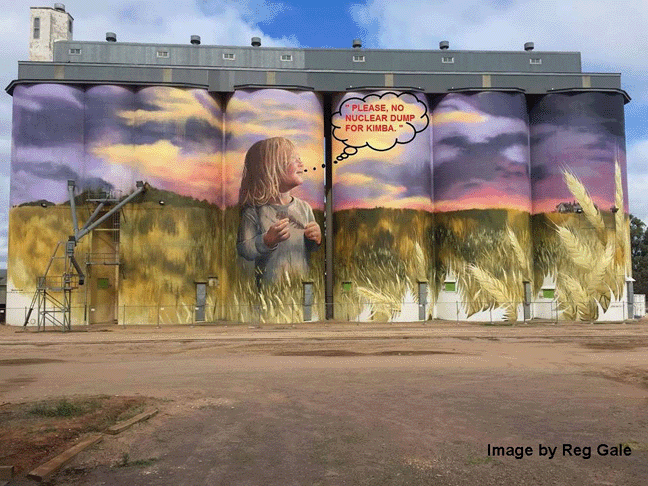
Whatever the result, the communities on South Australia’s Eyre peninsula are split over the issue – and will be for some time, Guardian, Calla Wahlquist 27 Oct 19, After four years of speculation and three years of consultation, the small towns of Kimba and Hawker in South Australia have begun the final stage of a process that has divided neighbours and placed these otherwise forgotten communities on the national map.On 7 November, the Kimba district council will announce the result of a month-long vote on whether its residents support the construction of a nuclear waste facility at one of two proposed sites. On 11 November a similar vote will open for the Flinders Ranges council over a third proposed site at Wallerberdina.
The search for a suitable site has taken more than 30 years. If one or both of the communities vote yes, the resources minister, senator Matt Canavan, could name the final site by the end of the year.
Kimba and Hawker are only 200km apart, falling on either side of Port Augusta at the top of the Eyre peninsula. They are both in the federal electorate of Grey. The former federal member, Barry Wakelin, has drawn criticism from his ex-Liberal party colleagues for publicly criticising the proposal, citing as his chief concern the impact of community division.
“Once you divide the community, where there are really clear views one way or the other, it’s quite difficult to settle that down again,” he says.
What is proposed?
The proposed Wallerberdina site is on rangelands (used for grazing), occupying a 100 hectare slice of the 23,580ha station owned by former Liberal senator Grant Chapman, who sat on nuclear waste committees in his 28 years in parliament.
Both of the proposed sites at Kimba are on farming country, prompting a grassroots campaign against the use of agricultural land to dump nuclear waste.
All three sites were volunteered by the property owners, as part of a process that saw 28 sites nominated across Australia. The government says it is a coincidence that the three finalists are in one narrow patch of SA.
The proposed facility would provide for the disposal of low-level nuclear waste and the temporary storage — for how long it’s not clear — of intermediate-level nuclear waste.
“The facility will be able to hold Australia’s current and future intermediate-level waste until [the] establishment of a permanent facility for this material,” the taskforce says in a statement to Guardian Australia. “The permanent facility will be in a different location and of a different type.”
It says there’s about 1,771 cubic metres of intermediate-level waste and 4,975 cubic metres of low-level waste at 100 sites across Australia, including the Lucas Heights reactor, and those volumes are expected to rise incrementally over time.
There are 45 jobs promised as part of the facility and the host community will also receive $31m in federal funding, including $20m for community projects and $3m designated for Indigenous groups.
Both the Barngarla Determination Aboriginal Corporation, covering Kimba, and the Adnyamathanha Traditional Lands Association (Atla), covering Hawker and Wallerberdina, oppose the facility.
Regina McKenzie, an Adnyamathanha traditional owner who lives on a station adjoining Wallerberdina, says federal contractors damaged a cultural women’s site while conducting their cultural heritage survey. Atla was working with the station owner to catalogue the archeological and intangible heritage before the site was volunteered for a nuclear facility, but say they have since been left out.
“The government has been talking at us, they have not been talking with us,” she says.
The Barngarla lost a federal court challenge arguing that all registered native title holders should be eligible to vote in the community ballot, whether they are local residents or not, and are appealing that decision to the full court. An attempted injunction to stop the community ballot going ahead until that appeal was heard was unsuccessful. ………
Wakelin says the decision ought to have been made without money on the table. Affected communities have already received $5.76m in funding for community projects and a further $4m was announced this month.
He says politicians are “petrified” of discussing nuclear waste, and he believes the federal government will try to get the issue resolved quickly – even if both communities vote no.
“As the minister tells us now: ‘Yeah, you can vote, but I’ll still make the decision’,” he says.
Greg Bannon, a spokesman for the Flinders Local Action Group, has been opposed to the project since Wallerberdina was named as one of six shortlisted sites in November 2015 (the site was named Barndioota at the time). He knows the area well from working as a jackeroo. It’s typically very dry but has been known to flood, and abuts the Flinders Ranges, the most seismically active area of SA.
“I thought: this cannot be the right place, it must be a mistake,” Bannon said…….https://www.theguardian.com/environment/2019/oct/27/the-most-divisive-thing-two-small-towns-brace-for-a-vote-on-nuclear-waste
1 This month.
20 September –National Day of Action in Melbourne on the International Day of Peace


Help Aunty Sue Protect Her Land and Sacred Sites From Destructive Rocket Testing.
.

Australians deserve the truth
about
AUKUS – https://aukuspublicinquiry.com/

PETITION – To: Prime Minister Anthony Albanese and the Australian Labor Government

of the week – Australians for War Powers Reform (AWPR)
To see nuclear-related stories in greater depth and intensity
 Antinuclear