Australian schoolgirl attends United Nations Youth Climate Summit.

 Australian climate striker Harriet O’Shea Carre takes fight to New York https://www.abc.net.au/news/2019-09-23/australian-climate-striker-15-takes-fight-to-new-york/11539354, By Kirsten Robb 23 Sept 19, Every Friday night, 15-year-old Harriet O’Shea Carre can be found hanging upside down from an aerial hoop in an old train shed in Castlemaine, Victoria.
She is one of the founding members of the School Strike For Climate (SS4C) movement in Australia. Ms O’Shea Carre has just taken her fight all the way to New York City, where she was invited to attend Saturday’s United Nations Youth Climate Summit.
Around the world on Friday, millions of students — including Ms O’Shea Carre — and their supporters skipped school and work to attend what was touted as the biggest climate protest in world history.
Organisers estimated around 4 million people in more than 163 countries turned out, including an estimated 300,000 Australians.
It was in October last year that the “Castlemaine Three” — Ms O’Shea Carre and her friends Milou Albrecht and Callum Neilson-Bridgefoot — started the Australian SS4C movement in the town of Castlemaine, 120 kilometres north-west of Melbourne.
The teens stumbled across an article about Swedish teenager Greta Thunberg, who has been credited with beginning the global student climate movement.
“Milou read an article about Greta Thunberg when she was pretty much solo striking,” Ms O’Shea Carre said.
“She was really excited about it and she came to me on the school bus and was like, ‘Harriet, there’s this awesome article I read about this girl who’s doing this school strike.'”
After penning an impassioned letter to the editor of a Melbourne newspaper, the three teenagers and about two dozen classmates took the train from Castlemaine to Bendigo to protest outside the offices of their federal members of parliament, MP Lisa Chesters and Senator Bridget McKenzie.
The Castlemaine strikers then decided to hold a global SS4C on November 30. When their rally went viral, Prime Minister Scott Morrison famously called for “more learning in schools and less activism in schools”.
David Carre, Ms O’Shea Carre’s father, says the Prime Minister could not have helped more to galvanise the youth.
“It was probably the best thing he could have said in terms of mobilising these young people.
“To be so dismissive of them, and to suggest that they’re trying to get away with wagging school, that is just quite offensive.”
More than 10,000 went on strike on November 30. Another was held in March 2019, with 1.5 million striking around the world.
“We’re at a point in time where it’s an emergency, and we’re not seeing any action from our leaders,” Ms O’Shea Carre said.
“And if the people who are leading us aren’t doing any leadership, then I will.”
Ms O’Shea Carre was invited to attend the first United Nations Youth Climate Summit in New York City alongside Ms Thunberg.
While her parents and friends marched from Castlemaine to Melbourne, Ms O’Shea Carre joined the rally through the streets of Manhattan.
“It’s so inspiring to be here,” she told 7.30 from New York.
“There are so many people, I’m really excited to be involved in it.”
Ms O’Shea Carre says the group will keep striking until they get action.
“We’re not going to stop because there’s no point in having an education on a dead planet, and at this stage, that’s what we’re headed for.
“We’re going to keep going and keep fighting because we’re not going to let our future go away.”
Trump tries to pull Scott Morrison, ‘man of titanium’, into a military coalition
 Donald Trump suggests China ‘a threat to the world’ while praising Scott Morrison as a ‘man of titanium’. US president signalled he would raise with Morrison a military contribution in Iran but then indicated he did not do so, Guardian, Katharine Murphy Political editor
Following a ceremonial welcome for Morrison on Friday Washington time attended by more than 4,000 guests, Trump praised Morrison’s personal fortitude, describing him as “a man of real, real strength, and a great guy”.
The American president signalled he would raise with Morrison a possible military contribution in Iran beyond the current freedom of navigation commitment in the Strait of Hormuz, but later in the day indicated he had not, in fact, raised the issue during a bilateral meeting at the White House.
The Australian prime minister made a point of praising the president’s restraint in relation to Iran to date and made no commitment beyond saying the government would consider any request from the administration on its merits.
…….Trump said he was interested in building a coalition for military action with Australian participation, but then told reporters at a subsequent press conference Iran wasn’t discussed, and Morrison then described Australia’s possible participation as “moot”…….. https://www.theguardian.com/australia-news/2019/sep/21/donald-trump-suggests-china-a-threat-to-the-world-while-praising-scott-morrison-as-a-man-of-titanium
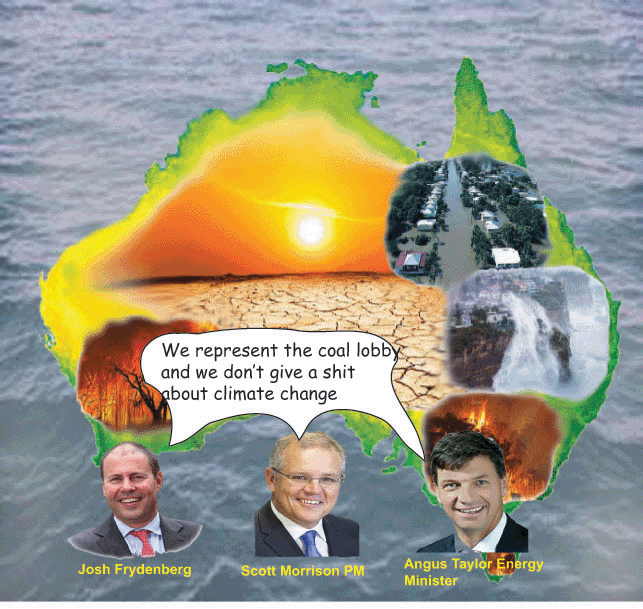
Coal’s servant, P.M. Morrison makes Australia an international pariah at UN Climate Summit
|
PM accused of ‘trashing’ Australia’s reputation by spruiking coal ahead of UN summit, SMH, By Dana McCauley September 22, 2019 Environmentalists are accusing Scott Morrison of “trashing” Australia’s international reputation, as official documents reveal the broad scale of his government’s efforts to significantly increase coal exports at a time of mass protests calling for action on climate change.
As delegates of the United Nations climate change summit – which Mr Morrison has snubbed – prepare to discuss emission reduction efforts this week, briefing notes obtained under Freedom of Information laws detail the emphasis placed on coal in the government’s diplomatic relations.
Departmental briefing notes provided to Resources Minister Matt Canavan ahead of his official visit to Singapore and India last month canvass the potential to expand Australia’s coal exports into Bangladesh – a nation that is among the most vulnerable to the effects of global warning. The government is seeking to grow its coal exports in overseas markets as it looks to buttress the economic fallout from a deteriorating relationship with China. Australian Conservation Foundation climate change campaigner Christian Slattery said Australia was “trashing its international reputation because of its addiction to polluting coal”. “As major importers of Australian coal move to transition to cleaner forms of energy, the Morrison government is doing the coal industry’s bidding, trying to secure new markets,” Mr Slattery said. “Burning coal is the number-one cause of climate damage. Unless we stop digging up and burning coal the planet will suffer unmanageable damage from more extreme fires, droughts, storms and coral bleaching that will harm hundreds of millions of people.” The briefing note to Senator Canavan, released in redacted form to the ACF, said that with “a significant expansion of coal-fired power in Bangladesh expected in the near future”, there were opportunities for Australia “to establish a new export market for thermal coal”…….. Foreign Minister Marise Payne will front the UN climate change summit this week, but will not address delegates – as Australia is among a group of coal-supporting economies singled out as not getting a spot on the list of 63 speakers. Mr Morrison’s snub comes despite him being in the United States on an official visit…….. ACF’s Mr Slattery said the government “seems intent on selling a 20th century technology to a 21st century world and doing a great deal more climate damage while they are at it”. “Australia’s reported blocking by the UN Secretary-General from speaking at the special climate summit in New York is nothing short of an international embarrassment for a wealthy and developed country that prides itself on being a good international citizen,” he said. https://www.smh.com.au/politics/federal/pm-accused-of-trashing-australia-s-reputation-by-spruiking-coal-ahead-of-un-summit-20190922-p52tr1.html |
|
Australia: Freedom of Information and the Nuclear Industry- theme for October 19
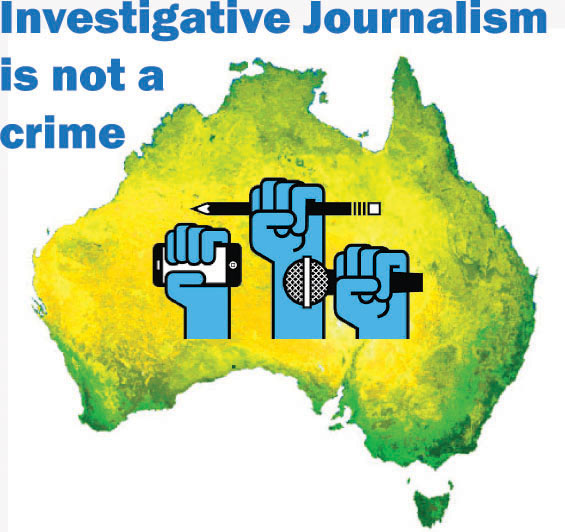
Australia’s press freedom is under threat as never before.
It’s always been pretty bad, with Murdoch media controlling at least 70% of media outlets, and with Liberal governments trying to strangle the ABC,
But now – it is at crisis point. We have an Australian citizen, Julian Assange, held in solitary confinement in London, for the crime of skipping bail. UK and complicit Australia want to have him extradited to USA, to face life imprisonment for ‘treason”. What was his “treason”? Publishing the facts, revealed by Bradley Manning, on USA military atrocities. i.e. investigative journalism. (Manning also in prison)
We also have federal police raiding ABC offices and a journalist’s home. We have draconian security laws, and prosecutions of whistleblowers Richard Boyle, David McBride and Witness K.
 Australia is fast developing a culture of press intimidation by government.
Has this anything to do with the nuclear industry? Not obviously directly. Not yet. But government and industry have always tried to see that the harms from uranium mining and nuclear bomb testing were covered up. Few Australians would have heard of the long term push by some politicians and defence industry personnel, for nuclear weapons.
As the global nuclear industry revs up its dishonest spin for “new nuclear”, and as climate change impacts this country, Australia is a sitting duck for the lie that “nuclear solves climate change”. And for the push for even more involvement in America’s nuclear weapons system. And for involvement in  Trump’s Nuclear Weapons in Space programme.
We now have a government without any policy (unless you count “having a budget surplus” as a policy) Scott Morrison can’t forever shout “How good is that?” about everything. Journalists that criticise government actions are under scrutiny. It doesn’t bode well for any public policy area. And that certainly includes matters nuclear. more https://www.meaa.org/campaigns/press-freedom/
Australian children, and adults who care, march in their hundreds of thousands, for Action on Climate Change
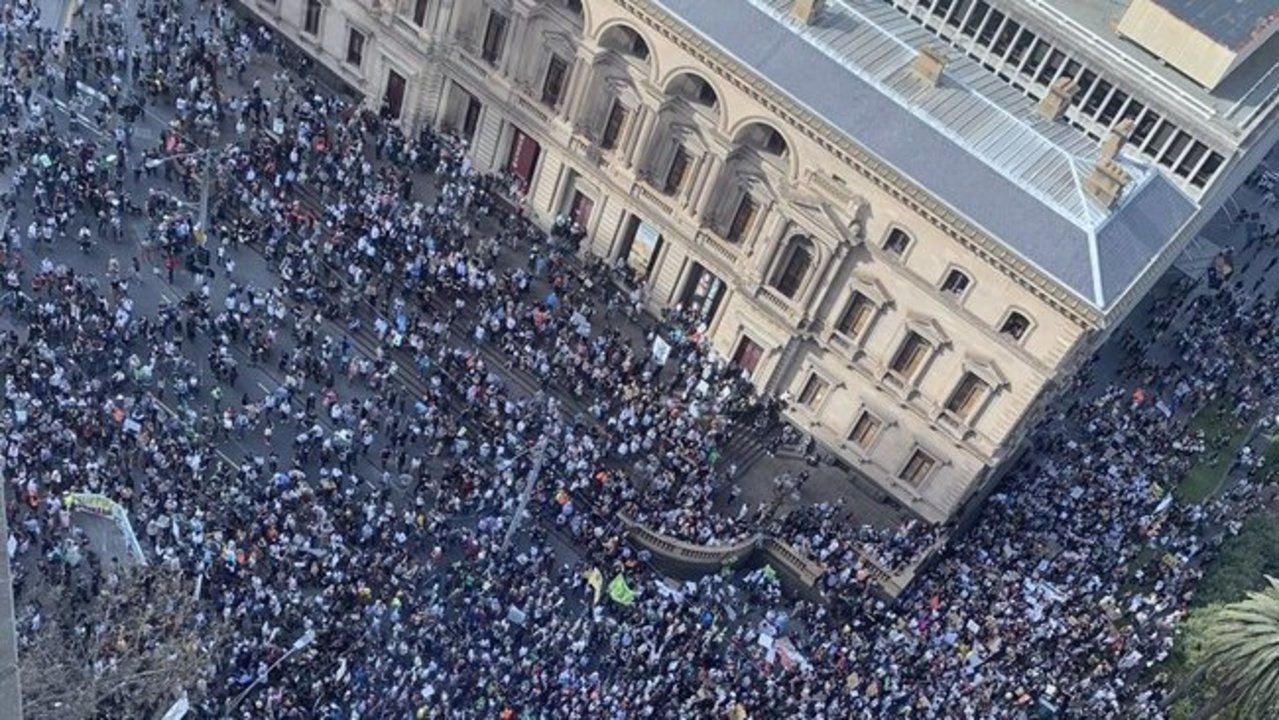
 While our revered Prime Minister was sucking up to USA’s revered President, and totally ignoring the climate issue, hundreds of thousands of Australian citizens were rallying for action on climate change. I was there, in Melbourne, and I’ve never seen anything like it. I’ve been there in big rallies, 100,000 and more- but this was the biggest ever!
And so many children. It is their future, that we are talking about!!
|
Global climate strike : Australian school students march to protest climate change https://www.smh.com.au/national/global-climate-strike-live-australian-school-students-march-in-protest-of-climate-change-20190920-p52t70.htm By Jenny Noyes and Natassia Chrysanthos September 20, 2019 — That’s a wrap for Australia’s climate strikes It’s been a huge day for more than 300,000 Australian school and university students, families and workers who took to the streets of their cities and towns to protest climate change inaction. Organisers described the turnout as the biggest nationwide since 500,000 people protested against the Iraq war in 2003. Similar school strikes in March and November last year drew 40,000 and 15,000 people. Police commended the large crowds for displaying good behaviour at the peaceful protests. The rallies produced some powerful images, particularly in Sydney and Melbourne where the crowds were especially large – so check out our gallery to the right for all the best photos. [on original] |
|
A dilemma for Scott Morrison, as Trump suggests that Australia join USA in a possibly nuclear war with Iran
|
Scott Morrison scrambles to contain political mushroom cloud after Trump raises nuclear option with Iran
The Australian press pack was hyperventilating when the US president made the suggestion Australia might be asked to join a coalition of the willing. Then collective amnesia set in, Guardian Katharine Murphy Political editor @murpharoo 21 Sep 2019 It seemed appropriate, albeit entirely surreal, to be inducted into the vagaries of the Trumpiverse by bearing witness, in the Oval Office, to the American president suddenly raising the spectre of using nuclear weapons against Iran. Friday’s program in Washington ran like clockwork while everybody had a script. But once we’d cleared the pomp and circumstance of the ceremonial welcome for Scott Morrison on the South Lawn of the White House, once the Australian press pack tumbled out of the sparkling spring sunshine into the Oval Office – we discovered Trump in an expansive mood…….. The president then volunteered he intended to have a quiet word to Scott Morrison over the course of their meetings on Friday, Washington time, about potential military options in Iran, and whether Australia might be persuaded to join a new coalition of the willing. …. Morrison maintained his best poker face as the president informed the hyperventilating press pack “I always like a coalition”….. Before we could process the information that Australia might be off to war in Iran, things spiralled. The unheralded military action could be – wait for it – nuclear. Trump noted America had renovated the arsenal and acquired new nuclear capability, and the rest of the military was “all brand new”…….. With vexed options now tumbling out of Trump’s mouth at a clip, it did seem prudent to check in with the prime minister at this point. What was his position on Australia joining military action in Iran?…… The politically vexed question about whether Australia would do more than protect freedom of navigation in the Strait of Hormuz was therefore moot. If any request was forthcoming, Australia would consider it on its merits, through the prism of national interest, Morrison said, before gathering his host, smiling at the cameras, and exiting, stage right. https://www.theguardian.com/australia-news/2019/sep/21/scott-morrison-scrambles-to-contain-political-mushroom-cloud-after-trump-raises-nuclear-option-with-iran |
|
Controversial MP Barnaby Joyce on the pro nuclear campaign trail
 If there’s anyone really intelligent in Australia’s nuclear lobby, might they be wishing that Barnaby would just shut up? With friends like Barnaby, who needs enemies?
Barnaby Joyce finds a new cause in nuclear power, Australia’s best-known backbencher is hitching a ride to the nuclear debate and creating awkward moments. AFR, Aaron PatrickSenior Correspondent. Who knew? Barnaby Joyce loves nuclear energy as much as he detests abortions.
As a budding debate over splitting the atom fires up in three parliaments, the former deputy prime minister has decided that his new parliamentary vehicle, the House of Representatives Standing Committee on Industry, Innovation, Science and Resources, deserves a piece of the nuclear action.
On Friday morning, before a tour of Sydney’s own nuclear reactor, Joyce’s committee held a “nuclear industry roundtable” discussion that was broadcast live with about 30 energy industry experts, bureaucrats and lobbyists.
The purpose was, Joyce said, “to dispel some strongly held beliefs which may or may not be true”.
He couldn’t refer to the hearing as an inquiry, because one of those already exists – and helpfully covered much of the same information last month.
The House of Representatives Standing Committee on the Environment and Energy, which is reviewing nuclear energy at the government’s direction, held its hearing in Sydney three weeks ago.
Several of the same organisations turned up to Joyce’s event, which was held in a hotel within walking distance of Sydney Airport, making transport easier for the Member for New England.
To add to the double-dating awkwardness, Joyce’s star witness, businessman Ziggy Switkowski, read out the same opening statement he prepared for the other committee – by phone.
The real inquiry also visited the reactor, where it’s a wonder the distracted engineers haven’t inadvertently triggered a core meltdown.
Which raises an interesting question: would a nuclear accident that took out a parliamentary committee increase or lower public support for the power source?…… https://www.afr.com/companies/energy/barnaby-joyce-finds-a-new-cause-in-nuclear-power-20190919-p52t2y
As Morrison and Australia’s richest suck up to Trump, plan for rare earths business
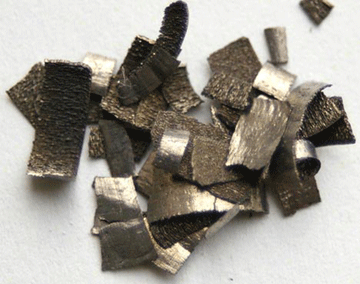 Morrison and Trump open new front in China trade war with rare earth ‘action plan’, SMH, By Matthew Knott and David Crowe, September 21, 2019 Prime Minister Scott Morrison will throw Australian support behind US President Donald Trump in a bid to counter China’s dominance in vital raw materials as part of a historic state visit to the US capital.
The “action plan” will open a new front against China in a widening technology and trade war by exploiting Australian reserves of the rare earths and other materials that are essential for products ranging from iPhones to batteries and hybrid cars.
Mr Morrison arrived in Washington DC with a message for Mr Trump that positioned Australia as an ideal friend that would back its longstanding ally on Israel, Iran and wider defence policy……
Mr Morrison wants Mr Trump and his colleagues to see Australia as their strongest military ally over the past century and is using the visit to pledge the same close alliance for the century ahead.
Mr Trump’s officials believe the joint plan with Australia will improve the security of supply of materials in critical shortage, saying this will ensure economic security for both partners…….
US officials also praised Australia as a “tremendous partner” in opposing Iran’s nuclear program and interference in shipping, while Mr Morrison made it clear he backed the US in its support for Israel – a totemic issue for Mr Trump.
“Under my government we have taken an even stronger stand against the biased and unfair targeting of Israel in the UN General Assembly,” Mr Morrison says in the draft of his speech to the State Department………
The menu served to guests including golfer Greg Norman, businesswoman Gina Rinehart and media mogul Rupert Murdoch will include sunchoke ravioli, Dover sole and lady apple tart with ice cream for dessert.
Following his visit to Washington, Mr Morrison will travel to Chicago to meet the governor of Illinois, then Ohio to visit a new recycling plant owned by Australian billionaire Richard Pratt and on to New York for the United Nations General Assembly. https://www.smh.com.au/politics/federal/morrison-and-trump-open-new-front-in-china-trade-war-with-rare-earth-action-plan-20190920-p52tco.html
Australian Labor Party standing firm on its climate policies
 Labor’s climate policies are ‘unshakeable’ despite election loss, Mark Butler says
Shadow climate minister says he believes Scott Morrison may shift on issue during the coming term, Guardian, Katharine Murphy Political editor @murpharoo, 21 Sep 2019 Mark Butler wants to make one thing clear: the shadow minister for climate change and energy is not for turning. It wasn’t a mistake to pursue an ambitious climate policy in the 2019 election and “we are not going to change our position to get to a level of profound irresponsibility [on policy], like the government”, he tells Guardian Australia’s politics podcast.
“Our position on climate is unshakeable.”……..
he also thinks it is possible Scott Morrison will shift on climate during the coming term, particularly if the Australian community remains vocal on the issue, and business also continues to demand policy certainty to allow it to deal with carbon risk. He says for people who want practical climate action, as opposed to rhetoric, bipartisanship remains “the holy grail”.
Butler says Morrison is not Malcolm Turnbull on climate, and not Tony Abbott, but somewhere in the middle. He suspects the prime minister has no “deep beliefs” on the issue, but that could enable him to pivot to a more plausible policy position in the event he makes a judgment that climate change is harming the electoral prospects of the Coalition. Perhaps Morrison, he says, can take “some baby steps to break down the culture war”.
…….. Butler says all the survey evidence he has seen indicates Australian voters are alarmed by the lack of policy action on climate change, and the issue rates second behind concerns about cost of living pressure. He says he is “utterly convinced” that public opinion in favour of action is “broad, deep and growing”.
Politicians, he says, need to be particularly aware that young people are hugely motivated on climate change. Butler has teenaged children and meets regularly with young activists.
“If we get to 2030 with the level of inertia we’ve had over the last decade, then we have profoundly let down our children and grandchildren”. https://www.theguardian.com/australia-news/2019/sep/21/labors-climate-policies-are-unshakeable-despite-election-loss-mark-butler-says?fbclid=IwAR0EPtILqei1clnBN_uRzHHflc-m2HBdcrvmQ3E9SUt0A3JkunlqKVc08Sk
Australian Workers Union join National Party’s push for nuclear power
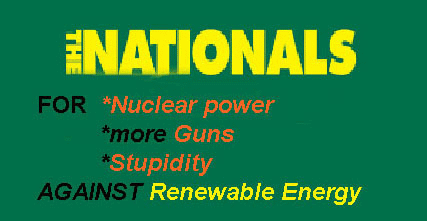 Nuclear energy: Nationals MPs welcome AWU support for domestic industry Union to tell parliamentary committee it’s ‘ludicrous’ to export uranium but not benefit from the energy source at home. Guardian, Sarah Martin 20 Sept 19, Nationals MPs have welcomed support from the Australian Workers’ Union for a domestic nuclear industry, as the union calls on progressives not to reject a “zero carbon compromise”.
A House of Representatives committee chaired by Barnaby Joyce will hear from the union during a roundtable discussion in Sydney on Friday, before MPs visit the Lucas Heights nuclear facility for a site visit…….
The AWU national secretary, Dan Walton, said that while he accepted that the Labor party had already expressed opposition to nuclear, there were people on both sides of politics who were stuck in old ideological debates over the issue. …….
The potential for Australia’s nuclear ban to be lifted has been revived since the May election after a group of Nationals lobbied for the issue to be revisited by a parliamentary inquiry.

Following a referral from the energy minister, Angus Taylor, in August, the environment and energy committee is conducting an inquiry into the “prerequisites for nuclear energy in Australia”.
At the same time, Joyce has tasked his lower house committee to also look at the issue through a series of roundtable events. Taylor has said that while there are no plans to drop the existing moratorium on nuclear energy, the government’s role was to plan for the decades ahead.
 The resources minister, Matt Canavan, a senior Nationals senator from Queensland, said the AWU’s view was welcome as the debate over nuclear continued.
“I welcome the AWU’s contribution,” he told Guardian Australia. “It will, of course, need support from a broad range of organisations, including the Labor party, to progress nuclear power…..
The Nationals MP for Hinkler, Keith Pitt, said that there could be no change to Australia’s current position on nuclear without bipartisan support……
Support for a domestic nuclear industry also appears to be gathering pace within the Coalition, with two new government senators, South Australian Alex Antic and NT National Sam McMahon, both using their first speeches to parliament this week to back the technology……
The union’s support will likely buoy conservative supporters of nuclear who are hoping the twin inquiries into the issue will be sufficient to win a change to government policy.
Ziggy Switkowski, who headed a 2006 review of nuclear power for the Howard government, told the environment committee that the technology had no chance of being introduced unless Australia had a coherent energy policy.
He also said that it would take about a decade before it was clear whether small nuclear reactors were suitable for Australia, and about 15 years to bring a plant online if a decision was made to build one.
The Australian Nuclear Association, which advocates for nuclear science and technology, has said nuclear power could provide cheap, reliable, carbon-free energy in Australia, but would only be financially competitive with a carbon price.
 In a group submission released this week environmental and civil society groups warned the government that nuclear power has “no role” in Australia, saying the issue was a distraction from “real movement on the pressing energy decisions and climate actions we need”. https://www.theguardian.com/environment/2019/sep/20/nuclear-energy-nationals-mps-welcome-awu-support-for-domestic-industry
Exposing misleading evidence to the federal nuclear inquiry
Big claims and corporate spin about small nuclear reactor costs, Jim Green, 19 September 2019, RenewEconomy https://reneweconomy.com.au/big-claims-and-corporate-spin-about-small-nuclear-reactor-costs-65726/
The ‘inquiry into the prerequisites for nuclear energy in Australia’ being run by Federal Parliament’s Environment and Energy Committee has finished receiving submissions and is gradually making them publicly available.
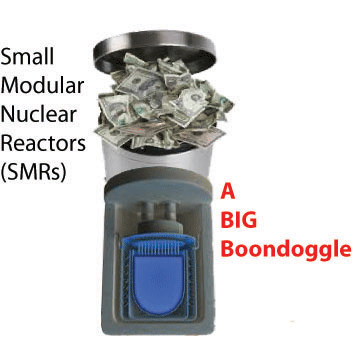 The inquiry is particularly interested in ‘small modular reactors’ (SMRs) and thus one point of interest is how enthusiasts spin the economic debate given that previous history with small reactors has shown them to be expensive; the cost of the handful of SMRs under construction is exorbitant; and both the private sector and governments around the world have been unwilling to invest the billions of dollars required to get high-risk SMR demonstration reactors built.
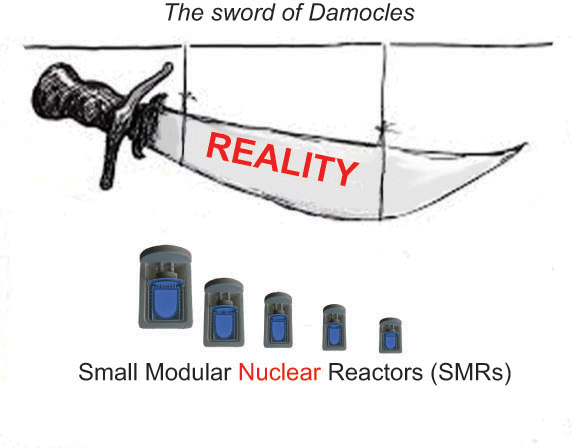 To provide a reality-check before we get to the corporate spin, a submission to the inquiry by the Institute for Energy Economics and Financial Analysis notes that SMRs have been as successful as cold fusion – i.e., not at all. The submission states:
“The construction of nuclear power plants globally has proven to be an ongoing financial disaster for private industry and governments alike, with extraordinary cost and construction time blow-outs, while being a massive waste of public monies due to the ongoing reliance on government financial subsidies. … Governments have repeatedly failed to comprehend that nuclear construction timelines and cost estimates put forward by many corporates (with vested interests) have proven disastrously flawed and wrong.”
The Institute is equally scathing about SMRs:
“For all the hype in certain quarters, commercial deployment of small modular reactors (SMRs) have to-date been as successful as hypothesized cold fusion – that is, not at all. Even assuming massive ongoing taxpayer subsidies, SMR proponents do not expect to make a commercial deployment at scale any time soon, if at all, and more likely in a decade from now if historic delays to proposed timetables are acknowledged.”
Thus the Institute adds its voice to the chorus of informed scepticism about SMRs, such as the 2017 Lloyd’s Register survey of 600 industry professionals and experts who predicted that SMRs have a “low likelihood of eventual take-up, and will have a minimal impact when they do arrive“.
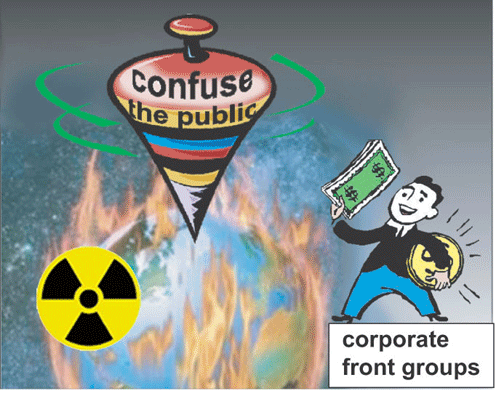 Corporate spin #1: Minerals Council of Australia
The Minerals Council of Australia claims in its submission to the federal inquiry that SMRs could generate electricity for as little as $60 per megawatt-hour (MWh). That claim is based on a report by the Economic and Finance Working Group (EFWG) of the Canadian government-industry ‘SMR Roadmap’ initiative.
The Canadian EFWG gives lots of possible SMR costs and the Minerals Council’s use of its lowest figure is nothing if not selective. The figure cited by the Minerals Council assumes near-term deployment from a standing start (with no-one offering to risk billions of dollars to build demonstration reactors), plus extraordinary learning rates in an industry notorious for its negative learning rates.
Dr. Ziggy Switkowski noted in his evidence to the federal inquiry that “nuclear power has got more expensive, rather than less expensive”. Yet the EFWG  paper takes a made-up, ridiculously-high learning rate and subjects SMR cost estimates to eight ‘cumulative doublings’ based on the learning rate. That’s creative accounting and one can only wonder why the Minerals Council would present it as a credible estimate.
Here are the first-of-a-kind SMR cost estimates from the EFWG paper, all of them far higher than the figure cited by the Minerals Council:
- 300-megawatt (MW) on-grid SMR: C$162.67 (A$179) / MWh
- 125-MW off-grid heavy industry: C$178.01 (A$196) / MWh
- 20-MW off-grid remote mining: C$344.62 (A$380) / MWh
- 3-MW off-grid remote community: C$894.05 (A$986) / MWh
The government and industry members on the Canadian EFWG are in no doubt that SMRs won’t be built without public subsidies:
 “The federal and provincial governments should, in partnership with industry, investigate ways to best risk-share through policy mechanisms to reduce the cost of capital. This is especially true for the first units deployed, which would likely have a substantially higher cost of capital than a commercially mature SMR.”
The EFWG paper used a range of estimates from the literature and vendors. It notes problems with its inputs, such as the fact that many of the vendor estimates have not been independently vetted, and “the wide variation in costs provided by expert analysts”. Thus, the EFWG qualifies its findings by noting that “actual costs could be higher or lower depending on a number of eventualities”.
Corporate spin #2: NuScale Power
US company NuScale Power has put in a submission to the federal nuclear inquiry, estimating a first-of-a-kind cost for its SMR design of US$4.35 billion / gigawatt (GW) and an nth-of-a-kind cost of US$3.6 billion / GW.
NuScale doesn’t provide a $/MWh estimate in its submission, but the company has previously said it is targeting a cost of US$65/MWh for its first SMR plant. That is 2.4 lower than the US$155/MWh (A$225/MWh) estimate based on the NuScale design in a report by WSP / Parsons Brinckerhoff prepared for the SA Nuclear Fuel Cycle Royal Commission.
 NuScale’s cost estimates should be regarded as promotional and will continue to drop – unless and until the company actually builds an SMR. The estimated cost of power from NuScale’s non-existent SMRs fell from US$98-$108/MWh in 2015 to US$65/MWh by mid-2018. The company announced with some fanfare in 2018 that it had worked out how to make its SMRs almost 20% cheaper – by making them almost 20% bigger!
Lazard estimates costs of US$112-189/MWh for electricity from large nuclear plants. NuScale’s claim that its electricity will be 2-3 times cheaper than that from large nuclear plants is implausible. And even if NuScale achieved costs of US$65/MWh, that would still be higher than Lazard’s figures for wind power (US$29-56) and utility-scale solar (US$36-46).
Likewise, NuScale’s construction construction cost estimate of US$4.35 billion / GW is implausible. The latest cost estimate for the two AP1000 reactors under construction in the US state of Georgia (the only reactors under construction in the US) is US$12.3-13.6 billion / GW. NuScale’s target is just one-third of that cost – despite the unavoidable diseconomies of scale and despite the fact that every independent assessment concludes that SMRs will be more expensive to build (per GW) than large reactors.
Further, the modular factory-line production techniques now being championed by NuScale were trialled with the AP1000 reactor project in South Carolina – a project that was abandoned in 2017 after the expenditure of at least US$9 billion.
Corporate spin #3: Australian company SMR Nuclear Technology
In support of its claim that “it is likely that SMRs will be Australia’s lowest-cost generation source”, Australian company SMR Nuclear Technology Pty Ltd cites in its submission to the federal nuclear inquiry a 2017 report by the US Energy Innovation Reform Project (EIRP).
According to SMR Nuclear Technology, the EIRP study “found that the average levelised cost of electricity (LCOE) from advanced reactors was US$60/MWh.”
However the cost figures used in the EIRP report are nothing more than the optimistic estimates of companies hoping to get ‘advanced’ reactor designs off the ground. Therefore the EIRP authors heavily qualified the report’s findings:
“There is inherent and significant uncertainty in projecting NOAK [nth-of-a-kind] costs from a group of companies that have not yet built a single commercial-scale demonstration reactor, let alone a first commercial plant. Without a commercial-scale plant as a reference, it is difficult to reliably estimate the costs of building out the manufacturing capacity needed to achieve the NOAK costs being reported; many questions still remain unanswered – what scale of investments will be needed to launch the supply chain; what type of capacity building will be needed for the supply chain, and so forth.”
SMR Nuclear Technology’s conclusions – that “it is likely that SMRs will be Australia’s lowest-cost generation source” and that low costs are “likely to make them a game-changer in Australia” – have no more credibility than the company estimates used in the EIRP paper.
SMR Nuclear Technology’s submission does not note that the EIRP inputs were merely company estimates and that the EIRP authors heavily qualified the report’s findings.
The US$60/MWh figure cited by SMR Nuclear Technology is far lower than all independent estimates for SMRs:
- The 2015/16 South Australian Nuclear Fuel Cycle Royal Commission estimated costs of A$180-184/MWh for large light-water reactors, compared to A$225 for an SMR based on the NuScale design (and a slightly lower figure for the ‘mPower’ SMR design that was abandoned in 2017 by Bechtel and Babcock & Wilcox).
- A December 2018 report by CSIRO and the Australian Energy Market Operator found that electricity from SMRs would be more than twice as expensive as that from wind or solar power with storage costs included (two hours of battery storage or six hours of pumped hydro storage).
- A report by the consultancy firm Atkins for the UK Department for Business, Energy and Industrial Strategy found that electricity from the first SMR in the UK would be 30% more expensive than that from large reactors, because of diseconomies of scale and the costs of deploying first-of-a-kind technology. Its optimistic SMR cost estimate is US$107-155 (A$157-226) / MWh.
- A 2015 report by the International Energy Agency and the OECD Nuclear Energy Agency predicted that electricity from SMRs will be 50−100% more expensive than that from large reactors, although it holds out some hope that large-volume factory production could reduce costs.
- An article by four pro-nuclear researchers from Carnegie Mellon University’s Department of Engineering and Public Policy, published in 2018 in the Proceedings of the National Academy of Science, concluded than an SMR industry would only be viable in the US if it received “several hundred billion dollars of direct and indirect subsidies” over the next several decades.
SMR Nuclear Technology’s assertion that “nuclear costs are coming down due to simpler and standardised design; factory-based manufacturing; modularisation; shorter construction time and enhanced financing techniques” is at odds with all available evidence and it is at odds with Dr. Ziggy Switkowski’s observation in a public hearing of the federal inquiry that nuclear “costs per kilowatt hour appear to grow with each new generation of technology”.
SMR Nuclear Technology claims that failing to repeal federal legislative bans against nuclear power would come at “great cost to the economy”. However the introduction of nuclear power to Australia would most likely have resulted in the extraordinary cost overruns and delays that have crippled every reactor construction project in the US and western Europe over the past decade – blowouts amounting to A$10 billion or more per reactor.
Nor would the outcome have been positive if Australia had instead pursued non-existent SMR ‘vaporware‘.
Dr Jim Green is lead author of a Nuclear Monitor report on SMRs and national nuclear campaigner with Friends of the Earth Australia.
Nationals MP lashes renewable energy as ‘hoax’ and ‘fraud’ but says nuclear will help solve energy crisis,
Nationals MP lashes renewable energy as ‘hoax’ and ‘fraud’ but says nuclear will help solve energy crisis, 7 News,Matt Coughlan AAP 18 September 2019 Nationals senator Sam McMahon has lashed renewable energy as a “fraud” and a “hoax” as she made the case for oil, gas and nuclear energy.
She became the second government senator in as many days to use their first speech to parliament to talk up nuclear power after South Australian Liberal Alex Antic did the same on Tuesday.
The NT senator said Australia was looking down the barrel of an energy crisis which “quiet Australians” wanted government to solve.
“Research must continue in the development of renewable technologies, but for commercial use they currently remain immature and in many cases fundamentally flawed,” McMahon told parliament on Wednesday.
“A hoax of immature technology replacing safe, clean, reliable and inexpensive power stations has unfolded. “……..
She also said 30 per cent of the world’s uranium reserves were located in the NT.
“The time is right for us to visit and re-examine options for us to utilise this [nuclear] technology.”…….https://7news.com.au/politics/federal-politics/nationals-mp-lashes-renewable-energy-as-hoax-and-fraud-but-says-nuclear-will-help-solve-energy-crisis-c-460357
The well-named Liberal Senator Antic goes all out for nuclear power and waste importation
 New Lib senator joins nuclear power push, Matt Coughlan 7 News, AAP, 17 September 2019
New Liberal senator Alex Antic has joined the push for nuclear power through capitalising on South Australia’s uranium industry.
Senator Antic’s first speech to parliament on Tuesday signalled he would add another nuclear advocate to the Liberal Party’s parliamentary ranks.
“The reckless rush into the unproven, un-costed world of renewable energy represents both the deceased canary down the coalmine, as well as a masterclass of failed policy from a failed former Labor government,” he said.
The Morrison government has announced an inquiry into nuclear power after the issue was raised by a rump of coalition backbenchers.
Senator Antic said “everything old could be new again” in his state, noting its history of uranium mining dating back to the early 1900s…….
The former Adelaide councillor said small modular reactors would increase efficiency and safety, while reducing the cost of nuclear power generation. …..
South Australia has the capacity to develop a safe nuclear waste facility which could bring billions into the state, he said.
Senator Antic also took aim at the “tyranny” of political correctness…….https://7news.com.au/politics/new-lib-senator-joins-nuclear-power-push-c-458275
Found – historic film of Aboriginal resistance to uranium mining
Kakadu uranium protest documentary Dirt Cheap unearthed by Northern Territory Library, ABC News By Matt Garrick 18 Sept 19 The rediscovery of an old VHS tape, left forgotten on the shelves of the Northern Territory Library, has unearthed a tense and important piece of Australian history.
Key points:
- The 1980 documentary Dirt Cheap showcased the Mirarr people’s fight against uranium mining
- The Northern Territory Library recently hunted down the only digital copy of the documentary so it could be shown at a film festival
- Filmmaker Ned Lander says the movie created a stir at the time of its release
The rare copy of the nearly 40-year-old documentary Dirt Cheap, which details the early pushback against uranium mining in Kakadu National Park, was practically unwatchable due to its age……..
The film documented the concerns of the Mirarr people during what was a tense period of negotiation in the lead-up to the 1979 Ranger Uranium Mining Agreement.
It also showcased the pressures and broken promises the traditional owners faced. “It was very, very apparent to us that people were not ready to sign the agreement in relation to mining, and this was being done under pressure.
Mirarr resistance inspires protests around nation
Against the push of government and business interests, the Mirarr stood resolute in their bid to protect their land.
“As a child growing up I saw the struggle of my family, including my grandfather — they [had] been struggling,” traditional owner Jimmy Nabanardi-Mudjandi said.
I’m really proud of them, but it’s sad because they’re not here to see what the new future of Jabiru’s gonna be.”
The resistance from the Mirarr had a flow-on effect around the nation.
Banner-waving protesters took to the streets in Melbourne and Sydney in great numbers, scenes which Dirt Cheap captures in vivid detail.
“Mirarr people got major support from around Australia, from around the whole nation,” Mr Nabanardi-Mudjandi said.
Next stage of uranium mining looms
In the decades since the film’s release, uranium has been mined at Kakadu, but the Ranger mine is now expected to wind up in 2021.
Mr Nabanardi-Mudjandi said it was vital the land was protected during its rehabilitation.
“We are watching them, what they’re doing,” he said.
Mr Nabanardi-Mudjandi will be a special guest when Dirt Cheap screens as part of the Darwin International Film Festival at the Northern Territory Library at 5:30pm on Wednesday. Contact Matt Garrick https://www.abc.net.au/news/2019-09-18/northern-territory-film-uranium-protests-unearthed-for-festival/11519914
Revealed: Josh Frydenberg was behind the strange Environment Department decision to block wind turbines on Lord Howe Island.
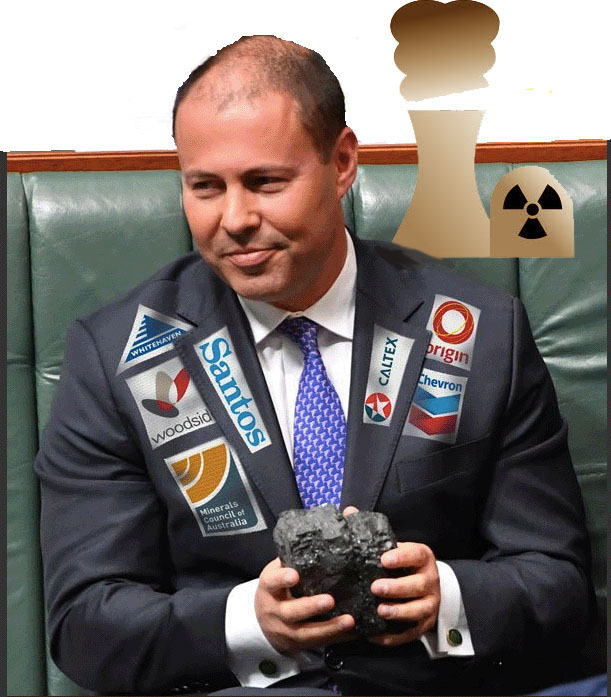 Josh Frydenberg overruled department to block Lord Howe Island wind turbines, FOI documents reveal former environment minister took action despite support from islanders, Guardian, Anne Davies, 18 Sept 19 The former environment minister Josh Frydenberg went against the advice of his departmental experts when he blocked two wind turbines on Lord Howe Island in 2017, consigning the world heritage-listed island to relying on diesel fuel for the bulk of its electricity. Josh Frydenberg overruled department to block Lord Howe Island wind turbines, FOI documents reveal former environment minister took action despite support from islanders, Guardian, Anne Davies, 18 Sept 19 The former environment minister Josh Frydenberg went against the advice of his departmental experts when he blocked two wind turbines on Lord Howe Island in 2017, consigning the world heritage-listed island to relying on diesel fuel for the bulk of its electricity.A freedom of information request by the Guardian has uncovered that the minister took the unusual action of blocking the project under the Environmental Protection and Biodiversity Conservation Act, deeming it “unacceptable”…… Projects are rarely ruled “unacceptable” under federal environmental laws but are often approved with modifications or strict conditions. For instance, the Adani coal project’s groundwater plan was approved in 2019 with conditions; the Abbot Point coal terminal was judged not to have unacceptable impacts on the Great Barrier Reef; and the Watermark coal project near Tamworth was waved through in 2015. But two medium-sized wind turbines on Lord Howe Island proved a bridge too far for Frydenberg as environment minister. Now the Guardian can reveal that his decision was taken despite the advice of his own department, strong support from the majority of residents on Lord Howe Island, the governing board of the island, and even another federal government agency – the Australian Renewable Energy Agency – which had offered $4.6m in funding towards the renewable energy project. The department’s natural heritage section 23 November 2016 advice was that “the proposed action is unlikely to significantly impact the Island Group’s world heritage values” and that moving the island away from reliance on weekly deliveries of diesel would help secure its Unesco world heritage status……… The case raises questions about political influence in environmental decision making. “Former environment minister Josh Frydenberg’s rejection of the Lord Howe Island windfarm is inconsistent with many other environmental approvals where there was strong departmental advice about unavoidable risks to internationally protected places and wildlife,” Basha Stasak, the Australian Conservation Foundation’s nature campaign manager, said.
“For example, Frydenberg ignored clear departmental advice urging a rejection of the Toondah Harbour property development because it would destroy part of an internationally protected wetland. “These inconsistencies go to the heart of the environmental law reform Australia needs. We need strong laws and decisions made under them by an independent national Environment Protection Authority,” she said…….. Lord Howe Island resident Craig Thompson – “Sustainable clean energy for a world heritage site like Lord Howe should be mandatory. We should be setting an example to the whole world, not being held back by a minister’s political ideology or personal opinion.” …….. Lord Howe Island is now exploring what can be done with solar and batteries to meet the island’s needs. New South Wales spends $750,000 a year on shipping diesel to the island to provide power for its 350 residents. https://www.theguardian.com/australia-news/2019/sep/18/josh-frydenberg-overruled-department-to-block-lord-howe-island-wind-turbines |
|
1 This month.
20 September –National Day of Action in Melbourne on the International Day of Peace


Help Aunty Sue Protect Her Land and Sacred Sites From Destructive Rocket Testing.
.

Australians deserve the truth
about
AUKUS – https://aukuspublicinquiry.com/

PETITION – To: Prime Minister Anthony Albanese and the Australian Labor Government

of the week – Australians for War Powers Reform (AWPR)
To see nuclear-related stories in greater depth and intensity
 Antinuclear