Beautiful Flinders Ranges – no place for a nuclear waste dump
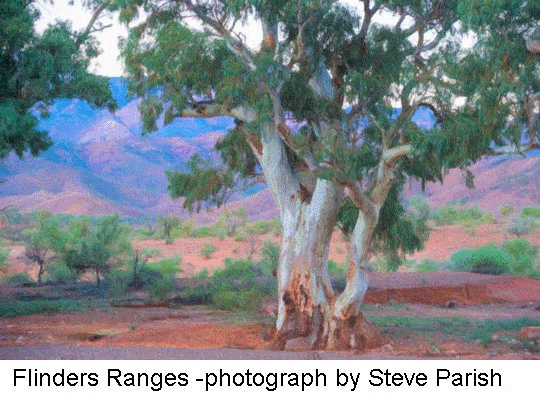
Beautiful Flinders, The Advertiser, MICHELE MADIGAN, 15 Aug 19
RE Susan Andersson’s letter “No nuclear move” (The Advertiser, yesterday): As I travelled south along the highway from Coober Pedy this week, the glorious Flinders Ranges to the east were an inspiring sight.
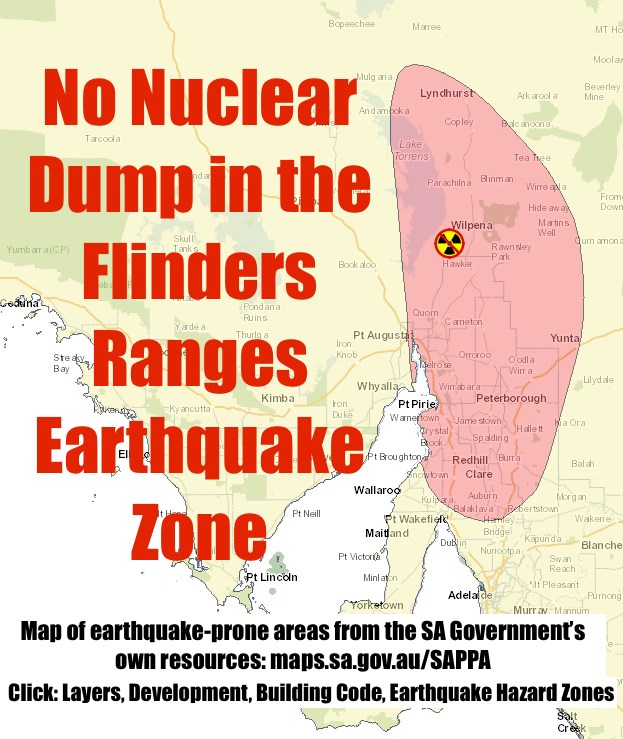
One can only wonder at a Federal Government, which proposes to build a low-level nuclear dump (toxic for 300 years) and, even more concerning, as the letter stated, to simply store intermediate nuclear waste (toxic for 10,000 years) at such an iconic Australian site.
Neither does it make sense to build and store such literally halfway across the country in the international grain farming area of the Kimba region.
Yes, surely, both for residents and we travellers, it is safer (and better for the SA economy) to store the intermediate-level waste where it is – under the eyes of the nuclear experts.
South Australian students plan more climate action -“No jobs on a dead planet”
Tom Webster and Guthrow Taylor Johnson are among 12 student protesters skipping school between 9am and 3pm on Friday each week with no intention of stopping in the near future.
The weekly strikes follow mass school walkouts across the globe earlier this year, including in South Australia.
On March 15, thousands of high school and university students swarmed King William Street demanding politicians take a firmer stance on climate change.
During the event, Adelaide School 4 Climate spokesperson Doha Khan called on her peers to boycott Friday classes until the Federal election.
lthough the election came and went, Taylor Johnson said the group wouldn’t stop protesting until their key demands were met.
“We want no more new fossil fuel projects in Australia,” he said.
“Starting with saying no to Adani, which is going to be the biggest coal mine in the Southern Hemisphere if the government allows them to build it.
“We also want 100 per cent renewables by 2030 and we want a just transition for workers in fossil fuel industries for them to go into renewables.”
The South Australian climate strikes are part of an international movement led by 16-year-old Swedish climate activist Greta Thunberg.
In 2018, Thunberg spent every school day sitting outside of Sweden’s parliament protesting the country’s inaction on climate change. Thunberg later reduced her strikes to every Friday, kicking off a movement of Friday school protests.
A wave of school and university strikes demanding more progressive climate policy has since erupted across the globe.
Last Friday, the National Union of Students led university students in Australian capital cities in striking against climate change.
Webster said while many of their fellow weekly protesters were attending the strike he and Taylor Johnson – who are both still in high school – felt it was important to continue their parliamentary protest as well.
Taylor Johnson said the pair planned to join the next major climate strike, to be held on September 20, and hoped to see his peers there.
“Right now, in Australia, [there’s] a lot of climate deniers. So, it’s up to Australia to both lead the way in climate policies and set an example to other countries,” Taylor Johnson said.
A Seaton High School year 11 student, Taylor Johnson said he originally struggled to find a balance between his studies, social life and activism but has managed to navigate the three successfully…. https://indaily.com.au/news/2019/08/16/no-jobs-on-a-dead-planet-the-sa-students-who-wont-give-up-on-the-climate-change-strike/
How will Zali Steggall vote, in the Liberal Coalition’s Parliamentary Nuclear Inquiry
Coalition MPs are usually loyal to the government. If Taylor didn’t want to build the case for nuclear power, it is hard to see why he would have commissioned the inquiry.
In that case, it may be that the process is more important than the outcome. Get ready for a nuclear sales job.
Australian investigative journalist Mark Davis explodes the myths around Julian Assange

While the Internet was meant to democratise the transmission of information we see a few giant technology companies, Google, Facebook, and Twitter, have near total control of what is seen and shared.
The situation is even worse in Australia with two or three media companies and the same technology giants having control. And the Government of Australia has granted them ever wider market access to extend their monopolies.
Slowly, instance by instance, the malicious and deceitful smears of Julian Assange’s character have been exposed for what they are; an effort to destroy trust in a system of anonymous leaking that will educate everyone.
WikiLeaks’ threat to the powerful was recognised and every effort was, and is, being made to criminalise anonymous leaking, which would be akin to criminalising Gutenberg’s printing press, but there is not much chance this criminalisation will succeed.
It’s time to bring Julian Assange home. Torturing and punishing him has never been legitimate and serves absolutely no purpose.
Media dead silent as Wikileaks insider explodes the myths around Julian Assange, Michael West, by Greg Bean — 16 August 2019 – It is the journalists from The Guardian and New York Times who should be in jail, not Julian Assange, said Mark Davis last week. The veteran Australian investigative journalist, who has been intimately involved in the Wikileaks drama, has turned the Assange narrative on its head. The smears are falling away. The mainstream media, which has so ruthlessly made Julian Assange a scapegoat, is silent in response.
Nuclear’s disadvantages – greenhouse gases and costs
Michele Madigan, Advertiser, August 19, Re‘Nuclear Benefits’ (Advertiser 31/7/19), according to the 2006 Switkowski Report, nuclear power emits three times more greenhouse gases than wind power. In these drought years, Australians may prefer other uses for the 35 to 65 million litres per day that reactors typically consume. It’s a long wait – 15 years or more to develop nuclear power in Australia.
The nuclear power industry survives only because of huge taxpayer subsidies an estimated A$40 billion for Hinkley Point’s two reactors in the UK. Finally, the awkward matter of very possible accidents with Chernobyl and Fukushima being only more recent and catastrophic examples: modern technology notwithstanding. No surprise then that insurance companies do not insure against the risk of nuclear accidents. Given the inconvenient facts, nuclear power mightn’t seem such a good idea after all.
Bankrupted traditional owner vows to keep opposing Adani
Bankrupted traditional owner vows to keep opposing Adani, SBS, 16 Aug 19, A Queensland traditional owner forced into bankruptcy by Adani after failed legal actions says it means nothing to him. A traditional owner forced into bankruptcy by Adani after numerous failed legal actions against them has vowed to continue to speak out against its Queensland coal mine.
Wangan and Jagalingou man Adrian Burragubba was formally bankrupted in the Federal Court in Brisbane on Thursday.
Mr Burragubba’s property will be held until $600,000 in legal costs are paid to the miner following unsuccessful legal attempts to stop the Galilee Basin project…… https://www.sbs.com.au/news/bankrupted-traditional-owner-vows-to-keep-opposing-adani
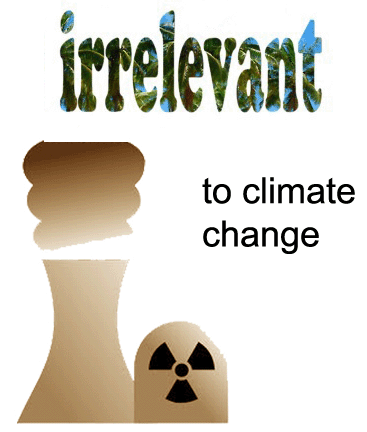
NUCLEAR POWER ‒ NO SOLUTION TO CLIMATE CHANGE
 Friends of the Earth Australia Statement August 2019 http://www.nuclear.foe.org.au
- Introduction 2. Nuclear Power Would Inhibit the Development of More Effective Solutions 3. The Nuclear Power Industry is in Crisis 4. Small Modular Reactors 5. Nuclear Weapons Proliferation and Nuclear Winter 6. A Slow Response to an Urgent Problem 7. Climate Change & Nuclear Hazards: ‘You need to solve global warming for nuclear plants to survive.’ 8. Nuclear Racism 9. Nuclear Waste 10. More Information
- Introduction
Support for nuclear power in Australia has nothing to do with energy policy – it is instead an aspect of the ‘culture wars‘ driven by conservative ideologues (examples include current and former politicians Clive Palmer, Tony Abbott, Cory Bernardi, Barnaby Joyce, Mark Latham, Jim Molan, Craig Kelly, Eric Abetz, and David Leyonhjelm; and media shock-jocks such as Alan Jones, Andrew Bolt and Peta Credlin). With few exceptions, those promoting nuclear power in Australia also support coal, they oppose renewables, they attack environmentalists, they deny climate change science, and they have little knowledge of energy issues and options. The Minerals Council of Australia – which has close connections with the Coalition parties – is another prominent supporter of both coal and nuclear power.
In January 2019, the Climate Council, comprising Australia’s leading climate scientists and other policy experts, issued a policy statement concluding that nuclear power plants “are not appropriate for Australia – and probably never will be”. The statement continued: “Nuclear power stations are highly controversial, can’t be built under existing law in any Australian state or territory, are a more expensive source of power than renewable energy, and present significant challenges in terms of the storage and transport of nuclear waste, and use of water”.
Friends of the Earth Australia agrees with the Climate Council. Proposals to introduce nuclear power to Australia are misguided and should be rejected for the reasons discussed below (and others not discussed here, including the risk of catastrophic accidents).
- Nuclear Power Would Inhibit the Development of More Effective Solutions
Renewable power generation is far cheaper than nuclear power. Lazard’s November 2018 report on levelised costs of electricity found that wind power (US$29‒56 per megawatt-hour) and utility-scale solar (US$36‒46 / MWh) are approximately four times cheaper than nuclear power (US$112‒189 / MWh).
A December 2018 report by the CSIRO and the Australian Energy Market Operator concluded that “solar and wind generation technologies are currently the lowest-cost ways to generate electricity for Australia, compared to any other new-build technology.”
Thus the pursuit of nuclear power would inhibit the necessary rapid development of solutions that are cheaper, safer, more environmentally benign, and enjoy far greater public support. A 2015 IPSOS poll found
that support among Australians for solar power (78‒87%) and wind power (72%) is far higher than support for coal (23%) and nuclear (26%).
Renewables and storage technology can provide a far greater contribution to power supply and to climate change abatement compared to an equivalent investment in nuclear power. Peter Farley, a fellow of the Australian Institution of Engineers, wrote in January 2019: “As for nuclear the 2,200 MW Plant Vogtle [in the US] is costing US$25 billion plus financing costs, insurance and long term waste storage. For the full cost of US$30 billion, we could build 7,000 MW of wind, 7,000 MW of tracking solar, 10,000 MW of rooftop solar, 5,000MW of pumped hydro and 5,000 MW of batteries. That is why nuclear is irrelevant in Australia.”
Dr. Ziggy Switkowski ‒ who led the Howard government’s review of nuclear power in 2006 ‒ noted in 2018 that “the window for gigawatt-scale nuclear has closed”, that nuclear power is no longer cheaper than renewables and that costs are continuing to shift in favour of renewables.
Globally, renewable electricity generation has doubled over the past decade and costs have declined sharply. Renewables account for 26.5% of global electricity generation. Conversely, nuclear costs have increased four- fold since 2006 and nuclear power’s share of global electricity generation has fallen from its 1996 peak of 17.6% to its current share of 10%.
As with renewables, energy efficiency and conservation measures are far cheaper and less problematic than nuclear power. A University of Cambridge study concluded that 73% of global energy use could be saved by energy efficiency and conservation measures. Yet Australia’s energy efficiency policies and performance are among the worst in the developed world.
- The Nuclear Power Industry is in Crisis
The nuclear industry is in crisis with lobbyists repeatedly acknowledging nuclear power’s “rapidly accelerating crisis”, a “crisis that threatens the death of nuclear energy in the West” and “the crisis that the nuclear industry is presently facing in developed countries”, while noting that “the industry is on life support in the United States and other developed economies” and engaging each other in heated arguments about what if anything can be salvaged from the “ashes of today’s dying industry”.
It makes no sense for Australia to be introducing nuclear power at a time when the industry is in crisis and when a growing number of countries are phasing out nuclear power (including Germany, Switzerland, Spain, Belgium, Taiwan and South Korea).
The 2006 Switkowski report estimated the cost of electricity from new reactors at A$40–65 / MWh. Current estimates are four times greater at A$165‒278 / MWh. In 2009, Dr. Switkowski said that a 1,000 MW power reactor in Australia would cost A$4‒6 billion. Again, that is about one-quarter of all the real-world experience over the past decade in western Europe and north America, with cost estimates of reactors under construction ranging from A$17‒24 billion (while a reactor project in South Carolina was abandoned after the expenditure of at least A$13.3 billion).
Thanks to legislation banning nuclear power, Australia has avoided the catastrophic cost overruns and crises that have plagued every recent reactor project in western Europe and north America. Cheaper Chinese or Russian nuclear reactors would not be accepted in Australia for a multitude of reasons (cybersecurity, corruption, repression, safety, etc.). South Korea has been suggested as a potential supplier, but South Korea is slowly phasing out nuclear power, it has little experience with its APR1400 reactor design, and South Korea’s ‘nuclear mafia‘ is as corrupt and dangerous as the ‘nuclear village‘ in Japan which was responsible for the Fukushima disaster.
- Small Modular Reactors
The Minerals Council of Australia claims that small modular reactors (SMRs) are “leading the way in cost”. In fact, power from SMRs will almost certainly be more expensive than power from large reactors because of diseconomies of scale. The cost of the small number of SMRs under construction is exorbitant. Both the private sector and governments have been unwilling to invest in SMRs because of their poor prospects. The December 2018 report by the CSIRO and the Australian Energy Market Operator found that even if the cost of power from SMRs halved, it would still be more expensive than wind or solar power with storage costs included (two hours of battery storage or six hours of pumped hydro storage).
The prevailing scepticism is evident in a 2017 Lloyd’s Register report based on the insights of almost 600 professionals and experts from utilities, distributors, operators and equipment manufacturers. They predict that SMRs have a “low likelihood of eventual take-up, and will have a minimal impact when they do arrive”.
No SMRs are operating and about half of the small number under construction have nothing to do with climate change abatement – on the contrary, they are designed to facilitate access to fossil fuel resources in the Arctic, the South China Sea and elsewhere. Worse still, there are disturbing connections between SMRs, nuclear weapons proliferation and militarism more generally.
- Nuclear Weapons Proliferation and Nuclear Winter
“On top of the perennial challenges of global poverty and injustice, the two biggest threats facing human civilisation in the 21st century are climate change and nuclear war. It would be absurd to respond to one by increasing the risks of the other. Yet that is what nuclear power does.” ‒ Australian
Nuclear power programs have provided cover for numerous covert weapons programs and an expansion of nuclear power would exacerbate the problem. After decades of deceit and denial, a growing number of nuclear industry bodies and lobbyists now openly acknowledge and even celebrate the connections between nuclear power and weapons. They argue that troubled nuclear power programs should be further subsidised such that they can continue to underpin and support weapons programs.
For example, US nuclear lobbyist Michael Shellenberger previously denied power–weapons connections but now argues that “having a weapons option is often the most important factor in a state pursuing peaceful nuclear energy”, that “at least 20 nations sought nuclear power at least in part to give themselves the option of creating a nuclear weapon”, and that “in seeking to deny the connection between nuclear power and nuclear weapons, the nuclear community today finds itself in the increasingly untenable position of having to deny these real world connections.”
Former US Vice President Al Gore has neatly summarised the problem: “For eight years in the White House, every weapons-proliferation problem we dealt with was connected to a civilian reactor program. And if we ever got to the point where we wanted to use nuclear reactors to back out a lot of coal … then we’d have to put them in so many places we’d run that proliferation risk right off the reasonability scale.”
Running the proliferation risk off the reasonability scale brings the debate back to climate change. Nuclear warfare − even a limited, regional nuclear war involving a tiny fraction of the global arsenal − has the potential to cause catastrophic climate change. The problem is explained by Alan Robock in The Bulletin of the Atomic Scientists: “[W]e now understand that the atmospheric effects of a nuclear war would last for at least a decade − more than proving the nuclear winter theory of the 1980s correct. By our calculations, a regional nuclear war between India and Pakistan using less than 0.3% of the current global arsenal would produce climate change unprecedented in recorded human history and global ozone depletion equal in size to the current hole in the ozone, only spread out globally.”
Nuclear plants are also vulnerable to security threats such as conventional military attacks (and cyber-attacks such as Israel’s Stuxnet attack on Iran’s enrichment plant), and the theft and smuggling of nuclear materials. Examples of military strikes on nuclear plants include the destruction of research reactors in Iraq by Israel and the US; Iran’s attempts to strike nuclear facilities in Iraq during the 1980−88 war (and vice versa); Iraq’s attempted strikes on Israel’s nuclear facilities; and Israel’s bombing of a suspected nuclear reactor site in Syria in 2007.
6. A Slow Response to an Urgent Problem
Expanding nuclear power is impractical as a short-term response to climate change. An analysis by Australian economist Prof. John Quiggin concludes that it would be “virtually impossible” to get a nuclear power reactor operating in Australia by 2040.
More time would elapse before nuclear power has generated as much as energy as was expended in the construction of the reactor. A University of Sydney report states: “The energy payback time of nuclear energy is around 6.5 years for light water reactors, and 7 years for heavy water reactors, ranging within 5.6–14.1 years, and 6.4–12.4 years, respectively.”
Taking into account planning and approvals, construction, and the energy payback time, it would be a quarter of a century or more before nuclear power could even begin to reduce greenhouse emissions in Australia … and then only assuming that nuclear power displaced fossil fuels.
- Climate Change & Nuclear Hazards: ‘You need to solve global warming for nuclear plants to survive.’
“I’ve heard many nuclear proponents say that nuclear power is part of the solution to global warming. It needs to be reversed: You need to solve global warming for nuclear plants to survive.” ‒ Nuclear engineer David Lochbaum.
Nuclear power plants are vulnerable to threats which are being exacerbated by climate change. These include dwindling and warming water sources, sea-level rise, storm damage, drought, and jelly-fish swarms.
At the lower end of the risk spectrum, there are countless examples of nuclear plants operating at reduced power or being temporarily shut down due to water shortages or increased water temperature during heatwaves (which can adversely affect reactor cooling and/or cause fish deaths and other problems associated with the dumping of waste heat in water sources). In the US, for example, unusually hot temperatures in 2018 forced nuclear plant operators to reduce reactor power output more than 30 times.
At the upper end of the risk spectrum, climate-related threats pose serious risks such as storms cutting off grid power, leaving nuclear plants reliant on generators for reactor cooling.
‘Water wars’ will become increasingly common with climate change − disputes over the allocation of increasingly scarce water resources between power generation, agriculture and other uses. Nuclear power reactors consume massive amounts of cooling water − typically 36.3 to 65.4 million litres per reactor per day. The World Resources Institute noted last year that 47% of the world’s thermal power plant capacity ‒ mostly coal, natural gas and nuclear ‒ are located in highly water-stressed areas.
By contrast, the REN21 Renewables 2015: Global Status Report states: “Although renewable energy systems are also vulnerable to climate change, they have unique qualities that make them suitable both for reinforcing the resilience of the wider energy infrastructure and for ensuring the provision of energy services under changing climatic conditions. System modularity, distributed deployment, and local availability and diversity of fuel sources − central components of energy system resilience − are key characteristics of most renewable energy systems.”
- Nuclear RacismTo give one example (among many), the National Radioactive Waste Management Act dispossesses and disempowers Traditional Owners in every way imaginable:
- The nomination of a site for a radioactive waste dump is valid even if Aboriginal owners were not consulted and did not give consent.
- The Act has sections which nullify State or Territory laws that protect archaeological or heritage values, including those which relate to Indigenous traditions.
The nuclear industry has a shameful history of dispossessing and disempowering Aboriginal people and communities, and polluting their land and water, dating from the British bomb tests in the 1950s. The same attitudes prevail today in relation to the uranium industry and planned nuclear waste dumps and the problems would be magnified if Australia developed nuclear power.
The Act curtails the application of Commonwealth laws including the Aboriginal and Torres Strait Islander Heritage Protection Act 1984 and the Native Title Act 1993 in the important site-selection stage.
- The Native Title Act 1993 is expressly overridden in relation to land acquisition for a radioactive waste dump.
9. Nuclear Waste
Decades-long efforts to establish a repository and store for Australia’s low-and intermediate-level nuclear waste continue to flounder and are currently subject to legal and Human Rights Commission complaints and challenges, initiated by Traditional Owners of two targeted sites in South Australia. Establishing a repository for high-level nuclear waste from a nuclear power program would be far more challenging as Federal Resources Minister Matt Canavan has noted.
Globally, countries operating nuclear power plants are struggling to manage nuclear waste and no country has a repository for the disposal of high-level nuclear waste. The United States has a deep underground repository for long-lived intermediate-level waste, called the Waste Isolation Pilot Plant (WIPP). However the repository was closed from 2014‒17 following a chemical explosion in an underground waste barrel. Costs associated with the accident are estimated at over A$2.9 billion.
Safety standards fell away sharply within the first decade of operation of the WIPP repository ‒ a sobering reminder of the challenge of safely managing nuclear waste for millennia.
- More Information
- Climate Council, 2019, ‘Nuclear Power Stations are Not Appropriate for Australia – and Probably Never Will Be‘
- WISE Nuclear Monitor, 25 June 2016, ‘Nuclear power: No solution to climate change‘
- Friends of the Earth Australia nuclear power online resources
Parliamentary Inquiry into nuclear power for Victoria
Inquiry to explore Victoria going nuclear, Yahoo News Benita Kolovos
Australian Associated Press, 14 August 2019 The Victorian parliament is set to explore lifting the state’s bans on nuclear activities in an effort to tackle climate change.
A Liberal Democrats motion for an inquiry into the potential for nuclear power passed the state’s upper house on Wednesday.
The 12-month inquiry will explore if nuclear energy would be feasible and suitable for Victoria in the future, and will consider waste management, health and safety and possible industrial and medical applications.
Liberal Democrat MP David Limbrick said the political climate – and actual climate – have changed significantly since nuclear energy was last seriously considered in the 1980s.
“The young people of today no longer fear nuclear holocaust. Today’s young have a new fear – global warming,” he told the Legislative Council…….
The Greens’ Tim Read said it makes “absolutely no sense” for Victoria to consider getting into nuclear energy.
“This inquiry is a waste of resources and a waste of time,” he said in a statement.
“Dredging up the tired old debate on nuclear will only delay the urgent work needed to end our reliance on coal and gas and transitioning to clean and safe renewable energy.”
Similar inquiries are being held in NSW and federal parliament…… https://au.news.yahoo.com/inquiry-explore-victoria-going-nuclear-093346544–spt.html?guccounter=1&guce_referrer=aHR0cHM6Ly9uZXdzLmdvb2dsZS5jb20v&guce_referrer_sig=AQAAABq2naeyyQ9ohtcPQW2Ho9e2-qDfI6XSbDwfZUneTxi4VhdT3GWx-zWbqg0MCFS2ArOO-cBI7xrEXbGJxc_Z4MEQGCMb8xZYz9GdF6dLu3azUPUvN5EB4x2GgyUSjwZkX1E93xGECuqxS4HnxqOETaVwytGf9KBTZIzT3QuaBP-R
21 August Senator Matt Canavan to hold closed meeting , then 2 open ones, in region designated for nuclear waste dumping

Queensland Sinister Matt Canavan is having a closed door meeting with the Barndioota Consultative Committee before the Hawker meeting. No doubt the serious nuclear waste dump decisions will be made then
But there’ll be open meetings – ?window dressing – at Hawker 21 August, and at Kimba 22 August.
21 August Wed 3.30 – 430 pm Hawker Sports Centre – Druitt Range Drive, Hawker
22 August Thurs 11 a.m – 12. pm Kimba Gateway Hotel- 40 High St Kimba
Mirrarr people to lead the Kakadu region’s transition from uranium mining

Kirsten Blair, Community and International Liaison, 15 Aug 19, Gundjeihmi Aboriginal CorporationToday GAC chairwoman, Toby’s Gangale’s daughter: Valerie Balmoore signed an MOU with the Federal and NT Governments as well as mining company ERA committing all parties to a Mirarr-led post-mining future for Jabiru.
There is still much work to be done on Mirarr country including cleaning up the immense Ranger uranium mine. GAC and others will continue our diligent work in this area – and there are no guarantees the cleanup will be wholly successful – but restoration of country remains the absolute objective.
Mirarr continue to assert their rights as Traditional Owners and lead the way for people and country, this Jabiru story is evidence of a massive shift. The power in these images speaks for itself. Today is deeply hopeful for the Kakadu region and offers an incredible message for all communities resisting unwanted mining projects.
|
JABIRU FUTURE SECURE AS PARTIES SIGN MoU. A historic Memorandum of Understanding (MoU) to be signed today in Jabiru will secure the town’s future as the tourism heartland of the World Heritage Listed Kakadu National Park. Federal Minister for the Environment Sussan Ley will join Northern Territory Minister for Aboriginal Affairs, Selena Uibo, Energy Resources of Australia (ERA) and Traditional Owners from the Gundjeihmi Aboriginal Corporation (GAC) for the signing of the MoU, which will support the town’s transition from a mining town to a tourist town. ERA is scheduled to cease operations at the Ranger
“This is about working together to ensure that the community will prosper and the mining land is cared for,” Federal Minister for the Environment Sussan Ley said. “The Australian Government has committed $216m to Kakadu with $35m directly supporting Jabiru’s transition from mining to tourism. Importantly, the certainty that comes from this MoU will encourage further private investment.” Selena Uibo, Minister for Aboriginal Affairs, said the NT Government has committed a further $135.5m to the town. “Jabiru is, and always has been, Aboriginal land. The Territory Labor Government will work closely with GAC to support the employment opportunities tourism will present for the Mirarr people, so they can achieve their social and economic aspirations,” Minister Uibo said. “Kakadu is home to the oldest continuous culture on earth. The Mirrar traditional owners, by drawing upon more than 65,000 years of knowledge and wisdom, can improve the visitor experience for those who come to visit this very special part of the Territory.”
Valerie Balmoore, Chair of GAC and a senior Mirarr Traditional Owner, said the Corporation has formed a new partnership with the NT Government, Jabiru Kabolkmakmen Ltd, to guide the postmining move, and developed a Jabiru Master Plan to drive the town’s evolution. “The Masterplan is our vision for the new Jabiru town. We welcome the investment commitments from the Commonwealth and the Northern Territory and ERA in supporting our goals. Jabiru and Kakadu are places where we can share our cultural heritage with future generations,” Ms Balmoore said.
Paul Arnold, Chief Executive and Managing Director, Energy Resources of Australia Ltd (ERA), said ERA will continue to have a presence in Jabiru as the Company undertakes the rehabilitation of the Ranger Project Area to protect Kakadu’s World Heritage values. “I want to acknowledge the leadership of the Mirarr Traditional Owners and the contributions of the Commonwealth and Northern Territory Governments toward creating a future for Jabiru,” Mr Arnold said. “ERA is proud of its role in establishing the town and the contribution of our people to the community over the last 40 years. We look forward to continuing to be a valued member of the community and working closely with the Mirarr and the Commonwealth and NT Governments to support the transition of Jabiru.
Jabiru was established in 1982 to support uranium mining in the region. Today it is a services and tourism hub for Kakadu National Park and the West Arnhem region. ERA will cease processing activities at the Ranger Uranium Mine no later than January 2021, with remediation work to be completed by 2026. As Jabiru transitions from a mining town to a locally-led community, until 2023, the Northern Territory Government will continue to take responsibility for essential services and infrastructure, including education, health, police, fire and emergency
|
|
Jacinda Adearn and Scott Morrison – the contrast over attitudes to climate change
Speaking at the Pacific Islands Forum, she has urged for greater action on climate change and made a thinly veiled criticism of Australia’s defence of its rising greenhouse gas emissions.
We will continue to say that New Zealand will do its bit and we have an expectation that everyone else will as well,” she told reporters.
“Australia has to answer to the Pacific, that is a matter for them.”
Ms Ardern noted New Zealand contributes a small amount to global emissions but said that wasn’t an excuse not to act.
“If we all took the perspective that if you’re small it doesn’t matter, we wouldn’t see change.”
This is in stark contrast to Energy Minister Angus Taylor, who has used Australia’s small global contribution when defending rises in domestic emissions.
The New Zealand leader also sided with Pacific nations by saying anything more than a 1.5-degree rise in global temperatures would have a catastrophic effect.
Negotiations on the wording of the final communique are ongoing, with smaller nations calling for a phase-out of coal, no new coal mines and for Australia to not use carryover credits to reach emissions goals……
Although regional security issues are bubbling under the surface, Pacific leaders are dedicated to focusing on climate change, which is threatening their survival. …..
Minister for the Pacific Alex Hawke, who now has the prime minister by his side, earlier admitted Australia was trying to remove mention of phasing out of coal in the final communique.
He described it as a “red line issue” for Australian negotiators.
Mr Morrison has delved right into the forum, holding bilateral meetings on Wednesday with Ms Ardern as well as Vanuatu leader Charlot Salwai, Cook Islands Prime Minister Henry Puna and Tuvalu’s Enele Sopoaga.
Mr Sopoaga has not held back on his strong language against Australia, saying its aid for the region was no excuse not to reduce emissions or open new coal mines.
The Pacific leaders will spend Thursday together at a leaders’ retreat. https://www.sbs.com.au/news/australia-has-to-answer-to-the-pacific-ardern-weighs-in-on-climate-change-responsibilities
Redirecting aid money to Pacific will not excuse Australia’s inaction on climate change
Tuvalu’s PM says Australia’s climate funding for Pacific ‘not an excuse’ to avoid emissions cuts, ABC, Pacific Beat , By foreign affairs reporter Melissa Clarke 13 Aug 19 Tuvalu has warned Australia that redirecting aid money to climate resilience projects in the Pacific should not be used as an “excuse” to avoid reducing emissions and phasing out coal-fired power generation.
Key points:
- Tuvalu wants Australia to cut domestic emissions and stop opening coal mines
- Countries like Australia have been urged to continue to fund the UN’s Green Climate Fund
- Australia’s aid budget will stay the same, just redirected to fund climate change initiatives
Australia’s Prime Minister Scott Morrison on Tuesday morning announced a $500 million package of funding, redirected from aid spending, to help Pacific countries invest in renewable energy and become more resilient to climate and weather events…….
Speaking after a meeting of Smaller Island States (SIS), Mr Sopoaga also called on countries like Australia to continue to fund the UN’s Green Climate Fund, which helps developing nations cope with climate change.
“We certainly respect what Australia decides to do with its assistance in terms of how big, but we want … global actions,” he said……
Mr Sopoaga, Fiji’s Prime Minister Frank Bainimarama and other Pacific leaders have become increasingly vocal in the lead-up to this year’s PIF leaders’ meeting in appealing to Australia to take a stronger stance on climate change. ….. https://www.abc.net.au/news/2019-08-13/australias-climate-funding-pacific-islands-forum-tuvalu/11408930
Nuclear waste dump: Barngarla group says indigenous ballots won’t fix its worries over vote discrimination
Nuclear waste dump: Barngarla group says indigenous ballots won’t fix its worries over vote discrimination The Advertiser, 14 Aug 19
An Aboriginal organisation at the centre of a legal battle over the site for a nuclear waste dump says a separate consultation process for indigenous people will do little to dampen its discrimination concerns.
The Barngarla Determination Aboriginal Corporation took Kimba Council to court over its plan to host a community vote to gauge support for a waste storage facility near the Eyre Peninsula town.
The organisation argued the poll was discriminatory because it excluded native title holders who did not live in the area.
After losing the Federal Court challenge in July, the Barngarla has lodged an appeal in the Full Court.
Resources Minister Matthew Canavan has since written to Kimba and Flinders Ranges councils saying he will approach indigenous organisations reaffirming his department’s offer to pay for a poll of their members, providing them with a voice.
But the Barngarla board told The Advertiser such a poll was “designed to exclude our people from having a say on equal footing to the rest of the community”.
“It is very simple to solve this problem – all which needs to happen is to allow our people the right to vote with the rest of the Kimba community rather that segregate us,” the board said.
The organisation said Mr Canavan had not provided a template ballot paper and associated material so the ballot could be run on equal terms. The council and Federal Government had also not agreed to consolidate all the results into one process.
The Barngarla board has written to Indigenous Australians Minister Ken Wyatt asking him to intervene.
Three SA sites are being considered for the radioactive waste dump – two near Kimba and one at Wallerberdina Station, near Hawker in the Flinders Ranges. It would hold low and intermediate-level waste, primarily from the production of nuclear medicines.
Polls in the Hawker and Kimba communities were due to happen in August 2018 but were stalled after the Barngarla court appeal was flagged.
The Adnyamathanha Traditional Lands Association (ATLA) has also lodged a complaint with the Human Rights Commission.
Meanwhile, Government staff on Tuesday confirmed at a Flinders Ranges-based consultative committee meeting the minimum size of the nuclear site and its surrounding buffer zone would increase from 100ha to 160ha – as claimed by a source close to the project in The Advertiser last month.
The Government says the extra space will allow for features such as a water treatment plant, power infrastructure and road access, depending on the selected site.
Mr Canavan said the Government had “listened carefully” to communities when shaping ballot boundaries.
“At Kimba it extended to the entire local council area, while at Wallerberdina Station it is the local government area plus an approximate 50km radius,” he said.
“Wherever a boundary is defined there will be a number of groups outside that line, but the process gives those people the ability to fully participate by making a submission that will be taken into account in the decision-making process.”
A spokeswoman for Mr Canavan said details of polls among indigenous organisations would be worked out alongside any groups who wanted to participate.
Maurice Blackburn lawyer Nicki Lees, representing ATLA, said the organisation had made it clear it opposed a nuclear waste dump on its traditional land.
“If the Government is considering further consultation on this project, we would consider this in due course,” she said.
“However, it is important that this is a meaningful process, which hasn’t occurred to date.”
Adnyamathanha woman Regina McKenzie has previously told The Advertiser the long-running debate had disrupted her community.
Kimba Council renews commitment to local community ballot on nuclear waste dump
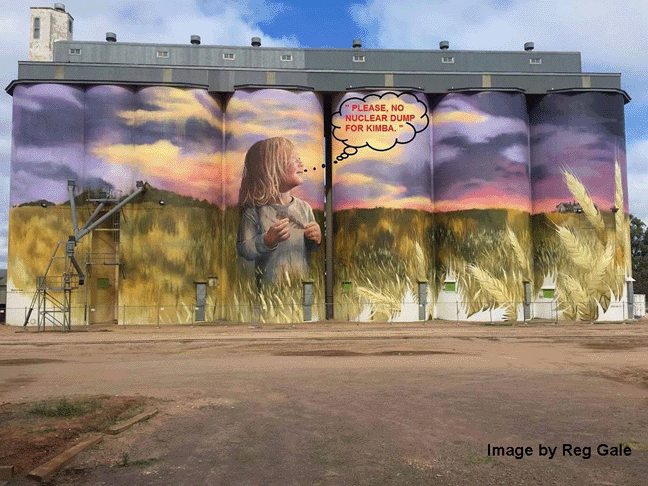
Despite this, Kimba mayor Dean Johnson said the council had received legal advice that the ballot process could now resume.
“There’s no legal impediment to us proceeding with the ballot,” he said.
Mr Johnson said the council had received a “strong judgement” in the federal court, and he encouraged the community to read it themselves.
He said the Resources Minister had requested the council proceed with the ballot, and it was important to give the Kimba community their vote on whether the waste management facility should go ahead in the district
“Our community have been in a holding pattern for a very long time… our main objective is to give our community an opportunity to have their say.”
He said he believed it was the responsibility of the Department of Industry, Innovation and Science to make sure the Barngarla people were properly consulted during the site selection process.
1 This month.
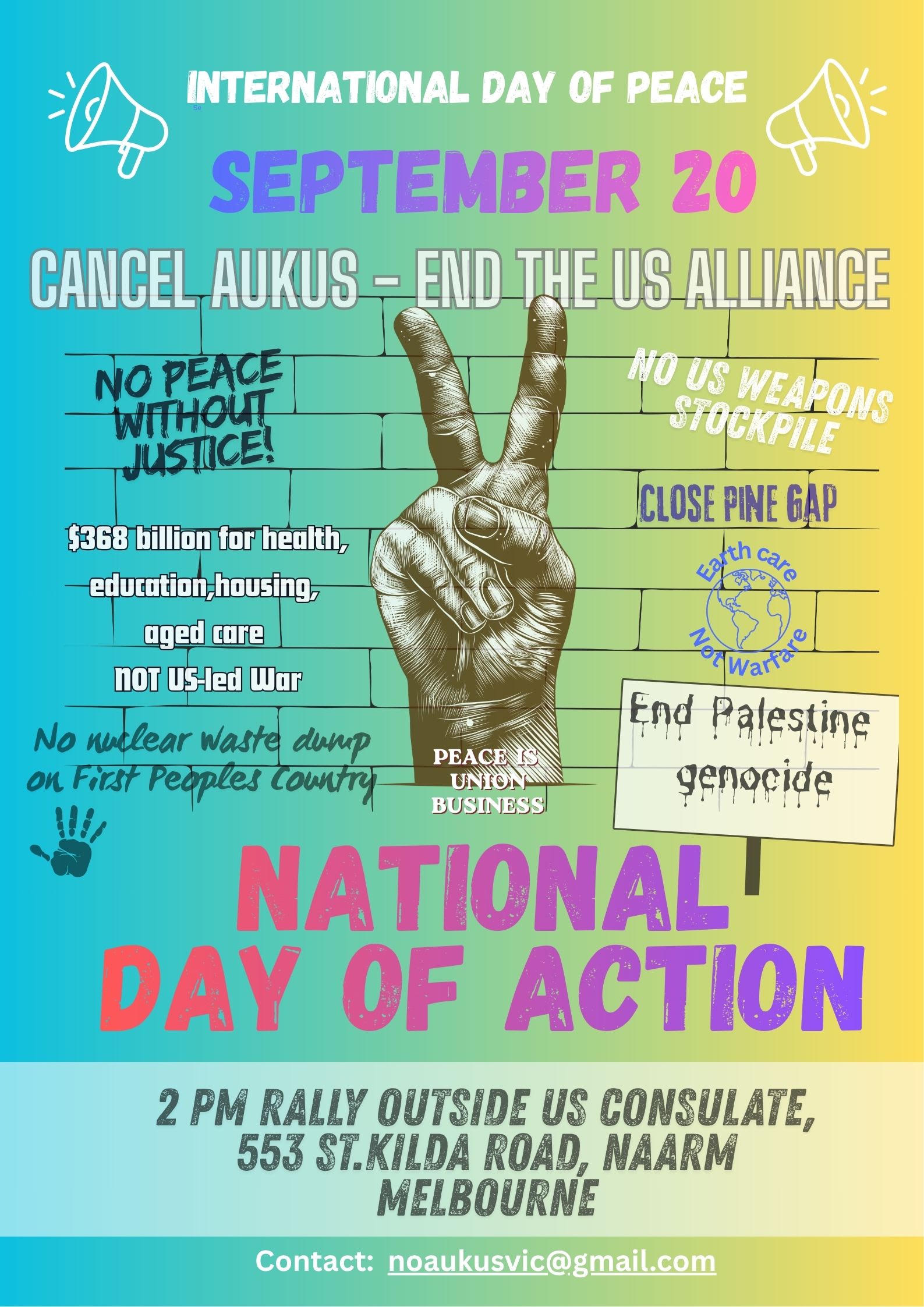
20 September –National Day of Action in Melbourne on the International Day of Peace

Help Aunty Sue Protect Her Land and Sacred Sites From Destructive Rocket Testing.
.

Australians deserve the truth
about
AUKUS – https://aukuspublicinquiry.com/


PETITION – To: Prime Minister Anthony Albanese and the Australian Labor Government

of the week – Australians for War Powers Reform (AWPR)
To see nuclear-related stories in greater depth and intensity
 Antinuclear