Australia’s Trump cards
by Rex Patrick | Mar 16, 2025, https://michaelwest.com.au/tariffs-australias-trump-cards/
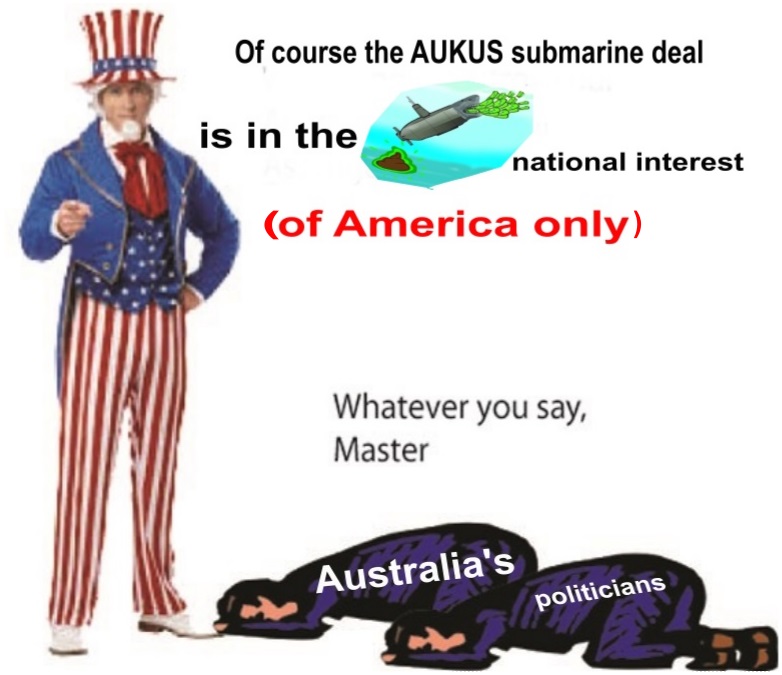
Australia does have Trump cards; North West Cape, Pine Gap, US Marine Rotational forces in Darwin, AUKUS and/or critical minerals that the US needs. Perhaps it’s also time to cancel the traitorous quantum computing development contract given to a US company over Australian companies.
These are things that we can put on the table. But doing that requires a measure of boldness. Our problem is our Prime Minister doesn’t have the ticker. Neither does the opposition leader. They are with Trump internationally as they are with the gas cartel domestically; owned and weak.
Anthony Albanese has it all wrong, writes former senator and submariner Rex Patrick. He’s trying to bribe Trump with sweeteners in response to trade tariffs. Instead, he needs to tell Trump he’s prepared to take things away.
US nuclear deterrent
Deep beneath the Indian Ocean, USS Kentucky, a nuclear-powered Ohio Class Ballistic Missile Submarine (SSBN) ploughs its way through the water. Contained within its 18,750 tonne pressure hull structure are 24 Trident ballistic missiles, each capable of carrying eight nuclear warheads to targets up to 12,000 km away.
The launch of all of USS Kentucky’s missiles would, quite literally, change the world by exacting severe destruction on whole societies.
This ability to inflict damage on an exceptionally large scale is the basis of the SSBN’s deterrent capability. Unlike silo based missiles, which are vulnerable to a first strike, or aircraft delivered nuclear weapons, which can be pre-emptively hit or shot down, SSBNs are essentially invisible. They provide certainty of response.
SSBNs serve as the ultimate nuclear deterrent. They’re extremely important to the US, whose navy possesses 14 of them. At any one time six to eight will be at sea, with four of them always on deterrent patrol. They are spread about the globe giving the US President the ability to quickly deliver return-fire with nuclear warheads at any adversary.
24/7 Operation
The primary performance metric for an SSBN is to be able to deliver its nuclear weapons with reliability, timeliness and accuracy.
The Commanding Officer of USS Kentucky must be able to loiter undetected in a place suited for the launching of weapons, be able to receive an order to launch, have an understanding of the submarine’s exact navigational position to a high degree of accuracy and have the ability to launch the weapons quickly and reliably once that order arrives.
Loitering undetected and being able to receive an order to launch is challenging. When a submarine is near the surface, their hulls can be seen by aircraft, and raised periscopes and communications masts can be seen visually and on radar. Operating a submarine at shallow depth can also result in acoustic counter-detection.
The Commanding Officer of USS Kentucky knows that deep is the place to be.
But being deep frustrates a submarine’s ability to receive communications, particularly an ‘emergency action message’.
And that’s were Very Low Frequency (VLF) communications stations come into play. In conjunction with a submarine’s buoyant wire antenna – a long wire that sits just below the sea surface – they can receive a launch command from the President.
The US has a network of these VLF communication stations around the world including in Maine, Washington state and North West Cape, Australia.
North West Cape
The VLF Communication Facility at North West Cape (NAVCOMMSTA Harold E Holt) has been in operation since 1967. Born of secrecy, it was at first exclusively US operated until 1974 when the facility became joint and started communicating with Australian submarines. In 1991 it was agreed that Australia would take full command in 1992 and US Naval personnel subsequently left in 1993.
The facility’s deterrence support role now rests on a 2008 treaty which, ratified in 2011, is formally titled the “Agreement between the Government of Australia and the Government of the United States of America relating to the Operation of and Access to an Australian Naval Communication Station at North West Cape in Western Australia”.
The station’s antenna is 360 meters high, with a number of supporting towers in a hexagon shape connected to it by wires. Considered to be the most powerful transmitter in the southern hemisphere, it transmits on 19.8 kHz at about 1 megawatt.
The station enables emergency action messages to be relayed to submerged SSBNs, like USS Kentucky, when operating in the Indian and Western Pacific oceans.
If the facility was taken out by a first strike nuclear attack, the US Air Force can temporarily deploy Hercules ‘TACAMO’ aircraft, with a long VLF wire they deploy while airborne. It’s a back-up measure with much lower transmission power capabilities.
A bedrock of certainty
After US steel and aluminium tariffs were put into play, the Australian Financial Review ran with a headline “How Australia was blindsided on the US tariffs”. The article opened with, “Australia pulled out all stops to avoid Donald Trump’s duties on steel and aluminium, but it’s impossible to negotiate with someone who doesn’t want anything”.
But the US does want something.
A fact not so well appreciated with respect to nuclear deterrence is it must be seen to be a robust and continuous capability. Onlookers must see a 24/7 capability including deployable submarines manned by well-trained crews, proven and reliable missile systems, an organised strategic command, a continuous communication system that reliably links that strategic command to the submarines with appropriate redundant communication pathways, training facilities and maintenance support.
Potential adversaries must know that they could be struck by an SSBN that could be lurking anywhere in the world’s major oceans.
Effective nuclear deterrence must be built on a bedrock of operational certainty.
Remove the transmitter keys
North West Cape forms part of that certainty.
Australia has the keys to take some certainty away. Without our cooperation the US can’t operate a certain global deterrent capability. Turning off transmissions at North West Cape reduces the effectiveness of the US nuclear deterrence while eliminating one Australian nuclear target
The North West Cape Treaty provides leverage. While the agreement has another decade to run, Article 12 provides that “either Government may terminate this Agreement upon one year’s written notice to the other Government.”
It’s open to Australia to signal or give actual notice of termination. That would focus up policy makers in Washington.
Would we do that to a mate? No, but the US is showing they are not a mate. They are not showing us the loyalty we have shown them. Other actions; abandoning Ukraine, threatening Greenland and Panama and a not so subtle push to annex Canada have also shown they are an unreliable ally who doesn’t share our values.
Trump cards
In negotiating with President Zelensky over the war in Ukraine, President Trump told him in no uncertain terms. “We’re going to feel very good and very strong. You’re, right now, not in a very good position. You’ve allowed yourself to be in a very bad position. You don’t have the cards right now with us.”
But Australia does have Trump cards; North West Cape, Pine Gap, US Marine Rotational forces in Darwin, AUKUS and/or critical minerals that the US needs. Perhaps it’s also time to cancel the traitorous quantum computing development contract given to a US company over Australian companies.
These are things that we can put on the table. But doing that requires a measure of boldness. Our problem is our Prime Minister doesn’t have the ticker. Neither does the opposition leader. They are with Trump internationally as they are with the gas cartel domestically; owned and weak.
Things have changed
Alliances are means to ends, not an end in themselves; and, as pointed out above, things have changed. We can pretend everything is okay, but that doesn’t make it so.
But the bureaucracy is unlikely to advise the Government of alternatives.
Our uniformed leaders are locked into AUKUS, a program that gives them relevance at the big table; something they wouldn’t otherwise have with the depleted Navy they’ve built out of their procurement incompetence. They’re clinging to that relevance, despite all signs showing the program is running aground.
Our spooks are in the same place. In response to calls to put Pine Gap on the table, former Home Affairs Secretary Mike Pezzullo (sacked for failing to safeguard sensitive government information) spoke out, putting the facility ahead of trade interests and Aussie jobs.
The bulk of the intelligence from Pine Gap is very usable for the US and rather less so for Australia. Senior spooks just want to maintain their own relevance in the Five Eyes club; but it’s a mistake to conflate their interest with our national interest.
We should be prepared to play our Trump cards and we should be prepared to face the national security consequences.
If that means an Australia that‘s more independent and more self-reliant, that would be a very good thing. If there’s a shock to the system, then all well and good, because in the changing world we find ourselves in, it might be the only thing that wakes the Canberra bubble from its stupor and pushes us to actually be prepared.
In these uncertain times, there are no hands more trustworthy than our own.
Rex Patrick is a former Senator for South Australia and earlier a submariner in the armed forces. Best known as an anti-corruption and transparency crusader, Rex is running for the Senate on the Lambie Network ticket next year – www.transparencywarrior.com.au.
Nuclear law: Could Australia go nuclear?

Holding Redlich, 11 March 2025, Scott Schlink, Valentina Hanna
Key takeaways
- The Coalition continues to advocate for its plan to introduce nuclear into Australia’s energy mix, claiming that it will provide cheaper, cleaner and consistent power. Part of this plan includes the construction of 7 nuclear power plants across the country.
- Australia has legislated prohibitions at commonwealth, state and territory levels against the construction and operation of nuclear plants and installations.
- The House Select Committee on Nuclear Energy recently published an interim report, concluding that nuclear power generation is not a viable option for Australia’s energy needs due to the significant deployment time and costs.
- A future Coalition Government must therefore navigate through a series of social, political and economic barriers to bring nuclear energy into the mix.
……………………………………………………………………………………………………………………………………………………… https://www.holdingredlich.com/nuclear-law-could-australia-go-nuclear
US report discusses possibility of nuclear submarine accident, if subs supplied to Australia

A report to the US Congress discusses the possibility of an accident with a nuclear-powered submarine if it supplies one to Australia.
This comes amid renewed questions over whether an AUKUS submarine deal would leave the US vulnerable, and an accident off the English coast where a tanker carrying jet fuel for the US military has hit a cargo ship.
The risk of a marine accident is one of three risks looked at around the submarines deal that is central to the the AUKUS Pillar One pact.
The congressional research report said an accident “might call into question for third-party observers the safety of all US Navy nuclear-powered ships”.
That could erode US public support and the ability of US nuclear-powered ships to make port calls around the world.
The 111-page report by the Congressional Research Service discussed the US not handing over the subs at all – although Canberra just made a $870m downpayment on them.
Keeping them might make up for the US sub fleet hitting “a valley or trough” around now till the 2030s, and shipbuilding being at a low point, it said.
Donald Trump’s pick for the top defence policy role at the Pentagon, Elbridge Colby, has said AUKUS could leave the US short and “it would be crazy to have fewer SSN Virginia-class [attack submarines] in the right place and time”.
The new research report to Congress said Pillar One was launched in 2021 without a study of the alternatives.
One alternative “would keep all US-made SSNs under the control of the US Navy, which has a proven record extending back to 1954 of safely operating its nuclear-powered ships”.
The original Pillar One pact is for the US to sell between three and five subs to Australia, then Australia to use US and UK nuclear propulsion technology to build another three-to-eight nuclear powered, conventionally armed submarines itself, for a total fleet of eight.
Australia’s Defence Minister Richard Marles said on Monday that Elbridge Colby was broadly supportive of AUKUS, if enough subs were available.
Canberra was aware of the challenge in the US around producing submarines, “and that’s why we’re contributing to the US industrial base”.
“And it’s a significant contribution and it’s going to increase the availability of Virginia class submarines for the United States.
“That’s a point which has been accepted and understood by the US Defence Secretary, Pete Hegseth, in the meeting that I had with him.”
Australia was last year included as a “domestic source” of US military production for the first time, and is aiming to ramp up making ammunition and missiles, as well as test hypersonic weapons with the US and UK.
“That’s going well in the sense that we are making the contributions, we are seeing an increase in production rates, and over the time frame in which we are looking to have our Virginia class submarines transferred to us, we are confident that this challenge can be met,” Marles told the ABC.
In the US, Trump appears most focused on building an ‘Iron Dome’ missile defence system, as he mentioned in his speech to Congress. This would be another huge pressure on military spending.
The report to Congress covered three big risks – accidents and whether Pillar One was the best option for deterrence and “warfighting cost-effectiveness”, and how the tech – the “crown jewels of US military technology” – could be kept secret, especially from China.
It debated a different “military division of labour”.
“Australia, instead of using funds to purchase, build, operate, and maintain its own SSNs, would instead invest those funds in other military capabilities – such as … long-range anti-ship missiles, drones, loitering munitions, B-21 long-range bombers, or other long-range strike aircraft” to conduct “missions for both Australia and the United States”.
The general rule was programmes should not go ahead without a sound business case, it noted.
“There is little indication that, prior to announcing the AUKUS Pillar 1 project in September 2021, an analysis of alternatives … or equivalent rigorous comparative analysis was conducted to examine whether Pillar 1 would be a more cost-effective way to spend defence resources for generating deterrence and warfighting capability”.
The report made no mention of how New Zealand, Japan, Korea and others might join AUKUS Pillar Two, an agreement for sharing advanced military tech.
Coalition’s nuclear plan most expensive option for Australia, former US climate official says
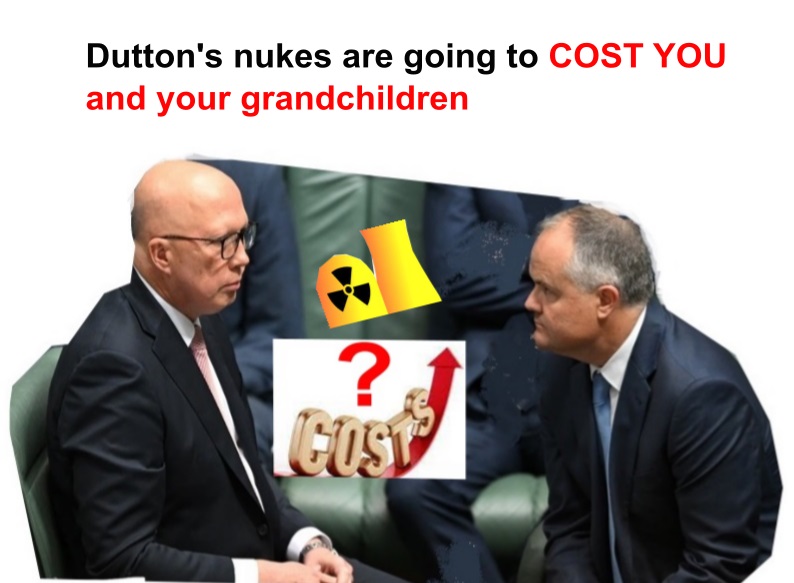
Dr Jonathan Pershing, a former US special envoy for climate change and climate negotiator under Democratic presidents, says few countries building nuclear power plants
Adam Morton Climate and environment editor, Tue 11 Mar 2025 , https://www.theguardian.com/australia-news/2025/mar/11/coalitions-nuclear-plan-most-expensive-option-for-australia-former-us-climate-official-says
A longtime senior US climate official has weighed in on Australia’s energy debate, saying “very, very few people” internationally are building new nuclear power plants and, in most cases, the combination of solar and batteries delivers “higher reliability than gas”.
Dr Jonathan Pershing, a former US special envoy for climate change and climate negotiator under Democratic presidents, was in Sydney on Monday to speak at the city’s climate action week. Asked whether nuclear power as proposed by the Coalition was a viable option for Australia, he said “almost all the numbers that I have seen suggest that that’s a more expensive option than other choices”.
“What’s really interesting is the global community’s progress on nuclear with, frankly, a bigger head start than Australia’s had, because the ban here has been in place for a long time,” he told Guardian Australia.
“Very, very few people are building new nuclear.”
Pershing, who is program director at the William and Flora Hewlett Foundation, said even if Australia was able to overcome two immediate hurdles to nuclear energy – the legislated ban and an historical lack of public support for the technology – it then faced asking taxpayers to pay “holding costs” for 10 to 20 years when it could be building the same amount of generating capacity sooner.
“The cheapest one still globally, and I think here as well, is probably a combination of solar plus batteries – and that’s firm capacity, by the way,” he said. “If we look at the way that’s been analysed, the combination of the two [solar and batteries] gets you higher reliability than you get from gas.
He cited the example of the 40-year-old Diablo Canyon nuclear plant, in California. He said it was not likely to be replaced with a new nuclear generator once it reached the end of its life because of the cost. “They’ll do some life extensions, but they don’t think it is even plausible to imagine building new capacity there,” he said. “It’s just too expensive.”
The Coalition has claimed that its proposal to slow the rollout of renewable energy, extend the life of ageing coal plants, rely more on gas-fired power and later build publicly funded nuclear plants at seven sites, mostly after 2040, would be cheaper and more reliable than Labor’s promise of sourcing 82% of Australia’s electricity from renewable energy by 2030.
Peter Dutton has said the Coalition’s claim is supported by a report by consultants at Frontier Economics. But several other independent energy experts have argued the Coalition’s plan would, in relative terms, be likely to be more expensive for consumers over the next decade, at least, and less reliable and lead to substantially higher greenhouse gas emissions.
Pershing said a another problem for Australia would be training personnel for a nuclear power industry. Technical experts would have to be brought from overseas, which isn’t the case for other types of energy generation, he said.
That expertise could come from Canada, China, France or Russia, adding that in the case of Russia, “I’m not so convinced that that’s where you’d want to go”.
Pershing said the Trump administration’s anti-climate action stance would have an effect “but, I think, less than people might imagine”. He said the change in the US was an opportunity for Australia, “depending on how it chooses to engage”.
“The thing that’s most salient is that the rest of the world has decided that the least-cost solution to provide for more energy, particularly for electricity, is through some combination of renewables technologies plus batteries,” he said, citing International Energy Agency data showing it was the cheapest and faster solution “for about 80% of the world”.
“In much of the world, demand [for energy] is rising and you’re going to have to supply that demand from something. That means transition minerals, and that means technology, and that means investment. Those are places that the Australian economy is well positioned to deliver.”
Based on Trump’s language and early actions, the US was likely to slow the construction of wind and solar power and electric vehicles while increasing its demand for critical minerals, he said. But the US was “not the primary place where things are happening”.
“The place where things are happening is across Asia, broadly, with enormous continued demand from China, demand from India, demand from Indonesia and then actually others around the world who are building on that capacity,” he said.
Regarding fossil fuel exports, Pershing said the question for Australia was how it replaced the economic value of the coal and gas it sells with other exports, and what commitments it has made that were consistent with keeping global heating to less than 2C.
Australia could, for example, build a new mutually beneficial trade relationship with Japan where Australia produced and sold zero carbon steel and other metals. Pershing said Australia would also have to deal with the future of communities, such as in the Hunter Valley and its nearby port of Newcastle, that rely heavily on coal mining and coal exports.
“I think these are difficult questions, and they’re legitimate ones for the whole society to take up,” he said. “[A change] is coming. It’s not that it won’t come, but if we don’t manage it, it’ll have enormously negative consequences for communities, and I think that’s on the collective government, civil society and thought leadership to resolve and to address”.
Climate Authority head Matt Kean says Liberals ‘socialist’ for ‘nonsense’ nuclear policy
In short:
Matt Kean, a former NSW treasurer and energy minister, has launched a broadside at his own party for backing nuclear energy.
Mr Kean now chairs the Climate Change Authority, which argues nuclear reactors will result in more emissions than renewable energy.
But Liberal senator Hollie Hughes told Q+A nuclear energy promised zero emissions and jobs for coal plant communities.
A former Liberal state treasurer has branded his own party “socialist” in an extraordinary broadside at the opposition’s plan to build nuclear power reactors.
Matt Kean, who now chairs the government’s Climate Change Authority, has also warned parts of Australia will become “uninhabitable” from worsening climate events such as the ongoing emergency from ex-Cyclone Alfred.
Mr Kean told the ABC’s Q+A on Monday the federal Liberal Party proposal for replacing coal-fired power plants with nuclear reactors was too expensive for governments and consumers.
“I’m not anti-nuclear, but I am anti-nonsense,” he said.
“There’s no private investors knocking down anyone’s door to build a nuclear reactor.
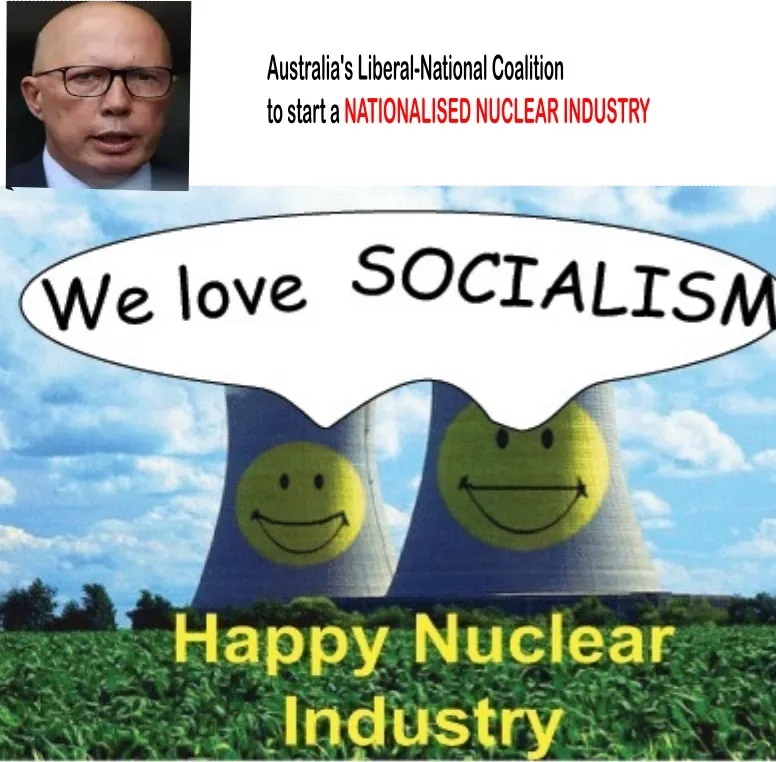
“In fact, under Peter Dutton’s nuclear plan, it won’t be the national energy market, it will be the nationalised energy market, because it will only be funded by the government.
“Now I forgot when the Liberal Party decided to be socialist in how it operates.”
Mr Kean is in a public spat with the federal branch of his party, with Liberal frontbencher Jane Hume suggesting he would be sacked from a Climate Change Authority (CCA) that had been “badly politicised”.
The CCA has modelled the potential impacts of the Coalition’s promise to build seven nuclear power plants by 2050, concluding it would result in an additional 2 billion tonnes of emissions…………………………………………………….
Mr Kean argued smaller reactors as proposed by the Coalition “aren’t even invented yet” and offered no short-term cost relief for consumers.
“People talking about building nuclear today are the same people that are sort of arguing that we should be building a Blockbuster Video complex when Netflix is already here,” he said.
“I don’t think anyone in this audience believes that a nuclear power station that’s not going to be built ’till at least 2035 — and that’s the most heroic assumption anyone has ever said, right? — is going to help anyone with their power bills today.
“It’s just not, OK?”
Senator Hughes said of the Liberal nuclear proposal, “I own it,” prompting Mr Kean to point out: “Not the NSW Liberals.”
Both NSW Liberal leader Mark Speakman and Queensland Liberal Premier David Crisafulli have rejected nuclear as a short-term fix for energy cost and reliability.
‘Poor planning’ on disaster risks
With ex-Cyclone Alfred still posing major a flood risk to parts of Queensland and New South Wales, Mr Kean warned of “whole communities being disrupted” by worsening climate conditions.
“There will be some parts of the coastline, there’ll be some parts that are flood prone, that will be uninhabitable,” he said.
“We need to make sure that we’re protecting those vulnerable people and dealing with the issue of carbon emissions, but also building in policies that help communities adapt to the new reality, which is a changing climate.”………………………………………….. more https://www.abc.net.au/news/2025-03-10/matt-kean-nuclear-energy-liberal-party-slammed-socialist/105033754
Higher household bills by 2030 under nuclear: report

by News Of The Area – Modern Media – , https://www.newsofthearea.com.au/higher-household-bills-by-2030-under-nuclear-report
HOUSEHOLDS could fork out an extra $450 a year for power by 2030 if policymakers pursue nuclear and a slower renewable rollout, modelling suggests.
An analysis commissioned by the Clean Energy Council found the additional pricey gas needed under a nuclear pathway would drive bills higher by 2030 than if the renewables-led grid transition continues.
The modelling mirrors the energy policies on offer from the major federal parties – the Labor government is vying for 82 per cent of renewable energy in the grid by 2030, while the coalition is promising to build nuclear power plants.
Renewable energy would make up about half the energy grid by 2050 and nuclear power 38 per cent under the opposition plan.
Opposition leader Peter Dutton has promised cheaper electricity long-term based on calculations it commissioned from consultancy Frontier Economics.
Using AEMO’s “progressive change” scenario for the nation’s energy mix, Frontier found including nuclear energy would reduce costs from $437 billion to $331 billion – or slash costs by 44 per cent compared to the “step change” scenario.
Yet numbers crunched by professional services firm Jacobs on the clean energy industry body’s behalf found households could expect a 30 percent average increase by 2030 under the nuclear pathway.
This would amount to an $449 annual increase for the typical consumer ser
viced by the main energy grid.
Small businesses could expect a $877 increase in their bills by 2030 if the clean energy rollout slows down while waiting for nuclear to be built.
Even bigger price jumps were possible were a coal generator to unexpectedly fail – something that becomes more likely as they age – as more gas would be needed to make up the shortfall.
Voters are set to go to the polls May 17, at the latest, and cost of living will be front of mind following a prolonged stint of high interest rates aimed at taming inflation.
Clean Energy Council chief executive officer Kane Thornton said halting renewable energy deployment and relying on coal and gas before nuclear comes online would be a “disaster” for power prices.
“Australia would have to increase its reliance on increasingly expensive and unreliable old coal generation, as well as significantly increase gas generation, which is a much more expensive energy source,” he said.
“Getting more renewables into our system, such as solar and wind and backed by pumped hydro, batteries and small amounts of gas, is the cheapest and most reliable way to keep energy bills as low as possible for Australians.
The analysis considered the influence of wholesale electricity prices on power bills for households and small businesses under each scenario.
Network costs and other components of electricity bills were not included in the modelling.
Tuesday’s power bill numbers follow the Climate Change Authority’s report highlighting the nuclear power plan could push Australia’s 2030 climate target out until 2042 and add two billion tonnes of carbon emissions to the environment by 2050.
What if a Fukushima-sized nuclear accident happened in Australia?
Today is the 14th anniversary of the Fukushima disaster, and this morning the good folks at Don’t Nuke the Climate released a huge research project that shows what a Fukushima-style nuclear disaster would look like if it happened at one of Dutton’s seven proposed reactor sites.
About these maps, https://nuclearplume.au/ 11 Mar 25
The seven sites on this map have been selected by the federal Coalition to house multiple nuclear power reactors.
You can select the reactor site and wind direction to see how a Fukushima-scale nuclear disaster would contaminate different areas surrounding the seven sites in Australia.
The interactive map uses a radiation plume map, originally peer reviewed and published by the European Geosciences Union. It shows the deposition of radioactive caesium-137 from the Fukushima disaster as of July 2011. The darker the shading, the higher the level of radioactive contamination and the higher the radiation exposures for people in those areas. At distances far from the Fukushima plant, radiation exposures were low but even low radiation doses can cause negative health impacts including fatal cancers and cardiovascular disease.
Caesium-137 has been one of the most significant radioactive contaminants since the March 2011 Fukushima disaster but many other types of radioactive particles contaminated wide areas (iodine-131, xenon-133, etc.).
Other radiation fallout maps from the Fukushima disaster can be seen here and here.
‘In Defence of Dissent’

Mapping the repression of protest rights in Australia and identifying strategies communities can use to protect them.
Our new report in collaboration with Grata Fund analyses key trends in the restriction of protest rights in Australia – corporate clampdown on opposition, criminalisation of peaceful protest, over-policing, government misuse of emergency powers and the use of notification systems as approval regimes for protests. Using data from legal observer organisation and independent media sources, the report provides a picture of protest repression around Australia between 2019-2024.
The report identifies litigation and legislative pathways to protecting the right to protest that can be used by protestors, advocates, community organisations and campaigners.
Email the report to your MP
1. Find your local State and Federal MP’s email using this tool: https://heymp.com.au/
2. Email your State and Federal MP and cc’ing in anastasia.radievska@australiandemocracy.org.a
3. If you don’t get a response and have capacity, please call your MP to follow up.
A report from Australian Democracy Network and Grata Fund has found that protest rights in Australia are being severely restricted through corporate clampdown on opposition, criminalisation of peaceful protest, over-policing, government misuse of emergency powers and the use of notification systems as approval regimes for protests.
Key findings include:
Imprisonment sentences for civil disobedience have increased ten-fold in the last five years, with nine activists engaged in civil disobedience have been sentenced to a combined total of 50 months imprisonment.
Police appear to be engaging in over-policing, particularly at protests by marginalised groups including protests carried out by First Nations communities and South West Asian and North African (SWANA) communities.
Communities peacefully engaging in protest have been increasingly subject to heavy-handed militarised policing, including more frequent deployment of dangerous police weapons such as OC spray (pepper spray), tear gas, batons, rubber bullets and flash-bang grenades.
The use of OC spray has increased in the last year, having been used at 11 protests in 2023-24, compared to seven in the five years prior.
People with physical disabilities and children are being seriously impacted by heavy-handed, militarised policing. For example, three incidents involved people with disabilities, with police removing a person from their wheelchair in one instance, and forcefully moving and damaging a wheelchair in another. Four involved children, including four children aged 16 and under being pepper sprayed and a child in a pram caught up in a police kettle, a controversial police tactic also known as containment or corralling.
Protest notification and pre-approval regimes are increasingly operating as de facto ‘authorisation’ systems, which runs counter to Australia’s democratic obligations under international law. The use of permit systems as de-facto authorisation regimes has had a particular influence on First Nations groups, with a First Nations group in the NT having been required to pay for their own traffic control in January 2024 as a precondition to obtaining authorisation from police to carry out protests when there are no recorded instances of other groups having to do so.
Sign the Declaration of our Right to Protest
Nuclear fallout: why Karina Lester is calling on Australia to sign the treaty banning atomic weapons

The late Yami Lester was blinded due to fallout from British nuclear testing at Emu Field. His daughter Karina addressed the UN in New York this week.
In the 1950s the British Government conducted a series of nuclear weapons tests at Maralinga and Emu Fields in South Australia.
Yankunytjatjara-Anangu woman Karina Lester, whose father the late Yami Lester went blind due to effects from the tests, wants to ensure no-one forgets.
On Thursday she spoke at the United Nations in New York as part of an International Campaign to Abolish Nuclear weapons (ICAN) delegation at the Third Meeting of States Parties to the Treaty on the Prohibition of Nuclear Weapons.
“Australia hasn’t signed and ratified the treaty on the prohibition of nuclear weapons,” Ms Lester told NITV from New York.
“It’s really important to voice our concerns, and in particular as victims or affected communities of the British nuclear testing, so as a second generation survivor.”
On October 15, 1953, the British Army, with the support of the Australian Menzies Government, detonated a 9 kiloton nuclear bomb, called Totem 1, at Emu Field, 480km north-west of Woomera in South Australia, without warning any of the Anangu communities living nearby.
“Totem 1 was the first mainland test in Australia. The radiation fallout drifted over Dad’s community, Walyatjatjara community, where Anangu and Yankunytjatjara people were living and working on their traditional lands none the wiser of what was being conducted under 160km south,” Karina said.
“But they did witness the black mist rolling over their traditional lands, and there was huge impact for our people.
“For Dad, four years after those tests, his world turned into complete darkness.
“People on that day became really ill. Many of the older, weaker generation passed.”
Karina says there were ripples that are still felt today, more than 70 years later.
“Because we had the fallout fall onto our environment, our trees, animals, our sand dunes, our grasses, our food that we eat as well.
“So it’s been a long, generational story for my family, where the onus is always on the victim to be continuing to speak about these things and to speak about nuclear injustice.”
As part of the Aukus security treaty between Australia, the United Kingdom and the US, Australia has signed up to acquire nuclear-powered attack submarines and will be responsible for radioactive waste generated through operations, maintenance and decommissioning.
“Us South Australians are very concerned because we often are pressured to be the nuclear waste dump of the nation,” Karina said.
“There’s been many struggles in that area where Indigenous peoples and Aboriginal people of South Australia have needed to fight against government pressure looking for a nuclear waste dump and nuclear powered submarines will produce this waste.”
Karina also has concerns about Opposition Leader Peter Dutton’s plan for nuclear power.
“These power plants are on traditional lands of Indigenous peoples across our nation and while there are seven locations that have been identified, yet the Coalition has not come to address and talk to Aboriginal people of those communities,” she said.
“There’s a strong message coming from South Australia that we certainly do not want nuclear power in our state, when we have been struggling and fighting against nuclear mining, nuclear waste dumps and nuclear testing.”
The nuclear industry has impacts on Indigenous peoples across the world, Karina pointed out.
“In our very own state of South Australia, they mine uranium, they tested in the 50s and 60s, they put pressure on the Aboriginal community to be the waste dump of the nuclear waste that is produced by industry,” she said.
“And now coming up with a bright idea of nuclear power.
“Aboriginal voices of South Australia have been strong to say ‘no nuclear power plants in our state’.
“So our strong message is, ‘no, we don’t want nuclear power’.”
Karina is disappointed that Prime Minister Anthony Albanese has not yet ratified the treaty against nuclear weapons.
“For us affected communities in very remote South Australia who carry the scars and carry this burden and this trauma of this lived experience through generations, now our government has failed us,” she said.
“We are out of sight and out of mind.”
It’s time to ditch Virginia subs for AUKUS and go to Plan B

In this op-ed, Henry Sokolski argues Australia should switch its focus from buying Virginia-class submarines and instead put that money towards Pillar 2 technologies.
Breaking Defense Henry Sokolski March 06, 2025
Earlier this month, the Australian government made its first payment of $500 million toward eventually obtaining US nuclear-powered submarines under the 2021 AUKUS agreement. Because the submarine deal is unlikely to overcome budgetary, organizational, and personnel hurdles, that payment should be Australia’s last.
Rather than sacrificing much of its defense program to buy nuclear submarines, Canberra should instead adopt an AUKUS Plan B that would field new defense technologies such as uncrewed systems and hypersonic weapons that would enhance Australia’s security faster, and for far less.
Most experts believe funding AUKUS’s nuclear submarine plans will be challenging. Australia’s defense budget this year is almost $35 billion USD, and is planned to rise to almost $63 billion annually by the end of this decade when Australia would begin buying US nuclear submarines. At more than $3 billion per boat, each Virginia sub will eat up five to ten percent of the Australia defense budget that year, assuming Australia can double its defense spending in five years. Already, a former top officer has warned that the submarine pact will “cannibalize” other priorities and require deferring future surface warships or eliminating some ground units.
Another potential stumbling block is what’s needed to manage a nuclear propulsion program. More than 8,000 people work for the US Naval Nuclear Propulsion program. Today only about 680 people work at the Australian Submarine Agency. If Australia wants a sovereign submarine force that isn’t dependent on Washington’s oversight, it will need thousands of additional skilled civilian workers.
Military personnel is also a challenge. The Royal Australian Navy (RAN) includes about 16,000 sailors today. Each Virginia-class submarine has a crew of about 130 people, and about 400 sailors per ship to account for training, shore duty, and maintenance. With retention already difficult for the Australian Defence Force, the RAN may be hard-pressed to find and keep the thousand-plus highly-qualified personnel it needs to crew the nuclear sub fleet……………………………..
https://breakingdefense.com/2025/03/its-time-to-ditch-virginia-subs-for-aukus-and-go-to-plan-b/
Surface tension: could the promised Aukus nuclear submarines simply never be handed over to Australia?
Guardian, Ben Dohert, 7 Mar 25.
The multi-billion dollar deal was heralded as ensuring the security of the Indo-Pacific. But with America an increasingly unreliable ally, doubts are rising above the waves.
Maybe Australia’s boats just never turn up.
To fanfare and flags, the Aukus deal was presented as a sure bet, papering over an uncertainty that such an ambitious deal could ever be delivered.
It was assured, three publics across two oceans were told – signed, sealed and to-be-delivered: Australia would buy from its great ally, the US, its own conventionally armed nuclear-powered attack submarines before it began building its own.
But there is an emerging disquiet on the promise of Aukus pillar one: it may be the promised US-built nuclear-powered submarines simply never arrive under Australian sovereign control.
Instead, those nuclear submarines, stationed in Australia, could bear US flags, carry US weapons, commanded and crewed by American officers and sailors.
Australia, unswerving ally, reduced instead to a forward operating garrison – in the words of the chair of US Congress’s house foreign affairs committee, nothing more than “a central base of operations from which to project power”.
Reliable ally no longer
Officially at least, Aukus remains on course, centrepiece of a storied security alliance.
Pillar one of the Australia-UK-US agreement involves, first, Australia buying between three and five Virginia-Class nuclear-powered submarines from the US – the first of these in 2032.
Then, by the “late 2030s”, according to Australia’s submarine industry strategy, the UK will deliver the first specifically designed and built Aukus submarine. The first Australian-built version will be in the water “in the early 2040s”. Aukus is forecast to cost up to $368bn to the mid-2050s.
But in both Washington and Canberra, there is growing concern over the very first step: America’s capacity to build the boats it has promised Australia, and – even if it had the wherewithal to build the subs – whether it would relinquish them into Australian control.
The gnawing anxiety over Aukus sits within a broader context of a rewritten rulebook for relations between America and its allies. Amid the Sturm und Drang of the first weeks of Trump’s second administration, there is growing concern that the reliable ally is no longer that…………………….
‘The cheque did clear’
On 8 February, Australia paid $US500m ($AUD790m) to the US, the first instalment in a total of $US3bn pledged in order to support America’s shipbuilding industry. Aukus was, Australia’s defence minister Richard Marles said, “a powerful symbol of our two countries working together in the Indo-Pacific”.

“It represents a very significant increase of the American footprint on the Australian continent … it represents an increase in Australian capability, through the acquisition of a nuclear‑powered submarine capability … it also represents an increase in Australian defence spending”.
………….. just three days after Australia’s cheque cleared, the Congressional Research Service quietly issued a paper saying while the nuclear-powered attack submarines (known as SSNs) intended for Australia might be built, the US could decide to never hand them over.
It said the post-pandemic shipbuilding rate in the US was so anaemic that it could not service the needs of the US Navy alone, let alone build submarines for another country’s navy…………………………………………………………………………………………………..
‘Almost inevitable’
Clinton Fernandes, professor of international and political Studies at the University of New South Wales and a former Australian Army intelligence analyst, says the Aukus deal only makes sense when the “real” goal of the agreement is sorted from the “declared”.
“The real rather than declared goal is to demonstrate Australia’s relevance to US global supremacy,” he tells the Guardian.
“The ‘declared goal’ is that we’re going to become a nuclear navy. The ‘real goal’ is we are going to assist the United States and demonstrate our relevance to it as it tries to preserve an American-dominated east Asia.”
Fernandes, author of Sub-Imperial Power, says Australia will join South Korea and Japan as the US’s “sentinel states in order to hold Chinese naval assets at risk in its own semi-enclosed seas”.
“That’s the real goal. We are demonstrating our relevance to American global dominance. The government is understandably uneasy about telling the public this, but in fact, it has been Australia’s goal all along to preserve a great power that is friendly to us in our region.”
Fernandes says the Aukus pillar one agreement “was always an article of faith” based on a premise that the US could produce enough submarines for itself, as well as for Australia.
“And the Congressional Research Service study argues that … they will not have enough capacity to build boats for both themselves and us.”
He argues the rotation of US nuclear-powered submarines through Australian bases – particularly HMAS Stirling in Perth – needs to be understood as unrelated to Aukus and to Australia developing its own nuclear-powered submarine capability.
“Submarine Rotational Force-West (SRF-W) is presented by the spin doctors as an ‘optimal pathway’ for Aukus. In fact, it is the forward operational deployment of the United States Navy, completely independent of Aukus. It has no connection to Aukus.”
The retired rear admiral and past president of the Submarine Institute of Australia, Peter Briggs, argues the US refusing to sell Virginia-class submarines to Australia was “almost inevitable”, because the US’s boat-building program was slipping too far behind.
“It’s a flawed plan, and it’s heading in the wrong direction,” he tells the Guardian.
Before any boat can be sold to Australia, the US commander-in-chief – the president of the day – must certify that America relinquishing a submarine will not diminish the US Navy’s undersea capability.
“The chance of meeting that condition is vanishingly small,” Briggs says.
It now takes the US more than five years to build a single submarine (it was between three and 3.5 years before the pandemic devastated the workforce). By 2031, when the US is set to sell its first submarine to Australia, it could be facing a shortfall of up to 40% of the expected fleet size, Briggs says.
Australia, he argues, will be left with no submarines to cover the retirement from service of the current Collins-class fleet, weakened by an unwise reliance on the US.
The nuclear-powered submarines Australia wants to buy and then build “are both too big, too expensive to own and we can’t afford enough of them to make a difference”.
He argues Australia must be clear-eyed about the systemic challenges facing Aukus and should look elsewhere. He nominates going back to France to contemplate ordering Suffren-class boats – a design currently in production, smaller and requiring fewer crew, “a better fit for Australia’s requirements”……. https://www.theguardian.com/world/2025/mar/07/surface-tension-could-the-promised-aukus-nuclear-submarines-simply-never-be-handed-over-to-australia
$480 million facility to train Australia’s nuclear submarine builders

COMMENT. I wonder which services will be cut to fund this folly? Health? Education? Welfare? The regular military?
By Gus Macdonald • State Political Reporter Mar 5, 2025, https://www.9news.com.au/national/training-centre-australia-nuclear-powered-submarines-aukus/772e5e1d-4cae-4ee1-bab7-d048b46e7241
Australia’s nuclear-powered submarines are one step closer to fruition, with work starting on the academy to train builders in South Australia.
The $480 million facility is being described as the cornerstone of the nation’s naval future under the AUKUS partnership, and promised to provide students in South Australia with safe and sustainable employment for life.
“This is the single biggest industrial endeavour that our nation has ever attempted and today is a day that marks that endeavour is well underway,” Deputy Prime Minister and Defence Minister Richard Marles said.
The Skills and Training Academy in Osborne will provide education in various disciplines, ranging from new trades to nuclear engineering.
It aims to accommodate 800 to 1000 students, mirroring the successful model of the Barrow-in-Furness academy in the United Kingdom, where students contribute to building Britain’s nuclear-powered fleet.
While sourcing teachers to skill workers with the tools to create nuclear submarines will be a challenge, the government confirmed today it will recruit internationally with the intention to eventually have Australians teaching at Osborne.
How US Military Bases in Australia Threaten Our Future & How to Remove Them

March 5, 2025 AIMN Editorial, By Denis Hay, https://theaimn.net/how-us-military-bases-in-australia-threaten-our-future-how-to-remove-them/
US military bases in Australia endanger our environment and security. Discover the damage they cause and how Australians can push for their removal.
Introduction
Picture this: A farmer in Williamtown, NSW, watches helplessly as his once-fertile land becomes toxic. His water source is contaminated, his livestock is sick, and his family’s health is deteriorating. The culprit? The nearby U.S. military base is leaking toxic PFAS chemicals into the environment.
Australians have long been told that hosting U.S. military bases makes the country safer, but at what cost? The presence of these bases has led to severe environmental degradation and heightened national security risks. This article explores the damage caused by U.S. military installations in Australia and how citizens can push for their removal.
The Environmental Destruction Caused by U.S. Military Bases in Australia
PFAS Contamination – Poisoning Our Water and Soil
Families in towns like Williamtown and Oakey are forced to buy bottled water because their groundwater is contaminated with per and poly-fluoroalkyl substances (PFAS). These toxic chemicals, used in firefighting foams on U.S. military bases, have been linked to cancer, liver damage, and immune system disorders.
Environmental reports indicate that PFAS contamination from military bases has made land unusable and driven down property values. This is not an isolated issue—similar contamination has been reported in the U.S. and other host countries.
Real-World Example: Residents of Oakey filed a class-action lawsuit seeking compensation for the damage caused by PFAS contamination, highlighting the devastating impact on their health and livelihoods.
Land Degradation and Destruction of Ecosystems
Military exercises have wreaked havoc on Australian ecosystems. Take Puckapunyal, where years of heavy military training have led to severe soil erosion, deforestation, and destruction of native habitats. The Australian Defence Force (ADF) has had to implement large-scale rehabilitation projects to restore these lands, but the damage is still significant.
Additionally, invasive species such as fire ants have spread due to poor biosecurity measures on military bases, further threatening Australia’s fragile biodiversity.
Historical Context: During World War II, military use of Australian land led to long-term damage, including unexploded ordnance in training zones, which is still an issue today.
Greenhouse Gas Emissions – A Major Polluter
The ADF is one of Australia’s largest carbon emitters, generating over 1.7 million tonnes of CO₂ annually. The U.S. military is even worse – if it were a country, it would rank as the world’s 47th largest carbon emitter. Hosting U.S. military operations means Australia bears part of that environmental burden, contradicting national climate goals.
Expert Opinion: Environmental scientists have called for stricter regulations on military emissions, arguing that they undermine Australia’s commitment to reducing its carbon footprint.
The National Security Threat of Hosting U.S. Military Bases
U.S. Military Presence Makes Australia a Target
Imagine a future conflict between the U.S. and China. Australia automatically becomes a military target with Darwin, Pine Gap, and Tindal bases. A Chinese missile strike on these bases would devastate Australian communities, dragging us into wars we did not choose.
Experts warn that hosting U.S. bases places Australia in a dangerous position, increasing the likelihood of conflict instead of deterring it.
Military Analysis: Former Australian Defence officials have voiced concerns that U.S. bases undermine our national security by making Australia an extension of American military strategy.
Imagine a future conflict between the U.S. and China. Australia automatically becomes a military target with Darwin, Pine Gap, and Tindal bases. A Chinese missile strike on these bases would devastate Australian communities, dragging us into wars we did not choose.
Experts warn that hosting U.S. bases places Australia in a dangerous position, increasing the likelihood of conflict instead of deterring it.
Loss of Sovereignty – Who Controls Our Defence Policy?
Successive Australian governments have signed defence agreements with the U.S. without public consultation. AUKUS, the latest military deal, commits Australia to long-term U.S. military priorities, undermining our independence.
When Australia allows U.S. forces to operate freely on its soil, it loses control over its military decisions. This compromises Australian sovereigntyand prioritises American interests over national security.
Political Insight: Documents leaked in 2023 revealed that U.S. military officials exert considerable influence over Australian defence planning, reinforcing concerns about eroded sovereignty.
How Australian Citizens Can Demand the Removal of U.S. Military Bases
Raising Public Awareness
The first step is education. Many Australians are unaware of U.S. bases’ environmental and security risks. Sharing this information through independent media, social movements, and community discussions can build momentum for change.
Pressuring Politicians to Take a Stand
• Demand transparency in defence agreements.
• Call for national referendums on foreign military bases.
• Support politicians who prioritise Australian sovereignty over U.S. interests.
Protesting and Direct Action
• Organise mass demonstrations against U.S. military expansion.
• Boycott defence contractors profiting from war.
• Push for divestment from institutions supporting militarism.
Historical Success: The Philippines removed U.S. bases in the 1990s after public outcry and political pressure, proving that citizen activism can lead to change.
Conclusion – Time for an Independent Australia
For decades, Australia has allowed foreign military bases to dictate its defence policies. These bases have contaminated our environment, threatened our sovereignty, and increased our risk of war.
The time for action is now. Australians must demand accountability, advocate for policy changes, and work towards a truly independent national defence strategy.
Delve into details before voting for Dutton’s nuclear vision

John Bushell, Surry Hills, NSW, https://www.afr.com/politics/federal/delve-into-details-before-voting-for-dutton-s-nuclear-vision-20250304-p5lgrs 4 Mar 25
Examination of detail will quickly demonstrate that the (would be) emperor has no clothes (“Dutton’s nuclear bid short on detail, but who cares?”).
From 2018 to 2023, electricity delivered globally to customers from various energy sources changed as follows: utility solar, plus 193 per cent; onshore wind, plus 80 per cent; nuclear, minus 1.1 per cent.
Independent international investment bank Lazard advised last year that the average electricity costs from these same energy sources, in US dollars per megawatt hour, were: utility solar 61; onshore wind 50; nuclear 182.
The International Energy Agency advised in January that solar and wind energy generation is being installed five times faster than all other new electricity sources combined, and it forecasts that renewable generation capacity globally from 2024 to 2030 will be triple that added from 2017 to 2023.
So, who do you think is right? Peter Dutton or the rest of the world?
It might be a good idea to find out before the federal election rather than after it.
Nuclear could cost households an extra $450 or more a year by 2030
Australians for Affordable Energy , https://theaimn.net/nuclear-could-cost-households-an-extra-450-or-more-a-year-by-2030/
New modelling confirms a shift to nuclear power could significantly increase household electricity bills, with Australians for Affordable Energy (AFAE) urging policymakers to back the most affordable energy option.
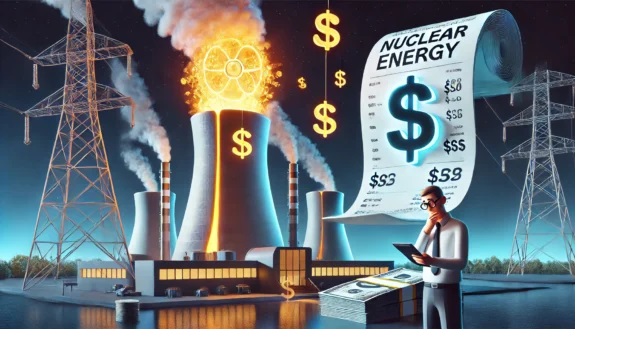
The analysis, released by the Clean Energy Council, found households could face a 30 per cent increase in power bills by 2030 under a nuclear pathway, with households paying an additional $450 annually.
“Australians want affordable and reliable energy now. Every independent study we’ve seen suggests nuclear power will be a guaranteed hit to household budgets now and in future,” AFAE spokesperson Jo Dodds said.
“The cost of living is what it’s all about for most Australians, with energy prices a major concern. From everything we know so far, nuclear is the far more expensive option, and cheaper practical alternatives exist.
“While we wait decades for expensive nuclear plants Australians will be forced to rely on expensive gas and aging coal plants, driving bills even higher. A 30 per cent hike in power bills would place even more strain on Australian households who are already grappling with cost-of-living pressures. Our energy policies must prioritise affordability.”
The findings mirror concerns raised in the Climate Change Authority’s recent report, which found nuclear energy could add 2 billion tonnes of emissions and delay Australia’s clean energy transition until 2042.
“It says small businesses could expect an $877 increase in their bills by 2030 if we slow down our clean energy rollout,” Ms Dodds said.
“There’s a clear choice here between affordable energy now or higher bills for decades to come.”
“Any energy policy that doesn’t put affordability front and centre is out of touch with what voters actually want. These are tough times for households, we shouldn’t allow energy policy to make them worse.”
Australians for Affordable Energy is urging policymakers to focus on practical, cost-effective energy solutions that can deliver more affordable power right now.
1 This month

of the week – Australians for War Powers Reform (AWPR)
To see nuclear-related stories in greater depth and intensity
 Antinuclear