Australia’s F-35 exports a “facilitation of war crimes”: US expert.

Following Sydney’s huge protest against Israel’s killing and starvation of Palestinians in Gaza, the federal government has doubled down on its misinformation about Australia’s arms exports to Israel
Undue Influence, Michelle Fahy and Elizabeth Minter, Aug 17, 2025
The Labor government’s word games continue as it tries to persuade an increasingly sceptical public that Australia’s hands are clean when it comes to complicity in Israel’s genocidal war against the Palestinian people.
An expert on US arms exports has given short shrift to the Albanese government’s misleading mantras, telling ABC radio last weekend that Australia was facilitating war crimes by exporting F-35 parts and components to Israel.
When asked how he would describe the Australian military’s recent direct supply of F-35 parts to Israel, former US State Department official Joshua Paul said: “It’s directly a facilitation of war crimes. There’s no question about it, to my mind.”
Mr Paul made international headlines in 2023 as the first US official to resign publicly in protest over the Biden administration’s policy of expediting weaponry to Israel for its current war on Gaza, stating that America knew the weapons were to be used to commit human rights violations. Mr Paul was director of congressional and public affairs at the Bureau of Political-Military Affairs, a US State Department agency that works closely with the Pentagon on weapons transfers.
Defence Minister Marles squirms under scrutiny
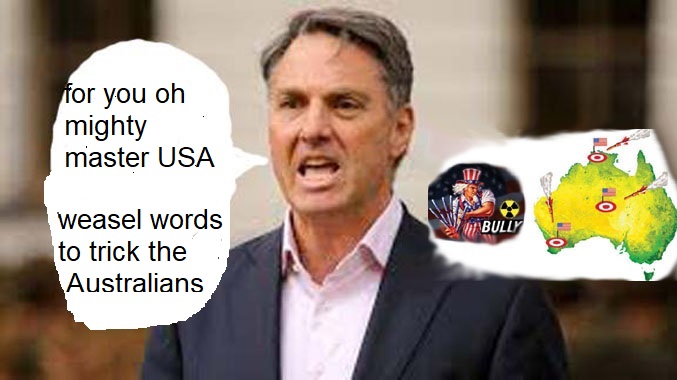
Also last weekend, on ABC TV’s Insiders, Defence Minister Richard Marles criticised what he labelled “misinformation” about Australia’s arms exports to Israel. Yet he refused to answer basic questions on the topic, resorting repeatedly to the government’s discredited mantra that Australia is not supplying weapons to Israel.
Mr Marles also passed the buck for his role in personally approving Australia’s continued export of F-35 parts and components, deflecting responsibility for the F-35 global supply chain onto prime manufacturer, Lockheed Martin.
Without providing any justification, Mr Marles claimed that Australia’s F-35 exports presented a “very different question” and were a “separate issue” from other arms exports.
Australia’s F-35 exports cannot be separated out from the overarching question of Australia’s arms exports to Israel during its genocidal war on Gaza.
The Defence Department has stated that more than 75 Australian companies have contributed to the F-35 global supply chain, which has been working overtime – at “breakneck speed” – for almost two years to increase spare part supply rates to ensure Israel’s F-35s remain operational.
In her June report, From economy of occupation to economy of genocide, the UN’s Special Rapporteur on human rights in the occupied Palestinian territories, Francesca Albanese, named Lockheed Martin and the members of its F-35 supply chain as enhancing Israel’s ability to sustain its genocide of Palestinian people.
Mr Marles’ claims are also at odds with a significant UN statement last year: ‘States and companies must end arms transfers to Israel immediately or risk responsibility for human rights violations’, which named 11 multinationals, including Lockheed Martin and BAE Systems. These companies, by sending weapons, parts, components, and ammunition to Israeli forces, risk being complicit in serious violations of international human rights and international humanitarian laws, the statement said.
UK-based BAE Systems is one of Lockheed Martin’s three major partners in the F-35 supply chain. Its Australian subsidiary is also involved in supplying parts and components.
Australia’s export of F-35 parts and components into the supply chain is essential to the assembly of new aircraft and the maintenance and operation of the global fleet, including Israel’s F-35s.
Australia is the sole global source of some F-35 parts and components including, for example, the high-tech mechanism that opens and closes the weapons bay doors, enabling Israel to drop bombs on Gaza.
Despite this, foreign minister Penny Wong repeated in the Senate last month the ludicrous assertion she and Richard Marles first aired last year that the Australian-made parts and components in the world’s most lethal fighter jet are “non-lethal”. (Watch SBS News clip.)………………………………………………………………………………………………………………………….
Could Australia make a difference?
Undue Influence last year reported comments by the head of the US-based F-35 joint program office, Lieutenant General Michael Schmidt, that the just-in-time F-35 global supply situation was “too risky”.
Despite claims from Mr Marles and Ms Wong that Australia has no power to make any impact on Israel’s military activities in Gaza, Josh Paul’s insights reinforce the fact that Australia could make a difference, should it have the courage to do so.
Australia could announce it will cease its export of F-35 parts and components unless or until the other member nations of the F-35 consortium agree to cease exporting to Israel. https://undueinfluence.substack.com/p/australias-f-35-exports-a-facilitation?utm_source=post-email-title&publication_id=297295&post_id=171175147&utm_campaign=email-post-title&isFreemail=true&r=1ise1&triedRedirect=true&utm_medium=email
Government-funded nuclear is fine for Dan Tehan, but not renewables or climate initiatives
Rachel Williamson, ReNeweconomy, Aug 14, 2025
From the party that promised seven taxpayer funded nuclear reactors, now comes a call to enforce pure free-market economics on all things renewable and climate related, at least according to new shadow energy minister Dan Tehan.
Tehan’s speech to the Carbon Market Institute’s emissions summit in Melbourne on Thursday was a pitch for renewable energy and climate initiatives to be turned over to competitive markets.
But mentions of the Coalition’s former plans for state-funded nuclear power plants, or the removal of the $14.5 billion in annual fossil fuel subsidies were conspicuously absent.
And while Tehan was keen to adopt Ross Garnaut’s contention that Australia will struggle to achieve its 82 per cent renewable energy target by 2030, he did not also reference in his markets-led speech Garnaut’s contention that oligopolistic gas participants are using their market power to drive up prices.
Playing to his role as a free market champion, Tehan opened his talk with a gentle neg at the audience about why he thinks the entire premise of the conference founder is wrong.
“I called it the so-called carbon market, for a reason,” he told the crowd, saying markets are defined by transparency.
“Australians deserve clarity about costs, trade-offs and pathways in our energy transition. At the moment, this has been hidden, and we need to know why.”
In a speech that repeatedly referenced the cost blowout of the VNI West transmission line, called for CSIRO to “release its code, data and assumptions in full” for the GenCost report, and demanded to know how much the beneficiaries of electric vehicle incentives are earning, Tehan’s pitch was that governments are too involved in the economy-wide changes currently underway to reduce emissions. …………………………………………………………………………………………………………………………………
Currently, the Coalition still can’t agree on what kind of energy they’d like in Australia.
Two weeks ago, Barnaby Joyce and Matt Canavan from the Nationals were again calling for more coal fired power stations to be built, and last week Liberal frontbencher Andrew Hastie came out against a too-quick transition from fossil fuels,
Energy is one of the five issues Liberal leader Sussan Ley has put up for negotiation.
Tehan listed eight different areas where the federal government should bring in more market-based measures rather than an approach marked by “ideology, energy constraint and emissions reduction through a high cost de-industrialisation”……………………………………………https://reneweconomy.com.au/government-funded-nuclear-is-fine-for-dan-tehan-but-not-renewables-or-climate-initiatives/
‘Disarm now’: Anti-nuke advocate’s message to world leaders at Pine Gap protest.

Following the breakdown of a nuclear treaty, an antinuclear advocate wants world leaders to hear a message she’s made from the doors of a top secret Territory spy base.
12 Aug 25,https://www.ntnews.com.au/journalists/gera-kazakov
An antinuclear ambassador for a Nobel prize winning group has delivered a message to world leaders at the edge of a Red Centre spy base, days after Russia pulled out of an arms treaty following an American missile test in the Top End.
ICAN ambassador Karina Lester was one of a dozen demonstrators who gathered at the edge of the Pine Gap Joint Defence Facility restricted area on Sunday, where she told world leaders to “disarm now” when speaking with this masthead.
“Get rid of your weapons. Lets fund and focus on world peace, not arm up and test missiles,” she said.
Ms Lester’s visit to the border of the Pine Gap restricted zone on Hatt Rd comes a day after she gave a speech at the sixth Yami Lester memorial event in Alice Springs – an event named after her father.
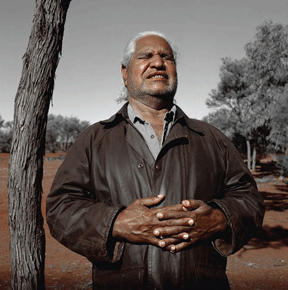
Mr Lester, a Yankunytjatjara elder who died in 2017, was blinded by the British nuclear tests in northern South Australia in the 1950s.
He was blinded as a child, and spent his life advocating against nuclear weapons – a mantle his daughter has taken up with ICAN, who won a Nobel Peace Prize in 2017 for their antinuclear advocacy.
The group got to the edge of the Pine Gap restricted at about 4.30pm Sunday, where they were again met with a police blockade at where the restricted zone begins.
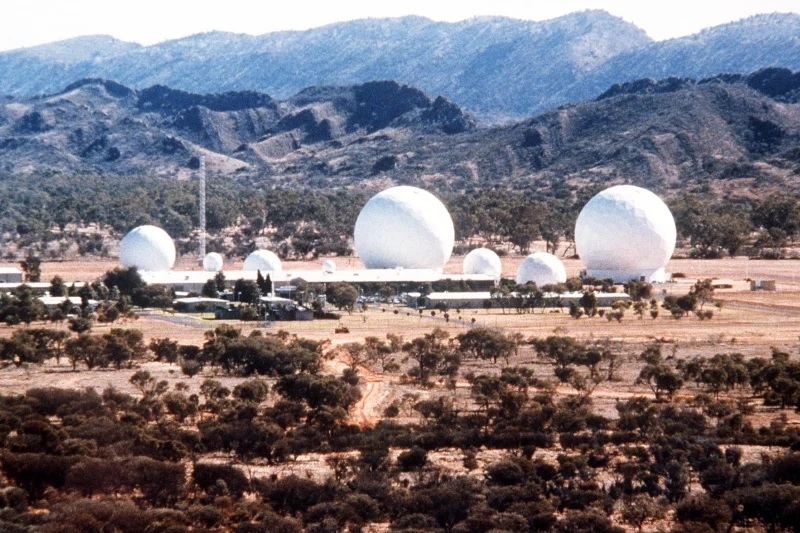
Two unmarked Toyota LandCruisers followed the convoy to their meeting place, and a police drone was also observed overhead.
The group heard from speakers who opposed the US-run base, with members of the crowd holding signs reading “Yankee go home” while others held Palestinian flags.
At the conclusion of the demonstration, the group gathered for a photo and chanted “land back, close Pine Gap” while various media outlets filmed and photographed them.
Federal NSW Greens senator David Shoebridge was also billed to be at the Pine Gap demonstration on Sunday, but pulled out due to covid, this masthead understands.
The Greens defence and foreign affairs spokesman said the political party has opposed the US-run base “for decades” but did not comment on why he was unable to come on Sunday when asked by this masthead.
The lethal legacy of Aukus nuclear submarines will remain for millennia – and there’s no plan to deal with it
Ben Doherty, 10 Aug 25, https://www.theguardian.com/world/2025/aug/10/the-lethal-legacy-of-aukus-nuclear-submarines-will-remain-for-millennia-and-theres-no-plan-to-deal-with-it
“None of the leaders who announced Aukus are in power any more,” he tells the Guardian. “One hundred thousand years from now, who knows what the world looks like, but Australia, whatever is here then, will still be dealing with the consequences of that high-level waste.”
Australia’s future nuclear submarines will produce highly radioactive waste, and allies in the UK and the US still don’t have a safe place to store their own.
In the cold deep waters of Rosyth Harbour lie the dormant hulks of Britain’s decommissioned nuclear submarines.
One of the shells lashed to the dock here is HMS Dreadnought, Britain’s first nuclear-powered submarine. It was commissioned in 1963, retired in 1980, and has spent decades longer tied to a harbour than it ever did in service. The spent nuclear fuel removed from its reactor remains in temporary storage.
For decades the UK has sought a solution to the nuclear waste its fleet of submarines generates. After decades of fruitless search there are “ongoing discussions” but still no place for radioactive waste to be permanently stored.
Similarly, in the US – the naval superpower which controls a vast landmass and which has run nuclear submarines since the 1950s – there is still no permanent storage for its submarines’ nuclear waste.
More than a hundred decommissioned radioactive reactors sit in an open-air pit in Washington state, on a former plutonium production site the state’s government describes as “one of the most contaminated nuclear sites in the world”.
This is what becomes of nuclear-powered submarines at the end of their comparatively short life.
A nuclear-powered submarine can expect a working life of three decades: the spent fuel of a submarine powered by highly enriched uranium can remain dangerously radioactive for millennia. Finland is building an underground waste repository to be sealed for 100,000 years.
For Australia’s proposed nuclear-powered submarine fleet there is, at present, nowhere for that radioactive spent fuel to go. As a non-nuclear country – and a party to the non-proliferation treaty – Australia has no history of, and no capacity for, managing high-level nuclear waste.
But Australia is not alone: there is no operational site anywhere on Earth for the permanent storage of high-level nuclear waste.
‘Australia shall be responsible … ’
Documents released under freedom of information laws show that, beginning in the 2050s, each of Australia’s decommissioned Aukus submarines will generate both intermediate- and high-level radioactive waste: a reactor compartment and components “roughly the size of a four-wheel drive”; and spent nuclear fuel “roughly the size of a small hatchback”.
The Australian Submarine Agency says the exact amount of high-level waste Australia will be responsible for is “classified”.
Because Australia’s submarines will run on highly enriched uranium (as opposed to low enriched uranium – which can power a submarine but cannot be used in a warhead) the waste left behind is not only toxic for millennia, it is a significant proliferation risk: highly enriched uranium can be used to make weapons.
The eight nuclear-powered submarines proposed for Australia’s navy will require roughly four tonnes of highly enriched uranium to fuel their sealed reactor units: enough for about 160 nuclear warheads on some estimates.
The spent fuel will require military-grade security to safeguard it.
The problems raised by Australia’s critics of Aukus are legion: the agreement’s $368bn cost; the lopsided nature of the pact in favour of the US; sclerotic rates of shipbuilding in the US and the UK, raising concerns that Australia’s nuclear submarines might never arrive; the loss of Australian sovereignty over those boats if they do arrive; the potential obsolescence of submarine warfare; and whether Aukus could make Australia a target in an Indo-Pacific conflict.
All are grave concerns for a middle power whose security is now more tightly bound by Aukus to an increasingly unreliable “great and powerful friend”.
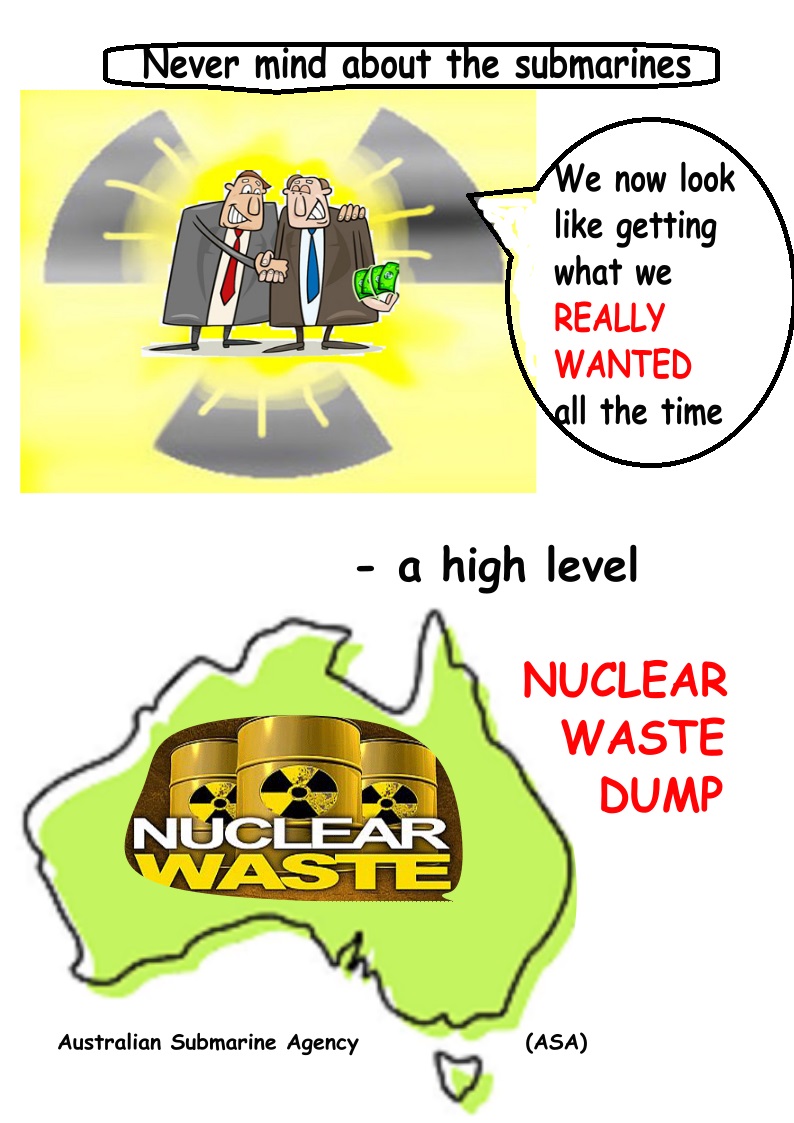
But the most intractable concern is what will happen to the nuclear waste.
It is a problem that will outlive the concept of Australia as a nation-state, that will extend millennia beyond the comprehension of anybody reading these words, that will still be a problem when Australia no longer exists.
And it cannot be exported.
The Aukus agreement expressly states that dealing with the submarines’ nuclear waste is solely Australia’s responsibility.
“Australia shall be responsible for the management, disposition, storage, and disposal of any spent nuclear fuel and radioactive waste … including radioactive waste generated through submarine operations, maintenance, decommissioning, and disposal,” Article IV, subclause D of the treaty states.
As well, should anything go wrong, at any point, with Australia’s nuclear submarines, the risk is all on Australia.
Australia shall indemnify … the United States and the United Kingdom against any liability, loss, costs, damage or injury … resulting from Nuclear Risks connected with the design, manufacture, assembly, transfer, or utilization of any Material or Equipment, including Naval Nuclear Propulsion Plants,” subclause E states.
“‘Nuclear Risks’,” the treaty states, “means those risks attributable to the radioactive, toxic, explosive, or other hazardous properties of material.”
‘Decide and defend’
An emeritus professor at Griffith University’s school of environment and science, Ian Lowe, tells Guardian Australia that the government’s regime for storing low-level nuclear waste is a “shambles”. He says the government’s “decide and defend” model for choosing a permanent waste storage site has consistently failed.
“You currently have radioactive waste from Lucas Heights, from Fishermans Bend, and from nuclear medicine and research all around Australia, just stored in cupboards and filing cabinets and temporary sheds,” Lowe says.
“The commonwealth government has made three attempts to establish a national facility – it’s a repository if you’re in favour of it, it’s a waste dump if you’re opposed – and on every occasion there’s been local opposition, particularly opposition from Indigenous landowners, and on each of those three occasions … the proposal has collapsed.”
Most of Australia’s low-level and intermediate nuclear waste – much of it short-lived medical waste – is stored at the Australian Nuclear Science and Technology Organisation facility in Lucas Heights in outer Sydney. Lowe says the nuclear safety regulator, ARPANSA, does a commendable job in protecting the public but the facility was never intended to be permanent.
Australia has been searching for a permanent site for nuclear waste for nearly three decades.
Its approach – derided by Lowe as “decide and defend”: where government chooses a place to put radioactive waste and then defends the decision against community opposition – has failed in Woomera, in central South Australia, in the late 1990s, then Muckaty station in the Northern Territory, then on farmland near Kimba, again in SA.
The federal court ruled against the Kimba plan in 2023, after a challenge from the traditional owners, the Barngarla people, who had been excluded from consultation.
Lowe, the author of Long Half-Life: The Nuclear Industry in Australia, says the complexities and risks of storing high-level nuclear waste from a submarine are factors greater than the low- and intermediate-level waste Australia now manages.
“The waste from nuclear submarines is much nastier and much more intractable,” he says. “And because they use weapons-grade highly enriched uranium there is the greater security issue of needing to make sure that not only do you need to protect against that waste irradiating people and the environment, you must also ensure that malevolent actors, who have in mind a malicious use of highly enriched uranium, can’t get their hands on it.”
Australia’s decision to use highly enriched uranium to power its submarines, as opposed to low enriched uranium (reactors would need refuelling each decade), is a “classic case of kicking the can down the road and creating a problem for future generations”, Lowe argues.
“In the short term, it’s better to have highly enriched uranium and a sealed reactor that you never need to maintain during the life of the submarine. But at the end of the life of the submarine, you have a much more serious problem.”
The high-level nuclear waste from Australia’s submarines will be hazardous for “hundreds of thousands of years,” Lowe says.
“There are arguments about whether it’s 300,000 or 500,000 or 700,000 years, but we’re talking a period at least as long as humans have existed as an identifiably separate species. The time horizon for political decision makers is typically four or five years: the time horizon of what we’re talking about is four or five hundred thousand years, so there’s an obvious disconnect.”
Inside ‘Trench 94’
The US and the UK have run nuclear-powered (and nuclear-armed) submarines for decades.
In the UK, 23 nuclear submarines have been decommissioned, none have been dismantled, 10 remained nuclear-fuelled. Most are sitting in water in docks in Scotland and on England’s south-west coast.
The first submarine to be disposed of – the cold war-era HMS Swiftsure was retired from service in 1992 – will be finally dismantled in 2026. Keeping decommissioned nuclear subs afloat and secure costs the UK upwards of £30m a year.
There is still no site for permanent storage of their radioactive waste: there has been “progress and ongoing discussions”, the defence minister, Lord Coaker, told the House of Lords last year, but still no site.
The UK has about 700,000 cubic metres of toxic waste, roughly the volume of 6,000 doubledecker buses. Much of it is stored at Sellafield in Cumbria, a site described by the Office for Nuclear Regulation says as “one of the most complex and hazardous nuclear sites in the world”.
In the US, contaminated reactors from more than 100 retired submarines are stored in “Trench 94” – a massive open pit at the Hanford nuclear site in Washington state. Spent nuclear fuel is also sent to the Idaho National Laboratory and sites in South Carolina and Colorado. Hanford is designed to last 300 years but the site has a chequered history of pollution and radiation leaks. Washington state describes it as “one of the most contaminated nuclear sites in the world”.
Finland is the first country to devise a permanent solution. It is building an underground facility 450 metres below ground, buried in the bedrock of the island of Olkiluoto.
The Onkalo – Finnish for cave or cavity – facility has taken more than 40 years to build (the site was chosen by government in 1983) and has cost €1bn. It is now undergoing trials.
‘A Trojan horse’
In March 2023 Australia’s defence minister, Richard Marles, said high-level nuclear waste would be stored on “defence land, current or future”, raising the prospect that a site could be identified and then declared “defence land”. A process for establishing a site would be publicly revealed “within 12 months”, he said. That process has not been announced nor a site identified.
Australia will require a site for high-level nuclear waste from the “early 2050s”, according to the Australian Submarine Agency. Senate estimates heard last year that there have been no costings committed for the storage of spent fuel. And preparing a site for storing high-level radioactive waste for millennia will take decades.
Guardian Australia sent a series of questions to Marles’ office about the delayed process for selecting a site. A spokesperson for the Australian Submarine Agency responded, saying: “The government is committed to the highest levels of nuclear stewardship, including the safe and secure disposal of waste.
“As the Government has said, the disposal of high-level radioactive waste won’t be required until the 2050s, when Australia’s first nuclear-powered submarine is expected to be decommissioned.”
The spokesperson confirmed that Australia would be responsible for all of the spent nuclear fuel and radioactive waste generated from the Aukus submarines: it would not have responsibility for intermediate- or high-level radioactive waste – including spent fuel – from the US, UK or any other country. No permanent storage site had been identified for low-level radioactive waste, which would include waste from foreign submarines.
The government has consistently said it will engage extensively with industry, nuclear experts and affected communities to build a social licence for a permanent storage site.
But Dave Sweeney of the Australian Conservation Foundation says he has seen little evidence of genuine effort to build social licence.
The leaders who signed the Aukus deal – and those who continue to support it – have failed to comprehend the consequences beyond their political careers, he says.
“None of the leaders who announced Aukus are in power any more,” he tells the Guardian. “One hundred thousand years from now, who knows what the world looks like, but Australia, whatever is here then, will still be dealing with the consequences of that high-level waste.”
Sweeney says the “opacity” of the decision-making around the Aukus agreement itself is compounded by fears that the deal could be only the beginning of a nuclear industry expansion in Australia.
“We see this as a Trojan horse to expanding, facilitating, empowering the nuclear industry, emboldening the nuclear industry everywhere,” he says. “It is creepy, controversial, costly, contaminating, and leading to vastly decreased security and options for regional and global peace.”
Beyond the astronomical cost of the submarine deal, its the true burden would be borne by innumerable future generations.
“We are talking thousands and thousands of years: it is an invisible pervasive pollutant and contaminant and the only thing that gets rid of it is time. And with the whole Aukus deal, that’s what we’re running out of.”
New report on British nuclear submarines should raise alarm bells across Australia.
Friends of the Earth Australia, 11 Aug 25, https://newshub.medianet.com.au/2025/08/new-report-on-british-nuclear-submarines-should-raise-alarm-bells-across-australia/113276/
A detailed new report on the British nuclear submarine experience should ring alarm bells across Australia. The report has been written for Friends of the Earth Australia by British scientist Tim Deere-Jones, who has a B.Sc. degree in Maritime Studies and has operated a Marine Pollution Research Consultancy since the 1980s.
Mr. Deere-Jones said:
“The British experience with nuclear submarines reveals a litany of safety risks, cost blowouts and delays. It can confidently be predicted that these problems will beset the AUKUS submarine programme.”
“Operational risks include radiological pollution of marine and coastal environments and wildlife; risks of radioactivity doses to coastal populations; and the serious risk of dangerous collisions between civilian vessels and nuclear submarines, especially in the approaches to busy naval and civilian sea ways and fishing grounds.
“Ominously, the problems seem to be worsening.”
Dr. Jim Green, national nuclear campaigner with Friends of the Earth Australia, said:
“The report reveals disturbing patterns of unacceptable safety risks, an appalling lack of transparency, cost-blowouts and delays.
“None of the issues raised in Tim Deere-Jones’ report have been adequately addressed in the Australian context. Indeed a federal EPBC Act assessment absurdly precluded nuclear accident impact assessments as ‘out of scope’. If those vital issues are addressed at all, it will be by a new, non-independent military regulator ‒ a blatant, deliberate breach of the fundamental principle of regulatory independence.
“The Australian government must immediately initiate a thorough, independent review of the AUKUS submarine project and this report should be an important input into that inquiry.”
The report, ‘The British experience with nuclear-powered submarines: lessons for Australia’, is online at https://nuclear.foe.org.au/nuclear-subs/ or direct download https://nuclear.foe.org.au/wp-content/uploads/Deere-Jones-nuclear-submarine-report-final-August-2025.pdf
Those left behind: The long shadow of Britain’s nuclear testing in Western Australia
WA TODAY, ByVictoria Laurie, August 10, 2025
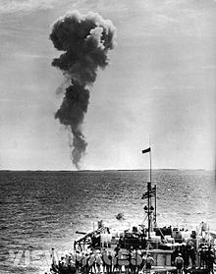
son, a daughter and a grandson of Australian servicemen exposed to nuclear testing have made an emotional pilgrimage up to the remote Montebello Islands to capture details of an era with – literally and metaphorically – enduring fallout.
Paul Grace, Maxine Goodwin and Gary Blinco recently stood together in the ruins of a bomb command centre overlooking the scene of three British nuclear tests in the 1950s that few younger Australians have ever heard of.
As the world commemorates Japan’s wartime nuclear blasts in Hiroshima and Nagasaki, the trio say Australians should not forget the impact of atomic tests conducted on West Australian soil in the 1950s, starting with Operation Hurricane in 1952 and followed by two more tests in Operation Mosaic in 1956. Other atomic tests at Emu Field and Maralinga bookended the Montebello series.
Grace, Goodwin and Blinco all know the tests left a family legacy of death or ill-health – and lingering contamination 70 years later on several islands. On a recent expedition up to the Montebello archipelago, 80 kilometres offshore from Onslow, the trio gathered documentary and archival material while filling gaps in their own family histories………………………
For Grace and Goodwin, the most poignant moment was when they stood on the tarmac at Onslow airport in the exact spot where his grandfather and her father posed for a photograph with No 86 Transport Wing Detachment RAAF, to commemorate the successful test of Britain’s first ever nuclear bomb detonation on October 3, 1952.
“They performed what they called ‘coastal monitoring sorties’ after testing, but that was code for looking for fallout – the British had promised that no fallout would reach the mainland.”
Grace’s grandfather wrote later: “As pilot of the aircraft, I would have been the most exposed crew member, being shielded only by the Perspex of the front and side windows. The navigator, radio operator and Mr Hale being in the body of the aircraft had, presumably, more protection.
“Further to the above, after leaving the atomic cloud, we spent approximately two more hours in a radioactive airplane (as proved by the Geiger-Counter check) during the return to Onslow, landing, parking and shut-down.”
Maxine Goodwin’s father died of lymphatic cancer aged 49, when she was 16.
“He would have been servicing contaminated aircraft, so my mother and I do believe his illness was the result of his participation in the nuclear tests,” she says…………………………………………….
……………………………………. a 2006 DVA study of Australian participants in British nuclear tests in Australia showed an increase in cancer deaths and cancer incidence (18 per cent and 23 per cent respectively) than would be expected in the general population.
“They tried to explain these figures away, but they are really quite damning,” says Paul Grace, an author whose book Operation Hurricane gives a detailed account of the events and personnel involved in UK nuclear testing in Australia.
The three descendants of nuclear veterans describe the Montebello Islands as haunting but beautiful. “Within the landscape, you’ve got an incredible number of Cold War artefacts lying around, what the British referred to as ‘target response items’,” says Grace………………………………………………………………………
The nuclear fallout was not limited to those servicemen involved. Still affected 70 years later are large tracts of land and seabed across the Montebello archipelago.
New research into plutonium levels in sediment on some islands have found elevated levels up to 4500 times greater than other parts of the WA coastline. The research by Edith Cowan University, released in June, was supported by the Australian Radiation Protection and Nuclear Safety Agency. Visitors are urged to spend no more than an hour on some islands.
Grace says the Montebello story is a cautionary tale of Australia’s over-eagerness to host Britain’s nuclear test series, and of UK authorities’ lack of safety and casual attitude toward radioactive drift.
“It forces you to question the wisdom of tying Australia’s defence to powerful allies, especially in the context of the current debate over AUKUS, where the benefits are vague and shifting and the costs will only become clear decades in the future,” she says.
It might seem like we are doing the same thing all over again.” https://www.watoday.com.au/national/western-australia/those-left-behind-the-long-shadow-of-britain-s-nuclear-testing-in-wa-20250808-p5mlj9.html
Australia to chart its own course on Palestinian statehood, without Trump’s say-so.

Trump’s return to the White House has already shifted global diplomatic currents, with several leaders recalibrating their positions to maintain favour. By declaring that Australia’s decision will not be subject to U.S. approval, Albanese is signalling a willingness to resist that pressure – even if it means copping criticism from one of the country’s most powerful media empires.
9 August 2025 Michael Taylor, https://theaimn.net/australia-to-chart-its-own-course-on-palestinian-statehood-without-trumps-say-so/
Australia’s decision on whether to recognise a Palestinian state will not be dictated by Washington – and that, apparently, was enough to attract howls of condemnation and disapproval from sections of the Murdoch media.
Prime Minister Anthony Albanese confirmed this week that he was unlikely to consult with U.S. President Donald Trump before making any decision on recognition. It’s a simple case of Australia acting in Australia’s national interest, emphasising that the issue will be decided in Canberra, not in the White House.
The reaction from the Murdoch media was swift and fierce. Headlines and opinion columns framed Albanese’s stance as a diplomatic snub to a “key ally,” warning of potential damage to the Australia–U.S. relationship. The coverage fits a familiar pattern: when leaders diverge from U.S. policy – especially under a Republican president – Murdoch media frequently portrays it as reckless or unpatriotic.
At the heart of the dispute is a deeper question of sovereignty. Critics argue that Australia should stand firm on charting its own foreign policy, particularly on sensitive Middle East matters, which have been shaped for decades by complex international law and humanitarian concerns. Recognition of a Palestinian state has long been debated within Australia, with supporters citing the need for a two-state solution and opponents warning of diplomatic repercussions with Israel and the United States.
Trump’s return to the White House has already shifted global diplomatic currents, with several leaders recalibrating their positions to maintain favour. By declaring that Australia’s decision will not be subject to U.S. approval, Albanese is signalling a willingness to resist that pressure – even if it means copping criticism from one of the country’s most powerful media empires.
In a political environment where foreign policy is often filtered through the prism of domestic politics and media narratives, Albanese’s comments draw a sharp line: Australia will make its own call. The real question is whether the public sees that as principled independence – or unnecessary defiance.
Either way, the stance taps into a deeper tradition in Australian foreign policy: the belief that while alliances matter, sovereignty matters more. From Whitlam’s recognition of China to Howard’s refusal to sign the Kyoto Protocol, Australia has occasionally charted its own course against the preferences of powerful allies. Albanese’s decision – or even just his refusal to seek Trump’s blessing – may yet be remembered as another of those moments.
AUKUS delusions. More rivets pop in submarine drama.
by Rex Patrick | Aug 4, 2025 https://michaelwest.com.au/aukus-delusions-more-rivets-pop-in-submarine-drama/
Announcing a new one-sided subs-deal with the UK, resisting calls for a review, ignoring a US Admiral’s caution, while building hundreds of houses for US military. AUKUS is having a shocker. Former senator and submariner Rex Patrick reports.
On Friday, 25 July, Defence Minister Richard Marles and Foreign Minister Penny Wong stood beside their UK counterparts at a brief press conference in Sydney. They answered questions on a new 50-year treaty-level agreement between the UK and Australia related to the AUKUS submarine scheme.
The journalists who attended the press conference were not in possession of the text of the agreement, which was not actually signed by Marles and UK Defence Secretary John Healey until the following day, and not in Sydney but rather in Geelong. Without the text of the treaty being released, no hard questions could be asked (see below).
Marles apparently thought it more important to have the text signed a day after the ministerial discussions so that the “Nuclear-Powered Submarine Partnership and Collaboration Agreement between the Government of Australia and the Government of Great Britain and Northern Ireland” could be informally named after his hometown, as “the Geelong Treaty”.
The whole stage-managed affair was one that would have left everyone feeling warm and fuzzy in the halls of Parliament, where rhetoric counts for more than reality.
Meanwhile, in US Congress
About the same time, the Geelong Treaty was being announced, news was breaking in Australia of the testimony to the United States Senate of the nominee to serve as the next US Chief of Navy, Admiral Daryl Caudle. What he had to say did not augur well for Australia eventually being provided with three US Virginia-class nuclear-powered attack submarines as envisaged under AUKUS.
“The question of Australia’s ability to conduct undersea warfare is not in question by me or by anyone,” the admiral told the Senate Armed Services Committee’s seapower subcommittee. “But as you know, the delivery pace is not where it needs to be to make good on the Pillar 1 of the AUKUS agreement, which is currently under review by our Defense Department”.
Caudle testified that “There are no magic beans.”
“We do have to understand whether or not the industrial base can produce the submarines required so that we can make good on the actual pact that we made with the U.K. and Australia, which is around 2.2., 2.3 Virginia-class submarines per year.”
“That’s going to require a transformational improvement, not a 10 percent improvement, not a 20 percent, a 100 percent improvement.”
Of course, none of this was really news. The US Congressional Research Service and numerous other well-informed observers have been spelling out these facts for some time, but Prime Minister Anthony Albanese and Defence Minister Marles remain wilfully blind to the facts. Having put all their political chips on AUKUS, they don’t want to see or hear anything negative. Instead of a pause, they’ve been writing taxpayer-funded cheques to gift United States shipyards.
They quietly slipped the US Government another non-refundable $800M last week – following on from a non-refundable $800M in February.
No control, no warranty
By Monday, the ‘Geelong Treaty’ had been tabled in the Parliament.
A read of the treaty documents revealed the completely lop-sided nature of the partnership with the UK. Whilst Australia gets to have a bit of a say, the UK get to decide the design of SSN-AUKUS. Australia will be buying and building a British design, and the success, delivery schedule, and cost will be absolutely dependent on the United Kingdom’s currently run-down and struggling submarine industrial base.
And if it doesn’t work in the end, there is no warranty.
During the election campaign, a number of cross-benchers and the Greens started calling for an AUKUS inquiry, a call repeated this week by Senator David Shoebridge. He lodged a motion to establish a Select Committee into what is our most expensive and purportedly most important Defence procurement project ever.
The inquiry motion was originally set to be voted on on Tuesday, but as the week progressed, Senator Shoebridge kept postponing it. That’s a signal that he didn’t have the numbers to get a ‘yes’ vote. The Labor Party has already ruled out an inquiry, and it looks like the Senator is trying to get the Liberal Party on board.
We’ll now find out the inquiry’s fate on 25 August. The Liberal Party are unlikely to support the inquiry. They want to criticise the government’s handling of the US alliance, but they have no intention of questioning AUKUS, which, after all, was first conceived by their man, Prime Minister Scott Morrison.
It’s an all-eggs-in-the-one-$368B-basket capability acquisition full of risk – but it appears as though there will be no oversight.
As the Parliament appears reluctant to review AUKUS, in true Trump tariff negotiation style, the US Defence Department announced its review of AUKUS would not be completed until “fall” (the next three months).
Housing bill waved through
To add icing on the cake, the government’s first Housing Bill in the 48th Parliament, voted through the House on Wednesday by the duopoly, was one to build houses, not for Australians, but for foreign military personnel and their families in Perth.
As Senator Shoebridge tried to have this Bill referred to a Senate Committee, he laid it out:
“In the last parliament, we saw Labor coming up with a million reasons they couldn’t do anything on public housing. They couldn’t help people out on rents, they couldn’t build public housing, and they kept saying it was all the Greens’ fault for not supporting their crap bills. Then, in this parliament, they start with a public housing bill. Well done, Labor! You bring a public housing bill into the chamber. You push it through the lower house. And do you know what public housing they’re building? They’re building public housing for US troops under AUKUS. That’s their public housing bill.”
“Please, minister, you haven’t explained in the bill how much this is going to cost; is it going to come from the Defence budget or some other budget?”
No answer was given, and no referral to a committee occurred.
The AUKUS week closed with some lobbying on Sky by former Secretary of Home Affairs, Michael Pezzulo. Pezzulo is officially disgraced, but is not without expertise on national security issues.
Pezzulo does know something about the financing of Australia’s defence capabilities, and he issued a blunt warning about the scale and urgency of Australia’s AUKUS commitments, saying the nuclear submarine program will demand a national effort on par with Medicare.
“It’s like having the military version of Medicare. It’s something that’s got to become an all-consuming, focused effort that transcends Commonwealth, state, territory governments into industry, academia, the training pipeline through both universities and vocational educational training institutions.”
All that statement does is roll out the trifecta. The US can’t deliver Virginia Class submarines to us; the UK submarine industry is a cluster fiasco; and Australia’s not ready. And, we will have to make AUKUS submarines our number one national priority if we are to have any chance of success.
In 2023 Paul Keating – without knowledge of the total $4.7B that is to be gifted to the United States, or the similar amount that is being gifted to the UK, nor the facts that the US is unlikely to deliver, and that we really don’t have any rights in relation to the SSN-AUKUS – called it “the worst deal in all history”.
Knowing what we know now, Keating was wrong. He should have said “dumbest deal in all history”.
The AUKUS Submarine Deal is Dead

National Security Journal, By Andrew Latham, 7 Aug 25
– Key Points and Summary – The central promise of the AUKUS security pact—to provide Australia with nuclear-powered submarines—is reportedly no longer viable due to a severe crisis in the U.S. and UK defense industrial bases.
-The U.S. Navy is struggling to build and maintain its own submarine fleet and cannot spare any Virginia-class boats, while the UK’s industry has no surplus capacity to make up the shortfall.
-This leaves Australia facing a dangerous capability gap.
-As a result, Canberra is now forced to upgrade its aging Collins-class submarines and fast-track its own domestic submarine production, a process that will take over a decade.
The AUKUS Submarine Deal Looks RIP
The central element of AUKUS was always the promise to provide Australia with nuclear-powered submarines. According to the terms of the agreement, the US would provide Australia with at least three Virginia-class boats, and the UK and Australia would begin development on their own SSN-AUKUS platform. This plan is no longer viable.
The United States can’t provide the submarines; the United Kingdom can neither make up for the shortfall nor co-develop such a submarine in a reasonable timeframe; and Canberra must now face the unpleasant truth that the promises made in 2021 were more fantasy pledges than realistic commitments.
…………………..there was a tacit acknowledgement all along that a nuclear submarine program was more than a propulsion system—it was an entire industrial ecosystem. It needs an industrial base, a trained workforce, a secure supply chain, and, most critically, decades of institutional memory. AUKUS made the assumption that the United States could build Virginia-class submarines for itself and its AUKUS partners. That is no longer a reasonable assumption.
The US Navy is two boats short of its target force, it’s fielding a rate of barely 1.2 boats a year (far short of a two-per-year benchmark), and it has a chronic maintenance backlog that leaves a third of its force in port. It is unable to uprate its skilled labor pool, reactor modules, or dry dock capacity, and there is no margin in the shipyards even with billions in new money being injected into the program. Canberra had pledged US$2bn by the end of 2025 to help build up US industrial capacity. The yards at Groton and Newport News have no space to spare even for that investment. The bottleneck is a systemic one.
Admiral Daryl Caudle was frank in testimony last month. The US industrial base, he testified, would have to double its attack submarine output for America to meet its obligations under the AUKUS agreement with Australia and the United Kingdom. In April, the Pentagon initiated a 30-day review to see if it could simultaneously meet the needs of the US Navy and the Australian demand. Four months later, the review is still not public, but the answer is already clear: the US cannot do both. It cannot, even if it wanted to, turn over one or two boats to Australia, because the Navy has none to spare. Even if it did, the optics of transferring high-end submarines to another country while its own force contracts would be impossible for Congress to accept.
And the UK simply cannot provide subs in place of the promised but undeliverable American boats. The Royal Navy has already made an in-principle commitment to the SSN-AUKUS program. Still, Britain’s existing submarine program, which produces the Astute-class submarine, has suffered from years of delays, budget overruns, and production shortfalls since it was first launched. And BAE Systems, the prime contractor in the British submarine industry, has minimal spare capacity to increase the rate of production beyond its existing domestic orders. In short, there are no surplus subs—and, more importantly, no realistic possibility of any near-term export of nuclear-powered boats to Australia before the 2040s. Political will aside, industrial capacity isn’t there. The UK cannot bail out the US shortfall, and the AUKUS partnership as a viable trilateral supply chain has effectively ceased to exist. That, in turn, leaves Australia with no option but to fast-track its submarine industrial base; a process which it is already doing, quietly but steadily.
Canberra is already responding. The Collins-class submarines, at more than 20 years old, are being upgraded and their lifespan extended………………………. Australia will not be launching a domestically built nuclear submarine before the late 2030s. That is a decade away. The capability gap is real, and the risk profile is increasing.
The idea that the US could transfer a Virginia-class boat or two to make good the gap was floated early on. The politics have since moved against it. Congress is increasingly dubious about hardware transfers when the state of American readiness is already so poor. The Navy itself is against anything that would take boats from its already underpowered undersea fleet. The situation is not in flux: it is set. Washington cannot deliver what it promised. The internal Pentagon review, which has already been provided to Congress, reportedly makes that clear. The language might be diplomatic; the reality is not…………………………………………………… https://nationalsecurityjournal.org/the-aukus-submarine-deal-is-dead/
Assange Joins Historic Anti-Genocide March Across Sydney’s Harbour Bridge
By Joe Lauria, Consortium News, 3 August 25, https://consortiumnews.com/2025/08/03/assange-joins-historic-anti-genocide-march-across-sydneys-harbour-bridge/
Julian Assange joined at least 90,000 and as many as 300,000 people who marched across Australia’s most famous bridge on Sunday to protest Israel’s genocide in Gaza.
Wikileaks founder Julian Assange, his wife Stella and brother Gabriel Shipton joined Australian journalist Mary Kostakidis and, according to police estimates, 90,000 other people, but according to organizers as many as 300,000, to march across Sydney’s Harbour Bridge on Sunday to demand an end to Israel’s genocide in Gaza.
The Sydney Morning Herald reported:
“At least 90,000 pro-Palestine protesters walked across Sydney Harbour Bridge and into history through the pelting rain, as a larger crowd than expected used the landmark as a symbol, bringing the city to a standstill and leading police to sound the alarm of a potential crowd crush.
In the face of the sheer size of the protest against the Israeli government’s actions in Gaza, which organisers say drew between 200,000 and 300,000 people, police were forced to ditch plans for the march to end at North Sydney and redirected the crowd. … The last major march across the bridge was 25 years ago, when 250,000 people marched in support of reconciliation [with Indigenous Australians.]”
Kostakidis is in court accused of racial hatred by the Zionist Federation of Australia for her social media reporting and commentary critical of the Israeli government’s genocide in Gaza.
[Consortium News was on the bridge and will be providing a full video report.].
The New South Wales premiere and police both tried to stop the march from happening by making protestors liable to arrest for blocking traffic. It took a Supreme Court ruling on Saturday to let it go ahead. About four times as many people turned up than organizers had expected — even in a driving winter rain — because of the concerted effort to stop it, an organizer told The Sydney Morning Herald.
The paper quoted Palestine Action Group organiser Josh Lees as saying said the march was “’even bigger than we dreamt of’ after people travelled from across the country to attend. He called the event a ‘monumental and historic’ success. ‘Today was just a huge display of democracy,’ he said.”
The massive turnout shows the revulsion a good number of Australians feel for Israel’s ongoing slaughter and for their government’s complicity. “Netanyahu/Albanese you can’t hide. Stop supporting genocide,” the protestors chanted.
Police were not prepared for the outpouring of outrage. The Herald said:
“NSW Police acting deputy commissioner Peter McKenna said the march came ‘very close’ to a ‘catastrophic situation’ and that officers had been forced to make a snap decision to turn tens of thousands around to avoid a crowd crush as people exited for North Sydney. McKenna said part of the problem was the organisers’ application to march stated that 10,000 people were likely to attend, not the 90,000 people the police estimated turned up.”
Dare To Hope
Caitlin Johnstone, Aug 04, 2025, https://www.caitlinjohnst.one/p/dare-to-hope?utm_source=post-email-title&publication_id=82124&post_id=170050544&utm_campaign=email-post-title&isFreemail=true&r=1ise1&triedRedirect=true&utm_medium=email
At least 100,000 Australians, including WikiLeaks founder Julian Assange, marched for Gaza across the Sydney Harbour Bridge in the pouring rain at a demonstration on Sunday.
It wasn’t that long ago when I sincerely wondered if we’d ever see Assange’s face again, let alone in public, let alone in Sydney, let alone heading up what had to be one of the largest pro-Palestine rallies ever held in Australia. Dare to be encouraged. The light is breaking through.
The western political/media class is fuming with outrage about images of Israeli hostages who are severely emaciated, which just says so much about how dehumanized Palestinians are in western society. Everyone stop caring about hundreds of thousands of starving Palestinians, it turns out two Israeli hostages are starving in the same way for the same reason.
Israel’s Foreign Ministry has announced that in order to improve “public diplomacy” efforts the term “hasbara” will no longer be used, because people have come to associate it with lies and propaganda.
The Times of Israel reports:
“Long referred to as hasbara, a term used to denote both public relations and propaganda that has been freighted with negative baggage in recent years, the ministry now brands its approach as toda’a — which translates to ‘awareness’ or ‘consciousness’ — an apparent shift toward broader, more proactive messaging.
That “negative baggage” would of course be public disgust at the nonstop deluge of lies that Israel and its apologists have been spouting for two years to justify an act of genocide. Westerners have grown increasingly aware that Israel and its defenders have a special word for their practice of manipulating public narratives about their beloved apartheid state, so they’re changing the word.
Simply stopping the genocide is not considered as an option. Simply ceasing to lie is not considered as an option. They’re just changing the word they use for their lies about their genocide.
One of the reasons Israel’s supporters love to hurl antisemitism accusations at its critics is because it’s a claim that can be made without any evidence whatsoever. It’s not an accusation based on facts, it’s an assertion about someone’s private thoughts and feelings, which are invisible. Support for Israel doesn’t lend itself to arguments based on facts, logic and morality, so they rely heavily on aggressive claims about what’s happening inside other people’s heads which cannot be proved or disproved.
It’s entirely unfalsifiable. I cannot prove that my opposition to an active genocide is not in fact due to an obsessive hatred of a small Abrahamic religion. I cannot unscrew the top of my head and show everyone that I actually just think it’s bad to rain military explosives on top of a giant concentration camp full of children, and am not in fact motivated by a strange medieval urge to persecute Jewish people. So an Israel supporter can freely hurl accusations about what’s going on in my head that I am powerless to disprove.
It’s been a fairly effective weapon over the years. Campus protests have been stomped out, freedom of expression has been crushed, entire political campaigns have been killed dead, all because it’s been normalized to make evidence-free claims about someone’s private thoughts and feelings toward Jews if they suggest that Palestinians deserve human rights.
A Harvard professor of Jewish studies named Shaul Magid recently shared the following anecdote:
“I once asked someone I casually know, an ardent Zionist, ‘what could Israel do that would cause you not to support it?’. He was silent for a moment before looking at me and said, ‘Nothing.’”
This is horrifying, but facts in evidence indicate that it’s also a very common position among Zionists. If you’re still supporting Israel at this point, there’s probably nothing it could do to lose your support.
Senate launches inquiry into who is funding fake astroturf anti-renewables groups.
Rachel Williamson, Jul 31, 2025, https://reneweconomy.com.au/senate-launches-inquiry-into-who-is-funding-fake-astroturf-anti-renewables-groups/?fbclid=IwY2xjawL7lhVleHRuA2FlbQIxMABicmlkETFYcTREaGZqTGVKTWZZSW15AR5cMmu1PBB20ZAr6159zOAR8q2xQnTPPQwVB8SWse9kOCEuKiGNiOnOwzpF3g_aem_zBcQMv8fwSb8s4qbxBk1uA
Australians have a right to know who is funding anti-climate campaigns and, if a new Senate inquiry can uncover those money trails, the findings could be shocking, says the Smart Energy Council’s Tim Lamacraft.
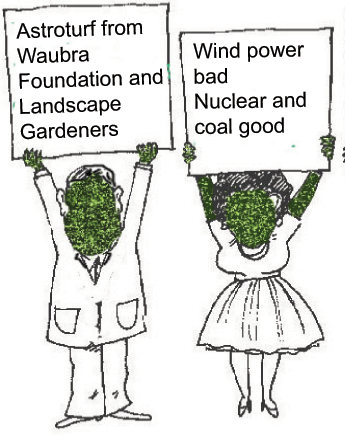
The new Senate committee was installed last night and tasked with investigating climate and energy mis- and disinformation campaigns and uncovering which foreign and local organisations are funding “astroturfing”, fake grassroots movements that are actually coordinated marketing campaigns.
“Australians have a right to know who’s really behind the clogging up of their social media feeds with anti renewables, anti climate, anti science propaganda. Rest assured, they’ll be shocked when they find out,” Lamacraft told Renew Economy.
“We saw from the last federal election campaign, where [conservative lobby group] Advance Australia had a $15 million warchest, $14 million of that was in dark money where we don’t know where it came from.

“The most important thing to do with shadowy networks like this is to shine a light. It’s extremely damaging to our democracy to allow millions of dollars from shadowy multinationals, and hidden domestic interests, to influence public policy for their personal gain, not the public.”
The inquiry, formally known as the select committee on Information Integrity on Climate Change and Energy, will also question whether Australia’s laws preventing foreign interference in national politics are strong enough to fight off internationally-funded domestic political campaigns.
That work will encompass the role of social media in building astroturf campaigns through the coordinated use of bots and trolls, messaging apps and AI to spread fake ideas and news.
It will be the first step towards finding out who is financing sophisticated anti-renewable energy campaigns and misinformation, and whose interests they truly serve, says committee chair Greens senator Peter Whish-Wilson.
“For decades, vested interests have been waging a global war of disinformation against the clean energy transition, including environmental and climate legislation, and these vested interests have recently achieved significant political success in nations such as the US,” he said in a statement.
“In the last parliament, evidence was provided to the Senate Inquiry into offshore wind industry that strategies such as establishing fake community groups – otherwise known as astroturfing – were being used in Australia to spread lies about renewable energy.
“It’s critical that parliament continues this work and now examines these interests for what they are and who they serve.”
Devastating impact of astroturfing
The inquiry comes on the back of years of sophisticated anti-climate campaigns masquerading as grassroots movements.
These seek to demonise a climate or renewable energy issue and rally support for nuclear power, a position known to be a cover for retaining a fossil fuel status quo.
Campaigns against everything from offshore wind to individual projects have polarised public opinion and are having a tangible impact.
Coordinated anti-offshore wind campaigns in 2023 peddled fears such as that offshore turbines kill whales and any in the waters around Wollongong would block out the sunrise.
As a result, the federal government reduced the Illawarra offshore wind zone by a third and pushed it 10km further offshore, while in Queensland the Stop Chalumbin Wind Farm claimed the scalp of the Wooroora Station proposal by claiming risks to the nearby world heritage rainforests.
Ark Energy, which was behind the Wooroora Station project, also scrapped the Doughboy wind project in NSW after the New England landowners involved in the project changed their minds.
Organised anti-renewables groups are weaponising NSW’s planning process by forcing projects into the Independent Planning Commission, the final arbiter of development applications if more than 50 opposing submissions are lodged during the regular planning process.
David and Goliath battles
For genuine activist groups, going up against well-funded, apparently grassroots campaigns that are peddling half truths and outright lies is “incredibly frustrating”, says Surfers for Climate CEO Joshua Kirkman.
“We simply do not have the financial resources as an advocacy group… against big forces like that which the Senate inquiry will actually find out about,” he told Renew Economy.
“I really hope this inquiry can put the spotlight on the realities of where the support for these voices in Australia comes from. I think the public have a right to know, and I think the public wants to understand how their democracy is being influenced by nefarious parties with ill-intent for the environment.”
Kirkman says climate change is a big enough problem without tactical misdirection and influence undermining the work being done.
Organisations such as Responsible Future (Illawarra Chapter) are what Kirkman is up against.
The anti-wind, pro-nuclear organisation was registered in April 2024 and claims to be funded by donations. Founder Alex O’Brien declined to comment on a series of basic questions about the organisation sent by Renew Economy last year.
Follow the money
The risks of foreign funding influencing Australian climate debates is not a conspiracy theory: the issue was raised in the Senate last year after an inquiry into offshore wind recommended the government act to stop foreign lobby groups from crowding out local community voices in public debates.
Last year, Walker published a submission which highlighted the similarities between US anti-wind campaigns and those targeting offshore wind in Australia.
He found similarities between the claims made by groups like Stop Offshore Wind, such as the same imagery and messaging in social media campaigns saying turbines kill whales, as used in campaigns overseas funded by conservative US lobby the Atlas Network.
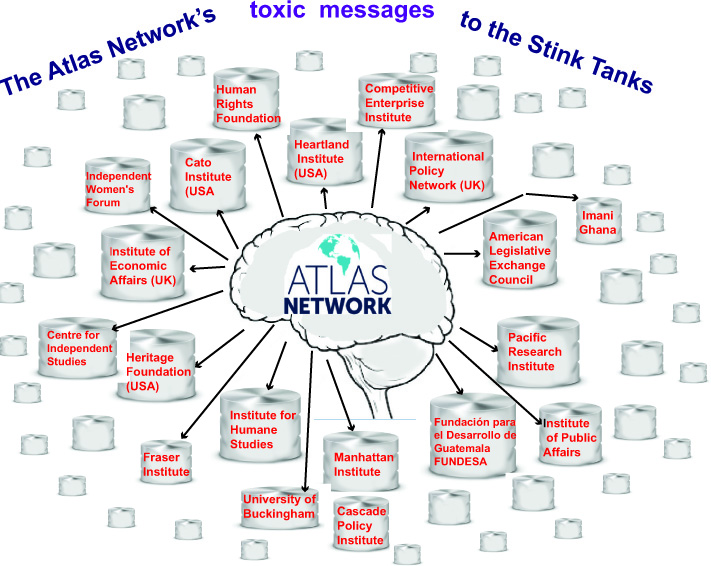
But he was only able to guess at actual funding trails into Australia.
It’s known that deep-pocketed conservatives such as mining billionaire Gina Rinehart and the multimillion-dollar Liberal Party investment arm Cormack Foundation have been sponsors of the likes of the Institute of Public Affairs (IPA), the Centre for Independent Studies (CIS), Menzies Research Centre and the ‘campaign group’ Advance Australia, all of which have strongly campaigned against renewable energy.
Walker has linked their campaigns with those of a global network of conservative think tanks.
Albanese government substantially expands renewable energy scheme amid 2030 target concerns

Albanese government substantially expands renewable energy scheme amid
2030 target concerns. Chris Bowen says Labor will increase size of its main
climate and energy program by 25% to capitalise on falling cost of solar
panels and batteries. The Australian government will substantially expand a
renewable energy underwriting scheme as it aims to capitalise on the
falling cost of solar panels and batteries and combat concerns it may
struggle to meet its 2030 climate target.
Guardian 29th July 2025,
https://www.theguardian.com/australia-news/2025/jul/29/australia-expands-renewable-energy-scheme-2030-target
“We can do that:” Australian Energy Market Operator says the country’s power system can be run on 100 pct renewable energy.
The head of the Australian Energy Market Operator says he confident that
the country’s main grid – and its smaller ones for that matter – can
be run on 100 per cent renewable energy. “At AEMO, I set an ambition in
2021 for us to understand what it takes to run a power system on 100%
renewable energy,” Westerman said in an address to the Clean Energy
Summit in Sydney on Tuesday. “And today, we’re confident that with
targeted investments in system security assets, we can do just that. I’m
incredibly proud of this, but the future is coming at us fast and those
system security investments are needed urgently run a power system on 100%
renewable energy.”
Renew Economy 29th July 2025,
https://reneweconomy.com.au/we-can-do-that-aemo-says-power-system-can-be-run-on-100-pct-renewable-energy/
Plunging cost of solar batteries ensures renewables remain lowest cost option for Australia, CSIRO says
The plunging cost of battery storage has ensured that integrated
renewables remain the lowest new build generation option for Australia,
while the western world’s first small modular reactor contract has
confirmed the CSIRO’s view that nuclear is by far the most expensive.
The final version of the 2024/25 CSIRO’s GenCost report has been released on
Tuesday and once again confirms – despite the extraordinary attacks from
critics over the last few years – that integrated renewables is easily
Australia’s best option as it looks to replace its ageing and heavily
polluting coal fired generators. This is despite inflationary pressures on
civil construction works, and the additional costs of worker camps for
large wind projects that have been included in its calculations for the
first time, adding around 4 per cent to the costs of wind energy.
Renew Economy 29th July 2025, https://reneweconomy.com.au/plunging-cost-of-solar-batteries-ensure-renewables-remain-lowest-cost-option-for-australia-csiro-says/
1 This month
.

Australians deserve the truth
about
AUKUS – https://aukuspublicinquiry.com/

PETITION – To: Prime Minister Anthony Albanese and the Australian Labor Government

of the week – Australians for War Powers Reform (AWPR)
To see nuclear-related stories in greater depth and intensity

