Home Affairs Minister, and wannabe Australian P.M> Petewr Dutton rubbishes the climate action schoolkids
‘Defies common sense’: Peter Dutton takes aim at school climate strikers Peter Dutton has taken aim at school students who protested about inaction on climate change, saying they would be sitting in the dark without coal-fired power. https://www.sbs.com.au/news/defies-common-sense-peter-dutton-takes-aim-at-school-climate-strikersHome Affairs Minister Peter Dutton has laid the boot into Australian students who skipped school to rally against inaction on climate change.
Nearly 40,000 students took the day off school last Friday to participate in strikes around the country.
Mr Dutton said it was “100 per cent right” to suggest people would be left to sit in the dark if coal-fired power was stripped from the grid for 48 hours.
“Let the teachers tell their students that and go out on strike – but their mobile phones aren’t being charged,” he told 2GB radio on Thursday. This is how stupid the debate’s gotten, it defies common sense.”
Adani protesters shut down WA Parliament, ejected from public gallery
WA Today, By Nathan Hondros, March 19, 2019 Protesters against a coal mining project in Queensland briefly shut down question time in WA Parliament on Tuesday.
About eight protesters in the public gallery interrupted Housing Minister Peter Tinley to shout slogans about Adani’s Carmichael mine in Queensland’s Galilee Basin…….https://www.watoday.com.au/politics/western-australia/adani-protesters-shut-down-wa-parliament-ejected-from-public-gallery-20190319-p515kv.h
Do we want another nuclear industry puppet in the South Australian federal seat of Grey?

There are 3 contenders for this electorate, for the coming Federal election.
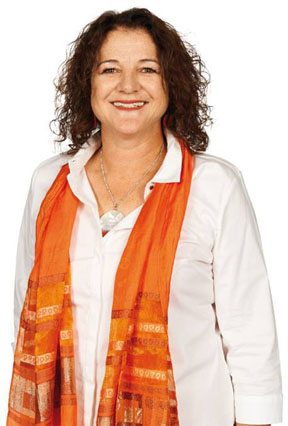 ANDREA BROADFOOT for Centre Alliance– “This election is for our grandchildren, and theirs. Energy security, reliability and affordability through renewable sources”
Andrea stood for this seat in 2016, and came very close to winning it, moving it from a (safely ignored by government safe seat) – to marginal (1.9%), which has brought millions of dollars of Government investment into the regions.
ROWAN RAMSEY The current Liberal Federal Member of Parliament, Rowan Ramsey,  is an enthusiastic mouthpiece for the nuclear industry. If you tap his name into the “Search” slot on this page, you will see his many efforts on behalf of the nuclear industry.
RICHARD CARMODY – Independent .
Kazzi Jai Fight To Stop Nuclear Waste Dump In Flinders Ranges SA, 17 Mar 19 writes:
Richard Carmody originally from Cowell and now lives in Whyalla has tossed his hat into the ring as an Independent.
Purely ONLY so that people are informed of these candidates, here is his policy on Nuclear from his website – with an INTERESTING TWIST when it comes to his policy on Coal!!
 Regardless, seems people are NOT HAPPY with Rowan Ramsey. I wonder why?….(rhetorical question of course!) – we must also be careful of EXACTLY what POLICIES these OTHER CONTENDERS PUT FORWARD!!!
“Nuclear Since I’ve worked at Roxby (a copper and uranium mine) and Beverley (a uranium leach operation) people wonder about whether I advocate for nuclear related things. I’m neutral on nuclear. I am not for it nor against it. I am concerned there is a really poor understanding of radioactivity, radiation and nuclear science amongst the public, thanks to many years of sensationalist media and documentaries, both for and against, with agendas to push. The first thing I’d like is for an education program for the public on radioactivity and nuclear science to be put out. Then after people are much better informed, then they can decide if they want nuclear energy or the waste dumps and once the people decide, then I’ll go along with what they want.”
And then the PENNY DROPS!! He is IN FAVOUR OF NUCLEAR POWER!!
“Coal
Coal’s effect on climate emissions is much higher than that for oil and gas, roughly double to triple, depending on how you look at it. So it would be unwise to have any new coal power. That said, it is sensible to maintain the existing coal fleet until we have sufficient renewables / storage or other types of low carbon energy(ie nuclear) to support at least 50% of our energy usage.”
The fact that he wrote on his home page: “I will donate the other half to small parties that are going in the right direction (Sustainable Australia, Real Democracy, Reason etc)”…should have been a bit of a give away…..
Just realised his policy on COAL involves the use of NUCLEAR!!!!! How the hell can you be “neutral on nuclear” when you then advocate “low carbon energy (ie NUCLEAR) to support at least 50% of our energy usage”?????????????
Noel Wauchope “ not for it nor against it” means pro nuclear – as it means – just letting it happen. Let us not forget the lie about nuclear curing climate change is still a LIE. Carbon-14 is produced in coolant at boiling water reactors (BWRs) and pressurized water reactors (PWRs). It is typically released to the atmosphere in the form of carbon dioxide at BWRs, and methane at PWRs. EPRI | Product Abstract | Impact of Nuclear Power Plant Operations on Carbon-14 Generation, Chemical Forms, and Release”. www.epri.com.
Carbon emissions are released in lage amounts throughout the entire nuclear fuel chain – from uranium mining, milling, conversion, enrichment, fuel fabrication, through to radioactive trash management and eventual burial. AND all the transport involved in between these stages.. AND all the building of all the stages’ facilities, and eventual demolition thereof.
New South Wales school students rallied for climate action, despite the Premier’s disapproval
Students defy warning from Premier Gladys Berejiklian and skip school to attend Sydney climate rally, ABC News 17 Mar 19 By Antonette Collins and Kevin Nguyen Thousands of NSW students have skipped class to attend a protest in Sydney to call for action on climate change, defying calls from Premier Gladys Berejiklian and Education Minister Rob Stokes to stay in school.
The event at Sydney Town Hall was expected to be one of the largest of the nationwide climate rallies today.
The big crowd of young people, predominantly students, cheered loudly amid calls for an end to the Adani coal mine in Queensland and 100 per cent renewable energy by 2030.
Rock star Jimmy Barnes and Sydney Lord Mayor Clover Moore were among those who attended the rally, and were spotted alongside the students wielding colourful signs.
Many students were attending against the advice of the NSW Government’s leaders and conservative commentators.
Students have called on governments to do more to reduce fossil fuel emissions, but they have faced resistance from government leadership and conservative commentators.
Premier Gladys Berejiklian criticised Opposition Leader Michael Daley, who this week backed schoolkids planning to protest.
“I encourage young people to feel passionately about important issues including climate change,” she said.
“But to suggest that they should strike during school hours is grossly irresponsible. I want to encourage students during school hours to express their views, to discuss their views in the classroom or the playground.
“But to take time off to go to a protest is not acceptable…….
We’re here to make a change’
Around 2,000 students rallied in Newcastle, where many felt environmental issues were close to home.
“I can see the world’s largest coal port from my doorstep and it’s shameful,” said Miette Xenith, 17, from Newcastle High.
She said her generation was scared for the future “because at my age it’s kind of like staring down the barrel of a gun”.
“The Intergovernmental Panel on Climate Change has said that we have 12 years to completely change what we’re doing, before the impact is irreversible, so yeah, I feel strongly about it, because it’s my future.”
Newcastle student Molly Highet said she was angry at the Government’s inaction on climate change. “It’s scary thinking that if they don’t do anything real soon that we won’t have a good future, or maybe won’t have one at all, and our children won’t.
“They’re the ones that can really make a change, but now they’ve left it up to us so we’re trying to make the change for them.” https://www.abc.net.au/news/2019-03-15/nsw-schools-climate-change-rally-sydney-gladys-berejiklian/10904254
New South Wales Labor’s pledge for ‘solar schools’
 Labor promises $100 million for ‘solar schools’ https://www.smh.com.au/nsw-election-2019/labor-promises-100-million-for-solar-schools-20190315-p514i9.html, By Lisa Visentin, March 17, 2019 Labor leader Michael Daley has pledged to spend $100 million installing solar panels on hundreds of public schools across NSW.
Mr Daley linked his “solar schools package” to the recent student strike over climate change inaction, and said the policy would help teach students about renewable energy.
“As we saw at rallies across the country on Friday, the next generation is demanding real action on climate change,” Mr Daley said.
“Putting solar panels on schools will help students further their knowledge about renewable energy, as well as bring down their school’s power bills and reduce emissions.”
Under Labor’s plan, solar panels would be installed at 350 government schools. The $100 million package would be funded as part of the Labor’s $800 million “cool schools” policy to install airconditioning in every single classroom in the state.
Mr Daley’s announcement comes after he publicly backed the striking school students during a speech earlier in the week, describing their actions as a “demonstration of young leadership”.
His endorsement drew fire from Premier Gladys Berejiklian who said she was “appalled” the alternate premier was encouraging students to skip school.
It comes as a recent ReachTEL poll revealed climate change was a pressing concern for most NSW voters, with 57.5 per cent of voters saying it would influence the way they voted.
As part of the state election campaign, Ms Berejiklian has announced interest-free loans to 300,000 households for solar and battery systems while Labor has pledged to put solar on 500,000 homes over the next decade through rebates.
Ms Berejiklian earlier this week restated her government’s support for action on climate change and said NSW had the largest renewable projects in Australia.
“We’ve had a consistent position since we’ve been in government, that climate change is real and that as a government we need to do everything we can to deal with it and we have been,” she said.
It’s time that the Liberal Coalition politicians stopped manipulating dissent about climate change – and apologised to the Australian public
 Malcolm Farr: ‘The public debate on the existence of climate change is over and we are owed an apology’
Some elected politicians have been too frightened or deliberately manipulative to acknowledge this issue. It’s time, writes Malcolm Farr. news.c om.au Malcolm Farr@farrm51 17 Mar 19, The public debate on the existence of climate change is over and we are owed an apology from those who prolonged it for self-serving political purposes.
They might acknowledge their disrespect for science, or for driving rejection as a vehicle for “brutal retail politics”.
Voices as varied as the schoolchildren who marched on Friday, the top ranks of Australia’s central bank, and federal department chiefs are warning of the consequences of those changes.
The debate continues, but it now is centred on measuring the urgency of a response to increasing climate instability, and the detail of that response.
Emergency services, diplomats and farmers are all seeking the best answers to climate change effects — effects which some of their flecked representatives for the better part of a decade said didn’t exist.
Military and intelligence agency leaders have warned climate change is a national security threat to Australia.
There still are holdouts, including a few reactionary MPs who continue to embrace Tony Abbott’s belief just over nine years ago that the science was “absolute crap”. And there is a fringe which make cases which can only be resolved by outlandish conspiracy theories, often along the dubious lines of the United Nations and One World Government.
And there are credible sources moving in the other direction.
Deputy governor of the Reserve Bank of Australia Guy Debelle last week made clear climate change is now a factor in tracking and guiding the economy; he gave no hint it was a UN plot.
But he did stress the need for an orderly transition to clean energy; a need for greater backing of renewable energy projects; preparing for new ways we work and the jobs available to us; and the broader task of readying the entire economy for change.
“Financial stability will be better served by an orderly transition rather than an abrupt disorderly one,” he said.
Last week, secretary of the Department of Home Affairs Mike Pezzullo mentioned climate change in a speech — Seven Gathering Storms — to a think tank.
Mr Pezzullo warned of states which might become ungovernable and a possibility of “mass displacement of people”.
Contributions to this displacement could be “poverty, hunger, water and resource scarcity, and a changing climate, which will have to be thought of as a systemic risk factor”.
These are just a few elements of government which have appreciated the existence and impact of climate change in ways some elected politicians have been too frightened or deliberately manipulative to acknowledge.
These are the folk who might consider an apology.
Tony Abbott is not the only denier in parliament but over a decade he has been the pacesetter if not the leader of that block of ignorance.
“The argument is absolute crap. However, the politics of this are tough for us,” he told a regional audience in December 2009.
“Eighty per cent of people believe climate change is a real and present danger.”
Just as Mr Abbott scorned majority views on same sex marriage, he early on resolved to ignore voters on climate change.
He used that rejection of evidence and local opinion to wreck the carbon price policy of Labor Prime Minister Julia Gillard, his offensive from Opposition against the so-called “carbon tax”.
His chief adviser in Opposition and when he became prime minister, Peta Credlin, in 2017 put that campaign into context.
“That was brutal retail politics, and it took Abbott six months to cut through and when he did cut through Gillard was gone,” she told Sky News.
And, Ms Credlin said, “It wasn’t a carbon tax, as you know.”
However, Mr Abbott was “hugely unconvinced” in 2009 and continued to harness his rejection of climate change science in 2017 in a speech he made in along on.
“Primitive people once killed goats to appease the volcano gods. We are more sophisticated now but are still sacrificing our industries and our living standards to the climate gods to little more effect,” he said.
But something happened 10 days ago.
Mr Abbott abruptly endorsed the UN backed Paris agreement on emission reduction, a process aimed at limiting climate change.
A sudden convert, he has yet to say sorry for his past rejection.
— Malcolm Farr is news.com.au’s national political editor. Continue the conversation @farrm51
Students’ climate action strike: 150,000 people at 60 locations across Australia
Students strike to demand climate action | ABC News
Climate strikes attract 150,000 supporters, https://www.sbs.com.au/news/climate-strikes-attract-150-000-supporters, 16 Mar 19, About 150,000 people took part in climate strikes across the country on Friday, with students planning more rallies if their demands for more action aren’t met. About 150,000 students, parents and activists have taken to the streets to protest over the federal government’s inaction on climate change.
Strikes were held across the country on Friday at 60 locations, as part of a global effort to shine a light on climate change.
The protests were estimated to be 10 times the size of those held in November. The students have three demands: stop the Adani coal mine in central Queensland, no new coal or gas, and 100 per cent renewables by 2030.
More strikes will be planned if the students don’t see the action they want from the government.
“If the politicians are just going to throw our futures away there’s nothing we can do but be out here and say: we’re not going to let you do that,” 15-year-old Olivia Boddington told AAP at a climate strike in Canberra.
“We’re not going to just go away.”
Huge crowds gathered across the country on Friday, including at Sydney’s Town Hall Square, outside Melbourne’s Old Treasury Building and in Brisbane’s CBD.
The movement was inspired by Swedish teen Greta Thunberg, who has been striking for climate action since last August.
The 16-year-old’s activism has earned her a Nobel Peace Prize nomination.
Senior cabinet minister Christopher Pyne criticised the students for striking, saying the move will damage their education.
However, Labor national president Wayne Swan defended student activism.
Animal Justice Party – pro nuclear advocate in sheeps’ clothing?
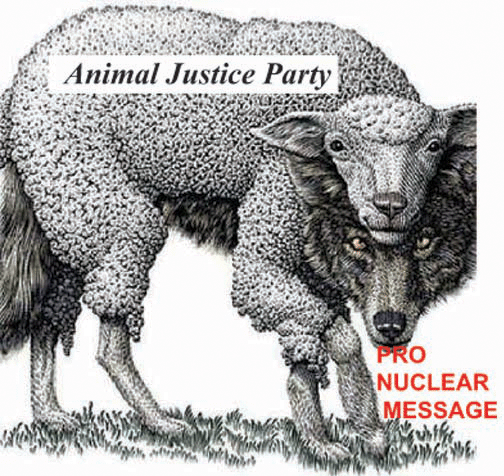 Well, I gave this party my preferences at the most recent election. But not any more. Rumour has it that there’s a strong pro nuclear presence in the Animal Justice Party.
This rumour is now confirmed by Michael Dello, Animal Justice Party candidate for Heffron, New South Wales.
I n response to a request about this, Michael Dello writes:
- Nuclear is one of the safest forms of energy per unit energy produced, safer than even wind and solar (in terms of lives lost per unit energy). Some highly publicised events make this seem untrue, but the st statistics support this. I admit that this isn’t simple, as nuclear causes more property damage per unit energy, but it seems far from clear that nuclear is more dangerous than wind and solar.
- Nuclear has saved millions of lives to date by pushing out coal. Granted, renewables have done this too to an extent.
- The production of renewable energy and batteries also has waste, in particular the process of mining nickel and lead which are used for batteries produce far more toxic waste (e.g. sulfur dioxide) per unit energy produced than nuclear.
- I don’t believe we can achieve the emissions reduction targets we need with renewable energy alone. I believe that nuclear power and a reform of our agriculture system (animal agriculture being the leading cause of climate change yet the most ignored in Australia by far) are important and neglected parts of this process.
- I don’t believe it is possible with current or even near future technology to have sufficient battery storage with renewables alone.
- Nuclear has a significantly smaller land use requirement than renewable energy. The environmental cost of clearing land to make room for renewable energy is non-trivial (less of an issue in SA than the east coast).
Hypocrisy in Scotland. For political reasons, First Minister Nicola Sturgeon refused to meet Aboriginal nuclear waste protestor
 Gaffe reveals why Sturgeon refused to meet nuclear waste protestor https://theferret.scot/sturgeon-nuclear-waste-protestor/ James McEnaney on March 14, 2019 The Scottish Government has mistakenly revealed that Nicola Sturgeon refused to meet an Aboriginal nuclear waste protestor in an attempt to avoid political damage – not because she was too busy, as her officials said.
 Internal emails uncovered by The Ferret reveal that the First Minister was advised to turn down a request for a meeting in 2018 so as not to become a “focus for criticism”. But officials said the public reason given for her refusal would be “on the standard basis of diary pressures”.
Campaigners reacted with sadness, saying that the Scottish Government’s “ears are closed”. The government stressed that it had “very limited scope” to address the issues raised.
Nuclear fuel was sent from an Australian research reactor to Dounreay on the north coast of Scotland for reprocessing in the 1990s. The resulting radioactive waste, amounting to 51 cemented drums, was originally due to be returned to Australia for disposal.
But under the terms of a waste substitution deal in 2014, Scottish and UK governments agreed that the drums should stay at Dounreay. Instead, the plan is to send four containers of “radiologically equivalent” waste to Australia from the Sellafield nuclear complex in Cumbria.
Two sites have been identified for a planned store for the waste in south Australia – Wallerberdina Station, near Hawker, and Kimber – both of which face opposition from indigenous communities. The Ferret reported in February that Scottish ministers had been advised that they had powers to prevent the waste being exported to protect human rights.
Matt Canavan, Australia’ s Minister For Nuclear and Coal, skirts around the truth about radioactive waste dump plan
 Matt Canavan radio interview March 14th 2019 Fight To Stop Nuclear Waste In The Flinders Ranges
More drought, more heat, if a large El Nino event occurs in 2019
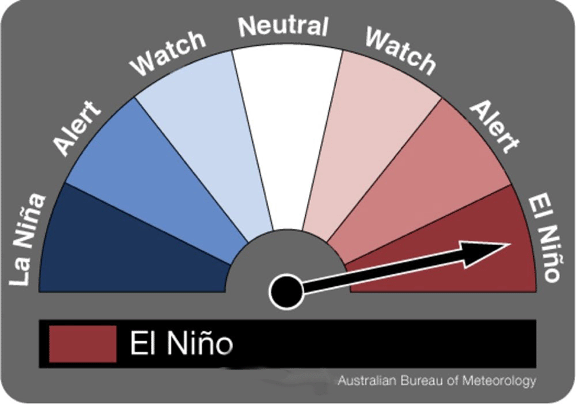 ‘Monster’ El Nino a chance later this year, pointing to extended dry times , Brisbane Times, By Peter Hannam, March 15, 2019 Relief for Australia’s drought-hit regions could be a long way off, with climate influences in the Pacific and Indian oceans tilting towards drier conditions and a large El Nino event a possibility by year’s end.
Climate scientists said the conditions in the Pacific were particularly concerning given an unusual build-up of equatorial heat below the surface that could provide the fuel for a significant El Nino.
If such an event transpires, the Great Barrier Reef would face another bout of mass coral bleaching while the drought gripping southern and eastern Australia could intensify.
Agus Santoso, a senior scientist at the ARC Centre of Excellence for Climate Extremes, said there were two likely outcomes from the developments in the Pacific. “We could have an El Nino fully formed by the end of May and then it could dissipate,” Dr Santoso said.
“The other is that by May it’s already formed and it still keeps building up… and by the end of the year we could have a monster El Nino.”
During El Ninos, the normal easterly winds blowing along the equator slow and even reverse. Rainfall patterns tend to shift eastwards away from south-east Asia and Australia, setting up conditions favourable for below-average rainfall and bushfires………..
Climate change and big events
Dr Santoso’s research, including a paper published late last year, has found the frequency of big El Ninos will increase with climate change.
That result is “quite concerning”, particularly for ecosystems sensitive to heat spikes such as coral reefs that suffered mass bleaching during the 2015-16 big El Nino.
“If we get one or two bleaching events, [the Great Barrier Reef] can recover, but if we keep having these events coming up then maybe the corals are not going to be able to adapt,” Dr Santoso said.
During El Ninos, the Pacific Ocean takes less heat from the atmosphere and even gives some up, giving global surface temperatures a bump up.
The trialling years of big El Ninos, especially 1998 and 2016 – the current holder of the world’s hottest year on record – are particularly warm.
An event later this year would likely see temperatures next year “spike up, and that’s not very helpful for global warming”, Dr Santoso said. https://www.brisbanetimes.com.au/environment/climate-change/monster-el-nino-a-chance-later-this-year-pointing-to-extended-dry-times-20190315-p514hi.html
Good to see former Australian Chief Scientist Penny Sackett with the kids in Canberra climate march
‘More effective than UN’: Student climate strike draws thousands https://www.canberratimes.com.au/national/act/more-effective-than-un-student-climate-strike-draws-thousands-20190315-p514fx.html 16 Mar 19Students have skipped school and marched through Canberra in their thousands to demand federal government action on climate change.
“We’ll stop acting like adults if you stop acting like children,” students told crowds gathered in Garema Place for the “School Strike 4 Climate” rally on Friday.
We’re skipping school today to do some teaching, we’re teaching politicians about science. We’re teaching them that coal causes climate change. We’re teaching them what happens if they continue to do nothing.”
Organisers estimate 150,000 Australian students flocked to 50 rallies across Australia on Friday, part of a global movement spanning more than 100 countries that began in Sweden last year with teen activist Greta Thunberg.
Roads were closed off in parts of Civic as crowds marched to Glebe Park, holding high home-made signs declaring “Don’t burn our future” and “I can’t go to school today, I’m saving the planet”.
While the first school climate strike in November last year drew attention, this time around students wanted action. They came prepared with a list of demands (which they chanted down the line of Prime Minister Scott Morrison’s personal phone in Canberra) – an end to new fossil fuel projects, including the controversial Adani coal mine, and a shift to 100 per cent renewable energy in Australia by 2030.
George, 10, explained why he chose to skip school as he waited for a squadron of classmates cycling over from North Ainslie Primary.
“The earth is warming up and if adults aren’t going to do something about it, we sure are,” he said.
Parents, grandparents, activists and academics also joined the march, including Australia’s former chief scientist Penny Sackett. The reality is that the approach taken by adults so far isn’t working,” Professor Sackett said.
“School children striking around the world may be the beginning of a social movement more effective than 25 years of UN climate summits.”
Fourteen-year-old Maanha Manzur was one of about a dozen student organisers behind the event, coordinating security, land permits and public liability insurance in between classes.
She said the ACT turnout had greatly outstripped the first strike, which saw about 500 students brave the rain outside Parliament House. More than 3500 people poured into the city for Friday’s rally, she said, and at least 2000 of them were students.
Some said they had defied their schools by attending but many said they had been supported to head along, with parental permission. Most scoffed at criticism from federal ministers, including the prime minister’s calls for students to focus on learning not activism.
“We’re here because we’re almost out of time.”
Also among the crowd were federal candidates Tim Hollo from The Greens and Labor’s Alicia Payne, as well as ACT Minister for Climate Change Shane Rattenbury. Mr Rattenbury said he was inspired by the strikers and suggested those still denying the science of global warming should go back to school themselves.
Education Minister Yvette Berry also backed the protest as “learning in itself” and said students would not be penalised for attending.
But shadow education spokeswoman Elizabeth Lee questioned who was really behind the strike and suggested skipping school was not the best way for students to get their point across.
“I would hate for them to have been used as a political pawn in a matter as serious as climate change,” she said.
On Friday afternoon, students shrugged off the suggestion, collapsing gratefully in the shade of Glebe Park after months of hard work.
“We do have our own minds,” one laughed.
“But it’s motivating to see so many people behind us, even my grandma’s here.”
Australia’s Previous Chief Scientist spells it out on global warming
Repeating this item. What a pity that the excellent full article has been removed from the Australian government website!
Why we must act now to reduce greenhouse gas emissions
Australian Government 8 Dec 09 Despite world attention, humans emit more greenhouse gases every year than they did the year before. It’s a situation that Australia needs to help turn around if we don’t want to bear the brunt of climate change, says Chief Scientist Professor Penny Sackett……
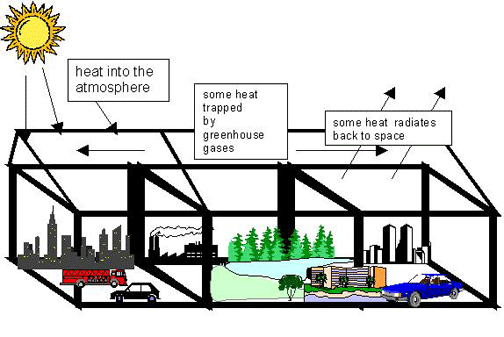
…..The Greenhouse Effect
The sun continuously bathes the Earth with energy in the form of sunlight. Much of this energy is absorbed by the Earth, and then emitted as infrared radiation, or heat. Greenhouse gases prevent the Earth from discarding as much of this heat as it otherwise would back into space.Without naturally occurring greenhouse gases, the Earth would be a much colder place, inhospitable to modern human existence. But by the same token, the additional greenhouse gases added to this store by humans is slowly increasing the average temperature of the Earth system.
Due to the quantity in which it is emitted by humans, its longevity in the atmosphere, and its effects in trapping heat, carbon dioxide is the most important of the greenhouse gases currently causing changes in the Earth’s climate……
In Australia, extreme fire danger days are already becoming more numerous in many parts of the country, and floods and cyclones more intense.
Research by the CSIRO indicates that the frequency of days with very high and extreme Forest Fire Danger Index ratings is likely to increase by 15 to 70 per cent by 2050 in southeast Australia…..
Why we must act now to reduce greenhouse gas emissions | Chief Scientist of Australia
Landmark High Court decision guides how compensation for native title losses will be determined
March 14, 2019 1.43pm AEDT William Isdale Jonathan Fulcher
theconversation.com/landmark-high-court-decision-guides-how-compensation-for-native-title-losses-will-be-determined-113346
‘The High Court has decided, for the first time, the approach that should be taken to resolving native title compensation claims. In a previous article, we said it would be “the most significant case concerning Indigenous land rights since the Mabo and Wik decisions”. The High Court’s decision yesterday certainly stands up to that description, and provides a degree of certainty for native title holders and governments. … ‘
New South Wales Labor leader sticks up for the right of school students to strike over climate change
Michael Daley says NSW schoolchildren have right to strike over climate change, Guardian, Anne Davies
State Labor leader says education is ‘bigger than the classroom’ as he applauds students for ‘standing up and taking action’
The New South Wales opposition leader, Michael Daley, has backed the state’s schoolchildren striking and attending rallies on climate change, saying it was a democratic right to protest and “an important way to realise their own personal power”.
Speaking at a National Press Club event in Sydney, Daley said he supported the rallies on Friday, even though he might soon be the premier and responsible for ensuring children attend school.
“Education is also bigger than the classroom. It is based on life experience. That is, in part, the importance of being confident and passionate enough to form beliefs and being prepared to stand up for them,” he said.
“They don’t have a microphone or money like the big end of town. But they do have their democratic right to assembly. I support that right to protest especially when it comes to climate change and our fragile environment.
“And more importantly in this inert digital age, of acting on that belief. Of standing up and taking action for what you believe in – it is called leadership.”
Labor has sought to distinguish itself from the Coalition by promising more rapid action on climate change, including installing seven gigawatts of regional solar farms and establishing a rebate scheme to encourage households to install a further two gigawatts of rooftop solar……… https://www.theguardian.com/australia-news/2019/mar/13/michael-daley-says-nsw-schoolchildren-have-right-to-strike-over-climate-change
1 This month.
20 September –National Day of Action in Melbourne on the International Day of Peace


Help Aunty Sue Protect Her Land and Sacred Sites From Destructive Rocket Testing.
.

Australians deserve the truth
about
AUKUS – https://aukuspublicinquiry.com/

PETITION – To: Prime Minister Anthony Albanese and the Australian Labor Government

of the week – Australians for War Powers Reform (AWPR)
To see nuclear-related stories in greater depth and intensity
 Antinuclear