Crikey.com devotes an entire edition to climate change
 Today, Crikey dedicates an entire edition to covering climate change. The world has reached a tipping point on this issue. Voters now overwhelmingly accept the science, and denialists have increasingly been pushed to the fringes. Among other things, today’s edition looks at what the military is doing to prepare for climate change, and how environmental catastrophe could soon make the insurance industry redundant. This is the slow burn of climate change.
We believe climate change is an issue that needs to be talked about more.

Angus Taylor, Energy Minister, confirms that the Morrison government considering supporting new coal projects
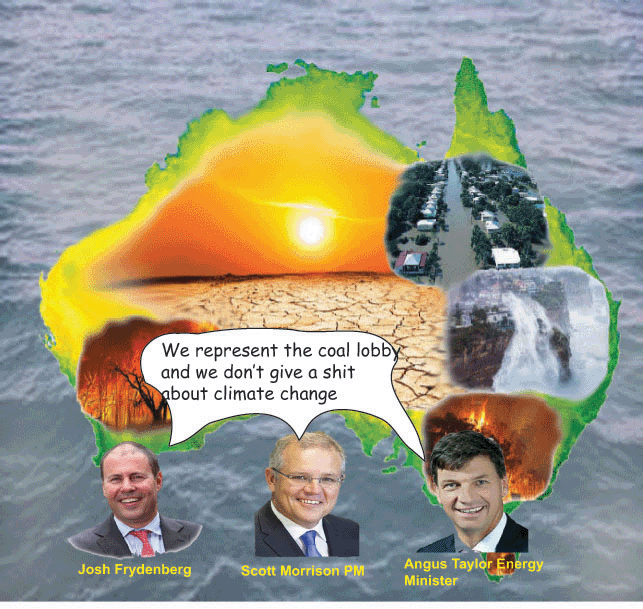
Angus Taylor says Coalition assessing new projects despite pushback from moderate Liberals, but says taxpayers will only support ‘viable’ projects
The energy minister Angus Taylor has confirmed the Morrison government is continuing to assess new coal generation projects despite pushback from moderate Liberals, but he says taxpayers will only support projects that are “viable”.
In a statement to Guardian Australia, Taylor confirmed the government was continuing to consider 10 coal projects through its power generation underwriting program, as well as new gas and pumped hydro proposals……
Taylor’s confirmation that new coal generation projects remain on the table for consideration comes as an open brawl is continuing within the Coalitionabout energy policy.
Queensland Nationals and the former deputy prime minister Barnaby Joyce are demanding the government commit taxpayer support to new coalregardless of whether or not the projects stack up economically, and city-based Liberals, under pressure from their constituencies, are pushing back against that offensive….. https://www.theguardian.com/australia-news/2019/mar/12/morrison-government-has-not-ruled-out-supporting-coal-energy-minister-says
Students strike to spur adults into climate action
Kids across the globe are protesting a failure of governments to cut greenhouse-gas emissions Science News for Students, KATHIANN KOWALSKI, MAR 11, 2019 “…… As of March 6, there were 596 planned events across 64 countries, according to a list kept by the group Fridays For Future.
A worldwide movement Many young protesters have drawn inspiration from Greta Thunberg. The 16-year old Swedish teen……..
began regularly protesting outside Sweden’s Parliament last summer. She also has encouraged kids to strike in other countries. She even spoke to delegates at the 2018 United Nations Climate Change Conference (UNCCC). It was held in December in Katowice, Poland.
“You say you love your children above all else, and yet you are stealing their future in front of their very eyes,” Greta told attendees at the UNCCC. There is still time to limit the worst impacts, she noted — but only if governments act now. “Until you start focusing on what needs to be done rather than what is politically possible,” she said, “there is no hope.”…..
“Climate denialism is like suicide,” Nakate Vanessa of Uganda, says of the people who argue climate change is not happening. “We cannot let ourselves perish as we look on without doing anything,” she says. “Not taking climate action is like locking yourself up in a house on fire.” …….
As Greta Thunberg told the United Nations meeting, “We have run out of excuses, and we are running out of time.” https://www.sciencenewsforstudents.org/article/students-climate-strike-march-spur-adults-climate-action
School students’ climate action strike, across Australia, on 15 March -and this is having its impact!
Students strike for climate change, defying calls to stay in school | ABC News
Australia’s young climate activists to strike again – and people are listening Students around the world have been holding protests over climate change in recent months, and they’re happening again in Australia this week. SBS, BY NICK BAKER 11 Mar 19, Australian students are once again planning to walk out of schools to protest climate change inaction.
Dismissing Aboriginal objections, Leonora Shire Council, (Western Australia) wants an underground nuclear waste dump!
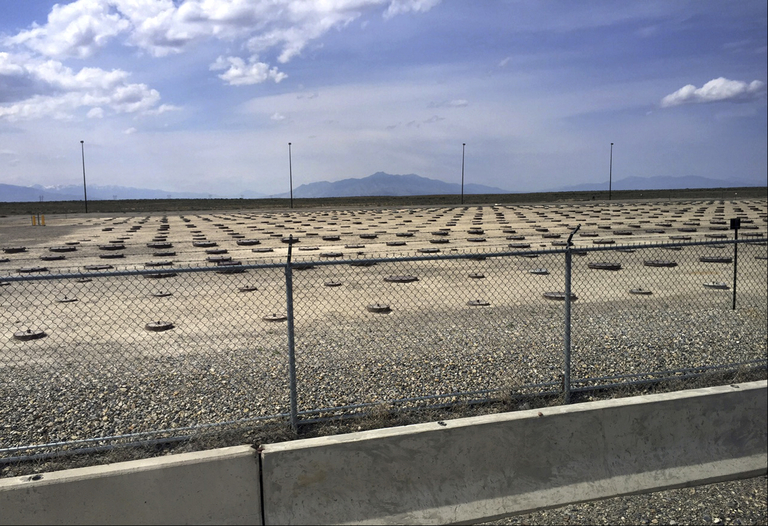
Outback WA council keeps hand raised for nuclear waste facility, as legal action halts progress on SA sites ABC North and West ,By Gary-Jon Lysaght , 12 Mar 19, While the search for a place to store Australia’s nuclear waste remains on hold pending a decision by the Federal Court, a small council in outback Western Australia still has its hand raised as a potential site.
Key points:
- Kimba and Hawker in South Australia are being considered as sites for storing nuclear waste
- A company called the Azark Project has a proposal to store waste in a “seismically stable” location near Leonora in the WA Goldfields
- The Federal Government says it is currently not considering Leonora as a potential location
Leonora, a WA Goldfields town about 200 kilometres north of Kalgoorlie, is being touted as a potential location for an underground nuclear waste disposal facility.
The Federal Government is considering sites at Kimba and Hawker in South Australia for an above-ground facility capable of permanently storing low-level waste and temporarily storing intermediate-level waste.
Nuclear waste being stored at Australia’s Nuclear Science and Technology Organisation (ANSTO) would be sent to the nuclear waste disposal facility…….
He said the Azark proposal was to store low-level and intermediate-level waste underground on a permanent basis. ……
Leonora not being considered
The Department of Industry, Innovation and Science said it was currently not considering Leonora as a potential location and that detailed studies were continuing at the three nominated sites in South Australia.
Lyndhurt and Napandee are the properties near Kimba being considered and the site near Hawker is called Wallerberdina Station.
A proposed community ballot on support for the facility in Kimba and Hawker has been on hold pending legal action.
The Leonora Shire Council remains in favour of a nuclear waste facility near the town, saying it could provide jobs and much-needed infrastructure for the small town.However, Leonora Shire President Peter Craig said that support could wane because of what he described as a lack of consultation from Azark.
“Azark did have a community meeting back in April 2018, which was pretty positive, there were some questions that still needed to be answered,” he said.
“To this day, in our view, as a council, Azark have failed in consultation work with the community…….
Mr Craig said Azark had consulted people one-on-one but not in a wider group since the 2018 meeting. ……
Cultural and environmental concerns
Throughout the site selection process at both Kimba and Hawker there has been opposition from local Aboriginal groups, who say a facility would impinge on sacred land.
Dave Sweeney from the Australian Conservation Foundation said local Aboriginal groups at Leonora remained strongly opposed to the facility.
“[Azark] says there’s no chance of any impact on water — there’s no evidential basis for that,” he said.
“They say there is no cultural or heritage issues — that is contested by local Aboriginal people.
“When this was first flagged, Aboriginal people who have deep concerns about this proposal got a petition together that rapidly got, in a number of days, around 500 signatures.
“In a remote region, that’s a quick and significant expression of concern.”……
Mr Sweeney said the Federal Government should stop the site selection process.
“We desperately need, right now, for the brakes to go on the federal process at Kimba and at Hawker and an independent assessment of the best ways we can manage radioactive waste.” https://www.abc.net.au/news/2019-03-12/goldfields-council-continues-support-for-nuclear-waste-facility/10887644?pfmredir=sm&fbclid=IwAR1mUzAfXLzOl5CeF41xkST82NALrwTf4xs8pVRnfW5v5U1FS9KxJZoLX04
Even more Australian students will strike for climate action, this Friday
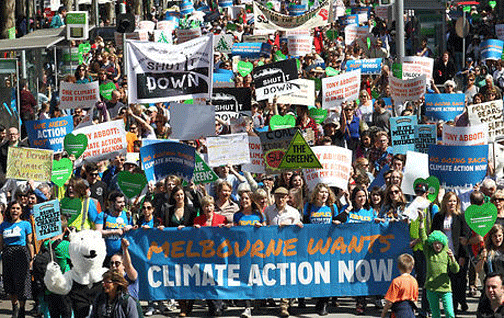
We’ve been forced into this’: Australia’s school climate strikes to go global Guardian, Naaman Zhou@naamanzhou, 11 Mar 2019 In November, Scott Morrison told the striking students to ‘go to school’ – this time even more of them will strike Four months on, 17-year-old Doha Khan says the school climate strikers have learned a lot.
On Friday, thousands of primary and high school students are again planning to walk out of class across the country, protesting against the government’s inaction on climate change, and what they see as the destruction of their future.
Up to 50 rallies, in scores of regional towns, are planned for 15 March. This time, the students will be joined by others in America and Europe, in what has become a global movement.
At the November protests, thousands took to the streets. In Canberra, they met Greens senators, Labor MPs and the independent MP Rebehka Sharkie. They were told by the prime minister, Scott Morrison, to “go to school”, and by the resources minister, Matt Canavan, that they were “learning to join the dole queue”.
More recently, the New South Wales education minister, Rob Stokes, told students to stay in class because “you can’t strike if you don’t have a job”.
But the leaders of Friday’s strike say the movement has only grown, gained momentum, and become smarter.
“We really did take into account a lot of the criticism that came out of last year,” says Khan, who goes to the Glenunga International high school in Adelaide.
“There were claims that the kids were just striking and didn’t have any demands. So this time around we’ve made our demands a lot clearer.
“We have them set out on all banners: stopping the Adani coalmine. No new fossil fuel projects, 100% renewables by 2030.”
This year, the number of rally points has grown, mostly in regional areas. There are 18 in New South Wales alone – from Bowral to Byron Bay – and Khan feels enthusiasm has risen, rather than quietened down.
“This time our response rate has doubled,” she says. “Last time, a week before the strike, we had 1,000 responses on Facebook. This week we are over 2,300. We are now getting a hundred responses a day. That’s pretty cool – and this is just the Adelaide strike.”……..https://www.theguardian.com/environment/2019/mar/11/weve-been-forced-into-this-australias-school-climate-strikes-to-go-global
After Fukushima: Nuclear power’s deepening crisis -it’s never appropriate for Australia
Independent Australia By Dave Sweeney | 12 March 2019 Eight years ago the world held its breath as the Fukushima nuclear crisis unfolded in Japan. Today the lands are littered and the seas awash with the consequences of radioactive waste responses and the economic, human and environmental costs are severe and continuing.
Fukushima was directly fuelled by Australian uranium and in its aftermath, this contested trade remains hard hit, as is the wider global nuclear power sector. Globally, reactors are in recession and the promises of the promoters look increasingly hollow.
The nuclear industry is in crisis everywhere.
In contrast, worldwide renewable power generation has doubled over the past decade and costs continue to fall dramatically.
A record amount of new renewable power capacity has been installed worldwide every year over the past decade. Renewables accounted for over 26 per cent of global electricity generation in 2017, while the nuclear contribution languishes at ten per cent. Around our shared planet, over ten million people are employed in renewable energy industries and the trajectory is only going one way.
In January, Australia’s Climate Council, comprising leading climate scientists and policy experts, issued a policy statement concluding that:
‘Nuclear power stations are not appropriate for Australia — and probably never will be.
According to the Climate Council:
‘Nuclear power stations are highly controversial, can’t be built under existing law in any Australian state or territory, are a more expensive source of power than renewable energy, and present significant challenges in terms of the storage and transport of nuclear waste, and use of water.’
This view was reinforced by Federal Labor, at its national conference in December, when it committed to
“prohibit the establishment of nuclear power plants and all other stages of the nuclear fuel cycle in Australia.”
At this time, Shadow Energy Minister Mark Butler was scathing of nuclear advocates, telling ABC Radio:
“This is not a technology that has any opportunity for Australia, it is extraordinarily expensive power as well… we want to focus on renewable energy which is going to bring down emissions, bring down power prices, and power thousands and thousands of jobs.”
China ‒ long seen as the saviour for the industry ‒ has not approved a new reactor construction site for more than two years and is instead prioritising renewable energy. The number of countries phasing out nuclear power now includes Germany, Switzerland, Spain, Belgium, Taiwan and South Korea.
The British nuclear power industry is in free-fall …….
Nuclear lobbyists used to claim nuclear power would be too cheap to meter. Now, it’s too expensive to matter……. https://independentaustralia.net/business/business-display/after-fukushima-nuclear-powers-deepening-crisis,12459
Climate change is a key issue for New South Wales election
 Climate change top of voters’ minds in NSW election SMH, By Alexandra Smith March 12, 2019 Climate change is a key election issue for most people in NSW, polling shows, as the environment emerges as a more pressing concern for voters than hospitals, schools and public transport.
Exclusive Herald polling shows that 57.5 per cent of voters say they will be swayed by climate change and environmental protection when deciding who to vote for on March 23…….
Internal party research showed climate change played a major role in last year’s Wentworth byelection and is shaping up to be a key issue in former prime minister Tony Abbott’s seat of Warringah.
With climate change again looming as an issue at the federal election in May, Mr Abbott on Friday abandoned his call to withdraw from the Paris agreement to reduce carbon emissions, falling in to line with Prime Minister Scott Morrison on the key policy………
The three independents – Sydney MP Alex Greenwich, Lake Macquarie MP Greg Piper, and Wagga Wagga MP Joe McGirr – are demanding Labor and the Coalition take action on climate change.
The crossbenchers, who will hold the balance of power if the government loses six seats, wrote to the Premier and Mr Daley last week asking them to act on transitioning from coal mining to clean energy……https://www.smh.com.au/politics/nsw/climate-change-top-of-voters-minds-in-nsw-election-20190311-p513bb.html
State of the drought – New South Wales , South Australia, Northern territory, Western Australia
State of the drought shows dams empty and NSW drowning in dust ABC Weather By Kate Doyle 12 Mar 19, It’s not good. Not good at all.
The hot dry summer has stripped the soils of moisture, water storages are down in every state and territory, and New South Wales is drowning in dust.
Key points:
- Water stores are down in every state and territory
- Keepit dam is empty and Dubbo’s dam could be empty by 2020
- A hot and dry summer has exacerbated low soil moisture, with a dry autumn forecast
So far this drought has been short but hard-hitting. The coming cold season will be a test of that descriptor.
Last year’s national farm production was down on the bumper year of 2016, but a good year in the west, decent prices and some moisture last summer softened the blow.
But with widespread low soil moisture, the pressure is on the arrival of cool-season rain.
The heat is making things worse
Lynette Bettio, a climatologist at the Bureau of Meteorology, said the big dry was affecting large parts of NSW, eastern South Australia and parts of the Northern Territory and northern Western Australia.
And despite the flooding rains in the north, even Queensland isn’t off the hook.
“The floods largely missed those areas of drought that we were covering,” Dr Bettio said.
“It did relieve some of those areas; those large totals of rainfall meant that some areas near the border with the NT are no longer in that bottom 10 per cent for those [drought-measuring] periods.
“But there’s still large parts of southern Queensland that are in that bottom 10 per cent of rainfall and lowest-on-record rainfall for those 11-month and 23-month periods.”…….. https://www.abc.net.au/news/2019-03-12/state-of-the-drought-is-not-good/10876716
Uranium tailings at Olympic Dam – radioactive for at least 10,000 years- must be SAFELY managed!
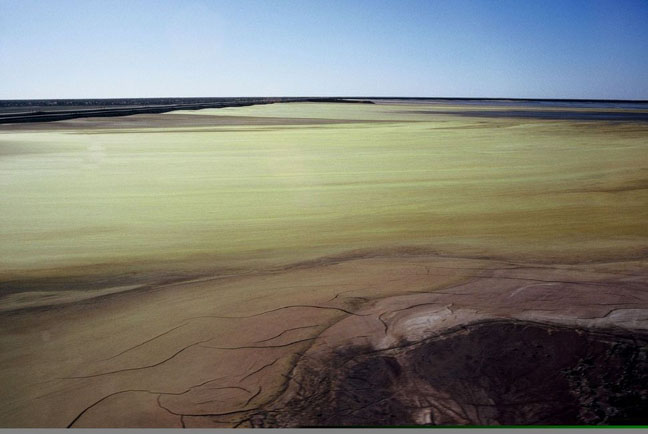
Initial Scoping – Olympic Dam Expansion Issues 22 Feb 2019 David Noonan B.Sc., M.Env.St., Independent Environment Campaigner“……….Radioactive Tailings Management
The 1982 Indenture places an onus on the SA Gov. to grant approvals on terms to facilitate mining.
Roxby Tailings Storage Facilities are to be covered and ‘disposed’ above-ground as final landforms.
Civil society must not accept continued downgrade of standards in Roxby uranium mine expansions.
A full comprehensive safety assessment to determine long term risks from radioactive tailings must be a core required part of this assessment AND apply the 1999 standards set at Ranger mine.
The most recent assessment of Radioactive Tailings Management at Roxby granted Federal and SA Gov. Approvals (Nov 2011) to vastly increase tailings production (from the now lapsed open pit mine proposal) prior to actually carrying out this type of safety study on the long term risks from tailings.
The 2011 Roxby Approvals downgraded the key 1999 standards applied to Ranger uranium mine.
Instead of Federal Gov. required final disposal of tailings (in to a pit) “in such a way to ensure that:
- i)The tailings are physically isolated from the environment for at least 10,000 years;
- ii) ii) Any contaminants arising from the tailings will not result in any detrimental environmental impact for at least 10,000 years;” Olympic Dam Condition 32 Mine Closure (Nov 2011) defers a Mine Closure Plan and only applies unstated environmental outcomes: “that will be achieved indefinitely post mine closure”, and:
“c. contain a comprehensive safety assessment to determine long term (from closure to in the order of 10,000) risk to the public and the environment from the Tailings Storage Facility and Rock Storage Facility.”
Requiring outcomes to “be achieved indefinitely” does recognise that tailings risks are perpetual.
However, rather than specific high standards of outcome set at Ranger for at least 10,000 years, this 2011 approval has unstated outcomes and only references 10,000 yrs as a period of modelling study.
In April 2013 Condition 32 was amended to further defer the safety risk assessment, from “within two years of the date of the approval”, to: “prior to the construction of the Tailings Storage Facility”.
A “No Uranium Recovery” alternative leaves all uranium & associated radioactive decay products in the tails. Roxby mine extracts approx. 2/3 of the uranium from the ore, with 1/3 left in the tailings.
In current mining practice, tailings retain some 90 per cent of the radioactivity in the ore (given the decay product radionuclides remain, thorium & radium ect). Deporting all uranium to the tails doesn’t affect the public interest requirement, in any case, to isolate tailings for over 10,000 years.
Note: BHP “Tailings Facility Update” (19 Feb 2019) claims a review shows “no significant deficiencies” at Olympic Dam Tailings Storage Facilities and says: “BHP supports calls for greater transparency in tailings management disclosure”. The BHP “Dams and Tailings Management” page cites “establishment of independent Tailings Stewardship Boards to undertake reviews”, and says: “A trial of the stewardship program has been completed at our Olympic Dam asset in SA”. https://nuclear.foe.org.au/wp-content/uploads/Noonan-Olympic-Dam-Expansion-2019.pdf
Defence Minister Christopher Pyne sadly admit’s that there’s no chance of Australia developing a nuclear industry
 Defence minister’s nuclear industry wish https://www.news.com.au/national/breaking-news/defence-ministers-nuclear-industry-wish/news-story/fbaeea83b802155c34460a23ce1b5aba
Defence Minister Christopher Pyne wishes Australia established a nuclear energy industry in the 1950s, but he cannot see it happening in the future, Daniel McCulloch ,Australian Associated Press, MARCH 8, 2019
Defence Minister Christopher Pyne believes it’s unrealistic to suggest Australia will ever establish a nuclear energy industry.
Mr Pyne cannot see the overwhelmingly negative community attitudes towards nuclear power shifting in the foreseeable future.
He made the assertion after fielding questions about why Australia’s new fleet of submarines, which are currently under construction, will be powered by diesel rather than nuclear energy.
The minister said Australia would have been the only country in the world with nuclear-powered submarines and no domestic industry to back them up.
“I wish we’d had a nuclear energy industry from the 1950s onward and then this wouldn’t even be an argument,” Mr Pyne told a Sky News defence summit on Friday.
“Bob Hawke said the same thing, but I think the horse has completely bolted.”
My Pyne described the debate around nuclear energy as a “parlour room” discussion.
“Which prime minister of any political persuasion is going to say, ‘I know what we’re going to do, we’re going to start a nuclear energy industry’?
“We have the most, in some respects, irrational debate occurring around the Adani mine but people think we’re going to have a new debate around nuclear energy? I mean, it’s just not real world.”
BHP wants the South Australian government to further weaken standards at Olympic Dam uranium mine

Initial Scoping – Olympic Dam Expansion Issues 22 Feb 2019 David Noonan B.Sc., M.Env.St., Independent Environment Campaigner “……… Mine Expansion Assessment – to drive down Standards?
BHP will shortly release a formal Application to the SA Gov., the SA State Planning Commission & Mines Minister will decide the level of assessment and reporting requirements, and the SA Gov. release “Guidelines” to the EIS. Public consultation & NGO input should occur on draft Guidelines.
These Guidelines to the EIS are crucial to the credibility of the mine expansion assessment and this process is likely to be conducted before the Federal election and to be near binding thereafter.
There are a range of reasons for concern over this Roxby mine expansion project and assessment:
- Public interest appraisal of this 2019 project needs to draw on analysis of BHP Roxby operations from 2005-06 and expansion proposals, process, decisions & conditions to 2013;
- The outdated 1982 Indenture imposes extraordinary legal privileges and vested interests of the proponent, including over Aboriginal Heritage, that are intended to continue to apply;
- A new SA Mining Act currently before Parliament to apply updated standards to all other mining projects in SA is not proposed to apply to SA’s largest mine: BHP Olympic Dam;
- Roxby is also governed by the Mine Works and Inspection Act 1920 which solely provides the powers for Mine Inspectors to enter & inspect and to make Orders, however the Depart has sought to repeal this Act and roll these powers over Roxby into the proponents Indenture;
- The SA Gov.’s Major Project Declaration has sought to impose serious limitations on this assessment, contrary to the standards, coverage, analysis and transparency that are required to inform good public interest decisions and conditions in this case
; · Successive SA Gov.’s have failed to secure a Rehabilitation Bond over the Olympic Dam mine. This process must now do so, requiring a new appraisal of liabilities over all mine operations: existing, enabling 200 000 tpa, and proposed expansion works and impacts; ;
- Olympic Dam should be subject to a statutory mandated 100 per cent Bond applying the ‘most stringent conditions’ over estimated Rehabilitation Liabilities to ensure full costs in radioactive ore mining are secured in advance. See D Noonan submission (April 2017) to the Federal Inquiry on Rehabilitation of Mining (due to report 20 March
- 2019): https://www.aph.gov.au/DocumentStore.ashx?id=3ecf8af6-a640-47d9-96c0-22c03df14728&subId=510447
- Radioactive Tailings Storages at Roxby are designed and operated to leak liquid wastes, with inadequate lining to cut costs. The BHP open pit expansion proposal was also designed to leak. This 2019 expansion project is highly likely to be designed to leak and to cut costs by failing to require physical isolation of tailings from the environment for at least 10 000 years;
- This assessment should include a range of alternatives to the proponent’s vested interest preferences, including that the ‘No Uranium Recovery’ option to only trade in copper and other non-radioactive products should be assessed across all Roxby operations;
- The SA Gov. has a significant conflict of interest in this case and the ‘one stop shop’ Bilateral Assessment Agreement Clause 8.1, c (ii) seeks to constrain the coverage of Conditions applied by the Federal Minister. In practice, this Federal Liberal Gov. failed to impose Conditions on Radioactive Tailings Management in granting uranium mine Approvals in WA;
- The next Federal Gov. must apply the ‘most stringent conditions’ on all uranium mining operations & reject ‘clearly unacceptable impacts’ on MNES under EPBC including on the fragile Mound Springs, as the State of South Australia can-not be relied upon to do so……. https://nuclear.foe.org.au/wp-content/uploads/Noonan-Olympic-Dam-Expansion-2019.pdf
Olympic Dam: Uranium responsibilities and alternative ‘No Uranium Recovery’
“Olympic Dam Mega-Expansion Without Uranium” Report Launch
Initial Scoping – Olympic Dam Expansion Issues 22 Feb 2019 David Noonan B.Sc., M.Env.St., Independent Environment Campaigner “………..Uranium responsibilities and alternative ‘No Uranium Recovery’
Since opening in 1988, Roxby mine has produced toward 80 000 tonnes of uranium oxide and left toward approx. 200 million tonnes of radioactive tailings to remain above ground on-site for-ever.
While this Roxby project is assessed in 2019-20 to a cited BHP Board decision in late 2020, the RioTinto Ranger open pit mine will close and go onto rehabilitation, leaving BHP’s Roxby mine and General Atomics Beverley 4 Mile mine in SA as the only operating uranium mines in Australia.
The Nuclear Free Movement & allies have a responsibility to contest this BHP Roxby mine expansion:
- Australian uranium (from both Roxby & Ranger mines) fueled the Fukushima nuclear disaster in 2011, always produces intractable nuclear waste, and present’s ongoing dual-use nuclear weapons risks and untenable nuclear accident risks. Australia’s uranium sales deals are also marked by secrecy;
- Australian uranium is routinely sold to nuclear weapon states failing to honor their NPT nuclear disarmament obligations, to non-transparent regimes in China (and previously Russia), and is intended to go on to unstable regions: to the UAE in the Middle East, to Ukraine, and to India – outside of the NPT and in a nuclear arms race with Pakistan.
This BHP Roxby expansion is intended to increase and to ‘lock in’ Australia’s complicity in untenable nuclear risks & impacts, rather than the needed phase out of uranium mining and export sales deals.
In response to the prior BHP Olympic Dam open pit mine plan, the Australian Greens released a report by academic Dr Gavin Mudd “The Olympic Dam Mega-Expansion Without Uranium Recovery” (Dec 2010), with no uranium and only non-radioactive products to leave the Roxby mine.
In the public interest, this technically viable alternative mine configuration – with significant reduced water usage, should be re-appraised in light of this 2019 Roxby mine expansion plan, see the 2010 Report at: http://users.monash.edu.au/~gmudd/files/Odam-Cu-only.pdf
As Senator Scott Ludlam & SA Greens MLC Mark Parnell have said, this is a challenge to BHP and to the SA & Federal gov’s to assess credible alternatives with better environmental outcomes – both here & overseas, see the Report Launch at: https://www.youtube.com/watch?v=8qAVtPYcNmU
Note: Uranium has declined over time as a share of Olympic Dam revenue to less than 20 per cent.
ACF/ D Noonan have campaigned for ‘No Uranium Recovery’ at existing & any expanded Roxby mine…….”. https://nuclear.foe.org.au/wp-content/uploads/Noonan-Olympic-Dam-Expansion-2019.pdf
BHP’s grand plans for Olympic Dam uranium mine, using old legislation for open slather on water, Aboriginal rights, environment
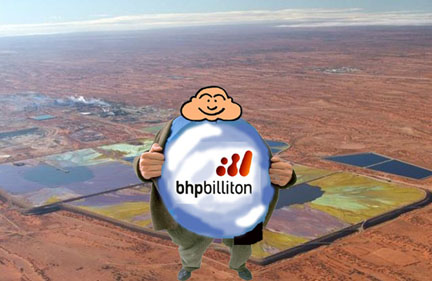
Initial Scoping – Olympic Dam Expansion Issues 22 Feb 2019 David Noonan B.Sc., M.Env.St., Independent Environment Campaigner The BHP Roxby ‘Major Project’ Copper & Uranium Mining Proposal: ‘Olympic Dreams: Major step for $3 billion, 1800-job North mine expansion’ (15 Feb, p.1 promo The Advertiser) as SA Gov. grant’s “Major Project” status to assess BHP’s latest expansion plan, to:
- Increase copper production from 200,000 tonnes per annum to 350 000 tpa, with an increase in ‘associated products’ – uranium oxide: from 4 000 to approx. 6 000 tpa;
- Use the outdated 1982 Roxby Downs Indenture Ratification Act to control this EIS assessment under the Mining Minister, with the Indenture over-riding other SA legislation and subjecting Aboriginal Heritage to a constrained version of a 1979 Act across BHP Olympic Dam operations in the Stuart Shelf Area (covering 1 per cent of SA) – rather than the contemporary standards, process and protections in the Aboriginal Heritage Act 1988;
- Use a since replaced 1993 Development Act and “Major Project” status Sec. 46 (1) that excludes Appeals regarding the Environment Impact Statement (EIS) process and outcomes;
- Use a ‘one stop shop’ Bilateral Assessment Agreement leaving the SA Gov. to conduct the assessment, including on Matters of National Environmental Significance (MNES)under the Commonwealth Environment Protection legislation (EPBC Act 1999), on nuclear actions and on the fragile Mound Springs Endangered Ecological Community – reliant on GAB waters;
- Use the SA Gov. Declaration to “Exclude” existing mining and “enabling activities” up to 200 000 tpa Cu & associated products and resultant impacts from this EIS assessment, “such as: waste treatment, storage and disposal, including but not limited to, Tailings Storage Facility 6, Evaporation Pond 6, additional cells for the contaminated waste disposal facility, and development of a low-level radioactive waste storage facility”;
- And to increase extraction of Great Artesian Basin fossil water “up to total maximum 50 million litres a day annual average” (above the volumes last assessed in 1997 and set at a max of 42 Ml/day) and give BHP rights to take GAB water – potentially up to 2070, with “any augmented or new water supply pipeline from the GAB along with any other wellfield”;…… ……. . https://nuclear.foe.org.au/wp-content/uploads/Noonan-Olympic-Dam-Expansion-2019.pdf
Paying a small tribute to Fr Denis Edwards RIP (March 5th) and his love of Earth and All connected
“I am opposed to an international waste dump in SA, because I believe we are called by God to love and to respect this land as a gift, and to protect its integrity for future generations. As Pope Francis has insisted, “intergenerational solidarity is not an option, but a basic question of justice.” He insists on the priority and fundamental role of indigenous peoples in all such decisions about the land: “For them land is not a commodity but rather a gift from God and from their ancestors who rest there, a sacred space with which they need to interact if they are to maintain their identity and values” (Laudato Si’, 146).”
Professor Denis Edwards Theology, Australian Catholic University, Priest of the Archdiocese of Adelaide
1 This month.
20 September –National Day of Action in Melbourne on the International Day of Peace


Help Aunty Sue Protect Her Land and Sacred Sites From Destructive Rocket Testing.
.

Australians deserve the truth
about
AUKUS – https://aukuspublicinquiry.com/
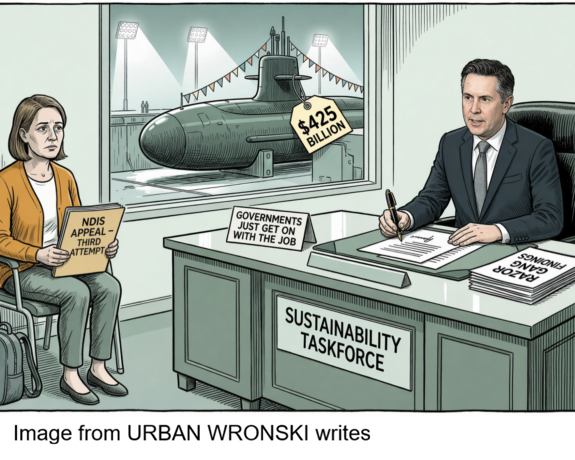

PETITION – To: Prime Minister Anthony Albanese and the Australian Labor Government

of the week – Australians for War Powers Reform (AWPR)
To see nuclear-related stories in greater depth and intensity
 Antinuclear