Abbot Point Nine fines reduced on appeal
 Source Document: mailchi.mp/frontlineaction.org/anti-adani-activist-fines-reduced 8 March 2019
Nine anti-Adani activists, each originally fined $8,000 for disciplined non-violent direct action, which blocked coal exports from Adani’s Abbot point coal terminal for a total of 14 hours in January 2018, have expressed great relief that their fines have been substantially reduced on appeal to Bowen District Court.
The activists’ fines were reduced to between $2,000 to $3,000 each.
“Our actions were aimed to highlight the massive threat posed to a liveable planet for future generations by Adani’s railway and mine. Burning the Galilee Basin’s coal will make limiting global temperature rise to 1.5 to 2 degrees above pre-industrial levels, as agreed at Paris, an impossibility.” said Liisa Rusanen, one of the nine activists.
“In confronting the climate emergency, of course we need to phase out coal and other fossil fuels. We also need to stop billion-dollar corporations from dictating government policy. The destruction of the environment has deep roots in the current political system and our future depends on facing this.” Added Nic Avery, another of the nine activists.
Another of the nine, Ella Skerret, pointed out “our original fines totalled $72,000 compared to Adani’s $12,000 fine for exceeding their licensed release of polluted water into the Caley Valley Wetlands during cyclone Debbie. A second pollution incident occurred in the recent major rainfall event and is being investigated. Will they be handed another meagre fine?”
The nine activists thanked Caxton Legal Centre, in addition to Barristers Andrew Boe and Sian McGee for their dedicated hard work in achieving this appeal court outcome.
We ignore the wipeout of insects at our peril
 Honey, we shrunk the bee and insect species that feed us,Canberra Times, By Elizabeth Farrelly, March 9, 2019 Insects or mortgage brokers, which to lose? Hmm. Tricky choice.
After the banking royal commission targeted mortgage brokers’ secret kickbacks last month, the industry retaliated. Its Grim Reaper-style advert showed an anxious family facing an endless corridor without choice or deviation. Imagine a world without mortgage brokers, the voiceover exhorted, as though that were inconceivable. Yet – such is our species’ self-absorption – no one wasted advertising dollars on a possible extinction, revealed days earlier, that’s exponentially more worrisome: the end of insects.
Insects are often held by the eco-minded (including the UN) as a solution to world hunger. There are insect cookbooks and insect-eating Ted talks. The catch, of course, is that mass insectivorism presumes precisely the kind of destructive, industrial monoculture that has turned food-production into the planetary eco-crisis we have. But there’s also this. On current trends there may not be any bugs, period – depriving us not only of crunchy six-legged comestibles but of virtually all food except (perhaps) the synthetic.
The new report, Worldwide Decline of the Entomofauna, by Australian biologists Sanches-Bayo and Wyckhuys, collated 73 longitudinal insect population studies to identify a single downward trend: continuing decline in many insect species globally over decades. “Over 40 per cent of insect species are threatened with extinction,” it says. The worst affected are those upon which world agriculture most relies yet which it also most mistreats: butterflies, moths, bees and dung-beetles.
It’s an old, old story, this prioritising of profit or convenience over nature, usually cloaked by “demand”. But in the choice between insects and mortgage brokers? Reckon I’ll follow the honey. https://www.canberratimes.com.au/national/honey-we-shrunk-the-bee-and-insect-species-that-feed-us-20190307-p512g3.html
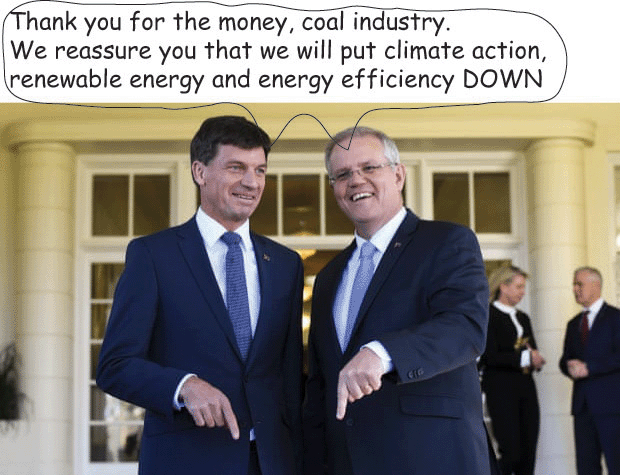
Environment minister Melissa Price and energy minister Angus Taylor lying to the public on Australia’s carbon emissions
Australia’s energy policy is a tangled mess built on a foundation of lies, Guardian,
Last week, environment minister Melissa Price and energy minister Angus Taylor once again hit the airwaves, lying to the public on Australia’s carbon emissions, claiming that emissions are falling.
“Seasonally adjusted, weather normalised” emissions for the September 2018 quarter did fall by a little over 1%. However, this cherry-picked data point deceptively obfuscates the true message that Australia’s emissions have risen year on year since Tony Abbott and Greg Hunt gleefully despatched the carbon pricing mechanism in mid-2014 and replaced it with the emissions reduction fund (ERF) the next year.
The ERF, however, has demonstrably failed to arrest Australia’s growing emissions. Continue reading
Traditional owners and Western Australia’s Conservation Council continue legal action, to uphold environmental law
 WA are continuing their fight against a proposed uranium mine, fearing unique subterranean fauna in the project area will be made extinct if it proceeds.
 “Stygofauna might be a relatively obscure species. In fact, these particular species of stygofauna were not known to science until the proponent started exploring for uranium in that area,” Mr Verstegen said on Tuesday.
“But the legal precedent here has much broader implications.
“We’re certainly very keen to be upholding environmental laws … which were never intended to be used by a minister or a government to approve the extinction of species.”
The matter was heard on Tuesday and a decision will be handed down at a later date.
Conservation Council of Western Australia (CCWA) and three Tjiwarl Traditional Owners in court battle against uranium mining
WILDLIFE AND TRADITIONAL OWNERS REPRESENTED IN LANDMARK LEGAL CHALLENGE http://www.ccwa.org.au/landmark_legal_challenge?utm_campaign=nuclear_news68&utm_medium=email&utm_source=ccwa
The Conservation Council of Western Australia (CCWA) and three Tjiwarl Traditional Owners have continued their landmark legal bid to prevent the extinction of multiple species and protect Aboriginal lands from uranium mining at Yeelirrie, with a hearing in the WA Court of Appeal today.
The Yeelirrie mine proposal by uranium miner Cameco in the Northern Goldfields on Tjiwarl Native Title land was approved by the Minister for the Environment in the final days of the Barnett Government, against the advice of the Environmental Protection Authority (EPA), and against the outcome of an appeals process.
The EPA found that the proposal would cause the extinction of multiple species of subterranean fauna.
Bret Walker SC, Dr Hannes Schoombee, and the Environmental Defenders Office WA (EDOWA) represented Traditional Owners and CCWA in the legal challenge to the environmental approval for the Yeelirrie uranium mine.
CCWA Director Piers Verstegen said, “This important case is seeking to prevent the extinction of multiple species at Yeelirrie, and uphold the rights of Traditional Owners to protect sacred country from uranium mining.
“Mr Walker is one of Australia’s most eminent legal minds and his involvement with this case is an indication of its national legal significance.
“The approval of extinction at Yeelirrie at the stroke of a Minister’s pen cannot go unchallenged because it sets a dangerous precedent for all wildlife across Western Australia.
“We are proud to stand with three members of the Tjiwarl Native Title Group, Shirley and Elizabeth Wonyabong and Vicky Abdullah, who have been fighting to protect their country from uranium mining for many years.
“As well as the threat of extinction, Cameco’s uranium project would have a major impact on the landscape and ecosystems at Yeelirrie. It would involve a 9km open mine pit and processing plant, clearing 2421 hectares of native vegetation, and generating 36 million tonnes of radioactive mine waste to be stored in open pits.”
EDOWA Principal Solicitor Declan Doherty said, “This is a landmark case to test how Western Australia’s primary environmental law should be applied.
We argued that in approving the Yeelirrie uranium mine, Minister Albert Jacob failed to correctly follow the process set out in the relevant legislation.
“It will be an important test for how the legislation should be applied, which could have significant implications for future decisions of this kind.”
Extreme weather is severely damaging Australia’s native creatures
Out of sight, out of luck: the hidden victims of Australia’s deadly heatwaves, Guardian, Graham Readfearn@readfearn 4 Mar 2019
Extreme weather events are causing severe damage to native flora and fauna, but the casualties are slipping under the radar……..
for ecosystems up and down the country – languishing far from the cities and the social media glare – there was no escape.
Australia’s Bureau of Meteorology confirmed 2018 was the hottest December since records began in 1910, while January was the hottest month ever recorded……
ere have also been less headline-grabbing climate change-related tragedies. Based on studies of past extreme heat events, the affect of this summer’s heatwaves on Australia’s flora and fauna would have been severe, fundamental and, in some cases, deadly.
“I think in a lot of places it would have been carnage,” says James Cook University ecologist Prof Bill Laurance of the January heatwave. “We have just had records after records being broken. We only tend to notice when things start dropping out of the trees. We know that basically, lots of things are dying.”……….https://www.theguardian.com/environment/2019/mar/04/out-of-sight-out-of-luck-the-hidden-victims-of-australias-deadly-heatwaves
Julian Burnside, Greens candidate will take on Treasurer Josh Frydenberg on climate change
 Burnside says Greens would not block Labor’s climate change policies, Guardian, Paul Karp, @Paul_Karp,5 Mar 2019
As Greens candidate for Kooyong, Julian Burnside sets up a four-way contest with Josh Frydenberg, Liberal-turned-independent Oliver Yates and Labor The human rights lawyer and refugee advocate Julian Burnside will run as the Greens candidate for Kooyong at the next election.
At a media conference on Tuesday the prominent barrister said he would take on the treasurer, Josh Frydenberg, in the blue-ribbon Liberal seat because he believes the “political system is broken”, with major parties listening to their donors not their constituents.
In an interview with Guardian Australia, Burnside suggested the Greens would “not treat the perfect as the enemy of the good” by threatening to block Labor’s climate change policies.
The comment suggests the candidate is keen to avoid a repeat of the Greens blocking Kevin Rudd’s emission trading scheme in favour of an interim carbon price that was later repealed by the Abbott government……… https://www.theguardian.com/australia-news/2019/mar/05/julian-burnside-takes-on-josh-frydenberg-as-greens-candidate-for-kooyong
Mining company Glencore behind global campaign to undermine climate change information
Revealed: Glencore bankrolled covert campaign to prop up coal , Guardian, Christopher Knaus@knausc, 7 Mar 2019
The mining company engaged Sir Lynton Crosby’s firm to push anti-renewables message and counter anti-coal activists The multinational mining giant Glencore spent millions bankrolling a secret, globally coordinated campaign to prop up coal demand by undermining environmental activists, influencing politicians and spreading sophisticated pro-coal messaging on social media.
An investigation by Guardian Australia can reveal the covert campaign, dubbed “Project Caesar”, was orchestrated by world-renowned political operatives at the C|T Group, the firm founded by Sir Lynton Crosby and Mark Textor.
The C|T Group used teams in Sydney and London to further Glencore’s interests across the globe, including in Australia, according to multiple sources with knowledge of the project and documents seen by Guardian Australia. …… https://www.theguardian.com/business/2019/mar/07/revealed-glencore-bankrolled-covert-campaign-to-prop-up-coal
Climate experts warn the Australian government about the nations climbing greenhouse has emissions
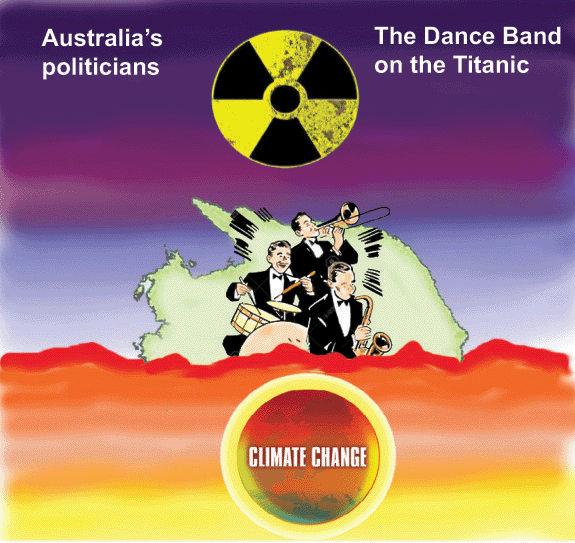 Coalition’s climate armour takes beating, SBS, News 4 Mar 19, A group of climate experts has issued a joint statement to the government, calling for a 45-to-65 per cent emissions reduction target on 2005 levels by 2030. A group of climate science experts has warned the government Australia needs more policies to cut greenhouse gas pollution in line with international obligations.
“Climate change is becoming an economic wrecking ball and it’s already having an impact,” the Climate Council’s Will Steffen said on Monday, calling for an emissions reduction target of 45-to-65 per cent below 2005 levels by 2030, instead of 26-to-28 per cent.
The joint statement was released after the government’s emissions data revealed last week showed a 0.9 per cent increase on levels in the September quarter compared to the previous year.
While emissions are declining in the electricity sector, this progress is outweighed by rises in transport and industrial energy, fuelled by a 19.7 per cent increase in LNG exports.
Climate Council spokesman and former head of BP Australasia Greg Bourne says the government’s recent policy announcements – including $2 billion for the Climate Solutions Fund – are unlikely to make a significant difference.
“Pollution has increased year on year under the government’s recently re-badged Emissions Reduction Fund,” he said.
“This is a failed policy because it does not effectively tackle pollution from fossil fuels, which contribute the lion’s share to the climate problem.”……. https://www.sbs.com.au/news/coalition-s-climate-armour-takes-beating
A climate-changed future – Australia’s marine heatwave disrupting ocean life
In the summer of 2017-18, the intense marine heatwave was combined with a land-based heatwave, together covering four million sq km. Scientists foundthe extreme weather event caused unprecedented loss of glacial ice in the New Zealand Southern Alps, changes to wine-grape harvests, and major disruption of marine ecosystems including kelp habitat loss, new species invasions and fisheries season changes.
This year the National Institute of Water and Atmospheric Research in New Zealand reported that sea surface temperatures in the Tasman were again above average.
Like coral reefs and tropical rainforests, the ocean suffers the slow torture of climate change peppered with high-intensity hits from extreme weather.
A window into the future
Marine heatwaves are generally out of sight and out of mind until one gets so bad it becomes impossible to ignore, says CSIRO research scientist Alistair Hobday.
A marine heatwave happens when the ocean temperature is much warmer than usual for the time of year from sunlight heating the surface water or warm water being brought via ocean currents – or both.
Climate change is causing marine heatwaves to happen more frequently and with more intensity. There may not be scorched earth or destroyed homes left in its wake, but a marine heatwave impacts our future in different ways – and serves as a warning. ……… https://www.theguardian.com/environment/2019/mar/05/australias-marine-heatwaves-provide-a-glimpse-of-the-new-ecological-order
Drought wipes billions from Australian farm production
ABC Rural By national rural reporter Kath Sullivan 4 Mar 19.The value of all that is farmed in Australia has fallen to $58 billion, from $63.8 billion two years ago.
In its latest commodity report, released today, ABARES found improved commodity prices and the low Australian dollar had softened the decline, largely driven by drought.
“Drought in the eastern states significantly reduced the 2018–19 winter crop, but one of the largest Western Australian harvests on record has provided a buffer to the national total,” it said.
Livestock industries also contributed to the decline, with ABARES reporting the volume of livestock products dropped by 2 per cent this year.
“Milk and wool production have been affected by the drought, and a significant decline in live animal exports also contributed to the fall,” it said.
“This is largely because of cessation in live sheep exports during the northern hemisphere summer months.”
ABARES reported that floods in Queensland last month could further reduce the volume of live cattle exports…….. https://www.abc.net.au/news/2019-03-05/value-of-australian-farm-production-drops-abares-figures/10867294
Victoria’s major bushfires still out of control
Victoria bushfires: Major blazes still out of control as residents may be allowed to return home
By 9News Staff, 6:03am Mar 5, 2019 Five of the 29 bushfires burning in Victoria this morning are still out of control this morning stretching across 59,000 hectares of land.
A cooler weather change that is moving over the state has seen yesterday’s ‘Emergency’ warning zones downgraded to a ‘Watch and Act’ level, however authorities have warned that four major fires are still out of control.
Those incidents include the largest blaze still raging in Victoria at the Bunyip State Park which is still sparking spot fires in multiple areas…….https://www.9news.com.au/2019/03/04/18/10/news-melbourne-bushfires-bangholme-dandenong-south-fire
Long delayed realisation of Australia’s brutal history of massacres of Aboriginal people
As the toll of Australia’s frontier brutality keeps climbing, truth telling is long overdue, The myth of benign, peaceful settlement persists today – even as historians reveal a far more sinister picture
• The Killing Times: the massacres of Aboriginal people Australia must confront
• A massacre map of the frontier wars – interactive
Guardian by Paul Daley, 4 Mar 19
“………… The Australian Museum estimates that pre-European invasion in 1788, about 750,000 Indigenous people (representing some 700 language groups) inhabited the continent that would become Australia. This figure may well be an underestimate.
Little over a century later, by federation in 1901, the Aboriginal and Torres Strait Island population had diminished to some 117,000. Black-white warfare and organised massacres, no matter how you define them, with police, British soldiers, native police, militia and raiding parties as the perpetrators, accounted for many tens of thousands of deaths. Individual acts of violence – including shootings, poisonings, torture and illegal incarceration – killed many more. Battle wounds, starvation (owing to the depletion of traditional hunting grounds) and disease – all of which can also be directly linked to invasion and frontier conflict – killed countless others.
Yet the historiographic confect of benign, peaceful settlement and the unexplained “passing” or “extinction” of the “natives” pervaded well into the 1960s, replete with the deception that very few Aboriginal people died violently during pastoral and urban expansion and dispossession. Things began to change with the emergence of a new, more inquisitive, less empire-centric cohort of historians and writers who, not content with the Anglophile colonial trope of terra nullius and benevolence to the Indigenes, began to commit truth to the page………..
In the 1970s and 1980s a number of historians – among them Henry Reynolds, Marilyn Lake and Richard Broome – began focusing on frontier violence, using the colonial records, newspaper archives and family histories (including generational oral accounts of killings).
Reynolds is acknowledged as the first Australian historian to make a calculated continental estimate of the number of Aboriginal and Torres Strait Islanders who died violently in Australian frontier conflict. In his 1981 book, The Other Side of the Frontier, and after at least a decade’s research Reynolds estimated the figure at about 20,000……….
Reynolds speaks of the significance of Evans and Ørsted-Jensen’s research on the numbers of killings in colonial Queensland.
Based on an extrapolation of native police documentation, they estimated (conservatively) that as many as 60,000 Aboriginal people died in frontier violence in Queensland alone.
The national implications of the figure are profound; the wars that raged across this continent from 1788 did, it seem, claim more Indigenous lives than 62,000 Australian service personnel who died in the first world war………… https://www.theguardian.com/australia-news/2019/mar/04/as-the-toll-of-australias-frontier-brutality-keeps-climbing-truth-telling-is-long-overdue
Over 2000 firefighters working to contain bushfires around Victoria
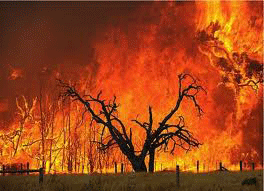 Fires rip through Victoria: ‘worse than Black Saturday’, A fire, which has destroyed properties and more than 10,000 hectares of land is burning in the same area as the deadly Black Saturday bushfires. Bushfires have ripped through Victoria’s east, with a wind change challenging firefighters working all night to contain the blaze. SBS News 4 Mar 19
Despite cooler conditions expected on Monday, firefighters may have to contend with dry lightning, which could start more fires.
The Bunyip State Park fire, burning 65km east of Melbourne, was sparked by lightning strikes on Friday and has destroyed more than 10,000 hectares.
The blaze is still racing towards the Princes Freeway and emergency warnings remain in place for the surrounding area.
“The risk of lightning redevelops in the late morning with the chance of some showers and thunderstorms,” Bureau of Meteorology’s senior forecaster Christie Johnson said.
While there was a chance of showers, it was hard to pinpoint where they would hit, and there would only be a few millimetres of rainfall, she said…..
More than 2000 firefighters are working to contain blazes around the state …..https://www.sbs.com.au/news/fires-rip-through-victoria-worse-than-black-saturday
Australia’s Energy Minister, Angus Taylor, lying about Australia’s greenhouse emissions
Angus Taylor again falsely claims Australia’s greenhouse emissions are falling, Guardian, Amy RemeikisIn an interview with the ABC program Insiders, Angus Taylor repeatedly stated emissions had decreased by 1% repeating the line first said by the prime minister, Scott Morrison, that Australia would meet its Paris commitments in “a canter”……. https://www.theguardian.com/australia-news/2019/mar/03/angus-taylor-again-falsely-claims-australias-greenhouse-emissions-are-falling
1 This month.
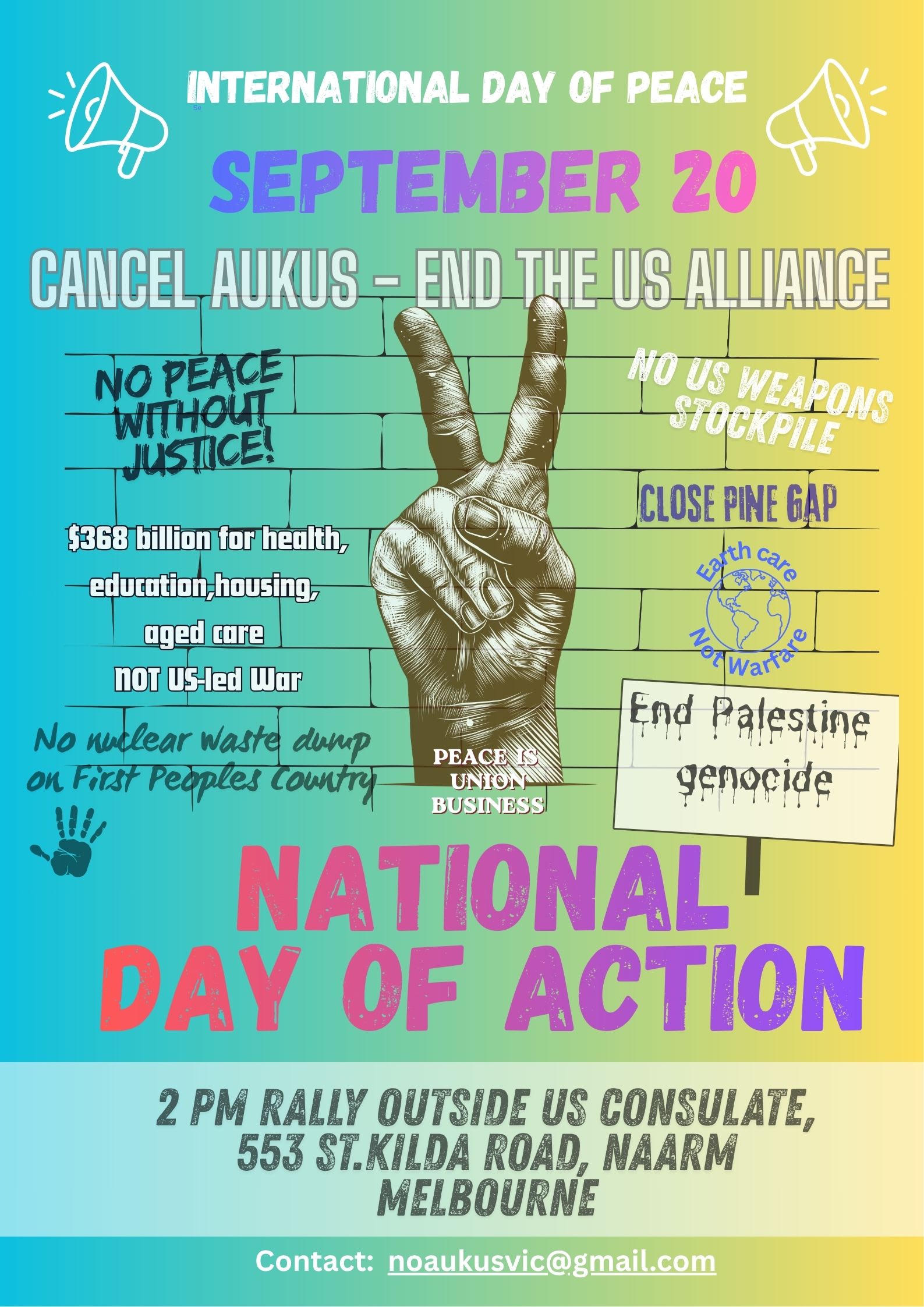
20 September –National Day of Action in Melbourne on the International Day of Peace

Help Aunty Sue Protect Her Land and Sacred Sites From Destructive Rocket Testing.
.

Australians deserve the truth
about
AUKUS – https://aukuspublicinquiry.com/


PETITION – To: Prime Minister Anthony Albanese and the Australian Labor Government

of the week – Australians for War Powers Reform (AWPR)
To see nuclear-related stories in greater depth and intensity
 Antinuclear