Risk of terrorism at radioactive waste site kept secret from residents near earmarked sites,Jade Gailberger, Federal Political Reporter, The Advertiser February 24, 2019 https://www.adelaidenow.com.au/news/south-australia/risk-of-terrorism-at-radioactive-waste-site-kept-secret-from-residents-near-earmarked-sites/news-story/2d275aa3353d665011b9b4792b5dea17
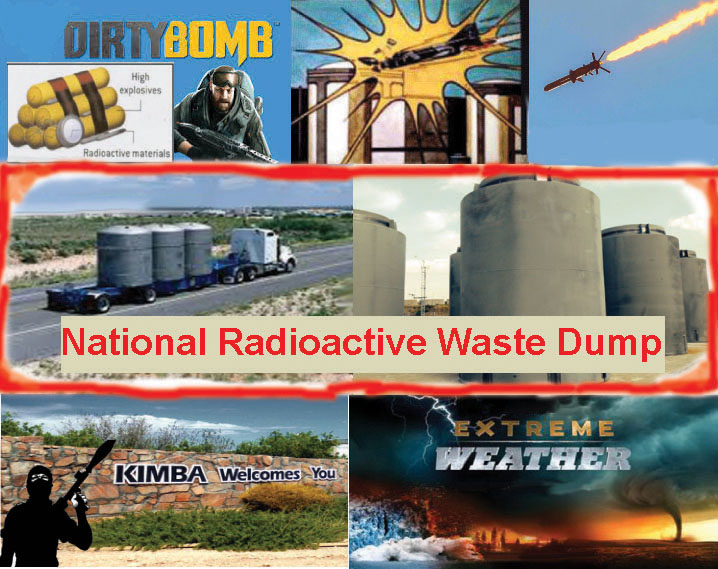
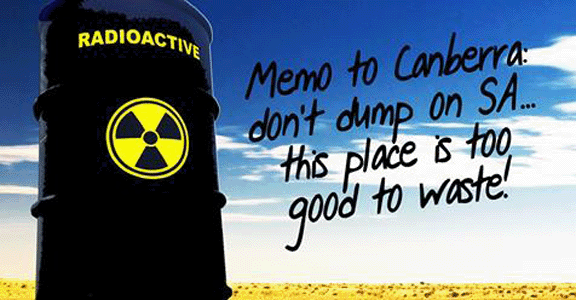
The risk of terrorist activity at a radioactive waste site, including the removal of drums for use in a “dirty bomb”, has been kept secret from residents near two sites earmarked for a new national dump.
As the communities of Hawker and Kimba remain divided on the site selection for a new waste site, documents obtained under Freedom of Information laws reveal the Defence Department identified a potential risk of terrorist activity at a dump at Woomera.
The revelation has cemented the security concerns of residents, who say they have been ignored by Government officials.
The now closed Koolymilka dump, situated on Defence land at Woomera, was licensed for temporary radioactive waste storage but has not taken new material since 2010.
An emergency response plan for the site, which still houses waste that is anticipated to be transferred to a national facility, details scenarios that may affect it including:
TERRORISTS removing drums to make a “dirty bomb”.
MISSILE and aircraft strikes, fire, flood or a storm in Woomera that could damage the building and cause contamination if drums ruptured.
CIVILIAN protest activity.
Defence has said it has no responsibility to inform the public of the risks because the new waste dump is an Industry Department project.
Kimba farmer Peter Woolford, who is opposed to radioactive waste storage on agricultural land, said security, terrorism and fire concerns at a national site had been raised but “fobbed off” by officials who claimed it “would be safe”.
“The (Industry) Department continually says it is going to be open and transparent but you have to obtain FOI documents to get the full story,” he said. “It’s an issue that the department should be … explaining.”
Centre Alliance Senator Rex Patrick said communities had been denied information needed to make an informed decision about a dump in their region.
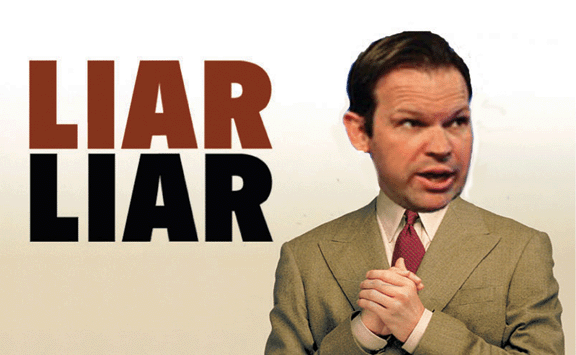
At a Senate estimates hearing last week, Mr Patrick asked if the Industry Department had briefed the communities about potential terrorism. Industry Minister Matt Canavan said: “I have never been provided with any advice that this is at all a risk … this has never been raised as an issue”.
The Industry Department said the new dump would pose “no security or safety risk to the community” and “significant detail” on safety and security had been made public.
The Australian Nuclear Science and Technology Organisation said 14 of 45 jobs at the new dump would be security.
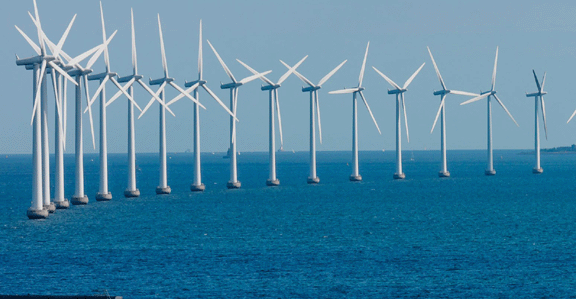
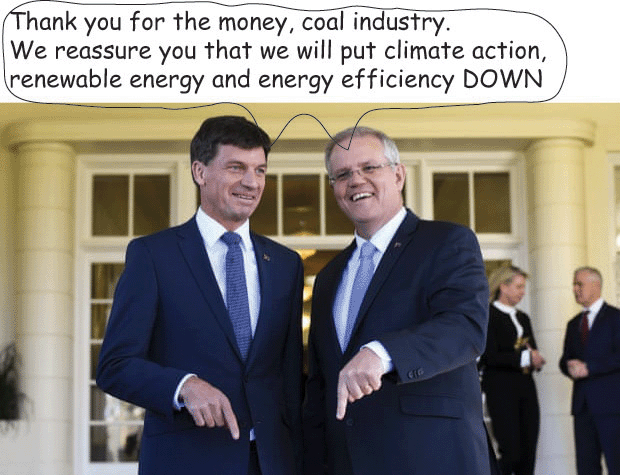
Development of Australia’s first offshore wind farm, which would power up to 1.2 million homes, has been stalled by Energy Minister Angus Taylor’s failure to sign off on an exploration license allowing a detailed assessment of the wind resource to commence.
Development of Australia’s first offshore wind farm, which would power up to 1.2 million homes, has been stalled by Energy Minister Angus Taylor’s failure to sign off on an exploration license allowing a detailed assessment of the wind resource to commence.
The Department of the Environment and Energy confirmed during Senate Estimates that an evaluation of the project has been undertaken, a plan for a customised exploration license developed, and a briefing and recommendations provided to the Energy Minister, but that the project can progress no further without the Minister granting the exploration license.
The Star of the South project seeks to construct 250 wind turbines in Commonwealth waters off the coast of Victoria’s Gippsland region, generating up to 20 per cent of Victoria’s electricity needs and feeding the power into the National Electricity Market via an underground cable to the Latrobe Valley.
The Maritime Union of Australia said the project — which the company claims will create up to 12,000 manufacturing and construction jobs and slash Australia’s carbon emissions — appeared to be falling victim to the Morrison Government’s ideological hatred of renewable energy.
MUA Deputy National Secretary Will Tracey said the exploration license awaiting approval did not allow construction to commence and was simply about allowing the use of floating buoys and platforms off the Gippsland coast to gather wind and wave observations.
“We have a major wind project that would create thousands of jobs and provide clean, reliable energy for more than a million Australian households, but because of their ideological hatred of renewable energy the Morrison Government appears to be actively stalling its development,” Mr Tracey said.
“The Star of the South project has been in the works since 2012, yet in this time no legislation has been put forward, no regulatory framework put in place, and no responsible agency nominated, despite offshore wind being an established industry internationally.
“Now we have revelations from Senate Estimates that Energy Minister Angus Taylor has been briefed on the project and presented with recommendations, yet the exploration license continues to sit on his desk gathering dust.
“Rather than support renewable energy projects, under the Morrison Government we can’t even get approval for a few wind measurement buoys off the Gippsland coast.
Energy Minister Angus Taylor must get off his hands and immediately allow the Star of the South wind project to move forward to the exploration stage.”
Mr Tracey said offshore wind generation was a mature industry internationally which has successfully operated for two decades, but Australia was falling behind, putting future employment opportunities at risk.
“This project isn’t just about generating renewable energy and tackling climate change, it’s about creating secure jobs for the future, particularly for workers who are being displaced from the offshore oil and gas industries,” he said.
“The Federal Government urgently needs to put in place a plan to support the development of the offshore wind industry, including a clear regulatory framework, along with the right port infrastructure and specialised construction vessels to roll out this project and others like it as quickly as possible.”
‘Everyone loves solar’: Climate action heats up as NSW election issue, Brisbane Times By Peter Hannam February 23, 2019 NSW voters, including conservative ones, want the state government to step up action on climate change, including boosting renewable energy, two separate polling sets show.
A statewide Essential survey conducted February 6-11 for the Nature Conservation Council of 544 respondents found 51 per cent were more likely to back a party boosting clean energy and 18 per cent less likely. Among those identifying as Liberal or National supporters, the ratio was 43 per cent in favour and a quarter against.
Three separate uComms surveys for Greenpeace, each of more than 600 respondents conducted in marginal seats of Ballina, Coogee, and Penrith, found higher support for renewable energy.
In Penrith, for instance, 60 per cent of Liberal voters said they were more likely to support a party investing in renewables and 30.7 per cent less likely. In Coogee, 52.1 per cent of Liberal voters were more likely to back a party with such policies, and 38.6 per cent against.
In Ballina, 65 per cent of National supporters agreed rooftop solar and batteries would cut household power bills for homeowners and renters, while 32.8 per cent disagreed.
The polling comes amid another torrid period of extremes. NSW smashed heat records in January, with temperatures almost six degrees about average and two degrees above the previous record set in bushfire-scorched January 1939.
Much of the state remains in severe drought – with 2019 off to a dry start amid rainfall levels typically less than a fifth of normal levels – sending reservoir levels tumbling and contributing to a series of mass fish kills and algal bloom outbreaks in the Darling and other rivers.
While climate scientists have yet to determine the role climate change is having, the background warming of more than a degree over the past century across Australia is raising the likelihood of heatwaves. Climate models also point to a long-term drying trend across southern Australia, including NSW, with more to come.
No policy’
The onus to demonstrate action to tackle climate change appears to fall heavier on the Coalition if the polling and last December’s federal byelection for the Sydney seat of Wentworth are any guide, Kate Smolski, chief executive of the Nature Conservation Council, said.
“Voters deserted the Liberals in Wentworth over climate change, and [this month’s] poll shows that it’s a statewide phenomenon,” Ms Smolski said.
“This is bad news for the Berejiklian government, which after eight years of Coalition rule still doesn’t have a climate change policy or a renewable energy target.”……..
the Greens plan to introduce a carbon change bill, including a broad carbon price, to reach the net-zero emissions goal by 2040.
“We need targets with teeth if we are going to actually decarbonise,” Cate Faehrmann, Greens environment spokeswoman, said. “That is why I have developed legislation which sets binding targets to reach net-zero emissions by 2040 and gives ordinary citizens the power to prosecute government ministers who are not serious about meeting these targets.”
Jeremy Buckingham, the former Greens and now independent MP, said policies are needed to tackle emissions from agriculture, industry and transport.
NSW election: our chance to vote 1 for climate and health, Croakey, Editor: Mark Ragg Author: John Van Der KallenJohn Van Der Kallen is a rheumatologist and the NSW Chair of Doctors for the Environment Australia. February 21,2019The Lancet has described tackling climate change as the ‘greatest global health opportunity of the 21st century.’ The upcoming NSW election is one of those opportunities to improve our health, but we need to vote for politicians who will take climate change seriously.
Tackling climate change will involve moving rapidly to renewable energy. It is encouraging to hear the NSW Labor party proposing seven gigawatts of new reliable renewable energy to power more than three million homes in the state by 2030. This is a good start on our way to 100% green power.
Stopping emissions from coal-fired power stations will immediately improve our health with fewer deaths, cardiovascular disease, low birth weight babies, premature babies and new cases of diabetes. Tightening the licences on coal fired power stations to reduce pollution, as well as putting a price on pollution by increasing the load based licencing fee, will further improve health.
Extreme weather events
Climate change is impacting on our health everyday through extreme weather events such as more severe fires, floods, droughts and heat waves. For Australia, January was the all-time hottest month. Hot weather exacerbates the urban heat effect resulting in huge discrepancies in temperatures from eastern to western Sydney. It worsens ozone pollution and puts more pressure on our emergency services. It is risking our food and water security. Most importantly, it causes an increase in deaths.
And this is only the beginning. Global temperatures are going to increase even if we were able to reduce our emissions to zero overnight.
With the right policies, there are many opportunities to improve our health in ways that will also mitigate against climate change. It’s a win-win situation.
Fortunately, many of the climate change sceptics are starting to understand climate change. For those who still don’t accept the science, the recent judgement in the Rocky Hill open cut coal mine case has made an impact. The mine was rejected for a number of reasons including its implications for climate change. In this judgement, the chief justice of the Land and Environment court stated: ‘All anthropogenic greenhouse gas emissions contribute to climate change…. The increased greenhouse concentrations in the atmosphere have already affected, and will continue to affect, the climate system.’
No more room for fossil fuel developments
So, it is now stated in law that humans are making climate change worse and that there is no room for further fossil fuel developments. This has caused massive concern within the fossil fuel industry. It is interesting to see how some politicians and some newspapers have responded by trying to discount this judgement. It has even resulted in the NSW Bar having to defend the Chief Justice!
Coal is not the only fossil fuels that needs to stay in the ground. Unconventional gas (UCG) is one of those fossil fuel developments which will also make climate change worse. It is imperative that this industry is not developed any further. UCG is not a transition fuel as some political parties would have us believe. The fugitive emissions alone are sufficient to negate any perceived benefit of UCG over other fossil fuels……..https://croakey.org/nsw-election-our-chance-to-vote-1-for-climate-and-health/
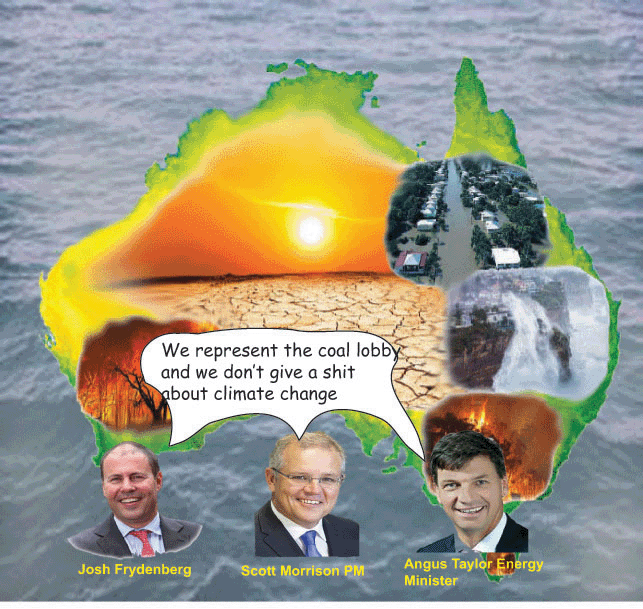
Scott Morrison to reboot Tony Abbott’s emissions reduction fund with $2bn PM to announce ‘climate solutions fund’ to appeal to voters concerned about Coalition’s record , Guardian, Katharine Murphy Political editor@murpharoo, 25 Feb 2019
Scott Morrison will attempt to appeal to voters deeply concerned that the Coalition has been been wreckers on climate change by rebadging Tony Abbott’s emissions reduction fund as a “climate solutions” fund – with $2bn to be rolled out over 10 years.
Attempting to draw a line over years of destructive in-fighting within the Coalition that has cruelled various emissions reduction policies, the prime minister will use a speech in Melbourne on Monday to launch a new package of measures on climate change, saying his government acknowledges and accepts the challenge “but we do so with cool heads, not just impassioned hearts”.
The emissions reduction fund is a vestige of Abbott’s heavily criticised Direct Action policy. Funded by taxpayers initially at $2.5bn, the ERF pays farmers and businesses to cut carbon dioxide pollution to below what it would otherwise be. But an investigation by Guardian Australia last year found it was often difficult to determine if the fund was offering value for money.
Morrison will confirm on Monday the ERF will be rebadged a “climate solutions fund” and given a 10-year funding profile. The rebooted fund will partner with farmers, local governments and businesses to deliver “practical climate solutions” across the economy that reduce carbon emissions.
The prime minister will also continue to assert that Australia will meet its Paris target despite the trend of rising emissions in the economy that has been evident in the government’s own figures since the abolition of the carbon price in 2013.
But a chart released in advance of Monday’s speech makes it clear the looming abatement exercise will rely significantly on accounting measures as well as on practical emissions reduction.
According to projections done last December, the government will count a 367 megatonne abatement from carry-over credits (an accounting system that allows countries to count carbon credits from exceeding their targets under the soon-to-be-obsolete Kyoto protocol periods against their Paris commitment for 2030) to help meet the 2030 target.
It is also factoring in emissions reduction from Turnbull’s pet project, the Snowy 2.0 expansion (which the Morrison government has not yet formally signed off on); energy efficiency measures; an electric vehicle strategy (that it has not yet unveiled); the rebadged climate solutions fund; additional hydro projects and just under 100Mt of abatement from “technology solutions” (which aren’t specified) and “other sources of abatement” such as projects under development but not yet contracted……. https://www.theguardian.com/australia-news/2019/feb/25/scott-morrison-to-reboot-tony-abbotts-emissions-reduction-fund-with-2bn
David Noonan 24 Feb 19,This shipment came in from France through Port Kembla to Lucas Heights. This was the first shipment ‘returned’ to Australia from previous ANSTO irradiated nuclear fuel waste shipments sent overseas for ‘reprocessing’ – to get it out of the country – while ANSTO continues to produce more… ANSTO have produced nuclear fuel waste for 60 years without a disposal capaciity, and intend to continue to do so for multiple decades to come, while targeting ‘indefinate’ above ground storage (said to be for up to 100 years) on communities in SA…
The seventh meeting of the Scientific and Technical Advisory Committee (STAG-7) of the Convention to Ban the Importation of Hazardous and Radioactive Wastes into Pacific Island Countries and to Control the Trans boundary Movement of Hazardous Wastes and the Management of Hazardous Wastes within the South Pacific Region (Waigani Convention) is underway in Nadi .
The two day regional meeting, chaired by the Director of Environment, Sandeep Singh, discussed the sound management of hazardous wastes and radioactive waste in the region. The outcomes from this meeting will be presented before the 10th Conference of the Party of the Waigani Convention in September 2019.
The 1995 Waigani Convention is a regional treaty that bans the exporting of hazardous and radioactive wastes to Pacific Island Forum countries, and prohibits forum island countries from importing such wastes.
The meeting is being attended by Australia, the Cook Islands, Fiji, Kiribati, Niue, Papua New Guinea, Samoa Tonga, Tuvalu, and Vanuatu. Other parties to the Waigani Convention included the Federated States of Micronesia, New Zealand and the Solomon Islands.
Waigani Convention, SPREP – Pacific EnvironmentThe Convention to Ban the Importation into Forum Island Countries of Hazardous and Radioactive Wastes and to Control the Transboundary Movement and Management of Hazardous Wastes within the South Pacific Region, also known as Waigani Convention, entered into force in 2001.
The Waigani Convention is modelled on the Basel Convention and constitutes the regional implementation of the international hazardous waste control regime (Basel, Rotterdam and Stockholm Conventions. There are however some differences between the two conventions: the Waigani Convention covers also radioactive wastes and extends to the Exclusive Economic Zone (200 nautical miles) rather than the territorial sea (12 nautical miles) under Basel.
The Convention is also strongly related to the Convention on the Prevention of Marine Pollution by dumping of wastes and other Matters, 1972 (London Convention)…….
Members are listed – include Australia, the Cook Islands, Fiji, Kiribati, Niue, Papua New Guinea, Samoa Tonga, Tuvalu, and Vanuatu. Other parties to the Waigani Convention included the Federated States of Micronesia, New Zealand and the Solomon Islands……more https://www.sprep.org/convention-secretariat/waigani-convention
Australia ramps up whistleblower protection, International Adviser, By Kirsten Hastings, 21 Feb 19 “…..Individuals who expose illegal or unethical behaviour at Australian institutions will be granted greater protections following updates to the law.
The changes follow a particularly damning period for Australia’s financial services industry, which has been hammered by a Royal Commission into banking, superannuation and financial services…..
The Australian Securities and Investments Commission (Asic) welcomed the passing of the Treasury Laws Amendment (Enhancing Whilsteblower Protections) Bill 2018, which was approved on 19 February.
What are the reforms?
Collectively, they will:
Broaden the whistleblower definition to include both current and former employees, officers and contractors, as well as their spouses and dependents, and anonymous disclosures.
Extend the protections to whistleblower reports that allege misconduct or an improper state of affairs or circumstances about any matter covered by financial sector laws, as well as all commonwealth offences punishable by imprisonment of 12 months or more.
Create civil penalty provisions, in addition to the existing criminal offences, for causing detriment to (or victimising) a whistleblower and for breaches of confidentiality.
Provide protections for disclosures to journalists and parliamentarians in certain circumstances.
Scottish ministers can stop nuclear waste dump, say advisers,The Ferret, 19 Feb 19, Scottish ministers have the power to halt plans to dump nuclear waste on Aboriginal land in Australia which could breach human rights, according to government advisors.
Documents obtained by The Ferret reveal that expert advice sought by ministers stated that the Scottish Government could prevent the export of radioactive waste from the UK under a swap arrangement involving the Dounreay nuclear complex in Caithness.
The revelations have prompted campaigners to call for the Scottish Government to step in and stop the waste dumping, which they see as a potential desecration of sacred Aboriginal lands in south Australia.
The Scottish Government and its regulator, the Scottish Environment Protection Agency (Sepa), have insisted that regulating the waste shipment is not their responsibility – but Sepa’s former chief executive says this is wrong.
Nuclear fuel was sent from an Australian research reactor to Dounreay for reprocessing in the 1990s. The resulting radioactive waste, amounting to 51 cemented drums, was originally due to be returned to Australia for disposal.
But under the terms of a waste substitution deal in 2014, Scottish and UK governments agreed that the drums should stay at Dounreay because of the difficulties of transporting them around the globe……
Peter Roche, an anti-nuclear campaigner and member of Nuclear Waste Advisory Associates, pointed out that environmentalists were opposed to nuclear waste being transported around the world. “It should be stored in above
ground stores on the site where it is produced,” he said. “And should certainly not be sent back to Australia if it is likely to pose a potential risk to the rights of Aboriginal communities near the two proposed storage sites in Australia.” He added: “The Scottish Government should accept that it bears some responsibility for this waste and tell the UK government
to halt the proposed shipment.” https://theferret.scot/scottish-government-australian-nuclear-waste/
TOP STUDENTS SELECTED TO WORK WITH AUSTRALIA’S BEST NUCLEAR SCIENTISTS, 20 February 2019 ANSTO
This month ANSTO is opening its doors to 11 talented young people from across Australia as the two-year Graduate Program kickstarts.
Working from Lucas Heights, ANSTO’s 2019 graduates will get extraordinary insights into nuclear science, engineering and technology and how it is being applied to help achieve sustainability for our health and environment industries.
Eminent members of legal profession, including a former supreme court judge, critical of law firm’s strategy document, The Adani mining company’s “legal intimidation” tactics against community groups are a “threat to democracy” and “gravely concerning”, say eminent members of the legal profession, including a former supreme court judge and an expert on corporate lawfare.The ABC reported on Tuesday that a law firm hired by Adani, AJ & Co, wrote a strategy document urging the Indian miner to “play the man” and adopt an aggressive legal posture against opponents.
The documents suggested Adani should trawl social media for evidence of bias among activists and decision makers. It recommended using the legal system to bankrupt poorly resourced opponents, silence commentators and put pressure on government……
Brian Walters, a Melbourne-based QC and human rights advocate, is an expert on so-called Slapp suits – strategic lawsuits against public participation. He wrote the 2005 book Slapping on the Writs and said using the law to silence community groups undermined the democratic process.
“It is a fundamental feature of free speech that people should be allowed to comment on the way that corporations and other powerful people are using their power,” Walters said.
“What appears to have happened here is a large corporation has agreed to use, or has tried to use, threats of legal intimidation to silence the public in speaking out about its proposals.
“When corporations attempt to use the law not to achieve a legitimate forensic outcome but to intimidate those who criticise them, they are abusing the process of the law. They are bringing the law and indeed their own corporation into disrepute.”…..
The Environmental Defender’s Office Queensland said on Tuesday it had received a legal letter sent on behalf of Adani on 12 September “clearly designed to intimidate us”.
“Instead of spending its legal energy on complying with Queensland’s laws, Adani is hiring lawyers to silence its critics in a well-funded campaign of intimidation, EDO Queensland’s chief executive and solicitor Jo-Anne Bragg said.
“Wangan and Jagalingou Traditional Owners say an explosive ABC report this morning has revealed the corruption of process and the intimidation being engaged in by Adani’s new legal team. They say Adani are trying to silence its opponents and build political pressure to push its Carmichael project through. (ABC News story here).
The Traditional Owners say they are clearly targeted in Adani’s “attack dog plan” and that Adani’s new law firm, AJ&Co, is running a malicious strategy to take down Adani’s critics, including the W&J Council’s senior spokesperson Adrian Burragubba. … “
The Psychology Of Getting Julian Assange, Part 1: What’s Torture Got To Do With It? New Matilda, By Dr Lissa Johnsonon February 19, 2019 “…Next month rallies will be held in Sydney and Melbourne in defence of Julian Assange. Protesters will call upon the Australian government to uphold its obligations to its citizens and secure freedom for Assange, whose health is failing is in his ninth year of UN-declared arbitrary detention.
Assange faces extradition to the United States and secret charges for his publishing activities should he step outside the Ecuadorian Embassy in London. This cross-border, extraterritorial persecution threatens not only Assange’s health, and possibly his life according to a recent UN statement, but poses grave legal risks both to journalism and dissent.
Among the speakers at the Sydney rally will be renowned journalist and film maker John Pilger, who will address protesters in the Amphitheatre at Martin Place on Sunday, March 3rd, from 2pm. The Melbourne rally will be held at the State Library on Sunday March 10th, from 1pm.
The Australian rallies join a growing international chorus of organisations and individuals sounding increasingly urgent alarms over Julian Assange’s plight, and its implications for freedom of speech and democratic rights.
Late last year, as secret US charges against Julian Assange surfaced, and the threat of his imminent extradition to the US loomed, the United Nations Working Group on Arbitrary Detention (UNWGAD) issued a strongly worded statement to the UK Government, having previously ruled twice that Assange is being arbitrarily detained in the Ecuadorian Embassy in London.
In its statement, the UNWGAD demanded that the UK abide by its “binding” legal obligations and “immediately” secure freedom for Julian Assange. The UN reminded the UK Government that “human rights treaty law is binding law, it is not discretionary law. It is not some passing fancy”.
The same fears prompted 33 EU parliamentarians to write a similarly strongly worded letter to the British Prime Minister, the Ecuadorian President and the UN Secretary General on December 10th, condemning the “very serious and egregious violations of human rights in the heart of Europe.” They called for Assange’s “immediate release, together with his safe passage to a safe country.”
Two German MPs followed with a visit to the Ecuadorian Embassy on December 20th, at which they denounced the violation of Assange’s “fundamental rights” and expressed their “demand that this case has to be solved: that no publisher, no editor, no journalist is detained because of publishing the truth”.














 Antinuclear