Kazzi Jai shared a link. 18 Feb 19, Fight To Stop Nuclear Waste In The Flinders Ranges
 X-rays and CAT scanners (which use x-rays) in hospitals do not use radioactive sources. The films
  from X-rays are very valuable due to their silver content, and can be recycled if they are no longer required. There are now hospitals which are using phosphor flat plate detectors on their X-ray machines, so that a digital image is obtained and kept on hospital computer files instead of generating a film.
The disposable items such as gloves, gowns, sheets etc used in hospitals for loved ones using nuclear medicine are withheld for a period of 10 or more days, then deemed, according to safety regulations, to be safe to be discarded in normal waste.
Of the isotopes which ANSTO – Lucas Heights reactor produces, only 28% are actually used in Australian Hospitals. The rest – 72% – are sent overseas. Which is interesting as the majority of Lucas Heights reactor use is for nuclear medical isotope production!
And of that 28% which is quoted as used in Australian hospitals, the majority of those isotopes are used for nuclear medical imaging – the rest is for treatment. So in fact actual nuclear medical treatment using isotopes is very small.
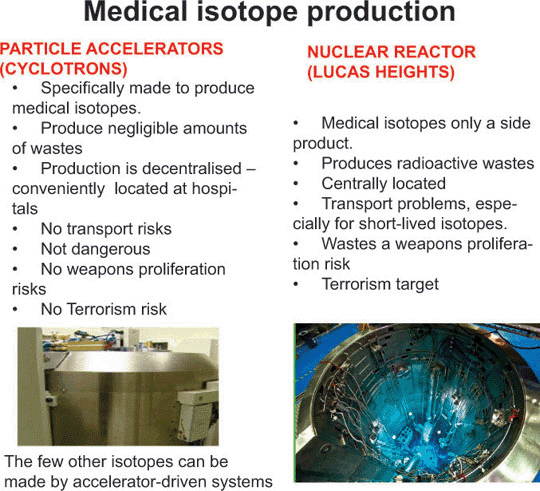
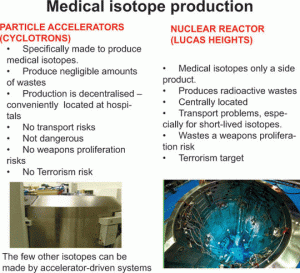 Also noteworthy is that now cyclotron/imaging partnership locations are found in all of the capital cities in Australia including Darwin – only Hobart does not. This means there will be less reliance on the isotope production from Lucas Heights, as cyclotrons allow generation of isotopes for imaging on site, and do not utilize radioactive sources such as a nuclear reactor to generate them! In other words they do not produce nuclear waste!
In Adelaide you will find the cyclotron and an imaging partnership in the SAHMRI building.
And ANSTO is heavily involved in the cyclotron sector as well. They have a cyclotron in Sydney and a similar piece of equipment called a synchrotron in Melbourne. But you rarely hear about those in South Australia……..
The solution to the waste generated at Lucas Heights – and they have the majority of the nuclear waste generated in Australia by the way, because they generate it there – is to keep it at Lucas Heights!
They claim it is safe there – then keep it there, until they have found a way to properly deal with the Intermediate Level Nuclear Waste, and the Low Level Nuclear Waste can follow that!
Double handling of Intermediate Level Nuclear Waste is NOT World’s Best Practice! Neither is transporting nuclear waste  over 1500+kms away from where it is generated!
And Lucas Heights has plenty of space to deal with its waste – and we have been told by DIIS and ARPANSA that should a suitable site not be found, that production of isotopes would not be affected nor Lucas Heights licensing and regulations be affected, and they would simply build more buildings to accomodate it.
Oh….and here is a link on how X-rays in hospitals (both used in X-ray machines and CAT scanners) are generated, if you are interested – https://en.wikipedia.org/wiki/X-ray_tube?fbclid=IwAR1u7fjU4_VazLAkx48teUiEHXccLTZZFKB99C_029yGUXWu18wkbmXaxow
February 19, 2019
Posted by Christina Macpherson |
AUSTRALIA - NATIONAL, reference, spinbuster |
Leave a comment

At 7th February 2019, all positions on the Kimba radioactive dump community consultative committee are vacant.
Committee members as in 2018 – the committee doesn’t seem to have been active since June 2018?
- Allan Suter (Convener)
- Dean Johnson (Deputy Convener)
- Symon Allen.
- Heather Baldock.
- Jeffrey Frank Baldock.
- Pat Beinke.
- Randall Cliff.
- Kellie Hunt.
February 19, 2019
Posted by Christina Macpherson |
Federal nuclear waste dump, South Australia |
Leave a comment


Noel Wauchope, 19 Feb 19 Today’s Adelaide Advertiser makes it clear. Adam Creighton , Economics Editor at The Australian, is quoted approvingly, as he calls for Australia’s laws against nuclear power to be removed – “for the public good”
According to Mr Creighton – nuclear power is ” ‘the best, most reliable, emissions-free form of power’”
Never mind that nuclear power is hugely expensive, takes decades to set up, lacks the flexibility needed in modern energy systems, and produces toxic wastes – https://www.ecowatch.com/nuclear-power-cost-renewables-2625524662.html
Emissions free? That’s a lie . more – http://www.counterpunch.org/2015/02/05/why-nuclear-power-is-not-low-carbon/
February 19, 2019
Posted by Christina Macpherson |
media, South Australia |
Leave a comment
Bad enough that leaked information has shown Adani and their lawyers will go after individual people, and attempt to use our legal system on our own government in an effort to bankrupt, jail and silence anyone stopping theirr mine.
“Lawyers for mining firm Adani proposed waging “war” on opponents of its controversial Queensland mine by using the legal system to pressure government, silence critics and financially cripple activists, according to documents obtained by the ABC.”
Adani are under investigation for tax evasion, and fraud (1), and have found themselves between a rock and a hard place with the massive mobilisation against the Carmichael mine in Australia putting the brakes on their cash cow.
Adani have a reputation for exploiting and destroying local communities and environments for profit, like the coal mine in  Parsa, that drained the entire village of water (2).
—-> .1 ADANI CORRUPTION INVESTIGATION:
https://mobile.abc.net.au/…/adani-companies-facing…/8140100…
—-> .2 PARSA DRAINED OF WATER:
https://thewire.in/…/in-chhattishgarh-adanis-coal-mine-leav…
—-> MAIN STORY:
https://mobile.abc.net.au/…/adani-law-firm-put-fo…/10821470…
February 19, 2019
Posted by Christina Macpherson |
AUSTRALIA - NATIONAL, climate change - global warming, legal, politics |
Leave a comment
Key points:
- Law firm AJ & Co promised to be Adani’s “trained attack dog”
- The firm launched bankruptcy proceedings against an Indigenous mine opponent
- Head of commercial litigation Alex Moriarty quit after a falling out over strategy
The draft copy of Adani’s new law firm’s aggressive strategy to bring the Carmichael mine to life is labelled “Taking the Gloves Off” and outlines a commercial proposal by AJ & Co to win a multi-million-dollar legal contract with the Indian mining giant.
In the document, the Brisbane firm promised to be Adani’s “trained attack dog”.
The strategy recommended bankrupting individuals who unsuccessfully challenge Adani in court, using lawsuits to pressure the Queensland Government and social media “bias” as a tool to discredit decisionmakers.
In a section called “Play the Man”, it recommended “where activists and commentators spread untruths, use the legal system to silence them”.
It also urged Adani to hire private investigators to target activists and work “with police and a criminal lawyer to ensure appropriate police action is taken against protesters”.
“Like a well-trained police dog, our litigations know when to sit and shake, and when it is time to bite,” the law firm promised. “To achieve its commercial goal, Adani needs to accept it is involved in a war.”
The AJ & Co plan pledged to “assess each battle as part of the overall war” and to “know when to negotiate and known when all out attack is required”.
An Adani spokeswoman said “we won’t apologise for pursuing our legal rights”.
“Like many organisations, we have a panel of law firms that service our business on a wide range of matters to ensure we are complying with Australia’s legal and regulatory frameworks,” the Adani spokeswoman said.
“We will not comment in detail on the legal firms we use, their marketing material and any matters where they may represent us or advice we may receive.”
Lawyer quit firm over strategy
The ABC can reveal AJ & Co’s former head of commercial litigation, Alex Moriarty, quit after an internal falling out over strategy in the wake of the proposal.
Mr Moriarty — who did not leak the planning document and now runs his own legal firm — also alleged he was assaulted by a colleague who confronted him over dealings with Adani, a complaint that Queensland police were investigating.
The ABC understands the alleged incident did not involve physical contact.
Mr Moriarty said he disavowed the “aggressive commentary” at the heart of the proposal, and that he believed it “tends to bring the legal profession into disrepute”.
“Such comments tend to damage the professional independence and integrity of the legal profession as a whole.”
The AJ & Co proposal suggested Adani “not settle for government departments dragging out decisions — use the legal system to pressure decisionmakers”.
It also argued that “social media is a tool to use against activists and decisionmakers”.
“Look for evidence of bias and use it to show the court system is being used for political activism,” the law firm wrote.
Since it was engaged by Adani, AJ & Co has pushed to bankrupt a cash-strapped Indigenous opponent of the mine, threatened legal action against a community legal service and an environmental group, and applied to access an ABC journalist’s expenses and documents.
Queensland Deputy Premier Jackie Trad told the ABC she believed it was “clear that their strategy has been activated … and we should be concerned”.
“We’ve seen the attacks on government — they clearly don’t like the role that the independent regulator [the Department of Environment and Science] is performing in terms of using science to make recommendations around final approval,” she said.
“I mean, seriously, what’s Adani going to do next? Are they going to start pressuring the CSIRO around the ground water management plan?
“And quite frankly, I am quite alarmed by some of the language used in the report like pursuing individuals so that they become bankrupt.
“I, like most Australians, don’t want to see us go down an Americanisation path of heavy litigation and corporate attack.”
Murrawah Johnson from the anti-Adani faction of the mine site’s traditional owners, the Wangan and Jagalingou (W&J), told the ABC that in recent months “Adani’s strategy has definitely changed — it’s become more aggressive”.
On Adani’s behalf in December, AJ & Co launched bankruptcy proceedings against vocal W&J opponent Adrian Burragubba over unpaid legal costs.
“My uncle Adrian has been public enemy number one for Adani,” Ms Johnson said.
“Going after him, I think, has been their plan all along — to essentially stamp out our resistance to the coal mine going ahead on our country.”
A day after the ABC revealed Adani was under investigation for alleged unlawful site works, AJ & Co wrote to Queensland’s Environmental Defenders Office (EDO).
EDO chief executive Jo Bragg, who commented in the ABC story, said the letter was “clearly designed to intimidate us”, although she declined to elaborate.
“It appears Adani has built an entire, well-funded strategy around hiring lawyers to bully community groups into silence,” she said.
AJ & Co later applied under federal Freedom of Information laws to access ABC journalist Mark Willacy’s expenses, and documents relating to the story.
In November, AJ & Co demanded environmental campaigners Market Forces abandon a trip to South Korea with W&J opponents to lobby banks not to invest in Adani.
Market Forces executive director Julien Vincent said the law firm accused the campaigners of injurious falsehood, unlawful conspiracy to cause economic loss to Adani and threatened legal action.
“It was pretty aggressive,” Mr Vincent said.
“It came across with a tone that had little substance to back up the allegations it made, and was quite threatening in the steps that would be taken if we didn’t comply with everything they wanted.”
A barrister for Market Forces told AJ & Co its allegations were “doomed to fail” and no more was heard from the firm.
Mr Vincent said Adani’s mine was “a massive public issue … and it is entirely reasonable for people to speak up and voice their concerns”.
An AJ & Co spokesman said “we don’t discuss matters which may relate to clients”.
February 19, 2019
Posted by Christina Macpherson |
aboriginal issues, climate change - global warming, legal, politics, Queensland |
Leave a comment
 News Corp attacks scientists assessing Adani coalmine – and ignores science, Guardian, Sarah Bekessy Hugh Possingham, James Watson, Georgia Garrard and Alex Kusmanoff, 16 Feb 19 Damaging the credibility of scientists when we need their fearless advice more than ever is socially irresponsible and morally reprehensible.
Scientists unite against Adani attack on report into endangered finch The relentless, sustained, needlessly personal attacks on the scientists analysing the impacts of the Adani coalmine undermines the role of science – and scientists – in important decisions that affect our future.
Mediawatch last week called out the
Courier Mail’s bias in reporting on the proposed Adani coalmine in northern Queensland, including blatantly false statements. One example is a claim that the “endangered black-throated finch faces extinction if the Adani coal mine does not go ahead”, when mining is
the very thing threatening the future of the species.
What Mediawatch did not report is the pointed attacks on the scientists engaged to critically assess the likely impact of the mine. The following sentence
in the Courier Mail on 27 January is just one example: “If you were in the bunny hugging business and were hiring you’d look at Prof Wintle’s resume and say “impeccable”.In the past month, there have been numerous News Corp articles published about the review under way regarding the impacts of the Adani coalmine on the critically endangered southern black-throated finch. Most have attacked the scientists behind the review or quoted statements undermining the scientist’s integrity. We could find none that have critically discussed the science, apart from
one article that cites an anonymous ecologist who claims that the mine is the only way to conserve the species. No evidence is provided to support this claim.
The attacks have consisted of unsubstantiated efforts to smear people instead of addressing the substantive issues. Wintle’s comical tweet of school children protesting (“I’ll stop farting if you stop burning coal”) is the only evidence provided that he is indeed a
“self-proclaimed anti-coal activist”, as claimed in the Queensland Times on 21 January and again on Friday mentioned
in the Australian. Yet,
apparently“questions still loom as to whether Professor Wintle, an open anti-coal activist, would be able to carry out the review with impartiality”.In addition to seeking to degrade political debate and balanced decision making on important topics, this kind of journalism also seeks to damage the credibility of science and scientists in the eyes of the general public. This is arguably socially irresponsible and morally reprehensible, but importantly may also discourage scientists from engaging in policy and planning processes where their expertise is essential………
https://www.theguardian.com/commentisfree/2019/feb/16/news-corp-attacks-scientists-assessing-adani-coalmine-and-ignores-science
February 17, 2019
Posted by Christina Macpherson |
AUSTRALIA - NATIONAL, climate change - global warming, media |
1 Comment
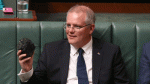 Government cannot fund new coal plants without parliamentary approval, advice says
New legal advice sought by the Australia Institute contradicts what government has been telling stakeholders, Guardian, Katharine Murphy Political editor@murpharoo, 17 Feb 19 A new legal opinion suggests the Morrison government will not have the ability to roll out taxpayer support to its controversial plan to underwrite new coal plants unless it enacts supporting legislation or amends existing legislation.The advice, sought by the progressive thinktank the Australia Institute, argues assistance for new generation projects will require “some form of supporting legislation”, either new or existing, to operate and fund the program, otherwise the arrangements would be open to a high court challenge.
Federal parliament resumes on Monday for one of the last sitting periods before the May election, and the Morrison government has already pulled its much-vaunted “big stick” energy legislation because of concerns it would have to cop an amendment from the Greens and Labor, preventing the government from funding new coal projects……. https://www.theguardian.com/australia-news/2019/feb/18/government-cannot-fund-new-coal-plants-without-parliamentary-approval-advice-says
February 17, 2019
Posted by Christina Macpherson |
AUSTRALIA - NATIONAL, climate change - global warming, politics |
Leave a comment
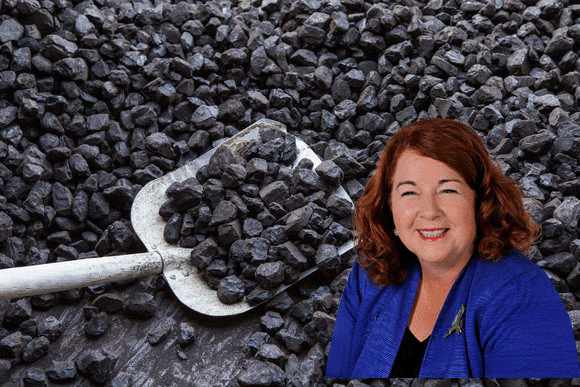
The invisible minister’: Melissa Price accused of going missing on the environment, Guardian, Lisa Cox, 16 Feb 2019
The criticism comes during a summer of disasters, including the mass fish kill, Townsville floods and fires in Tasmania
She is being called the “invisible minister”, the cabinet member responsible for the environment who is accused of “disinterest” during Australia’s summer of natural disasters and record-breaking heatwaves.
Melissa Price has been criticised by three of the country’s biggest environment groups who say they have been unable to meet with her since her appointment last year. A fourth is accusing her office of being in breach of its responsibilities on threatened species.
The criticism comes during a summer that has brought numerous environmental catastrophes, including the mass fish kill in Menindee in far-west New South Wales, fires in Tasmania’s world heritage area, a record-breaking January heatwave, and floods in Townsville that Queensland’s premier Annastacia Palaszczuk described as unprecedented.
While the prime minister Scott Morrison and other senior members of the government including Michael McCormack and David Littleproud have made public appearances in towns affected by the disasters, Price has been absent…….
The government’s key independent committee for the assessment of threatened species, the threatened species scientific committee, also currently has five vacancies including its chair. …… https://www.theguardian.com/australia-news/2019/feb/16/the-invisible-minister-melissa-price-accused-of-going-missing-on-the-environment
February 17, 2019
Posted by Christina Macpherson |
AUSTRALIA - NATIONAL, environment, politics |
Leave a comment
Brisbane Times, by Elizabeth Farrelly, 15 Feb 19…………women aren’t the only victims. Nature too bears the brunt. The world is being shoved off a cliff not by masculinity’s strength but by its terrifying fragility.Fragile masculinity is fear pressurised into rage; fear of losing control – of liberated femininity, of mysterious nature, of a world bucking its traces, of chaos. The anger is a desperate attempt to reinstate that control, illusory as it may always have been.
We’ve just endured a series of 40-plus days across much of the country, last month was the hottest on record. We joke. Thirty-six is the new normal, haha. I gaze with cold-envy at Antarctica, minus 29. But see this for what it is. This is the will-to-dominance: fragile masculinity in action.
Yet we continue to beat nature into submission, as if striving to make the world hotter and weather events more extreme. Other countries reduce emissions. Germany pledges to close its remaining coal-fired power plants in 30 years. Australia could match that. Both UNSW and the CSIRO with Energy Networks Australia argue that renewables could easily supply most or all of our future energy needs. Instead, we become the developed world’s only deforestation hotspot, expected to clear-fell a further 3 million hectares in 15 years.
It’s not fine. This is domestic violence. This planet is our home and they thrash around in it yelling, intimidating, wrecking the joint. Like violent husbands they get all remorseful and beg forgiveness only to do it all again. Why? Because we’ve always thrashed nature, and nature has always coped. As a bloke once said to me: “You don’t want me to shout and get possessive? But I’ve always treated women like this.”
Stoically, the planet has housed and nourished us, tolerated us. But it can’t last. A dominance relationship is never sustainable, human-to-human or human-to-nature. Winning? To win this battle is to lose. The era of collaboration is here………….
It’s when people “stitch their self-worth to being all-powerful” that things go bad. An equal-status relationship – with a partner or with nature – requires listening, empathy, the antidote to shame.
We talk as though “traditional masculinity” were the enemy, as though we want men to evolve into something more like women. But that’s wrong.
What we need is not faux-women but nobler, more confident men. The man-heroes of the future, if we’re to have one, won’t be the brutes and sociopaths. They won’t be the cruel and the thoughtless, the boat-stoppers and coal-brandishers. They’ll be those who hold power but refuse to exploit it, renowned as much for their kindness as their exploits. Literally, gentlemen.
Male anger is leading us over a cliff. If men can find the strength to be truly vulnerable, they deserve to lead. If not, if they persist in this fragile rage, it’ll be up to Rosie the Riveter to save the day. Why? Because there is no spare room to sleep in. https://www.brisbanetimes.com.au/national/what-the-planet-needs-from-men-20190214-p50xrq.html
February 16, 2019
Posted by Christina Macpherson |
art and culture, AUSTRALIA - NATIONAL, climate change - global warming, women |
Leave a comment

Why does BHP get this water for free?
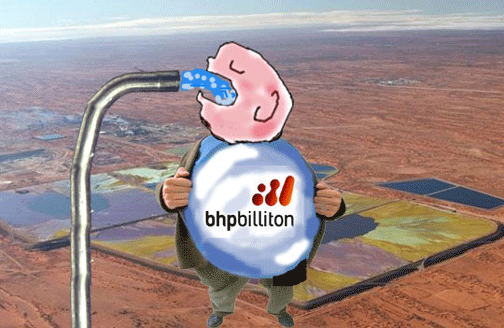
SA boost for Olympic Dam expansion https://www.sbs.com.au/news/sa-boost-for-olympic-dam-expansion 15 Feb 19, The South Australian government has granted the expansion of the Olympic Dam project major development status. BHP’s plans for a $3 billion expansion of its Olympic Dam project in South Australia’s north have been granted major development status by the state government.
The government’s move, gazetted on Thursday, clears the way for the company to increase annual copper production from 200,000 to 350,000 tonnes.
It also allows it to boost gold, silver and uranium production and to lift water extraction from the Great Artesian Basin to a maximum of 50 megalitres a day.
Declaring BHP’s proposed expansion of Olympic Dam a major development is a key milestone in this important project,” Mining Minister Dan van Holst Pellekaan said.
“Olympic Dam is already the state’s largest mining operation, providing jobs, investment and royalties for South Australia.
“(This is) a very important project that, if it goes ahead, would contribute 1800 additional jobs in South Australia during construction, and another permanent 600 jobs on site at Olympic Dam.”
But the minister said the project was still subject to thorough assessment, particularly the plan to extract more water.
“All potential environmental impacts, potential social impacts, potential economic impacts will be considered incredibly thoroughly,” Mr van Holst Pellekaan said.
Local communities will also be consulted on the company’s plans.
Mr van Holst Pellekaan said it would be several years before an expanded mine could begin operation.
The state government’s declaration also covers BHP’s development plans outside the mining lease, including proposals for extra accommodation. The proposed expansion of Olympic Dam has had a chequered history after first being mooted by the previous owners, Western Mining, back in 2002.
BHP initially proposed a $30 billion expansion, including development of one of the world’s largest open cut mines, but put the plans on hold in 2012.
The company has since been looking at lower-cost, smaller scale, alternatives to its original proposals.
February 16, 2019
Posted by Christina Macpherson |
climate change - global warming, South Australia, uranium |
Leave a comment
NT moves to clarify offshore oil, gas industry’s nuclear waste obligations http://m.miningweekly.com/article/nt-moves-to-clarify-offshore-oil-gas-industrys-nuclear-waste-obligations-2019-02-15
15th February 2019 BY: ESMARIE IANNUCCI CREAMER MEDIA SENIOR DEPUTY EDITOR: AUSTRALASIA PERTH – The Northern Territory has passed the Nuclear Waste Transport Storage and Disposal (Prohibition) Amendment Bill, providing the offshore oil and gas industry with a blueprint of their obligations around the management of nuclear waste.
The nuclear waste covered by the Bill included naturally occurring radioactive materials (NORMs) that could be incidentally generated from offshore oil and gas activities and subsequently brought into the Northern Territory, Environment and Natural Resources Minister Eva Lawler said.
“The Bill demonstrates the Northern Territory government’s commitment to protecting the Territory’s environment, while listening to and responding to concerns raised by the offshore oil and gas industry about the ambiguities in the regulatory environment.
“The Amendment Bill addresses ambiguities in exemptions for nuclear waste, including NORMs that may be created as a by-product of industry activities.”
NORMs are widespread in sands, clay, soils and rocks and many ores and minerals, commodities, products and by-products.
Lawler said that the amendments to this Bill became necessary after uncertainties were raised by industry about whether NORMs were exempt from the Act. The Amendment Bill reframes the exemptions while maintaining the Parliament’s original intention when passing the original Act.
She noted that the Northern Territory maintains a strong environmental stance against nuclear waste being dumped in the Territory, and from becoming a nuclear waste dump for the rest of Australia.
“Jobs are the number one priority for the Territory Labor government and we believe that good environmental policy makes good economic sense,” Lawler added.
February 16, 2019
Posted by Christina Macpherson |
legal, Northern Territory, politics |
Leave a comment
 “The system, the native title system,” Tony McAvoy, SC, Australia’s first Indigenous silk said, “coerces Aboriginal people into an agreement. It’s going to happen anyway. If we don’t agree, the native title tribunal will let it go through, and we will lose our land and won’t be compensated either. That’s the position we’re in.”
They can either agree to an ILUA, in which case the mine goes ahead and they get something out of it, or they can refuse, in which case the mine almost certainly goes ahead anyway, and they get nothing.
The mining company and its political backers engaged in a process of “manufacturing consent by exploiting dissent”.
The appeal is expected to be heard in May. The docket should read “David v Goliath”, given the relative resources of the parties involved. On one side the multibillion-dollar mining conglomerate, backed by the federal government and aided by a legislative regime skewed in its favour, and on the other, a relative handful of impecunious Indigenous custodians.
It’s a big case, not only for the W&J people, but for an entire, overheating planet.
 The Saturday Paper Mike Seccombe , 15 Feb 19,
Just before 1pm on Tuesday, most media attention in Parliament House was focused on the government’s historic embarrassment on medical evacuations of asylum seekers. So, relatively few were there to witness another embarrassment, in the senate courtyard.
Resources Minister Matt Canavan, chief government advocate for the coal industry in general and the Adani Carmichael mine in particular, had called a media conference with representatives of the Wangan and Jagalingou people, traditional custodians of the land Adani wants to mine.
Its purpose was to promulgate the line that the traditional custodians overwhelmingly support the giant coalmine. To that end, Canavan, along with his National Party colleagues Michelle Landry and George Christensen, had invited a member of the W&J people to spruik the benefits of the mine. Continue reading →
February 16, 2019
Posted by Christina Macpherson |
aboriginal issues, AUSTRALIA - NATIONAL, climate change - global warming, politics |
Leave a comment
Murray-Darling Basin’s outlook is grim unless it rains, authority’s report warns, Guardian, Anne Davies
Focus for year ahead will be on ‘providing drought refuges and avoiding irreversible loss of species The outlook for the environment in the Murray-Darling Basin, particularly in the north, is extremely challenging and there will be almost no scope for environmental flows for the remainder of the 2018-19 year unless it rains, the Murray-Darling Basin Authority has warned.It says the focus will be “on providing drought refuges and avoiding irreversible loss of species”.
Releasing its environmental watering outlook for 2019-20 the authority warns that there are almost no reserves of environmental water in the northern basin and that, as a result of above-average temperatures and low inflows over successive years, some important wetlands and floodplain forests have not received water for long periods.
It says conditions in the Coorong, a Ramsar-listed wetland in South Australia, are deteriorating, as are conditions in the Narran Lakes, despite the federal government paying $80m for water rights aimed at restoring them. The Macquarie Marshes and floodplains along the Murray are also deteriorating.
The report says the conditions in the lower Darling are particularly severe and the length and duration of cease-to-flow events in the lower Darling has skyrocketed since 2000. It acknowledges this is due to extraction by irrigators upstream as well as climate.
“The hydrology in this area has changed in recent years … an effect which can be tied to both the volume of water extracted from the river and climate across the northern basin,” it says.
“This trend has also affected water availability in Menindee Lakes and the flow characteristics downstream through the lower Darling,” it says…….. https://www.theguardian.com/australia-news/2019/feb/15/murray-darling-basins-outlook-is-grim-unless-it-rains-authoritys-report-warns
February 16, 2019
Posted by Christina Macpherson |
AUSTRALIA - NATIONAL, climate change - global warming, environment |
Leave a comment
Australia’s coal future under threat as more changes hit fossil fuels globally, ABC
By business reporter
Daniel Ziffer Two disparate decisions from opposite corners of the world have sounded warnings for the future of Australia’s coal industry.
Key points:
- Germany wants to exit coal power by 2038, which could have implications for Australian coal producers
- Renewables last year overtook coal as the key source of energy in the European nation
- Environmental groups are pushing candidates to outline their position on climate change ahead of the upcoming federal election
In Germany, Chancellor Angela Merkel confirmed the country would exit coal power by 2038.
In New South Wales, a court knocked back an application for a new coal mine on the grounds it would increase greenhouse gas emissions at a time when they need to be cut.
Neither will immediately derail the freight train that made Australia $66 billion in export earnings last year, overtaking iron ore as our most valuable traded commodity, but both decisions are a snapshot of large and incremental changes in policy and legislation that are hitting the coal sector.
“We want to be out of coal in 2038,” Chancellor Merkel told students in Tokyo last week, after a government-appointed commission released its 20-year plan to completely shut the coal-fired power plants that currently provide almost half the country’s electricity……….
Politics may dictate a shift
Australia is months away from a federal election where senior Liberal Party figures — including Treasurer Josh Frydenberg and former prime minister Tony Abbott — are being threatened by independents who support a rapid shift away from greenhouse-gas-producing fossil fuels like coal.
Even people who cannot vote, but feel passionately about the impact of climate change, are entering the debate.
School student Maiysha Moin helped found “Climate Voices” to amplify the concerns that prompted a strike by thousands of students last year.
“We want the voices of young people to be heard,” she said.
“Right now we see a lot of politicians don’t represent our vision for the future, especially on climate change, and what we want to do is endorse leaders and candidates who will represent what we believe in and our values.”
The new group is vetting the climate change credentials of potential candidates, giving them stamps of approval and offering campaign support in key marginal seats.
“What we need right now is visionary leadership,” she said.
“We need our politicians to be brave, step up, take action and listen to what the people have to say instead of standing around and hoping that climate change is going to go away — that’s not going to happen.” https://www.abc.net.au/news/2019-02-15/australias-coal-future-under-threat-amid-global-changes/10812758
February 16, 2019
Posted by Christina Macpherson |
AUSTRALIA - NATIONAL, climate change - global warming, politics |
Leave a comment
 https://www.sbs.com.au/news/climate-change-protesters-disrupt-parliamentary-question-time 15 Feb 19, Protesters complaining about what they see as a lack of action on climate change have tried to disrupt federal parliament during question time. Climate protesters have disrupted question time in federal parliament, with at least 10 people in the public galleries standing up to shout at politicians.
The first was applauded on Thursday as he yelled about “record-breaking droughts and bushfires” before being removed by security as another activist stood up to take his place.
Ministers ploughed on with their answers amid the shouting, while backbenchers looked up at the disturbance. One woman singled out Barnaby Joyce and Tony Abbott, telling them they would be judged harshly as Mr Joyce smiled and waved to her.
Standing up one after another across the three public galleries, others said, “stop lying to us”, that their children and grandchildren would suffer and “take urgent action … you should get arrested for what you’re doing”.
The Coffs Coast Climate Action Group claimed credit, saying they wanted to deliver a statement from their community and call on MPs to examine their conscience.
One of the group, Uniting Church deacon Jason John, said it was cynical of politicians including the prime minister to ask Australians to pray for rain in a time of record drought as if God controls every drop, while not doing anything to act on climate change.
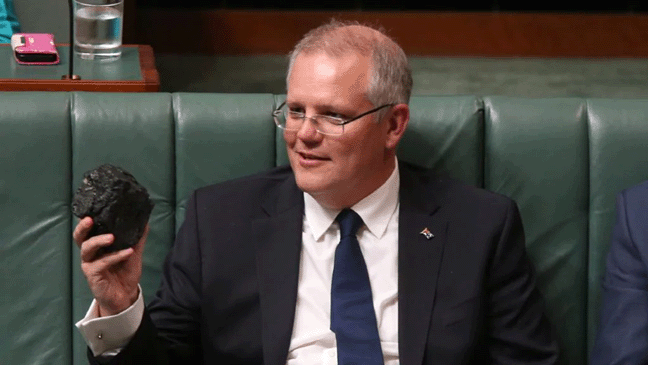
“I am not afraid of a lump of coal but I am afraid that some of our nation’s leaders seem to worship it,” Dr John said in a statement
During Julia Gillard’s prime ministership, multiple question times were interrupted by protesters against the so-called carbon tax.
February 16, 2019
Posted by Christina Macpherson |
AUSTRALIA - NATIONAL, climate change - global warming |
1 Comment

















 Antinuclear