New report skewers Coalition’s contentious nuclear plan – and reignites Australia’s energy debate
John Quiggin, Professor, School of Economics, The University of Queensland: February 26, 2025, The Conversation
Debate over the future of Australia’s energy system has erupted again after a federal parliamentary inquiry delivered a report into the deployment of nuclear power in Australia.
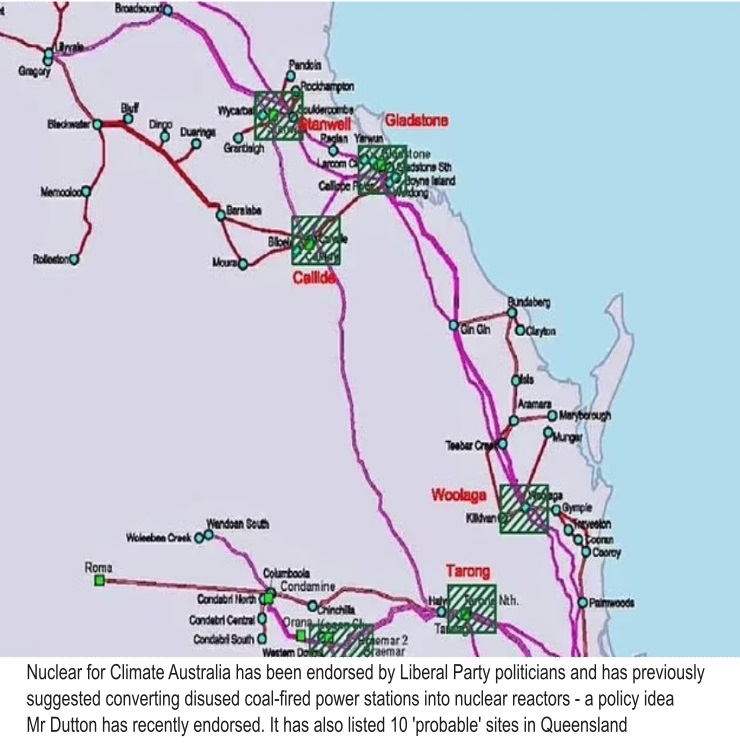
The report casts doubt on the Coalition’s plan to build seven nuclear reactors on former coal sites across Australia should it win government. The reactors would be Commonwealth-owned and built.
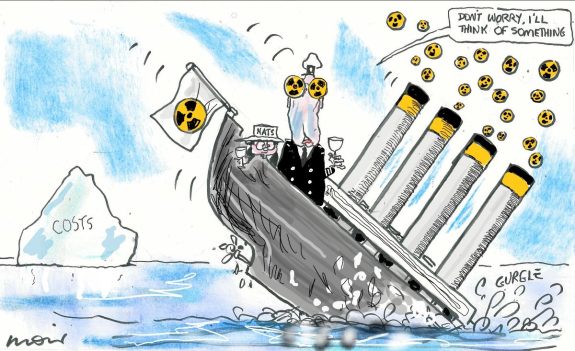
The report’s central conclusions – rejected by the Coalition – are relatively unsurprising. It found nuclear power would be far more expensive than the projected path of shifting to mostly renewable energy. And delivering nuclear generation before the mid-2040s will be extremely challenging.
The report also reveals important weaknesses in the Coalition’s defence of its plan to deploy nuclear energy across Australia, if elected. In particular, the idea of cheap, factory-built nuclear reactors is very likely a mirage.
A divisive inquiry
In October last year, a House of Representatives select committee was formed to investigate the deployment of nuclear energy in Australia.
Chaired by Labor MP Dan Repacholi, it has so far involved 19 public hearings and 858 written submissions from nuclear energy companies and experts, government agencies, scientists, Indigenous groups and others. Evidence I gave to a hearing was quoted in the interim report.
The committee’s final report is due by April 30 this year. It tabled an interim report late on Tuesday, focused on the timeframes and costs involved. These issues dominated evidence presented to the inquiry.
The findings of the interim report were endorsed by the committee’s Labor and independent members, but rejected by Coalition members.
What did the report find on cost?
The report said evidence presented so far showed the deployment of nuclear power generation in Australia “is currently not a viable investment of taxpayer money”.
Nuclear energy was shown to be more expensive than the alternatives. These include a power grid consistent with current projections: one dominated by renewable energy and backed up by a combination of battery storage and a limited number of gas peaking plants…………………………..
What about the timing of nuclear?
On the matter of when nuclear energy in Australia would be up and running, the committee found “significant challenges” in achieving this before the mid-2040s.
This is consistent with findings from the CSIRO that nuclear power would take at least 15 years to deploy in Australia. But is it at odds with Coalition claims that the first two plants would be operating by 2035 and 2037 respectively.
The mid-2040s is well beyond the lifetime of Australia’s existing coal-fired power stations. This raises questions about how the Coalition would ensure reliable electricity supplies after coal plants close. It also raises questions over how Australia would meet its global emissions-reduction obligations.
Recent experience in other developed countries suggests the committee’s timeframe estimates are highly conservative.
Take, for example, a 1.6GW reactor at Flamanville, France. The project, originally scheduled to be completed in 2012, was not connected to the grid until 2024. Costs blew out from an original estimate of A$5.5 billion to $22 billion.
The builder, Électricité de France (EDF), was pushed to the edge of bankruptcy. The French government was forced to nationalise the company, reversing an earlier decision to privatise it…………………………………………………………………..
Looking ahead
Undoubtedly, existing nuclear power plants will play a continued role in the global energy transition.
But starting a nuclear power industry from scratch in Australia is a nonsensical idea for many reasons – not least because it is too expensive and will take too long.
In the context of the coming federal election, the nuclear policy is arguably a red herring – one designed to distract voters from a Coalition policy program that slows the transition to renewables and drags out the life of dirty and unreliable coal-fired power.
Parliamentary inquiry finds nuclear is high risk, zero reward.
RenewEconomy, Jim Green, Feb 26, 2025
An Interim Report was released on Tuesday by the House Select Committee on Nuclear Energy, and splits on party lines, with the independent MP Monique Ryan listing a myriad reasons why nuclear is unsuitable for Australia.
Labor MPs have the numbers on the committee and their majority report states that nuclear power “cannot be deployed in time to support Australia’s critical energy transition targets and climate commitments, or to assist the coal workforce and communities in their transition away from the coal industry.”
The interim report says the committee “received compelling evidence nuclear power would cost consumers more to use”. The report continues:
“Evidence received about the private sector’s lack of interest in investing in nuclear power in Australia and the history of issues with private investment in nuclear power internationally highlights the financial challenges for this source of power, making taxpayer funding of an uncertain nuclear venture during a cost-of-living crisis a significant risk.”
The report notes that the evidence the committee received “strongly indicated SMR [small modular reactor] technology is not yet commercially available and so is not a viable option for Australia’s energy needs.”
Climate Change and Energy Minister Chris Bowen commented on the report’s findings:
“Peter Dutton is determined to ignore the experts, reverse policies that bring the cost of energy down, and stick his head in the sand until the 2040s wishing his $600bn nuclear scheme will fix everything. It’s a disaster for our energy system now, and a guaranteed recipe for big bills, blackouts, and bad investments. “
“We already have a solution that works for today, and for this critical decade, that delivers jobs for people transitioning away from coal now, that reduces emissions, and that gets more of the cheapest form of energy into the grid. That solution is reliable renewable energy and the Albanese Government is delivering it.”
Independent MP Monique Ryan
If the Coalition hoped to sway independent MP and committee member Dr. Monique Ryan, they were sorely disappointed. Dr. Ryan said in her ‘Additional Comments’ to the main report that an “ongoing pursuit of nuclear energy options will only perpetuate and increase Australia’s reliance on coal and gas”.
Dr. Ryan reached the following conclusions:
* There are considerable roadblocks to nuclear energy in this country
* Necessary regulatory framework for health, safety, security, environmental impacts, and transport of fuels and waste would likely take some years to develop
* Australia currently lacks the workforce and technical capability required for building multiple large-scale nuclear reactors
* Independent experts (including from the CSIRO and Australian Energy Regulator) repeatedly told the Inquiry that it would take at least 15 years to build a single nuclear reactor — possibly as long as 25 years
* The Coalition’s proposal would provide only 15% of the country’s electricity requirements by 2050
* Under current projections, by 2030 more than 84% of the main national electricity grid will be powered by renewables; 96% by 2035
* Nuclear power is the most expensive form of energy
* Nuclear power does not compete economically
* Australians would pay more for electricity generated from nuclear plants
* Nuclear energy lacks social licence in many parts of Australia
* The impact of nuclear power generation on Australia’s water supplies has been inadequately considered by the Coalition in its proposal.
Coalition dissenting report
The Coalition committee member’s dissenting report goes to some lengths to defend that Coalition’s indefensible claim that nuclear power would reduce energy costs and power bills. Those claims have been thoroughly debunked…………………………………………..
Nuclear Thuggery and Threats: Response to Interim Report of the House Select Committee on Nuclear Energy
February 26, 2025 AIMN Editorial, https://theaimn.net/nuclear-thuggery-and-threats-response-to-interim-report-of-the-house-select-committee-on-nuclear-energy/
Friends of the Earth (FoE) welcomes the Interim Report released by the House Select Committee on Nuclear Energy.
The Interim Report states that nuclear power “cannot be deployed in time to support Australia’s critical energy transition targets and climate commitments, or to assist the coal workforce and communities in their transition away from the coal industry.” It warns that “taxpayer funding of an uncertain nuclear venture during a cost-of-living crisis is a significant risk.”
In ‘Additional Comments’ to the Committee’s report, Kooyong MP Dr. Monique Ryan concludes that an “ongoing pursuit of nuclear energy options will only perpetuate and increase Australia’s reliance on coal and gas”.
FoE Australia’s national nuclear campaigner Dr. Jim Green said:
“The House Select Committee has found that nuclear power is too expensive and too slow. The Coalition hid its bogus economic costings until the Committee’s work was nearly complete, but the absurdity of those costings has now been thoroughly exposed.
“The simple fact is that recent reactor projects in the US, the UK and France have cost A$27-45 billion per reactor ‒ several times higher than the Coalition’s absurd assumption. No amount of sophistry and creative accounting changes the plain facts.
“This week the Climate Change Authority released a detailed analysis concluding that the Coalition’s energy plan would result in an additional two billion tonnes of greenhouse emissions. The Coalition’s response was to threaten to sack the Authority’s chair Matt Kean (a former NSW Liberal energy minister and treasurer) and to scrap the Authority just as a previous Coalition government defunded the independent Climate Commission and tried to kill off the Climate Change Authority and the Australian Renewable Energy Agency.
“The threat to the independent, expert Climate Change Authority is pure thuggery, as is Peter Dutton’s threat to use compulsory acquisition laws to acquire sites to build nuclear reactors from energy companies that are openly critical of the Coalition’s nuclear plan. Those companies are planning their exit from coal and its replacement with renewables and storage projects.
“The Dutton Coalition’s threat to override state governments and state laws is nuclear thuggery. And the threat to override community opposition is nuclear thuggery. Peter Dutton says it is in “the national interest to proceed” with nuclear reactors even in the face of adamant public opposition.
“The Dutton Coalition’s all-embracing nuclear thuggery stands in stark contrast to shadow energy minister Ted O’Brien’s comments in 2019 that a future government should only proceed with nuclear power on the condition that it make ‘a commitment to community consent as a condition of approval for any nuclear power or nuclear waste disposal facility’.”
Peter Dutton abandons global ‘Paris Agreement’ to phase out climate pollution by 2050

February 24, 2025, https://theaimn.net/peter-dutton-abandons-global-paris-agreement-to-phase-out-climate-pollution-by-2050/#comment-1882 Solutions for Climate Australia
New analysis from the national Climate Change Authority shows the Liberal and National Parties’ nuclear scheme would breach Australia’s commitment to international climate pollution targets and break their promise to phase out climate pollution by 2050.
“This independent analysis confirms earlier assessments that under opposition leader Peter Dutton’s nuclear scheme Australia will not reduce climate pollution by 43% by 2030, which would breach our international commitments,” said Senior Campaigner at Solutions for Climate, Elly Baxter.
“The Frontier Economics modelling the Liberal and National Parties are relying on shows the electricity grid would not reach net zero climate pollution until 2049 and would be 44% smaller than the government’s proposed grid. This would make it impossible to decarbonise the rest of our economy – all our transport, all our manufacturing and all our homes.
“Australians voted overwhelmingly for action on climate change and renewable energy at the last election. Mr Dutton insists that he will maintain our international commitment to the Paris Agreement and reach no net climate pollution by 2050, but the proof is in numbers. As we head to the polls in the coming months, voters need to be aware that Mr Dutton’s words do match his scheme.
“This matters enormously for all Australians. Yet again we are facing increasing climate disasters this summer – fires in the south and floods in the north. More Australians would be killed and homes and livelihoods lost if we push billions more tonnes of climate pollution into the air,” Baxter concluded.
The Coalition’s nuclear scheme includes nuclear reactors at seven sites across Australia. Modelling by Frontier Economics, released by the Coalition, shows an electricity grid that is 44% smaller than the government’s plan to use renewable energy like wind and solar with storage. The scheme would cap renewable energy at 54% when our grid was already powered by 46% renewable energy in the December quarter.
On the first sitting day of the year, over 80 community groups representing tens of thousands of Australians endorsed a statement objecting to Dutton’s nuclear push:
“We object to the Liberal and National parties’ nuclear proposal as it is incapable of cutting climate pollution this decade and upgrading our electricity grid in a timely manner,” the statement reads.
“We call for Peter Dutton and the Opposition to abandon the pursuit of nuclear reactors. It’s never too late to do the right thing.”
Nuclear power would push Australia’s net zero back 12 years
Energy Source Distribution, 25 Feb 25,
New analysis from the Climate Change Authority shows pursuing the deployment of nuclear in Australia’s grid could add at least 2 billion tonnes to national emissions.
This approach would involve a pace of climate action consistent with a global pathway to around 2.6°C of warming, a level at which scientists, economists and governments anticipate major social, economic and environmental harm.
The Climate Change Authority has compared published modelling by the Australian Energy Market Operator (AEMO) and Frontier Economics to understand how the adoption of a nuclear pathway could impact national efforts to reduce emissions.
The analysis finds that a nuclear pathway could see Australia miss the legislated 43% emissions reduction target for 2030 by over five percentage points, and still not achieve this level of reduction by 2035.
Australia would not reach 82% zero emissions electricity until 2042—more than a decade later than current national plans.
“Australia faces a fork in the road and we need to be clear about the choices in front of us,” Climate Change Authority chair Matt Kean says.
“Continuing on Australia’s current pathway and accelerating our progress can deliver rapid cuts to emissions by overhauling our grid with renewables, firming and storage in the next 15 years.
“On the other hand, the nuclear pathway would delay Australia’s necessary transition— keeping coal in the grid for longer and leading to billions of tonnes more emissions in the process………………………… https://esdnews.com.au/nuclear-power-would-push-australias-net-zero-back-12-years/
Fake fight over nuclear a distraction from real climate issues
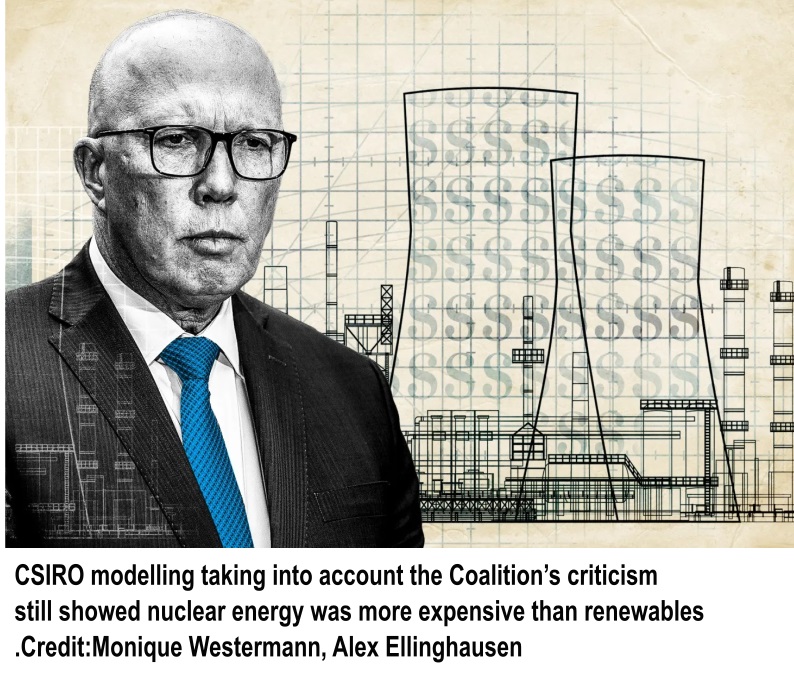
A new report which reveals the coalition’s nuclear plan would send an additional two billion tonnes of emissions into the atmosphere and send power bills even higher is yet another distraction from the real issues in Australia’s energy debate.
The Climate Change Authority report concludes that additional emissions under the coalition plan would see Australia miss its 2030 emissions target and delay the overall transition to clean energy.
“The Climate Change Authority’s slap-down of the Coalition’s nuclear proposal is welcome, but it is yet another distraction from the big climate issues,” said Rod Campbell, Research Director at The Australia Institute.
We’re talking about nuclear yet again, not about Australia’s uninsurable regions, massive fossil fuel subsidies and dodgy offset schemes.
“It suits both major parties to have a fake fight about nuclear and avoid these real problems in Australia’s climate policy, on which Labor and Liberals largely agree.
“It would be more useful if the CCA focused on Australia’s subsidised fossil fuel expansion and rising domestic emissions.
“Nuclear is a distraction that avoids scrutiny of Australia’s real climate problems.
Peter Dutton’s nuclear accounting trick #4: Assume climate change has no cost

Tristan Edis, Feb 23, 2025 https://reneweconomy.com.au/peter-duttons-nuclear-accounting-trick-4-assume-climate-change-has-no-cost/
This is the final part of a five part series of articles examining the four accounting tricks that the Liberal-National Party employed in the costing of their energy plan to slow the roll-out of renewables and rely instead on nuclear power. The first article, which provides the overarching context is published here. Part 2 is here. Part 3 is here, and part 4 is here.
These four accounting tricks act to mislead voters that the Liberal-National Party could lower energy bills through a shift to nuclear when in reality it is likely to increase power bills.
This article focuses on number four and the last of the accounting tricks covered: Assume climate change is not an important and urgent problem that is worthy of costing.
Most types of greenhouse gases last decades to centuries once released in the atmosphere and so the overall level of global warming the planet experiences will be a function of our cumulative emissions over time.
While it would be great if we can reach net-zero emissions in 2050, the level of warming we’re in for will be a result of not just emissions in 2050, but also the years prior to 2050.
The Liberal-National Party’s preferred plan for the electricity system involves slowing the replacement of coal with renewable energy over the next decade and instead waiting until the 2040’s to undertake a concerted replacement of coal with nuclear power. This leads to almost 1 billion extra tonnes of CO2 emissions compared to the so called Labor Scenario (AEMO’s Step Change) from the electricity sector.
There’s also substantial additional emissions from outside the electricity sector due to the Coalition’s preference to maintain consumption of petroleum for transport and natural gas for heating in homes and industry.
The Coalition’s consultant didn’t elect to provide any information to calculate these extra non-electricity emissions. However as detailed in part 3 of this series, it’s possible using AEMO data and the average fuel efficiency of EVs and petroleum-fueled vehicles to estimate extra petrol consumption in the Liberal Party scenario of 203 billion litres. This would add an extra 466 million tonnes of CO2 to atmosphere.
The extra CO2 carries a cost in terms of the damage global warming is expected to inflict on people.
It is interesting to note that the consultant who prepared the Liberal-National Party costing has acknowledged the existence of data prepared by the Australian Energy Regulator that would allow them to attribute an economic cost on this extra CO2.
Yet the consultant explicitly chose to place no economic value at all on carbon emissions. If they had applied the value recommended by the regulator then it would have added $392 billion in extra cost to the Liberal Party Scenario compared to an extra $75 billion to the Labor Scenario.
The end result for the aggregate cost (also taking into account the extra petrol expense to consumers) of the Liberal-National Party’s system versus that of Labor is shown in the chart below.
Overall, the Liberal-National Party system ends up close to $400 billion more expensive than that claimed to be the Labor system (AEMO’s Step Change scenario). Note this doesn’t correct for the fact that the Liberal-National costing has vastly understated the cost of nuclear power plants, which means it’s cost disadvantage is far higher than $400 billion.
No doubt for many people all of this modelling of possible alternative power systems and their cost 25 years into the future is a bit abstract and theoretical. They are right to be sceptical given the uncertainty which surrounds these estimates.
But one thing that isn’t at all uncertain is that the Liberal-National Party decided it was sensible to place a value of zero on avoiding carbon emissions in an economic evaluation of different policy options.
This is potentially far more informative about their energy and climate change policies than the 45 pages of economic modelling that supports their claimed energy policy costs.
Tristan Edis is director of analysis and advisory at Green Energy Markets. Green Energy Markets provides analysis and advice to assist clients make better informed investment, trading and policy decisions in energy and carbon abatem
Dirty deed: Dutton’s nuclear scheme locks in 20 years of higher climate pollution

February 24, 2025 AIMN Editorial, Climate Council https://theaimn.net/dirty-deed-duttons-nuclear-scheme-locks-in-20-years-of-higher-climate-pollution/
Federal Opposition leader Peter Dutton is keeping Australians in the dark about his risky nuclear scheme. An explosive new report from Australia’s independent Climate Change Authority reveals the Federal Coalition’s nuclear scheme would see climate pollution blow out for more than 20 years, leading to up to 2 billion tonnes of additional climate pollution by 2050.
The Climate Council says Mr Dutton’s nuclear scheme risks locking Australia into worsening climate catastrophes, with no credible plan to cut pollution from coal, oil or gas.
Climate Council CEO Amanda McKenzie said: “Mr Dutton knows most Australians want their government to be making progress on climate action. But modelling from the Climate Change Authority shows his nuclear scheme would massively drive up climate pollution and put Australia in breach of its own national law, and international law. Mr Dutton himself has warned that failing to meet our global climate commitments would hurt our own economy and cost Australians jobs.
“The Coalition is out of step and out of touch with the majority of everyday Australians, who overwhelmingly voted for climate action at the last election and want to ditch climate pollution for clean power.”
Climate Councillor Greg Bourne said: “The Federal Coalition has spent the past three years actively blocking policies that cut climate pollution in our electricity, industrial and transport sectors, and now they’re trying to sell an energy scheme to Aussies that could add more than two billion tonnes of pollution and blow up our targets as a credible climate policy.
“Records show the Federal Coalition voted against capping pollution from big industrial polluters. They opposed cleaner and more efficient vehicles being made available to Australians by voting against the National Vehicle Efficiency Standard. And they opposed key policies for making clean energy more accessible, affordable and reliable like the Capacity Investment Scheme. The Coalition’s policies obstruct climate progress.”
Climate Council CEO Amanda McKenzie said: “Dutton’s risky nuclear scheme would burden our kids with more unnatural disasters, rising pollution and higher power bills. All Australians deserve a bright future. We need proven solutions like renewable power, backed by big batteries, that cut pollution now, not a reckless delay that locks us into climate catastrophe.”
Peter Dutton’s nuclear accounting trick #3: Hide the costs of keeping coal
Tristan Edis, Feb 21, 2025, https://reneweconomy.com.au/peter-duttons-nuclear-accounting-trick-3-hide-the-costs-of-keeping-coal/
This is part 3 of a five part series of articles examining the four accounting tricks that the Liberal-National Party employed in the costing of their energy plan to slow the roll-out of renewables and rely instead on nuclear power. The first article, which provides the overarching context is published here. Part 2 is here. Part 3 is here.
These four accounting tricks act to mislead voters that the Liberal-National Party could lower energy bills through a shift to nuclear when in reality it is likely to increase power bills.
This article focuses on accounting trick three of four: Hide most of the cost of replacing coal with nuclear to outside the time period considered in the costing.
It’s very important to note that the Coalition’s costing of its electricity system cuts out in the year 2051. It only accounts for costs incurred between 2025 to 2051 and anything after that date is ignored.
The LNP’s claim of a 44% saving does not represent the cost of two alternative systems for achieving near zero emissions once they are both completed to see how nuclear might reduce the cost of the system.
Instead, a heavy influence on the cost estimates in the model is the degree to which the scenarios can delay incurring costs in replacing the old, highly polluting and likely to be increasingly unreliable coal power plants.
How is this a problem?
Coal power stations are much like a car – they are exposed to extreme heat, pressure and general mechanical stress that means they wear out and become unreliable as they get old. That’s physics.
Many of us will have experience with an old car that has got to the point where it increasingly encounters mechanical problems and the mechanic is warning us that it really needs some major repairs but these would cost more than the car is worth.
At this point many of us can be tempted to take a gamble by putting off such repairs, and go for temporary, less costly patch-ups and hope the car keeps going. That will be a lot cheaper than buying a new car, at least for as long as we can keep the old car going. But it comes with the risk that it could leave us stranded with a broken-down car at an extremely inconvenient point in time and even pose a danger to our safety and that of others.
The Coalition’s modeled plan chooses to take that gamble with our electricity system. But it doesn’t account for the risks and potentially extreme costs this involves if the gamble goes wrong.
Clare Savage, the head of the Australian Energy Regulator has repeatedly warned that failing to replace aging coal plants risks both power system reliability and also affordability observing, “Coal can’t last until you have nuclear power available.”
The bulk of Australia’s operating coal power stations commenced operation more than 30 years ago. By the 2030’s these power stations, particularly in NSW and Victoria, will be close to, or exceeding, the point when coal power stations are typically retired from service. At this point they are likely to be increasingly unreliable and suffering from mechanical wear and tear that can even lead to dangerous explosions and fires that pose a serious risk to worker safety.
This is not theoretical – several Australian coal power stations have suffered from explosions and fires over the years. It’s also important to note that coal power stations over the next decade will face a level of output ramping to work around rooftop solar that is far more stressful than Australian coal plants have typically faced in the past.
Unless Peter Dutton has a secret plan to prioritise curtailment of rooftop solar in favour of coal generators, this is likely to get worse over time.
Now, the way that the consultant, Frontier, constructed Dutton’s costing is that they space out the cost of constructing new power stations as an annualised payment – a bit like how you’d purchase a new car not by paying for it upfront but rather by taking out a loan and then paying it back incrementally over time.
Except in this case the annualised payment for a new power station is spaced out over several decades and for nuclear it is 50 years. Meanwhile for the existing, very old power plants the original cost of constructing those plants is omitted from the annualised costs.
By pushing out the point at which they replace the old power stations with new ones until the 2040’s, the Coalition gets to hide much of the cost of the nuclear plants until towards the very back end of the projection period. We’ll still have to pay for these nuclear power stations well after 2051, but that’s conveniently left out of the costing period.
Meanwhile, in the scenario said to represent Labor Policy, the coal-fired power stations are replaced quite quickly, so the cost of the new, replacement power stations is taken into account across almost the entire time period considered in the model.
You can get a glimpse of how this works in a chart the modelling consultant provides of the annualised cost, which is provided below [on original] (they’ve refused to provide the actual underlying numbers in the chart).
The red solid line is the scenario the Liberal Party claims represents its policy. What the red line shows is that annualised costs grow only slightly up until 2039 with the one exception of a blip upward in 2036. But after 2039 costs grow very quickly.
This growth in costs – both the blip in 2036 and the rapid growth from 2040 onwards corresponds exactly to the timing of replacement of the old coal power plants with new nuclear power plants.
The nuclear plants aren’t really delivering any meaningful saving in the unit cost of energy relative to relying on renewables and storage. Instead, the savings are coming from the Liberal Party delaying the point at which the coal power plants are replaced.
No matter which party is in government, physics still takes its toll on power stations and very old ones will need to be replaced. This will incur costs no matter which technologies we chose to go with.
If we choose to take a gamble that we can string out the life of the old coal power stations, we might save some money in the short-run, but if it doesn’t work out the costs to electricity bills will be very severe.
While building power stations is costly, not having enough power stations is far more costly. We can see that cost through the fact that when coal power stations break down unexpectedly when supply is short then electricity prices typically spike to many multiples of the price needed to pay for a new power plant. That is tolerable if it happens only occasionally, but if frequent we would be far better off building the new replacement plant.
This becomes a particularly significant risk if we choose to go down the path of nuclear power stations. This is not just because we’ll have to wait longer for them to be built, but also because the nuclear industry has been hopeless at accurately estimating their construction timeframes and they come in such large chunks of capacity.
If a utility-scale battery plant comes in late it is unlikely to exceed a year delay, and they come in blocks of a few hundred megawatts. But nuclear power stations come in units of at least a thousand megawatts and can be more than 10 years late (as France has just experienced with its most recently built reactor).
This could create a no-man’s land where multiple coal units are repeatedly out of service and unable to provide reliable supply, but no one is prepared to step into the breach to invest in technologies that are reasonably quick to build. That’s because once the nuclear plant is eventually completed, financial returns in these fast-build power plants will be undermined.
Tristan Edis is director of analysis and advisory at Green Energy Markets. Green Energy Markets provides analysis and advice to assist clients make better informed investment, trading and policy decisions in energy and carbon abatement markets.
Carbon time bomb: Dutton’s nuclear plan will blow up Paris and emissions targets, CCA says

ReNew Economy Rachel Williamson, Feb 24, 2025
Choosing a nuclear power future over renewables will blow up Australia’s carbon emissions budget and create a carbon time bomb of up to 2 billion tonnes in extra greenhouse gases by 2050, a new analysis from the federal government’s Climate Change Authority says.
The analysis, released on Monday, poses a grim picture of what the nuclear future, as painted by Opposition leader Peter Dutton and analysed in a controversial and contested Frontier Economics’ report in December, would look like from an emissions perspective.
Extra emissions from the electricity sector alone would spike by a cumulative 1 billion tonnes come 2050, and this number would double when adding emissions from a broader economy unable to use zero-carbon electricity.
Australia would miss its 82 per cent emissions-free electricity target by more than a decade, reaching that target by 2042, and those emissions would also be consistent with global warming of 2.6ºC, rather than the 1.8ºC currently forecast for a renewables-led transition.
It will also ruin short term targets, causing Australia to miss its legislated 43% national emissions reduction target for 2030 by more than five percentage points, and still not achieving this level of reduction by 2035.
The Coalition plans to build nuclear plants at seven sites across Australia for an estimated $331 billion over 25 years. The locations are all old or current coal power plant sites of Mount Piper and Liddell in New South Wales, Loy Yang in Victoria, Tarong and Callide in Queensland, Port Augusta in South Australia, and Collie in Western Australia.
Retaining coal fired power stations to hold space for the first nuclear generators, which would come fully online in the late 2040s, means the worst years for emissions will be 2034-2040……………………………
“What comes next is the fork in the road we are in the middle of. The market knows we are on a renewables road, supported by storage and where needed, gas. The Opposition has proposed a nuclear diversion, which provides a dramatic shift in momentum and direction.”
The former NSW Liberal treasurer says the choice as to which road Australia takes – nuclear or renewables – is now “imminent” but the consequences of that choice can be estimated.
“We will find out soon what Australians think of this proposed change in direction for the country’s energy source. The RBA considers the pressures nudging prices up or down and it is the Climate Change Authority’s role to do the same for emissions,” Kean says.
Breaching commitments
The emissions bill from switching to nuclear means Australia will need to re-negotiate national and international commitments, including the legislated national target of reducing emissions by 43 per cent by 2030.
Australia can’t meet this target, due in just five years, if it chooses nuclear as economy-wide emissions would be about 34 million tonnes higher in 2030 than under the current trajectory.
Instead, Australia would hit an emissions reduction below 2005 levels of just 37.1 per cent.
New Paris Agreement targets for 2035 are due this year, although Australia has already formally missed the deadline to issue these and Opposition leader Peter Dutton says while he wants to keep Australia in the global agreement, he won’t participate in the target-led pathway that it mandates. ……………………………………………………………………………………The current renewables-first energy transition has its own challenges and the nuclear debate is a distraction from focusing on ways to deal with these and other energy-related problems, The Australia Institute research director Rod Campbell said in a statement.
……………….“Nuclear is a distraction that avoids scrutiny of Australia’s real climate problems.” https://reneweconomy.com.au/carbon-time-bomb-duttons-nuclear-plan-will-blow-up-paris-and-emissions-targets-cca-says/
New report confirms nuclear fears: Higher bills, higher emissions
Australians for Affordable Energy February 24, 2025, https://theaimn.net/new-report-confirms-nuclear-fears-higher-bills-higher-emissions/
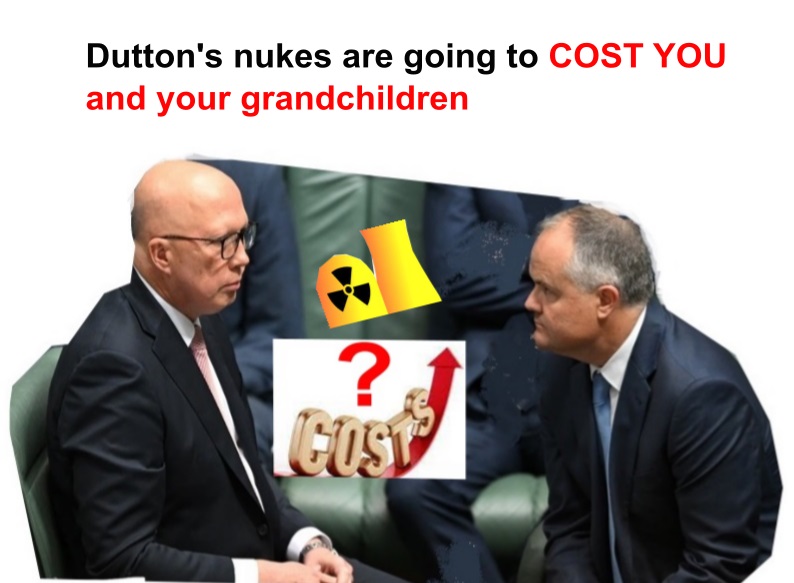
The Climate Change Authority’s latest report confirms the risks of delaying a clean energy future in favour of nuclear power will lead to higher emissions and increased costs for households.
The report warns that the Coalition’s nuclear energy proposal could add a staggering 2 billion tonnes of emissions while increasing costs for households, resulting in Australia missing its 2030 emissions targets and delaying the transition to clean energy until 2042.
“This report confirms our worst fears – betting on nuclear power isn’t just expensive, it’s a lose-lose for Australian families. Every year we waste waiting on nuclear means higher power bills and more emissions,” Jo Dodds, spokesperson for Australians for Affordable Energy, said.
“The Climate Change Authority has done the hard numbers. They’re telling us that going down the nuclear path means we’ll miss our 2030 targets and won’t get clean energy until 2042. That’s an extra 2 billion tonnes of emissions while we sit around waiting for nuclear plants that might never show up.
“Guess who pays for the delay? Everyday Australians – through their power bills and taxes.”
Crucial questions about the impact nuclear power will have on household budgets remain unanswered.
“Australians still need answers to fundamental questions: What is it going to cost? When will it actually deliver? What happens to our bills while we wait? What happens to our emissions?” Ms Dodds said.
“Families are already struggling with the cost of living and they can’t afford to bankroll expensive nuclear experiments that won’t deliver for decades all while their bills continue to rise. Every year we spend chasing nuclear dreams instead of getting on with real solutions is another year of higher costs for Australian households.
“We need to have a serious talk about our energy choices. This report makes it crystal clear – nuclear means paying more to get less and waiting longer to get it.
“Australian families deserve better.”
Australians for Affordable Energy is urging policymakers to focus on practical, cost-effective energy solutions that can deliver cleaner, more affordable power right now – not in decades.
Burying The CIA’s Assange Secrets

The Dissenter, Kevin Gosztola, Feb 19, 2025
The CIA won the dismissal of a lawsuit brought by four Americans who claimed they had their privacy rights violated when they visited Julian Assange in Ecuador’s London embassy.
A United States judge dismissed a lawsuit pursued by four American attorneys and journalists, who alleged that the CIA and former CIA Director Mike Pompeo spied on them while they were visiting WikiLeaks founder Julian Assange in Ecuador’s London embassy.
“The subject matter of this litigation,” Judge John Koeltl determined [PDF], “is subject to the state secrets privilege in its entirety.” Any answer to the allegations against the CIA would “reveal privileged information.”
Few publications followed this case as closely as The Dissenter. It unfolded at the same time that the U.S. government pursued the extradition of Assange, making any outcome potentially significant.
On August 15, 2022, Margaret Ratner Kunstler, a civil rights activist and human rights attorney, and Deborah Hrbek, a media lawyer, filed their complaint. Journalist Charles Glass and former Der Spiegel reporter John Goetz also joined them as plaintiffs.
The lawsuit claimed that the plaintiffs, like all visitors, were required to “surrender” their electronic devices to employees of Undercover Global, a Spanish security company managed by David Morales that was hired by Ecuador to handle embassy security. They were unaware that UC Global had allegedly “copied the information stored on the devices” and shared the information with the CIA.
Pompeo allegedly approved the copying of visitors’ passports, “including pages with stamps and visas.” He ensured that all “computers, laptops, mobile phones, recording devices, and other electronics brought into the embassy,” were “seized, dismantled, imaged, photographed, and digitized.” This included the collection of IMEI and SIM codes from visitors’ phones.
Morales and UC Global were named as defendants in the lawsuit, however, due to the fact that they were not in the U.S., the claims against them were never really litigated.
In December 2023, Koeltl dismissed multiple claims that were filed against the CIA. But remarkably, he found that the four Americans who had visited Assange had grounds to sue the CIA for violating their “reasonable expectation of privacy” under the Fourth Amendment of the U.S. Constitution.
“If the government’s search (of their conversations and electronic devices) and seizure (of the contents of their electronic devices) were unlawful, the plaintiffs have suffered a concrete and particularized injury fairly traceable to the challenged program and redressable by a favorable ruling,” Koeltl declared.
Soon after, the court was notified that the CIA would assert the state secrets privilege to block the lawsuit.
Bill Burns, who was the CIA director, submitted a declaration in April 2024 that asserted “serious” and “exceptionally grave” damage to the “national security” of the U.S. would occur if the case proceeded.
……………………………………………… Burying secrets so deep and for so long that the public does not find them is typically the CIA’s objective when they invoke the state secrets privilege. They have buried a 6,300-page Senate intelligence report on CIA rendition, detention, and torture during the global war on terrorism. They are now burying their Assange secrets.
The decision all but ensures that the CIA will be able to conceal what they allegedly did to Assange, WikiLeaks, and his supporters for several decades. The agency, with support from the U.S. Justice Department, has already frustrated a Spanish court trying to prosecute Morales and other UC Global employees for alleged criminal acts.
It was always unlikely that Assange’s defense would uncover details about the CIA’s alleged actions and share those revelations during an Espionage Act trial. The restrictions the government and courts impose on defendants come with procedures to shield the CIA from scrutiny.
When the prosecution against Assange ended in a plea deal in June 2024, that benefited the CIA even if it was not the outcome that current and former high-ranking officials had desired. The CIA would never have to worry about the agency’s actions being discussed by the press and on social media during a high-profile trial.
Of course, there is also the matter of the CIA allegedly violating the privacy rights of Assange visitors while the U.S government targeted a journalist living under political asylum in a foreign embassy. The U.S. news media never showed much interest in the CIA’s actions, however, let’s not forget there was widespread global opposition to the Assange prosecution that helped end the case. The agency is right to be concerned that if more was known it might erupt into an international scandal. https://thedissenter.org/burying-the-cias-assange-secrets/
Peter Dutton’s nuclear accounting trick #3: Hide the costs of keeping coal
RENEW ECONOMY. Tristan Edis, Feb 21, 2025
This is part 4 of a five part series of articles examining the four accounting tricks that the Liberal-National Party employed in the costing of their energy plan to slow the roll-out of renewables and rely instead on nuclear power. The first article, which provides the overarching context is published here. Part 2 is here. Part 3 is here.
These four accounting tricks act to mislead voters that the Liberal-National Party could lower energy bills through a shift to nuclear when in reality it is likely to increase power bills.
This article focuses on accounting trick three of four: Hide most of the cost of replacing coal with nuclear to outside the time period considered in the costing.
It’s very important to note that the Coalition’s costing of its electricity system cuts out in the year 2051. It only accounts for costs incurred between 2025 to 2051 and anything after that date is ignored.
The LNP’s claim of a 44% saving does not represent the cost of two alternative systems for achieving near zero emissions once they are both completed to see how nuclear might reduce the cost of the system.
Instead, a heavy influence on the cost estimates in the model is the degree to which the scenarios can delay incurring costs in replacing the old, highly polluting and likely to be increasingly unreliable coal power plants.
How is this a problem?
Coal power stations are much like a car – they are exposed to extreme heat, pressure and general mechanical stress that means they wear out and become unreliable as they get old. That’s physics.
Many of us will have experience with an old car that has got to the point where it increasingly encounters mechanical problems and the mechanic is warning us that it really needs some major repairs but these would cost more than the car is worth.
At this point many of us can be tempted to take a gamble by putting off such repairs, and go for temporary, less costly patch-ups and hope the car keeps going. That will be a lot cheaper than buying a new car, at least for as long as we can keep the old car going. But it comes with the risk that it could leave us stranded with a broken-down car at an extremely inconvenient point in time and even pose a danger to our safety and that of others.
The Coalition’s modeled plan chooses to take that gamble with our electricity system. But it doesn’t account for the risks and potentially extreme costs this involves if the gamble goes wrong.
Clare Savage, the head of the Australian Energy Regulator has repeatedly warned that failing to replace aging coal plants risks both power system reliability and also affordability observing, “Coal can’t last until you have nuclear power available.”……………………………………………………………………
Unless Peter Dutton has a secret plan to prioritise curtailment of rooftop solar in favour of coal generators, this is likely to get worse over time.
Now, the way that the consultant, Frontier, constructed Dutton’s costing is that they space out the cost of constructing new power stations as an annualised payment – a bit like how you’d purchase a new car not by paying for it upfront but rather by taking out a loan and then paying it back incrementally over time.
Except in this case the annualised payment for a new power station is spaced out over several decades and for nuclear it is 50 years. Meanwhile for the existing, very old power plants the original cost of constructing those plants is omitted from the annualised costs.
By pushing out the point at which they replace the old power stations with new ones until the 2040’s, the Coalition gets to hide much of the cost of the nuclear plants until towards the very back end of the projection period. We’ll still have to pay for these nuclear power stations well after 2051, but that’s conveniently left out of the costing period.
Meanwhile, in the scenario said to represent Labor Policy, the coal-fired power stations are replaced quite quickly, so the cost of the new, replacement power stations is taken into account across almost the entire time period considered in the model. …………………………
The nuclear plants aren’t really delivering any meaningful saving in the unit cost of energy relative to relying on renewables and storage. Instead, the savings are coming from the Liberal Party delaying the point at which the coal power plants are replaced. ………………………………………. more https://reneweconomy.com.au/peter-duttons-nuclear-accounting-trick-3-hide-the-costs-of-keeping-coal/
Dutton hints at privatising nuclear – one day
Phillip Coorey, 21 Feb 25
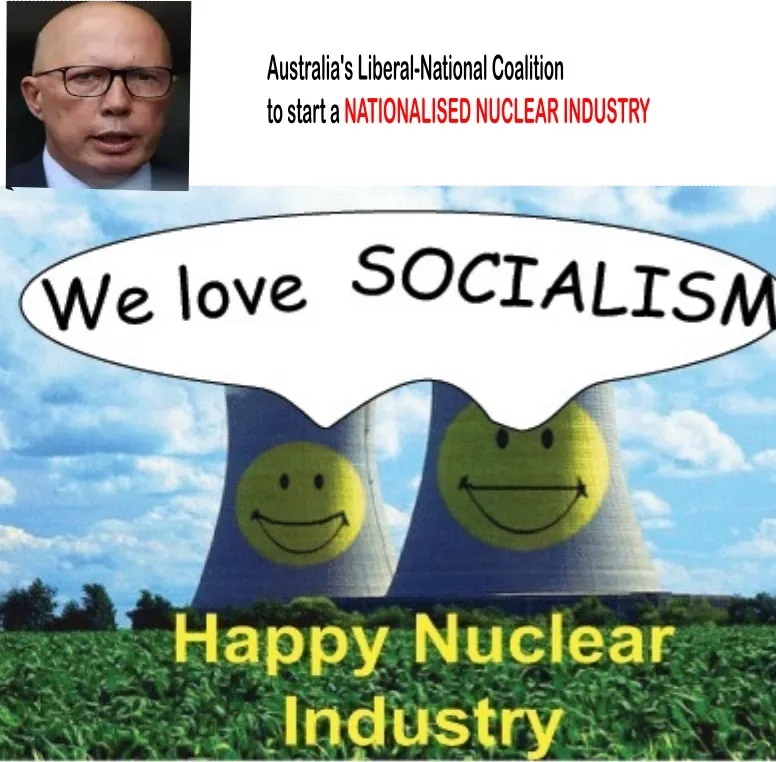
Peter Dutton has suggested his proposed nuclear power plants would one day be privatised, as he rejected the idea of the Albanese government taking an equity stake in the Whyalla steelworks.
With the $2.4 billion rescue plan for the steelworks in mid-north South Australia sparking a broader discussion about the re-nationalisation of business, the opposition leader said while he supported the plan, he derided the prospect of an equity stake in the Whyalla plant as “Whitlamesque”………………………….
Dutton said he was “completely opposed” to an equity stake.
“The prime minister can’t run a government – how can he run a steelworks? He’s now proposing to own an airline. I mean, this is Whitlamesque,” Dutton said.
Asked to explain why he opposed governments buying into troubled businesses but planned to spend $331 billion to build own and operate seven nuclear power plants, Dutton said there was a key difference in the nuclear energy would be a start-up industry.
“Nuclear power carries with it, from our country’s perspective, a zero-based knowledge, or a very low level of understanding, unlike in the United Kingdom or in Canada or in France or other parts of the world, including the United States,” he said.
“It’s obvious to me that there is greater reassurance in the public’s mind about the safety and the safe delivery of nuclear technology if it’s in government ownership.
“Now, it doesn’t need to be in government ownership forever.” https://www.afr.com/politics/federal/dutton-hints-at-privatising-nuclear-one-day-20250221-p5ldzj
Community consultation kicks off for submarine yard, but don’t mention nuclear
“South Australians should understand that AUKUS involves not only plans for the construction and sustainment of nuclear submarines at Osborne, but also for eventual decommissioning, storage and dismantling of those submarines on the banks of the Port Adelaide River, and indefinite storage of high-level nuclear waste, most likely in SA.”
The Australian Submarine Agency (ASA) will today start information sessions for community members about its planned nuclear submarine construction yard project, but any concerns about nuclear issues are out of scope.
The first of four information sessions for community members interested in the Australia Submarine Agency’s (ASA) planned nuclear submarine construction yard at Osborne begin today.
The first – at the State Library on North Terrace – comes during a period of public consultation through which the ASA is receiving feedback from community members on its draft ‘Strategic Impact Assessment Report’ for the yard.
Until 17 March members of the public can submit comments about the 203-page draft, which considers the plan’s potential impact on the environment but notably rules nuclear issues as “outside the scope” of the plan for a shipyard to build nuclear submarines.
It follows an agreement struck in November 2023 between the ASA and the Environment and Water Minister – Tanya Plibersek – which specifically precluded all nuclear issues from the scope of the environmental assessment process.
“The operation, sustainment and decommissioning of the submarines built at the Osborne SCY is considered out of scope of the Strategic Assessment and will be managed via separate environmental assessment processes and approvals as necessary,” the agreement reads.
“The manufacture, delivery and subsequent operation of the reactor power module is considered outside of the scope of the Strategic Assessment, however the assembly into the submarine is included.”
What is included is the processing of steel, outfitting of submarine sections, manufacture of pipe and electrical components, the use of supporting facilities (guard houses, car parks, warehousing, office accommodation, etc.) and more.
The resulting draft environmental impact report, plus 754 pages of appendices, asserts that the impacts of the construction yard are “likely to be acceptable”.
It also confirms on page 156 that “no nuclear actions” are included in the scope of the draft and that “other activities are considered outside the scope of the strategic assessment and will be managed via separate assessment processes and approvals as necessary”.
Former Senator and submariner Rex Patrick – who plans on running for a South Australian seat at the next Federal Election as a member of Jacqui Lambie’s political party – said the consultation process was designed to “minimise public engagement”.
“This is a ‘strategic assessment’ of a nuclear facility in which everything nuclear is excluded. More attention is paid to the environmental impacts of car parks than nuclear reactors,” he told InDaily.
“South Australians should understand that AUKUS involves not only plans for the construction and sustainment of nuclear submarines at Osborne, but also for eventual decommissioning, storage and dismantling of those submarines on the banks of the Port Adelaide River, and indefinite storage of high-level nuclear waste, most likely in SA.”
He added that the fact that Port Adelaide is yet to be visited by a nuclear-powered vessel because it has never been approved as a suitable location for such visits made the situation “an extraordinary state of affairs”.
“Whatever one thinks about AUKUS, it’s clear the environmental assessment has been rigged from the beginning.
“It’s been rigged by ASA with the connivance of Minister Plibersek to produce a predetermined outcome, opening the way for further stages of the project to be ticked off by Defence bureaucrats as they wish.
Those decisions will have consequences for South Australia that will last decades, hundreds and indeed thousands of years.”
1 This month

of the week – Australians for War Powers Reform (AWPR)
To see nuclear-related stories in greater depth and intensity
 Antinuclear