It has been six years since Julian Assange, founder of Wikileaks, fled to the Ecuadorean Embassy in London to seek asylum from possible extradition to the United States to face indictment under the US Espionage Act.
At the time, Assange, an Australian national, was wanted by Sweden for questioning over sexual offense allegations. Assange had also broken the terms of his UK bail. Since then, he has become even more controversial, having published US Secretary of State Hillary Clinton’s emails and internal emails from Democratic Party officials.
While some admire and others despise Assange, no one should be prosecuted under the antiquated Espionage Act for publishing leaked government documents. That 1917 statute was designed to punish people who leaked secrets to a foreign government, not to the media, and allows no defense or mitigation of punishment on the basis that public interest served by some leaks may outweigh any harm to national security.
The US grand jury investigation of Assange under the Espionage Act was apparently based on his publishing the leaks for which Chelsea Manning, a former US army soldier, was convicted. Her sentence was commuted.
The publication of leaks—particularly leaks that show potential government wrongdoing or human rights abuse—is a critical function of a free press in a democratic society. The vague and sweeping provisions of the Espionage Act remain ready to be used against other publishers and journalists, whether they be Wikileaks or the New York Times.
Assange has agreed to surrender himself to the British police – but only if he were granted assurances against extradition to the US, where he could face life in prison. He also offered to appear in Sweden if Sweden would offer similar assurances.
In 2016, the United Nations Working Group on Arbitrary Detention found Assange’s stay in the Ecuadorean embassy, enforced by the alternative of his potential extradition to the US, to be an arbitrary deprivation of liberty. Ecuador, offended by Assange’s political comments, this year has denied him internet access and visitors, other than occasional contact with his lawyers. Ecuador denied Human Rights Watch permission to visit him this May. Concern is growing over his access to medical care. His asylum is growing more difficult to distinguish from detention.
The UK has the power to resolve concerns over his isolation, health, and confinement by removing the threat of extradition for publishing newsworthy leaks. It should do so before another year passes.
If the recent Cambridge Analytica data scandal has taught us anything, it’s that the ethical cultures of our largest tech firms need tougher scrutiny.
But moral questions about what data should be collected and how it should be used are only the beginning. They raise broader questions about who gets to make those decisions in the first place.
We currently have a system in which power over the judicious and ethical use of data is overwhelmingly concentrated among white men. Research shows that the unconscious biases that emerge from a person’s upbringing and experiences can be baked into technology, resulting in negative consequences for minority groups.
These biases are difficult to shed, which makes workplace diversity a powerful and necessary tool for catching unsuspected bias before it has a chance to cause damage. As the impact of data-driven algorithms and decisions grows more profound, we need to ask: how is this going to change in the future?
Unfortunately, the indicators suggest the answer is: not much.
The problem has led to gendered language translations, biased criminal sentencing recommendations, and racially skewed facial recognition systems.
For example, when an automated translation tool such as Google Translate is required to translate a gender-neutral language (such as Turkish) into a gender-specific one (such as English) it makes a guess as to which gender to assign to the translated text.
People noticed that Google Translate showed a tendency to assign feminine gender pronouns to certain jobs and masculine pronouns to others – “she is a babysitter” or “he is a doctor” – in a manner that reeked of sexism. Google Translate bases its decision about which gender to assign to a particular job on the training data it learns from. In this case, it’s picking up the gender bias that already exists in the world and feeding it back to us.
If we want to ensure that algorithms don’t perpetuate and reinforce existing biases, we need to be careful about the data we use to train algorithms. But if we hold the view that women are more likely to be babysitters and men are more likely to be doctors, then we might not even notice – and correct for – biased data in the tools we build.
So it matters who is writing the code because the code defines the algorithm, which makes the judgement on the basis of the data.
Who holds the power?
Only ten years ago the first smartphones were making their mark. Today some of the most powerful people on the planet are those who control data gathered through mobile technologies.
Data is central to the functioning of the modern world. And power over business, democracy and education will likely continue to lie with data and data-dependent tools, such as machine learning and artificial intelligence.
Currently, the people who have the power to make ethical decisions about the use of data are typically white males from high-earning, well-educated families.
One research company, Open MIC, which describes itself as “investing in racial diversity in the tech world”, reviewed data from some of the biggest tech firms and found a consistent pattern: disproportionate percentages of white employees compared with the wider working population.
Adobe’s workforce is 69% white, Apple’s is 56% white, Google is 59% white and Microsoft is 58% white. The list goes on:
Black people, Latinos, and Native Americans are underrepresented in tech by 16 to 18 percentage points compared with their presence in the US labour force overall.
This is made far worse by a crippling lack of gender diversity.
In a 2017 Microsoft report, a survey of UK IT and tech leaders found that on average, the gender mix among their teams was 80% male and 20% female. A staggering 35% of respondents had no plans in place to change this imbalance.
The numbers are similar in Australia, according to a study of Australian professional profiles on the social network LinkedIn.
It revealed that just 14% of executive roles in the local tech industry were held by women. Of the 435,000 people in IT listed on LinkedIn in Australia, only 31% were women. Even these numbers may be optimistic, according to Australia’s Chief Scientist, Alan Finkel, who noted that women make up less than one-fifth of Australians qualified in science, technology, engineering and maths.
Will this change?
Those likely to be in charge of developing the algorithms of the future are those who are studying computer science and mathematical sciences right now. Sadly, the groups dominating those subjects at schools and universities largely reflect the current workforce.
Australian domestic students enrolled in tertiary level information technology dropped from a peak of 46,945 in 2002 to 27,547 in 2013. While the numbers have improved slightly according to AEN University Rankings, females in engineering and IT still represent less than one in five students.
Meanwhile, the number of girls at the senior high school level taking the advanced computing and mathematics subjects needed to enter these roles remains resolutely low.
This ship is taking a long time to turn around.
What can we do about it?
If the coders of the future are today’s middle-class boys, how are we preparing them to make unbiased ethical choices when they become the Zuckerbergs of tomorrow? And how can we steer the ship so that the wealth and power that will continue to flow from mastery of such technical skills is not denied to those who are not white and male?
Our education system is unwittingly allowing boys to train as technical people without the skills to put their work in a social context, and allowing girls to do the reverse.
Indeed, while many of the smartest young women are choosing to go into medicine or law, these professions are vulnerable to the advance of artificial intelligence – paralegals, radiologists, and those making preliminary diagnoses.
We are in a structure in which the same old imbalances are strengthening and look to persist. But this is not the way it should be. Unless we confront the culture through big shifts in educational trends, nothing will change.
Alexander HayesAfter three years of listening, a huge trip across country, countless hours spent editing and many community consultations we are thankful to be releasing today the Protecting Country film which was produced by Bruce Hammond and features Aboriginal leaders in their stand against the continued genocide of uranium mining, testing and dumping in Australia –
“…Protecting Country is an independently produced film bringing the voices of the contemporary Adnyamathanha, Gurindji, Tanganekald, Yankunytjatjara Anunga, Mirning, Narunnga Aboriginal Australian people forward who are united in their stand AGAINST the present and planned uranium mining and nuclear dump activities in South Australia. Bruce Hammond, an Aboriginal Tanganekald man with ties to the coast in the lower South East of South Australia and the central desert regions of Finke and Alice Springs in conjunction with Alexander Hayes & Magali McDuffie from Ngikalikarra Media brought the ‘Protecting Country’ documentary film on a screening road trip across Australia –
Dave Fergusson Submission TO THE SENATE STANDIN COMMITTEE ON ECONOMICS SENATE ENQUIRY SUBMISSION FOR THE SELECTION PROCESS FOR A NATIONAL RADIOACTIVE WASTE MANAGEMENT FACILITY IN SOUTH AUSTRALIA (Submission No 106)
My name is Dave Fergusson. I grew up in Port Adelaide and from the moment I learnt to drive I have been coming up to Flinders Ranges for camping holidays and for work ever since until I decided to move to Quorn about sixteen years ago. I am absolutely disgusted at the way in which this push by the Department (DIIS) to find a site for a National Radioactive Waste Management Facility (NRWMF) has been conducted from day one. Please find below a few of my reasons.
1/ Land nomination of Wallerberdina Station. The first that I heard of a waste dump being proposed in the Flinders Ranges was when I was in Adelaide Hospital in December 2015. After making several enquiries as to where it was to be proposed to be built it was found to be an Ex-Senator from South Australia, Mr Grant Chapman who co-owned this property Wallerberdina. This man has not ever lived in the area nor on the property and was a deputy chairman on the Lucus Heights Waste Management Board back in the late nineties. He did not consult with any of his neighbours about his nomination of this station to get away from the designated use of the land. IE. Pastoral. Had he have been establishing a tourist venture or a quandong farm on his property, this could have been put down to an oversite on his behalf. But a nuclear waste dump !!!. Even the aboriginal people whose connections to this area go back for thousands of years were not consulted. When I spoke to DIIS in 2016 I was told it was purely coincidence that Mr Chapman just happened to have all this information regarding a NRWMF and had nothing whatsoever to do with the nomination of the property.!!!
2/ The Need To Determine Broad Community Support During the early consultation days when the DIIS staff would come over here, it appeared as if they were not able to answer any of my more pertinent questions and would fob me off. There appeared to be a light feel to the sales spin and if we didn’t hurry up, then someone else could end up getting it. No one I talked to could understand why any one would want to put a waste dump in the Flinders. As no notes were ever taken at these informal meetings there would have been no record of names of who would attend or what their concerns were, especially if the concern was asking deeper and more meaning full questions.
When the radioactive waste at Woomera was discovered leaching into the ground, DIIS staff glossed over it saying this is why we need a NRWMF. If it’s at Woomera leaking all over the place and DIIS, ANSTO, CSIRO and ARPANSA, all Government departments, know of its existence then how can we be sure it’s not going to happen again? These Departments and the people who manage them are the ones that we have to put our trust in that they are managing the radioactive waste to the best possible standards. The leaking drums of unknown radioactive strength, some low, some intermediate and some with toxic chemicals are still sitting on site today on top of a concrete pad even though it was reported two years ago. This information has been suppressed to the public by the media and television.
The general public barely know this stuff exists, it will all be swept up and bought to the NRWMF wherever that may be. I don’t believe this is an issue for the communities of Hawker, Quorn and now Kimba to have to decide if we want it or not. It has already been seen that the people don’t want it. So why are they still pushing saying that transparency and openness is paramount!!!
3/ Disunity within the community What has become very noticeable is the fact that this process is splitting communities and families apart. Some who are just driven by the money can not see that waste is forever, money and our lives are not. If this goes ahead it will open up a pandora’s box. Last December 2017 I drove up to a public meeting at Hawker organised by the Hawker Community Development Board (HCDB)and DIIS for them to display several leading doctors to talk on the wonders of nuclear medicine and the life saving procedures that it produces. I waited until the presentation was over and as there were no comments from the public, I stood to ask one of the Doctors a question. I was then told by the convenor that I was not allowed to ask any questions as I did not live in Hawker. So much for openness and transparency. It was a public meeting for members of the public to attend. The Doctor asked me at the close of the meeting what my question was but I was too upset to go further with it. The senior DIIS member there also said afterwards, that it was the HCDB who chaired the meeting and as a result DIIS could not intervene. It is just another example of what I and many others are trying to say that we are being fed just the right amount of information to make us all want to have the NRWMF. They don’t want to listen to professors and doctors of geology who have worked and taught student’s geology in the area saying the proposed location is on a major fault line.
I have been evicted three times now from the Barndioota consultative Committee (BCC) meetings. These are meetings that are supposed to be run by the BCC to inform the general public of whatever information that DIIS want distributed, and concerns that the public have, to be made known to the DIIS. I have always been as unobtrusive as possible and only wished to observe. However, on three occasions it has been DIIS staff who have escorted me out. The openness and transparency just does not appear to be there.
4/ Jobs for the future It has been reported that last Friday, at a talk and dinner function, organised by DIIS at Hawker that an additional thirty new jobs will now be established at the NRWMF. This dinner was by invitation only and the selected few, were able to listen and hear the CEO of ANSTO announce the decision by the minister to create another thirty jobs. This is on top of the fifteen jobs already known about since 2016, to manage exactly the same waste that was coming into the NRWMF the week before the dinner function!!!!. I find this announcement insulting to our intelligence. Watch any documentary on our future and they all say the same thing. Robotics and A.I. will be our future. Its here now in the mining industry. One show on commercial television said “40% of Australian jobs could disappear within the next fifteen years due to robotics and artificial intelligence in the work force.” I wrote this down from the show to put it in here. Also, in the Worksafe book, it states that due to climate change within the next ten years that most outside jobs will be done robotically.
I would like to say thank you to Senator Rex Patrick for giving the concerned public a chance Selection process for a national radioactive waste management facility in South Australia Submission 106 to voice our opinions on this issue. Because I struggle to put my own words down on paper, I would sincerely like to be able to have the opportunity to talk at a Senate Hearing either here, at Adelaide or Canberra. I
It is an easier proposition, supported by the legal framework, to work with small, isolated and vulnerable communities that can be easily manipulated, than to conduct an open an transparent site selection process that engages the broader community.
The constant vernacular of the whole siting process is deliberately ambiguous. For example the use of the phrase ‘65% not opposed’, is often perceived as 65% of the community support the facility.
Is the Barndioota Consultative Committee just a rubber stamp for the Dept’s attempt to manufacture community consent?
There has been a constant flow of incentives handed out by the Dept, to the Indigenous and non Indigenous communities.
Through out the site selection process our communities have had to endure the Government’s disregard of community dissent and resulting social division by an unjust, unbalanced process.
Bob Tulloch to Senate Standing Committee on Economics Submission for ‐ The selection process for a national radioactive waste management facility in South Australia (Submission No. 87)
My name is Bob Tulloch and I have resided in the Flinders Ranges area for over 40 years. I am a self employed business person and together with my partner Sue, operated the successful Bush Bakery at Copley for 20 years which developed into an iconic tourist destination. I acknowledge the need for a national repository, but oppose and question the Government’s rationale, to establish a repository in one of Australia’s major tourist destinations, the Flinders Ranges.
Summary
The subject of this submission focuses on the apparent aim by the Department of Industry, Innovation and Science (the Dept.) to change the current boundaries, in an attempt to manipulate the outcome of the next community survey, that will be used to determine ‘broad community support’ for a facility to be established at the Barndioota site. This submission also focuses on the use of incentives to target local Indigenous community votes, the questionable distribution of community grants, provides examples of miss leading information and in doing so, covers the following terms of reference;
Barb Walker Fight To Stop Nuclear Waste Dump In Flinders Ranges SA, 19 June 18
I’ve just listened to another snow job on ABC 891 and then repeated on ABC 639. Senator Canavan is not telling the truth. He also contradicted statements he made in ‘The Australian’ newspaper this week.
Mr Canavan, your nuclear waste dump does NOT have 65% community support. He has used a figure from a dodgy phone poll that was conducted well over 2 years ago in the Flinders Ranges. Incidentally, that poll only consulted a small percentage of people on fixed phone lines – asking if they would like more information about the process of hosting a nuclear waste facility and so on. Hardly grounds to spruik 65% support, Mr Canavan!
This has been a flawed process every step of the way.
Senator Rex Patrick states, and rightly so;
“RADIOACTIVE WASTE SITE SELECTION = A SHAM”
Here in the Flinders, we have been fighting this proposed dump for over 2 years. Stress levels are through the roof for a lot of people within our communities. People are getting sick, and some are just sick and tired of hearing about it and many wanting the dump to just, go away!
The Australian Radiation Protection And Nuclear Safety Agency (ARPANSA), has stated they will not give a licence to build a nuclear waste facility where there is no community support. Why then are the facts being twisted to suit Mr Canavan? He is still spruiking “hospital waste”. Does he think he is talking to fools? Our communities have done extensive research and we are well informed. Perhaps we know more than he does?
Doesn’t he realise the implications of the ILW sitting in the Flinders for hundreds of years with no forward plans of future repacking and deep underground disposal. Lay your plans on the table, Senator Canavan. Let’s hear it.
If we were to hide valuable information by twisting the truth to suit an outcome that will effect communities for hundreds, if not thousands, of years we would all lose our jobs and probably finish up in jail.
Senator Canavan, if the August vote swings to a ‘NO’ vote will that be seen by you as just, “community sentiment” or does NO actually mean NO ? https://www.facebook.com/groups/344452605899556/
Just thinking, the proposed nuclear rubbish dump been forced upon us and the rest of the Adnyamathanha people is like imperialism. It is an economic, political dominance over us.
We as traditional owners have not heard of or seen any report of the so called cultural heritage assessment that was done upon our traditional lands, so I believe and see that as tokenism, because the wider community of Adnyamathanha people weren’t involved or weren’t consulted in a proper manner and it looks like we will never get to see the cultural heritage report.
So why is there so much secrecy on the cultural heritage report because at the end of the day, we are the Adnyamathanha people and its our traditional land and cultural heritage, our overall a big part of our cultural stytem our Muda that will be destroyed.
It will be total cultural genocide, so please dont destroy our culture our Muda by ripping out the pages of our story lines just for a nuclear waste repository. Listen to the first sovereign people, the Adnyamathanha of the Flinders Ranges, because we know the end of the story and the consequences that the Muda will bring, please respect it as we dont want mankind to suffer today, tomorrow and in the years to come.
Leave the poison nuclear waste at Lucas Heights or wherever it is around the world today, we dont want it on and in our yarta its muntha, no good! Hopefully oned ay, but at the moment it is only a big dream, our knowlege of our yarta and of the Dreaming, our people will be accepted, respected and embraced by all non Aboriginal Australians as true history and sovereign people of the northern Flinders Ranges and surrounding areas so please dont put a nuclear waste dump on our yarta.
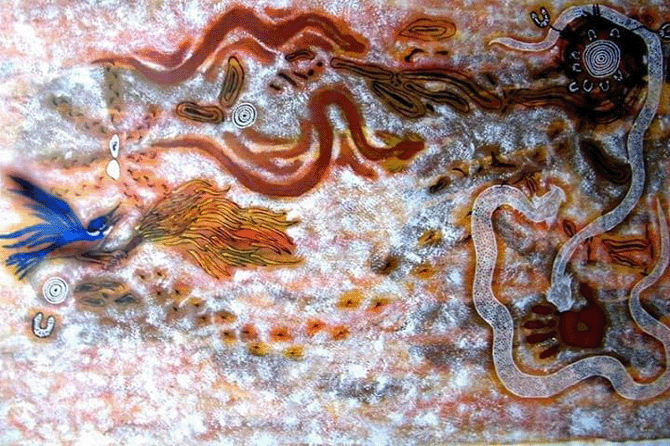
painting done by Regina McKenzie 6 yrs ago about Yurlus Dreaming tracks and where he went. This one depicts the a part of the tracks area where Yurlu went, but unfortunately now this area destined for a nuclear waste repository which will destroy the story and Dreaming tracks storyline and songs.
I want to stress, that I dont hate anyone regardless of race creed or colour all I want is for us as all Adnyamathanha people a tribal nation to be listened to by DIIS so that they dont destroy our cultural beliefs, our heritage our stories of creation of this land and where it goes. https://www.facebook.com/groups/344452605899556/
Australian mining companies have a poor track record operating in Africa. Australian uranium company Paladin Energy has now put two of its mines into ‘care-and-maintenance’ and bankruptcy looms. But who cleans up the company’s mess in Namibia and Malawi, asks JIM GREEN
Many Australian mining projects in Africa are outposts of good governance – this is what Julie Bishop, the country’s Foreign Minister, told the Africa Down Under mining conference in Western Australia in September 2017. The Australian government “encourages the people of Africa to see us as an open-cut mine for lessons-learned, for skills, for innovation and, I would like to think, inspiration,” the minister said.
But such claims sit uneasily with the highly critical findings arising from a detailed investigation by the International Consortium of Independent Journalists (ICIJ). The ICIJ noted in a 2015 report that since 2004, more than 380 people have died in mining accidents or in off-site skirmishes connected to Australian mining companies in Africa.
The ICIJ report further stated: “Multiple Australian mining companies are accused of negligence, unfair dismissal, violence and environmental law-breaking across Africa, according to legal filings and community petitions gathered from South Africa, Botswana, Tanzania, Zambia, Madagascar, Malawi, Mali, Cote d’Ivoire, Senegal and Ghana.”
Paladin Energy’s Kayelekera uranium mine in Malawi provides a case study of the problems with Australian mining companies in Africa. Western Australia-based Paladin exploited Malawi’s poverty to secure numerous reductions and exemptions from payments normally required by foreign investors.
United Nations’ Special Rapporteur Olivier De Schutter noted in a 2013 report that “revenue losses from special incentives given to Australian mining company Paladin Energy, which manages the Kayelekera uranium mine, are estimated to amount to at least US$205 million (MWK 67 billion) and could be up to US$281 million (MWK 92 billion) over the 13-year lifespan of the mine.”
‘Our kids need proper water’: Families plead for action over uranium in drinking water, ABC, 7.30 by Indigenous affairs reporters Isabella Higgins, Bridget Brennan and Emily Napangarti Butcher, 19 June 18,
Key points:
At least three communities in central Australia have levels of uranium in drinking water that exceed health guidelines
Dozens of other communities not meeting aesthetic guidelines, which ensure taste, feel and smell are up to standard
Residents fear water could be harming them and say governments have failed to act
Aboriginal community of Laramba, north of Alice Springs, drinking water contains more than double the recommended levels of uranium, and it’s been like that for a decade.
Billy Briscoe, a long-term resident, is deeply concerned about the impact that water is having on his family.
“The really important thing is about kids. Our kids need proper water, not with uranium. They need quality, really good water,” he said.
“We all drink the bore water … if there’s no water, how can you survive?
Official data obtained by the ABC’s 7.30 program shows Laramba’s water supply contains uranium at higher than 0.04 milligrams per litre (mg/L).
Australia’s drinking-water guidelines outline it should not exceed 0.017mg/L.
“The main toxic effect of short-term exposure to high concentrations of uranium is inflammation of the kidney,” according to the National Health and Medical Research Council.
“Little is known about the long-term exposure to low concentrations.”
Most communities in the Northern Territory rely on bore water, pumped up from an aquifer deep underground, which often contains high concentrations of naturally occurring minerals and contaminants — like uranium.
….. 7.30 can reveal that, in total, seven communities in the NT have exceeded health guidelines in the last financial year due to elevated levels of contaminants including uranium, barium, antimony, chromium and fluoride……A report from the West Australian auditor-general released in 2015 said three remote communities had exceeded the safe limit of uranium about half the time. ……
Arrernte elder Bob Liddle took this fight to the Federal Government after what he saw as inaction from the Territory Government.
The Federal Government said the provision of clean, safe, drinking water was not a federal responsibility.
“It is a responsibility of state, territory and local governments,” a spokeswoman for the Department of the Prime Minister and Cabinet said……
Mr Liddle said his biggest frustration was that he believed no level of government was taking carriage of fixing the water in his home communities.
“It’s an international scandal that this is allowed to happen in a country like Australia — a rich country like Australia,” he said.
“If that was happening in Victoria, you’d have a hell of a row. There would be politicians on the guillotine.
ABC managing director Michelle Guthrie has hit back against critics with a Deloitte Access Economics assessment that the public broadcaster contributed more than A$1 billion to the Australian economy in the last financial year.
This was on a par with the public funding of the organisation, she told the Melbourne Press Club, in an address coming days after the Liberal Federal Council urged the ABC be privatised – a call rejected by the government.
Far from being a drain on the public purse, the audience, community and economic value stemming from ABC activity is a real and tangible benefit,“ she said. The Deloitte study was commissioned by the ABC; Guthrie said its report was still being compiled and would be released next month.
Of the $1 billion, “more than a third is economic support for the broader media ecosystem. Far from being Ultimo-centric, the ABC is boosting activity across the country,” she said, giving as examples the filming of Mystery Road in the Kimberley and the production of Rosehaven outside Hobart.
Deloitte calculated the ABC was helping sustain more than 6000 full-time equivalent jobs across the economy. “It means that for every three full-time equivalent jobs created by the ABC, there are another two supported in our supply chain – local artists, writers, technicians, transport workers and many more.
“In hard figures, the research shows that the ABC helps to sustain 2500 full-time equivalent jobs in addition to the 4000 women and men who are directly employed by the public broadcaster.
“When broken down this equates to more than 500 additional jobs in production companies, over 400 jobs elsewhere in the broadcast sector, and close to 300 full-time equivalent jobs in the professional services.
“Amidst the debate over the ABC’s purpose and its funding we should all remember that there are 2500 jobs outside public broadcasting at risk in any move to curtail our remit and activities”.
Addressing the critics’ argument that the ABC’s about $1 billion funding wasn’t well spent, Guthrie pointed out that the broadcaster’s per capita funding had halved in real terms in three decades while the demands on it had increased, and that this financial year 92% of its budget would be spent on making content, supporting content makers and distribution.
“Thirty years ago, the ABC had five platforms and 6000 people working around the country. Today, Your ABC has two-thirds the number of people operating six times the number of platforms and services with half the real per capita funding”.
Guthrie argued that the claim that the latest 1% efficiency dividend could easily be accommodated ignored the accumulation of efficiency takes over the past four years, and the fact these efficiencies robbed the organisation of its ability to finance new content and innovation.
She rejected what she described as two other “fallacies” – that the ABC should be stripped back to servicing gaps in the market, becoming a “media failure operator”, and that the ABC served only sectional interests.
Referring to the ABC charter, she said that “as the independent national public broadcaster, our purpose is to provide a balance between broadcasting programs of wide appeal as well as specialised interest”.
Public broadcasting was “about providing the distinctive programs that Australians young and old, left and right, rich and poor, in Bourke and in Brisbane, both want and need”.
She attacked those commentators and politicians who liked “to pigeonhole our audience as being of a particular political bent or social strata.
“In the two years since I’ve been in this role, I have been constantly reminded how wrong that is”, she said, citing the 12 million Australians who would watch ABC TV this week, the nearly five million who’d listen to ABC radio, and the 13 million ABC podcast downloads that occurred every month.
“If all those listeners and viewers were on the one side of politics, there wouldn’t be much politicking left to do.
“I note also the findings of the recent Reuters Digital News Report. Australia may have an increasingly polarised media sector, but ABC television attracts viewers from across the political spectrum for its news coverage”.
Guthrie said that Australians regarded the ABC “as one of the great national institutions” and “deeply resent it being used as a punching bag by narrow political, commercial or ideological interests”.
June 19 marks six years since the founder of WikiLeaks entered the building of the Ecuadorian Embassy in London. He hasn’t stepped foot outside it since.
Julian Assange has been residing at the Ecuadorian Embassy in London since 2012, where he sought refuge while facing sexual assault allegations in Sweden.
981 days have passed since the Metropolitan police removed dedicated 24/7 guards from outside the Ecuadorian Embassy on October 12, 2015.
“Like all public services, MPS resources are finite. With so many different criminal, and other, threats to the city it protects, the current deployment of officers is no longer believed proportionate,” a statement by the Met police said.
865 days since the UN Working Group on Arbitrary Detention (WGAD) ruled in a majority decision that Assange was being detained inside the Ecuadorian Embassy in London arbitrarily and was allowed to leave.
396 days since the allegations were dropped by Swedish prosecutors, but the Wikileaks founder would still get arrested if he left the embassy’s premises — by the UK police — for failing to surrender to the court in 2012.
158 days since Assange was granted Ecuadorian citizenship and subsequently the UK was asked to recognize the whistleblower as a diplomatic agent. Had the British agreed — it would have given Assange immunity to finally leave the embassy.
83 days since the whistleblower’s access to the Internet was cut off “in order to prevent any potential harm.”
“The government of Ecuador has suspended the systems that allows Julian Assange to communicate with the world outside of the Ecuadorian Embassy in London… The measure was adopted due to Assange not complying with a written promise which he made with the government in late 2017, whereby he was obliged not to send messages which entailed interference in relation to other states,” the government of Ecuador said in a statement.
Julian Assange fears extradition to the United States to be prosecuted for espionage after his website leaked classified US data.
With the Senate not reporting on this until August 14, it is clear that this selection will be a rushed job. It is no doubt the government’s intention that the Senate Inquiry should be irrelevant.
A ballot to gauge community support in the small towns of Kimba and Hawker, about 450km north of Adelaide, for the facility will be held on August 20, Senator Canavan said.
“The decision will be made in the second half of this year … one way or another we need to make a decision,” he said. “We do not want this overlapping with a federal election. We have to find a solution.”
Senator Canavan told The Australian that economic benefits, including 45 direct jobs and a $10 million community fund, were behind support of more than 60 per cent in the communities affected by the proposal, following 18 months of consultation.
But Peter Woolfoord, president of a community group opposed to the facility, said Kimba was “completely divided” and insisted a waste repository should not be on agricultural land where “it poses unacceptable risks to our industry”.
Centre Alliance senator Rex Patrick said the site selection process “looks like an absolute sham” and claimed the Turnbull government was “determined to rush to select one of the South Australian sites despite there being a divided community”.
Senator Patrick said the government should properly engage with the remote mining town of Leonora, 240km north of Kalgoorlie in Western Australia, on its bid to host the facility.
Senator Canavan said there was already broad community support for three South Australian properties — two near Kimba, on the Eyre Peninsula, and Wallerberdina Station, near Hawker in the Flinders Ranges.
He said an “aggressive” push by the Azark company and the Shire of Leonora for a site on Clover Downs pastoral station, about 20km northwest of the central WA mining town, was a “plan B”.
“They want to run the facility themselves, which we haven’t ruled out … their initial scope was more focused on also taking overseas radioactive waste, which we definitely do not want,” Senator Canavan said.
“If we can’t get the support in South Australia we’ll most likely return to this other option (Leonora) as a plan B.”
The federal government has tried to find a site for a national radioactive waste management facility for more than a decade.
Marshall still open to nuclear powerIn Daily, Tom Richardson ADELAIDE April 11, 2018 Marshall today embarked on his third regional tour since seizing office at last month’s election, visiting the South-East seat of Mount Gambier where Liberal-turned-Independent MP Troy Bell is a firm advocate for nuclear power.
Marshall and Bell broke bread this morning, their second face-to-face meeting since election day.
Bell quit the party after being charged with dishonesty offences following an ICAC investigation. He is pleading not guilty in an ongoing court case……….
“I’ve always worked with Troy Bell… it’s quite obvious we share a lot of common aspirations for the people of the South-East,” he said.
One of those aspirations could yet be the establishment of a nuclear generator after Marshall last year flagged his interest in considering the industry, despite Royal Commissioner Kevin Scarce rejecting it as a commercially viable option “in the foreseeable future”.
“There will be a time when it may become viable, and desperate times call for desperate solutions – and we are in a desperate situation,” Marshall told media in February 2017.
Bell, who spearheaded the Liberals’ South-East fracking moratorium before he left the party-room, is a strong advocate for nuclear power and told InDaily he was “absolutely happy to lead the discussion” about establishing a local industry.
Paul Waldon Fight To Stop Nuclear Waste Dump In Flinders Ranges SA, 18 June 18
The American Department Of Energy’s (DOE), June 4th 2018 proposal to re-label (reclassify or rename) Hanford’s highly radioactive tank waste so it will not have to comply with the time consuming requirements of treating or disposing of such waste.
And if the DOE gets their way, high level radioactive waste “residue” will become “Waste Incidental to Reprocessing,” or WIR. This also means, radioactive waste in Hanford’s leaky tanks will only be cemented or grouted over, and will continue to purge its dangerous contents into the neighbouring Columbia river.
America’s irresponsible attempt to reclassify high grade radioactive waste is reminiscing of Australia labeling high grade waste as intermediate, and for those people that can’t remember it was only on the eve of WIPP’s inauguration that the residents of Carlsbad were adroit to the fact that radioactive waste to be accepted was of a greater classification at their unseen backdoor than indicated coming through the documented front-door.
Montebello Islands are a nuclear radiation risk, but boaters and campers flout the rules,ABC North West WABySusan Standen , 17 June 18
The Montebello Islands remain a nuclear radiation risk more than half a century after British bomb tests in the area, yet increasing numbers of people are risking their health by straying too close to the danger zones and even camping there.
There are more than 260 islands and islets in the Montebellos, which lie about 120 kilometres off the coast of Dampier in north-west Western Australia.
They are only accessible by boat and are rich in natural marine diversity and human history.
They are also the site of British nuclear testing in the 1950s.
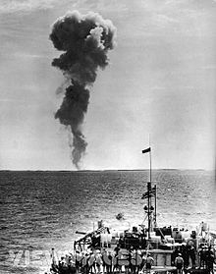
One of the test blasts conducted by the British military in the 1950s was filmed by a group of men from WA Newspapers camped on Karratha Station, approximately 150 kilometres away, then a thriving sheep station.
A family video of the action was made by station leaseholder Mrs Normie Leslie, mother of well-known local author Tish Lees, who is featured standing on the fence watching the blast.
Today the remoteness of the islands together with other personal health and safety concerns have prompted Parks and Wildlife Service staff to again highlight warnings to boating visitors.
With boating recreation a popular pastime in the coastal towns of Karratha, Dampier, Onslow and Port Hedland, some people are venturing further afield to offshore islands like the Montebellos.

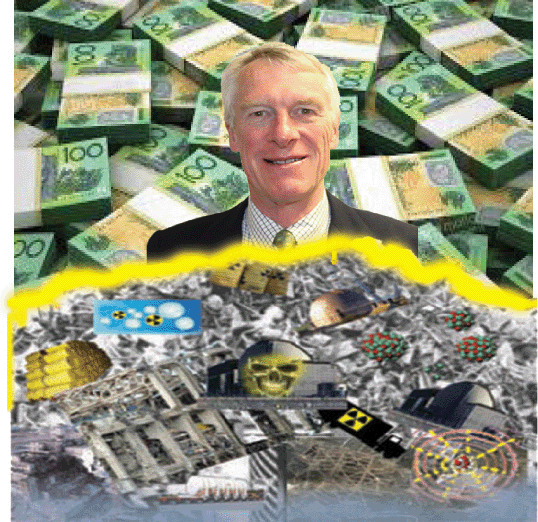





 –18 June 18 A site for the country’s first nuclear waste dump will be settled before the next federal election and will likely be in South Australia’s mid-north, Resources Minister Matt Canavan says.