Institute of Public Affairs aims for both nuclear power and privatising the ABC
 Steve Dale shared a link. Fight To Stop Nuclear Waste Dump In Flinders Ranges SA, 18 June 18
“In Mayo, the council motion has handed Ms Sharkie a small gift. There will be interest in what Ms Downer, who comes from the IPA, has to say about how she would like to see the future of the ABC.” https://www.facebook.com/groups/344452605899556/
Michelle Grattan: expect more government bullying to the Australian Broadcasting Corporation (ABC)
 The threat to the ABC is not sale but more bullying http://www.abc.net.au/news/2018-06-18/threat-to-the-abc-is-not-sale-but-more-bullying/9879420 The Conversation By Michelle Grattan
Activists hold jamboree to organise beyond coal and gas
GLW author Margaret Gleeson June 14, 2018
‘The burgeoning movements against coal and gas projects,
to defend the Great Barrier Reef and to conserve precious water resources
were boosted by the Beyond Coal and Gas Jamboree
held on the Sunshine Coast in Queensland over May 31 to June 3.
‘More than 350 activists from around Australia joined
international guests from the Pacific, the US and India
at the fourth Beyond Coal and Gas gathering.
Participants included Indigenous campaigners
against fracking in the Kimberley, Western Australia; the Northern Territory; and
against coal mining on traditional lands in the Galilee Basin, in Queensland. …
‘All age groups were present but youth, particularly Indigenous people and women,
were well represented, …
Indigenous campaigns
‘The opening session, “Indigenous rising: protecting country and organising our people”, heard how
Indigenous communities are heading up the fight to defend their lands from coal and coal seam gas mining.
‘Adrian Burragubba from the Wangan and Jagalingou Traditional Owners Council (W&J) spoke
of their opposition since 2012 of the Adani Carmichael coal project in the Galilee Basin,
and the court challenges they have faced. The current challenge is
against Adani’s bogus Indigenous Land Use Agreement.
The mine cannot go ahead until this issue is resolved.
If the Federal Court rules in Adani’s favour, the W&J will call for a judicial review
and have pledged to take it all the way to the High Court. …
‘Micklo Corpus a Traditional owner from Yaruru people in Broome, Western Australia,
has been campaigning since 2014 against gas company Buru Energy,
where many of the gas wells are located in wetlands.
The government is claiming veto over land to which his people have exclusive rights.
‘“The gas mining company’s offer is only for 40 years financial benefit,” Corpus said.
“I say ‘put the money back in your pockets’, we have 40,000 years to safeguard.”
‘The opening session also included speakers from the Indigenous youth climate network SEED,
who work with remote communities facing extractive industries.
‘Yorta Yorta woman Karrina Nolan spoke of communities having to choose
between safeguarding country and meeting basic needs.
“Communities in poverty shouldn’t have to give into mining to get services
which should be provided by government anyway,” she said. … ‘
Read more of Margaret‘s comprehensive, well-researched & inspiring account,
including Sections on Victorious Campaigns & the View from India re Adani:
www.greenleft.org.au/content/activists-hold-jamboree-organise-beyond-coal-and-gas
Need for an Independent Commission of Inquiry into Australia’s Nuclear Waste Management – FOE Submission
Friends of the Earth , Contact: Jim Green B.Med.Sci.(Hons.) PhD National Nuclear Campaigner ‒Australia SUBMISSION TO SENATE STANDING COMMITTEES ON ECONOMICS Selection process for a national radioactive waste management facility in South Australia Friends of the Earth Australia www.nuclear.foe.org.au/waste(Submission No. 86)
(Ed note. This copy of this submission does not include the copious references which are provided on the original at the Senate website. )
CONTENTS
- Introduction
- The financial compensation offered to applicants for the acquisition of land under the nominations of land guidelines
- How the need for ‘broad community support’ has played and will continue to play a part in the process
- How any need for Indigenous support has played and will continue to play a part in the process
- Whether and/or how the Government’s ‘community benefit program’ payments affect broad community and Indigenous community sentiment
- Whether wider (Eyre Peninsular or state-wide) community views should be taken into consideration and, if so, how this is occurring or should be occurring
- Any Other Related Matters ‒ Alleged Need for a Dump and Store
- Any Other Related Matters ‒ Long-lived Intermediate-level Waste
- Any Other Related Matters ‒ Need for an Independent Commission of Inquiry
- Introduction
Friends of the Earth Australia (FoE) welcomes the opportunity to provide a submission to this inquiry and would welcome the opportunity to appear at a hearing of the Senate Committee.
This submission comments on terms of reference (a) to (e).
Comment is also provided on several issues under term of reference (f) ‘any other related matters’.
In this introduction we wish to draw attention to two vital issues: the grossly deficient National Radioactive Waste Management Act, and the alleged need for a central waste facility. National Radioactive Waste Management Act We wish to emphasise gross deficiencies in the National Radioactive Waste Management Act (NRWMA), the federal legislation governing the nuclear waste management process.
The NRWMA is grossly undemocratic and it systematically disadvantages Aboriginal people. There is little point in seeking to improve processes under the NRWMA when the overarching legislation is itself deeply flawed. Conversely, significantly amending the NRWMA would be a logical starting point for resolution of intractable waste management issues. For those reasons, consideration of this issue should be central to the Committee’s deliberations.
It is noteworthy that in defending the government’s decision to oppose this Senate Inquiry, the Assistant Minister to the Prime Minister said the government is assessing three sites in SA “following a voluntary and fully transparent, community-driven process, consistent with the National Radioactive Waste Management Act 2012.” 1 Yet the government itself implicitly acknowledged serious flaws in the process by significantly amending it (for example compare the initial and subsequent nominations of sites near Kimba). Deficient processes have arisen from deficient legislation and the logical starting point to resolve the situation is to amend the legislation.
The NRWMA gives the federal government the power to extinguish rights and interests in land targeted for a radioactive waste facility. The Minister must “take into account any relevant comments by persons with a right or interest in the land” but there is no requirement to secure consent. Traditional Owners, local communities, pastoralists, business owners, local councils and State/Territory Governments are all disadvantaged and disempowered by the NRWMA.
The NRWMA disempowers Traditional Owners in multiple ways, including:
- The nomination of a site for a radioactive waste facility is valid even if Aboriginal owners were not consulted and did not give consent.
- The NRWMA has sections which nullify State or Territory laws that protect the archaeological or heritage values of land or objects, including those which relate to Indigenous traditions.
- The NRWMA curtails the application of Commonwealth laws including the Aboriginal and Torres Strait Islander Heritage Protection Act 1984 and the Native Title Act 1993 in the important site-selection stage
. • The Native Title Act 1993 is expressly overridden in relation to land acquisition for a radioactive waste facility.
The NRWMA also puts the federal government’s radioactive waste agenda above environmental protection as it seeks to curtail the application of the Environment Protection and Biodiversity Conservation Act 1999.
The NRWMA needs to be radically amended or replaced
Further deficiencies in the NRWMA are discussed in a briefing paper written by Monash University fifth-year law student Amanda Ngo in 2017. Her paper, ‘National Radioactive Waste Management Act 2012’, is posted at http://tinyurl.com/nrwma-2017 and we urge Committee members to read the paper.
The alleged need for a centralised site and the absurdity of moving intermediate-level waste from Lucas Heights to a store adjacent to the planned repository.
Much of the discussion around nuclear waste management in Australia assume the need for a centralised, remote waste management site. Yet successive governments have failed to demonstrate the need for a centralised site. This contradiction is most acute in regards to long-lived intermediate-level waste (LLILW) (including spent fuel reprocessing waste) currently stored at Lucas Heights.
Plans to move LLILW from Lucas Heights (and elsewhere) to an above-ground store colocated with the repository for lower-level wastes, and then to an unspecified site at an unspecified later date, make no sense from a policy perspective and they significantly raise public-acceptance obstacles. At best, the current co-location proposal would mean double handling i.e. transport to the interim national store then future transport to a currently undetermined disposal site. Such an approach would fail a net-benefit test (as required under the ARPANS Act) as it would involve a net increase in public health and environmental risks. The government plans to increase public health and environmental risks, and increase public acceptance obstacles, for no logical, defensible reason whatsoever. The current Coalition government should revert to the policy of the previous Howard Coalition government and separate the processes for managing LLILW and lower-level waste.
Even if the Senate Committee is unwilling to systematically investigate the claimed need for a centralised repository and co-located LLILW store, the Committee should at the very least explore the absurd proposal to transport LLILW from Lucas Heights to a co-located store and thence to a disposal site which could be located in any of Australia’s states or territories.
Sites other than those in SA.
Sites other than those in SA (Flinders Ranges and Kimba) have progressed towards formal nomination ‒ in particular, Leonora (WA) and Brewarrina (NSW). We urge the Senate Committee to consider submissions from local people and groups in those areas. Those sites are not further discussed in this submission but other submissions will alert the Committee to glaring process errors, such as a community survey initiated by the Brewarrina Council which made no mention of the words ‘radioactive’ or ‘nuclear’. 2.
The financial compensation offered to applicants for the acquisition of land under the nominations of land guidelines.
The federal government is offering $10 million for hosting the radioactive waste management facility. The facility will operate for approximately 300 years. Thus the compensation amounts to about $33,000 per year, i.e. next to nothing. The $10 million would likely be spent in a matter of years ‒ so for decades and centuries the local community would have to deal with the risks and problems associated with the facility, with no compensation.
There has been discussion about states/territories paying for the use of the national radioactive waste facility but details are vague and it is inconceivable that that could amount to anything more than a negligible revenue stream given that total national radioactive waste generation amounts to approx. 45 cubic metres annually according to the federal government (40 cubic metres of low-level waste and 5 cubic metres of intermediatelevel waste).2
The government’s claims about job creation are implausible and we urge the Senate Committee to say so clearly in its report. From 1998-2004, the Howard government stated that there would be zero permanent jobs at its proposed national repository site near Woomera. When attention later focused on the Muckaty site in the NT, successive governments said there would be six security jobs at the site and no other permanent jobs. Work would be available when waste was transferred to the facility, but there was no expectation that it would involve locals, and waste transfers to the site were only anticipated infrequently (once every 3‒5 years).3
The current government position is that “at least 15 full-time equivalent jobs will be needed to operate the facility.” 4 It is plausible that there might be 15 jobs in the initial stage as waste holdings are transferred to the site, processed/packaged and disposed of (or stored in the case of LLILW). However, it is implausible that 15 permanent jobs would be maintained beyond that initial phase given that waste transfers to the site would be low-volume and infrequent (once every three to five years). Annual generation of 45 cubic metres of waste could not sustain 15 jobs ‒ the claim is absurd and the government should be held to account by the Senate Committee for raising false expectations.
- How the need for ‘broad community support’ has played and will continue to play a part in the process, including: i) the definition of ‘broad community support’, and ii) how ‘broad community support’ has been or will be determined for each process advancement stage.
Minister Matt Canavan suggested 65% as the marker for ‘broad community support’ but then continued with the Kimba sites even after an AEC survey determined that support fell considerably short of that level at 56%.
There seems little point in assessing the level of community support and opposition when the government simply shifts the goal-posts to suit its political purposes. This issue will arise again with the government’s plan to formally survey local public opinion around nominated sites in August / September 2018 Continue reading
Donald Trump alienates America’s allies, raising the question “Should Australia get its own nuclear weapon?”
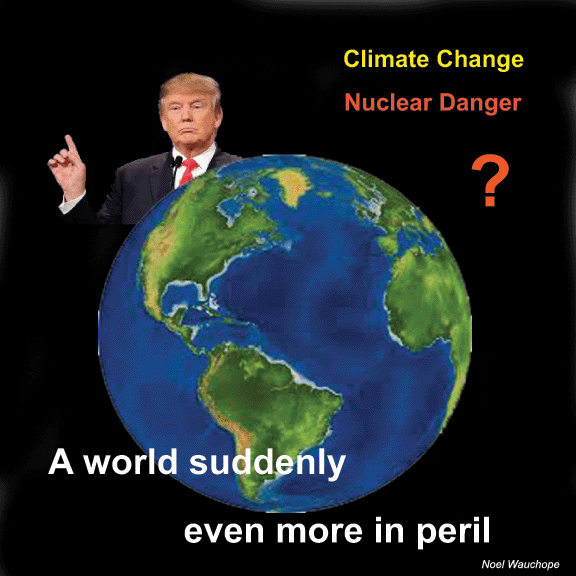 “The irony of the North Korean denuclearisation deal could be that everybody else decides to go nuclear. If it fails and Kim remains in power and countries doubt our commitment, then what’s to stop Japan or South Korea or Australia going nuclear?”
Trump triggers talk of Australia going nuclear, SMH, By Peter Hartcher
Should Australia develop its own nuclear weapons? It seems an outlandishly radical thought for such a safe country to consider. But a former adviser to Malcolm Turnbull and Julie Bishop thinks it’s an idea whose time is fast approaching.
In his book Why Australia Slept, launched this week, Peter Hendy says that Australia needs to consider nuclear weapons because “if we could financially afford them, [they] would secure an even more independent foreign policy” for the country.
Hendy, a former Liberal federal MP, former head of the Australian Chamber of Commerce and Industry and now a consultant, is not the first to raise this delicate subject. The way things are going he won’t be the last.
Three former deputy secretaries of Australia’s Defence Department – strategists Hugh White, Paul Dibb and Richard Brabin-Smith – have mooted the idea in the past year. Till these most recent months, it’s been something of a taboo topic in respectable circles.
One big reason? Australia already has the protection of the United States nuclear umbrella. Under this system, the US pledges that if anyone should launch a nuclear strike on one of its allies, Washington would retaliate against the aggressor.
So to suggest that Australia now needs its own atomic arsenal is to suggest that there has been a fundamental breakdown in trust. In short, that the US alliance is dead. Continue reading
Philip Fels: a farming family saddened at community disruption, due to unwise Barndioota nuclear waste dump site selection
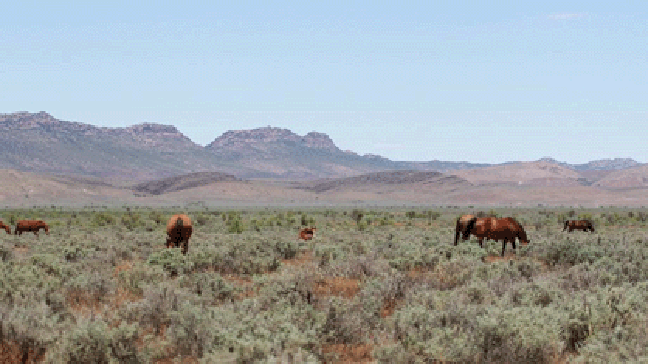
Philip Fels Selection process for a national radioactive waste management facility in South Australia Submission 84
To the Senate standing committee on Economics, Regarding the proposed nuclear waste facility at Barndioota near Hawker S.A.
As a family which has lived and worked the land very near to the proposed nuclear waste facility for more than 130 yrs we are very strongly against this facility going ahead for some of the reasons which we will try and point out in the text following.
The site in question shouldn’t have been allowed to be nominated by a person or persons with out any consultation with people whom this may directly effect considering they have only owned the property for a short time and have never lived or worked on the property or are ever likely to.
The land in question is one of the most unstable areas in Australia and we have earth tremors weekly if not daily and the Wilkatana Fault runs right up through this area.
As the soil structure is very porous and their is no granite bedrock in this area seepage or leakage into the local underground water table and then ultimately Lake Torrens is a very real risk.
As well as sustainably farming Merino Sheep and beef cattle for a very long time we also have a successful tourism business which we have been running on the property for 50 yrs which we fear will be severely impacted.
Our biggest worry of this process is the detrimental effect it will have and is already having on the local community as a whole.
Along with my family we have never seen an event in this area cause so much angst and division in a once very proud close knit community which was the envy of many other communities.
It saddens us greatly that somebody or bodies can come into a community for such a short time and cause such social stress which will only compound if this facility goes ahead.
Thank you if you took the time to read this and act on any of the concerns we have because they are real !!
Australian Radiation Protection and Nuclear Safety Agency (ARPANSA) agreement with IAEA on enhanced protection for uranium workers
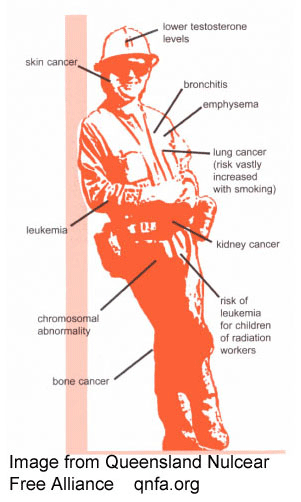 IAEA and Australia’s Regulatory Body Strengthen Cooperation to Enhance Radiation Protection of Uranium Mining and Processing Workers https://www.iaea.org/newscenter/news/iaea-and-australias-regulatory-body-strengthen-cooperation-to-enhance-radiation-protection-of-uranium-mining-and-processing-workers ,
Anna Taylor: Lucas Heights is the appropriate place, with the technology and expertise, for temporary storage of nuclear wastes
 Anna Taylor Submission to Senate on Selection process for a national radioactive waste management facility in South Australia Submission No 82
Introduction I live on the Eyre Peninsula and have deep concerns about this plan, including site selection, community consent, and the consultation process which lacks transparency and is fundamentally flawed. I do not support this current plan and welcome this opportunity to formally convey my concerns and opposition to the inquiry.
The Government has stated that it will not impose such a facility on an unwilling community. Myself and many locals believe the storage of intermediate level nuclear waste will affect tourism and primary industries. The issue continues to cause deep division and stress in the affected communities. Many Traditional Owners do not want cultural heritage sites and their spiritual connection to country put at risk.
After 70 years of the nuclear industry the federal government has no plans for a permanent solution of the long-lived intermediate-level waste. ‘Interim’ aboveground storage in SA could stretch to 100 years or more, this is not acceptable. The current project has not considered the full range of options to best advance responsible radioactive waste management in Australia
The federal government has not made a clear or compelling case that we need a national nuclear waste dump in SA. Australia must take responsibility for this waste; we must minimize future waste production and have a transparent approach to the future safety of intermediate level waste.
SITE SELECTION
I believe that
a) the process of site selection should be based on finding a permanent solution that is best suited to the safe management of this most Hazardous waste, with minimal transportation.Without expansion Lucas Heights has the knowledge and expertise to manage this waste for decades to come until a permanent (not a temporary storage facility) solution is found. Operations at the Lucas Heights site are licensed for a further three decades, which has the highest concentration of people with nuclear expertise and radiation response capacity in Australia. ANSTO and ARPANSA have publicly identified storage at ANSTO as a credible and feasible option
b) A single individual or property owner should not be allowed to nominate a site for a nuclear waste dump. .
COMMUNITY CONSENT Selection process for a national radioactive waste management facility in South Australia
Finding a solution rather than a location should begin with the government up holding its commitment to State community consent. I believe that the definition of broad community consent is extremely important and does not just belong to the people of one town adjacent to the proposed site but to a “broad” area as the term implies. The safe management of Australia’s nuclear waste is not only relevant to all of the Eyre peninsula / Flinders ranges population but too all South Australians and all populations along transportation routes. So far broad community consultation to the broader community has been non-existent. Consent within the communities is marginal but the site selection process has continued to the next stage regardless. This is extremely questionable, how can the community trust a process that does not listen to its results? I think its fair to say 57% community support in Kimba is not broad and should not have progressed further. We must clarify what percentage is acceptable for such a hazardous waste and this must not be the main factor in advancements of stages. This issue is an issue for all Australians and singling out a small community to deal with waste of this magnitude is ridiculous.
The South Australian community have already said no and raised enough concern back in 2002 when our state government passed the “ Nuclear Waste Prohibition act 2000” legislating protection to Sa from: A) The storage of nuclear waste (other than South Australia’s waste) B) A ban on the transportation of nuclear waste from interstate or overseas for the purpose of sending it to a national waste dump in this state.
I believe a failure of the National Waste Management Project has been to fully inform local communities about the facts of the intermediate level waste; where it is, how much of it there is and how radioactive it is. The public information campaign has been dishonest scare mongering, misleading to say the least. Linking the need for centralized radioactive waste storage facility with the production of isotopes for nuclear medicine is misleading. It is vital to provide accurate information to communities if you are genuinely looking for informed consent. Proponents claim that most of the waste planned to be stored in a national repository is from medicine, specifically medical radio isotopes, however measured by radio activity the figure is just 10-20%.*(1). The absence of a dump hasn’t harmed nuclear medicines and the establishment of a national dump won’t help nuclear medicine. There are new technologies to embrace,superseding nuclear medicine, such as making isotopes using cyclotrons that produce no long-term waste
I live near but outside the boundary for community consent and my conversations at the local community liaison office in Kimba have been unprofessional, misleading and not formally acknowledged.
COMMUNITY BENEFIT PROGRAMME The community benefit programme is questionable, verging on bribery creating further division in small communities .Its is an appalling approach to offer money (instead of transparent information) in return for a product that is poisonous to life for greater than your lifetime let alone hundreds of generations. I believe there should be no more taxpayer’s money spent on a site selection process that is flawed.
TRADITIONAL OWNERS
Traditional Owners have flagged concerns over cultural heritage issues. This must be recognized and acted on. The Barndioota site near Hawker has significant cultural values to the Adnyamathana peoples, this must be acknowledged and respected and ruled out of any more consideration.
ADVANCEMENTS OF STAGES Any advancements of stages of these site selections seems inappropriate whilst the proposal is for a “interim” solution that could stretch to a hundred years. This approach is not the safest management of Australia’s most long lived waste. The government needs to review future nuclear waste production with a commitment to reduce and phase out the creation of more nuclear waste.
Traditional Owners have flagged concerns over cultural heritage issues. This must be recognized and acted on. The Barndioota site near Hawker has significant cultural values to the Adnyamathana peoples, this must be acknowledged and respected and ruled out of any more consideration.
SUMMARY
The current project has not considered the full range of options to best advance responsible radioactive waste management in Australia. The waste can and should remain secured and monitored at Lucas Heights until a dedicated public review of the full range of options for waste management is carried out. I believe we need an expert open and independent inquiry into the full range of options. Nuclear waste management requires the highest quality decision-making and information. We must start afresh on planning and establishing the best way to deal with this highly toxic waste.
References:
*(1) Nuclear Medicine and the National Dump Site, Jim Green Med Sci. (Hons) PhD, Jan 2018 10 more questions about Australia’s nuclear waste. Nov 2017.
Dr Margaret Beavis and Dr Peter Karanoskos, Medical Association for Prevention Of War-Health professionals promoting peace.
The case for a revised approach: Extended interim storage and option assessment, Dave Sweeny
Kimba farmers Darren and Kellie Hunt deplore the Australian government’s flawed process for selection of nuclear waste dump site
Darren and Kellie Hunt SUBMISSION TO THE SENATE INQUIRY INTO THE SELECTION PROCESS FOR A NATIONAL RADIOACTIVE WASTE MANAGEMENT FACILITY IN SOUTH AUSTRALIA. (Submission No 80)
We are farmers in the Buckleboo district of Kimba, where we live with our three young children. We are both active members of the Kimba community and have been dismayed at the ongoing division and stress this proposal had caused amongst community members.
We feel the process that has brought us to this situation has been flawed and unfair, and we thank the Senate for their willingness to consider this issue.
Concerns we have include the lack of definition of what constitutes Broad Community Support, the use of financial incentive to coerce the community and the lack of consideration given to the potential implications to our agricultural industry.
a) The financial compensation offered to applicants for the acquisition of land under the Nominations of Land Guidelines;
Clearly, the landholders who have volunteered their land are the only persons to directly and personally benefit from this proposal. We understand that they will receive 4 time the value of their land for the section that is acquired, however it has not been made clear exactly how this value will be determined. Also, we understand that the nominators are receiving compensation for access to their land during the site evaluation phase, however information on the value of these payments have been kept from the public. If this process is to be ‘fair and transparent’ as the Department have insisted it is, we believe that this information should be available to the community.
b) How the need for ‘broad community support’ has played and will continue to play a part in the process, including: i) The definition of broad community support and ii) How broad community support has been or will be determined for each process advancement stage
- One of our greatest concerns regarding this process has been Ministers refusal to clearly define the term “broad community support’. As arguably the most important aspect in finding a suitable site, and certainly the biggest hurdle the Government have faced in their bids to date to do so, the unwillingness to clearly explain what they consider both ‘Broad’ and “Community” has created confusion and caused an escalating lack of trust towards the Minister and the process. It is very apparent that the reasoning behind the lack of clear definition is to allow the Minister to effectively ‘move the goal posts’, as was clearly evident when Kimba was accepted to phase two following our June 2017 vote.
- Having stated in the senate that he would require a number in the vicinity of 65% of the community voting to progress with the proposal, Minister Canavan chose to push Kimba into phase two of the process with a supporting vote of 57%. This result is subjective to the number of people who chose to participate in the vote, in actual fact those in support represented 49.94% of those within the community eligible to vote.One of the reasons the Minister given for his refusal to quantify broad community support is to enable him to accept opinions given from those who are ineligible to vote, via submissions. Prior to the June vote, 396 submissions were received both from the community and outside. The phase 1 summary report states that of the 112 local submission 86% were opposed. The remaining 294 submission were not given consideration in the report. Despite these results, Minister Canavan determined that broad community support existed in Kimba to progress the proposal to phase 2
We do not feel that Kimba should have continued to phase two after the vote as there was no clear indication of broad community support, merely proof that our community so divided in opinion on this issue. We believe strong consideration should be given to who has the right to vote, and if we are to continue to a further ballot, a definitive number must be provided prior as to what percentage of the overall community must be supportive for the proposal to progress. We believe this should be at least an absolute majority of 67% (of all eligible voters)
- How any need for indigenous support has played and will continue to play a part in the process, including how indigenous support has been or will be determined for each process advancement stage;We feel that the traditional land owners must be consulted and heard in this decision making process. We have not been aware of any consideration given to the Bungala people in the Kimba process at this stage.
- Whether and/or how the Governments community benefit program payment affect broad community and Indigenous community sentiment;The community benefits program was not a part of the initial package, and was announced prior to the 2017 Kimba vote, labelled ‘disruption money’. Clearly, the Minister was aware that this process has caused stress and division within communities, and felt that additional financial incentive would help to garner support. Unfortunately, no amount of ‘compensation’ can repair the damage that has been done and the division that we are forced to face on a daily basis.
f) Any other related matters.
We strongly believe that the facility is not suitable for Agricultural land. The storage of nuclear waste in a food growing region in a country which had as much un-arable land as ours makes no sense. The perception of the proximity of the nations nuclear waste to our productive land has the potential to adversely impact our commodity prices and land values and these are unacceptable risks to our business.
Clearly consideration has been given to potential impacts on agriculture as the draft ARPANSA’s Code for Disposal of Solid Radioactive Waste selection criteria includes ‘The immediate vicinity of the facility has no known significant resources, including potentially valuable mineral deposits, and which has little or no potential for agriculture or outdoor recreational use’.
This process has caused immeasurable contention and division within our town. The Department has upheld that they are running a fair and transparent process, and that everyone’s opinions are valid and will be respected. However, they have clearly put much effort into convincing those opposed to change their views. On a recent trip to Lucas Heights Selection process for a national radioactive waste management facility in South Australia Submission 80 (fully taxpayer funded and clearly orchestrated to demonstrate the safety of the facility) I was asked by our Community Liaison Officer if “we have managed to change your mind yet, now that you know there is nothing to fear”. This clearly sums up the objective of the department’s current presence in Kimba and the interest they are taking in our concern
Leon Ashton lays bare Australian govt hypocrisy, double-talk, lies , in its process for selecting nuclear waste dump site
 Leon Ashton Submission to STANDING COMMITTEE ON ECONOMICS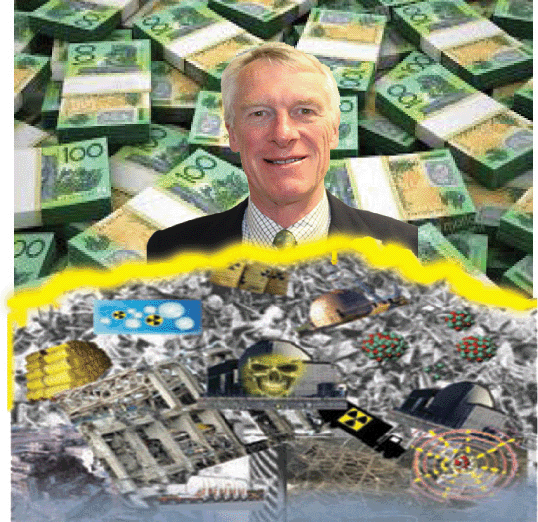
THE NEED TO DETERMINE BROAD COMMUNITY SUPPORT
In April 2016, a community sentiment survey was completed by DIIS through a company called ORIMA Research. This 205-page detailed report can be accessed on line. I attended another information gathering meeting at Quorn council chambers in April 2016, along with several other residents, to voice our concern. A member of our group voiced their concern at how the community survey was conducted and the methodology behind it. We all then heard a senior DIIS member tell us, yes, the community survey was flawed in some places, however we will still be going ahead with the next stage, into Phase 2, i.e. more information giving sessions to the public and looking at cultural and geological site compatibility.
[ “I understand there are a range of views within the community and the government encourages respect for all opinions. In my visit to the region and thru feedback from my department, I do not share your view that there is disunity in the area, or a need for assistance to support the community because of division.“ ] Mr Canavan could not possibly share my view because the people who were opposed to putting the waste dump in this area were told they could not have any time with him at all to discuss concerns face to face as he was too busy.?
TOURISM IN THE REGION
FUTURE EMPLOYMENT
We are informed by DIIS that there will be at least 15 full time job equivalents at the waste facility and yet when we look at every other industry, they are so tightly regulated, especially in areas of danger, it is only a matter of time before robotics also take over positions in this facility. This is the way of the future, so why would we trust people who are verbally telling us that we have nothing to worry about, the jobswill be there. I might add, that since January 2016, there have been at least five, possibly six key staff members from DIIS who have either left the Department or moved onto other positions. This does not allow continuity to the people they speak with and does not inspire confidence in what they are telling us. For example, I asked an employee of DIIS when they came to Quorn for the monthly gathering, what would DIIS do if the SA government citizens jury won the vote against having a HLW (high level waste) dump in South Australia. The employee told me DIIS would honour the SA Prohibition Act and walk away from it all. The next month I was told this would never happen and the Federal Government would overrule the Prohibition Act and carry straight on, as they have done. The employee who told me they would walk away, no longer works in that department.
ARPANSA have a guideline for prospective nuclear waste dump sites in Australia. The first three pre-requisites are 1. No seismic activity 2. Not flood prone and 3. Must have broad community support. Wallerberdina ticks all the boxes for where NOT to put it. I have stated before in writing that ANSTO are possibly the best people in the world to manage the waste storage at Lucas Heights.
OUTCOMES TO DATE AND RECOMMENDATIONS FOR FUTURE
It is for the above reasons that I believe DIIS need to scrap their prospective low-level waste dump locations and have a complete rethink in conjunction with other associations to try and rebuild a level of trust for what they are putting to the public before entering into public consultation.
Why is nuclear industry puppet – Matt Canavan not considering Leonora , Western Australia, as nuclear waste dump?
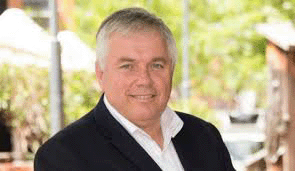 Nuclear site selection process questioned https://www.eyretribune.com.au/story/5467944/nuclear-site-selection-process-questioned/ Kathrine Catanzariti 14 June 18
Centre Alliance senator Rex Patrick (left) has called the site selection for the National Radioactive Waste Management Facility “an absolute sham”, claiming Minister for Resources and Northern Australia Matthew Canavan ignored a potential site at Leonora in Western Australia.
Mr Patrick, who introduced the senate inquiry into the site selection, made the claims on Wednesday following a visit to Leonora.

“Minister Canavan needs to more properly engage the proponents of the proposed site near the central WA mining township of Leonora or risk the whole selection process being confirmed as an absolute sham”, Mr Patrick said.
“I already hold enough concern in the selection process to have initiated a Senate Inquiry into it, but after visiting the Leonora site, I am convinced it is becoming a farce.”
Mr Patrick likened the lack of understanding of ‘broad community support’ to a running a race where participants are told they do not need to know where the finish line is.
The Leonora site was nominated in August last year, but Mr Canavan did not consider it due to the advancement of the sites in Kimba and Hawker.
Mr Patrick said that lead him to believe that a South Australian site was a “done deal”.
“It appears as though the new site is a ‘faster runner’ in the race, but won’t be allowed to participate because the Minister is determined to rush to select one of the South Australian sites despite there being a divided community.”
However, Mr Canavan said the government would not progress detailed assessment of other nominations until the results of the votes in the two South Australian communities were known. “We have well advanced proposals from three sites in South Australia, one near Hawker and two near Kimba,” he said. “These communities have been involved in extensive consultation and discussion about the site selection.
Next month each of the two communities will be given the opportunity to vote on whether they want to proceed with the nomination.
The government will not be progressing detailed assessment of other nominations until the results of the votes in the two South Australian communities are known.
No Radioactive Waste on Agricultural Land in Kimba or SA president Peter Woolford said it was important Mr Canavan made the right decision.
“…if there is a site on offer that meets all criteria, exhibits broad community support and is not on agricultural land, we believe he should be giving it serious consideration,” he said.
“We look forward to Minister Canavan’s explanation as to why he does not deem the Leonora proposal suitable for further investigation.”
The Kimba community will undertake the final vote on the facility in August.
Graham Readfern exposes the climate denial group “The Australian Environment Foundation”

The Australian Environment Foundation has secured a former prime minister to speak. But what does it actually do?
Securing a former prime minister to speak at your organisation is no doubt a coup for many groups.
Singapore’s Lee Kuan Yew School of Public Policy recently got Kevin Rudd. Australia’s Nelson Mandela Day committee has snaffled Julia Gillard for their next annual lecture.
What about our most recent former PM, Tony Abbott?
Next month, Abbott will deliver the “2018 Bob Carter Commemorative Lecture” to the Australian Environment Foundation (AEF), where the ticketing site says he’ll talk about “Climate Change and Restraining Greenhouse Gas Emissions”.
The AEF is an “environment charity” that promotes views that wind turbines make you sick, that human-caused climate change isn’t really a thing, and that environmentalists (the other sort) are killing farmers, fisheries and the economy.
Abbott’s lecture will no doubt pick up from his speech in London in December, where he delivered a suite of climate science denial talking pointsto the Global Warming Policy Foundation.
So who, or what, is the AEF? To look into its history, and the people involved with it, is to take a deep dive into Australia’s climate science denial network.
But first let’s look at the AEF right now because, as an “environmental charity”, Abbott’s next port of call doesn’t seem to do very much.
Latest figures available from the Australian Charities and Not-for-Profits Commission show that in 2016, the charity declared an annual income of just $1,175.
In May 2017, the AEF lent its logo to a letter to US President Donald Trump to offer “enthusiastic support” for his commitments to withdraw from the UN Paris climate agreement. But between July 2017 and February 2018, there was virtually nothing posted on its website.
Much of that website, including the “Climate News” section, is content from former Institute of Public Affairs fellow Alan Moran and postings that variously dismiss human-caused climate change and renewable energy, in particular wind power.
The charity has two other trading names listed with the Australian Securities and Investments Commission – the Australian Climate Science Coalition(ACSC) and ListenToUs – but both of these seem to be defunct. …….https://www.theguardian.com/environment/planet-oz/2018/jun/15/inside-the-aef-the-climate-denial-group-hosting-tony-abbott-as-guest-speaker
Event 27 June The Need for Leadership to Address White Supremacy in the NGO Sector
Pro Bono Australia Luke Michael, 14 June 18
 Charities and not for profits need to show leadership to address the issue of white supremacy in the NGO sector, a prominent Aboriginal writer and activist believes.
Nayuka Gorrie is a Kurnai/Gunai, Gunditjmara, Wiradjuri and Yorta Yorta writer and activist who spoke on a panel at the Victorian Council of Social Service (VCOSS) 2018 Summit on Wednesday.
She was joined by Victorian ombudsman Deborah Glass OAM, Will Stracke from the Victorian Trades Hall Council, Reason Party leader Fiona Patten, and Centre for Social Impact CEO Kristy Muir.
The panel discussed the “shifting nature of leadership and the role of citizens to shape their own prosperous and inclusive society”.
One of the topics discussed was the need for greater diversity in leadership, particularly around race and gender.
Stracke admitted during the panel discussion that leadership in the trade union movement was “too white”.
“One of our values that we say is ‘diversity is our strength and solidarity is our power’,” Stracke said.
“And that’s about the diversity of our movement and our movement is very diverse… but I think we as a union movement [still] need more voices.
“We’ve very white in terms of our leadership and we need to get better at that.”………
“Leadership needs to be much more representative of the people,” Glass said.
“It’s not just gender, it’s race, it’s disability, it’s everything we all stand for. We can’t have leaders speaking for us who don’t represent us, who don’t look like us or don’t speak like us.”………
Gorrie has organised an event to discuss “dismantling white supremacy in the NGO sector” at Victorian Trades Hall on 27 June.
She told Pro Bono News why she decided to create the event.
“I decided to put on that event after chatting to a number of different people that work in the not-for-profit sector,” she said.
“And [people of colour] are doing twice as much work just to survive I think.”
Gorrie said while white supremacy was found across all sections of society, it was especially disappointing to see it in the not-for-profit sector, considering the sector’s purpose to make the world a better place.
……..“I think a lot of not for profits make a lot of money and the Indigenous Advancement Strategy was a really good example of that. Most of the money in the strategy went to non-black organisations.“So there is a lot of money to be made in perceived black dysfunction and I don’t know if it’s possible for them to do the work they’ve set out to do if they haven’t examined and [removed] the white supremacy within themselves.”https://probonoaustralia.com.au/news/2018/06/need-leadership-address-white-supremacy-ngo-sector/
Centre Alliance Senator Rex Patrick exposes wider flaws in the Australian govt’s targeting of South Australia as nuclear waste dump

 Senator Rex Patrick has shown up the hypocrisy of the Federal Government in its expensive frenzy to foist a nuclear waste dump on rural South Australia. And in instigating the Senate Inquiry into this process, has set in motion the discrediting of the whole National Radioactive Waste Management Facility sham.
However, the propaganda by Western Australian private company Azark is not reliable, either. There is indigenous opposition to nuclear waste dumping in the Leonora region,Western Australia. Western Australia’s Labor government may not support Azark’s low level waste dump plan, may have its own plan for WA.s radioactive waste. This WA private offer is for low level waste disposal and is not for the Fed govt proposed above ground 100 year Store for 10,000 yr nuclear fuel wastes and long lived intermediate level wastes.
This exposes Federal govt’s plan to have two dumps in one, to “co-locate” a long lived waste Store’ along side a low level disposal site. It exposes their priority to dump Federal govt owned long lived nuclear wastes at an above ground “stranded wastes” dump in regional South Australia.
South Australian site selection for a national radioactive waste facility is a “sham”, as Western Australian private project is revealed

 South Australia nuclear waste site a “done deal: claims Senator Rex Patrick https://www.adelaidenow.com.au/business/sa-business-journal/sa-nuclear-waste-site-a-done-deal-senator-rex-patrick/news-story/08524bb4dc5004f467462b1591a55b1f, The Advertiser, Erin Jones, Regional Reporter, June 13, 2018
Centre Alliance senator Rex Patrick told The Advertiser the decision to establish a low-level facility at one of two sites in South Australia appeared to be a “done deal” following the revelation.
In August, Azark Project made a nomination to include the commercial operation of an underground storage facility, near the remote central mining town of Leonora, north of Kalgoorlie.
The South Australian senator, who visited Leonora, said the proposal appeared to have “considerable support” and unlike the two SA sites near Kimba and Hawker, did not need taxpayer funds to proceed.
“Resources Minister Matt Canavan needs to properly engage the proponents of the proposed site near Leonora or risk the whole selection process being confirmed as an absolute sham,” he said.
“It appears as though the new site is a ‘faster runner’ in the race, but won’t be allowed to participate because the Minister is determined to rush to select one of the South Australian sites despite there being a divided community.”
Azark Project chairman George Gear said the WA site had no environmental, land rights or water issues, and the proposal had support of the 2900 people in Leonora Shire.
Mr Gear said he had no confidence in the specially-formed government taskforce considering sites for the waste facility, given Leonora was not on the table.
“Apart from this being a superior site located in a mining area and in solid rock, this wouldn’t cost the taxpayer any money as it’s a private company that will build this,” Mr Gear, a former minister in the Keating government, said.
“The taskforce to date has either spent or committed $40 million and they haven’t finalised the project.
“Azark has completed all of its due diligence at its own cost and has offered to make it available to the taskforce — this invitation was not accepted.”
Mr Gear said Azark Project had decided to pursue the plan on its own, but was expected to meet Mr Canavan in Perth, today.
The Government is expected to decide in coming months whether to build the waste facility in SA, after a final ballot of Kimba and Hawker districts, on August 20.
Mr Canavan has previously said “broad community support” would be needed for the waste facility to go ahead — although no arbitrary figure has been provided.
The two-year site selection process has divided both communities — those in favour believe it would create economic opportunities, while those opposed say it will jeopardise industries.
The district where the waste facility is located would be rewarded by the government with a $10 million community fund to spend on local projects.
Both districts were already benefiting from a $4 million grants fund as a reward for being involved in the site selection process.
Senator Patrick this year successfully pushed for a Senate inquiry into the site selection process used for the national waste facility and an outcome is expected only days before the ballot, on August 14.
In a submission to the inquiry, Kimba’s mayor said more information on financial rewards and jobs was needed before the community voted in the ballot.
Mr Canavan did not respond to questions before deadline.

1 This month


Help Aunty Sue Protect Her Land and Sacred Sites From Destructive Rocket Testing.
.

Australians deserve the truth
about
AUKUS – https://aukuspublicinquiry.com/

PETITION – To: Prime Minister Anthony Albanese and the Australian Labor Government

of the week – Australians for War Powers Reform (AWPR)
To see nuclear-related stories in greater depth and intensity

