Submission to Senate Standing Committees on Economics “Selection process for a national radioactive waste management facility in South Australia “
My name is Noel Wauchope. I am a former school teacher, having taught science in secondary schools. I have a long term interest in nuclear issues. I would say that I am a generalist, rather than a specialist in a scientific field. I believe that this generalist approach is an advantage in examining and communicating about a nuclear waste dump proposal. All too often, even very well educated people are intimidated by the technical jargon of experts on nuclear technology, and thus become reluctant to form their own opinion.
I note the specific terms of reference that we are encouraged to address, and I deplore the fact that they, and the title of this Inquiry, are already begging the question – by stating “in South Australia”.
Already we are all supposed to accept without question the proposition that South Australia is the location for the federal nuclear waste dump – done and dusted!
SUMMARY
My main concern is in addressing b the concept of “broad community support”. The Inquiry ‘s brief for this appears to be confined to the Kimba and Hawker people. The establishment of a nuclear waste facility at Kimba or Hawker will involve transport of radioactive wastes through the region, and will have ramifications for its economy, agriculture and tourism. The local communities have not been properly informed, and pretty well brain-washed with the myth that the nuclear waste dump is a “medical necessity”. The nature of the wastes, lumping together Intermediate Level Wastes (ILW) and Low Level Wastes (LLW) is a messy and confusing plan, and its real meaning has not been explained to them. The safety problems with waste canisters have not been discussed. These local communities are not aware of their future in hosting “stranded wastes” – as there is no existing plan for the permanent burial of the very long lasting ILW wastes.
c The involvement of indigenous people by the National Radioactive Waste Management Facility (NRWMF) has been inadequate, and the idea that they support the plan is simply not believable, in view of the poor survey practices carried out, and the clear opposition of leading Aboriginal organisations.
e Eyre Peninsular , state-wide and nation-wide community views should be considered.
f Related matters include South Australia’s law prohibiting nuclear waste facilities, best practice for managing nuclear wastes, publicity and media coverage, and a responsible approach to radioactive waste management, and Australia- wide decision-making. Continue reading →
Photographs from a rally in Sydney, protesting against Federal Government plans to establish a nuclear waste dump at Brewarrinain North Western NSW, on Ngemba land. Traditional custodians of the land, the Ngemba, are opposed to the dump.
Speakers at the rally included organiser Natalie Wasley, Ngemba and Brewarrina representatives, Trish Frail and Natalie Eastwood, Nathan Moran from the Metropolitan Local Aboriginal Land Council, Dave Sweeney from the Australian Conservation Foundation, Jim Green from Friends of the Earth, and NSW Greens parliamentarians Jamie Parker and David Shoebridge, as well as others. The Wakagetti dance troupe provided dance performances and a smoking.
About 100 people from all around Australia then marched from Bligh Street outside the Commonwealth offices, through Sydney’s CBD to NSW Parliament House, chanting, “No bundabunda (poison) on Ngemba land”.
Peat fires burning near Cobden could smoulder for months, cause further evacuations ABC South West Vic By Matt Neal 24 Mar 18
Peat fires that have forced residents in Victoria’s south-west to evacuate their houses could continue smouldering for months, farmers say.
About 100 houses have been evacuated due to the fires burning near Cobrico over the last two days, with locals urged to leave the area until wind conditions change.
Cobrico farmer John Errey had to leave his home for a night on Thursday — and will probably have to do so again.
One of the blazes that tore through the region on St Patrick’s Day burnt three-quarters of his pasture, yet miraculously spared his house, dairy and livestock.
But the fires continue to smoulder in the peat swamp at the bottom of his farm.
The combination of a thinning ozone layer and farming practices in India may add up to more days of extreme ultraviolet radiation across Australia.
A Sun-Herald analysis of daily UV index readings since 1997 in Sydney, Melbourne and Brisbane found the number of days when ultraviolet radiation reached or passed extreme levels had risen slightly.
The amount of UV that hits Australia is influenced by fluctuations in cloud cover, ozone levels and the solar cycle.
In Sydney, four of the 10 highest UV index days since 1996 have been recorded since December 2016. While the ozone layer is recovering over the poles, it is thinning in mid-latitudes from Russia to the Southern Ocean below Australia, a study published last month in the journal Atmospheric Chemistry and Physics found.
“Decreases in ozone are less than we saw at the poles before the Montreal Protocol was enacted [in 1987], but UV radiation is more intense in these regions and more people live there,” said report co-author Joanna Haigh, from Imperial College London.
The weather bureau studied UV radiation in Australia between 1959 and 2009 and found an annual increase of 2 to 6 per cent since the 1990s, above a 1970-80 baseline. The bureau found these changes were related to ozone depletion.
Associate Professor Clare Murphy, from the school of chemistry at Wollongong University, said ozone trends were not fully understood.
“The largest factor involved in mid-latitude ozone depletion is the nitrogen cycle, which operates by nitrous oxide turning into reactive nitrogen in the stratosphere,” Dr Murphy said.
Nitrogen fertiliser is converted into nitrous oxide by soil microbes, creating a stable greenhouse gas that can reach the stratosphere, where the ozone layer protects the earth from most of the sun’s UV radiation,” she said. “However, once in the stratosphere, nitrous oxide is broken down by high energy radiation from the sun to become reactive nitrogen, which can deplete ozone.”
Dr Murphy said that last century, concerns about ozone depletion centred on “chlorine chemistry” (CFCs) because of the massive hole over the poles. “Now it’s nitrous oxide, which almost stopped the Concord from flying because they were worried about reactive nitrogen in the stratosphere.”
Nitrous oxide damage to ozone is ubiquitous, whereas damage from CFCs creates a hole during extreme weather years over the Antarctic, Dr Murphy said.
Nitrous oxide was identified as the most damaging substance to the ozone layer in the 21st century by a 2009 study published in Science. That study also suggested one of the best ways to address the problem was to give insurance to Indian farmers.
“In India, particularly, they’re putting in 10 times more nitrogen fertiliser on their crops than they need to because if a crop fails they may starve,” Dr Murphy said. “Insurance could pick up the loss.”
Robin Schofield, director of Melbourne University’s environmental science hub, said UV in Australia should be trending downwards because factors such as surface ozone, which is contained in smog, is on the rise and there is evidence of a recovery of stratospheric ozone.
The UV Index and skin cancer
The UV index relates to the intensity of sunburn-producing UV radiation. Sun protection is recommended when the UV Index is above 3 in clear sky conditions. The higher the number, the more severe.
11+ = Extreme. Avoid sun exposure between 10am and 4pm due to extreme risk of harm.
8-10 = Very High. Unprotected skin and eyes may be damaged and can burn quickly.
6-7 = High. Protection against skin and eye damage is needed. Reduce time in the sun between 10am and 4pm.
3-5 = Moderate. Stay in the shade near midday when the sun is strongest. Moderate risk of harm.
1-2 = Low. There is a low danger from the sun’s UV rays for the average person.
Note: UV intensity can nearly double with reflection from snow or reflective surfaces such as water, sand and concrete.
Heather Walker, Cancer Council Australia’s skin cancer committee chair, said UV is the most common cause of skin cancer but the council has not seen any evidence of a trend of more extreme or high UV days.
“Queensland is the skin cancer capital of Australia and they get more UV all year round,” Ms Walker said. “Skin cancer rates continue to rise but look like they may be stabilising over the next few years in all age groups except for the under 40s.”
The continued high rate of skin cancer in Australia is partly due to the ageing population, because cancer is a disease of ageing, Ms Walker said.
Brisbane average monthly maximum UV index.
Photo: Australian Radiation Protection and Nuclear Safety Agency
But skin cancer rates are falling for people under 40, she said, because they have had the benefit of Sunsmart messages [slip, slop, slap, seek shade and slide on sunglasses], which started in the 1980s.
“This is a message we need to keep reinforcing, because as it was put to me: ‘you don’t tell your children to brush their teeth once and expect them to do it for the rest of their lives’.”
Because UV and heat are not related, people often get sunburnt when there is no sun.
“The heat will rise and continue to rise in the afternoon, whereas UV is more of a bell curve shape that peaks in the middle of the day. And that’s why the advice is to avoid being outside in the middle of the day.
“Cool and cloudy days when the UV is high, that’s when people are most likely to be caught out because they don’t think they need sun protection.”
“Selection process for a national radioactive waste management facility in South Australia” – that’s the title of the Senate Inquiry . Begs the question, doesn’t it ? Why does it have to be assumed that it’s gotta be in South Australia?
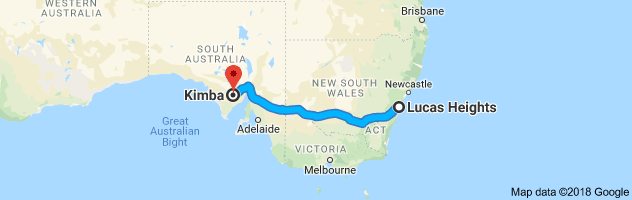
Sounds damn silly to me – toting highly radioactive trash for 1700 km – pretty much involving 3 States, all the way from Lucas Heights, Sydney, where it can be relatively safely kept – until decades later when they might bury it permanently – near to the nuclear reactor that’s producing it. (Heck they might even have the brains to shut down the reactor and stop producing radioactive trash)
But – never mind. These uninformed Senators need your submission. They’ve already got at least 5 submissions from pro nuclear enthusiasts – now showing on their website. We can do better.
SUBMISSION TIPS There have been rumours that Senate Inquiry submissions are limited to 5-6 pages. This is not the case, if your submission is longer than 5 pages you need to provide a summary at the front of your submission. See suggestions below:
The best submissions:
clearly address some or all of the terms of reference—you do not need to address each one
are relevant and highlight your own perspective
are concise, generally no longer than four to five pages
begin with a short introduction about yourself or the organisation you represent
emphasise the key points so that they are clear
outline not only what the issues are but how problems can be addressed, as the committee looks to submissions for ideas to make recommendations
only include documents that directly relate to your key points
only include information you would be happy to see published on the internet.
Submissions that include complex argument, personal details or criticise someone may take the committee longer to process and consider.
Your own ideas, your own words are best, BUT if you are pressed for time etc, you can submit an online submission at Waste Dump Senate Inquiry Submission.
Including my brief 3 pager, Summary:
To be credible, a finalised ARPANSA Code must mandate the best practice Principal of Non-Imposition of nuclear waste disposal facilities on community.
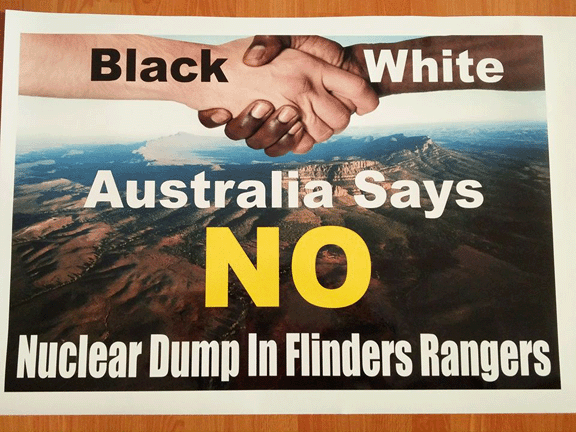
It is untenable for this Code to countenance Disposal Facility Siting in an area of special cultural heritage significance to Aboriginal people. Proposed NRWMF siting in the iconic Flinders Ranges must stop. A finalised ARPANSA Code must respect Aboriginal people’s rights and interests. ARPANSA needs to recognise the Storage and Disposal of nuclear wastes affects the rights, interests and safety of all South Australians and is prohibited in our State under the Nuclear Waste Storage (Prohibition) Act 2000.
Any imposition of Disposal Facility Siting in SA will be strongly resisted by community across SA.
at: https://www.arpansa.gov.au/…/4206–62d45b57e7ea1b50ccb30956…https://www.facebook.com/groups/344452605899556/
Paul Waldon No Nuclear Waste Dump Anywhere in South Australia, 18 Mar 18
Today the 18th of March is another red letter day in the nuclear arena with the 31st anniversary of a accident at Lucas Heights.
But first lets jump forward 29 years to the Hawker nuclear community meeting on the 6th of May 2016, where a man named Bruce Wilson from the DIIS who chaired such meeting, a man who could be a totally inept clairvoyant, a nuclear decision psychopath, a misinformed government payed nuclear spruiker, or just a sad ignorant man, this is a man whom said “We will NOT have accidents” .
The opposing dichotomy believes in the old dictum “Pray for the best, prepare for the worst” and the such dichotomy keeps giving a resounding NO to a deadly radioactive dump, which keeps falling on deaf ears of the liars who said they would walk away from a community that doesn’t want to accept it.
Now lets return to the anniversary of the 1987 accident where a fire at Lucas Heights nuclear research laboratory resulted in the contamination of two workers and the discharge of radioactive gas into the atmosphere over populated areas. Yes, Bruce this was a accident, however there was an event two years prior to such accident that may be called a purpose when alleged vandals dodged security patrols and smashed a underground pipe, releasing radioactive effluent into river ways. (What was this pipe made of, maybe brittle 2mm plastic?).
Are we to believe, Bruce, that there wont be anymore accidents, maybe because accidents will be suppressed, or called a planed event, or re-classed as “Technically produced anomalies” just like the erroneous, magniloquent re-classing of high grade waste to intermediate waste in an attempt to try and push through a egregious program while attempting to insult the intelligence of the majority of informed South Australians who don’t want a risky radioactive dump here? https://www.facebook.com/groups/1314655315214929/
Paul Waldon Fight To Stop Nuclear Waste Dump In Flinders Ranges SA “A rose by any other name would smell as sweet.” High Grade waste by any other name would be such a risk.
There has been one, only one successful test of a dry cask to find its safe threshold and that was a recorded drop from 10 meters, all other tests have failed to record the threshold for compromising a dry-cask.
Holtec industries had a reported failure in nine yes 9 different areas of construction of dry-casks, about the time Australia had some nuclear fuel vitrified, so ask yourself did we buy a poor quality dry-cask. Hidry buildup on nuclear fuel and its cladding in the dry-cask is a forever real explosive threat to the integrity of such containment vessels, this has a problem with no current tests able to monitor such issues.
The nuclear industry has acknowledged that stainless steel is susceptible to Chloride induced corrosion with cracking of dry-casks. These minor cracks are likely to develop into truwell cracks that can compromise the dry-casks. The president of one company that produces dry-casks for the nuclear industry whom was present at a Citizens Engagement Panel meeting in Orange County was reported to say “If there was a truwell crack, even a microscopic crack million of curies of radiation would escape through the crack, and it would be impossible to get near the canister or repair it, and he went on to say its not practical to repair these things when they start cracking.”
Rebecca HigginsFight To Stop Nuclear Waste Dump In Flinders Ranges SA, 24 March 18 On the news last night they made it sound like the dump was just a question of WHERE not IF.
This new government is pushing hard and fast. As someone living on the Eyre Pen. I am 100 percent opposed to this and can not understand why a few money hungry farmers in kimba get a vote and we don’t.
This will affect all of us we should all get a vote. Those of us not benefiting from this toxic nightmare would surly oppose it. Anyone with half a brain can see this is both unnecessary and dangerous. Anyone in Kimba who thinks this is a good thing needs a lobotomy and FAST. Greedy bastards. Ranges SA https://www.facebook.com/groups/344452605899556/
Business News 23rd March 2018,A group of small and medium-size South Australian businesses plan to launch a first-of-its-kind power trading platform using blockchain technology in an attempt to save money and buy and sell local clean energy.
Blockchain-based microgrid developer LO3 Energy, of New York, is working on the project with solar and electrical firm Yates Electrical Services, of Paringa, South Australia, a region known for its vineyards, almond and fruit orchards — and incredibly high electricity prices.
By Patrick Martin and Gary-Jon Lysaght, 24 Mar 18 South Australia’s Government says it will back a Federal Government proposal to build a nuclear waste dump in the state’s outback.
New Premier Steven Marshall made the comments this week after his cabinet was sworn in at Government House.
“That’s a federal issue. We need to be assured the host community is satisfied with that,” Mr Marshall said.
“The Labor Party has held the same position that we have.”
The Australian Radiation Protection and Nuclear Safety Agency (ARPANSA) held informal community consultations in both towns this week.
ARPANSA is the independent federal agency that would assess any application made by the Federal Government for a nuclear waste repository.
The ABC understands the Federal Government wants to make a decision on the location of the nuclear waste facility before the end of the year.
Kimba community split over proposal
Kimba local Audrey Lienert opposes the facility, but attended the ARPANSA session to gain further information about the process.
“It has split the community terribly,” Mrs Lienert said.
She said there was a common concern among those who did not support the facility at Kimba.
“If the word gets out that we’ve got nuclear here in our farming land, what [will] our market be overseas, and what will that do to our prices?”
But not all locals are against the proposal.
Lifelong Kimba farmer Trevor Cliff said the economic benefits could not be overstated for the small farming community of 600.
“Every country town is struggling with numbers. It’s hard to attract industry,” Mr Cliff said.
“To me, it’s something that can help the town employment-wise.”
He is convinced the facility and the transport of nuclear waste will be safe.
“I’m very happy to accommodate it here. I have no fear of the actual product.
“It’s well-contained, well before it gets to Kimba.”
He admitted the issue had been contentious, but disputed the town had been split.
“One of my best mates, he’s trapped on the no side and we talk about it,” Mr Cliff said.
“He can have his side, and I say my side — that’s democracy for you.”
Hawker locals battle over culture and economic growth
The Flinders Local Action Group (FLAG) comprises members who are against the facility being built in the Flinders Ranges.
FLAG member Greg Bannon said the group was strongly opposed to the potential Wallerberdina Station site near Hawker.
“That stretch of land between Lake Torrens and the ranges is totally unsuitable for something that will have to be managed for at least 300 years,” Mr Bannon said.
But Barndioota Economic Working Group chairman Malcom McKenzie said the potential for jobs could not be understated.
“If everything’s all safe to do I’m for that facility to go ahead because I want to see jobs for that region,” he said.
“I want to see opportunities for Aboriginal people and for the people of the area. And it’s a great opportunity I think we’re going to proceed with.”
ARPANSA’s role ‘informal’ for the momentARPANSA chief executive Carl-Magnus Larsson said the organisation would assess any application carefully.
“A facility will not go ahead unless we’re convinced it can go ahead and that protection of health and safety of people is taken care of,” Dr Larsson said.
He stressed recent meetings between the communities and ARPANSA had been informal because no official application had been lodged by the Federal Government.
He said if the agency were to receive an application, it could take between six and 12 months to decide whether to grant a licence for the facility.
A federal Senate inquiry into the process of site selection is ongoing, with submissions closing on April 3.
There are intermediate steps we can take right now, as long as we remember that that’s all they are. Bringing political parties under the remit of Australia’s mediocre privacy laws would be a start. Joining and supporting dedicated organisations like Digital Rights Watch and Electronic Frontiers Australia helps extend their reach and yours.
The question is whether we’re ready to exercise our data sovereignty, or whether we’re content to play passive victims while surveillance capitalism extends ever finer threads into every corner of our lives. For better or worse, a window is open in which to have that conversation
Emerging from several days in hiding while the Cambridge Analyticastorm swamped his company, Facebook founder and CEO Mark Zuckerberg finally spoke on Thursday.
“We have a responsibility to protect your data, and if we can’t then we don’t deserve to serve you,” his post sets out. To be clear, this is a statement, not an apology, and it would sit better if Zuckerberg had added the words “to our advertisers and other third parties,” to the end of the sentence. What has been exposed here is not some unforceeable aberration, but an ordinary consequence of what Shoshana Zuboff calls “surveillance capitalism”.
Important things can happen in these rare moments when the mask slips and some of the world’s underlying machineries are exposed to wide critique and analysis. Facebook, its business model, and the web of commercial and political agreements holding it in place are currently undergoing such a moment of slippage. Big, positive changes are possible when events conspire to blow a scandal onto the front page day after day, if the moment of outrage is channeled in meaningful ways.
As ever, this means a lot of well-paid people are scrambling right now to make sure that things change as little as possible, by making sure that we are collectively content to learn the wrong lessons and then go back to how we were. If this all dies down with a handful of executives forced to switch shell companies and an empty commitment by Facebook to work harder to earn our trust, the moment will have been wasted.
Plenty has been written about the Facebook-Cambridge Analytica tie up which boiled over after the Guardian published a whistleblower’s account of how he’d helped build Cambridge Analytica “a full service propaganda machine” to microtarget potential Trump voters in the election campaign which saw Donald Trump win the White House in 2016.
The sleazy way in which Cambridge Analytica was able to scrape Facebook’s vast collection of private information is not the real story here. Neither is the existence of these creepy little consultancies which promise to combine big data holdings with psychographic analysis to help political candidates manipulate voters.
The real question is whether we are ready, collectively, to draw a line under surveillance capitalism itself, and start taking back a measure of control.
The interests ranged against the public are huge. Corporate behemoths like Facebook and Google provide a free service in exchange for information about your most intimate personal, commercial, locational and political life, which they then sell to advertisers or other third parties. That’s the for-profit surveillance model: your inner life and purchasing habits are the product, packaged and on-sold. As you can imagine, political parties benefit hugely from data-driven micro-targeting. In Australia, political candidates are exempt from privacy law, and recent statements from the major parties indicate that’s not a privilege they are planning on giving up. Signals intelligence agencies acting within the Five Eyes network have built even greater data holdings under the US National Security Agency’s informal “collect it all” motto, material which places us all just a heartbeat away from “turn-key tyranny”, to borrow Edward Snowden’s memorable phrase. The common thread linking each of these layers is the non-consensual exploitation of private information that you might have had a reasonable expectation would be, well, private. It’s not just a simple case of opting out, either; even if you’re willing to give up Facebook’s near-ubiquitous “social graph”, the company also stands accused of amassing “shadow profiles’ of people who aren’t even signed up to Facebook. You also, as many have pointed out, will have a harder time opting out of government data collection. Continue reading →
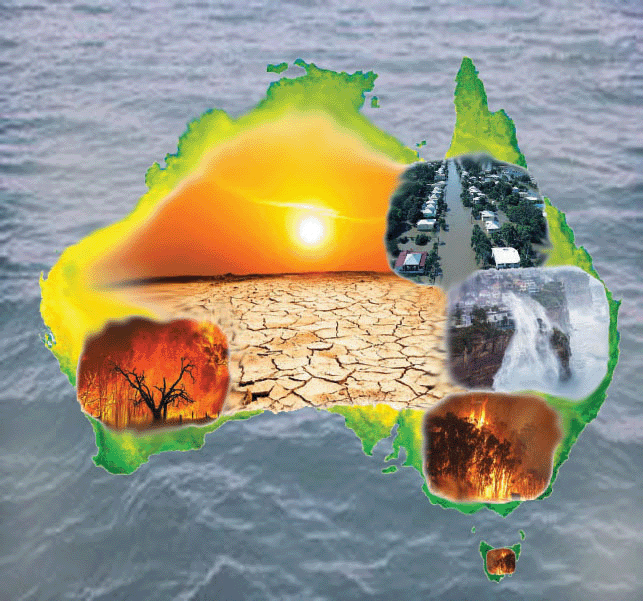
A new report by the bank, titled Fragile Planet, has ranked 67 countries for their exposure to climate change risks. Australia scored poorly, with the largest percentage rise in deaths attributable to climate change in the developed world.
Combining data from the World Bank and EM-DAT, the International Disaster Database which calculates economic damage estimates, HSBC said fatalities attributable to climate change-linked events such as stronger storms, floods, or heat-related incidents surged from 0.36 per cent of the population between 1997 and 2006 to 3.41 per cent between 2007 and 2016.
At the same time, the number of people impacted by climate change events surged from 3.25 to 15.25 per 1000 of the population.
Israel and the US were the only developed countries with a bigger share of the population impacted by climate change-related events such as floods, storms, hurricanes, and wildfires.
Globally, the World Health Organisation forecasts that around 250,000 additional deaths annually will be attributable to climate change.
HSBC developed the report as a tool for investors to provide in-depth information on countries’ climate change risk profiles, on their energy issues, risks to business operations, supply and demand and logistics as well as their long-term sustainable development issues.
Australia was ranked as highly sensitive to the physical risks of climate change, with predictions of more storms, floods, rain and bushfires. New Zealand ranked as one the nations least exposed to those risks.
Hurting the economy
Late last year, Deutsche Bank also developed a tool to forecast where its investments across the globe may be impacted by natural disasters brought on by climate change.
The German bank’s economic modelling estimated that if carbon emissions aren’t reduced throughout this century, per capita GDP will be 23 per cent lower than it otherwise would be.
Principal Advisor at The Australia Institute, Mark Ogge, said Australia’s industries and infrastructure, such as coastal based business, roads and rail, and both commercial residential assets, are at significant risk from climate change-related events.
“There’s up to $236 billion of infrastructure at risk from a one-metre sea level rise alone,” Mr Ogge said. Temperature increases also put Australia’s tourism industry at risk, with a rising number of days above 35 degrees celsius in holiday destinations such as Far North Queensland, he added.
Australia is the only developed market that ranked within the top ten in HSBC’s report for energy transition issues due to its high levels of fossil fuel exports – particularly coal – and is one of the few countries that has seen these exports growing as a percentage of their gross domestic product.
HSBC sees risks to the nation’s economy as Australia attempts to shift its energy and economic system, currently underpinned by fossil fuels, to one with a greater mix of renewables.
“Many countries and other actors are at risk of seeing parts of their old energy economy becoming effectively ‘stranded assets’ – or economically non-viable – given the relative economics of alternatives and new breakthrough technologies,” the HSBC report stated.
“Managing the transition to a lower carbon economy is key to mitigating downside risks,” the bank said. “We think achieving diversification is key.”
he good news
However, it is not all bad news. Australia was ranked amongst the top three nations – along with New Zealand and Norway – with the greatest potential to respond to climate change and financially prepare the country for a changing environment.
Despite Australia’s frequent drought conditions, it was seen as a market with adequate water resources availability, while Singapore was the developed market most at risk over water availability.
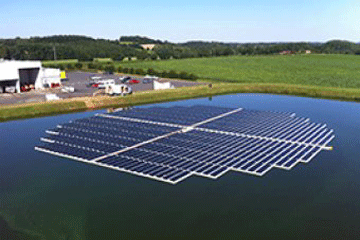
South Australia’s largest water and sewerage services supplier, SA Water, is set to install another 5MW of solar PV, including a floating solar plant, after local outfit Enerven was awarded the tender for the job.
Enerven said on Wednesday that it had won a Stage 1 contract to design and construct ground-based solar installations at facilities in Hope Valley, Christies Beach and Glenelg, and to develop a floating solar PV array.
The utility, which manages more than 27,000km of water mains, including 9,266 km in the Adelaide metropolitan area, said it was installing the solar and storage system to manage periods of high electricity prices, and to ensure safe and sustainable delivery of water to customers.
Ultimately, the company aims to get its on-site renewable energy generation to the point where it is equal to the total annual amount of energy used by SA Water’s buildings and desalination operations.
And it is not alone in its quest. As we have reported on One Step Off The Grid, a number of Australian water utilities are turning to solar and/or wind energy to lower costs and help guarantee supply.
The solution – delivered by the Logan Water Infrastructure Alliance and solar installer CSR Bradford – combined a 95kWh Tesla Powerpack with 323 PV panels at the site of the relatively new 20 Megalitre Round Mountain Reservoir, which provides drinking water for residents in Flagstone, Yarrabilba, North Maclean, Spring Mountain and Woodhill.
Enerven says design of the SA Water solar project has commenced, and is due for completion in September 2018.
This article was originally published on RenewEconomy’s sister site, One Step Off The Grid, which focuses on customer experience with distributed generation. To sign up to One Step’s free weekly newsletter, please click here.
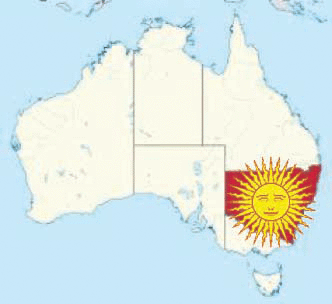
New South Wales has long played second fiddle to Queensland – the “Sunshine state”, when it comes to rooftop solar. Despite its bigger population, NSW is beaten into second place on rooftop solar installations by Queensland, which has already reached the 2GW mark.
But the Australian Energy Market Operator suggests that is about to change.
Over the next few years, it expects NSW to overtake Queensland with the most installed capacity (by 2020/21) and by 2035 it expects NSW to have more than 7GW of rooftop solar in the state – 50 per cent more than its nearest rival.
This graph above [on original] shows the estimate, including in the AEMC’s Reliability Panel’s annual report, which highlights the growing shift to decentralised energy, which includes rooftop solar and storage.
Indeed, this graph shows only one of AEMO’s installation scenarios – it’s high uptake shows another 3GW of rooftop solar, and many suggest that half of all Australia’s electricity needs may come from decentralised energy within a decade or two.
Recent data suggests that NSW recently pipped Queensland as the biggest market for rooftop solar in the month of February (with just over 28MW installed in the month), but AEMO’s forecasts suggests NSW will continue to set the pace over the next decade or two.
The rooftop solar is already having an impact, delaying and reducing the size of grid peaks, and so reducing the cost of peak demand events. Ausgrid is also looking at providing more subsidies to encourage more rooftop solar in inner-city suburbs to reduce the need for network upgrades.
The AEMO forecasts suggest a total of 18.6GW of rooftop solar PV capacity by 2035/36, which will be accompanies by strong growth of integrated solar PV and battery storage systems.
Indeed, this graph shows only one of AEMO’s installation scenarios – it’s high uptake shows another 3GW of rooftop solar, and many suggest that half of all Australia’s electricity needs may come from decentralised energy within a decade or two.
This will have an impact on the shape of the demand curve in Australia. Not only will it reduce maximum demand, and push it into the evenings, it will also push minimum demand into the middle of the day, rather than overnight.
This is already happening in South Australia (it has been since 2012), but will extend to NSW, Queensland and Victoria. Minimum demand may turn “negative” – where rooftop solar output exceeds customer demand – as early as 2025 on some days in South Australia.
AEMO suggests that in South Australia the excess rooftop solar output can be stored (in batteries) or exported to the rest of the market.
“This signals the important need for market and regulatory frameworks that support storage solutions and maximise the efficiency or shared electricity services for consumers.”
Indeed, the new South Australian government is toying with that idea, proposing its own $100 million plan to subsidise the installation of batteries in 40,000 homes, and considering what to do with the Tesla plan for solar and storage in 50,000 low income homes that would create the “world’s biggest virtual power plant”.
And here’s another interesting graph [on original] from a separate AEMO report, one that looks at the last quarter of the electricity markets.
It shows the average rooftop solar PV output in the last quarter, and it is nearing 1GW, having risen from 905MW in the same quarter last year to 969MW in the fourth quarter of 2017.
AEMO says the largest increases were in Victoria (+15 per cent) and South Australia (+8 per cent). These increases correspond with an increase in rooftop PV capacity and higher than average sunshine across all capital cities except Adelaide.