Solar energy poised to take off in a big way in New South Wales
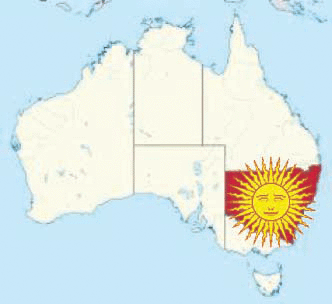 NSW, the sleeping giant of rooftop solar, is about to awake http://reneweconomy.com.au/nsw-sleeping-giant-rooftop-solar-awake-68621/ By Giles Parkinson on 22 March 2018
New South Wales has long played second fiddle to Queensland – the “Sunshine state”, when it comes to rooftop solar. Despite its bigger population, NSW is beaten into second place on rooftop solar installations by Queensland, which has already reached the 2GW mark.
But the Australian Energy Market Operator suggests that is about to change.
Over the next few years, it expects NSW to overtake Queensland with the most installed capacity (by 2020/21) and by 2035 it expects NSW to have more than 7GW of rooftop solar in the state – 50 per cent more than its nearest rival.
This graph above [on original] shows the estimate, including in the AEMC’s Reliability Panel’s annual report, which highlights the growing shift to decentralised energy, which includes rooftop solar and storage.
Indeed, this graph shows only one of AEMO’s installation scenarios – it’s high uptake shows another 3GW of rooftop solar, and many suggest that half of all Australia’s electricity needs may come from decentralised energy within a decade or two.
Recent data suggests that NSW recently pipped Queensland as the biggest market for rooftop solar in the month of February (with just over 28MW installed in the month), but AEMO’s forecasts suggests NSW will continue to set the pace over the next decade or two.
The rooftop solar is already having an impact, delaying and reducing the size of grid peaks, and so reducing the cost of peak demand events. Ausgrid is also looking at providing more subsidies to encourage more rooftop solar in inner-city suburbs to reduce the need for network upgrades.
The AEMO forecasts suggest a total of 18.6GW of rooftop solar PV capacity by 2035/36, which will be accompanies by strong growth of integrated solar PV and battery storage systems.
Indeed, this graph shows only one of AEMO’s installation scenarios – it’s high uptake shows another 3GW of rooftop solar, and many suggest that half of all Australia’s electricity needs may come from decentralised energy within a decade or two.
This will have an impact on the shape of the demand curve in Australia. Not only will it reduce maximum demand, and push it into the evenings, it will also push minimum demand into the middle of the day, rather than overnight.
This is already happening in South Australia (it has been since 2012), but will extend to NSW, Queensland and Victoria. Minimum demand may turn “negative” – where rooftop solar output exceeds customer demand – as early as 2025 on some days in South Australia.
AEMO suggests that in South Australia the excess rooftop solar output can be stored (in batteries) or exported to the rest of the market.
“This signals the important need for market and regulatory frameworks that support storage solutions and maximise the efficiency or shared electricity services for consumers.”
Indeed, the new South Australian government is toying with that idea, proposing its own $100 million plan to subsidise the installation of batteries in 40,000 homes, and considering what to do with the Tesla plan for solar and storage in 50,000 low income homes that would create the “world’s biggest virtual power plant”.
And here’s another interesting graph [on original] from a separate AEMO report, one that looks at the last quarter of the electricity markets.
It shows the average rooftop solar PV output in the last quarter, and it is nearing 1GW, having risen from 905MW in the same quarter last year to 969MW in the fourth quarter of 2017.
AEMO says the largest increases were in Victoria (+15 per cent) and South Australia (+8 per cent). These increases correspond with an increase in rooftop PV capacity and higher than average sunshine across all capital cities except Adelaide.
Indigenous work for the dole scheme ‘failing abysmally’, worsening poverty, Greens say
By political reporter Dan Conifer
“Whilst this program is allowed to continue,
there are kids not getting food on the table and communities
are being pushed into further poverty and disadvantage,”
Senator Siewert said.
‘Key points:
* Greens claim scheme is worsening poverty and hunger in Aboriginal communities
* Participants receive more penalties than every other Australian jobseeker combined
* Greens senator renewed calls to scrap penalty that freezes welfare for eight weeks ‘
‘The Government has conceded the Community Development Programme (CDP) needs a “complete rejigging”.
But it has indicated an overhaul will not be fully implemented until July 2019. …
‘Remote work for the dole participants work up to three-times longer
than city-based jobseekers to receive Centrelink payments.
‘The CDP covers three-quarters of Australia’s landmass,
and the overwhelming majority of its 33,000 participants
are Aboriginal or Torres Strait Islander. … ‘
www.abc.net.au/news/2018-03-17/work-for-the-dole-program-worsens-poverty-greens-say/9558012
Pro nuclear enthusiasm in Ben Heard’s submission to the Senate

Yes, Ben Heard is on the job, with this slick submission, in which he:
- enthuses over the Kimba region nuclear waste dump plan, while touting his own supposed environmental credentials as executive director of Bright New World, his membership of as a member of the Independent Assessment Panel – but all the same he stresses that he’s “an everyday Australian”. (not a mention that he works as a consultant for nuclear company Terrestrial Energy, and trips around the globe promoting nuclear power.)
- contends that nuclear waste is nothing special, really no different in safety needs from other kinds of industrial wastes.
- dismisses the idea that a nuclear waste dump in this agricultural reason would have any negative effects on the agricultural economics or reputation of the region.
- puts a long and unwieldy case for confining broad community support to just the immediate local community.
- reminds firmly that no stakeholder group has power of veto and goes on to waffle worthy statements about Aboriginal heritage etc.
- says that The District Council of Kimba is an appropriate definition of community in relation to these site nominations, and that citizens in wider areas do not need to be informed.
- State and National citizens do not need to take part in these decisions, which are best left to Parliament.
- minimises the importance of radioactive trash dumping- not much more important than household garbage collection.
- Glosses over the more toxic radioactive waste that will be included. Ignores the fact that with the planned “temporary” dump there is no prospect of a permanent dump being in place. Ignores the effect on the communities through which the radioactive trash will be transported
Extracts from Heard’s submission Continue reading
Leave Lucas Heights nuclear waste AT Lucas Heights – Mark Parnell
 Fight To Stop Nuclear Waste Dump In Flinders Ranges SA 20 Mar 18, “The real game here is Lucas Height’s nuclear waste. …. It’s been at Lucas Heights for decades, it can stay there. We don’t need to move it to South Australia” At least one of our politicians “gets it”. Marc Parnell on ABC radio yesterday. I know many people here don’t like the Greens. For those people, listen to the video below (last 2 minutes), write down his words and then send them to your favourite Labor/Liberal politician until they “get it” too. https://www.facebook.com/abcadelaide/videos/10160320509745604/
Steve Dale Here ya go, I transcribed what he said –
“Rather than looking for a site, we need to go back to first principles and say “what waste are we talking about?”, “where is it currently stored?”, “and is there a pressing reason to move it somewhere else?”. Now people talk about medical waste and hospital waste most of that ends up in landfill because it is very short lived radioactive isotopes.
The real game here is Lucas Height’s nuclear waste – and the Green’s position here is that it’s been at Lucas Heights for decades, it can stay there. We don’t need to move it to South Australia” ABC Adelaide was live. https://www.facebook.com/groups/344452605899556/
Minerals Council of Australia wants nuclear technology to be government funded as “clean and green”
 Miners want govt funds for nuclear, coal, https://www.sbs.com.au/news/miners-want-govt-funds-for-nuclear-coal, 20 Mar 18, -Australia’s mining sector wants the commonwealth’s green bank to help pay for nuclear and new-technology coal power along with other low-emissions power sources.
The Minerals Council of Australia says the Turnbull government’s new energy policy will only achieve its objectives of delivering reliable, affordable power with low emissions and without subsidies or taxes if it takes a truly technology-neutral approach.
Its submission on the national energy guarantee says current wholesale electricity prices are unsustainable for the mining sectors.
“Further increases would force mining companies to look elsewhere to invest and create jobs, and hurt families already struggling to pay their bills,” the council’s interim chief executive David Byers warned when making the submission public on Tuesday.
The council wants the Clean Energy Finance Corporation to be allowed to address gaps in financing for all new low emissions generation.
But Labor senator Doug Cameron, who worked as a maintenance fitter at Liddell Power Station for seven years, said there was no such thing as clean coal. “It’s a nonsense being put forward by the apologists who don’t support renewable energy,” Senator Cameron told reporters in Canberra.
“Renewable energy is how this country will grow in the future and create more jobs.”
At the moment the CEFC is explicitly banned from investing in nuclear or carbon capture and storage technology, although the government is trying to persuade parliament to lift the latter restriction.
Crossbench senator David Leyonhjelm said anyone who believed carbon emissions were too high had to take nuclear power seriously.
But he was no fan of using the CEFC to do so.
The MCA’s submission also raises its concerns about how the proposed reliability and emissions guarantees in the new energy policy will work in practice.
“Of particular concern is whether this contractually-based system will lead to a greater concentration of market power within the power sector, putting at risk the expected outcomes of the guarantee,” it says.
A powerful statement of warning against a nuclear waste dump for Kimba, south Australia
Heather Pepper ABC North and West 21 Mar 18 Don’t listen to them ! Nuclear waste stored in farm land areas or underground water areas will not be safe. The radiation will leak and enter the food chain.
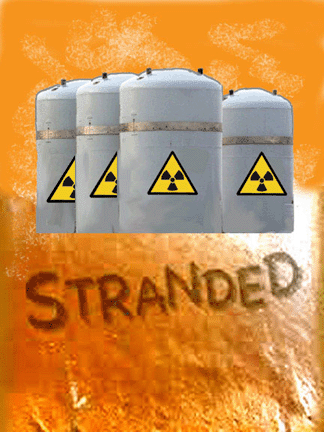 They intend to store this waste in metal barrels above ground until scientists can come up with a feasible way to store it underground.
Remember South Australia had a huge conference and committee over this very issue and at the end it was a resounding No!
This information is all available on the government website unless the liberals have removed it. It was very interesting and extremely frightening reading. Just remember also that this waste will be shipped across Australia from all the other states who point blank refuse to have it stored in their states either by rail, trucks and ships!
Our roads are already a disgrace and a death trap with many of these routes that they will take going  through little farming towns , can you imagine the fallout if there was an accident? The aim of the federal government has always been for South Australia to take not only Australia’s waste but also the worlds waste but couldn’t push this through under a labor government but now no matter what we the people say about this matter it’s going to happen and Turnbull and co are laughing all the way to retirement!
This mess will be with South Australians for thousands of years as that’s how long it will take o naturalise the waste to a harmless waste. Boy if you thought SA was the joke of the country before wait till this becomes a reality. https://www.facebook.com/northandwest/?hc_ref=ARR9p52A9mIR0O7YlgghLJngxi5oyS8ri4yZAnl1Gyx2tRtSXM_iMQaqCySvzM57kiQ&fref=nf&hc_location=group
Busting the pro nuclear spin to regional South Australia, by the visitors from Lucas Heights
 Roni Skipworth ABC North and West 21 Mar 18, The very first meeting re Waste Dump in farmland of Kimba thru Rowan Ramsay’s idea to put on his land or in Buckleboo area a small railway siding, the old RAH came into the conversation. They told the audience the Hospital will be demolished since there are high Nuclear Wastage within from Nuclear Medicine eg masks aprons gloves clothing. The bricks n other building materials will be crushed n loaded in drums.
Since that idea collapsed as it would’ve been Conflict of Interest on Rowan’s side. Then these 2 new sites have come up on the table, my suspicion is these people who own the properties are friends of Rowan Ramsay. I live 79kms away from Kimba, 30kms from one property who has put their land up to be destroyed as it is closer to the Wudinna Shire boundary than Kimba itself.
These visitors from Lucas Heights are bullshitting us South Aussies as their lease is drawing to a close and need to move because of surrounding land being turned into residential and it’s been outgrown.
Now that Liberals are everywhere the fight to not have it in the sites earmarked is going to be harder with Rowan rubbing his hands together n pushing either sites in Kimba because in the end people only see the $$$$ signs instead of the destruction of Mother Earth, some of the best farmland in the Kimba Shire and the people who live and travel through Kimba.
I wonder what will happen when there is a leakage n contaminated areas as Kimba is situated in the middle of Aust between Sydney and Perth. What happens the area gets contaminated? Vehicles travelling on Eyre Hwy (a few years ago I did a Tourism Course and found out over 24 hour timeframe 1400 vehicles travel on Eyre Hwy) won’t be able to travel thru this area.
I would like to know where r the other sites around Australia where they have put there hands up to have a Waste Dump Site. Also it isn’t just up to the Community of Kimba or Hawker it is up to the residents of South Australia.
Typical Gov of State Federal and Local Council trying to isolate the decision. It is up to all of US https://www.facebook.com/northandwest/?hc_ref=ARR9p52A9mIR0O7YlgghLJngxi5oyS8ri4yZAnl1Gyx2tRtSXM_iMQaqCySvzM57kiQ&fref=nf&hc_location=group

South Australian Premier Stephen Marshall carrying out the Liberal agenda – Cuts Access To Solar Batteries For Low Income Households.
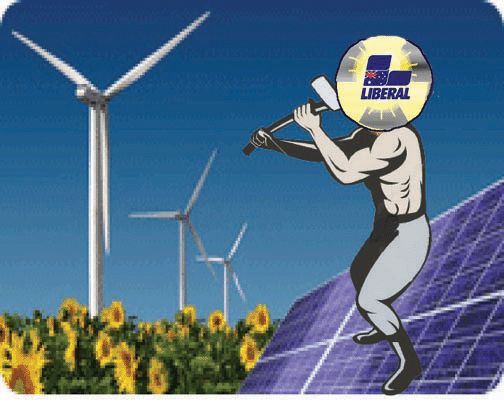 SA’s New Premier Cuts Access To Solar Batteries For Low Income Households. Gizmodo, Hayley Williams Mar 19, 2018
India’s solar parks – a good system for Australia, too
 Farming the sun’s rays: Should Australia follow India’s lead and create solar parks? http://www.abc.net.au/news/rural/2018-03-21/farming-the-suns-rays-australian-farmers-should-follow-india/9526812 NSW Country Hour By Michael Condon, 21 Mar 18, [Excellent graphics]
Neighbours not happy as a man builds his nuclear war bunker in Victoria
 Neighbours’ fury as man builds bunker for nuclear war, news.com.au, By Luke Mortimer • A Current Affair Producer Mar 20, 2018 He’s a former Yugoslavian who spent years guarding plutonium stockpiles and he refuses to be a sitting duck the day they may go off, preparing for all out nuclear war.
Jakov Loncarevic migrated to Australia in 1979 but in 1996 he fled Melbourne for Minyip, a tiny town 337 kilometres west. He purchased a block of land that he’s spent the past two decades making “nuclear proof” with a four-metre deep bunker in which he plans to wait out a nuclear winter.
Mr Loncarevic took A Current Affair reporter Martin King down into the bunker in which he claims he built by digging out 40,000 buckets of soil and constructing with 2500 bags of concrete, 40 tonnes of recycled steel and 20 tonnes of wood.
“(It’s my) emergency survival place,” he told King.“In case of unforeseen events … I will survive.“When the conditions become unbearable at floor level … I’m down here.
Mr Loncarevic says he has the supplies to wait out two years once a nuclear winter sets in, with a staggering 900 kilograms of sugar stored in industrial fridges, 200 kilograms of rice and dried beans, 6000 litres of water, 40 kilograms of washing detergent, 200 pairs of socks, 200 pairs of under wear, 100 t-shirts, and 120 kilograms of honey.
But despite being prepared for nuclear war, Mr Loncarevic is losing the war with his neighbours after council issued him with an order to stop building.
Neigbours fed up with living next door to the military-compound-style structure have told King of their embarrassment living next to it.
Mother Bec, a nurse who works in the nearby regional centre of Horsham, said her property’s value is in decline as no-one would want to buy in next to Mr Loncarevic’s house.
“It’s embarrassing. It’s frustrating. It’s wrong,” Bec said.
Her parents-in-law, Joe and Rae, lifelong Minyip residents who live another two doors up, told A Current Affair of how the house had transformed from a “lovely, little” weatherboard home owned by an elderly lady into a Soviet-style military compound. And Mr Loncarevic is losing popularity with his neighbours by the day.………..https://www.9news.com.au/national/2018/03/20/19/05/neighbours-fury-as-man-builds-bunker-for-nuclear-war
Protect South Australia from Nuclear Trash – the fight continues – theme for March 18
The South Australian election result by no means is a triumph for the nuclear lobby. The politicians and media managed to side-step the vital issue of nuclear waste dumping – so the public at large seemed unaware of this issue. South Australians have historically fought back, and won, against this nuclear threat, when they were clearly confronted with it.
South Australia now has a Premier Stephen Marshall, who says that he will destroy the Tesla big battery scheme, leading a Liberal government that no doubt would like to carry out the mission of the Federal Liberal government – to stop the transition to renewable energy.
Sorry, Mr Marshall and Mr Turnbull, but that horse has already bolted away. The nuclear and coal lobbies are not going to stop the global movement towards clean energy, with places like South Australia and Australian capital Territory (ACT) in a leadership position.
As for the fraudulent claim that Kimba, South Australia must host nuclear trash as a “medical necessity”- South Australia, and all Australians will see through this, when they properly get the facts.
It is up to Australian who care – to expose the lies, and to explain the unwisdom of toting the Lucas Heights toxic radioactive trash for 1700 km to Kimba. Also the mysterious and mingled radioactive trash at Woomera should stay where it is – and not pollute the Kimba agricultural region.

South Australia’s new Premier vows to kill the Tesla battery storage plan
 Marshall’s first promise as SA premier: Kill Tesla battery plan http://reneweconomy.com.au/marshalls-first-promise-as-sa-premier-kill-tesla-battery-plan-68601/ By Giles Parkinson on 19 March 2018
The newly elected South Australia premier, the Liberal Steven Marshall, has made his first promise – his government intends to kill the Tesla plan for the world’s biggest “virtual power plant” that would install batteries in low income households for no cost.
The Tesla plan – which aimed to install 5kW of solar and a 13.5kWh Tesla Powerwall 2 battery storage unit in 50,000 homes – would have created a virtual power plant with 250MW of capacity and 650MWh of storage.
The Tesla plan was announced just before the official start of the election campaign. The first two stages of the proposal – for 1,100 Housing Trust homes – is apparently locked in with a $2 million grant and a $30 million loan, but the broader third phase is not yet set in stone.
“No, that’s not part of our agenda,” Marshall told ABC’s Radio National breakfast program, just minutes before being sworn in as premier.
Instead, Marshall said his government would proceed with his previously announced commitment to a $100 million subsidy to 40,000 homes, where he would offer $2,500 for each battery storage unit installed.
“(Former premier Jay Weatherill) was doing it for Housing Trust homes in South Australia … that’s not part of our plan. What we are going to do is provide a subsidy to get (those with) solar rooftops systems with some storage capacity.”
Marshall’s plans would, of course, be very difficult to access for low-income households because it would still require an upfront capital payments that they would likely be unable to afford. And they do not already have rooftop solar.
It’s an extraordinary start for the new Liberal government – promising to ditch a private initiative that would provide loans to low-income households in favour of a $100 million government subsidy that would be out of reach of those households most in need of it.
So much for free markets. But it also raises the issue of sovereign risk.
If the Liberal Party is to do back-flips on initiatives like this, will it also renege on the other contracts entered into by Labor’s Renewable Technology Fund – and there are many of those, for larger-scale storage developments, and for a variety of smaller and micro-grid proposals.
It could be that the Tesla virtual power plant could go ahead, seeing that it is privately funded and requires a retailer to be chosen to help roll out the scheme and act as an intermediary.
The idea was to install the solar and battery storage for free, and deliver a reduction of around one-third in the electricity bills of 25,000 Housing Trust homes, and another 25,000 private low-income households. Investors would provide the capital.
However, given the new government’s antipathy to the scheme, it is entirely possible the tender process may be delayed and the private investors would not want to go ahead in such a hostile political environment.
It could also have an impact on Australia’s only solar manufacturer, Tindo Solar, which was looking to significantly increase its production capacity at its Adelaide manufacturing plant, and hire more employees, of course.
That’s because the Tesla plan would require half of the solar capacity to come from local manufacturers. It was also seen as an excellent platform for a new retailer to enter the South Australian market. The lack of competition in South Australia is one of the principal reasons for its high electricity prices.
The irony is that Marshall admitted he could see the benefits of battery storage – both at utility level and in households.
But he re-iterated his intent to scrap the state’s renewable energy target, because it would push up prices – even though the amount of projects under construction and promised by the new owner of the Whyalla steelworks would likely take the stake to Weatherill’s 75 per cent target, probably several years earlier.
Marshall also plans a new interconnector to NSW. Marshall says this will add to the “affordable reliable baseload” the state could access “when it’s not windy or sunny” in South Australia.
But appears to ignore the fact that NSW is already the state with the highest dependence on imports, even more than South Australia and may not been a position to export power to anyone.
But he also said the interconnector would allow for the “excess renewables” from South Australia to be exported to other states, “lowering prices across the entire nation.”
Hang on, didn’t you just say that the investment in renewables would push prices up? You can’t have it both ways.
Update: Marshall later told a news conference he would not rescind contacts entered into by previous government. This however protects only the first two stages of the Tesla virtual power plant, affecting 1,100 households. The third phase, involving 49,000 other low income households, was not subject to a signed contract, RenewEconomy understands, because it would source private funding.
Can Stephen Marshall stop South Australia’s transition to clean energy? Probably not
Speed of Australia’s energy transition hostage to Marshall law http://reneweconomy.com.au/speed-of-australias-energy-transition-hostage-to-marshall-law-65325/By Giles Parkinson on 19 March 2018
The consequences of South Australia’s election result on Saturday will be felt far beyond the state’s borders.
It was barely minutes after the SA Liberals – led by Steven Marshall – were declared winners that the federal Coalition began crowing that this was good news for Malcolm Turnbull’s signature policy, the National Energy Guarantee.
Senator Simon Birmingham said so almost immediately on ABC News 24, and the level of expectation that Marshall should serve as a vassal of the federal Coalition’s policy objectives was repeated by Turnbull, energy minister Josh Frydenberg and finance minister Matthias Cormann.
It seems unlikely that the NEG, or even Marshall, could do much to slow down the pace of the transition in South Australia, for reasons I will explain below. Continue reading
South Australia rejects the nuclear industry – as shown in poor vote for Cory ‘s Australian Conservatives
Zac Eagle 18 Mar 18, Australian Conservatives with their “All Nuclear” policy managed to get about 3% of the vote in the South Australian state election. Overwhelming rejection of nuclear industry. Bravo SA
Past accidents at Lucas Heights don’t augur well for nuclear dump plan
Paul Waldon Fight To Stop Nuclear Waste Dump In Flinders Ranges SA Today the 18th of March is another red letter day in the nuclear arena with the 31st anniversary of a accident at Lucas Heights, but first lets jump forward 29 years to the Hawker nuclear community meeting on the 6th of May 2016, where a man named Bruce Wilson from the DIIS whom chaired such meeting, a man who could be a totally inept clairvoyant, a nuclear decision psychopath, a misinformed government payed nuclear spruiker, or just a sad ignorant man.
This is a man whom said “We will NOT have accidents” while the opposing dichotomy believes in the old dictum “Pray for the best, prepare for the worst” and the such dichotomy keeps giving a resounding NO to a deadly radioactive dump, which keeps falling on deaf ears of the liars who said they would walk away from a community that doesn’t want to accept it.
Now lets return to the anniversary of the 1987 accident where a fire at Lucas Heights nuclear research laboratory resulted in the contamination of two workers and the discharge of radioactive gas into the atmosphere over populated areas.
Yes, Bruce this was a accident, however there was an event two years prior to such accident that may be called a purpose when alleged vandals dodged security patrols and smashed a underground pipe, releasing radioactive effluent into river ways. (What was this pipe made of, maybe brittle 2mm plastic?).
Are we to believe Bruce that there wont be anymore accidents, maybe because accidents will be suppressed, or called a planed event, or re-classed as “Technically produced anomalies” just like the erroneous, magniloquent re-classing of high grade waste to intermediate waste in an attempt to try and push through a egregious program while attempting to insult the intelligence of the majority of informed South Australians who don’t want a risky radioactive dump here. https://www.facebook.com/groups/344452605899556/
1 This month


Help Aunty Sue Protect Her Land and Sacred Sites From Destructive Rocket Testing.
.

Australians deserve the truth
about
AUKUS – https://aukuspublicinquiry.com/

PETITION – To: Prime Minister Anthony Albanese and the Australian Labor Government

of the week – Australians for War Powers Reform (AWPR)
To see nuclear-related stories in greater depth and intensity

