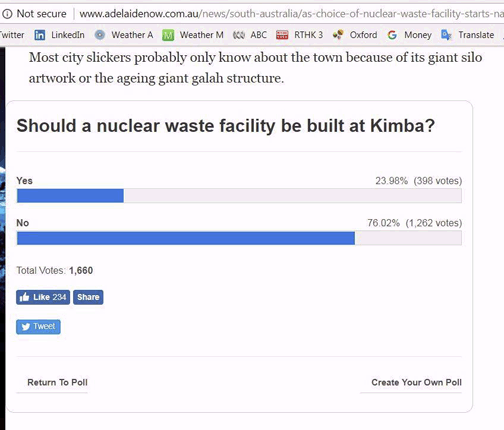
Opinion poll results 8 Jan 17 “3.30 pm – “NO vote is currently up to 76.75%
The Advertiser, South Australia is running an opinion poll – Should a nuclear waste facility be built at Kimba? on their article
As choice of nuclear waste facility starts narrowing, people of Kimba are either excited or disgusted
[Ed note 12 Jan – at a later date, the “NO” vote jumped to 85%]
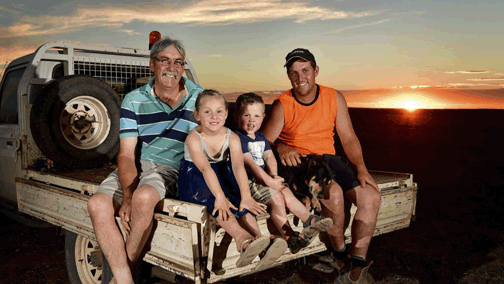
Jeff Baldock and family: A Kimba nuclear waste dump on their property would be a bonanza for them
But what would it do for the market’s perception of South Australia’s farm produce?
January 8, 2018
Posted by Christina Macpherson |
Federal nuclear waste dump, South Australia |
Leave a comment
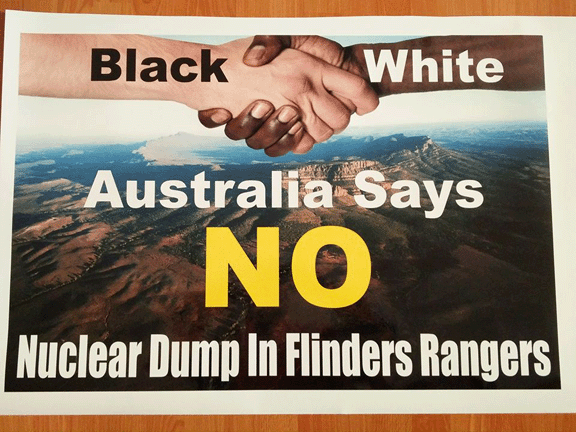
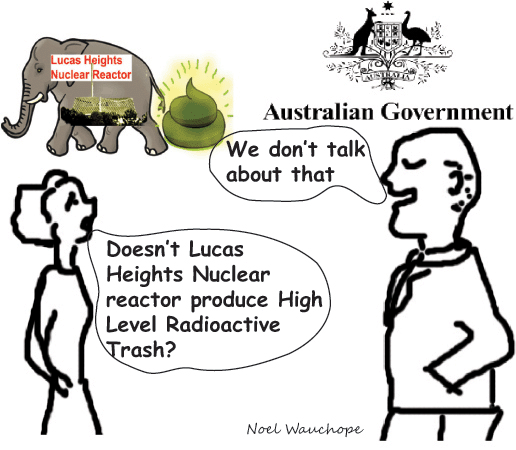
Paul Waldon, Fight To Stop Nuclear Waste Dump In Flinders Ranges SA Australian Nuclear Science  and Technology Organization, founded 1987… Australian Atomic Energy Commission, established 1952… Atomic Energy Policy Committee, created 1949…
How long it was on the drawing board is unknown. However the locals willingness to embrace and accept a nuclear waste producing machine with its ever growing stockpile of manufactured waste in their region is alive and strong.
For 69+ years the facility has been endorsed every time someone relocates to Lucas Heights/Barden Ridge and surrounding burbs,, or when a contract for a house or business in the area has been secured. 69 Years is along time in the cycle of a persons life, and presents a question:are there any surviving post nuclear residents residing in the district? So keep ANSTO’s deadly radioactive waste at Australia’s only accepted high grade nuclear waste dump, Lucas Heights. https://www.facebook.com/groups/344452605899556/
January 8, 2018
Posted by Christina Macpherson |
Federal nuclear waste dump, New South Wales |
Leave a comment

where do we want to see Kimba in 300 years? We’ll be a national centre for rubbish.
The community is a finalist for the Australian title of KESAB’s Sustainable Communities top town…..the award honours the community that does the most to protect the environment [!!!]
As choice of nuclear waste facility starts narrowing, people of Kimba are either excited or disgusted, Erin Jones, Sunday Mail (SA) January 6, 2018 IF there are two words that can split an already isolated South Australian town and destroy lifelong friendships, they are “nuclear waste”.
Kimba, on the northern edge of the Eyre Peninsula’s vast grain-growing belt, is home to two of the three proposed sites where the nation’s radioactive waste might be stored.
Most city slickers probably only know about the town because of its giant silo artwork or the ageing giant galah structure. But it is where farming is the lifeblood of the community and where the proposal to use agricultural land as a nuclear site weighs heavily on some residents in the town of 650.
“We were a really tight-knit community but now we’re just a town,” says farmer Amy Koch. “We’re not even a community anymore.”
Everything changed two years ago when the owners of two farms nominated to be the site for a nuclear waste repository. The move has had a polarising effect. Long-time friendships have broken down, businesses have been boycotted and people deliberately avoid each other in the street and at events.
Mrs Koch’s friend, Rachel Yates, also a farmer, says the division between residents is palpable.
“When you go into town, you make sure you know a friend is going to be there and you have someone to talk to,” Mrs Yates says. “I’ve never seen anything like this that has divided the whole town.” The women are part of No Radioactive Waste on Agricultural Land in Kimba or SA — a group started in response to the two farming families offering their land.
If approved, the successful farm will hold low-level waste from the Lucas Heights nuclear facility, in NSW, and Australia’s intermediate-level waste such as that from industrial, medical and research applications. (Ed. note: no mention of the high level nuclear waste from the Lucas Heights nuclear reactor, which will also come)
Many see the facility as a way forward, helping to boost the local economy and creating jobs.
Others say there will be little economic benefit and the town’s reputation will be tarnished.
Third-generation farmer Jeff Baldock defends his decision to offer 100ha of his Napandee property, 25km northwest of Kimba, despite some resistance.“When this process first started I felt physically ill going to Kimba and my family would feel really uncomfortable going to functions,” he says.“Twelve months ago I asked if it’s worth it but one of our neighbours said ‘If you believe in it you just have to keep going’. “Now we feel more than happy to go to town.
“Ninety per cent of people are still chatting away merrily to whoever but there is a group that has decided that they don’t want to be a part of that.
“I still say ‘G’day’ to everybody — if they choose not to say it back, that’s up to them.”
Mr Baldock and his wife, Jenny, nominated another of their properties last year but it was ruled out by the Federal Government following the assessment process and opposition.
As a result, they nominated their Napandee property, where they live with their children and five grandchildren. If successful, they will be paid four times the value of the land — believed to be about $400,000 — and Mr Baldock says they aim to crop the site’s 60ha buffer zone to put money back into the community through the local Agricultural Bureau and Lions Club.
But Mr Baldock believes the real benefit of the repository will be for the town’s residents in safeguarding them financially in the event of drought.
About 50 per cent of residents are employed in agriculture, according to figures from the Australian Bureau of Statistics. “This is an industry that doesn’t rely on agriculture, that’s the big thing,” Mr Baldock says.
“Seven of the last 10 years have been good but it won’t keep going that way and it might be a bit ugly if we have two or three droughts.
“We see this as drought-proofing the community.”
An Electoral Commission ballot of Kimba residents found 57 per cent of the 698 respondents — there are 1100 residents in the council area — agreed the sites should progress to the next round of consultation.
The process included a 90-day consultation period and the Government said there was widespread support from direct neighbours of the nominated properties, with all but one supporting proceeding to the next phase.
 The Kimba properties have now joined Wallerberdina Station, near Hawker, to advance to stage two of consultation but the Flinders Ranges site is facing strong opposition from the Adnyamathanha people — the traditional owners — for cultural reasons.
Both communities now have access to $2 million worth of grants — from the Government’s community benefit fund for local projects to create economic or social benefits — in recognition of any disruption during the assessment process.
 A $10 million fund for community development projects has been promised to the area of the final chosen site — expected to be announced in the second half of this year — which critics fear is a sweetener to encourage the waste facility’s approval.
Michelle Rayner believes the nuclear debate has already had positive benefits in town, including accommodation being filled with government workers and the media visiting on a regular basis.
Mrs Rayner, who owns Eileen’s cafe just off the main street, and her husband, Brett, proposed their Lyndhurst farming property as the other potential site to become the repository. That decision resulted in them being castigated by former acquaintances. but Mrs Rayner said the town needed something to boost its economic prospects.
“My husband wasn’t interested in it all initially but then he came to a community meeting and was blown away by the opportunities for the town,” she says.
“To become a government town, you’re guaranteed to have a decent hospital, better infrastructure and better internet communications.”
The Federal Government says wherever the facility is located, it will bring a minimum of 15 jobs in
administration, waste management and security.
As well, a facility of this scale would likely have additional investment in infrastructure such as roads and telecommunications.
Mayor Dean Johnson does not skirt around the issues and the importance of finding new ways to bring more people to the town, which currently has dozens of empty houses. “The truth is our population is on a slow decline and if we can’t turn that around our sustainability will be questioned,” he says.
“While we have the agriculture roots — and it will always be the main industry in Kimba [Ed note: Not when then market learns about the radioactive trash dump nearby]— any opportunity to diversify the economy and bring more jobs into the town should be investigated.
“That’s not saying this definitely is the thing but we believe we have to investigate it fully and the community has supported that view.”
The stage two consultation process was announced in June and, last month, 16 community members were appointed to a local consultative committee by the Federal Government.
In total, 51 people applied and explained why they wanted to be part of the committee to act as a link to
the government, the Department of Industry, Innovation and Science and residents.
The committee is to provide advice on jobs and business opportunities, relay information on the project’s technical aspects and review nominations for the $2 million community benefit fund.
TEACHER Meagan Lienert — one of the committee members — supports the waste facility because of the benefits she believes it will bring, especially to the school’s 174 students.
 She says medical and nuclear experts had run science lessons at the school and there was talk of access to scholarships at the Australian Nuclear Science and Technology Organisation, at Lucas Heights.
But she understands some people fear nuclear waste because they believe it will affect farming land.
“From my research, I can see the facility is safe and I know it won’t have any affect on the things around it but the fear some people have is real,” Mrs Lienert says.
“I don’t take that away from anyone but I hope to be able to help people gain a bit of understanding and perhaps relieve some of that fear through the consultative committee.”
No Radioactive Waste on Agricultural Land in Kimba or SA secretary Toni Scott is also on the consultative committee and raises concerns about whether the process will be fair.
Mrs Scott says there is a struggle to get information from the Government on why federal land is not used and how many jobs the waste facility will create, saying the number has fluctuated from 15 to 30.
“How do we trust the Government building this facility when we can’t even trust the process?” Mrs Scott says.
“We’re trying to get in writing that if there’s another vote what percentage the Minister needs for this to go ahead. The department head said he would need more than 65 per cent to build the facility but it has never reached 60 per cent.”
FOR two years, Mrs Scott has represented the group’s 204 financial members to oppose the facility, including  making representations at Parliament House in Adelaide and Canberra.
“The key concerns we have are for our farming and our produce; we live in a big country and only 4 per cent is arable farming land — and we sit within that,” she says. “We think we don’t need to risk productive land when there is so much non-arable land. They should try a bit harder to find a suitable site because people aren’t very happy here and it feels like two years of a government process has been forced upon you.”
Kimba farmer and former federal Liberal MP Barry Wakelin is a member of the anti-nuclear group and believes the Government is struggling to find a suitable site — an issue plaguing successive governments since 1992.
“This is their third go after Woomera, Mataranka, and now we have the Kimba/Hawker situation,” Mr Wakelin says.
“The Federal Government has so many other options; it’s absurd to have a community divided on this issue.
“The other thing that weighs heavily on people’s minds is where do we want to see Kimba in 300 years?
We’ll be a national centre for rubbish.” Federal Minister for Resources Matt Canavan told the Sunday Mail
no final decision on the site had been made. He says the Kimba community will get another vote on whether they support a facility — but says there is no “arbitrary figure” which will determine whether it will go ahead.
“The people of Kimba will have a chance to have their say again through another vote after this more comprehensive consultation period concludes,” he says. “There is no arbitrary figure for each step but I have always said there must be broad community support.” Mr Canavan says the process has been rigorous and transparent and a decision would not be made without consultation.
NEW LANDMARK PRAISED
KIMBA locals are forever trying to attract more visitors to their town — and now their efforts are gaining national attention.
The community is a finalist for the Australian title of KESAB’s Sustainable Communities top town — previously the Tidy Towns competition — after being named state winner in November.
The award — to be announced in April — honours the community that does the most to protect the environment, enhance their town and embrace sustainability.
Kimba Community Development Group chairwoman Heather Baldock says their entry included the Igniting Kimba arts project, which included stunning artwork on the town’s grain silos — a refreshing foil to the better-known but now tired-looking Big Galah.
“In a community where sport has always been important, art adds a whole other element to our community and it’s excited the locals even more than we expected,” she says.
“The media interest from across Australia regarding our silo art has been amazing and I think it’s something the whole community is quite proud of.
“We saw a 35 per cent increase in traffic when it was finished (in September) which was over 600 vehicles, so we’re pretty pleased with that.
“Anything that can make people stop for an extra night or two will help us economically because we have businesses that are struggling.”
The award also recognises the town’s grey nomad program, encouraging travelling retirees to work alongside local volunteers, pass on skills and, in return, stay for free….., http://www.adelaide now.com.au/news/south-australi a/as-choice-of-nuclear-waste-f acility-starts-narrowing-peopl e-of-kimba-are-either-excited- or-disgusted/news-story/ 8460ea159b77d47d915dc0abfc362b 37
January 8, 2018
Posted by Christina Macpherson |
Federal nuclear waste dump, South Australia |
Leave a comment
 As choice of nuclear waste facility starts narrowing, people of Kimba are either excited or disgusted, http://www.adelaide now.com.au/news/south-australi a/as-choice-of-nuclear-waste-f acility-starts-narrowing-peopl e-of-kimba-are-either-excited- or-disgusted/news-story/ 8460ea159b77d47d915dc0abfc362b 37Erin Jones, Sunday Mail (SA)
January 6, 2018 “………..1998: The Howard Government announces plans for two low-level nuclear waste sites in SA, both at Woomera. Low level nuclear waste includes items like contaminated clothing, rags, tools, medical tubes and swabs.
2003: The SA Government passes a Bill banning the establishment of a low-level waste dump, but the Commonwealth tries to acquire the land at Woomera.
2004: The Federal Court rules that the acquisition is unlawful and the Commonwealth abandons its SA plans.
February, 2015: SA Premier Jay Weatherill announces a royal commission into the role the state could play in the nuclear future, including establishing a high-level waste facility in SA. High level waste includes spent nuclear fuels and waste from the vitrification process.
May, 2015:Mr Weatherill decides upon a citizen’s jury process, to decide whether SA should pursue a high-level dump.
November, 2015:Six sites across Australia, including two at Kimba and one in the Flinders Ranges, are short-listed for a low-level nuclear waste site.
April, 2016: Wallerberdina Station, near Hawker, in the Flinders Ranges, goes to the next stage of the consultation phase — ahead of the five other sites.
November, 2016:The majority of Citizen’s Jury participants vote against a high-level waste dump.
June, 2017 Mr Weatherill formally abandons his high-level nuclear waste push.
■ Two more properties at Kimba nominate to be a low-level nuclear waste site and also progress to the next stage of consultation. http://www.adelaide now.com.au/news/south-australi a/as-choice-of-nuclear-waste-f acility-starts-narrowing-peopl e-of-kimba-are-either-excited- or-disgusted/news-story/ 8460ea159b77d47d915dc0abfc362b 37
January 8, 2018
Posted by Christina Macpherson |
Federal nuclear waste dump, South Australia |
Leave a comment
Cooking the books on climate change policy, The Age, 7 Jan 18, Eryk Bagshaw
Two reports released on the same day, from the same government department with two very different sets of findings.
The Turnbull government’s climate change policy review would have you believe we are well on our way to reaching our international commitment of a 26-28 per cent reduction by 2030.
wo reports released on the same day, from the same government department with two very different sets of findings.
The Turnbull government’s climate change policy review would have you believe we are well on our way to reaching our international commitment of a 26-28 per cent reduction by 2030.
While the policy review states: “we have a record of meeting and beating our emissions reduction targets and are on track to meet our 2030 target,” the department’s emissions report admits clearly: “Australia’s emissions have risen in the past three years.” …….
An independent analysis commissioned by the Greens suggests the size of the abatement is now so great that it would require us to take all cars off the road or cows off farms, not in a decade, but tomorrow.
The laughable proposition underscores the size of the task in the decade to come.
The first step in addressing that gap is admitting that it exists. Which why the deliberate omission of a chart in a review that clearly shows Australia sailing way above its targets in the climate change policy reviews is so striking.
The department and Environment Minister Josh Frydenberg consulted no less than 270 stakeholders and received 357 submissions but the government’s obfuscation in omitting the offending chart from its final policy review is remarkable.
By pretending it doesn’t exist, it has given themselves room to move.
Into that space falls the government’s concessions to “stakeholders”, aka big business, which have been carefully worded to essentially allows companies to increase their emissions if their production does. ……http://www.theage.com.au/business/comment-and-analysis/cooking-the-books-on-climate-change-policy-20171229-h0ba0h.html
January 8, 2018
Posted by Christina Macpherson |
AUSTRALIA - NATIONAL, climate change - global warming |
Leave a comment
Ms McKenzie said: “Australian Aboriginal people live in a land that they are the first people, yet our culture belief, our religion is ignored, our heritage and burial sites desecrated, we have never been acknowledged in the constituion. This act of placing a nuclear waste dump on the Adnyamathana nations country is cultral genocide.
“The United Nations Declaration on the Rights of Indigenous Peoples Article 29.2 says that governments must get consent from traditional owners to place any toxic substances on country, which never happened
“Please dont impact Aboriginal people like Britons did with Maralinga, when they tested the atomic bomb. Don’t destroy culture.
Video: Aborigine anger over lack of action to stop Scots nuclear waste transfers
Martin Williams ,January 2018
http://www.heraldscotland.com/…/15808815.Video__Aborigine_…/
CAMPAIGNERS have accused the Scottish Government of a lack of decisive action following protests over plans to dump nuclear waste from Dounreay at a sacred Aboriginal burial place.
Ministers have come under fire for failing to review proposals for a sacred area of Wallerberdina, 280 miles north of Adelaide, to become a potential location for Australia’s first nuclear dump.
It came despite Aborigine tribes people providing a video appeal to the officials to stop the dumping.
Campaigner Gary Cushway, a dual Australian-British citizen living in Glasgow, pressed the point in a meeting with the Government which was arranged after he wrote to First Minister Nicola Sturgeon over the controversy.
Wallerberdina is said to include Aboriginal burial mounds, fossilised bones and stone tools.
But it has been earmarked as part of a deal that returns spent fuel processed at the nuclear facility currently being decommissioned at the nuclear site in Caithness to its country of origin.
Mr Cushway said he was “disappointed” by the “lack of decisive action” after asking that the Government review the agreement.
Aborigines provided a video appeal to the Scottish Government to stop the dumping in an area identified as a potential location for Australia’s first nuclear waste dump as part of a deal that returns spent fuel processed at the nuclear facility currently being decommissioned in Dounreay, Caithness, to its country of origin.
The video, which came in the form of a documentary, highlighted one Aborigine speaking in the Adnyamanthatha language saying, “the poison, leave it alone” and “we don’t want it”.
The proposed dump site is next to an indigenous protected area where Aborigines are still allowed to hunt, and is part of the traditional home of the Adnyamathanha people, one of several hundred indigenous groups in Australia.
The Dounreay Waste Substitution Policy, agreed in 2012, sees waste from Australia, Belgium, Germany and Italy processed at the Scottish facility to make it safe for storage after being returned to its country of origin. Continue reading →
January 6, 2018
Posted by Christina Macpherson |
AUSTRALIA - NATIONAL, Federal nuclear waste dump |
Leave a comment
 Some nuclear-free sleuths on the Facebook site Nuclear Fuel Cycle Watch South Australia– help unravel the complexities.
While the South Australian Liberal Party’s official position was opposition to the Labor government’s 2016 plan to import nuclear wastes, Liberal politicians as well as Labor were funded by the Taiwanese government for trips to Taiwan to promote the cause of importing nuclear wastes.
MPs and MLCs visiting Taiwan:
During the financial year 2014-2015, Tom Kenyon and his wife received travel, accommodation and food courtesy of the Government of Taiwan. The Members Register of Interests for that year contains the information in the clipping below.
UPDATE – Other Parliamentarians to visit Taiwan and discuss nuclear industry include:
– Tom Kenyon (Newland) in 2006 (funding: GoT)
– Liz Penfold (Flinders) in 2007 (funding: unknown)
– Trish White (Taylor) in 2006-2007 (funding: GoT)*
– Michael Atkinson in March 2011 (funding: GoT)*
– Stephen Griffiths in March 2011 (funding: GoT)*
– Tom Kenyon (Newland) in 2014-2015 (funding: GoT)
– MLC Tung Ngo in 2016 (funding: unknown)
* Those marked with ‘*’ have not had the purpose of their travel confirmed.
Tom Kenyon’s visit to Taiwan in 2006, during which he claims he embraced the idea for South Australia to import spent nuclear fuel for storage and disposal, was paid for by the Government of Taiwan.
The supporting evidence was found in the 2007 Members Register of Interests, held by the SA Parliament.
Thanks to Sandra Kanck for suggesting that the Register might contain such details, and to the administrators at the SA Parliament for making past Members Registers of Interests available at my request.
Dan Monceaux , 6 Jan 18 Trish White also travelled to Taiwan in 2006-2007 at the expense of the Government of Taiwan. It was documented in an Erratum to the Members Register of Interests for that year.
More recently, White was a signatory on the latest Open Letter hosted by Bright New World, calling for the door to be kept open on the consideration of spent nuclear fuel importation to SA.
Her Wikipedia biography states that she was an engineer and project manager before entering the SA parliament. She also worked with DSTO. After leaving the Parliament, she became a senior exec. with engineering consultants, WorleyParsons.
I wonder if she traveled with Tom Kenyon on this occasion?
In an earlier Advertiser report – “Investment and Trade Minister Martin Hamilton-Smith said he was delivered a “clear message” that the tiny island nation would be interested in investing in nuclear storage infrastructure and making ongoing payments to dump waste overseas.” “our neighbours may be in a position to put hundreds of millions, if not billions. into infrastructure” – http://www.adelaidenow.com.au/news/south-australia/taiwan-first-country-to-consider-storing-nuclear-waste-at-a-facility-in-sa/news-story/9934181587580b42e35e2276980e299f
January 6, 2018
Posted by Christina Macpherson |
South Australia, wastes |
1 Comment
Is ARPANSA wrongfully regulating and promoting the project? Why did ARPANSA fail to address the safety issues at Lucas Heights that Comcare bought to their attention?
Why does ARPANSA have trouble dealing with people in group discussions?
Is ARPANSA being strong-armed by DIIS, and ANSTO to push a radioactive dump on a community of unwilling people?
Is ARPANSA listening to the majority that are saying “NO”?
Is ARPANSA insensitive to native heritage.? Is ARPANSA ignoring the science of nuclear waste being abandonment in a environment that fails on all the criteria put forward by DIIS?
Is ARPANSA honest and forthcoming with all the issues pertaining to the toxic proposal?
January 6, 2018
Posted by Christina Macpherson |
AUSTRALIA - NATIONAL, secrets and lies |
Leave a comment
EPA approves $900m rare earths mine in Central Australia despite radioactive risk, ABC News, By Ben Millington, 5 Jan 18,A proposed $900 million rare earths mine in Central Australia has been recommended for approval by the Northern Territory Environment Protection Authority (EPA), after an assessment process lasting more than two years.,
Arafura Resources’ Nolans Project at Aileron, 135 kilometres north-west of Alice Springs, would mine rare earth materials such as neodymium and praseodymium, used to manufacture strong magnets for wind turbines and electric vehicles.
The EPA identified several long-term environmental risks and impacts with the project, but found they could be managed.
“There will have to be a high level of operational management control for this project over a couple of generations, and there’ll have to be a high level of regulatory scrutiny, there’s no two ways about that,” EPA chairman Paul Vogel said.
The primary risks include the permanent storage of naturally occurring radioactive material onsite and the use of significant groundwater resources over the 35 to 55-year lifespan of the project……http://www.abc.net.au/news/2018-01-05/epa-approves-rare-earth-mine-in-central-australia/9306610
January 6, 2018
Posted by Christina Macpherson |
Northern Territory, rare earths |
Leave a comment
Whyalla and Port Augusta could be a renewables powerhouse, says local mayor, ABC North and West By Tom Rohde , 4 Jan 18
SA’s clean-energy projects
- A hybrid power station is being built at Coober Pedy. The hope is that the outback community can be powered solely by solar, wind and diesel energy
- Investors have funded a $300m solar battery-power plant at Roxby Downs
- A wind, solar and battery farm is planned at Crystal Brook in the state’s mid north
- A 100 megawatt solar powered facility is being built at Tailem Bend
- US-based company Solar Reserve is seeking federal support for a $650 million solar-thermal project in Port Augusta
- Zen Energy wants to build a solar power plant in the Upper Spencer Gulf
The mayor of a South Australian regional port city built on the steel industry and iron ore mining says it could pair with a neighbouring centre to become the nation’s hub for renewable energy.
Whyalla Mayor Lyn Breuer said she hoped her city could team up with Port Augusta 80 kilometres away to make the plan a reality.
Regional South Australian cities have seen several energy projects announced over the past year, with construction on a new solar thermal power station in Port Augusta to start early this year.
In October last year, Whyalla steelworks owner Sanjeev Gupta announced that he had approved a plan worth up to $700 million for solar, battery storage and pumped hydro, with 200 megawatts of solar photovoltaics at Whyalla……..
Port Augusta’s mayor Sam Johnson said he believed the region was already becoming a hub for renewable energy.
“Port Augusta will, and I believe actually is becoming the renewable capital of Australia and there’s no doubt that Whyalla is a direct link into that.
“There’s some really great synergies between Port Augusta and Whyalla in what’s becoming a new and exciting industry.”…. http://www.abc.net.au/news/2018-01-05/sa-cities-could-become-australian-renewable-energy-centre/9306318
January 6, 2018
Posted by Christina Macpherson |
solar, South Australia |
Leave a comment
 ‘In Commemoration of the 1988 Long March for Peace Justice and Hope,
where 40,000 people showed their support for Aboriginal rights’
‘And also commemorating 80 years since the 1938 Day of Mourning’
Indigenous Peoples Organisation
indigenouspeoplesorg.com.au
‘Aboriginal people across this country are calling for a Treaty with Aboriginal and Torres Strait Islander people
that recognises Aboriginal sovereignty as the First Peoples was never ceded,
address the stark disparity in economic social conditions of Aboriginal communities poverty
and the structural racism that continues to repress Aboriginal people.
‘The Declaration on the Rights of Indigenous Peoples,
now endorsed by the Australian Government, asserts in Article 3:
Indigenous peoples’ rights to self-determination.
‘Yet Australia remains the only commonwealth colonised country
without a Treaty with its Indigenous peoples.
‘Calls for a Treaty were repeatedly raised by Aboriginal communities
during the recent Constitutional Recognition consultations
as a practical means to recognize Aboriginal and Torres Strait Islanders
as the First Nation Peoples and to implement the structural changes
required to establish self-determination.
‘A Treaty builds on the Statement from the Heart’s call for a ‘Makarrata’,
a Yolgnu word for coming together after a conflict, to move forward together.
It also builds on several State based Treaties currently being developed.
‘A Treaty sets a process to legitimately move forward in partnership
between Aboriginal people and the Australian State.’
Read more from IPO’s comprehensive, informative & interesting website:
indigenouspeoplesorg.com.au
January 6, 2018
Posted by Christina Macpherson |
aboriginal issues, AUSTRALIA - NATIONAL |
Leave a comment
Adani $1b loan bid was likely to fail key criteria for NAIF approval, ABC News, By Josh Robertson, 5 Jan 18, Adani’s bid for a $1 billion taxpayer-funded loan may have been doomed even before it was scuppered by Queensland’s Palaszczuk Government, the Productivity Commission has said.
Key points:
- Qld Govt vetoed critical $1 billion loan for Adani mine
- Productivity Commission says mine may have failed loan criteria anyway
- Qld Govt could also veto rail company loan bid
The miner’s proposed Galilee Basin rail line faced rejection by the Northern Australian Infrastructure Facility (NAIF) because it may have failed key hurdles, the commission’s latest bulletin suggested.
However, the commission is yet to analyse a rival NAIF loan bid by rail operator Aurizon, which the State Government will also consider blocking in line with an election promise relating to Adani.
It comes as environmental activists plan to target Aurizon over its rail proposal, which would set up an export route for Adani.
State Labor told lobby group GetUp! during the election campaign in November it would veto “any NAIF loan” that enabled Adani’s coal project.
The Productivity Commission’s December newsletter noted that projects seeking low-interest loans from NAIF must “not otherwise be able attract finance, but would be commercially viable once constructed”.
There must also be “a public benefit from the infrastructure [to justify the cost to the taxpayer of the short-term assistance provided]”.
“Many of the projects suggested in the media as candidates for NAIF funding — such as the rail line to the Galilee Basin and various large irrigation dams — may fail at least one of these criteria,” it said.
This raised the risk of taxpayers throwing good money after bad, the commission suggested.
“If the return on the investment does not cover the operational costs of the infrastructure and the costs of servicing the loan at market rates over the life of the asset, the small initial level of assistance provided by a concessional loan may simply become another case of inefficient resource allocation,” it said……http://www.abc.net.au/news/2018-01-05/adani-loan-bid-likely-to-fail-before-palaszczuk-intervention/9305040
January 6, 2018
Posted by Christina Macpherson |
AUSTRALIA - NATIONAL, politics |
Leave a comment
Pacific rift: When nuclear tests made France a dirty word, SMH, Damien Murphy, 1 Jan 18 “…….the 1985 sinking of the Greenpeace vessel Rainbow Warrior by French operatives, union outrage, peacenik panic and maintenance of uranium exports shaped Australia’s response to Paris’ decision to start letting off bombs as far away as possible from La Belle France.
In a June 5 report to cabinet about possible resumption of French tests, the minister for foreign affairs, Gareth Evans and the minister for Pacific Island affairs, Gordon Bilney, said memories of the Rainbow Warrior were strong and New Zealand could be expected to postpone official visits and suspend military-related co-operation with France.
The ministers were concerned about Australia looking as hard-nosed as New Zealand.
“New Zealand will obviously be hoping that Australia’s response is similar to theirs,” the ministers said. “Wellington’s response may have an impact in Australia if it is significantly stronger than ours.”
The ministers advised treading softly so as not to make nuclear testing dominant in the bilateral relationship and stop the French from taking retaliation.
“Three specific areas of current Australian interest could be targeted by the French: Australia’s (United Nation’s) Security Council bid, market access for special Australian products such as kangaroo meat, and Australia’s candidature for the position of secretary-general of the South Pacific Commission.”
On June 13, president Jacques Chirac announced the resumption of nuclear tests in the South Pacific.
The Keating government hardened up its act.
On June 22 cabinet decided to recall Australia’s ambassador and Australian Defence Force staff from Paris, suspend Australian ship and aircraft visits to French territories and ban French ship visits and “not progress” collaboration on military logistics and equipment or exchange classified information.
Cabinet maintained the policy of not negotiating any new uranium contracts with France while it was conducting nuclear tests in the South Pacific.
“These measures are in line with the government’s consistent policy on this issue, which has been to respond in a measured, graduated way, leaving open every avenue for France to respond to South Pacific concerns,” an attachment to a cabinet minute noted.
Later, when 50 per cent of Australian Defence Industries was acquired by the Australian branch of a French engineering firm, presumably time had healed the Pacific rift with France. http://www.smh.com.au/nsw/boom-goes-paree-20171213-h04czc.html
January 3, 2018
Posted by Christina Macpherson |
AUSTRALIA - NATIONAL, politics international |
Leave a comment
Microgrids are in their early stages in Australia, but the country is swiftly taking a world-leading position, making the nation a renewable innovation hub.

Australian towns going off the grid http://www.theage.com.au/business/the-economy/australian-towns-going-off-the-grid-20171219-p4yxvv.html, Cole Latimer, 3 Jan 17, Australia is facing an energy crisis. As prices rose to new highs last year and the ever-constant threat of blackouts hung over the east coast, many Australians looked for energy alternatives. Some turned to solar panels and battery storage technology to solve their bill woes, gain greater control of their own power and make a real change in terms of their impact on the climate.
While they are taking steps at the individual level, others are looking to take full advantage of the push for more renewable energy and shift away from centralised power systems on a larger scale.
This is seeing the rise of microgrids, a unique solution to a very Australian problem.
The vast distance covered by Australian energy distribution networks presents a serious problem: How do you get energy generated from point A to a user at point B, and how much will it cost?
Microgrids circumvent this issue by creating power and keeping it local, and at the same time lowering costs by cutting much of the associated distribution costs. Microgrids are autonomous energy distribution systems that can generate power from its users and operate off the main grid, or connect to existing grids, and support different generation assets and load demand.
This market is forecast to increase to more than $20 billion annually, with around half of all Australian homes expected to have rooftop solar panels installed, by 2024. Continue reading →
January 3, 2018
Posted by Christina Macpherson |
AUSTRALIA - NATIONAL, energy |
Leave a comment
Spent nuclear fuel storage http://www.smh.com.au/nsw/spent-nuclear- fuel-storage-20171215-h0590r.html Damien Murphy,
Spent nuclear fuel storage at Sydney’s Lucas Heights was destined to be full within three years, cabinet was told in a December 1995 minute.
The cabinet agreed the Australian Nuclear Science and Technology Organisation should cost proposals to have Britain reprocess their spent fuel in Scotland, return all American spent fuel to the United States and not accumulate spent fuel beyond the capacity of existing storage.
Cabinet wanted the information for consideration in the 1996-97 budget.
The minister for primary industries and energy, Bob Collins, and the minister for industry, technology and commerce, Peter Cook, told cabinet that reducing spent research reactor fuel holdings would be welcomed by the community at Lucas Heights although any operations involving radioactive materials were likely to be opposed by groups that object to nuclear activities.
December 31, 2017
Posted by Christina Macpherson |
AUSTRALIA - NATIONAL, Federal nuclear waste dump |
Leave a comment