The bomb for Australia? (Part 2) https://www.aspistrategist.org.au/bomb-australia-part-2/, 19 Jan 2018|Ramesh Thakur As we consider whether Australia should obtain nuclear weapons, we need to ask who might subject us to nuclear blackmail. In the authoritative statement of China’s strategic vision in President Xi Jinping’s address to the 19th Communist Party Congress on 18 October last year, the three core elements of China’s vision of the new world order were parity in China–US relations; growing Chinese influence in writing the underlying rules and in designing and controlling the governance institutions of the global order; and more assertive Chinese diplomacy in that new international system.
The world therefore should prepare for a surge in Chinese international policy activism. It seems reasonable to conclude that—regardless of who may be at fault in initiating hostilities—the possibility of a future conflict with China can’t be ruled out. At the same time, Paul Dibb and Richard Brabin-Smith argue in their recent ASPI report, Australia’s management of strategic risk in the new era, that ‘it’s difficult to imagine any other major power … attacking Australia’. And there, for ASPI’s Andrew Davies, lies the rub, because ‘China is a nuclear power’.
But it does not follow that Australia must prepare for Chinese military or political use of nuclear weapons. For eight years or so, China has indulged in bellicose rhetoric and engaged in assertive behaviour against several neighbours, stoking their fears about its motives and intentions with growing capabilities. That said, of the nine leaders with fingers on the nuclear button, whose quality of nuclear decision-making is likely to be more responsible than Xi Jinping’s? Certainly not those who boast about the size of their button.
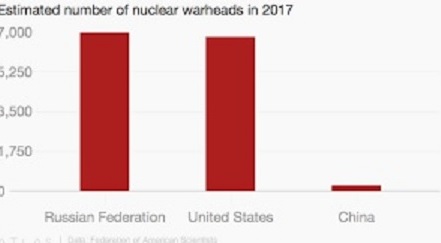
China’s nuclear stockpile is below 300, compared to nearly 7,000 warheads each for Russia and the US. Fan Jishe argues in an APLN policy brief that—notwithstanding its massively growing economy—China has consciously refrained from engaging in a sprint to nuclear parity with Russia and the US because its governing doctrine envisages only one role for nuclear weapons: to prevent nuclear blackmail.
Despite the total transformation in China’s economic fortunes since the 1960s, its nuclear doctrine, acquisitions program, and deployment and employment policies have remained essentially unchanged. It’s the only one of the nine possessor countries to be committed fully to an unequivocal no-first-use policy. Conversely, of the nuclear nine, only the US can be suspected of harbouring designs to shift from mutual vulnerability (the basis of deterrence) to nuclear primacy (which would enable use without fear of nuclear retaliation).
Of course, we can’t simply rely on the word of a potential adversary. But there are two further considerations. On the one hand, the international reputational cost to the next country to use nuclear weapons would be very high for breaking the global taboo. The cost would be even greater for a power that has a firm no-first-use policy. And the costs have been raised still higher by the new UN nuclear ban treaty. The treaty’s primary impact is intended to be normative, not operational, as I argue in the current issue of The Washington Quarterly, through moral stigmatisation and legal prohibition. It specifically prohibits the threat of use, along with banning any actual use of nuclear weapons. Instead of welcoming the treaty as a contribution to our national security, Australia has opposed and rejected it. On the other hand, an Australia reduced to a post-nuclear-attack atomic wasteland would be of no commercial, strategic or any other value to China, so the reputational cost would come with no compensating material or geopolitical gain.
According to a careful statistical analysis of 210 militarised ‘compellent threats’ from 1918 to 2001 by Todd Sechser and Matthew Fuhrmann (Nuclear weapons and coercive diplomacy, 2017), nuclear powers succeeded in just 10 of them, and even then the presence of nuclear weapons may not have been the decisive factor. Non-nuclear states were more successful at coercion than nuclear-armed states (32% of cases versus 20%) and nuclear monopoly gave no more assurance of success. In a different dataset of 348 territorial disputes between 1919 and 1995, possessor and non-possessor states won territorial concessions at almost the same rate (35% and 36%, respectively).
Lacking compellent utility against non-nuclear adversaries, nuclear weapons can’t be used for defence against nuclear-armed rivals either. Their mutual vulnerability to second-strike retaliatory action is so robust for the foreseeable future that any escalation through the nuclear threshold really would amount to mutual national suicide.
The only purpose and role of nuclear weapons, therefore, is mutual deterrence. They are credited with having preserved the long peace among the major powers in the north Atlantic (the argument that holds NATO to have been the world’s most successful peace movement) and deterred attack by the conventionally superior Soviet forces throughout the Cold War. Yet that too is debatable. How do we assess the relative weight and potency of nuclear weapons, West European integration and West European democratisation as explanatory variables in that long peace? No evidence exists to show that either side had the intention to attack the other at any time during the Cold War but was deterred from doing so because of the other side’s nuclear weapons.
Paul took that further in The Australian, canvassing the idea of investing in capabilities that would reduce the lead time for getting the bomb to give us more options for dealing with growing strategic uncertainty. North Korea’s nuclear advances and diminishing confidence in the dependability of US extended nuclear deterrence add to the sense of strategic unease.
In reply, Hughpolitely, gently but firmly rejected the implication that he’s a closet supporter of Australia taking the nuclear weapon path. He neither advocates nor predicts that Australia should or will go nuclear. He professes uncertainty about the role of nuclear weapons in shaping Asia’s emerging strategic landscape, highlights the importance of getting the decisions right on conventional capabilities first, and points to the choices and trade-offs that would then have to be made between the security benefits and risks of a weaponized nuclear capability.
Who will call out the nuclear emperor for being naked? Nuclear weapons haven’t been used since 1945—Hiroshima was the first time and Nagasaki the last. Their very destructiveness makes them qualitatively different in political and moral terms, to the point of rendering them unusable. A calculated use of the bomb is less likely than one resulting from system malfunction, faulty information or rogue launch.
On the other hand, the non-trivial risks of inadvertent use mean that the world’s very existence is hostage to indefinite continuance of the same good fortune that has ensured no use since 1945.
Curiously, Hugh, Paul and Andrew don’t explore the roles that nuclear weapons might play, the functions they would perform, and the circumstances and conditions in which those roles and functions would prove effective. This is a crucial omission. The arguments I canvassed in a review of the illusory gains and lasting insecurities of India’s nuclear weapon acquisition apply with equal force to Australia, albeit with appropriate modifications for our circumstances.
In short, the nuclear equation just does not compute for Australia.
Consistent with the moral taint associated with the bomb, the most common justification for getting or keeping nuclear weapons isn’t that we’d want to use them against anyone else. We’d only want them either to avert nuclear blackmail or to deter an attack. Neither of those arguments holds up against the historical record or in logic.
The belief in the coercive utility of nuclear weapons is widely internalised, owing in no small measure to Japan’s surrender immediately after Hiroshima and Nagasaki. Yet the evidence is surprisingly clear that the close chronology is a coincidence. In Japanese decision-makers’ minds, the decisive factor in their unconditional surrender was the entry of the Soviet Union into the Pacific war against Japan’s essentially undefended northern approaches, and the fear that the Soviets would be the occupying power unless Japan surrendered to the US first. Hiroshima was bombed on 6 August 1945, Nagasaki on 9 August. Moscow broke its neutrality pact to attack Japan on 9 August and Tokyo announced the surrender on 15 August.
There’s been no clear-cut instance since then of a non-nuclear state having been bullied into changing its behaviour by the overt or implicit threat of being bombed by nuclear weapons.
The normative taboo against the most indiscriminately inhumane weapon ever invented is so comprehensive and robust that under no conceivable circumstances will its use against a non-nuclear state compensate for the political costs. That’s why nuclear powers have accepted defeat at the hands of non-nuclear states (for example, Vietnam and Afghanistan) rather than escalate armed conflict to the nuclear level. Non-nuclear Argentina even invaded the Falkland Islands in 1982 despite Britain’s nuclear arsenal.
Australia’s nuclear breakout would also guarantee the collapse of the NPT order and lead to a cascade of proliferation. Each additional entrant into the nuclear club multiplies the risk of inadvertent war geometrically. That threat would vastly exceed the dubious and marginal security gains of possession. The contemporary risks of proliferation to, and use by, irresponsible states in volatile conflict-prone regions, or even by suicide terrorists, outweigh realistic security benefits. A more rational and prudent approach to reducing nuclear risks to Australia would be to actively advocate and pursue the minimisation, reduction and elimination agendas for the short, medium and long terms identified in the Report of the International Commission on Nuclear Non-Proliferation and Disarmament—an Australian initiative that was co-chaired by distinguished former Australian and Japanese foreign ministers.
In this three-part series, I examine the counter-arguments that proponents of Australia obtaining nuclear weapons need to address before the nation contemplates such a move.
Independent media: Our democracy depends on it, Independent Australia. Cathy McQueen“………It is hard to open a newspaper of the mainstream media (MSM) or indeed watch a television “report” today without seeing content littered with the journalistic opinion of the person writing or reporting it — even if it purports to be “straight” news.
I hate to think of what Keating would think of the Australian MSM now. We have a good 70 per cent of it — the Murdoch press — that only publishes far-right propaganda most of the time and blatant lies the rest of the time.
The Honourable Paul Keating – The Privacy Imperative in the Information Age Free for All
The remainder of the MSM does its best to do their jobs – I am talking Fairfax and The Guardianand the ABC – but even they are not immune from serving the far-right agenda of the Liberal Party at times. The African gangs outrage in Victoria provides the perfect example in recent times. The ABC and Fairfax both fell into the trap of pushing Minister for Home Affairs Dutton and Prime Minister Turnbull’s divisive agenda with this, instead of calling power to account and debunking it as the myth it was.
The Guardian is another great example of a publication that is less than perfect on this front at times. While its content is usually truthful and could even be said to be somewhat left-leaning, its headlines make the whole idea of language intelligence pointless.
Every day The Guardian’s Australian edition serves us up a slew of headlines that not only reinforce the far-right by directly quoting the latest outrage from a Turnbull Government minister – as in, ‘Victorians are scared to go to restaurants because of African gang violence: Peter Dutton ‘ – but they almost seem to glory in it. Headline after headline does this. Are they just being lazy or are they deliberately trying to confuse?……….
My disgust with my former profession extends to the entirety of News Corp’s workforce.
How do they sleep at night, I often wonder? Apparently, a lot of News Corp journalists, vote Labor, which begs the question:How on earth do they get through a day at the office?………
What I wonder about these people is this: How can anyone who cares about journalism – a profession whose main role is to call power to account, to uncover corruption and act as society’s democracy watchdog as well as informing and educating – write far-right propaganda and lies every single day? Every single day. They obviously believe it but how can seemingly intelligent people believe this dangerous rubbish? Are they sociopathic? You have to wonder.
And it is not just the aforementioned [the Andrew Bolts, Miranda Devines and Niki Savvas ] who are the offenders. The ordinary, everyday journalists at Murdoch publications are frequently called on to rabble rouse about “dole bludgers”, or “Kooris”, or African “gangs” or you name it. They attack the very working class and middle-class people that read their publications and write stories that push the agendas of the one percenters and Malcolm Turnbull’s Liberal Party mates — the banksters and Big End of Town.
It must be either soul-destroying or they must be so desperate for money that they have no choice. I could not live with myself — which is why I am studying law now. I have two years to go and I am hoping the ethics of my future profession is not going to be besmirched like the ethics of my former one. It is safe to suggest that many Australian journalists have forgotten that ethics even exist.
So is there any hope left for journalism in this country? Will we ever see reporting that is free from opinion, like Keating encouraged, or that actually does the job a member of the Fourth Estate should do — call power to account, uncover corruption and act as a watchdog on our democracy?
I remain positive. Publications like Independent Australia are leading the charge against the right-wing propaganda that has crept into our MSM — and they are doing a great job. Every time I click on an IA story I am so grateful that journalists like David Donovan and Martin Hirst still exist and are brave enough to carry on a tradition that has kept democracies healthy all over the Western world.
By only writing right-wing propaganda thanks to the Murdoch Press and the rest of the MSM, we lost a decent ALP government under Rudd and Gillard. We have been left with the current travesty of far-right ideology that governs only for its mates and the one per cent — the banksters and big business. The rest of us, along with health, education and the social safety net and, indeed, the greater good of the country can go to hell. Throw in a little racism and lack of humanity in the treatment of asylum seekers and refugees for good measure. And don’t even start me on the egregious way the MSM have dealt with climate science and climate change.
Australians should think long and hard about their media and what it serves up to them. We have a lot of talented journalists in this country who I know would like to write the truth, be independent and not serve up right-wing propaganda, constantly. We need to encourage independent media like IA as much as possible by republishing its stories on social media like Twitter and Facebook, by telling our friends and family about it and generally supporting it with our clicks every single day. We need to thank people like David Donovan and Martin Hirst, personally, for what they do.
If we don’t, we risk the only decent journalism – The Guardian and Fairfax press sometimes excepted – left in the country. The ABC has moved so far to the right it is almost unrecognisable.
Next time you open an MSM paper read it and its headlines critically; remember most are serving the far-right agenda of Murdoch and his cronies, the IPA and the Liberal Party.
Tell your family and friends to be sceptical and read your independent media and press as much as possible.
How a planned nuclear waste dump in the tiny SA town of Kimba impacts us all, Independent Australia, Should a remote farming community in South Australia be charged with the momentous decision of storing radioactive waste?Noel Wauchope reports.
THE AUSTRALIAN GOVERNMENT’S drive for a national radioactive trash dump continues.
It is being depicted by the Federal Government and the media as not a national matter. Indeed, it’s now not even a State matter concerning South Australia. It is now portrayed as just a local matter for small rural areas such as Kimba — population 1,100.
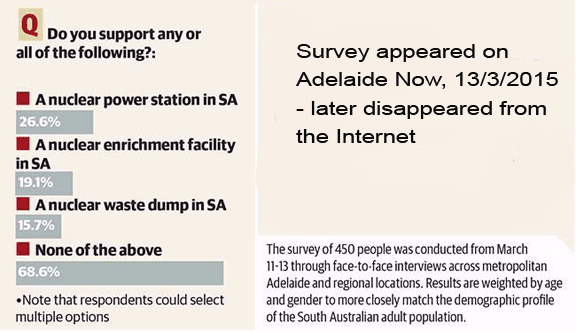
However, an opinion poll in Adelaide Nowshowed strong rejection of the plan for a nuclear waste dump at Kimba.
At the moment, Kimba is well in the running to host the national radioactive trash dump. In 2017, a Kimba town vote favouring this was 396 to 294 in favour. Not an overwhelming endorsement from this small community, but enough to keep enthusiasm for the project going, seeing as the matter is apparently of little concern to the rest of the State or the nation.
How come that Kimba is such a likely place for the dump?
Australia’s nuclear lobby has for decades been pursuing its plan for importing nuclear waste. In more recent years, this nuclear push has also turned its focus towards a dump for Australia’s own nuclear waste. The Australian Government, directed by its statutory body Australian Nuclear Science and Technology Organisation (ANSTO), joined in this because ANSTO is obligated by contract to deal with the high-level waste returning to Australia from processing in France and the UK. This waste is currently stored in containers at Lucas Heights in Sydney……….
in 2018, ANSTO and the ever-persistent nuclear lobby are going for what appears to be a moderate aim — the same old “low level” nuclear waste dump that Howard sought in 1998. TheNational Radioactive Waste Management Act 2012stressed the idea that the selection of a site should be “consent-driven” — though, in fact, it gives the Federal Government extraordinary powers to override state/territory governments, councils, communities, traditional owners and, indeed, anyone else.
With the emphasis on landowners volunteering sites – and with financial inducements offered – rural South Australians were encouraged to come forward.
The Turnbull Government claimed it had:
‘ … widespread support from direct neighbours of the nominated properties.’
Farmer Jeff Baldock nominated his property – and will be paid four times its value – if his offer is successful. Wallerberdina Station, near Hawker, has volunteered. Both communities can expect $2 million in government grants plus a $10 million fund for community development for the chosen site.
Because the discussion has been confined to communities in the region, there is little input from experts other than those provided by ANSTO. Farming community members have been transported to Lucas Heights at ANSTO’s expense and given reassuring technical information on nuclear waste storage in canisters. ANSTO medical and nuclear experts have been running science lessons in schools and offering hopes of scholarships to ANSTO.
A very problematic area, indeed, is the fraudulent story about storage of “low-level medical wastes” being the purpose of the facility. The practice of nuclear medicine has in no way been adversely affected by the absence of a national repository and it won’t in any way benefit from the establishment of a repository thousands of kilometres away from Lucas Heights. The real need is to store the processed spent fuel rod waste returning to Lucas Heights from France and the UK. This is classified by the French Nuclear Safety Authority (ASN) as “high level” waste.
An equally problematic area is in the temporary nature of the planned waste storage. This long-lasting radioactive trash will require burial for its thousands of years of toxicity. Kimba – or whichever area ends up with this facility – is facing the risk of “stranded” nuclear waste.
An Adelaide Now article (no longer available online) quoted a local teacher, Meagan Lienert, assuring us that she has done the research and that the waste facility would not affect the local farming environment. This illustrates a major problem with the way that this issue is being pitched to the locals.
As food produce marketing expert Kristen Jelk discussed in community discussions last year on the South Australian Government site, ‘Your Say’ the perception of clean, green South Australia is all-important. The presence of a nearby nuclear waste dump would ruin that market.
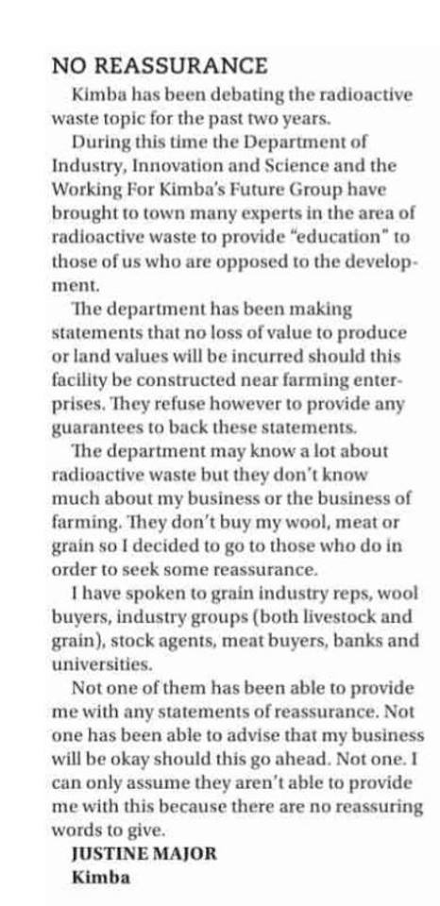
Similarly, Kimba farmer Justine Major wrote to the Eyre Peninsula Tribune, concerned about the image of the local agricultural produce if the radioactive dump should go ahead.
While some in Kimba, including its Mayor, are keen for further investigation of the project as a promising boost for the local economy, are they aware of the irony in that Kimba was, in 2017 State winner of KESAB’s Sustainable Communities top town? This award honours the community that does the most to protect the environment and embrace sustainability.
Mining body says contributions ‘provide additional opportunities for the MCA to meet with members of parliament’, Guardian, Paul Karp @Paul_Karp, The Minerals Council of Australia has conceded it makes political donations and pays to attend fundraisers to gain access to members of parliament in a submission to a Senate inquiry.
graph above goes back a few years, but illustrates the continuing trend
The frank admission – which reflects a commonly held belief about the role of money in politics – sticks out because major corporations and lobby groups by and large said they made donations to support democracy.
The Senate select committee into the political influence of donations, led by the Greens leader, Richard Di Natale, asked significant entities why they made political donations.
In its response to the committee, the MCA said that it made donations amounting to $33,250 in 2015-16 and $57,345 in 2016-17, which were declared to the Australian Electoral Commission. The majority in both years went to the Liberal or National parties and associated entities.
The MCA said it paid $25,000 each to the Federal Labor Business Forum and the Australian Business Network for membership subscriptions and its staff “occasionally attend fundraising dinners hosted by individual Members of Parliament.
“The MCA makes the political contributions detailed above because they provide additional opportunities for the MCA to meet with members of parliament,” it said. “The MCA uses these opportunities to update members of parliament about conditions in the Australian minerals industry and the policy priorities of the MCA.”
Di Natale said: “Our democracy is broken when a major mining lobby group feels comfortable publicly saying they pay for access to the old parties without fear of any consequences.”
The Australian Southern Bluefin Tuna Industry Association – which donated $320,000 to the Liberal Party in 2013 – described the decision as an “impulsive mistake” made out of frustration due to an alleged broken promise by a minister…….
Di Natale said cash-for-access dinners “are being used to hide millions of dollars” and laws should be changed to require they be declared as political donations.
The joint standing committee on electoral matters is also looking at political donations through inquiries into the 2016 federal election and the government’s bill to ban foreign political donations.
Brett Burnard Stokesabout ANSTO 15 Jan 18
(a) government backed nuclear corporation ANSTO are spending lots of money to establish a nuclear waste dump in South Australia,
|(b) there are laws in SA against nuclear waste dumps (see http://petition.dyndns.org/ ) including a provision that no public money be spent promoting nuclear waste dump.
(c) in contempt of SA laws, ANSTO has spent millions of dollars of public money on propaganda campaigns in South Australia, targetting various places with three sites active now, two in Kimba and one in the Flinders.
(d) ANSTO have run polling a while back, where the results were pretty marginal … and way short of “clear local consent” to proceed.
(e) ANSTO want to pretend that there is “clear local consent” so they are lying and also changing the rules,
(f) ANSTO have dodgy expansionary business plans involving huge export earnings from “medical isotopes” they plan to make at Lucas Heights.
If they do this, it will produce a lot of waste that they do not want to keep at Lucas Heights where there is room.
The business plans are dodgy on many levels.
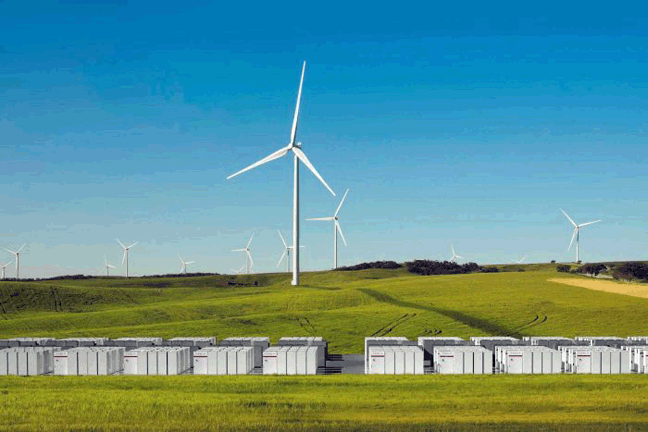
Inverse Innovation 11th Jan 2018.The results are in: Tesla’s South Australian project, touted as the
world’s largest lithium-ion battery with enough energy to power 30,000
homes, had an astonishing first month of operation. The 100-megawatt
behemoth, originally conceived by Elon Musk through a bet over Twitter, has
inspired the states of Queensland and Victoria to follow suit with their
own projects. https://www.inverse.com/article/40117-elon-musk-tesla-south-australia-batter
Business Green 12th Jan 2018, Connected Energy has secured a £3m investment from Australian banking giant Macquarie and French utility ENGIE to support the rollout of its
stationary storage system, it announced yesterday. The E-STOR system
offered by Connected Energy uses second-hand batteries from electric
vehicles (EVs), repurposing them into an energy storage system to help
homes and businesses cut energy costs and manage their power use more
effectively. https://www.businessgreen.com/bg/news/3024303/connected-energy-banks-gbp3m-investment-from-engie-and-macquarie
Farmers in distress as devastating drought enters its sixth year The Australian, RICK MORTON, Social Affairs reporter, Sydney @SquigglyRick
Almost five years after drought was last officially declared in Queensland, two-thirds of the state, or 120 million hectares, is in the grip of a dry so long and grinding that many who can afford to have forgotten it even exists.
At the end of last year, 35 council areas in the state remained wholly drought declared — some since April in 2013 — affecting thousands of beef and sheep stations, farms and other agricultural businesses.
Take Audrey Stone, a beef cattle property in Queensland’s central-west. It would be easy, owner Brett Wehl says, to sit back and believe it is the driest place on the continent.
The Wehl family homestead, about 40km northwest of Barcaldine, sits among a flat moonscape filled only with choking acacia bushes and tumbleweeds. The 6070ha property has run about 1000 head of cattle in the past but there are just 20 on it now.
Others have it worse, some have it better, but playing that game will drive a person mad, Mr Wehl says.
At the end of last year, precisely two-thirds of Queensland remained drought-declared with much of this officially in drought for four years and counting.
The state government has handed out $140m in drought assistance in that time. The proportion of the state affected has fallen from 87 per cent at the beginning of last year but thousands of farmers and graziers are still in its grip.
When they resuscitate Ziggy Switkowski to promote nuclear, and when Anti-Environment Minister Josh Frydenberg comes out of his quiet environmental closet to promote nuclear – you know that the nuclear lobby is having a serious attempt to persuade Australians.
Trouble is – the global nuclear lobby mightn’t be so happy about this.
They do pretend to be a professional, unified, competent force in the world. But not really. Small Nukes better shut up as Big Nukes will not tolerate them being successful, might allow them in only as a foot in the door for Big Nukes
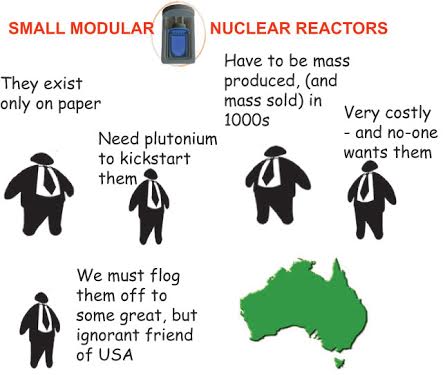
With giant companies like Toshiba, AREVA, EDF, China National Nuclear Corporation, Rosatom determinedly pushing their “conventional”nuclear reactors -there’s no likelihood that they are going to let new “little” nukes take over. They tolerate the media acrobatics of the Small Modular Nuclear Reactor companies – just as long as those companies claim (pretend) to be helping them.
In reality, there’s an absolute dispute between the two.
Australian politicians seem to be easily sucked in by the propaganda antics of the Small Nukes lobby –
Australia has ‘missed the boat’ on nuclear power, SMH, Cole Latimer, 11 Jan 18, The Minerals Council of Australia has called for the country’s prohibition on nuclear power to be lifted. But both critics and supporters see little future for large-scale nuclear power in Australia’s energy mix.
The man who once famously called for 50 nuclear reactors across Australia, nuclear physicist and NBN chairman Ziggy Switkowski, says “the window for gigawatt-scale nuclear has closed”.
A lack of public support and any actual proposals for a nuclear plant had resulted in government inertia, he said on Thursday.
“Government won’t move until a real business case is presented and none has been, to my knowledge, and there aren’t votes in trying to lead the debate,” he said, adding that renewables were now a more economically viable choice. “With requirements for baseload capacity reducing, adding nuclear capacity one gigawatt at a time is hard to justify, especially as costs are now very high (in the range of $5 billion to $10 billion), development timelines are 15+ years, and solar with battery storage are winning the race.”
Warwick Grigor, the former chairman of Uranium King, mining analyst, and a director of uranium miner Peninsula Energy, agrees.
“I think nuclear energy is great, but we’ve missed the boat in Australia, no one is going down that path in the foreseeable future,” Mr Grigor told Fairfax Media.“When Fukushima [the 2011 nuclear accident in Japan] occurred, that was the closing of the door to our nuclear power possibilities.”
Mr Grigor sees battery technology, a market he has since entered, as a better alternative.
Australian Conservation Foundation nuclear free campaigner Dave Sweeney said talk of nuclear power was “a dangerous distraction” from the steps that needed to address the energy and climate challenges facing Australia.
Nuclear energy has been officially banned in Australia since 1998, with the Australian Nuclear Science and Technology Organisation’s OPAL reactor at Lucas Heights, NSW, the only nuclear reactor in the country.
But the Minerals Council’s executive director for uranium, Daniel Zavattiero, said the nation had excluded a low-emissions energy source of which Australia has an abundant supply from the current debate.
“Maybe nuclear power might be something that is not needed, but an outright prohibition on it is not needed,” he said.
Federal Energy Minister Josh Frydenberg supported the Mineral Council’s stance. “There needs to be bipartisan support for nuclear power and that does not exist right now,” Mr Frydenberg said. “You would also need state-based support and that is not clear at this stage either.”…..
Mr Switkowski said smaller, modular nuclear reactors could play a part in the future energy mix, and could support regional centres.
An ANSTO spokesman told Fairfax Media these smaller plants could technically work in Australia.“If Australia did want to expand into nuclear energy technologies, there would be a number of options to consider in the future, including small modular reactors and Generation IV reactors, which could be feasible if the policy, economic settings and technology were right and public support was in place,” he said.
However, the country currently did not have enough skilled personnel to safely operate a nuclear energy industry, he said.
The Minerals Council of Australia made the call in its pre-budget submission.
“Nuclear power has the advantage of being able to generate baseload electricity with very low CO2 emissions over its life cycle,” the submission says.
The council said the ban on nuclear power in Australia is hampering an open debate about future energy and climate change management and stands at odds with Australia’s export uranium mining industry.
Turnbull Government conceals damning climate data, Independent Australia, Turnbull Government is negligently concealing its massive climate change policy failure, writes Peter Boyer.8 January 2018
“……..a malignant trend in public life: the willful, calculated, planned use of the festive season to disguise government failure to meet its obligations.
In this case, it’s about accounting for national carbon emissions as required under an international agreement to which we’re a party — and the principal culprits are Minister for the Environment and Energy Josh Frydenberg and Prime Minister Malcolm Turnbull……
Climate change is not just some trivial idea to be tossed aside at will. It’s real and it’s dangerous. And in failing to take their reporting obligations seriously, the Minister and his leader are seriously negligent.
This latest example of Turnbull Government misbehaviour also happened last year. By rights, the pair should be made publicly accountable; and applying their own party’s law-and-order mantra about repeat offenders they should, at the very least, lose their jobs. Fat chance, I know.
The emissions data released before Christmas takes us up to June 2017, fully six months ago. The Government has had all that time to put it out there for public and Parliamentary scrutiny. But this matter of crucial importance was relegated to a footnote that got buried in the Christmas rush.
To understand why the official figures have been withheld for so long, we need to set aside land use data, which since the 1997 Kyoto Protocol has repeatedly been used by successive Australian governments to make the picture look much rosier than it really is.
The Turnbull Government’s climate policy centrepiece, the Emissions Reduction Fund (ERF), has been focussed mainly on land use — including tree growing and clearing. The problem with that is huge uncertainty around the data, making it impossible to measure the scheme’s effectiveness.
With fossil fuel use, which the ERF does not address, we know where we stand. The good news from last year was that our per capita emissions were at their lowest for 28 years and the emissions intensity of the economy was nearly 60 per cent below its 1990 level.
But the really important figure is the actual amount of emissions, which in 2016-17 totalled 550.2 megatonnes. That is a rise of 0.7 per cent on the previous year and continues a clear, steady rising trend since early 2014……..
The Turnbull Government’s National Electricity Guarantee, which is being heavily promoted in the Government’s climate policy review, does no more than shut the stable door after the horses have bolted. It will do little to cut electricity emissions and will not affect petrol and diesel use.
Expectations were low ahead of the release of the policy document this month, but even so, it’s a big disappointment. Having set weak emission targets for 2020 and 2030, the Government seeks to avoid heavy lifting by using foreign carbon credits while relaxing the obligations of business.
We have nothing to look forward to in 2018. Malcolm Turnbull may be a better policy salesman than former PM Tony Abbott, but the awkward truth is that, just like his predecessor, while having no climate measures of any substance to offer, he hoodwinks electors into thinking all is as it should be.
It isn’t. National climate policy is a shambles. Frydenberg’s attempts to hide emissions data show that he knows the figures are damning, yet he and his leader continue to play games with us.





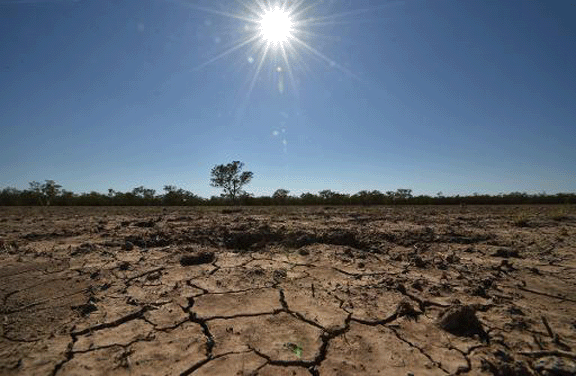
 Almost five years after drought was last officially declared in Queensland, two-thirds of the state, or 120 million hectares, is in the grip of a dry so long and grinding that many who can afford to have forgotten it even exists.