2 December REneweconomy News
 RenewEconomy
-
ASX top 20 companies for climate change reporting in 2017We’ve looked at the top 20 companies listed on the ASX to see what they actually said about climate change in their latest annual report.
-
Developing nations are driving record growth in solar powerEmerging markets now account for the majority of growth in solar power, according to new data from Bloomberg New Energy Finance .
-
How to find a site for a solar farm in less than 10 minutesWant to know where to connect a local solar farm to the grid? Now you can, in 10 minutes or less.
Yami Lester’s daughters continue his fight against the nuclear industry
Yami’s daughters take up anti-nuclear fight https://nit.com.au/yamis-daughters-take-anti-nuclear-fight/ – Wendy Caccetta –reporter@nit.com.auSisters Karina and Rose Lester know all too well the tragedy nuclear weapons can bring.
Their late father Yami Lester, a Yankunytjatjara man of northern South Australia, lost his sight after  being exposed as a boy to nuclear testing by the British Government at Maralinga in remote SA.
He went on to become a prominent anti-nuclear campaigner.
Now his daughters have taken up the battle, collecting and sharing stories that have helped the International Campaign to Abolish Nuclear Weapons (ICAN) win a Nobel Peace Prize.
The prestigious prize will be presented in Oslo on December 10, with an event at Melbourne Town Hall to be held the same day.
 Karina Lester, who lives in Adelaide, said when she was growing up her father did not talk much at home about what had happened to him as a boy when the nuclear testing took place.
But in public Mr Lester, who passed away in July at the age of 75, felt it was important to share with the world the events that shook the Wallatina community in the ’50s.
“There’s a role a parent plays in protecting your children from really knowing some of the sad, sad stories that did take place across our community,” Ms Lester said.
“He spoke a bit about where the camp was, he remembers that day, he remembers the ground shaking and this black mist rolling and the fear in the community.
“There was a huge loss for us as an Aboriginal community and we were so badly done by when the British came in and tested in our backyard that we still suffer to this day.”
Ms Lester said conditions in the community deteriorated over a week after the testing.“When the fallout happened, that evening, people were violently ill,” she said. “There was a lot of vomiting going around in the camp. People became sick. Their eyes started getting sore and tender.
“By day two, people were really starting to suffer. By week two, people’s eyes were either burnt out or people had bad burns on their bodies. “There were lots of rashes appearing and there was a trail of black-like soot that fell over the whole of the community.
“The oranges had shrivelled up and by that week were non-edible.”
Ms Lester said the story was a painful one, but needed to be heard. She said it was important to take a stand against anything nuclear from weapons to waste storage facilities. The Lester sisters gave NIT permission to reproduce the photo of their late father.
Report finds that Aboriginal landowners would get little benefit from Adani’s coal mine expansion
Adani’s compensation for traditional owners ‘well below’ industry standard, report finds, ABC News 1 Dec 17, By Josh Robertson A hotly contested deal between Adani and traditional owners of its proposed Carmichael mine site in Queensland’s Galilee Basin would deliver compensation “well below” what most big miners pay, according to a new analysis.
The Wangan and Jagalingou (W&J) people would only get 0.2 per cent of Adani’s earnings from the mine, less than half the industry average, respected mining industry outfit Economics Consulting Services has found.
Its report, obtained by the ABC, was commissioned by six W&J representatives whose looming court challenge to the deal stands as the final legal hurdle to Adani’s contentious mega-mine.
It found the W&J people would earn up to $145 million over 30 years, out of the project’s estimated $77.4 billion in gross revenue, a share which was “well below industry benchmark standards”.
The benchmarks for such deals usually ranged from 0.75 per cent to 0.35 per cent.
Only 11 per cent of the deal would come to the W&J people in cash, up to $17.4 million over 30 years, or about $2,300 a year per adult member of the clan.
Report author Murray Meaton, who was awarded an Order of Australia in 2014 for services to the mining industry, found the benefits to the W&J people would be “dramatically lower” if job promises for locals fell short as they did “in most jurisdictions and agreements”.
Traditional owners divided
To gain finance for the $21 billion project, Adani needs an Indigenous Land Use Agreement (ILUA) with the W&J people, or it must call on the Queensland Government to forcibly extinguish any native title claim over the mine site in the Galilee Basin.
After almost six years of vexed negotiations with Adani, the W&J representative group is evenly split over the deal.
The Indigenous group twice rejected Adani in 2012 and 2014 before seven of 12 W&J representatives swung their support behind the miner last year.
But Adani lost majority support in June when one representative changed heart, sending the group into deadlock after the ILUA was allegedly authorised in a meeting funded by Adani……… http://www.abc.net.au/news/2017-12-01/adani-compensation-well-below-industry-standard-report-finds/9212058
Chinese Government denies receiving application to fund Adani’s Carmichael coal mine
 Adani: Chinese Government denies receiving application to fund Carmichael mine, ABC News, 30 Nov 17, By Stephen Long, As Adani angles for Chinese money for its giant coal mine in North Queensland, China’s Australian embassy has made clear that any backing from Chinese state enterprises would need central government approval.
Senior embassy officials have also told opponents of the mining venture that no applications for funding have been made, despite Adani insiders claiming recently that finance from China had been secured.
Over the past month, businessman and environmentalist Geoff Cousins and prominent investment banker Mark Burrows, AO, have held talks with Chinese embassy officials in Canberra to lobby against Adani’s Australian project, amid reports Adani was close to finalising a deal for Chinese backing.
“Myself and Mark Burrows went to see senior officials from the Chinese embassy; we explained that China might think that Australians supported the Adani mine and we gave them a lot of evidence that that was not the case,” Mr Cousins told the ABC.
“The Chinese embassy was very forthright in saying that investment from a Chinese corporation would require the approval of the central government and that also no such proposal had been put.”……….
Chinese funding for the project is becoming more critical as prospects for a subsidised loan of up to $1 billion from the Northern Australia Infrastructure Facility for the mine railway fade.
The Labor Party, which looks likely to form a government in Queensland, has pledged to effectively veto the loan.
Pauline Hanson’s One Nation Party, which has secured at least one seat in the state parliament, is also opposed to the loan.
Banks across the globe have refused to fund the Carmichael coal mine because of doubts about its financial viability and its potential to worsen global warming. http://www.abc.net.au/news/2017-11-30/adani-china-government-would-have-to-sign-off-on-loans-for-mine/9209188
Hot weather in South Australia: Tesla battery turned on a day ahead of schedule
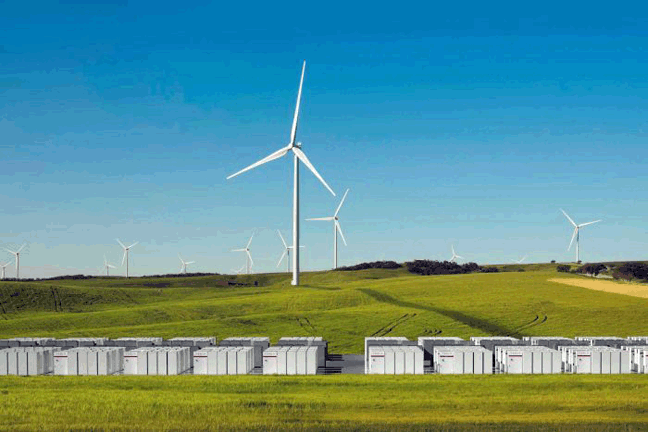 South Australia’s Tesla battery called on a day ahead of schedule as hot weather takes hold, ABC News 30 Nov 17 By politics reporter Nick Harmsen, South Australia’s giant Tesla battery has begun dispatching stored wind power into the electricity grid a day ahead of its scheduled switch-on.
Premier Jay Weatherill will visit the battery site — alongside the Hornsdale windfarm near Jamestown in the state’s mid north — on Friday, to mark its official opening on the first day of summer.
But with temperatures across South Australia and Victoria hitting the mid 30s, and output from the state’s wind farms low, the battery was called upon early to help meet Thursday afternoon’s peak demand.
The battery dispatched a maximum of 59 megawatts of power. The 100MW/129MWh battery is capable of powering about 30,000 homes for a little over an hour.
The manufacturer, Tesla says the lithium-ion device — made up of PowerWall 2 batteries — is both the “largest” by storage and “most powerful” of its type in the world……..http://www.abc.net.au/news/2017-11-30/sa-tesla-battery-begins-producing-power-a-day-ahead-of-schedule/9212794
1 December REneweconomy News
-
 It’s 30 years since scientists first warned of climate threat to AustraliaIn November 30, 1987 Australian scientists officially sounded the climate alarm. No one can say we haven’t been warned.
 -
Wind power prices have plummeted again in GermanyThe predicted price of onshore wind in Germany is now half the EU’s projections for 2030, following an auction in Germany this week.
-
Tesla big battery shows off its flexibility in final testingTesla battery goes through final testing with a rapid series of charging and discharging – never seen before on Australia’s ageing dumb grid.
-
Finkel’s frustration: Everyone else has a strategy, but not AustraliaFinkel vents his frustrations in final energy speech of the year, dumping on six biggest myths about electricity market, and delivering brick-bats to both policy makers and regulators.
-
Aera Energy and GlassPoint to build California’s largest solar energy projectAera Energy to install first-of-its-kind solar project to reduce oilfield emissions.
-
Vestas, CWP get serious about plan to export Pilbara solar and wind to AsiaSceptics might call it crazy to run a clean power ‘extension cord’ all the way to Indonesia, but the ELEXI plan to export Pilbara generated renewable energy to Asia has a serious team behind it.
South Australian law: government now prohibited from spending money to promote nuclear waste importing
 29 Nov 17, Today the Lower House of the SA Parliament passed my Greens Private Members Bill to remove the clause in the Nuclear Waste Storage Facility (Prohibition) Act 2000 that allowed the Government to spend public money on spruiking the benefits of an international high-level nuclear waste dump in SA.
That means that this will now become South Australian law as it has passed both Houses of the SA Parliament.
The Government will no longer be able to spend public money on pursuing an international nuclear waste dump.
With the focus now on fighting the Turnbull Federal Government’s plans for an intermediate-level nuclear waste dump in Kimba or the Flinders Ranges, it’s important to show your opposition to these plans. Come along to the “Don’t Dump on SA Rally” at 11am this Saturday, 2 December 2017 on the steps of Parliament House.
I will be speaking at the rally, outlining the Greens position on this important issue.
The Greens stand with the people of South Australia who choose a nuclear-free future for our State.
News Corpse writers and politicians mindlessly parrot spin about Small Modular (Nuclear) Reactors (SMRs.
 Steve Dale Nuclear Fuel Cycle Watch South Australia
How big is a SMR (Small Modular Reactor)? If you read the comments in the recent Australian article entitled “Want a nuclear reactor in your backyard? Step this way” – many people really think these things can fit in your back yard.
The news article is based on SMR Nuclear Technology Pty Ltd submission to the Australian Energy Security Board (Nov 2017) ( http://www.smrnuclear.com.au/…/SMRNT-ESB-Submission-Nov-201… ). The submission mentions the NuScale SMR module – which is actually 3 metres in diameter and 20 metres high! – and you need 12 or more of them together to create a plant, each weighing 700 tons.
I wonder how many politicians that parrot the words “Small Modular Reactor” actually know how big they are? The following document (“Small Isn’t Always Beautiful – Safety, Security and Cost Concerns about Small Modular Reactors”) is still very relevant http://www.ucsusa.org/…/nuc…/small-isnt-always-beautiful.pdf
Adani coal mine ‘fundamentally not in Australia’s interests’ – could be a financial disaster
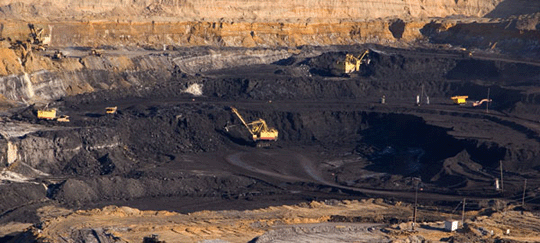 The ‘Kodak moment’ for coal, and why the Adani mine could be a financial disaster, ABC Radio, The World Today By Stephen Long 27 Nov 17, The woman who led the world to a global climate change agreement has a message for Australia: “You really do have to see that we are at the Kodak moment for coal.”
Christiana Figueres, until last year the executive director of the United Nations Framework Convention on Climate Change, doesn’t mean happy snaps for the family album.
Rather, the decimation of the once dominant photographic company Kodak by digital change — in the same way that coal-fired power is being eclipsed by renewable energy.
She hopes to see coal, like those sentimental moments in time captured in photographs, confined to history — with the world remembering the contribution the fossil fuel has made to human development, while recognising the need to retire it as a fuel source because of its contribution to global warming.
And, she says, it’s happening.
“We just had 25 countries come together [at the latest international climate change talks] in Bonn to say that they are moving out of coal in the short term.
“That does not include Australia or India or China, but you can begin to see the trend.
“India is headed for peaking its coal consumption by the year 2027.”
Adani ‘fundamentally not in Australia’s interests’
Which makes arguments that India needs the coal from Adani’s planned mega-mine in North Queensland — and the Federal Government’s determination to see the mine ahead — baffling to Ms Figueres.
The Government’s Northern Australia Infrastructure Facility, or NAIF, is considering Adani’s request for a subsidised loan of up to $1 billion to help it build a railway to connect the Carmichael mine in outback Queensland to the Abbot Point Coal Mine near Mackay, which Adani also owns.
By law, the NAIF is not permitted to make loans for projects that would damage Australia’s international reputation……..
this issue of the Carmichael coal mine which, if it goes ahead, would frankly blow completely out of the water any emissions reductions that Australia has committed to.
“Admittedly, those emissions from that coal will not be on Australian territory but they will affect the atmosphere and directly affect the livelihoods and the survival of Pacific islands around Australia.”…….
Various parties are considering court action against the NAIF should it grant the loan to Adani, including NGOs and commercial parties in other coal-mining regions……..
Lest climate change not be a concern, Ms Figueres has a warning to those considering investing in Adani’s Carmichael project that appeals to self-interest — she says it could be a financial disaster.
“I put it to you: do we not have here a financial house of cards?” she said.
Her assessment is based on various considerations.
These include the huge debts Adani’s Australian operations are carrying; the financial plight of Adani’s giant power plant at Mundra, which is meant to take much of the coal, but is on Adani’s own admission financially unviable — losing money and barely covering interest payments on its debt.
Adani Group is trying to flog the power plant to the Gujarat state government for just 1 rupee (about 2 Australian cents) with no guarantees that the Government would use coal from the Queensland mine if it were to take over the ailing plant.
Then there is the possibility that the giant mine, with a license to extract 60 million tonnes of coal a year, would become a stranded asset as the world introduces tougher measures to limit climate change…….http://www.abc.net.au/news/2017-11-27/the-kodak-moment-for-coal,-and-why-adani-could-be-a-disaster/9197134
Australian Energy Market Operator (AEMO) – Australia has enough electricity for summer
Australia has enough power for summer: AEMO, The Age, Cole Latimer, 28 Nov 17,
The chance of major summer blackouts has been cut as energy operators have found extra power for the east coast.
The Australian Energy Market Operator has added almost 2000 megawatts of additional power for the summer ahead, which it says will more than replace the 1600 megawatts taken offline after Victoria’s Hazelwood brown coal-fired power station closed in March…….
AEMO has now secured additional power to plug these forecast energy holes, and prepared the National Electricity Market – comprising Tasmania, South Australia, Victoria, Queensland, and NSW – for the summer ahead.
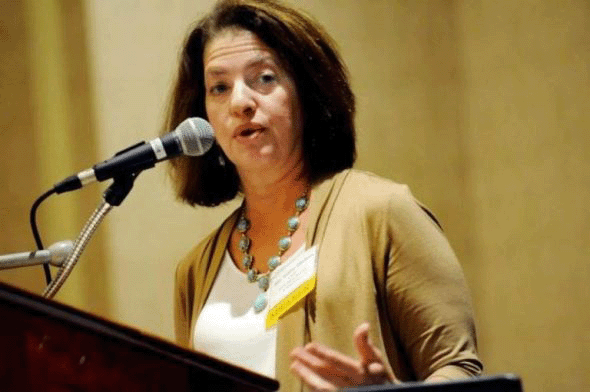 “AEMO is confident that we have taken all the necessary actions – and then some – to make sure we are ready,” AEMO chief executive Audrey Zibelman said. “We now have a range of dispatchable resources that can be used to strategically support the market as required, including battery storage, diesel generation and demand resources,” she said…….
More than 1000 megawatts of generation has been secured through demand response programs and the Reliability and Emergency Reserve Trader (RERT) mechanism, which encourage major power users to reduce their energy consumption during peak demand times.
Home consumers have also been encouraged to reduce their consumption, although AEMO expects demand to stay stable…….. http://www.theage.com.au/business/energy/australia-has-enough-power-for-summer-aemo-20171127-gztzfn.html
Queensland election result – an ill omen for the Adani coal megamine project
I suspect that the Adani project is already a stranded asset, and definitely not worthy of either Australian taxpayer support or Chinese investment.
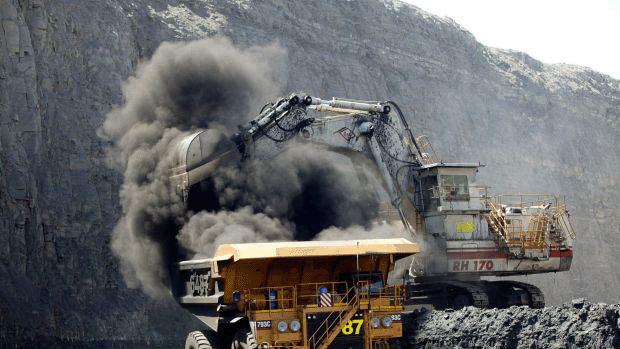 The Queensland election outcome is a death knell for Adani’s coal mine https://theconversation.com/the-queensland-election-outcome-is-a-death-knell-for-adanis-coal-mine-88148 The coal mine proposed for Queensland’s Galilee Basin by Indian mining giant Adani has been a moveable feast, with many stories about its scale, purpose, financing, job prospects, and commerciality. The prospect of a return of the Palaszczuk government in Queensland is effectively the death knell for the project.
Minerals Council pulls previous support for policies limiting advocacy by environmental charities,
Mining industry body retreats from hardline stance on charities, Minerals Council pulls previous support for policies limiting advocacy by environmental charities, Guardian Michael Slezak, 28 Nov 17, Australia’s mining industry has stepped back from its hard line on trying to limit the charity sector’s lobbying on energy and climate change issues.
The Minerals Council of Australia says it does not support policies requiring environmental charities to devote most of their resources to on-the-ground remediation, despite previously writing submissions to government calling for it to consider such policies.
Although the new stance seems to contradict earlier statements, the MCA insists there has been no change in its position.
The move comes amid fractures between the MCA’s membership over the tough approach, with BHP recently publicly distancing itself from the MCA’s position on activity requirements for environmental charities.
“They’ve over-reached in bashing-up on civil society, coal and climate and energy issues,” said Rod Campbell from the Australia Institute, who pressured the MCA to clarify its position. “They’ve gone rogue and they’re being pulled back – and that’s a good thing.”……..
Now, in a letter to Transparency International, the MCA has unequivocally said it does not support the moves it previously appeared to advocate for, writing:
However, the MCA does not support the government’s proposal to require environmental deductible gift recipients to commit no less than 25% and up to 50% of their annual expenditure to environmental remediation as referenced in your email………
The MCA has also been campaigning for all charities who receive foreign donations not to be allowed to take part in political advocacy during election campaigns. The Coalition has said it will introduce legislation before the end of the year that will do that.
Yesterday 25 charities launched a campaign to fight any such changes. https://www.theguardian.com/business/2017/nov/28/mining-industry-body-retreats-hardline-stance-charities
BHP aims to make a decision about a $2.76 billion expansion of Olympic Dam in the next few years
Cameron England, Business Editor, The Advertiser, 28 Nov 2017
BHP is considering a $2.76 billion expansion at Olympic Dam which it expects to make a decision on by mid 2020.
The company also said it has already started a $1 billion program to upgrade surface infrastructure as part of the Southern Mine Area Expansion, currently under way, which will increase its copper production to 230,000 tonnes per year.
The mine produced 166,000 tonnes last financial year which is expected to drop to 150,000 this year due to a major smelter upgrade. At an investor briefing in Adelaide today, Jacqui McGill, asset president Olympic Dam, said the company was working on a three phase expansion plan for Olympic Dam
The first phase — the SMA — will increase production to 230,000 tonnes of copper equivalent by 2020.
The term “copper equivalent” refers to the value of the mine’s production when also taking into account the gold, silver and uranium it produces.
The second phase of the project — brownfield expansion or BFX — would cost $US2.1 billion with the company currently running the numbers on the project with a view to making a decision on going ahead in mid 2020…. http://www.adelaidenow.com.au/business/jobs/bhp-aims-to-make-a-decision-about-a-276-billion-expansion-of-olympic-dam-in-the-next-few-years/news-story/1a9f517cb561e7f46ea58cfbdc7983f3
Centre for Policy Development urges companies to tell shareholders of climate change risks
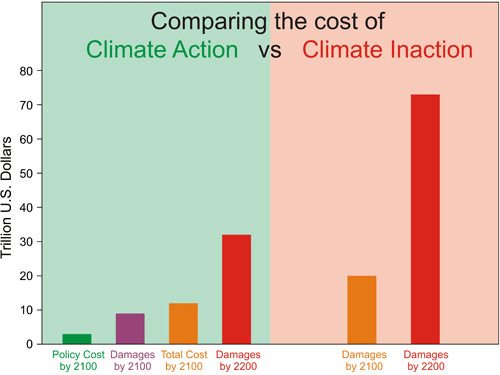 Australian shareholders should be told of climate risk to profits, says thinktank
Centre for Policy Development urges companies to adopt standardised analysis of climate’s impact on business, Guardian, Gareth Hutchens, 29 Nov 17, Australian companies need to start developing sophisticated scenario-based analyses of climate risks, and incorporating them into their business outlooks so shareholders know how climate change will affect profitability, a thinktank has said.
However, the Centre for Policy Development (CPD) said companies needed to do so in a standardised way, so investors and regulators were able to easily understand economy-wide risks to whole industries.
The progressive thinktank urged Australia’s biggest businesses to use the Paris climate agreement as the centrepiece for their scenario planning, saying it provided a credible, long-term anchor for policies that limit global warming to well below 2C.
The groups has released a discussion paper, called “Climate horizons: next steps for scenario analysis in Australia”, explaining the best way to do so.
Australia’s financial regulator warned in February that climate change posed a material risk to the entire financial system and urged companies to start adapting. Geoff Summerhayes, from the Australian Prudential Regulation Authority (Apra), told the Insurance Council of Australia’s annual forum in Sydney in February that Apra wanted companies to start incorporating “scenario-based analysis” of climate risks into their business outlooks.
He said Apra intended to start running stress tests of the financial system to see if it would survive various climate shocks, and all Apra-regulated entities would need to adapt to the coming regulatory changes. “I think the days of viewing climate change within a purely ethical, environmental or long-term frame have passed,” Summerhayes said.
The CPD’s new discussion paper suggested how Australian businesses could be consistent with the country’s international climate commitments under the Paris agreement and with the leading international framework for robust climate disclosures, the Financial Stability Board’s taskforce on climate-related financial disclosures (TCFD).
It said businesses ought to try to develop a standardised approach to scenario-based analysis, and that all scenario analyses should include:
- A scenario that is genuinely consistent with Paris targets. It should therefore incorporate a high probability of limiting warming to below 2C, and towards 1.5C
- A scenario that includes the physical impacts of climate change, not just transition risks
- Engage with the most relevant sectoral or regional scenarios and resources available
- Be transparent about assumptions and parameters used to develop the scenarios, in line with the TCFD disclosure framework
- Show evidence that management is overhauling their business models in response to scenario analysis results…….
- The CPD discussion paper will be discussed at a public forum in Sydney on Wednesday. Summerhayes will be speaking at the event, along with Steven Skala, the chair of the Clean Energy Finance Corporation, Christina Tonkin, the managing director of specialised finance at ANZ, and new CPD board member Sam Mostyn. https://www.theguardian.com/business/2017/nov/29/australian-shareholders-should-be-told-climate-risk-to-profits-says-thinktank
1 This month


Help Aunty Sue Protect Her Land and Sacred Sites From Destructive Rocket Testing.
.

Australians deserve the truth
about
AUKUS – https://aukuspublicinquiry.com/

PETITION – To: Prime Minister Anthony Albanese and the Australian Labor Government

of the week – Australians for War Powers Reform (AWPR)
To see nuclear-related stories in greater depth and intensity

