29 November REneweconomy News
- Know your NEM: Why AEMC needs a fresh view of policy mess
-
AEMC chief John Pierce has had a long run, perhaps long enough. And why sale of Loy Yang B is good for competition.NAB, Origin help Aussies make the switch and save with solarHomeowners will be able to make a positive impact on their finances as well as the environment, through a new solar initiative launched this week by NAB and Origin.
-
Kidston solar project set to start sending power to the gridThe first stage of huge solar and “water battery” storage project in an old gold mine in Queensland about to start exporting to grid.
-
Tesla big battery ramps up, AEMO seems happy so farTesla battery testing shows major charging and discharging – a novelty to the grid. Both AEMO and SA government sound pretty happy.
Proposed Federal nuclear waste dump threatens South Australia’s environment and economy

Susan Craig Fight To Stop Nuclear Waste Dump In Flinders Ranges SA November 22
• The current uranium waste storage facility is at Lucas Heights, NSW which has the capacity to continue storage for another 30 years. We are asking that this facility continue to be used until we have established a sound and safe resolution for the disposal of this waste and in collaboration with community and all interested parties.
• The waste dump proposed is not for underground storage, but rather a precarious and interim above ground storage site.
• Should the waste dump for Flinders Ranges be achieved, it will open the flood gates for the world to use South Australia as a dumping ground for many years to come, knowing they can dispose of their radioactive waste away from their own countries.
• South Australia has WORLD CLASS agriculture, food, wine, fibre and forestry industries.
• These industries are S.A’s LARGEST EXPORT INDUSTRIES and our products are transported directly to more than 100 countries.
• Our production systems are sustainable and makes use of CLEAN and SAFE environments.
• These industries are well supported and well positioned to meet the GROWING GLOBAL demand for CLEAN and SAFE food and wine.
• The total value of Australia’s farm exports is expected to hit a NEW RECORD OF $48.7 BILLION in 2016-17, $1 billion higher than the previous year.
• The value of Australia’s agricultural sector is tipped to BREAK ANOTHER RECORD this financial year, peaking at $63.8 BILLION
• Gross wine revenue increased by $329 million to $2.11 BILLION
• The value of wine exports increased by $119 million to $1.34 BILLION
• The value of the tourism market in the FLINDERS RANGES is worth $421 MILLION
• FLINDERS RANGES is the SECOND MOST VISITED regional site in South Australia.
• The value of S.A’s tourism market is worth $6.3 BILLION
• These industries show significant growth on previous years and forecast to CONTINUE GROWING, but a radioactive waste facility in our state will threaten all of this.
• Say NO to nuclear waste in South Australia and keep our farming, our tourism, our people and our future safe. https://www.facebook.com/groups/344452605899556/
www.dontdumponsa.net #dontdumponsa #sa2good2waste
Support for Adani coal mine damaged Liberal-Nationals in Queensland election
 Queensland election: how Adani helped undo the LNP’s push to
  regain power
Exit polls in the state’s south-east found up to 70% of respondents were against the billion-dollar rail line loan for Adani, Guardian, Amy Remeikis, 27 Nov 17, It was the sleeper issue that ended up dominating the Queensland election campaign – and, in the end, activists believed, may have saved government for Labor.
Labor sits the closest to the majority needed to take government in Queensland, 47 seats, after receiving gains in the south-east, largely helped by a drop in support for the Liberal National party.
Among those were Maiwar, the electorate held by the shadow treasurer, Scott Emerson, who looks to have lost largely due to Greens preferences, along with other LNP-held inner-city seats such as Mount Ommaney and Mansfield, which both look to have fallen to Labor.
Exit polls commissioned by GetUp in those electorates found up to 70% of respondents were against the billion-dollar rail line loan for Adani, while another 30% said Labor’s decision to veto the loan helped decide how they would vote.
“We already know the majority of voters from every single party at play opposed the Naif loan, including LNP and One Nation voters,” the GetUp environmental justice director, Sam Regester, told Guardian Australia. “Taking a stronger position against Adani clearly contributed to the swing in south-east Queensland. Just as tellingly, Labor held on to the regional seats that folks like conservative analysts predicted would fall because of the veto.”…….
Regester said that..voters in the south-east, particularly, saw a point of difference.
“The strong showing of the Greens, particularly in south Brisbane and Maiwar, showed more than anything the value of having the clearest, strongest policy on Adani,” he said. “ For most of the last term of government, the two major parties were equally bad on this key issue, so it’s no wonder they picked up a swag of votes.
“Labor was able to offset this somewhat with the Naif veto but this election made it clear that the Greens can be a threat to both major parties when they’re not up to scratch, particularly on Adani.”……..
Under the Naif rules, the states need to give approval for the loan. On Sunday, Palaszczuk confirmed she would stand by the veto decision. She also committed Labor to not allowing any taxpayer funds to flow to the mine, or its associated infrastructure, although has refused to give details of the royalty holiday granted to Adani, worth about $350m, which she said would be paid back with interest.
“We will veto the loan, they said on the 6th of June that they had the green light that they would build the mine and the rail line and we expect them to get on with it,” a Palaszczuk spokesman said.
The future of Adani now rests on whether it can receive financing to begin construction in the Galilee Basin, with some reports it may be close to securing Chinese money to open the mine. That has the potential to create another issue for the Queensland government, be it the LNP or Labor, as both have said they remain in support of the mine for the jobs it will create, with the Chinese funds potentially coming with Chinese labourer and steel strings attached.
GetUp have not finished fighting the project and Regester said Labor’s position was “still nowhere good enough” and a potential issue for the next federal election.
“After watching Adani dominate the state election, there will be folks in federal Labor keen to not see the next federal election nearly de-railed in the same way,” Regester said. “It’s in their interest to get on the right side of this extraordinary movement and oppose the entire Adani [mine] outright. https://www.theguardian.com/australia-news/2017/nov/27/queensland-election-how-adani-helped-undo-the-lnps-push-to-regain-power
Climate change could make some Australian cities virtually ‘uninhabitable’
 Deadly mix of heatwaves and humidity could make some Australian cities virtually ‘uninhabitable’http://www.news.com.au/technology/environment/climate-change/deadly-mix-of-heatwaves-and-humidity-could-make-some-australia-cites-virtually-uninhabitable/news-story/f90ff75e2f982e741efc714a1b7cf0a6, 26 Nov 17,
WITH temperatures nudging 70, this CBD has already been dubbed a “river of fire”. Deadly heatwaves could make it no-go zone. Benedict Brook@BenedictBrook CENTURIES-old heatwave records have been shattered all over Australia in the past week as cities from Hobart to Sydney have been hit by prolonged stretches of temperature far above normal.
Hobart’s recent run of six consecutive November days above 26C hasn’t been equalled for 130 years.
While it may have been warm, though, it was manageable.
However, climate scientists are warning the conditions in another of Australia’s capitals could get so bad it may become “not viable” to live there in decades to come.
A combination of debilitating humidity and what’s known as the “urban heat island effect” mixed in with a good dose of climate change could leave Darwin off-limits to all but the hardiest.
Already, surface temperatures in parts of Darwin’s CBD have been recorded nudging 70C.
And regional cities in Queensland might not be far behind.
Towards the end of November, Darwin locals look forward to the end of the “build-up”, the hot and sticky weather that precedes the wet season.
It’s been a tough few months. Earlier this year, the Bureau of Meteorology warned 2017’s build-up would be “brutal”.
“Everything is hotter than normal,” said the Bureau’s Greg Browning.
Australian National University’s Dr Elizabeth Hanna, an expert on the effects of climate change on health, told news.com.au it was the Top End’s tropical humidity that was the big problem. Continue reading
Heating oceans make South East Australian hot spots
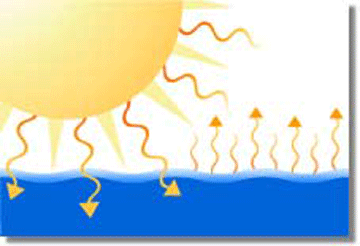 Global hot spot: Exceptional heat pushes up ocean temperatures off Australia http://www.theage.com.au/environment/weather/global-hot-spot-exceptional-heat-pushes-up-ocean-temperatures-off-australia-20171125-gzsrey.html, Peter Hannam
Australia is home to a global hot spot for sea-surface temperatures, with a record burst of prolonged heat in the country’s south-east helping to make conditions several degrees warmer than average.
Daily weather charts generated by the US National Oceanic and Atmospheric Administration show the unusual warmth is almost unmatched around the world, compared with normal temperatures.
Only patches off Greenland and New York in the US are as abnormally warm compared with long-run averages. (See chart below.)
“It’s clear sea-surface temperatures around south-eastern Australia, and Tasmania in particular, are well above average,” Blair Trewin, senior climatologist for the Bureau of Meteorology, told Fairfax Media.
Record warmth
Australia can meet its 2030 greenhouse emissions target at zero net cost
 What’s the net cost of using renewables to hit Australia’s climate target? Nothing https://theconversation.com/whats-the-net-cost-of-using-renewables-to-hit-australias-climate-target-nothing-88021, Andrew Blakers, Professor of Engineering, Australian National UniversityPhD Candidate, Australian National University, Research Fellow, ANU College of Engineering and Computer Science, Australian National University, November 27, 2017 Australia can meet its 2030 greenhouse emissions target at zero net cost, according to our analysis of a range of options for the National Electricity Market.
Our modelling shows that renewable energy can help hit Australia’s emissions reduction target of 26-28% below 2005 levels by 2030 effectively for free. This is because the cost of electricity from new-build wind and solar will be cheaper than replacing old fossil fuel generators with new ones.
Currently, Australia is installing about 3 gigawatts (GW) per year of wind and solar photovoltaics (PV). This is fast enough to exceed 50% renewables in the electricity grid by 2030. It’s also fast enough to meet Australia’s entire carbon reduction target, as agreed at the 2015 Paris climate summit.
Encouragingly, the rapidly declining cost of wind and solar PV electricity means that the net cost of meeting the Paris target is roughly zero. This is because electricity from new-build wind and PV will be cheaper than from new-build coal generators; cheaper than existing gas generators; and indeed cheaper than the average wholesale price in the entire National Electricity Market, which is currently A$70-100 per megawatt-hour.
Cheapest option
Electricity from new-build wind in Australia currently costs around A$60 per MWh, while PV power costs about A$70 per MWh.
During the 2020s these prices are likely to fall still further – to below A$50 per MWh, judging by the lower-priced contracts being signed around the world, such as in Abu Dhabi, Mexico, India and Chile.
In our research, published today, we modelled the all-in cost of electricity under three different scenarios:
- Renewables: replacement of enough old coal generators by renewables to meet Australia’s Paris climate target
- Gas: premature retirement of most existing coal plant and replacement by new gas generators to meet the Paris target. Note that gas is uncompetitive at current prices, and this scenario would require a large increase in gas use, pushing up prices still further.
- Status quo: replacement of retiring coal generators with supercritical coal. Note that this scenario fails to meet the Paris target by a wide margin, despite having a similar cost to the renewables scenario described above, even though our modelling uses a low coal power station price.
The chart below [on original] shows the all-in cost of electricity in the 2020s under each of the three scenarios, and for three different gas prices: lower, higher, or the same as the current A$8 per gigajoule. As you can see, electricity would cost roughly the same under the renewables scenario as it would under the status quo, regardless of what happens to gas prices.
Balancing a renewable energy grid
The cost of renewables includes both the cost of energy and the cost of balancing the grid to maintain reliability. This balancing act involves using energy storage, stronger interstate high-voltage power lines, and the cost of renewable energy “spillage” on windy, sunny days when the energy stores are full.
The current cost of hourly balancing of the National Electricity Market (NEM) is low because the renewable energy fraction is small. It remains low (less than A$7 per MWh) until the renewable energy fraction rises above three-quarters.
The renewable energy fraction in 2020 will be about one-quarter, which leaves plenty of room for growth before balancing costs become significant.
The proposed Snowy 2.0 pumped hydro project would have a power generation capacity of 2GW and energy storage of 350GWh. This could provide half of the new storage capacity required to balance the NEM up to a renewable energy fraction of two-thirds.
The new storage needed over and above Snowy 2.0 is 2GW of power with 12GWh of storage (enough to provide six hours of demand). This could come from a mix of pumped hydro, batteries and demand management.
Stability and reliability
Most of Australia’s fossil fuel generators will reach the end of their technical lifetimes within 20 years. In our “renewables” scenario detailed above, five coal-fired power stations would be retired early, by an average of five years. In contrast, meeting the Paris targets by substituting gas for coal requires 10 coal stations to close early, by an average of 11 years.
Under the renewables scenario, the grid will still be highly reliable. That’s because it will have a diverse mix of generators: PV (26GW), wind (24GW), coal (9GW), gas (5GW), pumped hydro storage (5GW) and existing hydro and bioenergy (8GW). Many of these assets can be used in ways that help to deliver other services that are vital for grid stability, such as spinning reserve and voltage management.
Because a renewable electricity system comprises thousands of small generators spread over a million square kilometres, sudden shocks to the electricity system from generator failure, such as occur regularly with ageing large coal generators, are unlikely.
Neither does cloudy or calm weather cause shocks, because weather is predictable and a given weather system can take several days to move over the Australian continent. Strengthened interstate interconnections (part of the cost of balancing) reduce the impact of transmission failure, which was the prime cause of the 2016 South Australian blackout.
Since 2015, Australia has tripled the annual deployment rate of new wind and PV generation capacity. Continuing at this rate until 2030 will let us meet our entire Paris carbon target in the electricity sector, all while replacing retiring coal generators, maintaining high grid stability, and stabilising electricity prices.
Uranium-to nuclear reactor- to nuclear weapons: Australia’s close involvement – theme for December 17
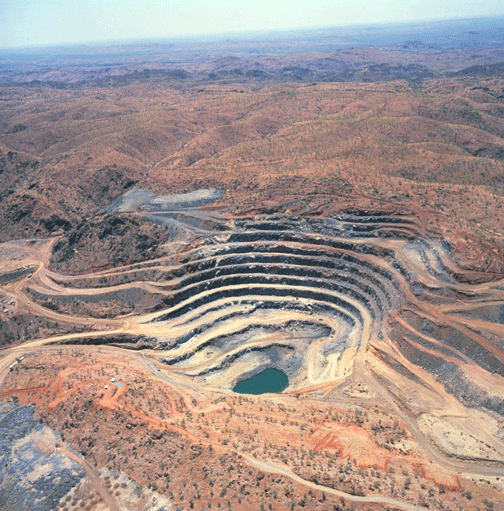 URANIUM. From 1944 the purpose of Australia’s uranium industry was to supply nuclear weapons. Up until 1962 Australia supplied 7,730 tonnes of uranium to the USA and UK for their nuclear weapons programs.
More recently, Australia’s uranium is supposed to go only to “peaceful” nuclear power. So – it can go to India, for example, where there’s dubious supervision anyway, and where it frees up other uranium supplies for India’s burgeoning nuclear weapons.
 NUCLEAR BOMBS. The Menzies government allowed Britain to explode its nuclear bombs in South Australia, and also at Monte Bello Island, in the 1950s and 60s. So the nuclear weapons industry has had its dirty foot well into Australia.
NUCLEAR REACTOR. Lucas Heights nuclear reactor was always intended as a step towards nuclear weapons, AND IT STILL IS. In the early 1950s, politicians, scientists and Defence Department enthusiasm for Australia to get a nuclear weapon led to the 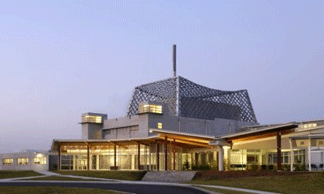 building, in 1957, of a nuclear reactor at Lucas Heights. A plan to build a nuclear reactor at Jervis Bay was pitched to the public as a commercial venture, but was always intended to provide enriched uranium for Australia’s own nuclear weapons.
Others favoured getting nuclear bombs supplied by Britain. The pro nuclear lobby always had nuclear weapons in mind, and campaigned for them strongly through the 1960s, to 1972, when Prime Minister Whitlam ended these ambitions. The campaign continued, more quietly.
 ANSTO. In 1987 the Australian Atomic Energy Commission was abolished, and the Australian Nuclear Science and Technology Organisation (ANSTO) was set
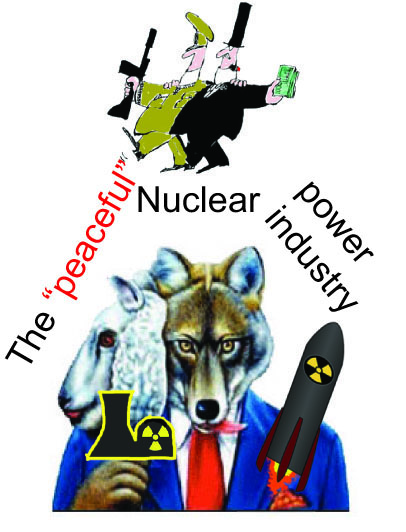 up. ANSTO is very secretive about its operations, but does pursue the advanced technology that would make nuclear weapons development possible. Today’s nuclear weapons advocates talk incessantly about “medical research”, and foster the myth of the “peaceful atom”.
As the nuclear weapons establishment in UK and USA now make clear – “peaceful” nuclear power is essential for nuclear weapons – as an industry supplying resources and trained operatives for the weapons industry.
The push for Australia to house nuclear wastes, and the whole nuclear fuel chain is an intrinsic part of the global nuclear weapons industry.
6 Australian religious anti-war protesters may face 7 years gaol for peaceful Pine Gap protest
An American Spy Base Hidden in Australia’s Outback, NYT The trials — and the Australian government’s uncompromising prosecution of the protesters — has put a spotlight on a facility that the United States would prefer remain in the shadows.
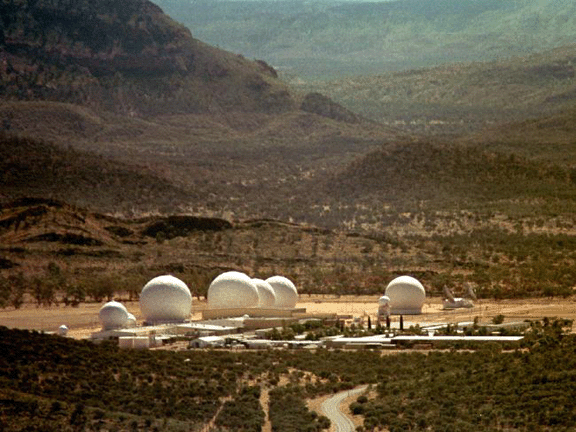
— Margaret Pestorius arrived at court last week in her wedding dress, a bright orange-and-cream creation painted with doves, peace signs and suns with faces. “It’s the colors of Easter, so I always think of it as being a resurrection dress,” said Ms. Pestorius, a 53-year-old antiwar activist and devout Catholic, who on Friday was convicted of trespassing at a top-secret military base operated by the United States and hidden in the Australian outback.
Australia needs special laws to protect its independent broadcaster – the ABC
 Special laws needed to budget-proof the ABC, says former PM Kevin Rudd, The Age, Peter Hartcher and James Massola, 25 Nov 17,
The ABC needs to have its budget protected from future attack by special legislation, according to former prime minister Kevin Rudd.
The former Labor leader said that while the national broadcaster’s independence was enshrined in law, its $1.04 billion annual budget was vulnerable. In an interview on the 10th anniversary of leading Labor to power, Mr Rudd said that one of his regrets was that his government didn’t protect the ABC budget against assault by a future Coalition government.
“To fix its baseline budget and entrench it in legislation with an automatic CPI acceleration would have been helpful,” Mr Rudd said.
The ABC was at particular risk from a future conservative government doing the bidding of Rupert Murdoch’s News Corporation, he said.
“I regret deferring constantly to the advice of my cabinet colleagues and not declaring open war on News Corporation. “It became clear early in the government’s life that, when we would not commit to the News Corporation agenda, they set out to destroy the government.”
His government’s decision to build the National Broadband Network was a threat to Murdoch’s Fox entertainment channels distributed through Foxtel cable, said the current president of the New York-based Asia Society Policy Institute.
“The current dominance of Murdoch represents a growing cancer on Australian democracy,” Mr Rudd said. He urged a future Labor government to hold a royal commission into New Corporation’s relationship with the Coalition…….http://www.theage.com.au/federal-politics/political-news/special-laws-needed-to-budgetproof-the-abc-says-former-pm-kevin-rudd-20171124-gzskmq.html
Queensland election is critical for solar energy, and for electricity consumers

 Queensland poll could be a show-stopper for solar, and consumers http://reneweconomy.com.au/queensland-poll-could-be-a-show-stopper-for-solar-and-consumers-11958/ By Giles Parkinson & Sophie Vorrath on 24 November 2017 Dirty versus clean; old versus the new; fossil fuels verses renewables; expensive energy versus cheap. There has rarely been so much at stake for an industry as there is in Saturday’s state election in Queensland, and the result is far from clear.
Current polling from Galaxy puts the ALP on track to win the required 47 seats for a majority, but as the Brisbane Courier-Mail reports, this will hinge on a number of factors, including unpredictable preference flows from One Nation supporters.
As at the federal level, politics in Queensland has been heavily focused on energy in the run-up to Saturday’s poll.
The Labor Palaszczuk government – which has a 50 per cent RET by 2030 for the state – has been campaigning strongly around renewables, with a particular focus on increasing rooftop solar uptakeas a way to cut power costs for businesses and homes around the state.
The new policies, launched in late October as part of the Palaszczuk government’s $2 billion Affordable Energy Plan, will offer no-interest loans to consumers wishing to invest in rooftop solar and battery storage, but lacking the up-front capital to do so.
They will also work to give landlords and renters equal access to solar, through a trial initially involving 1000 rental households. Queensland energy minister Mark Bailey said the rental solar scheme had the potential to save tenants up to 10 per cent off their annual bill, or up to $150 a year, while landlords could get a rebate of up to $520 per year.
On large-scale renewables, as we reported here, Labor, has promised to follow through on a program already underway to underwrite 400MW of renewable energy projects.
Following on from this, it has committed to support a further 1000MW of renewable energy projects via a new government power company; and to look to construct new transmission infrastructure in Northern Queensland that would unlock a vast new province of wind, solar and hydro power projects.
On the other side of the political divide, the LNP conservative coalition that is seeking to replace the current Labor government has made its intentions on energy clear: the end of renewables incentives; government money for a new coal generator in north Queensland; and support for the Adani coal mine.
The LNP is also claiming a huge reduction in consumer bills: $160 a year for two years, followed by savings of up to $460 a year in 2020.
But this is largely a mirage, as energy analyst Hugh Grant has pointed out. He noted that the only parties with policies that would deliver price reductions were the Greens, and Labor.
Not that Queenslanders got to read about that anywhere – apart from RenewEconomy, the local media refused to publish the results, as Michael West points out in this piece.
In the Conservative corner in the fight for new coal is federal minister for resources and northern Australia, Matt Canavan, who – recently restored to his portfolio – is as keen as ever to use the federal government’s Northern Australia Infrastructure Facility to help fund a new coal-fired power plant in Queensland’s north, as well as to get the Adani coal mine and port project off the ground.
One Nation is also keen to build a coal-fired power station west of Townsville, with party leader Pauline Hanson pledging to commit $1.5 billion to the project, which she wants built in Collinsville – a former coal hub of the state that is more recently turning to large-scale solar.
In fact, according to data gathered for RE’s Renewable Energy Index, the North Queensland region has more power generating capacity under construction than the entire state of NSW, and almost as much as Victoria, South Australia and Western Australia combined.
Meanwhile, Queensland home and business owners are leading the country – which in turn is leading the world – in rooftop solar uptake.
A Climate Council report last month showed that almost one third (31.6 per cent) of all Queensland homes now have solar panels, which puts the state ahead of South Australia, at 30.5 per cent, and Western Australia at 25.4 per cent.
What’s more, there are 14 postcodes in the Sunshine State alone where more than 50 per cent of households have rooftop solar, including the the Moreton Bay region town of Elimbah, where an impressive 63 per cent of homes have PV panels on their roofs.
The Australian Solar Council – newly rebranded as the Smart Energy Council – aren’t resting on their laurels, though. The peak solar industry body is spooked enough about a possible LNP victory that is has launched its own major election campaign, urging voters to put the Coalition last.
“Queensland voters face a stark choice at the election tomorrow,” the SEC said in an email to members on Friday:
“A new polluting coal-fired power station or a solar thermal plant providing 24-hour solar power; no new large-scale renewables and massive job losses or 1,000 megawatts of new large-scale renewable projects in regional Queensland; and a National Energy Guarantee that delivers the longest solar eclipse in history or sensible national energy policy.”
Australian environment has no constitutional protection, unlike Norway’s
 An Australian right to a healthy environment?

Our Constitution doesn’t contain an explicit paragraph for environmental protection, nor do we have a bill of rights.
Brendan Sydes said we have very few rights in our Constitution. “We don’t have the direct constitutional foundation for pursuing these sorts of actions,” he said.
“But there certainly is interest in … trying to find duties or obligations deep within our legal system that would force the Australian Government to take climate change and the need to reduce emissions farm more seriously than they are at the moment.
Dr Tom Baxter, corporate governance lecturer at the University of Tasmania, says the Federal Government hasn’t added a climate change trigger to Australia’s environment legislation. “Environmental lawyers are trying to use other mechanisms to prevent companies like Adani digging up the Galilee Basin and shipping coal out through the Great Barrier Reef.”
Should a healthy environment be a human right? These Norwegians think so http://www.abc.net.au/triplej/programs/hack/should-a-healthy-environment-be-a-human-right/9186144 23 NOVEMBER 2017 By Courtney Carthy
Their argument is based on an article in the Norwegian constitution protecting the right to an environment that’s healthy and that long-term consideration be given to digging up natural resources.
Greenpeace Norway head Truls Gulowsen told Hack it all comes down to climate change and oil licenses.
“We had challenged the Norwegian state for handing out new licenses for drilling in the arctic in spite of the fact that they have signed the Paris Agreement,” he said on his way to court. “They acknowledge climate change is a problem, and they know that the world has already found more carbon, fossil carbon, than we can ever afford to burn.”
He said Norway’s constitution gives future generations the right to a healthy environment.
“[That] puts duties on the state to guarantee and safeguard those rights.”
Brendan Sydes, lawyer and CEO of Environmental Justice Australia, says the strategy used by Greenpeace goes to a country’s legal foundation, instead of working with a country’s environmental regulations. Continue reading
Wind Energy – a brave new world for New South Wales farmers
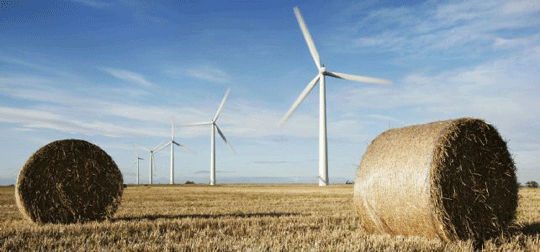 Wind Alliance to host public forum for landholders in Kentucky to bust myths about living with turbines http://www.northerndailyleader.com.au/story/5074983/farmer-busts-the-myths-behind-living-with-turbines/ Rachel Baxter , 24 Nov 17
Millions of dollars are being injected into the New England for large-scale renewable projects every year.
And while it might be daunting for many farmers, it’s a brave new world we have to get used to, Wind Alliance NSW organiser Charlie Prell says.
He said a major issue is when neighbouring properties are left with no say and no money while next door gets the benefits. “It’s really easy to solve,” he said. “The Wind Alliance has been promoting this thing called benefit sharing.” It’s all about strategic options for delivering ownership for wind farms in NSW, Mr Prell said.
“It’s so most people are not excluded from projects,” he said. “They probably won’t get paid as much as a host but at the moment there’s a cliff face where the host gets paid a lot and the neighbours get paid nothing.“Obviously they become disillusioned and skeptical by that process.”
Mr Prell said if neighbours are paid on a sliding scale depending on their proximity to the turbines, instead of a “cliff face” there’s a gradual decline.
“There’s no economic precedent for doing that but in small regional communities it actually makes a whole lot of social sense,” he said. Continue reading
Northern Territory to unveil plan for 50% renewables
 Northern Territory to release 50% renewables plan next week http://reneweconomy.com.au/northern-territory-release-50-renewables-plan-next-week-18260/ By Giles Parkinson on 24 November 2017 As Australia’s national energy policy enter a new hiatus – as the industry awaits some text to be inserted into the thought bubbles around the proposed National Energy Guarantee- some states and territories are getting on with their own plans.
The Labor government in the Northern Territory is expected next week, and possibly as early as Monday, to unveil the detail of its roadmap to a 50 per cent renewable energy target.
The government last year commissioned a special panel to put together the plan, which could result in some 400MW or more of mostly solar capacity in the territory over the next decade – not a huge sum by any means, but still significant given the potential investment droughts elsewhere.
As in other states, Labor has a diametrically opposite view to the conservative parties. Former LNP leader and chief minister Adam Giles was an ardent critic of renewables, and now works for Australia’s richest person, the mining magnate Gina Rinehart.
Victoria’s Labor government, meanwhile, has legislated a 40 per cent renewable energy target by 2025, and is conducting a 650MW auction – the largest ever in Australia – while the ACT has already contracted with some 700MW of wind and solar to meet its 100 per cent renewable energy target by 2020.
South Australia’s Labor government has already met its 50 per cent renewable energy target, and is keen on adding more, with numerous large scale solar, wind and storage projects lining up in the state.
The Northern Territory is almost entirely reliant on gas and diesel, and has three small grids – around Darwin, Tennant Creek and Alice Springs, and a host of stand alone systems and micro-grids in its many remote communities.
Alice Springs has made a major push into solar – including 12MW of rooftop solar and the 4MW Uterne solar system (the first large scale system in Australia) – and is installing a 5MW battery storage unit to help allow more solar into its small grid.
The Department of Defence is also making a major push into solar, announcing tenders for a total of 12.5MW of utility-scale solar for the RAAF base and barracks in and around Darwin.
The advisory panel was appointed by the government last December and asked to deliver a roadmap by mid year.
It was chaired by remote power system expert Alan Langworthy, and including Katherine Howard, former Australian Renewable Energy Agency chair Greg Bourne, Climate Council CEO Amanda McKenzie, and Lyndon Frearson, the head of solar and storage specialists Ekistica.
Australian Capital Territory’s energy policy could be damaged by Turnbull’s National Energy Guarantee
A National Energy Guarantee could be bad news for the ACT, Canberra Times, Katie Burgess , 24 Nov 17, A National Energy Guarantee could risk years of ACT energy policy and force Canberrans to pay more, ACT climate change minister Shane Rattenbury has warned.
The Greens minister met with his state and federal counterparts at the COAG Energy Council meeting in Hobart on Thursday and Friday.
Federal energy minister Josh Frydenberg had intended to ask state and territory leaders to give in-principle support to the energy guarantee, but instead sought approval to undertake further analysis of the proposal.
But Mr Rattenbury said he was concerned that the guarantee would “stymie” new sources of renewable energy, the emission targets were too low, the agreement too short and the modelling was tailored to “inflate the apparent cost-savings”.
He also said an “artificially suppressed” wholesale price would impact on the contract-for-difference model the ACT used as part of its plan to go 100 per cent renewable by 2020.
However when wholesale prices are higher than the feed-in tariff, the generator pays ActewAGL and the savings are passed onto customers.
That model has insulated Canberra customers from future price rises.
But if the wholesale price was pushed down, Mr Rattebury said the ACT could pay more.
“We are concerned it will suppress artificially prices in the wholesale market and we believe the wholesale market is an effective means of driving good energy outcomes so the transition across to a certificate-based approach we think distorts the price signalling effect the labour wholesale market is designed to operate,” Mr Rattenbury told a stakeholder meeting.
“As a jurisdiction it’s particularly problematic for us because we have set ourselves on a pathway that’s premised on having an effective wholesale price. For our consumers it’s going to represent a potentially significant cost increase because of the way our electricity contracts are set for the next 20 years.”………
The federal government chose not to adopt the Clean Energy Target recommended by Chief Scientist Alan Finkel, instead opting for a National Energy Agreement which would require energy retailers to meet a reliability and emissions guarantee.
The reliability guarantee compels retailers to make a proportion of electricity available from “dispatchable” sources like batteries, hydro or gas, that can be switched on when demand is high.
The emissions guarantee requires retailers to cut their greenhouse emissions by 26 per cent on 2005 by 2030.
The energy guarantee won’t apply to Western Australia and the Northern Territory, meaning those two jurisdictions will have no federal emissions reduction policy after the Renewable Energy Target is scrapped in 2020.
The ACT and South Australia called on the federal government to model the cost of a Clean Energy Target and a Renewable Energy Target as well but they refused.
Mr Rattenbury that was “deeply concerning”.
“We know the National Energy Guarantee is the fourth or fifth best choice because that’s what the backbench watered it down to.
“[The refusal to model other options] says to me it’s not going to stack up.” http://www.canberratimes.com.au/act-news/a-national-energy-guarantee-could-be-bad-news-for-the-act-20171123-gzryin.html
Turnbull govt’s National Energy Guarantee inadequate and confusing
Hard to overcome the impression that energy plan guarantees only more confusion http://www.theage.com.au/federal-politics/political-news/hard-to-overcome-the-impression-that-energy-plan-guarantees-only-more-confusion-20171124-gzs1x9.html Peter Hannam
It is notable that as late as two days before Australia’s energy ministers gathered in Hobart, the Turnbull government was still hoping to secure in-principle support for its national energy guarantee.
“Expecting us to sign up was a ridiculous proposition,” Lily D’Ambrosio, Victoria’s energy minister told Fairfax Media, adding there was a “massive pushback” against such undue haste.
So it’s perhaps no wonder the resulting COAG communique was unusually thin.
Indeed, the first pass at modelling the vaguely outlined policy was only completed and shared a few days earlier. Modelling can be made to do almost whatever you want it to do. That’s especially the case when the modeller – in this case, Frontier Economics – wasn’t commissioned to compare outcomes for other schemes.
While on the face of it a reasonable request, the bid stirred anger from at least one other state because Josh Frydenberg, the environment and energy minister, would never have got such a proposal near his partyroom for approval.
More number crunching in any case may not be the answer – at least, not until the design of the two elements of the guarantee to curb emissions and boost reliability are better defined.
A better approximation of the market distortions caused by relying on the electricity retailers to carry the guarantee obligations – rather than generators, as other programs such as an emissions intensity scheme, would require – may also reveal smaller savings for consumers than being touted.
Closer scrutiny of the guarantee modelling to date only fans doubts.
As South Australia’s Tom Koutsantonis notes, renewable energy schemes of Victoria and Queensland have largely been ignored, while the massive Snowy 2.0 pumped hydro scheme that hasn’t passed a feasibility study is assumed as operating.
The emissions trajectory also falls far short of what has otherwise been projected for the electricity sector – an industry that accounts for about a third of Australia’s carbon pollution.
As Dylan McConnell of Melbourne University notes, the modelling to date has been based on sector emissions for the National Electricity Market, totalling 1352 million tonnes of carbon-dioxide equivalent for 2021 to 2030.
Separate work by the government’s Climate Change Authority last year, however, projected electricity sector emissions of 1600 MT of CO2 for the whole 2020-50 period, and included Western Australia and the Northern Territory in that total.
Compared with the Authority’s work then, the national energy guarantee would leave less than two years’ of current power sector emissions for the entire 20 years after 2030, he says.
It really does look like there’s a lot more work to be done.
1 This month



Help Aunty Sue Protect Her Land and Sacred Sites From Destructive Rocket Testing.
.

Australians deserve the truth
about
AUKUS – https://aukuspublicinquiry.com/

PETITION – To: Prime Minister Anthony Albanese and the Australian Labor Government

of the week – Australians for War Powers Reform (AWPR)
To see nuclear-related stories in greater depth and intensity

