Senator Bernardi’s Nuclear Fuel Cycle (Facilitation) Bill – joins Tony Abbott in pro-nuke fervour
 Bernardi seeks to lift ban on nukes, THE AUSTRALIAN, MICHAEL OWEN, SA Bureau Chief, Adelaide, 12 Nov 17
Senatorr Cory Bernardi will introduce a bill in parliament today that seeks to lift a ban on nuclear power plants and enrichment and processing facilities…….
South Australian Premier Jay Weatherill has asked Malcolm Turnbull to give Aborigines the “final right of veto” over any site chosen by the federal government for the planned national radioactive waste dump.
Senator Bernardi, who plans to run candidates under his Australian Conservatives banner at the South Australian election in March, said he would introduce a bill today to remove bans on an Australian nuclear fuel cycle, particularly as they apply to nuclear power plants……
Last month, former prime minister Tony Abbott called for laws to allow for the construction of nuclear power plants……
Bernardi said the proposed legislation did not fully deregulate the nuclear fuel cycle, but if passed would “send a powerful signal to the world that we are … open for an Australian nuclear industry”.
The bill would remove sections of the Environment Protection and Biodiversity Conservation Act (1999) and the Australian Radiation Protection and Nuclear Safety Act (1998), which ban construction of nuclear power, fuel fabrication, enrichment or reprocessing plants, and any authorisation of such facilities…….
High-level international nuclear waste storage would require approval from federal parliament, which the Turnbull government had indicated it was prepared to support.
Federal Labor has a longstanding constitutional opposition to nuclear waste storage.
Mr Weatherill has written to the Prime Minister about the federal government’s plans to establish a national low-to-medium-level dump for domestic nuclear waste, with three SA sites under consideration: two near Kimba and one near Hawker.
In the letter obtained by The Australian, Mr Weatherill said Aboriginal leaders were deeply concerned about the Hawker proposal and urged the commonwealth to commit to “provide a local Aboriginal community with a final right of veto over any future facility proposed on their lands”.nukes http://www.theaustralian.com.au/news/nation/bernardi-seeks-to-lift-ban-on-nukes/news-story/06ef1d96c74c833146722aaeb88c3248
Malcolm Turnbull urges Hong Kong to put pressure on North Korea
Malcolm Turnbull calls North Korea ‘criminals’, urges Hong Kong to help, SMH, Lindsay Murdoch, 12 Nov 17, Hong Kong: Prime Minister Malcolm Turnbull has accused North Korea of being one of the world’s most “cunning, sophisticated criminals,” involved in many serious crimes, including drug trafficking, in his strongest condemnation yet of the dictator Kim Jong-un.
And Mr Turnbull told US president Donald Trump and China’s president Xi Jinping during a leaders’ retreat in Vietnam that their relationship is one of the “single most priorities for the world today,” urging them work together to pressure North Korea over is nuclear weapons program……http://www.smh.com.au/federal-politics/political-news/malcolm-turnbull-calls-north-korea-criminals-urges-hong-kong-to-help-20171112-gzjp85.html
13 November REneweconomy news
 RenewEconomy
-
Know your NEM: Queensland poll – what are the odds?Queensland energy politics has something for everyone – including a new coal plant – but bookmakers are backing the state Labor. Meanwhile, on the NEM…
-
Wind turbine collapse under investigation at Antarctic research centreOne of two wind turbines that help to power Australia’s Mawson research station in Antarctica has partially collapsed.
-
Sugar vs solar, round 2: 60MW Qld project stalls after opposition from cane farmersESCO Pacific’s proposed 60MW Mirani Solar Farm has failed to win approval from the local council, after strong opposition from local sugar can growers.
-
Climate change spurs Medibank fossil fuel divestmentMedibank’s announcement it will divest tens of millions of dollars from fossil fuels due to the ‘health effects of climate change’ has been welcomed by environmental finance group Market Forces.
-
South Australia’s new power plant ready before summerSouth Australia now has access to an additional 276 MW of electricity generation, with the state’s new power plant installed in time for the warmer summer months.
-
Wind farm researchers found to have no human ethics approvalA new research paper into the health impacts of wind farms has raised serious concerns over academic credibility.
-
Qld Labor ups ante on renewables – more ambition, new technologyLabor commits to “at least” 50% renewables by 2030, and promises $50m for first large scale solar tower and storage plant. Premier hails technologies that can power Queensland 24 hours a day, 7 days a week.
-
CWP proposes 250MW solar thermal + storage near TownsvilleCWP Renewables proposes 250MW solar tower and storage project near Townsville, while SolarReserve looking at six different projects in Queensland.
-
100% global renewable electricity more cost-effective than current systemMaking a global transition to 100% renewable electricity grid has long been a dream of many, and new research shows it is a viable reality.
-
NEG – behavior, details, details?The more we look at the NEG, the more bizarre it gets. And it seems disrespectful, or even arrogant, of the ESB to think an overnight thought bubble is going to be superior to carefully developed process in overseas markets.
-
Impact Investment Group appoints new CEO: Daniel MadhavanLeading Australian impact fund manager Impact Investment Group is proud to announce the appointment of Daniel Madhavan as Chief Executive Officer (CEO).
Australian Greens now influencing broad policy , for example on Adani coal project
The Greens believe they have put a difficult year behind them, and are seeing their ‘Cassandra’ foresight picked up by other parties. Saturday Paper,
 How the Greens drive policy, Saturday Paper Mike Seccombe , 11 Nov 17, Even in Richard Di Natale’s office they refer to the middle months of 2017 as the “winter of discontent”. It was as bleak a season as the federal Greens party has known.
But there is more than a whiff of spring in the air now, and if a few things go right over the next few weeks, maybe glorious summer. So Di Natale hopes.
……..One example is the giant coalmine proposed by the Indian conglomerate Adani in Queensland. Most Australians don’t want it. A Morgan poll last month showed that among those who had a view – and almost a quarter didn’t – opinion ran against the mine’s development by more than three to one.Says Bob Brown: “That poll showed that supporters of every political party from [Pauline] Hanson and the Nationals, across to the Greens, has a majority opposed to the mine. But the popular mood is not echoed in the big party rooms.
“It’s a classic example of how a small powerful lobby can work wonders with the big parties. It takes a very restive public to change their minds.”
And right now we are seeing that change happen. The Queensland public is very restive on the Adani project and only now, two weeks out from a state election, has the penny dropped within the Labor government of Annastacia Palaszczuk.
Until last Friday, her government supported a proposal for the Northern Australia Infrastructure Facility to loan Adani $1 billion to help build rail infrastructure for the project, on the basis that it would help generate jobs – and harvest votes – in north Queensland.
Then came the announcement that state Labor would no longer support the loan. Palaszczuk offered a convoluted and un-credible rationalisation, based on the claim her political opponents were planning a smear campaign about a conflict of interest involving her partner, Shaun Drabsch, who works for PwC, which is involved with the project.
The near universal view is that the decision was really based on simple electoral calculus: Labor stood to lose more votes than it would hold if it continued to defy public opinion. The Greens, the only party to have consistently opposed Adani, have hopes of picking up several seats in Brisbane.
We’ll soon see how much damage Labor has done to itself, and, more importantly for Di Natale, whether it translates into significant gains for the Greens.
Di Natale sees the Queensland election as one of a couple of “defining moments” in the near future, which will indicate whether the party really has put the winter of discontent behind it.
Another such moment will come even sooner, at next Saturday’s byelection for the inner Melbourne state seat of Northcote. The demographics of the seat favour the Greens, and Daniel Andrews’ Labor government is going all out to hold on. On the policy front, that has entailed a raft of changes, by which Labor has aligned itself with Greens positions……https://www.thesaturdaypaper.com.au/news/politics/2017/11/11/how-the-greens-drive-policy/15103188005492
Liberal National Coalition puts One Nation ahead of Labor on Queensland how-to-vote cards
 LNP puts Greens last, One Nation ahead of Labor on how-to-vote cards, SMH
“The only way for Queenslanders to get the positive change they want is to vote for their local Liberal National Party candidate. And the only way for you and your family to get ahead is to vote for your local Liberal National Party candidate,” Opposition Leader Tim Nicholls said in a statement issued on Friday night…… The Greens have already announced they will put One Nation last, and the LNP second last, on their how-to-vote cards……http://www.smh.com.au/queensland/lnp-puts-greens-last-one-nation-ahead-of-labor-on-how-to-vote-cards-20171110-p4ywxy.html
11 November REneweconomy news
-
Koutsantonis slams NEG, says it is an attack on renewablesSA energy minister Tom Koutsantonis says cannot support NEG, says it an attack on renewables, designed to keep alive dirty coal.
-
Graphs of the Day: Australia the global climate laggardIf the Turnbull government was setting the standard for global climate action… we’d be going to hell in a handcart, says new report.
-
Renewable energy for industry next big thing for Australia, says IEAInternational Energy Agency says solar, hydro and and wind have enormous potential for use in industrial processes – particularly in places like Australia, where the cost will be $USUS30/MWh.
-
Energy incumbents are going on a ‘gorging spree’Big fossil-fuel-based utilities are overcharging their customers, going on a “’gorging spree” while they still can.
-
Australia adds 107MW rooftop solar in October as 2017 heads for record yearCommercial solar growth helps push Australia’s total PV installs to 107MW in October, almost guaranteeing 1GW record for 2017.
Australia can expect ‘increased bushfire and storm danger’ due to climate change
 Climate change causing ‘increased bushfire and storm danger’ across Australia https://www.9news.com.au/national/2017/11/09/17/50/extreme-weather-is-getting-worse-in-south-east-australia
10 November More REneweconomy news
-
We’ll keep lights on, states can worry about emissions: ESBESB chair Kerry Schott says it will be up to the states to act if they want higher emissions targets.
-
Schott defends NEG modelling, says wind and solar at “low end”Schott says NEG modelling assumes “low end” of wind and solar costs, defying recent evidence. But ESB did admit there is much work to do on policy, dispatchability had yet to be defined, new coal unlikely to get a look in, and states free to pursue own targets.
-
Queensland coal plant has a photo – now all it needs is a massive subsidyA mock-up image of a new coal plant has been created, as part of the increasingly intense campaign to have one built – and funded by taxpayers – in north Queensland.
-
Video of the Day: The end of coal generation in South AustraliaBoilers of old Northern coal fired generator brought down, bringing end of coal era in South Australia and paving way for huge investment in renewables and storage.
-
DP Energy appoints contractors to build Australia’s largest hybrid renewable power stationInternational renewable energy company DP Energy has appointed preferred suppliers Vestas and Downer to develop Stage 1 of its Port Augusta Renewable Energy Park, which when complete will be Australia’s largest hybrid renewable power station
-
JinkoSolar claims record 23.5% efficiency for PERC solar cellJinko sets new efficiency record for PERC solar cell and sees big future in “half cell” modules.
-
10 Nov REneweconomy news
RenewEconomy-
We need to talk about rooftop solarSo you’ve installed rooftop solar – but is it performing as well as you expected? A new APVI web-based survey aims to help improve the quality of PV system components, installations and system designs.
-
Flinders Island makes switch to renewables, with solar, wind and energy storage HubFlinders Island’s Hybrid Energy Hub is already taking the previously diesel powered Tasmanian island to levels of 80% renewables, and should manage to supply 100 per cent of demand before the year is out.
-
Chevy Bolt set to catch Tesla in US EV raceLuxury price tags have not stopped Tesla from dominating the US electric vehicle market so far, but is all that about to change?
-
WA’s Synergy to bring in Dutch fund to bankroll wind and solar farmsWA government owned utility Synergy looking to bring in outside investors to bankroll investments in new wind and solar farms and meet RET obligations.
-
Wind, solar costs continue fall, and fossil fuels can’t stop themLatest analysis from Lazard points to continuing falls in cost of wind and solar, and a growing divide between renewables and fossil fuels. And the cost of storage is falling too.
-
You heard right: Trump administration is bailing out coal plantsConsumers paying more on electric bills is exactly what might happen if the US DoE goes through with plan to bail out uneconomic coal plants.
-
Photon Energy reports a profitable third quarterBuilding on the strong half-year results, the company confirmed continuing revenue growth at 6.8% compared to 2016Q3 and a 2,5-fold increase in net profit compared to last year’s result.
-
Australia wins early Fossil award as Syria leaves US alone on climateAustralia wins first Fossil of the Day award at Bonn climate talks, as Syria signs up to leave the US isolated as the world’s only non-member state.
Australian uranium company Paladin to leave costly environmental mess in Malawi
Paladin has ignored our requests to provide its estimate of the cost of rehabilitating Kayelekera, but we can safely say that the figure will be multiples of the US$10 million bond. Just keeping Kayelekera in care-and-maintenance costs US$10–12 million annually.
As things stand, if Paladin goes bankrupt and fails to rehabilitate Kayelekera, either rehabilitation will be coordinated and funded by the Malawian government (with a small fraction of the cost coming from Paladin’s bond) or the mine-site will not be rehabilitated at all.
It does Australian companies investing in mining ventures abroad no good whatsoever to leave Kayelekera unrehabilitated, a permanent reminder of the untrustworthiness and unfulfilled promises of an Australian miner and the indifference of the Australian government.
The company’s environmental and social record has also been the source of ongoing controversy and the subject of countless critical reports.
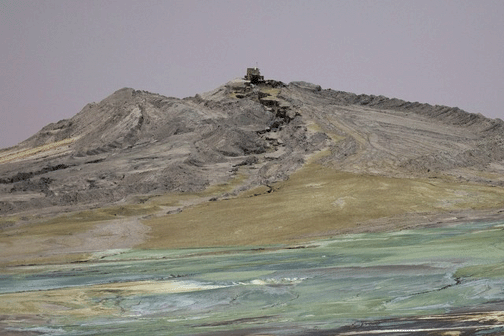
Julie Bishop, the WA government, Paladin and its administrators from KPMG need to liaise with the Malawian government and Malawian civil society to sort the rehabilitation of Kayelekera. An obvious starting point would be to prioritise the rehabilitation of Kayelekera if and when Paladin goes bankrupt and its carcass is being divided up. (picture below shows uranium sludge going to river)
Australian uranium miner goes bust ‒ so who cleans up its mess in Africa? By Morgan Somerville and Jim Green, Online Opinion, 8 November 2017, http://onlineopinion.com.au/view.asp?article=19394&page=0
Perth-based uranium mining company Paladin Energy was put into administration in July and the company is teetering on the brink of bankruptcy. Critics of the uranium industry won’t miss the company if it disappears. Other uranium mining companies won’t miss Paladin; in an overcrowded market, they will be pleased to have less competition.
But the looming bankruptcy does pose one major problem. Paladin’s Kayelekera uranium mine in Malawi, the ‘warm heart of Africa’, needs to be rehabilitated and Paladin hasn’t set aside nearly enough money for the job.
Under the leadership of founder and CEO John Borshoff, described as the grandfather of Australian uranium, Paladin has operated two uranium mines over the past decade. The Langer Heinrich mine in Namibia was opened in 2007, and Kayelekera in 2009.
They were heady days ‒ there was an endless talk about a nuclear power ‘renaissance’ and the uranium price tripled between June 2006 and June 2007. Continue reading
Australian navy joins USA and South Korea in drills to stop and search North Korean weapons ships
Australia conducts naval drills to stop and search North Korean weapons ships, SMH, David Wroe, 6 Nov 17, Australia is stepping up its role in tightening the net around North Korea, carrying out naval drills with the United States and South Korea to practise intercepting ships suspected of carrying illicit weapons to and from the rogue regime.
Two Anzac Class frigates began the two-day joint exercises on Monday in seas to the South of the Korean peninsula alongside powerful guided-missile destroyers from the other two countries as well as four smaller warships, maritime patrol planes and helicopters.
The crews are rehearsing how to stop and search a suspect ship of any country but the drills are clearly aimed at North Korea, which is not allowed to trade in arms because of several sets of United Nations sanctions.
Defence Minister Marise Payne said the drills would enforce UN Security Council Resolution 2375, concerning “the interdiction of vessels carrying suspicious cargo”……..
The training mission came as the Pentagon outlayed the grim choices facing the US and its allies in stopping North Korea, saying that a full ground invasion of the country was “the only way” to be certain it could destroy all of Pyongyang’s nuclear weapons…….
The United States wanted to dramatically increase ship interdictions in the most recent round of UN sanctions aimed at reining in Pyongyang’s nuclear weapons program. That would have allowed the US and others to use force on the high seas to stop ships suspected of carrying any type of goods whose trade is prohibited by sanctions.
But veto-wielding Security Council members China and Russia stripped out those measures, leaving the noose of interdiction efforts only incrementally tightened, meaning that interdiction can only happen if ships are suspected of carrying arms materials, particularly anything used in the production of weapons of mass destruction and missiles to deliver them. http://www.smh.com.au/federal-politics/political-news/australia-conducts-naval-drills-to-stop-and-search-north-korean-weapons-ships-20171106-gzg01k.html
Dean Johnson, Kimba mayor, ecstatic about Kimba getting Federal govt bribe for radioactive trash dump search
 Make the most of the funding for Kimba Eyre Peninsula Tribune http://www.eyretribune.com.au/story/5039693/make-the-most-of-the-funding-for-kimba/ Kathrine Catanzariti , 7 Nov 17
It has been refreshing to have our nearby regional cities in Whyalla and Port Augusta in the news lately, having secured government and private funding for major projects and improvements in or near those cities. However, despite our continued optimism and positive ‘can do’ attitudes, we still find our rural towns and smaller community centres are battling to receive our fair share as we struggle to show population and economic growth that would build the case for increased funding.
With this in mind, the Kimba community is fortunate to benefit from a substantial injection of funds as a result of our continued consultation and engagement in the national radioactive waste management facility search. Continue reading
Fairfax media uncritically regurgitates China-Bill Gates pro nuclear propaganda

Bill Gates and China partner on world-first nuclear technology , Cole Latimer, SMH, The Age, and global media outlets, 8 November 17
Bill Gates’ nuclear firm TerraPower and the China National Nuclear Corporation have signed an agreement to develop a world-first nuclear reactor, using other nuclear reactors’ waste
TerraPower chairman Bill Gates and Chinese premier Li Keqiang signed a joint venture agreement to create the Global Innovation Nuclear Energy Technology company, which will build a Travelling Wave Reactor and commercialise the technology…… http://www.smh.com.au/business/energy/bill-gates-and-china-partner-on-worldfirst-nuclear-technology-20171106-gzfrf0.html

Australian government might not be able to bypass Queensland and give funds to Adani for coal mine rail line
Queensland election: Naif testimony casts doubts on claim Adani loan can bypass state. Annastacia Palaszczuk gets support from former LNP MP Vaughan Johnson, who says she made the right call on loan, Guardian, Joshua Robertson, 7 Nov 17, The Northern Australian Infrastructure Facility cannot bypass the Queensland government and award Adani a $1bn loan, according to Senate testimony from its own executives that casts doubt on fresh suggestions funds could be fast-tracked before the state election.
Annastacia Palaszczuk’s belated pledge to veto the Adani loan if Labor holds government remains a campaign flashpoint, with the treasurer, Curtis Pitt, forced to refute a report that his office said the state would process the loan.
The Queensland premier is under attack for framing her dramatic about-face as a bid to quash a rumoured “smear campaign” by Coalition senators about a conflict of interest from her partner’s role in Adani’s Naif application.
But Palaszczuk also gained an unlikely supporter in the former LNP MP Vaughan Johnson, who said she made the right call amid “mudslinging” from Canberra. The Guardian has been told that Labor’s decision to commit to a veto involved strategic input from the former Adani lobbyist Cameron Milner, who cut ties with the miner to devote himself to the party’s campaign.
A veto now hinges on Labor’s re-election after the opposition leader, Tim Nicholls, refused Palaszczuk’s request for bipartisan support in a caretaker period….https://www.theguardian.com/australia-news/2017/nov/07/queensland-election-naif-testimony-casts-doubts-on-claim-adani-loan-can-bypass-state
Turnbull’s climate policies ‘immoral’ says former Clean Energy Finance chief Oliver Yates
Former Clean Energy finance chief Oliver Yates slams Turnbull government’s ‘immoral’ climate policies, SMH, Nicole Hasham, 7 Nov 17, A Liberal Party veteran and former head of the federal government’s green bank has unleashed on his party’s “immoral” climate change policies, saying they “knowingly and willingly inflict damage on others”.
Ex-Macquarie banker Oliver Yates, chief executive of the government’s $10 billion Clean Energy Finance Corporation until April this year, said far-right members had hijacked the party and that “reform from the outside” may be required – in the form of a rival party that better reflects core Liberal values……
“If we don’t address climate change and start to reduce our emissions, then it’s likely that billions of families could be forced to move home unnecessarily,” Mr Yates said.
He “cannot understand how Liberals would knowingly inflict damage on others when they have a perfectly workable economic cure in front of them” – the adoption of clean energy.
Mr Yates lives in the inner-Melbourne electorate of Kooyong, held by Environment and Energy Minister Josh Frydenberg. A life-long member of the Liberal Party, he is the son of former federal Liberal MP William Yates and began campaigning for the party at the age of nine. He is the independent director of several emerging renewable energy companies. http://www.smh.com.au/federal-politics/political-news/former-clean-energy-finance-chief-oliver-yates-slams-turnbull-governments-immoral-climate-policies-20171106-gzfobv.html
1 This month


Help Aunty Sue Protect Her Land and Sacred Sites From Destructive Rocket Testing.
.

Australians deserve the truth
about
AUKUS – https://aukuspublicinquiry.com/

PETITION – To: Prime Minister Anthony Albanese and the Australian Labor Government

of the week – Australians for War Powers Reform (AWPR)
To see nuclear-related stories in greater depth and intensity

