Australian government helps business lobbies, while punishing charities
 Business lobbies get free rein, while govt delivers charities a legal body-slam https://www.crikey.com.au/2017/11/15/business-lobbies-get-free-rein-while-govt-delivers-charities-a-legal-body-slam/ Michael West, 15 Nov 17
The government is crunching charities for foreign donations and tax breaks. Why, then, are the Minerals Council and other corporate lobby groups allowed tax breaks on their foreign funding?
SLAPP: a strategic lawsuit against public participation (SLAPP) is a lawsuit that is intended to censor, intimidate, and silence critics by burdening them with the cost of a legal defence until they abandon their criticism or opposition. Such lawsuits have been made illegal in many jurisdictions on the grounds that they impede freedom of speech.
— Wiktionary
It’s all happening to charities: Australian Tax Office (ATO) audits, investigations by the charity regulator and the Australian Electoral Commission (AEC), and new laws slated for early next month to stymie tax deductibility, contain advocacy and ban or restrict foreign donations. Many in the not-for-profit sector are scared to speak out for fear of reprisal.
Left-wing activist group GetUp went before the Senate inquiry into political donations last week and pulled out a report detailing the vast amount of money that is spent buying influence in Australian politics.
I should declare an interest here: yours truly did the research, which found 18 corporate lobby groups had raised $1.9 billion over the past three years.
These are vast sums, yet they only represent a few of the most powerful advocacy groups in a handful of sectors: banking, mining, property and big pharma. There must be 100 more. And, together with an estimated $1 billion in corporate political donations since 1998, the “revolving doors” between industry and government, and the hundreds of millions spent by individual companies on “in-house” government relations and external consultants, the real numbers involved in swaying politicians must be well north of $1 billion a year, or more than $4 million per federal politician, per year.
There is already a dangerous imbalance between corporate political power and people’s political power in this country.
In her new autobiography, Christine Milne: An Activist Life, the former Greens leader warns of the shift from democracy to plutocracy. “The takeover is almost complete … The rush toward the revolving door between business and politics has become a stampede. Of the 538 lobbyists registered by the Department of Prime Minister and Cabinet in 2016, 191 were former government representatives,” wrote Milne.
The farmer, and veteran of death threats, jail time and arrests as an activist, describes the hegemony of corporate influence as a “major factor in the disillusionment with politicians and democracy”.
Meanwhile, the government is slapping down its ideological adversaries with Tax Office audits and investigations by the AEC and charities regulator, the Australian Charities & Not-for-Profits Commission (ACNC).
Draft legislation is prepared and a bill is tipped to come before parliament in the final sitting week of this year. There are serious implications for democracy and free speech.
One one of the main planks of this “reform” is expected to be a ban on foreign donations. It is mostly designed to hit environmental groups such as Greenpeace, 350.org, Lock the Gate and the Australian Conservation Foundation but will also affect those charities working with Indigenous people, poor people, sick people and medical research.
If the bill gets up — and this may depend on what deal is dangled in front of Opposition Leader Bill Shorten, given the government is no longer in majority in parliament — it may see off foreign donations and tax deductibility.
Such would leave an unlevel playing field. Membership to corporate peak bodies such as the Business Council of Australia and the Minerals Council of Australia is tax deductible. Like the charities and NFPs, they pay no tax, but their funding is enormous.
Keen to contain the influence of environmental groups whose message flourishes on social media, the Minerals Council has been the chief urger in lobbying for the government crackdown on NFP advocacy.
More pertinently, while the government moves against foreign donations for environmental and other civil society groups, the corporate lobby remains untouched. The question should be asked, is this fair? The Minerals Council, its state affiliates and the oil and gas peak body, Australian Petroleum Production and Exploration Association (APPEA), have raised more than half a billion dollars for advocacy over the past 11 years …
*Read the rest of this article at michaelwest.com.au
17 November More REneweconomy news
-
 Australia fails again in climate rankings, but states get honourable mentionAustralia’s “unambitious, uninspired” climate policyagain puts it near bottom of global rankings. States get a mention for taking “independent action.”
 -
Victoria’s battery storage won’t be ready for this summerVictoria will likely go without its much-vaunted battery storage installations this summer, following months of delays likely to be centred around finance and contracting.
-
Pilbara Solar eyes NAIF funding for plan to export WA solar to AsiaPilbara Solar seeks federal government funding for plan to export WA generated solar power to Indonesia, via a sub-sea cable.
Australian Solar Council launches campaign againstQueensland’s Liberal National Party
 Solar industry launches big campaign in Queensland poll against
  LNP http://reneweconomy.com.au/solar-industry-launches-big-campaign-queensland-poll-lnp-59401/ By Giles Parkinson on 17 November 2017 The Australian Solar Council – the peak body for the country’s solar industry – has announced a major advertising campaign against the Liberal National Party coalition in the Queensland election campaign, saying the future of the industry is at stake.
 The ASC says it is spending “hundreds of thousands” of dollars in the first stage of its campaign, which will include TV, designed to highlight the implications for the solar industry if the LNP win power.
“It is a huge step for the Australian Solar Council to do political advertising, but solar companies are concerned,” says John Grimes, the chief executive of the ASC.
Liberal National Party policies present a direct threat to profits in Queensland’s renewables industry.”
“The reality of what’s at stake is not well understood, we have got to shake people up,” Grimes said.
“The implications of a Queensland LNP government that abolishes the renewable target, abolishes the RET in Queensland and signs up to new coal fired power station is completely untenable. That’s why we are taking this action.”
The LNP has made clear it will remove all subsidies for renewable energy in the state, and focus instead on building a new coal fired power station in north Queensland – an idea that even other coal generation companies say is ridiculous.
Labor, on the other hand, has promised to reach “at least” 50 per cent renewable energy by 2020, and promised more funding for a first solar thermal plant with storage, more solar for schools, initiatives for renters and low income households, and a 400MW tender for solar and storage.
The result, however, is in the balance, with One Nation polling strongly enough to possibly win some seats, and provide the numbers to support the LNP in a minority government.
Grimes noted that there were more than 24 large scale solar projects under development, or committed, in Queensland, and a pipeline of at least double that.
“We right on the cusp of an energy transformation,” he said. “There is a whole lot of investment that will fall by the wayside if we get a change in government.
The ASC is also concerned about the LNP’s declared support for the proposed National Energy Guarantee, which critics say will end up supporting existing fossil fuel generators and effectively penalise and put a halt to renewable energy development. The National Energy Guarantee is really a guarantee for coal,” Grimes says. “It means delay, inaction and confusion for renewable energy. That’s untenable for Queensland’s solar industry.
“When the National Energy Guarantee was announced, the Australian Solar Council promised a pointed political campaign against it. We are making good on that promise through newspaper, radio and digital advertising in key marginal seats in Queensland.
“Thousands of regional jobs have been created by the solar boom, and billions of dollars are being invested in regional communities but the solar boom could turn to bust in the Sunshine State,” said Mr Grimes.
17 November REneweconomy news
 RenewEconomy
-
Gas generators profit from scarcity in S.A. again, and againBig gas generators in South Australia have combined again to create “scarcity” and push prices into orbit, pocketing windfall profits at the expense of consumers.
-
Tasmanian tech drives renewable RottnestHydro Tasmania’s Hybrid Energy Solutions team has installed a 600 kilowatt solar array to complement the island’s existing 600kW wind turbine.
-
Australia’s dirtiest industry dealt another blow as Commonwealth Bank rule out new coal projectsGreenpeace welcomes the announcement today by the Commonwealth Bank that the bank would distance itself from coal projects.
-
Consumers to displace fossil fuels as biggest supplier of energyNetwork operator Ausnet says consumers will provide nearly half of their electricity needs, surpassing fossil fuels as the biggest supplier to the grid.
-
NSW bowls club boosts solar capacity to 414kW, to cut grid power by 25%Warilla Bowls and Recreation Club joins commercial solar boom, adding another 314kW to existing 100kW array to save $75,000 a year.
-
“Autononbus” driverless shuttle trial kicks off at Victoria’s La Trobe UniDriverless shuttle bus trial kicks off at La Trobe University’s Bundoora campus, to test the use of autonomous vehicles as “last mile” transport solutions.
-
How China is driving global green shift in electric power sectorThe IEA has recently published its new report Renewables 2017, which received maximum coverage around the world for its argument that solar PV is now growing faster than any other energy source.
-
Victoria utility installs first large-scale solar system on water tankWannon Water says 100kW system first to be put on utility water tank in Australia, will provide all power for water treatment facility on sunny days.
-
Canberra homes battle to be energy championsACT homes with solar and batteries are taking energy saving to the next level by competing with their neighbours to be named Canberra’s super solar heroes thanks to a new website by Reposit Power and SolarHub.
-
Soltec to serve Australian solar marketThe European leader in solar tracking continues international expansion to APAC region with a new subsidiary in Sydney.
Federal radioactive waste in South Australia : three sites, two years, one message
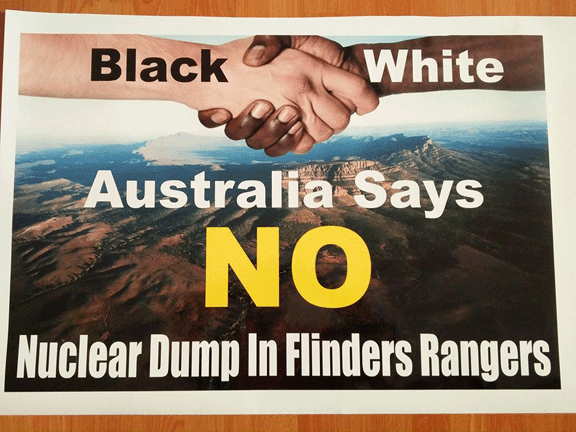 This week marks two years since the federal government announced its six shortlisted sites across Australia for the development of a National nuclear waste dump. Three of those sites were in South Australia and today both the Flinders Ranges and the Kimba agricultural region remain under threat.
The planned National Radioactive Waste Management Facility (NRWMF) project has been met with contest and concern from community members and state and national environment groups.
The waste issue is also set to be highlighted in the March state election with all SA politicians and hopefuls facing calls to explicitly back existing state legislation that makes any such dump illegal. Conservation SA was pleased to see an article in yesterday’s Australian newspaper disclosing Premier Jay Weatherill’s support for the Flinders Ranges community in their campaign against a radioactive waste dump in a letter to Prime Minister Turnbull urging him to respect Aboriginal opposition to the planned dump.
Regina McKenzie, Adnyamathanha Traditional Owner who lives next door to the Barndioota site and is a member of the Flinders Local Action Group (FLAG) said “The Liberal government’s plan is impacting the mental health and well being of the people in the Flinders Ranges and Kimba communities. We are happy that Premier Weatherill has opened his ears to us and is urging Malcolm Turnbull to do the same. For two years we have said no and we continue to say no.”
Kimba farmer Peter Woolford, chair of No Radioactive Waste on Agricultural Land In Kimba or SA, a group that formed around the issue, said “Two years on and the Commonwealth government continues to apply pressure to our small vulnerable community. The uncertainty, stress and toll this has taken on people within Kimba is immeasurable.
“Ministers and the Department of Industry, Innovation & Science state broad community support is critical for the facility, yet Kimba has continually been contested with strong opposition being maintained. The recent poll was clear that nearly half the community are opposed to siting a nuclear waste dump on farming land even with “disruption” money offered to communities to stay in the process.
“Current legislation in South Australia needs to be upheld and the Commonwealth should not ‘impose’ a national waste facility onto any unwilling community”, he said.
Radioactive waste dumps for non-SA wastes are illegal in SA. In response to earlier federal moves to dump waste in SA, state Parliament passed a law to say No: The Nuclear Waste Facility (Prohibition) Act 2000. This Act is “to protect the health, safety and welfare of the people of South Australia and to protect the environment in which they live by prohibiting the establishment of certain nuclear waste storage facilities in this state.”
The majority of Australia’s radioactive waste is currently securely stored at the Australian Nuclear Science and Technology Organisation’s (ANSTO) site at Lucas Heights, in southern Sydney. ANSTO says it “is capable of handling and storing waste for long periods of time.” ANSTO produced the waste and they are best placed to manage it until a proper disposal approach is agreed. The current substandard plan does not meet world’s best practice and there is no need for short term approaches to this long term issue.
Mara Bonacci, Nuclear Waste Campaigner at Conservation SA said “The current process is flawed and divisive and targets vulnerable remote communities. In the two years since the six shortlisted sites were announced, the government has got no closer to securing a site. In fact, the site nomination process is still open. The government has only succeeded in causing stress and division in the areas it has targeted. It is time to stop the clock and adopt an evidence based approach to waste management.
“The waste can and should remain secured and monitored at Lucas Heights until a dedicated public review of the full range of options for radioactive waste management is carried out. The focus needs to shift from targeting SA to establishing a fair, open and responsible process for the management of Australia’s most hazardous waste”, she concluded.
Pacific Islanders call on Australia and other nations, as climate change submerges islands
Pacific Island nations urge world leaders to act as islands expected to sink
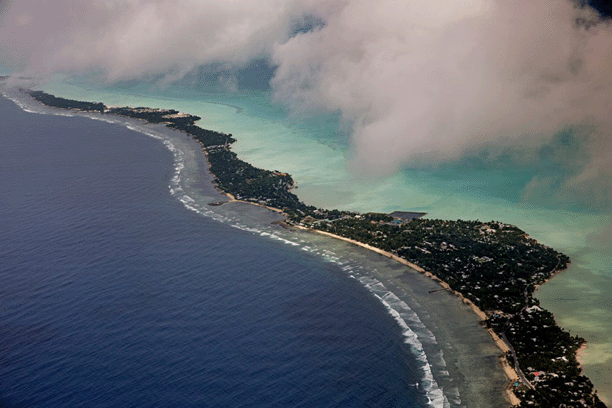
AUSTRALIA’S tropical island neighbours may exist today, but their leaders have urged us to help them from sinking. news.com.au, Matt Young@MattYoung 14 Nov 17 A LARGE swath of Pacific Island nations are slowly being eaten away until residents will be forced to evacuate and the islands eventually sink into the sea — and it’s coming sooner than we think.
This modern-day Atlantis is thanks to sea levels across small island nations that have seen a dramatic rise over the past few decades, a rate of up to 3-4 times larger than the global average. Tuvalu, in the western Pacific Ocean, will reportedly be uninhabitable by 2050, while its island neighbour Kiribati, is expected to be fully submerged by 2100.
The Maldives, which has the lowest elevation in the world and a population of 427,000, may also have sunk by the end of the century.
It has led experts — including Professor Tim Flannery, climate change expert and Professor at La Trobe University — to believe we are “on a trajectory that will see those nations compromised”.
Five reef islands in the Solomon Islands have already been lost forever while a further six have been completely eroded. Last year, the island of Nuatambu had already lost half of its habitable area.
Professor Flannery told news.com.au The Maldives, Kiribati, Marshall Islands, Tokelau and Tuvalu were most at risk.
“It’s very much on their minds, they’re trying to work out how to deal with it,” Mr Flannery told news.com.au.
Scientists are convinced more and more of these tiny islands at risk of sinking into the sea in the next 30 years and Pacific Island leaders have gathered to urge its neighbours, including Australia, to take action to save their dwindling nations……http://www.news.com.au/technology/environment/pacific-island-nations-urge-world-leaders-to-act-as-islands-expected-to-sink/news-story/9416ac1726d1f8d02a1ae435924e364f
Australian Aboriginal concerns will now be addressed in Scotland discussions on destination of reprocessed nuclear wastes
 Herald 13th Nov 2017, ABORIGINES challenging proposals to dump nuclear waste from northern Scotland to a sacred Australian site have won a breakthrough meeting with
government officials about their concerns.
Wallerberdina, 280 miles north of Adelaide, has been identified as a potential location for Australia’s
first nuclear waste dump as part of a deal that returns spent fuel processed at the nuclear facility currently being decommissioned in Dounreay, Caithness, to its country of origin.
This is despite claims that it is a priceless heritage site rich in archaeological treasures including
burial mounds, fossilised bones and stone tools. Some have claimed the
impact would be similar to “building a waste dump at the heart of the
Vatican”.
Campaigners who have appealed to the Scottish Government to halt
the plans to ship nuclear waste processed at Dounreay in Caithness to
Australia, have now been told that their concerns should be addressed
before any final decision is taken.
The Dounreay Waste Substitution Policy, agreed in 2012, sees waste from Australia, Belgium, Germany and Italy processed at the Scottish facility to make it safe for storage after being
returned to its country of origin. Campaigners have complained that the
intended South Australian destination forms part of an Aboriginal heritage
site rich in burial mounds, fossilised bones and stone tools.
http://www.heraldscotland.com/news/15655056.Breakthrough_in_Australian_aboriginal_challenge_to_nuclear_waste_transfers_from_Dounreay/
Australian World Heritage sites at special climate change risk- International Union for Conservation of Nature(IUCN)
 From the Everglades to Kilimanjaro, climate change is destroying world wonders
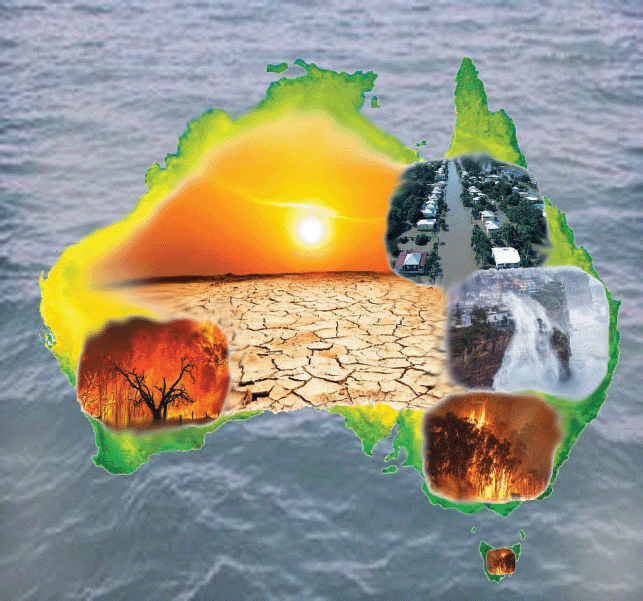
Number of natural world heritage sites at serious risk from global warming has doubled in three years, says the IUCN, including the Great Barrier Reef and spectacular karst caves in Europe, Guardian, Damian Carrington 14 Nov 17, From the Everglades in the US to the Great Barrier Reef in Australia, climate change is destroying the many of the greatest wonders of the natural world.
A new report on Monday from the International Union for Conservation of Nature(IUCN) reveals that the number of natural world heritage sites being damaged and at risk from global warming has almost doubled to 62 in the past three years.
Those at high risk include iconic places from the Galapagos Islands to the central Amazon and less well known but equally vibrant and unique sites such as the karst caves of Hungary and Slovakia and the monarch butterfly reserves in Mexico.
Coral reefs are particularly badly affected by rising ocean temperatures, from the Seychelles to Belize, where the northern hemisphere’s biggest reef is situated. Global heating is also causing mountain glaciers to rapidly shrink, from Kilimanjaro in Tanzania to the Rocky Mountains in Canada and the Swiss Alps Jungfrau-Aletsch – home to the largest Alpine glacier.
Other ecosystems being damaged are wetlands, such as the Everglades, where sea level is rising as the ocean warms and salt water is intruding. In the Sundarbans mangrove forest on the delta of the Ganges, Brahmaputra and Meghna rivers on the Bay of Bengal, two islands have already been submerged and a dozen more are threatened. Fiercer storms are also increasing the risk of devastation.
Australia is especially exposed as it has 10 natural heritage sites where climate change damage is rated as high or very high risk, from its Gondwana rainforests to Shark Bay in western Australia and islands such as Fraser and Macquarie.
The new IUCN report was launched at the UN climate summit being held in Bonn, Germany, where the world’s nations are working to put the 2015 landmark Paris agreement into operation.
“Protection of world heritage sites is an international responsibility of the same governments that have signed up to the Paris agreement,” said Inger Andersen, IUCN director general. “This report sends them a clear message: climate change acts fast and is not sparing the finest treasures of our planet. This underlines the need for urgent and ambitious national commitments and actions to implement the Paris agreement.”
Climate change is one of a range of factors that mean about a third of the world’s 241 natural heritage sites are being damaged, with invasive alien species being the top threat. Then, after global warming, comes unsustainable tourism, followed by other problems like poaching and construction…… https://www.theguardian.com/environment/2017/nov/13/from-the-everglades-to-kilimanjaro-climate-change-is-destroying-world-wonders
Western Australia: SUPREME COURT JUDICIAL REVIEW OF ENVIRONMENTAL APPROVAL for YEELIRRIE URANIUM MINE
DATE Thursday 16th November
TIME 9.30am
LOCATION Supreme Court of WA
David Malcolm Justice Centre
28 Barrack Street, PERTH WA 6000
The Supreme Court of WA will commence proceedings to review the environmental approval for the Yeelirrie Uranium mine proposal, brought by the Conservation Council of Western Australia and Traditional Owners.
Australia business leaders Michael Myer and Geoff Manchester oppose Adani’s coal mine project
THEY know how to make a million and these two successful Australian businessman say claims about Adani’s coal mine are delusional. 14 Nov 17
OPPOSITION to Adani’s coal mine continues to build as two prominent Australian business leaders come out against the project.
Entrepreneur and philanthropist Michael Myer of the prominent Myer retailing family, and Intrepid Travel founder and chief executive officer Geoff Manchester, have both decided to speak out against the $16.5 billion project in Queensland’s Galilee Basin.
The two men share similar concerns but were not aware of the other’s views before going public.
“The mine itself is an outrage,” Mr Myer told news.com.au.
“It’s a stranded asset … and the proponent (Gautam) Adani is basically doing a very good job at conning our politicians at all levels of government.”
But he said the fact that governments were subsidising the project was also concerning. Federal, state and local governments have all agreed to, or are considering, providing the project with financial assistance.
Mr Myer said the economics of the project did not stack up and the leading supporters of the project were politicians, not those in the business world.
“The whole line that this is good for Queensland jobs is farcical and delusional,” Mr Myer said.
“It doesn’t stack up economically and as time goes on the economics get even worse.”
While the governments have continued to spruik the “10,000 jobs” that will be created, Adani’s own expert has admitted the figure will be closer to 1400 once jobs lost in other areas are taken into consideration.
Mr Myer believes the 10,000 number is “mythical” and the real number will likely be even less than 1400 as many operations can now be automated.
These jobs could also come at the expense of others.
At risk is Australia’s lucrative tourism industry with many concerned about the impacts of climate change on the Great Barrier Reef.
“Tourism operators are very concerned about this because we’ve already seen some negative impact on the Great Barrier Reef from bleaching in the last couple of years,” Intrepid CEO Geoff Manchester said.
“We’ve already had seen some local tourism operators impacted.”
Intrepid runs tours around the world so Mr Manchester is not too worried about his own business but he said the reef was of huge importance to Australia.
“We are coming into an era of potential growth in Australia, Asian countries are becoming more wealthy and travelling in larger numbers,” he said.
Mr Manchester said Asian tourists, especially those who lived in polluted cities, wanted to experience nature and animals they would not necessarily see in their home countries. This provided Australia with a significant opportunity to boost its economy.
“People are less interested in owning things and are becoming more interested in experiences,” he said.
“They see travel as part of life rather than a luxury that you only do when you can afford it.”
As leaders in their industries, both men said they wanted to voice their opposition publicly to the mine and a potential $1 billion concessional loan that the Northern Australia Infrastructure Facility is considering.
“There are lots of tourism businesses in Australia and it’s hard for them to get together and speak with one voice, we hope to speak up for them,” Mr Manchester said.
“We are a private, significantly sized company and I feel we have a duty to speak out against it.
“Hopefully this will make other companies feel more comfortable about speaking out as well.”
Mr Manchester said tourism was the biggest employer in Australia.
“It seems wrong to be threatening the (tourism) industry, and wrong to be subsidising the (coal) industry.”
Their remarks come as another entrepreneur warned Australia’s economy had serious problems.
In analysis published in news.com.au today Matt Barrie and Craig Tindale point out that coal consumption in China had dropped three years in a row, and in January 2017, 100 coal fired power plants were cancelled.
“China has announced that it is spending a whopping $360 billion on renewables through 2020, and this year is implementing the world’s biggest cap-and-trade carbon market to curb emissions,” the authors noted.
“Blind to the reality of this situation, Australia is ramping up coal production while China commits to ending coal imports in the very near future in what can only be described as a last-ditch “dig it up now, or never” situation.”
According to the Australian Bureau of Statistics, in 2015-16 the entire Australian mining industry which includes coal, oil and gas, iron ore, the mining of metallic and nonmetallic minerals and exploration and support services made $179 billion in revenue.
But it had $171 billion in costs, which meant it delivered an operating profit before tax of $7 billion — representing a wafer thin 3.9 per cent margin on an operating basis.
“Collectively, the entire Australian mining industry (ex-services) would be loss making in 2016-17 if revenue continued to drop and costs stayed the same,” the authors said.
Mr Myer said companies like BHP were now getting out of coal assets because they could see the writing on the wall.
“China and India both have to, and are, decarbonising their economies,” he said.
“So the notion that Adani is going to build this mine and produce 60 million tonnes a year (of coal), it’s delusional.”
Instead of giving Adani a $1 billion taxpayer-funded loan, Mr Myer said putting the money towards something like a Tesla Gigafactory to produce lithium-ion batteries, would create far more long term jobs than a coal mine.
“It could piggyback an electric vehicle factory,” he said. “That’s the future and that’s where the state should be investing.”
The Australian Government’s Northern Australia Infrastructure Facility will be making a decision soon on whether to grant a $1 billion loan to Adani to build a 388km rail link to Abbot Point.
The Queensland Government has already agreed to a royalty deal that may allow Adani to defer the royalties it pays to the government.
Premier Annastacia Palaszczuk has said the royalties will be paid in full but has left option the possibility of royalties being deferred for the first few years.
Meanwhile local councils have been falling over themselves trying to accommodate the mine, with Townsville and Rockhampton councils both putting in at least $15 million each to fund an airstrip at the Carmichael mine.
Financial peril for Adani’s Carmichael mine company
Profits of Adani’s Carmichael mine company tumble, leaving it in financial peril
Owner of Carmichael project can’t walk away from mine without descending further into distress, says energy expert, Guardian, Michael Slezak, 14 Nov 17, Profits of Adani Enterprises – the company in Adani Group’s complex structure that owns the proposed Carmichael coalmine – have collapsed almost 50% year-on-year, according to a half-yearly report released this week which does not mention the mine.
The results further show the company is in financial distress, according to Tim Buckley from the Institute of Energy Economics and Financial Analysis, who says they also reveal the company can’t walk away from the unviable Carmichael project without descending further into financial distress.
The Carmichael coalmine, which would be the largest ever built in Australia, has struggled to find financing for either the mine itself or the associated infrastructure such as the rail line that would transport coal to an export terminal on the Great Barrier Reef.
Every major Australian bank has said it will not be involved in the project, and the company has been seeking subsidised government finance from the Australian government and possibly also from China.
“If they tried to exit the project now, they would either have to write it off or find someone willing to buy it,” said Buckley.
If the project was written off or sold for significantly less than its current book value of US$1.15bn, the company would find it increasingly hard to finance its many other projects around the region, said Buckley.
Currently, the Adani Enterprises Limited – which is the only publicly listed company in the Adani Group – has a book value of just under US$2.3bn. Meanwhile, its latest report shows its debt has risen by almost US$400m to US$3.83bn………https://www.theguardian.com/business/2017/nov/15/profits-of-adanis-carmichael-mine-company-tumble-leaving-it-in-financial-peril
15 November REneweconomy news
-
WA wind, solar industry in turmoil as green fund cements govt monopolySynergy’s new “green fund” will cement its near monopoly powers, and put up to $1bn of wind and solar developments at risk, industry warns.
-
Rooftop solar changes unsettle industry, raising fears worse to comeConfusion over RET regulation changes has revealed large cracks in the faith of the renewable energy industry, which – still recovering from the Abbott years – is spooked by the National Energy Guarantee, and possible future policy changes, just as the market is hitting its stride.
-
Elon Musk: Tesla semi truck event will “blow your mind”Elon Musk tweets that the Tesla Semi Truck unveiling will “blow your mind clear out of your skull and into an alternate dimension.” Let’s see.
-
Carnegie jacks up CETO capacity in bid to take wave power mainstreamCarnegie boosts nominal capacity of CETO unit from 1MW to 1.5MW, in bid to make wave power cost competitive with mainstream renewables.
-
RCR preferred contractor for the Clermont and Woman solar farm projectsRCR is pleased to announce that it has been selected as the Preferred EPC Contractor for two major contracts, totalling approximately $260 million.
-
Hear from Leading Solar Researchers in Melbourne in December 2017The rate of change of progress is rapid and to stay current with the latest in technology developments and deployment, each year, Australia’s leading solar researchers get together in an annual conference, with international and regional colleagues.
-
Lincoln Gap may treble battery size, as wind and solar lead new eraLincoln Gap wind farm may treble amount of battery storage, as it seeks new formula to escape dominance of big energy retailers.
-
Even IEA says coal boom is dead, hails the solar ageEven the conservative IEA is calling the end of the coal era, and hailing new age of renewables as the world addresses climate, energy poverty and health.
-
Sungrow’s ESS system – PowCube4.8 LaunchSungrow presents its residential energy storage system (ESS) – the PowCube4.8.
Australia’s Friends of the Earth continues to reject Australia’s Pro-Nuclear Lobbying
Green Groups Urge Negotiators in Bonn – \Reject Australia’s Pro-Nuclear Lobbying\ http://www.foe.org.au/media-releases/2001-media-release/green-groups-urge-negotiators-in-bonn—reject-australias-pro-nuclear-lobbying
July 17, 2001

 The Australian Government’s hypocrisy and disregard for less developed countries has again come under international scrutiny at the high-level climate negotiations in Bonn, Germany.
Australia is one of only a few countries actively lobbying for the inclusion of nuclear power in Joint Implementation projects in the Kyoto Protocol. Safety, health and cost concerns have resulted in strong community opposition to nuclear power in Australia, which has never built a nuclear power station itself. The government is now arguing that the Kyoto Protocol should subsidise nuclear power in non-industrialised countries.
The motivation is largely economic; as one of the world’s largest suppliers of uranium, the Government hopes that increased use of nuclear power will increase uranium exports. The Australian Government’s short-term political agenda has led it to put economic self-interest ahead of the integrity of the Protocol and the development of clean and safe alternative energy in non-industrialised countries.
Australian environment groups have urged Parties to the Climate Convention to reject Australia’s proposal that nuclear power be eligible for inclusion in Joint Implementation and Clean Development Mechanism projects. Money spent on nuclear power will be diverted away from renewable energy and energy efficiency, which are the real solutions to climate change and sustainable development.
South Australian government: local Aboriginal community has final veto on nuclear waste suppositary
Tim Bickmore shared ENuFF South Australia‘s post. No Nuclear Waste Dump Anywhere in South Australia, 13 Nov 17
Oct 24 letter from SA Premier J to the PM regarding proposed radioactive waste suppository in the Flinders Ranges.
“….. the South Australian government committed to provide a local Aboriginal community with a final veto right over any future facility proposed on their lands.
I recommend the Commonwealth Government now consider adopting a similar policy position ….” https://www.facebook.com/groups/1314655315214929/
Australia sells weapons to countries like Saudi Arabia, that perpetrate human rights abuses
 It’s a nearly impossible task to discover exactly what Australia is selling and to whom because the federal government refuses to say, but nuggets of information make it clear that Canberra is aggressively selling weapons and defence equipment to countries involved in conflicts where human rights abuses are being perpetrated.
In his seminal 2011 book on the global arms trade The Shadow World, journalist Andrew Feinstein exposes the fallacies of a nation’s expanding defence sector. “The arms industry’s economic contribution is undermined by the frequency with which its main players around the world, Lockheed Martin, BAE, Boeing, Northrop Grumman … are implicated in grand corruption, inefficiency and wastage of public resources,” he wrote.
Feinstein concludes that the arms trade “often makes us poorer, not richer, less not more safe, and governed not in our own interests but for the benefit of a small, self-serving elite, seemingly above the law, protected by the secrecy of national security and accountable to no one”.
Murky business: Australia’s defence industry is growing, but at what cost? SMH, Antony Loewenstein , 4 Nov 17
This year’s Avalon Air Show in Geelong was the first chance for the public to see the long-delayed Joint Strike Fighter in action. At a cost of at least $100 million per aircraft, Canberra is slated to spend $17 billion on 72 F-35s in the coming years.
Manufacturer Lockheed Martin, the world’s biggest defence contractor, has faced countless problems with the plane including cost blowouts (spending more than $US1 trillion and counting), a Pentagon report in January finding 276 deficiencies (with 20 new issues discovered per month) and consistent troubles with overheating and cybersecurity. An Australian contractor on the aircraft was recently hacked, with sensitive material stolen.
None of this dampened the mood at Avalon. Prime Minister Malcolm Turnbull, along with Defence Minister Marise Payne, Defence Industry Minister Christopher Pyne and Lockheed Martin CEO Marillyn Hewson, praised the plane and Australia’s growing defence sector. Continue reading
1 This month


Help Aunty Sue Protect Her Land and Sacred Sites From Destructive Rocket Testing.
.

Australians deserve the truth
about
AUKUS – https://aukuspublicinquiry.com/

PETITION – To: Prime Minister Anthony Albanese and the Australian Labor Government

of the week – Australians for War Powers Reform (AWPR)
To see nuclear-related stories in greater depth and intensity

