Australia should cease to be subservient to USA foreign policy – John Hewson
John Hewson: We need some homegrown diplomacy in North Korea http://www.smh.com.au/comment/john-hewson-we-need-an-independent-position-on-north-korea-20171005-gyuojr.html John Hewson
The evolving tragedy that is North Korea is now at the mercy of a mere miscalculation, or accident, an isolated piece of stupidity, or a Trump shot from the hip – even just a piece of an intercontinental ballistic missile (ICBM) dropping on Japan.
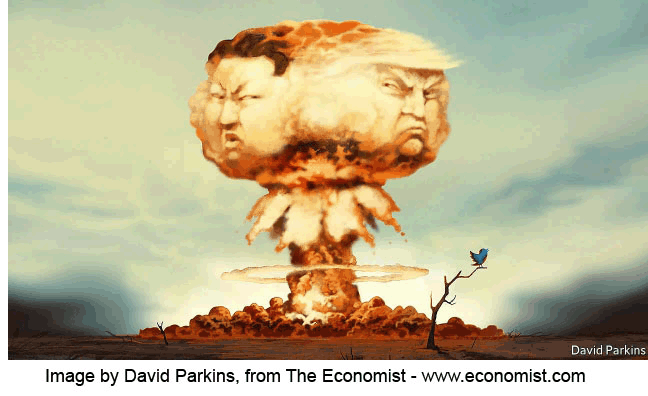 This vicarious situation necessitates Australia adopting a strong, independent, foreign policy stance on this challenge, in our national interest. The inflammatory rhetoric from both Trump and Kim Jong-un seems to have no limit, but achieves very little, except more missiles and tests from Pyongyang, and more threats of military options/retaliation from the US.
Sanctions are important, especially now they have been given greater grunt by China, but they will take many months to be fully effective. Clearly, military engagement would be catastrophic, so every effort should be made to foster effective diplomatic engagement and, ultimately, hopefully, negotiation. Obviously, the major powers, the US, China, Russia and Japan, would be fundamental to any effective resolution.
In this context, Australia needs to consider what more we can do, if anything, as a middle-ranking power, but capable, at times, of punching above our weight, especially from the point of view of our national interests.
 I fear that we are far too embedded in the US position, and where it may go. I am concerned that our political leadership is simply happy to be subservient to the US, leaving them, Trump, to define us. Yet, we could play a more significant role, diplomatically, in attempting to manage the emerging crisis.
In attempting to understand and strategise on how events might unfold, we would have to contemplate the possibility, even if we gave it a low probability, that an effective target for North Korean aggression could be Pine Gap – it would not kill many of us, but would represent a very significant blow to US intelligence capability.
To be absolutely clear, despite all the US bluster, I sincerely doubt that Pyongyang will ever be the aggressor, would ever initiate a war. Apparently, China has told the North Koreans that they will only come to their defence if they are attacked, but not if they are the aggressor. But have no doubt, the nuclear tests, and rocket launches, will continue, with rockets directed towards say Guam, but to land outside their territorial waters.
The point is that we need to look after our own interests, and position ourselves most effectively, from that perspective. In these terms, we could announce a desire to establish an embassy in Pyongyang, with a view to opening and developing a dialogue, perhaps, ultimately leading to a resumption of the Six Party talks.
Other back channels could also be exploited. For example, I was somewhat surprised that our Foreign Minister, Julie Bishop, didn’t create the opportunity to meet with her North Korean counterpart at the recent UN meetings. Australia could also play a significant role in co-ordinating the responses of many of our Asian neighbours, from sanctions to missile interception and defence capabilities.
We presently run our “diplomacy” with North Korea, with a non-resident ambassador, based in Seoul, making trips up North. This would surely be insulting to the North Koreans, and easily dispensed with as just another “branch of the US”. It doesn’t begin to give Pyongyang the global recognition that it so desperately craves.
We need to be seen to be able to stand on our own two feet, and we might be surprised at just how much influence we could achieve.
Despite all the sabre rattling and inflammatory rhetoric, the world needs a diplomatic solution on North  Korea. Sanctions may ultimately force Pyongyang to the negotiating table, but there will be no alternative to face-to-face, hard-headed negotiations that, surely, must initially accept North Korea as an emerging nuclear power, and then focus on deterrence. Think about it from their point of view. The world seems to happily accept countries such as India, Pakistan, and Israel, as nuclear powers, but where is the balance of risks? These are risks that we don’t want to talk about, while at the same time saying that North Korea is a “clear and present danger”.
The government needs to be prepared to discuss publicly its assessment of the North Korean situation. I really don’t understand why we don’t use the processes of Parliament, and encourage a parliamentary debate, leading to a broader debate across civil society.
All too often, the way government has worked in this country is that government closes down debate on an issue, calls all the shots, and, in the end, we drift into a situation that is not necessarily in our national  interest. Recall the futility of Howard’s sycophantic support of Bush junior in the Iraq war. We never should have been involved.
On North Korea, we are again letting the issue drift, driven by the possible irrationality of the US. We will end up where, in our national interest, we won’t want to be. Yet, we could play a globally significant role in resolving the matter.
John Hewson is a professor at the Crawford School of Public Policy and a former leader of the Liberal Party.
Australian and international scientists’ desperate race to save the great Barrier Reef
-
Scientists have become angry! #ClimateChange #Coral #StopAdani
The amazing biological fixes that could help save the Great Barrier Reef October John Pratt 3 Oct 2017
In just the past two years, up to half the coral on the Great Barrier Reef has died.
-
Can We Save the Reef? #Catalyst #Science #StopAdani #ClimateChange
Off Australia’s northeast coast lies a wonder of the world; a living structure so big it can be seen from space, more intricate and complex than any city, and so diverse it hosts a third of all fish species in Australia. John Pratt 3 Oct 17
The Great Barrier Reef as we know it — 8,000 years old and home to thousands of marine species — is dying in our lifetime.
Can We Save the Reef?The epic story of Australian and international scientists who are racing to understand our greatest natural wonder, and employing bold new science to save it. VisitJohn
6 October More REneweconomy news
-
Australia adds 97MW rooftop solar in September, set for record 1GW in 2017Australia maintains strong pace of rooftop solar installations in September, and is now set to break through the 1GW annual instal milestone for the first time in 2017.
-
CS Energy signs 10 year agreement with Kennedy Energy ParkAnother page in Queensland’s renewable energy boom story has been turned with Queensland Government-Owned generator – CS Energy – entering a 10 year-agreement with the 60 megawatt Kennedy Energy Park.Stunning new low for solar PV as even IEA hails “age of solar”Saudi solar tender attracts stunning low bid of $US17.9/MWh, as even the conservative IEA hails a “new era of solar.” And while Australia currently enjoys an investment boom, a new report by Climate Council says “politics” is the only major barrier to a high penetration renewable grid.
-
Samsung chosen for new 30MW battery storage facility in S.A.Samsung batteries to be used in new 30MW battery storage project next to create reenables-based micro-grid in South Australia.
-
Australia’s first solar farm co-located with wind park begins productionGullen Range solar farm is the first to be paired with a wind farm, but is just one of a number of wind-solar hybrids planned for Australia.
-
In energy and transportation, stick it to the orthodoxy!At most, the current orthodoxy – despite its renewable energy, electric vehicles and energy efficiency – will result in flat or gently declining emissions. It’s time to stick it up the orthodoxy!
-
US plan to defibrillate failing coal plants is part of a global trendRick Perry’s plan to require increased payments to some coal plants is part of a global trend as the coal lobby desperately tries to rescue failing coal plants.
-
Many utilities believe cyberattacks could bring down the electric distribution gridCoupled with anticipated risk to employee and customer safety and physical assets, unprepared distribution utilities must act now to improve cybersecurity capabilities.
-
Romilly Madew wins prestigious international sustainability awardRomilly Madew, CEO of GBCA, has been awarded the prestigious WorldGBC Chairman’s Award for her work to advance sustainable building globally.Energy Efficiency Market Report: Slow transition for lighting creditsSpot market jumps to highest levels since May as staged transition unveiled to changes in credits for lighting upgrades.
6 Oct REneweconomy news
-

-
Utilities scramble to catch up with stunning fall in renewable energy costsWhile it may take decades yet for renewables to become the dominant form of generation globally, their presence today is permanent, economically rational and their advance inevitable.
-
Tritium boosts EV charger production seven-fold at Brisbane plantTritium unveiled new facility that will lift manufacturing of EV charging stations 7-fold, while QLD government unveils its long term EV strategy.
-
Greens push 20GW energy storage target to shift debate from baseloadGreens unveil plan for 20GW of energy storage by 2030, providing incentives for storage at household and grid level, and try to move the energy debate beyond the limited scope of baseload vs renewables.
ARENA, CEFC back plan to recycle EV-batteries for household storageA Melbourne company that has found a way to recycle EV batteries for use in household and grid-scale storage gets some money from Turnbull’s innovation fund.Australian household electricity prices may be 25% higher than official reportsThe IEA may be underestimating Australian household energy bills by 25% because of a lack of accurate data from the federal government.Renewable energy markets un-moved by bizarre push for coalOnce upon a time political divisions on energy policy would have had a significant impact on the renewable energy market. This time, however, it has been largely ignored. -
-
Investec Australia supports Australian green energy sectorInvestec Australia Limited’s Infrastructure Finance & Investment team has added to its local funding of green energy by helping a UK developer of solar projects expand in Australia.
Nuclear shill group on the move in New South Wales
Rob Parker injects nuclear  into energy debate, Goulburn Post
  @ThrowerLouise,
Rob Parker, who coordinates Nuclear for Climate Australia (NCA), argued politicians should not shy away from nuclear energy. In southern NSW NCA has identified Marulan, Yass and the Shoalhaven as three of 18 potential sites for nuclear reactors.
Mr Parker ran unsuccessfully as a Labor candidate for Goulburn in 2007 and as an independent in 2011. But he says his views have little to do with politics, other than to shatter notions.
He was speaking about the latest tit-for-tat between shadow State energy spokesman Adam Searle and Goulburn MP Pru Goward. Mr Searle last week said Deputy Premier John Barilaro should “come clean” about his social media post on Thursday.
“We could have them (small nuclear reactors) operating here in a decade – which is not long for the energy industry…,” it stated.
Mr Searle said it was the second time Mr Barilaro had raised the possibility of nuclear energy in the State, the first time being in May when he was “prepared to talk about it as an option.”
“He can’t just float an idea like this without being specific. He should be clear with the public on where he thinks the nuclear reactors should be. A pro- nuclear power group is on the record suggesting reactors should be in the Goulburn electorate – does Mr Barilaro agree?
“Our farmers’ clean and green reputation is known throughout the world but a nuclear industry in these areas would end all that.”
Mr Searle told The Post the technology was a “silly idea” given there were no apparent solutions for dumping nuclear waste and required a “huge amount” of water….
The consultant civil engineer [Parker] said one of the great problems with renewables supported by gas was that “they entrenched failure while giving the impression of achievement.” …….
Mr Parker argued that nuclear energy needed to be 80 per cent of the mix due to climate change.
The NCA has listed 18 possible nuclear reactor sites on its website, including Yass, Marulan and Shoalhaven which could be constructed by 2040 and provide 149 terrawatts of energy annually.
Mr Parker said he considered many locations but the best ones were those near water, rail and the transmission grid…….. He maintained the Snowy Mountains area could work given its plentiful water reservoirs. Yass was also close to the Burrinjuck storage.
 Mr Parker believed Mr Barilaro was raising the possibility of smaller modular reactors being developed across more sites, which did not involve significantly opening up the grid or a large water supply.
He also maintained that nuclear was becoming more price competitive due to the combined effects of electricity generation at $105/MWh in 2018 and the likelihood of increased network costs.
He will address the Australian Nuclear Association conference in Sydney this weekend. He will argue nuclear energy will not only restore business confidence and energy price stability but increase Australia’s resilience in the face of increasing climate change.
But Premier Gladys Berejiklian has ruled out nuclear reactors. http://www.goulburnpost.com.au/story/4962964/nuclear-debate-takes-off/
Adani mining company facing income crash – desperate to get Australian tax-payer funding
IEEFA’s Tim Buckley told Four Corners a potential $1.5bn loss on any decision to walk away from the mine proposal explained why the Adani Group remained focused on securing Australian taxpayer support through a Northern Australia Infrastructure Facility loan
 Adani needs Carmichael mine to stave off income crash, report says
The Indian mining giant faces plummeting revenue and risks losing the Abbot Point coal terminal, while new questions have arisen about its ownership structure, Guardian, Joshua Robertson, 3 Oct 17, Adani’s ambitions face a grave new risk in Australia, where its grip on its only operating asset, a Queensland coal port, is threatened by a crash in income unless its contentious Carmichael mine becomes a reality, a new report says.
Adani must refinance more than $2bn in debt on the Abbot Point coal terminal – more than it paid for the port in 2011 – despite earning $1.2bn in revenue and paying virtually no tax in Australia since, according to the Institute for Energy Economics and Financial Analysis.
And Adani must gain fresh lender backing at a time when the port faces plummeting revenue that only its $5bn mine proposal, itself yet to secure finance, can make up for, the analysis says.
IEEFA’s analysis was included in an ABC Four Corners program on Adani on Monday that also featured a former Indian environment minister saying he was “appalled” by Australia’s approval of the mine.
Jairam Ramesh told the program Adani’s environmental history in India “leaves a lot to be desired” and questioned whether the Australian and Queensland governments had properly considered this or its financial conduct, including allegations of large-scale fraud.
The IEEFA report found new links between Adani’s Australian corporate structures and a Caribbean tax haven, the port in particular having a “complex and opaque ownership structure [that] appears well-suited to minimising tax”.
It was previously thought that local companies relating to Abbot Point and a proposed rail link with the Carmichael mine – for which Adani is seeking a concessional loan of up to $900m from Australian taxpayers – were owned by an Adani family company in the Cayman Islands, Atulya Resources Limited.
But Singapore corporate filings show Atulya is owned by another Adani family company in the British Virgin Islands, ARFT Holding Ltd.
And two trusts related to the Carmichael rail project are potentially held by another BVI-registered company called Carmichael Rail Australia Ltd, according to the IEEFA analysis. One of the trusts holds a $2/tonne royalty deed that would net the Adani family income from the Carmichael mine, which is expected to yield up to 60m tonnes a year.
Contracts that force Abbot Point’s coalmining customers to pay for using the port’s full capacity have begun to expire, with the port actually running at just over half its capacity as the bullish predictions of a coal boom gave way to a downturn.
To refinance the port, Adani needed to “convince financiers that [Abbot Point] will be fully utilised into the future” with its own Carmichael mine the only candidate to pick up this looming shortfall of about 25 million tonnes a year, IEEFA said.
The port thus ran “the risk of becoming a stranded asset” if the Carmichael mine, itself a $5bn greenfield project that represented a “high-risk gamble”, did not secure financial backing overseas, it said.
IEEFA’s Tim Buckley told Four Corners a potential $1.5bn loss on any decision to walk away from the mine proposal explained why the Adani Group remained focused on securing Australian taxpayer support through a Northern Australia Infrastructure Facility loan……. https://www.theguardian.com/business/2017/oct/03/adani-needs-carmichael-mine-to-stave-off-income-crash-report-says
Adani’s tax havens – the Queensland coal mine plan’s connection with corruption
Adani Australia: Investigation uncovers tax haven ties to British Virgin Islands, Four Corners ,By Stephen Long, Wayne Harley and Mary Fallon , ABC News, 3 Oct 17 An investigation by the ABC’s Four Corners program has uncovered previously unknown tax haven ties for Adani Group’s Australian operations, with key assets ultimately owned in the British Virgin Islands.
Key points:
- Adani Group’s filings with ASIC fail to mention a company registered in the British Virgin Islands
- Vinod Adani, older brother of Adani Group chairman Gautam Adani, has been under investigation in India
- Vinod Adani also a substantial shareholder in Adani Enterprises Limited
Adani Group has promised a $22 billion windfall in taxes and mining royalty payments for Australia over the life of the giant Carmichael coal mine it has been given approval to build in outback Queensland.
But experts say an opaque web of companies and trusts behind its Australian assets gives it ample opportunity to minimise the tax it pays.
Adani Group’s assets in Australia include the Abbot Point Coal Terminal near Mackay in Queensland, a terminal expansion project it has approval to undertake at Abbot Point, and a planned railway line of nearly 400 kilometres from the port to the giant mine it wants to build in the Galilee Basin — aided by a subsidised loan of up to a $1 billion it is seeking from the Federal Government’s Northern Australia Infrastructure Facility.
It was previously thought that Atulya Resources, a Cayman Islands domiciled company controlled by members of the Adani family, was the ultimate holding company for Abbot Point, the expansion project, and the railway.
However, filings in Singapore by privately-owned Adani companies show that a company registered in another notorious tax haven, the British Virgin Islands, sits behind Atulya Resources.
Vinod Adani investigated over alleged scam
It is variously described in the offshore company filings as ARFT Holding Limited, AFRT Holding Limited and Atulya Resources Family Trust.
Adani Group’s filings with Australia’s corporate watchdog, ASIC, fail to mention this company, instead continuing to list Atulya Resources as the owner.
The British Virgin Islands’ company’s apparent position at the apex of the structure is disclosed in the financial reports of a series of Adani companies controlled by Vinod Adani, also known as Vinod Shantilal Adani or Vinod Shah.
Vinod Adani, the older brother of Adani Group chairman Gautam Adani, has been under investigation in India over an alleged scam designed to shift money offshore…….http://www.abc.net.au/news/2017-10-02/adanis-tax-haven-ties-to-british-virgin-islands-revealed/9007714
Minerals Council of Australia – a wealthy lobby on behalf of foreign corporations
- Major members of the MCA are majority foreign-owned (BHP and Rio 70 per cent plus) and Glencore and Peabody owned in Switzerland and the US respectively. Therefore this is an organisation which effectively represents overseas interests.
The Minerals Council, coal and the half a billion spent by the resources lobby by Michael West | Oct 2, 2017 There is no peak body in the country which conducts its business as belligerently, and its proponents would say as successfully, as the Minerals Council of Australia (MCA).
Flush with funding thanks to the contributions of its multinational mining company members such as BHP, Rio and Swiss-owned coal giant Glencore, the miners’ peak body can raise a campaign warchest at a moment’s notice. And it is uncompromising, often venomous, in its rhetoric.
In 2010, the MCA managed to oust a sitting prime minister, Kevin Rudd, from office with a $22 million advertising blitz against the mining tax.
Earlier this year in the Western Australian state elections, the leader of the National Party, Brendon Grylls, lost his seat after the mining lobby campaigned against his proposal for higher taxes on iron ore producers.
Meanwhile, Rio Tinto booked a net profit of $6 billion profit for 2016, while BHP handed down a first-half profit of $4.2 billion.
An investigation of the financial statements of the MCA shows the not-for-profit association has booked revenues of more than $200 million over the past 11 years. Revenues peaked at $35 million, $32 million and $37 million in 2010, 2011 and 2012 when the group was busy fighting the mining tax, the carbon tax and the Renewable Energy Target.
This is but a fraction of the story however. Continue reading
Extreme heat days to come, for Australia’s cities
 Sydney and Melbourne should prepare for 50-degree days, climate researchers warn, Climate scientists from two leading Australian universities say more extreme heatwaves are inevitable even if global CO2 targets are met. http://www.sbs.com.au/news/article/2017/10/04/sydney-and-melbourne-should-prepare-50-degree-days-climate-researchers-warn By James Elton-Pym
Queensland council saves $1.9m in grid costs from single Tesla Powerpack
A Queensland local government council has installed what is believed to be Australia’s first off-grid solar and battery storage system to use a Tesla Powerpack, to maintain local drinking water quality around the clock.
http://reneweconomy.com.au/queensland-council-saves-1-9m-grid-costs-single-tesla-powerpack-90623/
Market Forces list COMPANIES THAT COULD MAKE OR BREAK THE ADANI CARMICHAEL COAL PROJECT
THE ADANI LIST: COMPANIES THAT COULD MAKE OR BREAK THE CARMICHAEL COAL PROJECT Adani’s plans to dig up hundreds of millions of tonnes of dirty Galilee Basin coal are gargantuan, requiring input from a range of project partners. And every company that helps this nightmare become a reality would be partly responsible for the environmental and climate devastation the Carmichael project stands to inflict.
‘Market Forcesbelieves that the banks, superannuation funds and governments
that have custody of our money should use it to protect not damage our environment.
‘Our work exposes the institutions that are financing environmentally destructive projects
and help Australians hold these institutions accountable.
‘We work with the community to prevent investment in projects
that would harm the environment and drive global warming.’
www.marketforces.org.au/about-us/
How We Work
‘Market Forces is proud to be an affiliate project of Friends of the Earth Australia
and a member of the BankTrack international network,
connecting us with passionate campaigners, environmental issue experts
and advocates of environmentally sustainable behaviour from the finance sector.’
Our Vision
‘Our vision is a future where institutions invest with a high degree of respect for the environment,
utilising our money to deliver solutions to major environmental issues, and
where the community holds to account the custodians of their money
to ensure it is used to benefit the environment.’
4 October REneweconomy news
 RenewEconomy
-
He may already had one, but prime minister Malcolm Turnbull has just been given a blueprint by the Trump administration on how to protect dirty “baseload” coal, and extend his fight against the energy future.
-
Australia’s New Energy Solar completes US$62.5 million private placement.New Energy Solar Fund and New Energy Solar Limited are pleased to announce the financial close of an issue of US$62.5 million of senior secured 24-year amortising notes in the US private placement market.
-
Tesla post record deliveries, but Model 3 production not yet jumpingQ3 was Tesla’s best quarter ever for deliveries but Model 3 deliveries were lower than anticipated, due to production restraints.
-
CEFC provides $98.5m debt finance to Victoria solar farmCEFC to provide all debt finance for Victoria’s largest solar farm to “accelerate” project.
-
Know your NEM: Gas deal underlines attraction of renewablesOrigin gas deal underlines one of the main advantages of renewables: they provide security against rising fossil fuel prices.Graph of the Day: How wind energy trumped Liddell in SeptemberAustralia wind farms enjoy record output in September, with average capacity factor of 49.5% – significantly more than the Liddell coal generator.Brisbane Airport to be world leader for biojet fuelBrisbane is set to become one of a handful of hubs around the world for sustainable aviation fuel.Tech Mahindra and Power Ledger unite to unleash the power of MaaSTechnology trials in Microgrid-as-a-Service aimed to impact the urban population in India.
Could Australia be the target of a North Korean missile?
Leonid Petrov, a leading North Korean expert, said Australia could play a much better and more viable option in the crisis.
Dr Petrov, a visiting fellow at the College of Asia and the Pacific at the Australian National University,  said it was obvious someone who served as US deputy assistant secretary of defence for nuclear and missile defence policy would recommend buying a US-made piece of equipment.
However, Dr Petrov said there was a cheaper option on the table.
“Australia can save a lot of money (and lives) by using its diplomatic channels and mediate a comprehensive peace deal, which North Korea is begging for since 1974,” he said.
 North Korea missile crisis: Could Australia be targeted by Kim Jong-un? A PENTAGON adviser has warned Australia could be on the receiving end of Kim’s fury as experts say anything could happen.news.com.au Debra Killalea@DebKillalea 2 Oct 17
IT WAS a stunning warning that made Australia sit up and take notice.
Former Pentagon official Dr Brad Roberts said Australia needed to develop greater missile defences in the event of a North Korea missile strike.
Dr Roberts, who served as US deputy assistant secretary of defence for nuclear and missile defence policy between 2009 and 2013, also warned Australia had no say in Kim Jong-un’s decisions.
“Unfortunately, Australia doesn’t really get to choose whether or not North Korea threatens it — it’s the choice that the North Korean leader,” he told the ABC.
“His objective is to make us fearful so that our leaders will not stand up to his threats and coercion.”
But just how much of a target is Australia, and are we likely to feel the wrath of Kim?
CAN A NORTH KOREAN MISSILE HIT AUSTRALIA?
Experts warn anything is possible and hope this scenario remains an unlikely possibility. Continue reading
Australia should not blindly follow USA on foreign policy – Gareth Evans
I never had any doubt about the genuineness of Hawke’s position when he said at the time that “we are not an aligned country which had to agree, or did agree, with every single aspect of US policymaking.
The ability to maintain a healthy balance in our alliance relationship seems, unhappily, to have largely evaporated since the Hawke-Keating years.
Gushing sentiment has become the norm..
The election of President Donald Trump has given a new urgency to restoring some real balance in the alliance relationship. We can only hope that enough cooler and wiser heads than his own will emerge to eventually dispel the worst fears generated during his campaign and in his first weeks in office.
We now have to be ready for American blunders as bad as, or worse than, in the past. We will have to make our own judgments about how to react to events, based on our own national interests.
Australian foreign and defence policy for the foreseeable future is going to have to be founded on three core principles: More self-reliance. More Asia. Less United States.
Trump era: Australia should rely less on the US, GARETH EVANS, The Australian,
Australia’s alliance with the United States was not undervalued by the Hawke-Keating governments. But nor did we overvalue it, and we certainly did not accept that its care and maintenance demanded obeisance to all Washington’s whims and wishes.
Then, as today, there could be little doubt that the ANZUS alliance contributes hugely to our military capability, above all in the access it gives us to American intelligence and weapons systems. As self-reliant as we may be, we are by no means completely self-sufficient, certainly when it comes to really major threat contingencies. It has been credibly estimated that without the alliance, Australia would have to triple or quadruple its defence spending, at a budgetary cost of an additional $70 billion to $100bn a year. There is, moreover, the deterrent value against potential aggressors that a close alliance with a global superpower, on the face of it, seems clearly to provide.
But the issue of deterrent value needs closer scrutiny than it usually gets. The ANZUS Treaty formally provides only that each party “will consult together whenever in the opinion of any of them the territorial integrity, political independence or security of any of the Parties is threatened in the Pacific” (Article III) and that in the event of an “armed attack in the Pacific Area on any of the Parties” each “would act to meet the common danger in accordance with its constitutional processes” (Article IV). That is in significant contrast to the language of Article 5 of the NATO treaty, whereby “The Parties agree that an armed attack against one or more of them in Europe or North America shall be considered an attack against them all” and commit to applying armed force as necessary in response. Continue reading
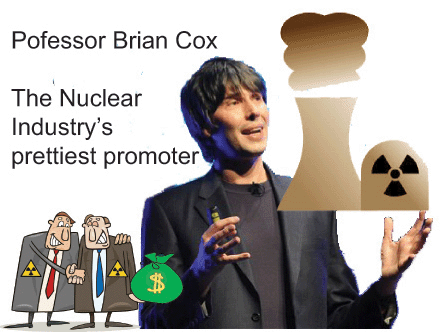
Professor Brian Cox – subtle spinner for nuclear power, will tour Australia in November
 Brian Cox is a very personable and knowledgeable TV star and particle physics expert. He is also a promoter of the nuclear industry. He is a big fan of plutonium -powered space travel.
Currently, Cox is in Cumbria, UK, addressing schoolchildren groups, and revving up enthusiasm for science and technology. All good, yes. He enthuses about the opportunity for top jobs in high tech in Cumbria. Good? Yes, but – where are these future jobs? Well – in the nuclear industry, which is desperately trying to get a new nuclear power station built.
Whitehaven News 29th Sept 2017, Television star Professor Brian Cox says Cumbria has a world-leading industry which warrants talent – but there’s a shortage of scientists and engineers. But he hopes to change that by helping to bring the prestigious Infinity Festival to the area and inspiring hundreds of teenagers to follow their dreams. Professor Cox was the star speaker at today’s festival which was held at West Lakes Academy in Egremont. More than 200 schoolchildren, aged 13 and 14, attended the event from schools across the whole of the county. http://www.whitehavennews.co.uk/news/Professor-Brian-Cox-visits-Egremont-and-declares-Cumbria-is-a-world-leading-high-tech-industry-941aa057-9b77-46a5-8eac-6e92f0341783-ds
The scientist, Professor Brian Cox, has told guests at the opening of a new exhibition in Whitehaven that nuclear power should be an important source of energy in the UK.
Famous scientist argues for ‘stable’ forms of energy, The famous scientist Professor Brian Cox has told guests at the opening of a new exhibition in Whitehaven that nuclear power should be an important source of energy in the UK.
He argues that education is important for accepting nuclear energy: http://www.itv.com/news/border/story/2014-05-30/professor-brian-cox-opens-beacon-museum/
1 This month


Help Aunty Sue Protect Her Land and Sacred Sites From Destructive Rocket Testing.
.

Australians deserve the truth
about
AUKUS – https://aukuspublicinquiry.com/

PETITION – To: Prime Minister Anthony Albanese and the Australian Labor Government

of the week – Australians for War Powers Reform (AWPR)
To see nuclear-related stories in greater depth and intensity

