Across Australia, thousands protest against Adani Carmichael coal mine
Adani: Thousands turn out across Australia to protest against Carmichael coal mine, ABC News 8 Oct 17 A national day of action to oppose the proposed Carmichael coal mine has seen thousands of protesters turn out in locations across Australia.
Rallies in locations including Sydney, Brisbane, Melbourne, the Gold Coast and Port Douglas in North Queensland heard messages against Indian company Adani’s proposed mine in the Galilee Basin.
Adani has promised thousands of local jobs but opponents say the project will fuel global warming and destroy the Great Barrier Reef.
The ABC’s Four Corners program on Monday revealed alleged cases of bribery, corruption and environmentally destructive behaviour by the Adani Group in India.
Adani is seeking a $900-million loan from taxpayers so it can build the railway line from the proposed mine site in the Galilee Basin to the Abbot Point coal port.
“If this mine does go ahead it drives us into a dirty future and Australia is a country that’s smarter than that,” said Simon Fosterling, a Bondi surf life saver at the Sydney protest, which attracted about 2,000 people.
Protesters spelled out ‘#STOP ADANI’ by standing in formation on the sand………
Sydney Stop Adani campaigner Isaac Astill called the construction of the mine an international issue.
“It’s going to be the biggest coal mine in the southern hemisphere at a time when our climate is crumbling,” Mr Astill said.
It’s an international issue and that’s why we’re seeing people around the world and in Australia coming out in their thousands to say no to Adani.”
About 2,000 people rallied in Melbourne’s Princes Park carrying placards reading ‘Coal=CO2!!!’ and ‘Protect Our Future’.
Australian Conservation Foundation CEO Kelly O’Shanassy said she hoped the “big day of action” would send a strong message that taxpayers did not want their money subsidising the project…..
At Miami on the Gold Coast around 200 people turned out to oppose the mine.
“We know how important this is and we know there’s a growing movement and more and more people are realising how desperately we need this to stop,” said Shane Primrose of the Stop Adani Gold Coast group…….
The protests were organised by the Stop Adani Alliance, which is made up of 31 organisations.http://www.abc.net.au/news/2017-10-07/thousands-protest-adani-mine-across-australia/9026336
Indian news report – “Australians don’t like Adani”
 Australians don’t like Adani: Poll shows majority oppose coal mine, https://www.nationalheraldindia.com/international/australians-dont-like-adani-poll-shows-majority-oppose-coal-mine, Oct 08th 2017, demonstration at 45 different locations across the island continent on Saturday
Thousands of Australians also participated in protests against Adani at 45 locations across the country
Most Australians don’t want work on the Adani Group’s coal mine to go ahead, a new poll commissioned by Australia Institute has found.
As per the poll findings released on Saturday and Sunday, even more Australians oppose the proposed government assistance of $1 billion to the Adani Group. The borrowed money would reportedly be used to build a railway line to nearby Abbott Point coal port.
The poll findings were published in Guardian Australia.
The survey, conducted by market research agency ReachTel, interviewed 2,200 people across Australia. While 55.4 per cent opposed the mine, 18.4 per cent of the respondents remained undecided.
Meanwhile, thousands of Australians on Saturday across 45 locations also protested against Adani’s mine, forming human signs reading “Stop Adani.” The protests were reportedly organised by Stop Adani Alliance, a community group comprised of at least 31 environment organisations aimed at keeping the Carmichael Coal Mine from operating. The group has cited destructive environmental impact that the proposed mine could have on the waters of the Great Barrier Reef as a primary reason behind its reservations about the mine.
According to the Australia Institute survey, the opposition to Adani’s mine cut across political persuasions, with the findings showing that majority of Liberal and Labor voters opposed the project. While the Liberals are in power at the national level in a coalition, a Labor government is at the helm in Queensland.
Nearly 65.8 per cent of those polled stated that Annastacia Palaszczuk, Premier of Queensland, the state where the mine is proposed to come up, should veto the $1 billion loan being mulled for Adani’s project.
The Adani Group has been saying that the mine would generate thousands of jobs and help the troubled economy of Queensland, a claim endorsed by both the state and national governments. Critics, on the other hand, say that the claims are overrated, and the mine would spell disaster for the environment besides hitting the tourism revenue.
New $400 million solar farm for Port Augusta.
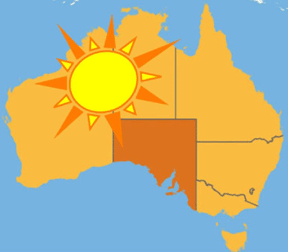 European energy giant Enel to build $400m solar plant in Port Augusta http://www.adelaidenow.com.au/news/south-australia/european-energy-giant-enel-to-build-400m-solar-plant-in-port-augusta/news-story/94dfb0cd8 Adam Langenberg, Political reporter, The Advertiser, October 9, 2017 EUROPEAN energy giant Enel has received final approval for a $400 million solar farm on the outskirts of Port Augusta.
International Campaign to Abolish Nuclear Weapons (ICAN): how it won the Nobel Peace Prize
 “We’re calling on all countries to sign the new UN treaty prohibiting nuclear weapons, which offers a powerful alternative to a world in which threats of mass destruction are allowed to prevail.
“We will work in coming months to persuade more nations to sign this landmark treaty.
“One of our priorities will be to bring the Australian government on board.
 What is ICAN and how did it win this year’s Nobel Peace Prize? http://www.abc.net.au/news/2017-10-07/who-is-ican/9026326
So how did a campaign from Melbourne make its way to the international stage?
Key points:
- Group honoured for “ground-breaking efforts” to achieve nuclear ban treaty
- ICAN also awarded for drawing “attention to the catastrophic humanitarian consequences” of nuclear weapons
- 215 individuals and 103 organisations were nominated for the prize
So what is ICAN?
ICAN describes itself as a coalition of non-governmental organisations in 100 countries promoting adherence to and implementation of the United Nations nuclear weapon ban treaty.
That global agreement was adopted by 122 countries — but not by Australia — in New York on July 7 this year.
It has advocated at the United Nations and in parliaments around the world, bringing the stories of those impacted by nuclear testing and survivors of the Hiroshima and Nagasaki bombings to a world stage.
How did it form?
ICAN set up its first office in Melbourne, with disarmament campaigner Felicity Hill as the coordinator.
It officially launched in Vienna, Austria in April 2007 during the Non-Proliferation Treaty preparatory committee meeting.
ICAN campaign director Tim Wright said it was inspired by the International Campaign to Ban Landmines, which had played a major role in the negotiation of the Anti-Personnel Mine Ban Convention, also known as the Ottawa treaty. Continue reading
Queensland’s $12 million Queensland climate change policy dragging on in implementation
Slow progress on key $12 million Queensland climate change policy, SMH, Tony Moore , 7 Oct 17, Progress appears slow on one of Labor’s key climate change policies to encourage coastal Queensland councils to formally adopt a 0.8-metre higher sea level to combat beach erosion and storm surge problems.
The state government cannot say how many of the 41 coastal councils in Queensland have formally adopted the higher sea level, despite two departments being given four days to answer.
However, funds from the $12 million set aside by the state government has now gone to 21 of the 41 oceanside councils to develop plans.
Gold Coast City Council last week formally adopted the higher sea level when they updated their Gold Coast City Plan last week, as part of Queensland’s Climate Adaption Strategy.
Fairfax Media believes Cairns and Townsville councils have adopted the 0.8-metre higher sea level but it remains unclear if Moreton Bay Regional Council has accepted the higher sea level.
Gold Coast City Council last week formally adopted the higher sea level when they updated their Gold Coast City Plan last week, as part of Queensland’s Climate Adaption Strategy.
Maps produced by Geoscience Australia for the Australian government show localised flooding in three scenarios: a 50-centimetre sea level rise, an 80-centimetre rise and a 1.1-metre rise.
The Geoscience maps show a considerable flood impact on the Gold Coast’s northern suburbs and in the canal estates…….
Earlier this year Local Government Association president Mark Jamieson said more than 30 Queensland councils would be gradually affected by rising sea levels.
“More than half of Queensland’s 77 councils will be exposed to coastal hazards in the future,” Cr Jamieson said.
“It’s vital that local governments work together to assess risks and identify practical solutions that will help coastal communities prepare for serious issues such as storm tide flooding, coastal erosion and sea level rise.”
On Sunday evening, a Local Government Department spokeswoman said the department had provided funding to 20 of the 41 Queensland councils to begin planning how to cope with higher sea levels……http://www.smh.com.au/queensland/slow-progress-on-12-million-climate-change-beach-erosion-projects-20171008-p4ywcm.html
Nobel Peace Prize Win and the work of Australian indigenous activist Karina Lester
 Indigenous anti-nuclear activist tells of her personal work with Nobel Prize-winning ICAN http://www.abc.net.au/news/2017-10-07/ican-and-a-personal-battle-against-nuclear-weapons/9026846 By Karen Percy For Karina Lester 2017 has been a mixed bag — the loss of her beloved father, but a big win as part of the Nobel Peace Prize-winning International Campaign to Abolish Nuclear Weapons (ICAN).
Ms Lester’s anti-nuclear stance is a very personal one.
Her father was Yami Lester, an Aboriginal elder who was blinded by nuclear fallout when he was a child.
Mr Lester died just two weeks after the United Nations agreed to the Treaty on the Prohibition of Nuclear Weapons thanks to ICAN’s work, which was last night named by the Norwegian Nobel Committee as the Peace Prize winner for 2017.
He was 75 and had spent a lifetime raising awareness of the dangers of nuclear weapons, having been blinded during British weapons testing in Maralinga in South Australia in the 1950s.
“I think he’d be really pleased and very proud to know but also grateful that ICAN was able to provide that platform for us and that his story was so powerful,” Ms Lester said.
On July 7 the United Nations adopted the treaty. Mr Lester died on July 21.
Ms Lester has become as passionate about the anti-nuclear movement as her father. “It’s not a happy story, it’s quite a sad and tragic story, but ICAN has certainly been a wonderful platform for us Anangu and Aboriginal people of Australia to really talk up strongly about what happened to us back in those days,” she said.
When she was younger, she did not know what had caused her father’s blindness.
“It wasn’t until later in life that I realised it was such a sad story … with the doings of the British Government and our Australian Government as well … allowing for tests to happen in South Australia in the 1950s and 60s.
“[And] that they were responsible for taking my father’s sight.
“There were a lot of people affected by this, not only Aboriginal people, there were non-Aboriginal people, ex-servicemen and women who were exposed to this as well.”
As a representative of Indigenous voices within ICAN’s 400-strong organisations around the world, she has told her father’s story to audiences around the Asia-Pacific region, including the Japanese city of Hiroshima, which was struck by an American nuclear bomb in 1945.
A later attack on the Japanese city of Nagasaki prompted an end to World War II.
Ms Lester has also exchanged stories with the people of the Marshall Islands and Tahiti affected by nuclear testing by French authorities from the 1960s until the 1990s.
“Many tests have taken place or nuclear issues have occurred in Indigenous countries around the world, so it’s a global issue for sure,” said Ms Lester, a Western Desert Pitjantjatjara Yankunytjatjara woman.
Her grandparents were part of efforts to prevent the establishment of a nuclear waste facility in SA.
She took her daughters to Hiroshima in November 2015 where Yami Lester’s experience was well understood.
“It’s important for us to continue on sharing that story for the next generation to know the story and [then] the next generation to know the story,” she said.
The historic treaty pushed by ICAN needs 50 nations to sign on before it will be activated.
Australia has yet to join the treaty.
Australia’s Ben Heard – fake environmentalist and pro nuclear shill
 Jim Green Nuclear Fuel Cycle Watch https://www.facebook.com/groups/1021186047913052/– 9 October 17 Ben Heard is a fake environmentalist ‒ Australia’s version of Patrick Moore. Heard’s last gig was for the COAL MINING funded Minerals Council of Australia!
 Corporations can donate to Heard’s fake environment group and he “will respect the company’s right to privacy if desired”. Since he openly takes money from coal miners and murderous military corporations, I shudder to think who he’ll accept secret donations from.
Heard got a $55,000 government grant to come up with his lunatic Gen 4 proposal and, needless to say, he refused to repay one cent of the money.
#followthemoney
http://www.archive.foe.org.au/…/oz/ben-heard-decarbonisesa
9 October REneweconomy news
 RenewEconomy
-
Another blackout, another tweet, and Tesla’s Musk sets out to save another gridCould Tesla come to the rescue of Puerto Rico’s hurricane decimated grid with solar and battery storage? Twitter says, “let’s talk.”
-
CleanTech Index: Even the miners are supporting it now!Australia’s CleanTech Index outperformed the ASX in September and in Q1 of the financial year – just as it has over the last three years.
-
The case against Tesla and battery storage just hit peak stupidAFR’s Chanticleer column writes article about battery storage so absurd and stupid it beggars belief that it was published. Such is the state of the energy debate in Australia. It’s not just politicians and vested interests that are letting consumers down, it’s the media.
-
Coalition wrestles with internal demons on clean energy targetCoalition had sought to dodge CET because renewables were too costly, now it is arguing they are too cheap. But Frydenberg says renewables without storage are a “costly burden.”
-
Know your NEM: Frydenberg’s election losing speechIf a CET is abandoned, it will be NSW that will be thrown under a bus. Victoria and QLD have renewable share policies that incentivise new generation. NSW has no policy and despite being an energy importer is not getting its share of new generation investment.
-
Building and precincts to go carbon neutralThe Turnbull Government today launched the National Carbon Offset Standard for buildings and precincts
-
World Solar Challenge is an adventure in engineering and enduranceThe World Solar Challenge begins this weekend when more than 40 solar cars brave the Australian Outback on a 3000-kilometre journey from Darwin to Adelaide.
-
S.A. tender attracts 60 proposals for “next-gen” renewables and storageS.A. gets 60 proposals for batteries, bioenergy, pumped hydro, thermal, compressed air and flywheel technologies in response to its tender for next-gen renewables and storage.
International Campaign to Abolish Nuclear Weapons (ICAN) started in Melbourne
Nobel peace prize awarded to Melbourne-born International Campaign to Abolish Nuclear Weapons http://www.theage.com.au/victoria/nobel-peace-prize-awarded-to-melbourneborn-international-campaign-to-abolish-nuclear-weapons-20171006-gyw4wh.html Melissa Cunningham
During a time when the risk of nuclear conflict is imminent, the prestigious Nobel peace prize has been awarded to a Melbourne-born advocacy group that pushed to establish the first treaty to ban nuclear weapons.
The Nobel Committee honoured the now Geneva-based group, the International Campaign to Abolish Nuclear Weapons, “for its work to draw attention to the catastrophic humanitarian consequences of any use of nuclear weapons and for its ground-breaking efforts to achieve a treaty-based prohibition of such weapons.”
The group worked to advance the negotiations that led to the Treaty on the Prohibition of Nuclear Weapons, which was passed earlier this year at the United Nations.
In July, 122 nations voted to pass the treaty, but nuclear-armed states including the United States, Russia, China, Britain and France stayed out of the talks.
Australia is also yet to sign the treaty.
Australia must prepare for super-hot days
 Dehydration, death and power cuts: What 50C days would look like in Australia ABC NEWS, 6 OCT 17, The Conversation By Liz Hanna, Australian National University Australia is hot. But future extreme hot weather will be worse still, with new research predicting that Sydney and Melbourne are on course for 50 degrees Celsius summer days by the 2040sif high greenhouse emissions continue.
That means that places such as Perth, Adelaide and various regional towns could conceivably hit that mark even sooner.
This trend is worrying, but not particularly surprising given the fact that Australia is setting hot weather records at 12 times the pace of cold ones. But it does call for an urgent response.
Most of us are used to hot weather, but temperatures of 50℃ present unprecedented challenges to our health, work, transport habits, leisure and exercise.
Humans have an upper limit to heat tolerance, beyond which we suffer heat stress and even death. Death rates do climb on extremely cold days, but increase much more steeply on extremely hot ones.
While cold weather can be tackled with warm clothes, avoiding heat stress requires access to fans or air conditioning, which is not always available……….
Preparing ourselves
Last year, the Australian Summit on Extreme Heat and Health warned that the health sector is underprepared to face existing heat extremes.
The health sector is concerned about Australia’s slow progress and is responding with the launch of a national strategy for climate, health and well-being.
Reinstating climate and health research, health workforce training and health promotion are key recommendations.
There is much more to be done, and the prospect of major cities sweltering through 50C days escalates the urgency.
Two key messages arise from this. The first is that Australia urgently needs to adapt to the extra warming.
Heat-wise communities (or “heat-safe communities” in some states) — where people understand the risks, protect themselves and look after each other — are vital to limit harm from heat exposure.
The health sector must have the resources to respond to those who succumb. Research, training and health promotion are central.
The second message is that nations across the world need to improve their efforts to reduce greenhouse emissions, so as to meet the Paris climate goal of holding global warming to 1.5C.
If we can do that, we can stave off some of the worst impacts. We have been warned.
Liz Hanna is an honorary senior fellow at the Australian National University.
Originally published in The Conversation http://www.abc.net.au/news/2017-10-06/50-degree-days-what-would-sydney-and-melbourne-look-like/9024914
Hypocrisy of Gareth Evans – supposedly promotes nuclear disarmament, but now plugging for nuclear waste importing
 Nuclear power and nuclear weapons are intrinsically connected. The shonky 2016 South Australian plan to import nuclear wastes was intended to promote the global nuclear industry, as Gareth Evans well knows
Paul Waldon Fight To Stop Nuclear Waste Dump In Flinders Ranges SA, 7 Oct 17 Thursdays Advertiser story: Gareth Evans calling to resuscitate the dead program of South Australia being the worlds nuclear waste dump with desire to debate on something that should remain buried, or is he a “Mass Debater” trying to satisfy himself. However he has condemned the “NIMBY’s”, who he has claimed employed arguments by activists for their roll in the death of a program he supports.https://www.facebook.com/groups/344452605899556/
Australia’s choice: renewable energy superpower or Asian Pacific rust belt
 It’s our choice: renewable energy superpower or Asian Pacific rust belt, Guardian
Pat Conroy, 6 Oct 17,
If we stop fighting change, Australia can be the land of endless energy powering generations of manufacturing industries The shift to decarbonise our economy is portrayed by opponents of such a shift as the death of Australia as an energy superpower.
Nothing can be further from the truth.
As the world decarbonises, if we plan well, Australia can not only continue to be an energy exporting superpower, we should also enjoy a manufacturing boom.
We need to acknowledge that exports of coal for power generation, that is thermal coal, will decline significantly over the next few decades. We will continue to export metallurgical coal, which makes up 65% of our coal exports by value, for a long time to come as there is no other way of manufacturing steel. However, we are in position to replace the thermal coal exports with liquid sunlight.
Around the world, scientists and policymakers are working on the concept of “Power2gas”. Power2gas is driven by a simple issue: how to store and transport solar and wind power for later use.
This is a great way of using solar or wind power when there is a surplus of electricity supply in the grid, for example in the middle of the night, when the wind might be blowing hard but people and factories don’t need the power. The electricity is practically free, and it is a very cost-effective way of producing hydrogen from water.
This hydrogen can then be used to fuel cars or to bulk out natural gas to be burned to create electricity; both options are completely carbon neutral……..
The shift to renewables also offers Australia the opportunity to revitalise the manufacturing sector.
As the world decarbonises its electricity supply, the nations that can transform into manufacturing powerhouses are those with the cheapest energy, which will be the nations with the best renewable energy resources.
Australia has the highest average solar radiation per square metre of any continent in the world.
This power can be made reliable and despatchable when coupled with gas peaking plants initially and then pumped hydro and battery storage.
In this scenario Australia can be the land of cheap and endless energy which could power generations of metal manufacturing and other energy intensive manufacturing industries.
We are also well poised to be the capital of mining and processing of key inputs for the renewables revolution. We are the second largest producer of rare earths, we supply 41% of the world’s lithium and we have 12.4% of global copper reserves. These are all crucial materials for clean energy and battery manufacture.
At the moment Australia as a renewable energy export superpower, land of energy intensive manufacturing and home of “renewable metals” processing is merely one of many potential outcomes.
If we continue to bury our heads in the sand and fight change, another outcome is almost assured. In this scenario, we will become the rust belt economy of the Asia Pacific. The home of high electricity prices, the home of broken down, old power plants, the home of unrealised potential and the home of a very gloomy future. It is our choice.
- Pat Conroy is the federal member for Shortland and shadow assistant minister for climate change and energy and shadow assistant minister for infrastructure https://www.theguardian.com/commentisfree/2017/oct/05/its-our-choice-renewable-energy-superpower-or-asian-pacific-rust-b
9 October REneweconomy news
RenewEconomy-
California rejects gas peaker plant, seeks clean energy alternativesCalifornia regulator rejects proposal to refurbish a gas peaking plant, paving the way for a solar plus storage solution instead.
-
Carnegie turns wave energy focus to Albany after winning W.A. grantCarnegie wins WA tender for wave energy project, switching focus to Albany for a potential 100MW facility but apparently delaying deployment of first 1MW unit.
-
Disasters must force insurers into climate actionIf ever you needed to quantify the cost of a decade of toxic debate around energy policy, insurance industry earnings would be a good place to start.
-
New Energy Solar to acquire 130MW portfolio of PV plants from Cypress Creek RenewablesFourteen plants will serve customers in North Carolina and Oregon.
-
General Motors pledge for “all EV future” will keep Big Oil up at nightGM, Ford, and China strongly embrace electric cars, signaling trouble for Big Oil.
-
Why are we still pursuing the Adani Carmichael mine?Why, if Adani’s gigantic Carmichael coal project is so on-the-nose for the banks and so environmentally destructive, are the federal and Queensland governments so avid in their support of it?
-
EVs and storage: Lithium’s wild ride and why it will be bigger than LNGThe market for lithium, storage and gigafactories will rival that of Australia’s LNG boom. It will be a wild ride, particularly for Australian lithium companies, but Australian policies remain a disgrace because the government wants to censor talk about carbon.
-
Australia Defence looks to solar power to cut costs, lift securityDefence Department seek solar power to reduce costs and improve energy security at satellite tracking base, in first major push into solar power.
Tony Abbott calls on Turnbull govt to change laws, and develop nuclear and coal power
Tony Abbott seems to be a very confused person. He certainly is not following the nuclear lobby script – “that nuclear fixes climate change” – hell – Tony doesn’t even believe that climate change, if it exists at all, matters!
He’s supposed to be a Liberal – I thought that Liberals didn’t believe in socialism – that is – governments taking over industries – but he wants to have government run coal power stations (or more correctly government run stranded assets?)
And, poor Tony – is under the illusion that he knows anything at all about science – and that his knowledge is better than that of researchers at Australian National University.
 Tony Abbott says nuclear power should be part of Australia’s energy mix THE AUSTRALIAN GREG BROWN, Canberra @gregbrown_TheOz , 5 Oct 17 Tony Abbott has called on the Turnbull government to change laws to allow for the construction of nuclear power plants.
The former prime minister said nuclear power should be part of Australia’s energy mix, as well as government-funded coal power plants.
“If we ever do need zero emissions baseload power the only reliable way of getting it is nuclear, currently nuclear is illegal under federal law, well that law should be changed,” Mr Abbott told 2GB radio on Wednesday.
Mr Abbott was critical of a government advertisement played during the AFL and NRL grand finals that mentioned the electricity system was in “transition”……
“If the private sector won’t build new coal fired power stations because of political risk, well then the government must……
Mr Abbott also attacked research by the Australian National University which predicted Sydney and Melbourne would have 50 degree days by the end of the century, labelling the researchers “group thinkers”.
“I think people are thoroughly sick of this kind of alarmism,” he said.
“I don’t think we should take this so-called research very seriously and the researcher in question just few months ago was saying that she didn’t think she could have a baby because that would exacerbate climate change.
“I think this is just alarmist nonsense.” http://www.theaustralian.com.au/national-affairs/tony-abbott-says-nuclear-power-should-be-part-of-australias-energy-mix/news-story/2fe5a0f41526d
Nuclear Reactor for Burrinjuck Dam – says Rob Parker of Nuclear For Climate Australia
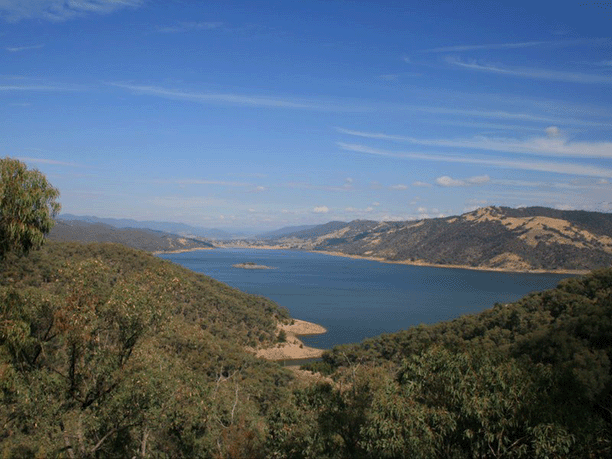
Nuclear debate: Burrinjuck Dam a potential site, Yass Tribune,
Rob Parker, who coordinates Nuclear for Climate Australia (NCA), argued politicians should not shy away from nuclear energy.
In southern NSW, NCA has identified Marulan, Burrinjuck and the Shoalhaven as three of 18 potential sites for nuclear reactors, envisaged to be constructed by 2040 and provide 140.9 terawatts of energy annually.
Mr Parker ran unsuccessfully as a Labor candidate for Goulburn in 2007 and as an independent in 2011. But he says his views are not political, other than to shatter notions………
Burrinjuck Dam cited for nuclear reactor
Mr Parker argued that nuclear energy needed to be 80 per cent of the mix due to climate change. He said the best locations were those near water, rail and the transmission grid.
“Yass has a high viability because of the dam. It also has a good grid connection and good geology,” he said.
NCA proposes that cooling in Burrinjuck would be a hybrid wet-dry process, with water being drawn from Burrinjuck Dam to a storage reservoir at the power station.
However, Ms Goward said “those of us who live here would recall the last serious drought, when the levels of the Burrinjuck Dam were dangerously low”.
“I do not believe the community nor this government would support the use of Burrinjuck Dam as part of a nuclear facility,” she said.
Mr Parker believed Mr Barilaro was raising the possibility of smaller modular reactors being developed across more sites, which did not involve significantly opening up the grid or a large water supply.
He also maintained that nuclear was becoming more price competitive due to the combined effects of electricity generation at $105/MWh in 2018 and the likelihood of increased network costs. Premier Gladys Berejiklian has ruled out nuclear reactors. http://www.yasstribune.com.au/story/4965939/nuclear-debate-burrinjuck-dam-a-potential-site/
1 This month


Help Aunty Sue Protect Her Land and Sacred Sites From Destructive Rocket Testing.
.

Australians deserve the truth
about
AUKUS – https://aukuspublicinquiry.com/

PETITION – To: Prime Minister Anthony Albanese and the Australian Labor Government

of the week – Australians for War Powers Reform (AWPR)
To see nuclear-related stories in greater depth and intensity

