Why Nuclear Energy May Not Be Our Best Alternative Option To Fossil Fuel, Forbes, 9 Sept 17 , Michael Barnard, low-carbon innovation analyst, on Quora: “… From a carbon capture and sequestration perspective, there’s exactly one sequestration project associated with a coal generation plant which is actually sequestering any reasonable amount of carbon. It’s in Saskatchewan, Canada. It was operating at 40% of targets for months and nobody noticed. It’s very expensive.
I did an assessment of all sequestration efforts in Australia over the past 19 years recently and found that they had spent $4,300 AUD per ton to sequester a vanishingly tiny fraction of Australia’s emissions.
The US CCS projects have gone vastly over forecasts and are abandoned and no new ones are projected. The UK government has stopped funding them………
That is clearly something that the Federal Government should be involved in as it involves Australia’s international status and obligations. But that is the one area that the Federal Government is not touching.
Despite Finkel, despite our COP 21 obligations, the Federal Government does nothing. No electricity policy, no vehicle emission standards, no policy in other areas of the economy responsible for half of Australia’s emissions.
Gross misuse of AEMO report for political purposes
Perhaps the very worst thing, of the many to choose from, about the Liddell negotiation is the gross misuse of the AEMO report. This is only possible because the media is too busy, to put it kindly, to do its homework.
The definition of a “problem” is when forecast “Unserved Energy (blackouts)” exceeds the desired reliability standard. That is not the whole story, but if you want one metric, it’s that.
Unfortunately, AEMO didn’t draw its graph relating to NSW all that clearly. We have attempted to do better, [graph on original] using the .xls data that AEMO provides. AEMO does not forecast a problem and if more renewables are built, the standard will be easily met.
Liddell move emboldens the pro coal, pro socialization, anti private enterprise groups – i.e. the National party and right of the Liberals
Turnbull’s naked interference, partly symbolic, has emboldened the anti-climate change cheer lobby. Examples include:
Over the weekend we saw The National Party has passed a motion that is essentially anti a Clean Energy Target.
In NSW energy minister Don Harwin’s public statements about the need for more renewables, see this article and the NSW Government’s “aspirational” zero carbon policy by 2050 have been shown up in their true light by Premier Gladys Berijiklian’s statement that NSW is “not ruling out a new coal fired power station”
“Asked if the state government will pay to keep Liddell open beyond 2022, Mr Berejiklian said: “We’ve not come to any conclusions regarding that. Obviously we are interested in the federal government’s announcements.”
Ms Berejiklian lashed South Australia for going rogue and piling into renewables, despite their inability to cope with peak demands.
A third option, which many believe is the only viable alternative, is for NSW to build its own new coal-fired power station.
“I’m not going to rule it out,” the Premier said yesterday.” Source: Daily Telegraph, Sep 10
Interference in the market using Federal money instead of policy development
Despite the virtually universal endorsement of the “Finkel Report”, despite the electricity industry, including the large coal generators, and also the growing band of renewable investors and consumers, in coalition with many but not all energy consumers the Federal Govt has been unable to progress industry policy in a way that provides an investment confidence.
It has been unable to form policy consistent with our international obligations.
So what is the alternative? It’s to be populist and interfere in the market – similar to say Venezuala’s recent policy developments – or as if Turnbull had Russian Presidential powers.
It’s not as if Turnbull has a great record on micro managing public investment, you can find plenty of critics of the NBN for instance. Let’s look at some of the “Captain’s picks” that are just announced on the floor of parliament as “done deals”
Snowy 2.0: $8-$10 billion
The Federal Govt’s only historic investment in electricity was its 13% investment in Snowy Hydro. Now in order to subsidize a minimum $2 bn, and likely more, investment in pumped hydro, the Federal Govt is proposing to spend $5bn-$6bn buying the NSW Govt and Vic Govt out of Snowy.
The Federal Govt has no experience in electricity generation. Snowy is also the 4th largest retailer by customer numbers and the Federal Govt has no experience in electricity retailing.
The pumped hydro project has not gone through any competitive process for funding in the way that say CSP or nearly anything has to.
Our studies of pumped hydro show that it needs about $90 MWh differential between peak and offpeak to be profitable. How can anyone really know whether that will be on offer when this plant is built?
No private sector operator would do it now. This purchase and the subsequent investment should be open to far more public scrutiny. At least $2 bn of transmission will be needed to support the investment.
However, as large as that investment is, and as risky as it is, a case can be made that in a world of high renewables where there was lots of zero marginal cost PV in the middle of the day a pumped hydro investment could be of use.
We are not in that world today and there is no plan to get to that world in the future. Pumped hydro, like batteries, consume about 25% more electricity than they produce. If that electricity is being produced by coal there is little more that can be said.
Snowy is a gamble with taxpayer funds, Liddell is a gift of taxpayer funds to one private sector operator
Snowy 2.0 is an $8 billion plus gamble with Federal money, but subsidizing Liddell using Federal money to enrich one private sector operator as an effective massive bonus to entice them to buy and take over a coal fired station is basically disgraceful. We list some of the issues below.
All we can say though is it leaves a bad smell. If Turnbull thinks these investments are such a good idea, raise some private capital and do it yourself. Or at least get the States to do it. It is just not a Federal issue to be running State power stations and interfering in the market.
Meddling in business because you can’t do politics
The proposed Federal subsidy to one private sector operator to keep a coal fired generator open in NSW is open to criticism on many grounds. The list includes.
It’s totally incompatible with Australia’s international COP 21 commitment to reduce emissions by 28% by 2030. How can keeping a coal station power station going from 2022-2027 or 2032 do anything other than harm that goal.
It potentially hands say West Australian GST proceeds to one private sector operator to build a bigger position in the Australian electricity market. Kerry Packer RIP, once famously said on selling Channel 9, that you only get one Alan Bond. Trevor St Baker must be thinking you only get one Malcolm Turnbull. Turnbull and St Baker do share one thing in common. They both live in houses with lots of PV and batteries. And yet exploit everyone else to sell them coal fired electricity.
It potentially changes the sale of Loy Yang B. According to press reports one of about 2 bidders left for LYB was Delta’s owner, Sunset Power. Press reports state Sunset was having some difficulty getting bank finance. This could play out as Sunset finding it easier to get bank finance if its backed by the Federal Government Turnbull/Fydenberg investment bank, or it could lead Sunset to say, we won’t bother with LYB and the private sector we’ll just take the Government money and run Liddell.
Maybe the Federal Govt could buy LYB as well? If you are going to nationalize the electricity industry why stop with just Snowy and Liddell, surely you need a position in Victoria? After all there are endless free taxpayer dollars to be used.
It will make new generation investment in NSW less likely. If the Government is prepared to do all the work and increase private sector risk why invest. High prices at present, and the expected closure of Liddell are creating a strong investment incentive in NSW.
Ditto, it makes the job of getting the 1 GW capacity reserve built
There is no identified need to keep Liddell open. AEMO does not forecast an energy supply issue in NSW.
In any case forecasting the post 2022 electricity market is just a guess. We all know that.
It totally hands all the cards to AGL. AGL has been a good steward of the Macgen and LYA coal assets. Its worked hard on their costs and reliability, it’s come to the party on bailing out Portland smelter and it is doing a bit, albeit not a big bit, to get some new renewables built. Its also potentially helping with gas by getting Cribb Point on the agenda.
AGL will not want to sell Liddell to a competitor. Never mind the potential increase in competition, it will also complicated the coal position. AGL’s coal supply is set up on the assumption Liddell will close. Its and everyone else’s coal prices will be higher if Liddell stays open. How much higher, hard to say, but we think there are escalators in some of the Macgen contracts which would drive conservation of coal all else being equal.
Governments, understandably, want to make sure the lights stay on. But now is the time for perspective, not panic.
Because, as the latest Grattan Institute report – Next Generation: the long-term future of the National Electricity Market – shows, there are emerging challenges to the NEM that need dealing with. Make the right decisions now and a return to affordable and reliable electricity supply is on the cards.
The NEM is an energy-only market. This means that generators only get revenue when they sell their electricity into the market.
All costs – including the capital costs of building the plant – need to be covered by the revenue they make when they sell electricity. Anyone who wants to build new generation capacity wants to be pretty certain that the market is going to deliver the revenue they need to cover their costs.
But right now no one is building any generation, unless it is government-backed renewables. This is despite a ripe environment for investment: high current and future prices in the wholesale market and the closure of old power stations.
The result, as AEMO pointed out last week, is potential shortfalls in generation and potential blackouts in South Australia, Victoria and NSW over the next few years.
Much of the blame for this investment hiatus can be placed on politicians and the climate change policy mess that is creating so much uncertainty for potential investors.
But the rise of wind and solar power is also causing problems. Wind and solar energy have zero marginal cost: once the facility is built, the energy produced is essentially free. And they are intermittent suppliers: they don’t produce energy unless the wind is blowing or the sun is shining.
So when wind and solar plants are operating, the wholesale price of electricity is forced down. This means there needs to be high prices – sometimes very high – when wind and solar are not operating. This price volatility makes investors nervous that they will not be able to cover the costs of building new generation.
Governments may be tempted to conclude that the market has failed. But intervention may be premature.
There are still five years until Liddell is scheduled to close. Just because a new coal-fired power station will not be built in time to fill the gap doesn’t mean the market cannot respond.
Coal was never going to be the market response, given climate change risks. But new gas-fired generators, or batteries to store electricity, could be built in this time frame.
Or the market could finally get its act together on what is called demand-response: that is, paying consumers to reduce their electricity consumption during periods of peak demand, so that less new generation is required.
There are no guarantees for government, however. The risks that the market won’t deliver the new generation that is needed are increasing. If nothing changes, Australia will need, in the words of AEMO, “a longer-term approach to retain existing investment and incentivise new investment in flexible dispatchable capability in the NEM”.
Many countries have responded to these same pressures by introducing a capacity mechanism. A capacity mechanism pays generators for being available, regardless of whether they actually sell electricity.
Payments for capacity provide extra income for generators, giving them greater assurance that they will make enough revenue to cover their costs.
Any new market-based mechanism in Australia is likely to be better than the scattergun approach of various governments in recent years.
S.A. put energy security target on back-burner after AEMO steps in, REneweconomy By Giles Parkinson on 11 September 2017 South Australia has abandoned plans to have its state-based energy security target in place this summer after conceding is could have little impact given the new initiatives by the Australian Energy Market Operator and the lack of competition in the local grid.
Officially, South Australia has decided to “defer” the start date of the EST until 2020, having already deferred it from a July 1 start to a January 1, 2018 start. But given the state poll in 2018, and the new initiatives taking place in the broader market, it seems unlikely to ever see the light of day.
The EST was a key component of the $550 million Energy Security Plan the S.A, government unveiled earlier this year following its dismay at the forced load shedding in February and other incidents.
8 Sept 17,ANSTO and DIIS are hedging ones bets on a chosen site while their agenda has always been to abandon High Grade waste under the guise of calling it Intermediate Waste.
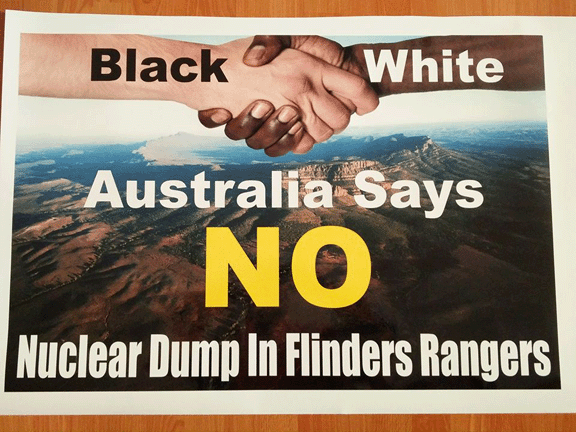
Regina McKenzie I say No to nuclear waste dump in the Flinders Ranges or anywhere , the government says if there is a strong community movement against it , they will walk away . So why are they still hanging around Barndioota, Like blow flies on a shitty arse sheep? Honest they say one thing and do another , just a form of bullying from the Federal government, SA dont want No Nuclear Waste dump! Get over it and move on ….. We Say No!
Paul Waldon, How does your community make a small fortune gambling on nuclear waste? You start with a big fortune! The monkeys in the community happy to accept peanuts to risk contamination and death of their environment, maybe satisfied till things go wrong. But remember the culturally significant, seismically unstable, flood prone, non reducing, aquifer vulnerable, tourism missed, and peoples welfare are all issues that ANSTO, ARPANZA, and the Department of Industry, Innovation and Science have all overlooked or have NO regard for, in their wrongful pursuit to ensure their own job security.
Steve DaleThey do it because they are drowning in a sea of nuclear muck of their own creation, and they want to keep creating nuclear muck for profit. They are drowning and they are desperate – and if we are not careful they will drag down everything good about South Australia with them.
Why HAS AN INTERMEDIATE DUMP BEEN CONSIDERED ALONGSIDE THIS IDEA..??….
NOW..
IF A CONTAINMENT FIELD THAT IS MADE `SAFE` CANNOT BE SITUATED NEAR LUCAS HEIGHTS.??..
.
WHY DOES IT NEED TO BE `OUTBACK` IF ITS SOOO SAFE..??..
WE DONT TRUST U MOB TO LEAVE IT LOW..
CMON.. U THINK WE ARE STUPID..!!..
ONCE YOU HAVE LOW-THEN U GO MEDIUM… THEN U GO HIGH AND STUFF FROM ALL OVER THE WORLD(SPENT RODS ect)
Gets sent here for REHAB.. 200,000YRS .
NOOO.. THAT MEANS NNNOOO…
Paul Waldon September 7 regional news, reports Broken Hill in the grip of a tourism boom, and things are looking rosy. While ANSTO and the Department of Industry, Innovation and Science are busy promoting South Australia as a “Nuclear Dump.” There is no Cupie Doll, as a prize for the person who can guess who prospers and what state goes down the toilet.
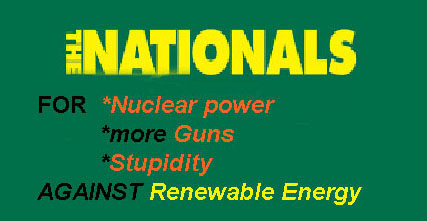
The three-day grassroots federal conference in Canberra comes as some members want to separate the LNP branding in Queensland for elections, because they believe the Nationals’ brand is better than the Liberals’.
In a sign that strengthening the classification of the controversial Adler shotgun in December last year still grates on some members, a motion will be moved that “this federal conference acknowledge the National Firearms Agreement and states that no changes should be made to it without compelling evidence”.
The Federal Government is in the middle of the first national firearm amnesty since the Port Arthur massacre about 20 years ago. The Nationals’ Queensland contingent, under the LNP banner, will move a motion to promote and support the coal industry and resist environmental groups “which are determined to disrupt and impede”.
Members will also be asked to vote on urging the Government to freeze renewable energy subsidies at current level for 12 months, and then phase in a subsidy reduction program that will remove all renewable energy subsidies over five years.
They will also be asked to call on the Government to urgently adopt a comprehensive energy supply policy that includes pursuing further initiatives, including nuclear.
Members also want the Government to transition the shut down Hazelwood coal-fired power plant into a new efficient coal power station.
The Minerals Council is also urging development of nuclear energy, and Prime Minister Malcolm Turnbull has said it was a debate worth having.
Deputy Prime Minister Barnaby Joyce will address the conference today, just weeks before the High Court determines whether he and two other Nationals, Fiona Nash and Matt Canavan, were legally elected to Parliament.
Queensland Opposition Leader Tim Nicholls will attend the leaders’ lunch.
DESPITE the fact we closed our grubbiest coal-fired power plant in March, Australia’s emissions have actually grown to the highest level since 2011. Kirrily Schwarz , 8 Sept 17AUSTRALIAN greenhouse gases last year were the highest since 2011, despite the closure of our grubbiest coal-fired power plant.
The electricity sector had its biggest drop on record in the three months to June, following the closure of Victoria’s Hazelwood power station, which burned brown coal deposits from an open-cut mine in nearby Morwell.
However, even that wasn’t enough to stop Australia’s overall greenhouse gas emissions from rising, with increases recorded in every other sector. That’s according to new projections reported in the Guardian, which take stock of quarterly emissions across the country.
According to environmental experts, Australia has now consumed 24 per cent of the carbon budget set by the government’s Climate Change Authority. The budget represents the total amount of carbon Australia can release from 2013 while keeping global warming under two degrees. The alarming revelation comes as new modelling shows South Australia and Victoria both risk four-hour blackouts this coming summer.
The Australian Energy Market Operator released its annual stocktake this week, showing there’s a heightened risk of a shortfall over the next decade if nothing is done. “The power system does not have the reserves it once had,” Audrey Zibelman, chief executive of the Australian Energy Market Operator, told AAP.
Victoria, meanwhile, is rolling out a large-scale storage plan the government says will boost storage capacity by 100 megawatts by the end of 2018.
Both states will ask consumers to use less electricity during peak times.
Mr Turnbull seized on the report to highlight the vulnerability of the nation’s electricity supply, but said measures were in place to cover the immediate gap.
The Prime Minister also revealed he and Energy Minister Josh Frydenberg were in talks with energy company AGL about keeping open the Liddell power station in NSW at least five years beyond 2022, while the Snowy Hydro 2.0 project is completed.
However, AGL is working on shutting down all its coal-fired plants, and in August ruled out extending the Liddell plant’s life.
Meanwhile, Labor has offered to work with the government for a “constructive compromise” on energy policy so something can actually be done to drive down power prices.
But the Greens are angry the two major parties agree on subsidies for coal.
Mr Turnbull has set a deadline of developing a clean energy target — as recommended by Chief Scientist Alan Finkel — before Christmas.
Opposition Leader Bill Shorten called on the government to just get on with its job. “The number one problem contributing to energy prices in this country, out-of-control energy prices, is the absence of proper national policy,” he told reporters in Canberra.
Renewable energy agency assesses incentives for households to cut power this summer, ABC News, By Melissa Brown, 8 Sept 17, Twenty-four electricity retailers and tech companies have applied to be part of a scheme the Australian Renewable Energy Agency (ARENA) says will help the country avoid looming blackouts this summer.
Under the scheme, large groups of households or business will be offered incentives, such as payments, to cut their electricity usage when the grid comes under stress.
ARENA business development manager Phil Cohn said, as an example, participating customers could be sent messages, telling them a high-stress period was expected at the next day, and asking them to switch of their air conditioner or pool pump for 30 minutes.
The agency and the Australian Energy Market Operator (AEMO) announced their Demand Response trial program in May.
Mr Cohn said ARENA was now examining proposed projects under the scheme.
“We’re going through our assessment and contracting process at the moment with the successful projects,” he said.
“We got a wide range of energy retailers come in the door, from energy retailers through to new technology start-ups that are looking to utilise things in people’s homes to control appliances and help manage energy use.”
Mr Cohn said the successful projects would be announced in October and they would need to be up and running by December, so the energy savings could be used in summer.
Blockchain energy trader Power Ledger raises $17m in “coin offering”
Perth blockchain-based renewables trading start-up, Power Ledger, raising tens of millions of dollars in Australia’s first “initial coin offering” in energy space.
AEMO explains caution on S.A. wind: We’re first in the world
AEMO explains caution of grid operations in South Australia, saying it is way out front of rest of the world and in virgin territory. But there is debate on grid weakness is due to wind farms or ageing gas units with the wrong settings.
Faced with two irrational and aggressive nuclear-armed leaders, deterrence theory is failing. The promise of nuclear attack is meant to keep nuclear states from using their weapons. Is it becoming clearer every week that this fragile structure is not built to last.
North Korea’s 6th nuclear test is alarming, yes, but an unsurprising next move in the war-game with US President Trump. Both Trump and North Korean leader Kim Jong-un are threatening each other with some form of catastrophic “fire”, a thin veil for nuclear war.
Both the US and North Korea are engaging in reckless provocations. Joint US/South Korean military drills on the Korean peninsula and the pursuit of the THAAD missile defence system are continually fueling the fire. Trump and Jong-un are paving the path to nuclear war. Another path exists and we must take it.
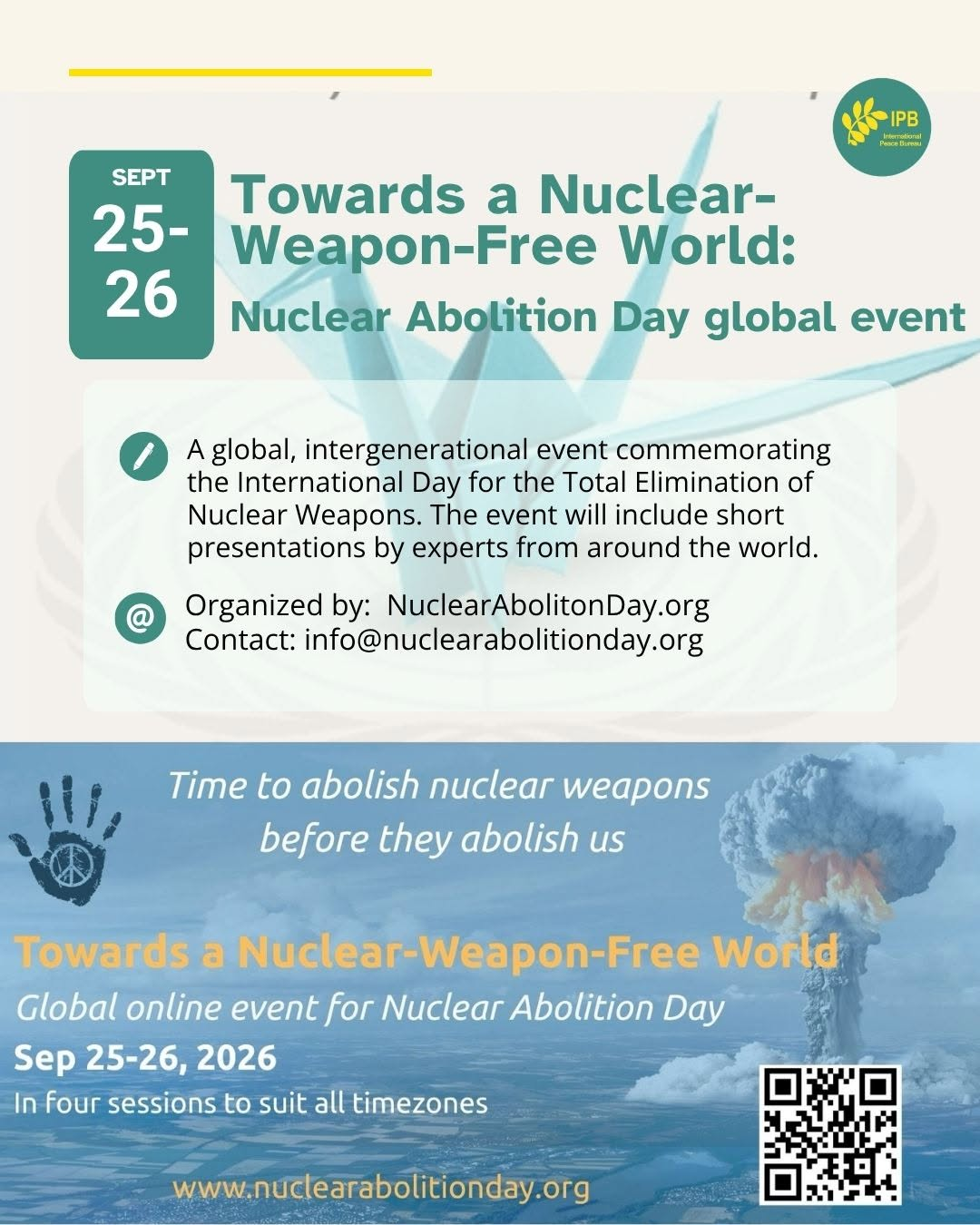
On September 20, heads of state and foreign ministers will line up at the United Nations to sign the Treaty on the Prohibition of Nuclear Weapons (TPNW). All states are invited to participate in the signing ceremony. When 50 countries have ratified, the new Treaty will enter into force. The TPNW was negotiated and adopted at the UN by 122 nations earlier this year, and promises to be a powerful tool to de-escalate, de-legitimise and disarm nuclear weapons.
The TPNW categorically rejects nuclear weapons for the instruments of catastrophe that they are. Founded on a deep and detailed understanding of the humanitarian impacts of the weapon, the treaty’s drafters have closed the legal gap by which nuclear possession by some was apparently tolerable.
Now, all three weapons of mass destruction are outlawed by international treaties, and nuclear possession by anyone is declared equally unacceptable. As former UN Secretary-General Ban Ki-moon said, “there are no right hands for the wrong weapon.”
The TPNW prohibits the development, stockpiling, testing, use and threat of use of nuclear weapons. It also prohibits any nations from encouraging, assisting or inducing others to engage in the prohibited activities. The goal of the Treaty is the total elimination of nuclear weapons; and it provides the formal legal channel to facilitate the process.
Prime Minister Malcolm Turnbull’s unqualified support for Trump serves to legitimize and condone his actions. Instead of providing constant approval, Australia is in a position to change the landscape. The ANZUS Treaty doesn’t require us to be “joined at the hip”, as Turnbull suggests, but to consult together. Australia’s interests are not identical to the US’. Shadow Foreign Minister Penny Wong explained in the Lowy Interpreter last October; “being in an alliance does not mean Australia must agree reflexively with every aspect of American policy or make its foreign policy subservient to that of our partner”.
On September 20, the Australian leadership is faced with a choice to support or reject nuclear weapons. If it fails to sign the TPNW, Australia’s commitment to nuclear disarmament is fictional. As a signatory to the treaties banning biological and chemical weapons, anti-personnel mines and cluster munitions, expectations are high. Public opinion is with the Treaty; a March 2017 IPSOS poll found 74 per cent of Australians wanted our government to join the negotiations that led to this landmark agreement.
With every new signatory on the TPNW, the international norm against nuclear aggression will strengthen. The weapon will lose its status and it will be harder for nuclear programs to secure resources for modernization and maintenance. Countries that claim dependence on extended nuclear deterrence, like Australia, will experience increasing pressure to sign on and choose a non-nuclear defence posture.
What right does Turnbull have to criticise the North Korean nuclear program when Australia claims that nuclear weapons are essential for our security? De-escalation is urgently required, and the UN Treaty on the Prohibition of Nuclear Weapons provides a legally sound and feasible alternative to the perilous path we’re currently on.
Julie Bishop helps promote African uranium with Australian zombie miner, Independent AustraliaDave SweeneyBetter known for her support for asbestos, why is Julie Bishop fronting an African mining conference beside uranium miner John Borshoff, who ran Paladin Energy into insolvency and called Fukushima a “sideshow”?
NO DOUBT, tall tales and cocktails will both flow at this week’s Africa Down Under mining conference in Perth, an annual event that sees Australian politicians join their African counterparts alongside a melange of miners, merchants and media.
But it is unlikely that too many of these will be the stories of corruption, dirty dealing and corner cutting that are so common in the world of resource extraction, especially in the developing or majority world.
‘Australian companies, particularly mining companies, can have a severe impact on human rights throughout the world, including the right to food, water, health and a clean environment. Despite this, successive governments lack a clear framework of human rights obligations for Australian corporations operating overseas. This is particularly problematic in countries with lax or limited regulations.’
The operations and impacts of one embattled Australian miner highlights the point. For years, Paladin Energy was a bullish uranium promoter, now in the wake of the Fukushima nuclear disaster it has joined the zombie companies — the walking corporate dead.
For a few short years, Paladin, headed by the John Borshoff, a man reminiscent of Les Patterson with a drill-rig, operated the Kayelekera Uranium Mine in Malawi.
Borshoff was clear in his rationale stating that the
“Australians and the Canadians have become over-sophisticated in their environmental and social concerns over uranium mining — the future is in Africa.”
The contested mine was a focus of sustained criticism from community and civil society groups before being placed into extended ‘care and maintenance’ following the collapse in global demand and the freefall in the uranium commodity price that followed Fukushima.
Borshoff termed the Australian uranium fuelled Fukushima meltdown a “sideshow”. Not true, although Paladin were always clowns. But never funny ones.
The company is now in administration and a complicated planned bailout involving a Chinese takeover of a shrinking Namibian uranium project has failed. So now, as the creditors circle, who cleans up after the party? What priority will be given to addressing the disrupted and damaged country and communities around Kayelekera?
All good questions to ask John Borshoff, who is presenting Africa Down Under in a session with Foreign Minister Julie Bishop. But don’t hold your breath. This year he will wear a different hard hat. Paladin is the past and the future now is Deep Yellow — a junior miner with ambitions in Namibia. The caravan moves on with scarcely a glance behind.
Paladin’s ambition and appetite always exceeded its capacity and competence and now the gap between its inflated promises and its profound under-performance is absolute.
As the senior Mirarr Traditional Owner Yvonne Margarula reflected about her experience with the uranium sector in Kakadu:
”The promises never last, the problems always do.”………
The absence of a robust regulatory regime in many African countries can see situations where Australian companies are engaged in activities that would not be acceptable practise at home.
Paladin’s boom to bust case study is a further clear example of the lack of independent scrutiny of the uranium sector that also reflects poorly on the activities of Australian miners operating in nations with limited governance and regulatory capacity.
The mining sector always makes a difference, but it is not always a positive one. Especially given that many of the Australian company’s active in the African mining sector are juniors with limited capacity, scant accountability and little or no operational experience or proven compliance history.
In 2015, Tracey Davies, a lawyer with the South African-based Centre for Environmental Rights told Fairfax Media of the widespread and
“… very strong perception that when Australian mining companies come here they take every advantage of regulatory and compliance monitoring weaknesses, and of the huge disparity in power between themselves and affected communities, and aim to get away with things they wouldn’t even think of trying in Australia.”
There are too many examples of Australian mining activities in Africa ending in corruption, environmental damage or community disruption for us to simply accept pro-industry rhetoric. There is a clear need for increased transparency, responsibility and support for affected communities. And a clear need for independent proof, not industry promises.
Africa Down Under cannot be allowed to be an uncritical platform for Plunder Down Under.
Paul Waldon Fight To Stop Nuclear Waste Dump In Flinders Ranges SAYesterday,Thursday the 7th of September was Threatened Species Day. The promotion of nuclear waste abandonment in the Flinders Ranges by The Department of Industry, Innovation and Science (DIIS), and ANSTO can only be seen as a irresponsible act pushing life to extinction with a radioactive assault on a incompatible and fragile environment, while threatening the taxon and the biotas of the Flinders Ranges.
MAMMALS: One species of mammal, the Yellow-footed Rock-wallaby (Petrogale Xanthopus), has a national and state conservation rating of “Vulnerable.” Half of all mammal fauna that was once known for the Flinders are now extinct, with surviving species assessed at a regional level, with 15 rated “Vulnerable”, 2 “rare”, 7 “Uncommon” and 6 listed “Immediate Conservation Concern”, while the vulnerable will require focused management to ensure their long term future.
BIRDS: 15 birds species are listed a South Australian Conservation Rating, 7 rated “Vulnerable”, 4 as “Rare”, 4 as “Uncommon”, 1 the Short-tail Grass-wren (Amytornis Merrotsyi) listed as Endemic, significantly near Hawker.
REPTILES: Several species are near “Endemic” to the Flinders Ranges, and 5 species known in the region have “Conservation ratings.”
PLANTS: 18 Plant taxa are “Endemic” to the Flinders Ranges, some of these are locally very common, while others are more sparsley present, and have conservation significance ratings. No less than 221 plant species have conservation rating of the 1361 plant taxa recorded.
This well balanced fragile ecosystem, may collapse with the death of any taxa or biota that suffer the impact of radiation from nuclear waste abandonment. ANSTO at Lucas Heights offers a low environmental impact site for nuclear waste while Hawker and Kimba fail to deliver, and in the interest of safety, radioactive waste should remain at Lucas Heights https://www.facebook.com/groups/344452605899556/
AEMO switches focus to dispatchable generation over baseload http://reneweconomy.com.au/aemo-switches-focus-dispatchable-generation-baseload-75800/, By Giles Parkinson on 6 September 2017 The Australian Energy Market Operator has sought to switch the debate about Australia’s energy future, saying it is critical to focus on dispatchable and flexible generation rather than baseload, and it wants to create a short-term “strategic reserve” and long-term changes to market design to ensure this need is met. Continue reading →
AGL bought Liddell for nothing, but would cost Turnbull a small fortune, and his credibility
Liddell was bought for nothing and for good reason – “it’s clapped out”. Turnbull’s intervention raises probity issues and could have as devastating an impact on new technology as canning of the carbon price and the attempt to kill the RET.
Barnaby Joyce’s bizarre call to arms against “green peril”
Joyce says Australia under attack from “green peril”, that will only become apparent to all when the power goes out, leaving people stuck in a lift, busting for a pee. Oh, and he doesn’t think India will want Australia’s thermal coal. Say, what?
Energy Efficiency market – commercial lighting takes centre stage
Whatever the recent VEEC market volatility may imply, it seems clear that the intent exists within government to bring about change, the question now remains what will the end result be?
Though the awareness of climate risk disclosure has become more prevalent, such disclosures by Australian companies are still the exception rather than the norm.
Australia has uranium export agreements in place with all of the five ‘declared’ nuclear weapons states – the US, Russia, China, France and the UK – although none of these countries take seriously their obligations under the Nuclear Non-Proliferation-Treaty to pursue nuclear disarmament.
IAEA safeguards inspections in the declared weapons states are voluntary and, in general, tokenistic.
Australia, along with the weapons states, boycotted recent negotiations on a Treaty on the Prohibition of Nuclear Weapons, adopted by the United Nations in early July.
Australia has fallen into the trap of bending over backwards to support its allies on an international scale, and subordinating non-proliferation objectives to the commercial interests of the (mostly foreign-owned) uranium companies operating in Australia.
Australia’s contribution to nuclear proliferation risks,Bridget Mitchell and Jim Green, 6 Sept 2017, Online Opinion www.onlineopinion.com.au/view.asp?article=19268&page=0 Once again, the world finds itself in a dangerous place as one mad-man explodes increasingly powerful nuclear weapons and another mad-man threatens North Korea with “fire, fury and frankly power the likes of which this world has never seen before.”
There appears to be no solution to the North Korean problem. Diplomacy, threats and sanctions have not been effective. Military intervention would likely result in the slaughter of hundreds of thousands of people on both sides of the 38th parallel ‒ with or without the use of nuclear weapons.
Australia isn’t to blame for the dangerous and escalating situation in North Korea but it’s worth reflecting on how we ‒ or more to the point, how successive governments ‒ have made the world a more dangerous place.
According to the World Nuclear Association, from the 1950s until the 1970s, Australia’s uranium was “primarily intended for US and UK weapons programs”. Although we no longer supply uranium for weapons production, Australia does contribute to proliferation risks. Continue reading →