A nuclear bomb: effects on each of Australia’s major cities
The good news for Australians and the world at large is that North Korea has no intention of using its nuclear arsenal.
North Korea has a very limited nuclear arsenal, and does not view Australia as a particularly worthy adversary. If they can reach Melbourne or Sydney, they could also reach the mainland United States, which would prove a more tempting target.
So even if Kim Jong-un were to push the button, it’s very unlikely the missiles will be aimed at Australia.
What North Korea’s nukes would do to Australia’s cities http://www.9news.com.au/national/2017/09/06/12/03/what-north-korea-nuclear-bombs-would-do-to-australian-cities, By Nick Pearson, Sep 6, 2017 North Korea would be capable of killing tens of thousands of Australians instantly if they target one of our cities in a nuclear attack.
A 100 kiloton bomb was detonated under a mountain in North Korea over the weekend, and it would be capable of an extraordinary amount of damage if it targeted an urban area.
US academic Alex Wellerstein created a piece of software that estimates the scale of a nuclear attack on various locations.
At present only Darwin is potentially within the range of North Korea’s missiles. The regime also has not developed the technology to put a nuclear warhead on such a missile, so these estimations are at present, hypothetical.
The bomb tested by North Korea on Sunday would kill an estimated 126,000 people straight away if dropped in the heart of Sydney.
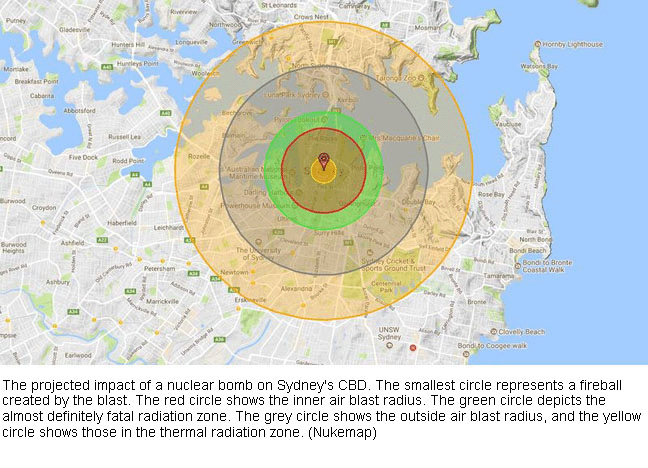
If the bomb landed in Pitt Street Mall, it would create a fireball wide enough to destroy state parliament, St Mary’s Cathedral, Wynyard Station and Town Hall.
The air blast radius would flatten just about every building in the CBD, stretching from Circular Quay to Elizabeth Bay.
A slower death from radiation poisoning would affect up to 90 percent of people in the wider blast radius stretching from Kirribilli to Balmain to the University of Sydney.
Victims from Newtown to Taronga Zoo would suffer third-degree burns as part of the thermal radiation radius.
But survival outside the blast zone is reliant on the strength and direction of the wind. Continue reading
John Quiggan demolishes foolish Minerals Council of Australia’s nuclear spin
The Minerals Council of Australia pushing zombie ideas, September 4th, 2017, John Quiggin, http://johnquiggin.com/2017/09/04/the-minerals-council-of-australia-pushing-zombie-ideas/
Fighting zombies is a tiresome business. Even when you think you’ve finally killed them, they bounce back as often as not. But it has to be done, and there are some benefits. When you see a supposedly serious person or organization pushing zombie ideas, it’s an indication that nothing they put out should be presumed to be serious.
There can be few zombies more thoroughly undead than nuclear power in general, except for the idea that nuclear power is a sensible option for Australia. The strongly pro-nuclear SA Royal Commission demolished this zombie so thoroughly that it should have taken a decade at least to regenerate.
But here’s the Minerals Council of Australia, which has taken a break from promoting coal to push the idea thatAustralia needs a nuclear power industry and that the biggest obstacle is a legal prohibition imposed in 1998. The supporting “analysis” is riddled with absurdities, some of which have already been pointed out. I’ll give my own (incomplete) list over the fold
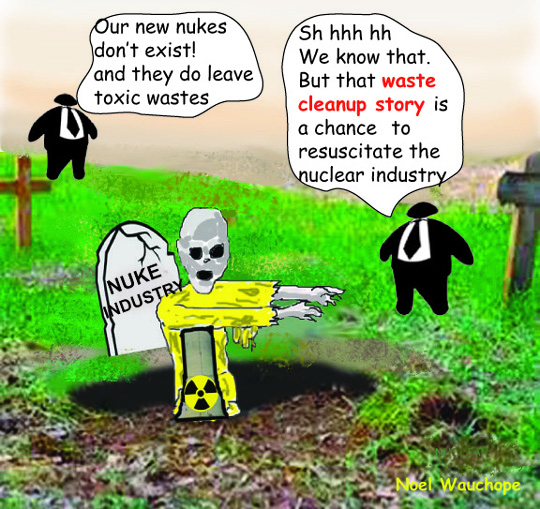
Most obviously, there’s the statement that 58 nuclear reactors are currently under construction. As anyone who’s been paying attention could tell them, that number was 66 not long ago. The decline reflects the abandonment of half-built projects like the VC Summer plant in North Carolina and the fact that some long overdue projects like Watts Bar, started back in 1973, have been completed, while new starts have slowed to a crawl.
That’s only going to accelerate. China currently has 23 plants under construction, but they haven’t approved a new one in eighteen months. Other countries with projects under construction, but no recent approvals include the US and France. Unless something changes, the completion of current projects will cut the number under construction in half within a few years.
Then there’s the claim that nuclear power is affordable. There’s no reference to the dismal record of the existing industry. Instead, the MCA is relying on vaporware
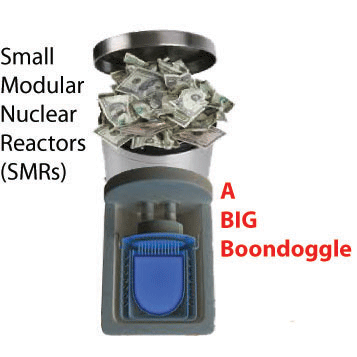 Small modular reactors (SMRs) are close to commercialisation in the US. A Nu-scale 50MWe SMR, for example, is projected to cost around US$250 million.10 Three of these would cost and produce around the same amount of power as the largest wind farm in the southern hemisphere – and it would be reliable, synchronous, on-demand power
The reality is that the NuScale SMR doesn’t exist even as a prototype. Any estimate of the costs of such a reactor is purely speculative. The SA Royal Commission looked hard at SMRs and concluded they weren’t a viable option now or in the foreseeable future.
Showing patent bad faith, the MCA quotes the Royal Commission’s claims about the potential for a nuclear waste dump (an idea that has been abandoned) but ignores the more significant finding that nuclear power, including SMRs is hopelessly uneconomic for Australia.
Even more startling is the suggestion that we should follow the example of Canada which supposedly has a thriving nuclear industry. The reality is that nuclear power in Canada has been a failure, with massive cost overruns and frequent breakdowns. After spending at least a billion in subsidies, the Canadian government sold its nuclear energy business for a mere $15 million in 2011. It’s highly unlikely that Canada will ever build another nuclear plant.
Then there’s a reference to some real vaporware, notably including Transatomic a startup backed by Peter Theil. Google reveals that Transatomic had to back away from its inflated claims by a factor of more than 30. An honest mistake, apparently, but not promising as a basis for Australian energy policy.
Regardless of whether the prohibition on nuclear energy is lifted, it’s not going to happen in Australia, or most other countries. The real lesson from this episode is that any analysis coming out of the MCA should be treated with extreme scepticism. In particular, the next time an MCA spokesperson pops up to say that we need coal-fired power indefinitely into the future, remember their similar, and patently false, claims about nuclear power.
Australia’s defence forces to buy lethal drones from US nuclear weapons maker General Atomics?
 Dan Monceaux Nuclear Fuel Cycle Watch South Australia 3 September 2017.
General Atomics popped up in the news yesterday, but their name wasn’t mentioned in the news report I saw. Apparently, Australia’s defence forces are interested in acquiring Reaper drones with lethal capabilities.
General Atomics already has a presence in South Australia through their ownership of two uranium mining projects. Their subsidiary companies are Quasar Resources and Heathgate Resources- both operate in-situ leach operations in the Frome Basin area: at Four Mile and Beverley https://www.facebook.com/groups/1021186047913052/
Donald Trump and Malcolm Turnbull hold talks, as North Korea again threatens America
North Korea makes another threat to America as Donald Trump and Malcolm Turnbull hold talks, The West Australian , Claire Bickers, Sarah Blake in New York, wires 6 September 2017 Donald Trump’s phone call with Prime Minister Turnbull has been described as warm and constructive.
The two leaders have agreed North Korea poses a grave threat to regional stability and that it is time for the international community to act.
China’s role in putting pressure on Pyongyang to end its nuclear and missile testing program was discussed, along with the emerging threat of Islamic militants in the Philippines.
Earlier, Australian Defence Minister Marise Payne said Australia and its allies sought to avoid a military conflict with North Korea “at all costs”.
The Minister will be travelling to Seoul today to meet with South Korean President Moon Jae-in and to deliver the keynote address at a forum on regional and global security.
“We seek to pursue the sanctions process and to ensure that they are allowed to operate to their fullest effect to send the clearest possible message to the regime in North Korea that their behaviour is unacceptable,” she told ABC radio.
…… There has been speculation North Korea may be planning to fire an ICBM this weekend when the republic celebrates its foundation on September 9. Mr Turnbull told coalition MPs at a partyroom meeting on Tuesday that the action of North Korea was “reckless, dangerous and provocative”.
He echoed the US ambassador to the United Nations Nikki Haley who said the regime seems to be “begging for a war”.
Meanwhile, Opposition Leader Bill Shorten and foreign affairs spokeswoman Penny Wong will meet leaders in South Korea and Japan later in the month. Mr Shorten said he was pleased about the phone call between Mr Trump and Mr Turnbull.
“Australia must use its influence wherever possible to promote a peaceful resolution to this crisis, and I hope this phone call goes some way to achieving this,” Mr Shorten said.
Confirmation of the Oval Office phone call came late Tuesday, during a dramatic day of developments in the burgeoning nuclear crisis, as the Japanese government started planning for mass evacuations of nearly 60,000 citizens in South Korea…….https://thewest.com.au/news/world/north-korea-makes-another-threat-to-america-as-donald-trump-and-malcolm-turnbull-hold-talks-ng-b88590753z
CSIRO a paid-up member of Minerals Council, which fights climate change action
 Science agency stands in contrast to Australia’s biggest polluter, AGL, which parted ways with MCA over climate change, Guardian, Michael Slezak, 6 Sept 17, The Australian government’s science agency, the CSIRO, has paid tens of thousands of dollars to peak mining lobby group the Minerals Council of Australia, which fights against government action on climate change.
The CSIRO has been listed as an “associate member” of the Minerals Council of Australia (MCA) since at least 2004 and new documents obtained by the Australian Institute, under freedom of information laws, show that in 2017 the “annual subscription” for membership was just under $10,000.
The mining lobby plays a vocal role in Australian climate change policy debates and the positions it takes are on the extreme end of the spectrum and include pushing for more coal power stations to be built.
The CSIRO continues to be a member of the MCA despite even Australia’s biggest climate polluter, AGL, publicly parting ways with the Minerals Council of Australia in 2016, saying it did so because of the positions the MCA took on climate change.
“AGL’s positions on climate change and renewable energy differed from those held by the Minerals Council of Australia … and AGL has elected not to renew its membership,” the company said in its 2016 sustainability report.
CSIRO declined to answer specific questions about how long it had been a member, what the cost had been and what the CSIRO got in return for membership. A CSIRO spokesman instead gave a statement, published in full below. [on original] …….
CSIRO has come under fire in recent years for a perception it has not been giving fearless advice to the public and to government on climate-related issues. At the same time, the organisation has cracked down on employees who themselves seek to speak publicly on policy issues……
ohn Church, a world-leading climate scientist who was made redundant in the organisation’s 2016 job cuts and who was one of the disgruntled employees in the leaked emails, told the Guardian CSIRO’s membership of the MCA was in contradiction to its refusal to engage in policy debates.
“I would definitely say there was a conflict,” Church said. “CSIRO is putting itself in a position where it is implicitly supporting particular policy positions by being a member of the Minerals Council.
“They should not only be independent but be seen to be independent.”
A senior climate scientist still at the CSIRO told the Guardian that currently it is almost impossible for climate scientists there to speak publicly about policy…….
Other public organisations with associate membership of MCA include ANSTO Minerals and the University of Western Australia……ANSTO Minerals, part of the government-owned Australian Nuclear Science and Technology Organisation is also an associate member of the Minerals Council and a spokesman said ANSTO was a member of the Uranium Forum of the MCA and also sits on the radiation protection working group…..https://www.theguardian.com/australia-news/2017/sep/06/csiro-member-minerals-council-which-fights-climate-change-action
South Australia’s Tesla big battery can stop the price gouging by Australia’s major energy players
 How Tesla’s big battery can smash Australia’s energy cartel, REneweconomy, By Giles Parkinson on 4 September 2017 A series of reports from Australia’s Energy Regulator has illustrated how Australia’s big energy players have taken advantage of their market dominance to push up prices for critical grid services, and underline why South Australia was so keen to support the new Tesla big battery.
The Tesla battery, due to be installed by December 1, has been derided by the federal government as too small to do much and about as useful as a Big Banana or Big Pineapple.
But going by the AER reports, it could completely puncture the price gouging (which, we should point out, is perfectly legal according to the market rules) by major energy players that is costing consumers $60 million a year. Continue reading
September 1st More REneweconomy news
 RenewEconomy
-
AEMO says fossil fuel failures, renewable investment delays biggest threat to gridAEMO says the biggest threat to Australia’s electricity supply is hotter temperatures, failure of large fossil fuel plants, and delays in investment in new wind and solar. Smart solutions such as demand management and storage will mean no need for new coal generators.
-
Graph of the day: South Australia’s “baseload” wind supplyWind energy has supplied a constant output of 1200MW over last three days in South Australia – just like “baseload”
-
Voters blame energy companies – and PM – for sky-high power pricesMore than four times as many people blame Malcolm Turnbull for sky-high power prices than renewable energy companies. That power campaign went well didn’t it!
-
Eight companies short-listed to tender for job to develop, operate 5MW solar farm on former landfill site at Newcastle.
-
Community retailer Enova to buy and sell rooftop solar powerNSW community-owned retailer to buy excess rooftop solar from customers, as well as from local community solar farms and gardens, to sell on to other customers who can’t generate solar themselves.
-
AEMO switches focus to dispatchable generation over baseloadEnergy market operator’s message on baseload generation is blunt: it’s struggling to compete and not well suited to the changes taking place. It’s time to modernise.
-
Graph of the Day: Green and gold on Australia’s gridAustralia’s wind and solar energy resources should put on a bit of a show on same day as Coalition declares its attachment to coal.
-
CEFC backs leasing model to boost Australia’s EV uptakeClean Energy Finance Corp backs Macquarie Leasing program offering discounted finance for electric vehicles, plug-in hybrids and other low-carbon investments, including rooftop solar and battery storage.
-
Liddell: Climate change and air pollution medical negligenceWith an estimated 3000 deaths pa and many illnesses in Australia due to heart and lung disease from air pollution The Prime Minister’s proposal to keep open heavily polluting Liddell as the solution to his government’s failures in energy policy must be condemned.
-
Garnaut slams AEMC move to delay 5-minute settlement ruleEnergy rule-maker says it supports change to 5-minute settlement period, but wants it introduced gradually and not before July, 2021.
-
Coalition asks AGL to keep Liddell coal generator open extra 5 yearsCoalition wants AGL to keep 46-year old Liddell coal generator open another five years, despite AEMO saying there is no threat to security standards and best way to minimise is to have more renewables.
-
Turnbull government encouraging mining, funds exploration
Turnbull invests $100m to secure mining investment, drive discoveries, The Age, 2 sept 17, The Turnbull government will commit $100 million to secure private investment in greenfield mineral exploration across the country to drive a new wave of discoveries and restart the flagging mining sector in its west.
WA had been the biggest beneficiary of the once-in-a-century mining boom during the first decade of the 2000s and into the start of this decade, but has become the country’s worst-performing economy as mining investment abated…..
Speaking at the Western Australian Liberal Party conference in Perth on Saturday, Prime Minister Malcolm Turnbull announced new tax incentives for junior exploration companies in a move he said would encourage investment and “risk taking”.
Turnbull said the new Junior Mineral Exploration Tax Credit (JMETC) would allow the tax losses in greenfield exploration companies to be distributed as a credit to Australian resident shareholders.
Mining lobby out to silence environmental charities
In its submission, MCA outlined the importance of ensuring all organisations engaged in political advocacy were subject to the same rules of transparency.
“While political parties are obliged to disclose the source of donations greater than $13,200, environmental groups can spend millions of dollars every year without having to disclose the identities or locations of their donors,” the submission said.
“This lack of transparency constitutes a potential threat to Austalia’s [sic] sovereignty, by allowing foreign interests to exert political influence by covertly funding domestic environmental groups.”
This comes as the Australia Institute released a discussion paper last Friday, which examined the mining industry’s own tax-deductible advocacy and found it to be controlled by foreign interests.
“The mining industry is 86 per cent foreign owned and has spent over $541 million in the last 10 years on lobbying Australian governments through its peak lobby groups, which are dominated by foreign interests,” the paper said.
“The MCA lobbies to maintain subsidies and tax concessions for mining companies which costs Australian taxpayers billions every year.”
The Australia Institute found that the decision-making bodies of industry lobby groups were dominated by representatives from foreign owned companies, which were having an undue effect on government policy.
“By influencing Australian government decision-making through spending hundreds of millions of dollars on political donations and lobbying, foreign mining companies are attempting to have their corporate interests prioritised over the interests of Australian communities, environments and industries. This level of influence can distort sound economic policy making,” the paper said…….
Paul Sinclair, the campaign director at the Australian Conservation Foundation (ACF), told Pro Bono News the Australia Institute report revealed the damaging effect of the mining lobby’s political advocacy. “Donors don’t give money to political parties for no reason, many of them expect a policy outcome,” Sinclair said.
“The Australia Institute report shows there is a clear correlation between donations being made by mining companies and policy outcomes like destroying the price on pollution that was pushing down Australia’s pollution levels.”
He said the mining lobby’s push to limit the advocacy activities of environmental groups would have a disastrous effect on these organisations.
“If the ACF was banned from using more than 10 per cent of our expenditure on advocacy, we would cease to be the organisation that Australians have supported for over 50 years,” Sinclair said……https://probonoaustralia.com.au/news/2017/09/environmental-charities-engaged-bitter-stand-off-mining-lobby-advocacy/
Victoria takes the lead on Renewable Energy Targets
Mixed Response as Victoria Moves on Renewable Energy Targets, Pro Bono, Lina Caneva, Editor, 5 Sept 17 The Victorian government has become the first Australian state to introduce legislation in a bid to have its renewable energy targets enshrined in law, but the move has received a mixed response. The state government said it was “harnessing the power of renewable energy to drive down prices, attract billions of dollars of investment and create thousands of local jobs.”
Premier Daniel Andrews said the Victorian Renewable Energy Targets (VRET) legislation was the largest renewable energy auction in Australia.
The legislation, introduced into parliament last week, set new renewable energy targets for Victoria of 25 per cent by 2020 and 40 per cent by 2025.
“It’s the first time such ambitious renewable energy targets have been enshrined in state legislation anywhere in Australia,” Andrews said.
“Importantly, the VRET will cut the average cost of power for Victorians by around $30 a year for households, $2,500 a year for medium businesses and $140,000 a year for large companies, while driving a 16 per cent reduction in Victoria’s electricity sector greenhouse gas emissions by 2034-35.”
The government said the competitive VRET auction for up to 650 megawatts (MW) of renewable energy capacity would provide enough electricity to power 389,000 households – or enough energy to power Geelong, Ballarat, Bendigo and the Latrobe Valley combined.
However Grattan Institute energy program director Tony Wood said Australia desperately needed a nationally consistent energy and climate change policy, with bipartisan support……..
Clean Energy Council chief executive Kane Thornton said the commitments made by the state government would “turbocharge” the renewable energy industry in Victoria.
“The renewable energy auction is a major step forward for communities, businesses and the state’s renewable energy industry,” Thornton said.
“This will turbocharge significant private investment in low cost renewable energy to fill the gap and bring power prices down.
“Victoria is realising an immense opportunity to grow its economy and preserve its future energy security through the establishment of a strong and long-term VRET scheme, which will ensure the roll-out of renewable energy projects well beyond 2020.”
Thornton said the auction round was the largest renewable reverse energy auction program to date in Australia, building on the success of the ACT government’s program.
“This is a significant addition to the Victorian government’s clean energy commitments to date, which include solar trams, solar schools, an energy storage initiative and a renewable energy certificate purchasing initiative,” he said.
Victoria’s opposition leader Matthew Guy said the Coalition would oppose the plan. https://probonoaustralia.com.au/news/2017/09/mixed-response-victoria-moves-renewable-energy-targets/
6 September REneweconomy news
RenewEconomy-
Billionaire Cannon-Brookes backs home energy loan start-upAustralian tech investor Mike Cannon-Brookes has tipped close to $4m into home energy loan start-up Brighte.
-
Gas and hydro get big $ in energy markets, solar and wind paid lessHydro and gas generation get higher half hourly prices than coal in Australia’s energy market. Wind & solar PV take a discount.
-
Wind and solar facing “valley of death” despite changing economicsAustralia faces energy crisis caused by failure of Labor and Coalition to face reality of both climate change and the technological transformation of the energy sector.A bunch of reasons to be optimistic about clean energy in AustraliaRenewable energy is increasingly profitable without subsidies, and coal has become uninvestable without government intervention – this used to be the opposite.Know your NEM: Baseload and reliability to take centre stageNo one will be surprised if AEMO projects a potential problem this summer in reports to be released this week.
-
Electricity bill relief package welcome news for households doing it toughPIAC’s Energy + Water Consumers Advocacy Program (EWCAP) has welcomed the NSW electricity bill relief package, announced yesterday
-
Renewable Energy Market Report: Connection worries force prices upThe key issue at moment around LGC prices remains the commissioning dates for new fleet of wind and solar generation.
-
How Tesla’s big battery can smash Australia’s energy cartelRegulator report cites seven different occasions where Australia’s big energy players used market power to push up prices nearly 100-fold. No wonder South Australia has pushed for Tesla big battery, which is likely to be able to smash this cartel, despite being derided by the Coalition.
-
New “ethical” debt fund targets renewables “merchant” marketWith $50m in backing from Future Super, new debt fund taps renewable energy “sweet spot” – including small to medium solar projects with no PPAs.
-
Will wind and solar be penalised by baseload hysteria?AEMO report will be critical to design of policy and market rules, but wind and solar industry fear they are going to be unfairly penalised, when it is the fossil fuel fleet causing much risk to the energy system.
-
The dilemma of North Korea’s nuclear weapons
North Korea: What can actually be done to deal with a nuclear Pyongyang? http://www.abc.net.au/news/2017-09-03/north-korea-is-it-time-to-accept-it-will-remain-a-nuclear-threat/8868138, ANALYSIS, By chief foreign correspondent Philip Williams, From the first tweak of the seismograph it was clear this was no ordinary tremor — it signalled the most powerful bomb of all.
The North Korean TV newsreader announced with a flourish this was the state’s first hydrogen bomb.If that now means Pyongyang has the weapon and the delivery system that could wipe out a Los Angeles, a San Francisco or a Sydney in a flash, then the world is now a different place.
Nuclear weapons are supposed to be a deterrent — make yourself so dangerous no-one will ever dare challenge you — and it is a fact that barring some Scuds aimed at Israel during the 1991 Gulf War and some border skirmishes between China and Vietnam and India and Pakistan, no nuclear-armed state has ever faced a serious attack by another country.
Clearly the thinking for three generations of Kim is that the regime is made safe if everyone fears you. And the clear impression you are crazy helps too — no-one wants to aggravate a disturbed mind.
But what to do? US President Donald Trump has described the test as hostile and dangerous and said Pyongyang “only understands one thing”.
Appeasement was not working, he said, and the rogue nation has become a “great threat and embarrassment” to China. He later tweeted the US was considering “stopping trade with any country doing business with North Korea”.
That would include both China and Russia. While both signed on to the latest UN sanctions, cutting trade altogether would be a far more serious step.
Beijing would have to cut off oil supplies and Moscow send back the North Korean labourers who “volunteer” to work in Siberian forestry camps in what have been described as slave-like conditions.
The whole region and beyond is in a fix. China especially is feeling the squeeze from the United States, and even Australia has argued Beijing has not applied full muscle against North Korea to mend its errant ways.
But the Chinese Government has agreed to the latest sanctions and deeply resents the assertion it could stop Kim Jong-un if it really wanted to. There is nothing for the Chinese to gain from a nuclear war on the Korean Peninsula.
Not only would there be the risk of nuclear contamination, what really worries Beijing is the thought of millions of refugees pouring over the border seeking shelter from a nuclear storm. Not to mention the terrible human and economic cost of shattered neighbours.
The constant refrain from Mr Trump and Malcolm Turnbull for China to do more and do it now could soon become counterproductive. Beijing’s influence on North Korea’s leadership is often overstated.
Its troublesome neighbour has repeatedly embarrassed China by testing bombs or missiles at an inopportune moment. This latest test happened at the opening of a major BRICS (Brazil, Russia, India, China and South Africa) conference held in China and hosted by President Xi Jinping.
Not only was his thunder stolen, he and guest Vladimir Putin were forced to issue a joint statement condemning the test but urging a negotiated solution. Mr Trump underlined that via a tweet, saying: “North Korea is a rogue nation which has become a great threat and embarrassment to China, which is trying to help but with little success.”
For his part, the US leader has wedged himself with rhetoric — it was only a couple of days ago he said the time for talking was over. But what does that leave?
The US military will have its plans ready, just in case. And Mr Trump is the only person with power to order what would be the destruction of North Korea. Is he really contemplating the death of millions, the ruin of cites on both sides of the 38th parallel?
Only if North Korea crosses his red lines. Do they exist in the seas off Guam, Hawaii, or the West coast of the mainland itself?
Surely Mr Kim and his predecessors have not come all this way to self-destruct. After all, these bombs and missiles are supposed to protect, not trigger an end game conflict. No party to this conundrum wants this to happen.
But the scene is set, the main players less than predictable and the talk tough. North Korea will never willingly trade away its newfound military clout, it is seen as vital for survival, but successive US presidents have made it clear they will never live with a nuclear armed and able North Korea.
It is a country that revels in regular threats to wipe out entire US cities. It is no longer trash talk that can be ignored and no-one, it seems, has a plausible answer.
One commentator suggested arming both South Korea and Japan with nuclear weapons to act as a foil to the North. That would mean five countries in the region with the ability to erase entire cities from the planet.
Our once relatively safe and increasingly prosperous neighbourhood is taking a serious turn for the worse. Only two people on the planet can change all that, and neither is showing signs there is a safe way out.
Asked by a reporter if the US would attack North Korea, Mr Trump said: “We’ll see.”
Greens warn Labor not to do clean energy deal that protects coal power
Guardian, Katherine Murphy, 4 Sept 17, Opposition told to be wary of doing a Finkel review deal with the Coalition that would prolong the life of coal plants The Greens are attempting to warn Labor off doing a deal with the Turnbull government on a new clean energy target, saying a Finkel handshake could trigger a “valley of death” for short-term investment in renewables, and lock in coal, rather than stranding it.
With parliament due to resume on Monday, and with the Turnbull government inching closer to finally resolving and outlining its energy policy, the Greens climate change spokesman, Adam Bandt, will bring forward a bill to prolong and expand the existing renewable energy target scheme.
While the Bandt bill won’t win parliamentary support, in political terms, it is a clear shot across Labor’s bow as the opposition begins to assess whether or not to sign on to the clean energy target – in the event the Coalition overcomes its internal brawl, and proposes one…….https://www.theguardian.com/australia-news/2017/sep/04/greens-warn-labor-not-to-do-clean-energy-deal-that-protects-coal-power
Minerals Council to lobby Malcolm Turnbull in favour of nuclear power
 Turnbull faces new push for nuclear power, news.com.au , SEPTEMBER 1, 2017 Malcolm Turnbull faces calls to remove legal hurdles for nuclear power in a report giving the government advice on ensuring enough baseload power for future electricity needs.
The Minerals Council, which will host the prime minister at its annual dinner in Canberra next Wednesday, has released a paper setting out the case for nuclear power. Nuclear power has relatively strong support among coalition MPs, but it remains a political hot potato and has been repeatedly ruled out by governments because of its cost.
The paper, Removing the Prohibition on Nuclear Power, by the Minerals Council’s Daniel Zavattiero says Australia is trying to build a reliable, affordable and low emissions electricity system with “one hand tied behind its back”.
Having been banned in 1998, the paper suggests the ban could be lifted with a single amendment to the Environment Protection and Biodiversity Conservation Act, removing four words – “a nuclear power plant”.
However, any projects would still have to meet stringent environmental and safety requirements.
Mr Zavattiero said a new generation of venture-capital backed nuclear start-ups are coming through, with designs for smaller reactors with significantly reduced up-front costs.
“Any objective science-based discussion devoid of hyperbole and emotion invariably finds that nuclear power is clean, economic and reliable, that it plays a vital role in the world today, will continue to do so in the future, and that it makes no sense for it to be banned in Australia,’ Vimy Resources chief Mike Young said.
A review of the electricity sector by chief scientist Alan Finkel found that while nuclear power had zero emissions “any development will require a significant amount of time to overcome social, legal, economic and technical barriers” and deal with the waste issue……..http://www.news.com.au/national/breaking-news/turnbull-faces-new-push-for-nuclear-power/news-story/13f1fa010017160b8c72ebbf340e03ab
Climate change and the link to Australia’s record-breaking winter warmth
 Australia’s record-breaking winter warmth linked to climate change https://theconversation.com/australias-record-breaking-winter-warmth-linked-to-climate-change-83304 Climate Extremes Research Fellow, University of Melbourne, September 1, 2017 On the first day of spring, it’s time to take stock of the winter that was. It may have felt cold, but Australia’s winter had the highest average daytime temperatures on record. It was also the driest in 15 years.
Back at the start of winter the Bureau of Meteorology forecast a warm, dry season. That proved accurate, as winter has turned out both warmer and drier than average.
While we haven’t seen anything close to the weather extremes experienced in other parts of the world, including devastating rainfalls in Niger, the southern US and the Indian subcontinent all in the past week, we have seen a few interesting weather extremes over the past few months across Australia.
Drier weather than normal has led to warmer days and cooler nights, resulting in some extreme temperatures. These include night-time lows falling below -10℃ in the Victorian Alps and -8℃ in Canberra (the coldest nights for those locations since 1974 and 1971, respectively), alongside daytime highs of above 32℃ in Coffs Harbour and 30℃ on the Sunshine Coast.
During the early part of the winter the southern part of the country remained dry as record high pressure over the continent kept cold fronts at bay. Since then we’ve seen more wet weather for our southern capitals and some impressive snow totals for the ski fields, even if the snow was late to arrive.
This warm, dry winter is laying the groundwork for dangerous fire conditions in spring and summer. We have already had early-season fireson the east coast and there are likely to be more to come.
Climate change and record warmth Continue reading
1 This month


Help Aunty Sue Protect Her Land and Sacred Sites From Destructive Rocket Testing.
.

Australians deserve the truth
about
AUKUS – https://aukuspublicinquiry.com/

PETITION – To: Prime Minister Anthony Albanese and the Australian Labor Government

of the week – Australians for War Powers Reform (AWPR)
To see nuclear-related stories in greater depth and intensity

