Queensland Resources Council denies urging Great Barrier Reef experts to ignore climate change, ABC, By Louisa Rebgetz, 2 Aug 17, The mining industry’s lobby group urged key advisors on the Great Barrier Reef not to consider climate change in the Reef 2050 plan, according to documents.
However, the Queensland Resources Council (QRC) said its position on climate change had been misrepresented in the notes, taken at Reef Advisory Committee (RAC) meetings in May this year.
The RAC’s role is to advise marine park authorities on ways to address risks to the reef and to assist with policy development.
The ABC has obtained an earlier copy of two reports by the Reef 2050 Independent Expert Panel and the RAC from meetings to advise on responding to mass coral bleaching events on the reef.
Committee members expressed the view both the Australian and Queensland Government’s position on coal extraction was “not consistent with its position on protecting the Great Barrier Reef” and stated the Adani’s Carmichael coal mine “should not proceed”.
The documents contained notes detailing the QRC’s position and stated the QRC did not support the committee making statements regarding climate change.
According to the notes, the QRC argued there was no direct scientific link between coal mining and climate change.
“NOTE — Queensland Resources Council believes that the Reef 2050 Plan should continue to focus on actions to support coral resilience but should not deal with direct action to address climate change,”…….http://www.abc.net.au/news/2017-08-02/lobbyists-deny-urging-reef-experts-to-ignore-climate-change/8766412
August 7, 2017
Posted by Christina Macpherson |
climate change - global warming, Queensland |
Leave a comment
Climate change a serious threat to national security: Climate Council http://www.mygc.com.au/climate-change-serious-threat-national-security-climate-council/, 5 Aug 17 INTENSIFYING climate change poses a serious threat to Australia’s national security and we are not sufficiently prepared, according to a new submission released from the Climate Council.
Climate Council CEO Amanda McKenzies said urgent reforms are needed in order for Australia’s defence forces to deal with the vast and far-reaching impacts of climate change.
She warns more resources and stronger planning is needed to enable the defence force to tackle the increasing threat as extreme weather events, such as bushfires, floods and cyclones become more intense. “The Australian Defence force will have to play an increasing role at home and in the Pacific as extreme weather events become more frequent and forceful,” Ms McKenzies said.
“This requires more resources and strong planning. To bury our heads in the sand would risk not being able to cope effectively.
“When it comes to tackling this threat, Australia is at risk of being labelled Missing In Action, all while the UK and US militaries have spent years preparing for intensifying climate change, driven by the burning of fossil fuels.”
It comes after 2016 was named the hottest year on earth, smashing consecutive records set in 2015 and 2014, as a result of rising greenhouse gas levels from the burning of coal, oil and gas. See below story.
McKenzie said the Climate Council’s recommendations span from military planning and operations, through to training, testing and acquisition.
“These recommendations have already been rolled out and implemented in the US and the UK. Australia cannot ignore these critical footsteps already taken by our strategic allies,” she said.
“We’ve even seen the fingerprints of climate change in Syria’s civil war. The country’s severe drought, which was exacerbated by climate change, contributed to instability in Syria.”
“This should serve as a warning signal for the Australian Defence Force. Australia and its military must be equipped and prepared in the face of worsening climate change.”
AUSTRALIA’S HOTTEST JULY ON RECORD Continue reading →
August 5, 2017
Posted by Christina Macpherson |
AUSTRALIA - NATIONAL, climate change - global warming |
Leave a comment
 Australia’s greenhouse gas emissions soar in latest figures Figures reveal trend of increasing emissions since the carbon tax was repealed in 2014 and cast doubt on whether Australia can meet cuts in Paris agreement, Guardian, Michael Slezak, 5 Aug 17, Australia’s greenhouse gas emissions are rising to the highest figures seen in years, according to official government figures, increasing 1.6% in the last quarter and 1% in the past year.
The country’s emissions in the year to March 2017 are the highest on record at 550.3m tonnes of CO2 equivalent when emissions from land use change are excluded – a sector where the government says its figures have a high degree of uncertainty.
The country’s emissions rose by 1.6m tonnes in the quarter to March 2017, or by 1.1% – a figure that is the same whether estimations of land use emissions are taken into account or not…….
The figures reveal a clear trend of increasing greenhouse gas emissions since the carbon tax was repealed in 2014 – a trend that runs counter to Australia’s international commitments…….
Australia pledged to increase its emissions at Kyoto and is meeting its 2020 emissions targets using an accounting measure, where it could “carry over” the amount it overshoots its Kyoto targets, allowing it to increase its emissions again. https://www.theguardian.com/australia-news/2017/aug/04/australias-greenhouse-gas-emissions-soar-in-latest-figures
August 5, 2017
Posted by Christina Macpherson |
AUSTRALIA - NATIONAL, climate change - global warming |
Leave a comment
 Heading to the slopes this winter? Why much of the snow you’ll see comes from a machine, not the sky, ABC Rural , By Catherine McAloon, 5 Aug 17
, With below average rain and warmer than usual temperatures, this Australian winter has produced conditions that would have once spelled disaster for the local ski industry.
The first month of winter was the driest June on record in much of the country’s south, while July brought record-breaking heat and little rain.
But despite the mild conditions, it has been pretty much business as usual at many of the major alpine resorts, with visitor numbers tracking around average.
That is because Australian ski resorts have invested heavily in advancements in snowmaking machines that can produce enough snow to cover ski runs, even when Mother Nature provides no natural snowfall.
This season, for the first time, some mountains have introduced a new generation of snowmaking technology that can churn out machine-made snow in just about any weather conditions.
And with predictions climate change could slash Australia’s ski seasons, resorts are making big investments in ramping up their snowmaking equipment to ensure the industry can keep drawing tourists to alpine regions in the winter months……….
Coping with climate change Australian ski seasons have always been hugely variable from year to year, but the long-term trend for natural snowfall is towards declining levels of natural snowfall.The CSIRO’s latest climate change modellingpredicts, under a low-risk scenario, the average snow season across Victoria and some of New South Wales will become 20 to 55 days shorter and, under a worst-case scenario, 30 to 80 days shorter.
Victoria’s Alpine Resorts Co-ordinating Council also commissioned a report into how climate change could affect the state’s alpine resorts, published last year, which found seasons had been getting shorter with less overall snow depth since the 1960s.
That trend was tipped to accelerate, while winter weather would become more unpredictable……http://www.abc.net.au/news/2017-08-05/snowmaking-the-future-in-face-of-climate-change/8752210
August 5, 2017
Posted by Christina Macpherson |
climate change - global warming, Victoria |
Leave a comment
Donald Trump’s environment boss Scott Pruitt heading to Australia, ABC News , Exclusive by defence reporter Andrew Greene, 4 Aug 17, A climate science critic and one of the most controversial figures in the Trump administration will soon tour Australia in a visit environmental activists are likely to target with protests.

Key points:
- Critics accuse Pruitt of trying to weaken the EPA
- Liberal backbencher Craig Kelly says Australia should welcome Pruitt “with open arms”
- Greenpeace says visit could spark protests and is not helpful for Australia as it tackles climate change policy
Lawyer Scott Pruitt was last year handpicked by Donald Trump to head the US Environmental Protection Agency (EPA).
Critics accuse the former Oklahoma attorney-general of trying to weaken the EPA since assuming his role as administrator in February.
The ABC has confirmed the Republican politician is scheduled to fly to Australia this year, joining other Trump administration figures who have already made the journey, including Vice-President Mike Pence, Secretary of State Rex Tillerson and Secretary of Defence James Mattis.
Federal Government backbencher and climate change sceptic Craig Kelly has welcomed Mr Pruitt’s impending visit……..
Alix Foster Vander Elst, a campaigner with Greenpeace Australia Pacific. – “To have someone who supports the fossil fuel industry at the head of the Environmental Protection Agency in the US is obviously extremely unproductive and upsets many people……..http://www.abc.net.au/news/2017-08-05/donald-trump-epa-boss-scott-pruitt-to-vist-australia/8776752
August 5, 2017
Posted by Christina Macpherson |
AUSTRALIA - NATIONAL, politics international |
Leave a comment
-
GE, Engie to build 119MW wind farm in South Australia
Engie and GE commit to 119MW wind farm in South Australia, taking confirmed new wind and solar projects in that state to more than 600MW.
-
Coal lobby hits peak denial on battery storage, renewables
Australia’s biggest coal miner and leading research organisation come up with ridiculous claims on battery storage in attempts to justify new coal plants and CCS.
-
-
Book Review: Energy Unlimited – 4 steps to 100% renewables
This well-timed Australian book offers a step-by-step how-to for businesses transitioning to a more sustainable energy future.
August 5, 2017
Posted by Christina Macpherson |
AUSTRALIA - NATIONAL, energy |
Leave a comment
 Another attack on the Bureau, but top politicians have stopped listening to climate change denial, The Conversation Michael J. I. Brown Associate professor, Monash University, August 4, 2017 Has the Australian climate change debate changed? You could be forgiven for thinking the answer is no.
Just this week The Australian has run a series of articles attacking the Bureau of Meteorology’s weather observations. Meanwhile, the federal and Queensland governments continue to promote Adani’s planned coal mine, despite considerable environmental and economic obstacles. And Australia’s carbon dioxide emissions are rising again.
So far, so familiar. But something has changed.
Those at the top of Australian politics are no longer debating the existence of climate change and its causes. Instead, four years after the Coalition was first elected, the big political issues are rising power prices and the electricity market. What’s happening?
A few years ago, rejection of climate science was part of the Australian political mainstream. In 2013, the then prime minister Tony Abbott repeated a common but flawed climate change denial argument:
Australia has had fires and floods since the beginning of time. We’ve had much bigger floods and fires than the ones we’ve recently experienced. You can hardly say they were the result of anthropic [sic] global warming.
Abbott’s statement dodges a key issue. While fires and floods have always occurred, climate change can still alter their frequency and severity. In 2013, government politicians and advisers, such as Dennis Jensen and Maurice Newman, weren’t shy about rejecting climate science either.
The atmosphere is different in 2017, and I’m not just talking about CO₂ levels. Tony Abbott is no longer prime minister, Dennis Jensen lost preselection and his seat, and Maurice Newman is no longer the prime minister’s business advisor.
Which Australian politician most vocally rejects climate science now? It isn’t the prime minister or members of the Coalition, but One Nation’s Malcolm Roberts. In Australia, open rejection of human-induced climate change has moved to the political fringe……..
Have those who rejected global warming and its causes changed their tune? In general, no. They still imagine that scientists are up to no good. The Australian’s latest attacks on the Bureau of Meteorology (BoM) illustrate this, especially as they are markedly similar to accusations made in the same newspaper three years ago.
This week, the newspaper’s environment editor Graham Lloyd wrote that the BoM was “caught tampering” with temperature logs, on the basis of measurements of cold temperatures on two July nights at Goulburn and Thredbo. For these nights, discrepant temperatures were in public BoM databases due to automated weather stations that stopped reporting data. The data points were flagged for BoM staff to verify, but in the meantime an amateur meteorologist contacted Lloyd and the Institute of Public Affairs’ Jennifer Marohasy.
In 2014, Lloyd cast doubt on the BoM’s climate record by attacking the process of “homogenisation,” with a particular emphasis on data from weather stations in Rutherglen, Amberley and Bourke. Homogenisationis used to produce a continuous temperature record from measurements that may suffer from artificial discontinuities, such as in the case of weather stations that have been upgraded or moved from, say, a post office to an airport.
Lloyd’s articles from this week and 2014 are beat-ups, for similar reasons. The BoM’s ACORN-SAT long-term temperature record is compiled using daily measurements from 112 weather stations. Even Lloyd acknowledges that those 112 stations don’t include Goulburn and Thredbo. While Rutherglen, Amberley and Bourke do contribute to ACORN-SAT, homogenisation of their data (and that of other weather stations) does little to change the warming trend measured across Australia. Australia has warmed over the past century, and The Australian’s campaigns won’t change that…….
How will Malcolm Turnbull’s government respond to The Australian’s retread of basically the same campaign? Perhaps that will be the acid test for whether the climate debate really has changed. https://theconversation.com/another-attack-on-the-bureau-but-top-politicians-have-stopped-listening-to-climate-change-denial-81993
August 5, 2017
Posted by Christina Macpherson |
AUSTRALIA - NATIONAL, climate change - global warming, media |
Leave a comment
As a coastal defence, the Great Barrier Reef’s value to communities goes way beyond tourism https://theconversation.com/as-a-coastal-defence-the-great-barrier-reefs-value-to-communities-goes-way-beyond-tourism-80952Mark Gibbs
Director, Knowledge to Innovation; Chair, Green Cross Australia, Queensland University of TechnologyAugust 4, 2017 Rising sea levels are widely recognised as a threat to coastal communitiesworldwide. In Australia, the Climate Council estimates that at least A$226 billion of assets and infrastructure will be exposed to inundation if sea levels rise by 1.1 metres. Another report recommended that global mean sea level rise of up to 2.7 metres this century should be considered in planning processes.
The Queensland state government has commissioned the QCoast2100 program. This program aims to help with the development of coastal climate adaptation plans for Queensland communities exposed to sea-level rise.
Although the largest population centres in Queensland are in the state’s southeast, several of the most populous regional centres in Australia are located along the Great Barrier Reef coastline between Gladstone and Cape York. These include Townsville, Cairns, Gladstone, Mackay and Port Douglas.
A major task in developing coastal adaptation plans under the QCoast2100 program is to model inundation from a range of scenarios for sea-level rises and assess how assets will be inundated in the future. However, another threat is on the horizon.
How urban centres are protected
Urban centres along the reef’s coastline, which forms the majority of the Queensland coast, are protected from major ocean storms by natural deposits of coastal sediments. These include dunes and associated vegetation such as coastal forests, wetlands and mangrove systems.
These natural features continue to exist largely because the Great Barrier Reef’s outer reefs dampen incoming ocean waves. Although exposed to the occasional cyclone – which can lead to short-term erosion at specific locations – much of the coastal zone inside the reef is slowly growing out into the sea.
This increasing buffer zone can form a natural barrier to coastal recession.
A recently released report estimated the total economic, social and icon asset value of the Great Barrier Reef at A$56 billion. By design, this report did not include many of the ecosystem services the reef provides. One of these is its role in reducing the energy of waves that impact the coastline behind the reef.
However, an earlier assessment of the total economic value of ecosystem services delivered by the reef estimated the present coastal protection benefit is worth at least A$10 billion.
Despite the inherent uncertainties in such assessments, it is clear the reef acts to reduce incoming wave energy and its impacts on cities and towns along much of the Queensland coastline. The total economic value of these benefits is in the billions of dollars.
What role is bleaching playing?
The Great Barrier Reef’s ability to keep protecting the Queensland shoreline, and communities living along it, depends upon the ability of individual reefs in the system to grow vertically to “keep up” with rising sea level.
The jury is still out on whether the outer reefs will be able to keep up with predicted rises. This is an active area of research.
However, it is clear reefs that are extensively affected by coral bleaching will struggle to maintain the essential processes required for productive reef-building. Many reefs are now experiencing net erosion.
Predictions of ocean warming suggest that bleaching events will become even more common in coming decades. Increasing levels of atmospheric carbon dioxide are also making the oceans more acidic, which makes it more difficult for organisms such as corals to maintain their skeletons, which are made of calcium carbonate. This mineral dissolves more rapidly with increasing acidification, reducing the reef’s capacity to recover from storm damage and coral bleaching.
Therefore, as bleaching events and acidification continue, the outer reefs that protect the Queensland coast from ocean waves will increasingly struggle to perform this function.
In turn, over time the Queensland coast will potentially suffer from more coastal erosion, which may increase the vulnerability of coastal infrastructure. This effect, combined with rising sea levels leading to more coastal inundation events, multiples the risks to coastal settlements and infrastructure.
August 5, 2017
Posted by Christina Macpherson |
climate change - global warming, Queensland |
Leave a comment
 Shortage of climate scientists ‘significant risk’ to Australia: Academy of Science, Australia’s ability to maintain world-class climate science research is being jeopardised by under-resourcing and a lack of staff, according to a new report by the Australian Academy of Science, SBS, By Marese O’Sullivan, 3 Aug 17,
The report by the Australian Academy of Science investigates the current arrangements for the country’s climate science workforce, assesses Australia’s capability to respond to new developments in the field in the future, and analyses how findings are communicated.
The study of climate science aims to understand atmospheric conditions and processes over an extended period of time, in a broader way than climate change science, and the country’s ability to assess climate science findings directly affects how the world can respond to climate change. Continue reading →
August 4, 2017
Posted by Christina Macpherson |
AUSTRALIA - NATIONAL, climate change - global warming |
Leave a comment

Focus on economy before climate deal, Glencore urges Australia, Perry Williams, SMH, 3 Aug 17 Australia may need to consider delaying its goals to combat global climate change in order to prioritise energy security and economic prosperity, according to a senior executive at Glencore.
August 4, 2017
Posted by Christina Macpherson |
AUSTRALIA - NATIONAL, climate change - global warming |
Leave a comment
EVs: Go hard, save big, say AGL and researchers
ClimateWorks urges Australia to go further and quicker on vehicle emissions standards, because the cost savings and health benefits to consumers will be even greater, while AGL says EVs can help transition to a decarbonised grid.
Conergy to focus on Australian solar after buyout led by Goldman Sachs
Conergy says acquisition by US-based funds including Goldman Sachs will strengthen its big solar and battery storage development in Australia and Asia-Pacific.
-
No small beer: Foster’s, VB to go 100% renewable by 2025
Some of Australia’s most iconic beers are set to be brewed using solar and wind after Foster’s Group and CUB parent company Anheuser-Busch InBev pledged to shift its 6 terrawatt-hours of annual energy consumption to 100 per cent renewables by 2025.
-
S.A. could dump gas plans if batteries, demand response deliver
South Australia has given itself the option to cancel installation of permanent government-owned gas generators. The huge response to ARENA’s demand response EOI, and new storage projects, make it hard to see why new plant is needed once next two summers negotiated.
-
Superannuation trustee duties and climate risk
A new legal opinion on climate change and trustee directors’ duties has wide-reaching ramifications for Australia’s $2.3 trillion superannuation industry, Environmental Justice Australia said today.
August 4, 2017
Posted by Christina Macpherson |
AUSTRALIA - NATIONAL, energy |
Leave a comment
 Australia records hottest July, Bureau of Meteorology says ABC News, 2 Aug 17 By Kristian Silva, Lucy Marks and staff Australia has had its warmest July on record, the Bureau of Meteorology (BOM) has said. A BOM report released today shows the country’s average July temperature was at its highest in more than 100 years of weather recording.
BOM forecaster David Crock said the warmest parts had been through Queensland, the Northern Territory, northern Western Australia and New South Wales. Mackay, in central Queensland, had its hottest July day on record at 28.9C on July 19, beating the previous record set only the year before.
“The month has been dominated — at least in eastern Australia — by a ridge of high pressure which has seen very clear skies and a warm air mass sit over the country for days and weeks at a time,” he said.”The inland areas have certainly been warmer away from the cooling influence of the ocean … but certainly some of the temperature anomalies extend right across northern Australia.
“Queensland had its warmest July on record for both maximum and minimum temperatures across the whole state — parts of Queensland have been very dry.” Mr Crock said temperatures had remained warm because the high-pressure system prevented cold fronts moving north from Victoria and NSW.
BOM meteorologist Greg Browning said it was “basically this background warming signal that we’re seeing right across the globe associated with global warming”.
“It seems like the warming conditions we’ve seen right across the globe are just becoming commonplace, and we’re seeing them in monthly temperatures on a regular basis.”
In the Northern Territory, the mean maximum temperature was 3 degrees Celsius above average — the mercury was the highest it had been in July since records began more than 100 years ago. Those in Darwin also sweltered through the nights with only six overnight lows under 20C, while the average for July is 18.5 nights below 20C.
New South Wales recorded the second month in a row of rainfall in the lowest 10 per cent of years since records began in 1910. The hottest July days ever recorded were in Brewarrina, Sydney, Bathurst, Dubbo and Scone.
BOM senior climatologist Blair Trewin said quite a few sites were also showing up as the highest average daytime temperature for July. “It is likely that overall this year the state of New South Wales as a whole will record in the top three years for the highest average daytime temperature for July,” Mr Trewin said.
Mr Trewin said a number of centres in the Riverina also recorded their lowest rainfall figures ever.”Following on from June, which was also very dry pretty well everywhere west of the ranges, it has been pretty dry through much of the state, particularly in the southern and central inland,” he said.
Research published in Nature Climate Change last week indicated the hot and dry climate system would increase in frequency if global warming was kept to the Paris Climate Summit target of 1.5C…. http://www.abc.net.au/news/2017-08-01/australia-records-hottest-july-on-record-bom-says/8762560
August 2, 2017
Posted by Christina Macpherson |
AUSTRALIA - NATIONAL, climate change - global warming |
Leave a comment
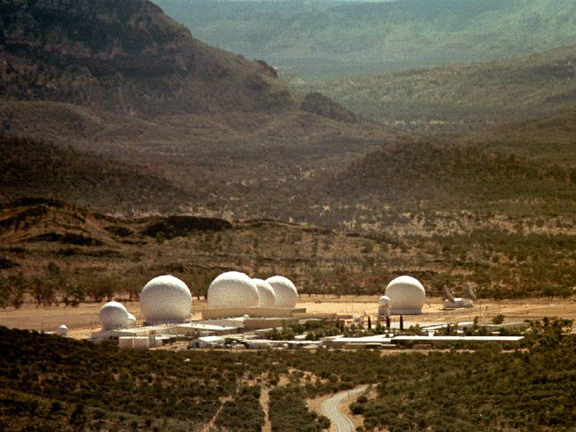
What is more pressing for the Canberra apparatchiks is what a base like Pine Gap does in the context of spats with other powers which Australia shares ties with. The China rise is particularly problematic, given the teeth-gnashing belligerence being shown over maritime disputes.
Even as Chinese nationals purchase Australian real estate, tremors between Washington and Beijing can be felt as the base celebrates its half-century. A happy birthday it would have been, but only for some.
The Alice Spring News Online described it, not inaccurately, as a “stealth party.” The Convention Centre hosting the dinner was tight lipped throughout the week about the guest list. “Unfortunately the details of this weekend’s event are not available for public release.” Not for residents in Alice Springs; not for the electors, or even the politicians. This would be an imperial, vetted affair.
A sense about how the base functions in a defiant limbo, one resistant to Australian sovereignty, can be gathered in various ways. The local federal member, Chansey Paech, whose constituency hosts the base, was not invited. Senator Nigel Scullion’s query about the exclusion of media from the event was rebuffed by the Defence department, with the Defence Minister keen to hold the line against her own colleague.
The Institute for Aboriginal Development (IAD), charged with supplying the indigenous “welcome to country” gathering at such bashes, seemed less than pleased to supply details. When the intrepid Alice Springs News Online dared ask, the CEO Kerry Le Rossignol responded with a dismissive “No comment.”
On July 25, a Defence spokesperson insisted that, “The Joint Defence Facility Pine Gap is proud to commemorate its 50th anniversary. However, celebrations are restricted to site personnel and invited guests only.” Power without perusal; might, without scrutiny. Continue reading →
August 2, 2017
Posted by Christina Macpherson |
AUSTRALIA - NATIONAL, politics international, weapons and war |
Leave a comment
Last Friday, landowners who volunteered a site for the National Radioactive Waste Management Facility made a trip to Australia’s home of nuclear science, the Australian Nuclear Science and Technology Organisation (ANSTO).
Brett and Michelle Rayner, who volunteered part of their property for consultation on the national facility, toured ANSTO, meeting with ANSTO’s CEO and the local Mayor.
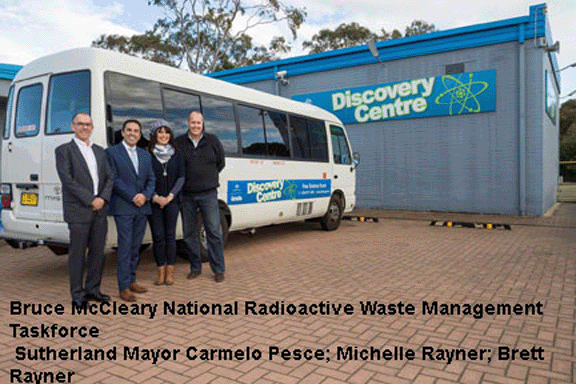
Brett said that the experience showed him that the waste was even safer than he thought.
“I was originally against the proposal, but after attending the community meetings I got the information and could see that there are no safety risks and there is opportunity for our community,” he said
“Based on that I volunteered my land, but coming to ANSTO and seeing this operation in person has really confirmed for me that this waste can and is being safely managed,” he said.
Being able to walk up to the intermediate level waste and touch the container it’s stored in, and to hear and see the different ways that the waste is treated to make it safe, was amazing.
“There is so much more done with this one reactor than I even imagined, so it was great to be able to come, see the way things are done here, and ask all your questions.”
 Michelle said that she really enjoyed the opportunity to come and see the reality of what waste storage looks like.
“What’s done at ANSTO is just mind-blowing, and what stood out is the wide variety of research that goes on here, that people maybe don’t realise the huge contribution nuclear science makes.”
Michelle said that she really enjoyed the opportunity to come and see the reality of what waste storage looks like.
“It has been extremely informative, it’s really opened our eyes to how safe the waste is – in many ways it is no scarier than a garbage bin,” she said.
“What’s done at ANSTO is just mind-blowing, and what stood out is the wide variety of research that goes on here, that people maybe don’t realise the huge contribution nuclear science makes.”
August 2, 2017
Posted by Christina Macpherson |
AUSTRALIA - NATIONAL, Federal nuclear waste dump |
Leave a comment