Desert Fireball Network (DFN), captures video of fireball across South Australia
Video emerges of fireball streaking across South Australia sky http://www.9news.com.au/national/2017/07/05/10/47/video-emerges-of-fireball-streaking-across-south-australia-sky Jul 5, 2017 New video has emerged of the moment a fireball streaked across the sky in South Australia last week.
Climate Change Authority has now lost all of its climate scientists
 Climate Change Authority loses last climate scientist, Guardian, Graham Readfearn. 6 July 17 David Karoly says without an expert to replace him, the CCA will struggle to fulfil its legal mandate. Imagine, if you will, a government board to champion Australian arts without any artists on it, or an agency to advise on medical research without any medical researchers.
Or perhaps even, imagine a government authority set up to provide expertise on climate policy without any actual climate scientists.
Well you don’t have to imagine that last one, because that’s what we now have – the government’s Climate Change Authority is now sansclimate scientist.
Prof David Karoly, of the University of Melbourne, has just finished his term on the authority’s board – the only member to stick it out for the full five years.
Karoly says without someone to replace him, the authority will struggle to fulfil its legal mandate. He told me:
it [the government] won’t replace Karoly and will instead just rely on the chief scientist, Alan Finkel, to act as a go-between, which of course is much more efficient and logical than actually having a climate scientist right there in the room. That would be silly, right?…….
Under the former Liberal leader Tony Abbott, the government vowed to axe the authority entirely – but couldn’t get enough support in parliament. So instead, if you believe its former insiders, the authority was carefully manipulated and undermined.
As Hamilton put it, the CCA became “dominated by people who want action, but not too much action”. https://www.theguardian.com/environment/planet-oz/2017/jul/05/climate-change-authority-loses-last-climate-scientist
Australia’s energy policy now under the control of the climate denying extreme right wing idealogues
 How the far Right have hijacked Australia’s energy policy, REneweconomy,
That was, however, before he was prime minister and became master of all he surveyed, apart from his own climate and energy policies. The thrust of Harwin’s speech was this: the era of baseload coal is coming to an end, fossil fuel plants are not a guarantee of reliability, wind and solar offer the cheapest forms of new generation, we need to look at storage, and we must not lose sight of the long-term climate targets.
Turnbull is not allowed to say any of these things, for fear of upsetting the Far Right. The sight of the craven apology offered by front bencher and government whip Christopher Pyne last weekend for daring to suggest that the moderates had some influence over policy matters was testimony to that.
The thrust of Harwin’s speech was this: the era of baseload coal is coming to an end, fossil fuel plants are not a guarantee of reliability, wind and solar offer the cheapest forms of new generation, we need to look at storage, and we must not lose sight of the long-term climate targets. Turnbull is not allowed to say any of these things, for fear of upsetting the Far Right. The sight of the craven apology offered by front bencher and government whip Christopher Pyne last weekend for daring to suggest that the moderates had some influence over policy matters was testimony to that.
Frydenberg said this to the party room and then repeated it when addressing an energy conference in Melbourne a week later. He made clear it was not about energy security, but “levelling the playing field” between lower cost renewable and expensive and polluting coal.
It’s a classic case of overkill – of politics over policy, and of ideology over technology.
It is true that the Far Right in Australia have not had the same powers as their colleagues now have in the US, where climate science, environmental protections, renewable policies, and emission controls are being systematically trashed and dismantled by the Trump administration.
But they have given it a good shot. While in power, the Abbott government abolished the carbon price, slashed the renewable energy target and other institutions. Since losing power, they have still succeeded in freezing their policy, or politics, in time.
And so too have been the efforts of federal energy minister Josh Frydenberg to placate the Far Right by suggesting that each individual new wind and solar farm should carry an equal amount of storage for its rated capacity – megawatt-hour per megawatt – effectively trying to turn the new technology into the same monoliths that exist now in the current energy market model which is clearly past its use by date. Frydenberg said this to the party room and then repeated it when addressing an energy conference in Melbourne a week later. He made clear it was not about energy security, but “levelling the playing field” between lower cost renewable and expensive and polluting coal. It’s a classic case of overkill – of politics over policy, and of ideology over technology. It is true that the Far Right in Australia have not had the same powers as their colleagues now have in the US, where climate science, environmental protections, renewable policies, and emission controls are being systematically trashed and dismantled by the Trump administration. But they have given it a good shot. While in power, the Abbott government abolished the carbon price, slashed the renewable energy target and other institutions. Since losing power, they have still succeeded in freezing their policy, or politics, in time.
The whole debate around the potentially ground-breaking Finkel Review boiled down to whether it was good for coal generators or not.
The climate science was discarded, and then the fossil fuel industry and the conservatives began to question the very idea that wind and solar were cheaper than new coal. Fake news made front page headlines in the Murdoch media as the incumbents fought back.
Harwin’s speech puts a nonsense to this, and highlights the fact that to be a member of a conservative government does not necessarily equate to the need to deny basic facts.
It is worth repeating Harwin’s major themes, because like the $565 million investment in Nectar Farms, the creation of 1,300 jobs and the shift of one of Australia’s biggest vegetable growing operations to 100 per cent renewables, it did not get a single mention in the mainstream media.
It seems there are some things MsM doesn’t want you to know. (Although we should belatedly note that the Guardian did finally write a story on the Harwin speech on Tuesday, nearly a week after it was delivered).
The whole debate around the potentially ground-breaking Finkel Review boiled down to whether it was good for coal generators or not. The climate science was discarded, and then the fossil fuel industry and the conservatives began to question the very idea that wind and solar were cheaper than new coal. Fake news made front page headlines in the Murdoch media as the incumbents fought back. Harwin’s speech puts a nonsense to this, and highlights the fact that to be a member of a conservative government does not necessarily equate to the need to deny basic facts. It is worth repeating Harwin’s major themes, because like the $565 million investment in Nectar Farms, the creation of 1,300 jobs and the shift of one of Australia’s biggest vegetable growing operations to 100 per cent renewables, it did not get a single mention in the mainstream media. It seems there are some things MsM doesn’t want you to know. (Although we should belatedly note that the Guardian did finally write a story on the Harwin speech on Tuesday, nearly a week after it was delivered).
The major themes of the speech were in direct opposition to the positions and beliefs held by the Far Right. Continue reading
Map of Aboriginal massacres shows that these colonial wars should be recognised
For the full map by the Centre for 21st Century Humanities and the Centre for the History of Violence, visit https://c21ch.newcastle.edu.au
 Mapping Aboriginal massacres makes it time to recognise the colonial wars, say leading historians http://www.smh.com.au/national/mapping-aboriginal-massacres-makes-it-time-to-recognise-the-colonial-wars-say-leading-historians-20170705-gx4y3m.html, Julie Power. 5 July 17, Almost every Aboriginal clan experienced massacres at the hands of early settlers in the “colonial wars”, according to the first stage of a new online mapping project.
So far the project has documented 150 massacres resulting in at least 6000 deaths in the early years of the colony. Most happened at dawn with a surprise attack on an Aboriginal camp where people “simply couldn’t defend themselves”, said University of Newcastle historian Professor Lyndall Ryan, who has been developing the online digital map for nearly four years.
Yet those who died defending their people and land have rarely been recognised. Professor Ryan and Tasmanian author Professor Henry Reynolds – whose books documented the “forgotten” and “silent” colonial wars against Aboriginal people – said it was time for the Australia War Memorial to recognise this war. Continue reading
Latest renewable energy news from REneweconomy
-
Musk praises SA’s “gumption” for building global example of energy futureElon Musk says Earth can be “powered with solar and battery,” praises South Australia for its “gumption” in leading the way.
-
Energy Locals defies industry and cuts consumer electricity ratesEnergy Locals announces cut to electricity tariffs, and a jump in solar tariffs as rest of industry lifts rates by nearly 20%.
-
Tesla Powerpack to enable large scale sustainable energy to South AustraliaThe Tesla Powerpack system will further transform the state’s movement towards renewable energy and see an advancement of a resilient and modern grid.Melbourne-ANU to lead new Energy transition hubThe Energy Transition Hub will generate collaborative and world-leading research to help the technical, economic and social transition to new energy systems and a low emissions economy.
-
Urgent need for Australia to act as world races ahead on electric vehiclesFrance’s announcement that it willban all petrol and diesel vehicles by 2040 is an urgent wake-up call for Australian governments to take immediate action to support growth in the domestic industry.
North Korea’ latest intercontinental ballistic missile would be able to hit Darwin
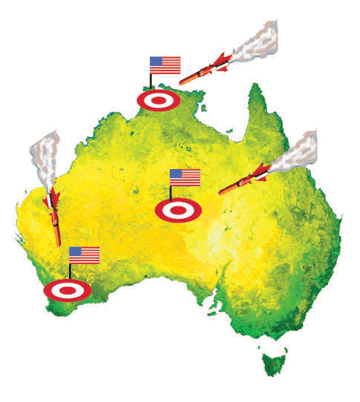 Australia now within range of new North Korean missile, as calculations show it could fly far enough to hit Darwin
- The ‘landmark’ test of a Hwasong-14 missile was overseen by leader Kim Jong-Un
- It was fired from a site in the North Phyongan province into the Sea of Japan
- It is believed to have reached an altitude of 2802 km and flew 933 km
- The North has long sought to build nuclear missiles capable of reaching the US
- Weapons analysts say the missile has the capability to travel up to 6,700km
- Darwin is only 5,750km from Pyongyang, putting Australia into the firing line
Experts say the missile could reach a maximum range of 6,700km on a standard trajectory, meaning it would be able to hit Darwin, which is 5,750km from Pyongyang.
David Wright, of the Union of Concerned Scientists, wrote on the organisation’s allthingsnuclear blog that the available figures implied the missile ‘could reach a maximum range of roughly 6,700 km on a standard trajectory’.
‘That range would not be enough to reach the lower 48 states or the large islands of Hawaii, but would allow it to reach all of Alaska.’ …………http://www.dailymail.co.uk/news/article-4664328/Australia-range-new-North-Korean-missile.html#ixzz4ltt8SE9M
Australian uranium miner Paladin Energy going broke
 Paladin Energy enters administration, WNN, 03 July 2017 Paladin Energy Ltd has today appointed administrators after it was unable to agree a delay to the repayment of $277 million it owes Electricité de France (EDF). The administrators will continue to operate the company on a business-as-usual basis until further
Western Australia-based Paladin in February announced plans for a balance sheet restructuring to enable it to meet debts due in April, after plans to sell a 24% stake in the Langer Heinrich uranium mine in Namibia to China’s CNNC Overseas Uranium Holdings failed to progress. The sale of a 30% stake in the Manyingee project in Western Australia to Avira Energy Ltd (formerly MGT Resources), announced at the same time as the CNNC sale in July 2016, also failed to complete.
CNNC, which already owns a 25% joint venture equity stake in the Namibian project, subsequently began a process that could lead to it exercising an option to acquire all of Paladin’s share of Langer Heinrich. This led to the proposal in May of an alternative restructuring plan by Paladin, as the original plan had assumed the company would retain an ongoing interest in its Namibian flagship project.
Paladin is due to pay EDF $277 million by 10 July under a long-term supply agreement signed in 2012. The company said it had approached EDF to grant a “standstill” agreement, which would allow time for the alternative restructure proposal to be implemented. Although terms had been negotiated they had not been signed.
“EDF has now informed Paladin that it is not prepared to enter into a standstill agreement and requires payment of the amount when due on 10 July 2017,” Paladin said today……. http://www.world-nuclear-news.org/UF-Paladin-Energy-enters-administration-0307177.html
Australian politicians condemn North Korea’s missile test
 North Korea’s missile test condemned by Australia, ABC News, By political correspondent Louise Yaxley 4 Jul 17 Australia has condemned North Korea after it said it had successfully tested a new intercontinental ballistic missile capable of hitting “anywhere in the world”.
Foreign Minister Julie Bishop called it a provocative act that is in breach of numerous United Nations Security Council resolutions. “North Korea continues to threaten its neighbours while undermining regional and global security,” Ms Bishop said in a statement. “North Korea’s long-term interests would be best served by ceasing its nuclear and missiles programs and focusing on improving the lives of its long-suffering people.”
The statement echoed her remarks after a North Korean missile test in April.
US Vice President Mike Pence was visiting Australia when that test occurred and declared the “era of strategic patience” over.
Ms Bishop said North Korea was “on a path to achieving nuclear weapons capability and we believe Kim Jong-un has a clear ambition to develop an intercontinental ballistic missile capable of carrying a nuclear payload as far as the US”.
“That would mean Australia would be in reach,” Ms Bishop said.
Australia ‘blindly and zealously toeing the US line’
Those comments angered North Korea, which singled out the US deployment of marines to Darwin as evidence of preparation for war. A North Korean Foreign Ministry spokesman said Australia was “blindly and zealously toeing the United States line”.
“If Australia persists in following the US’ moves to isolate and stifle North Korea … this will be a suicidal act of coming within the range of the nuclear strike of the strategic force of North Korea,” the spokesman said.
Defence Industry Minister Christopher Pyne responded by saying the location of US marines in Darwin was a longstanding government policy. “It’s not in any way a preparation for a conflagration on the Korean Peninsula,” he said. “Obviously, we want to avoid any such military action and we want the North Koreans to behave as well as they can, like reasonable, international citizens.
“That means ending their missile testing and not preparing for a nuclear war with either the United States, Japan, South Korea or anyone else for that matter.”……..http://www.abc.net.au/news/2017-07-04/north-korea-missile-test-condemned-by-australia/8677922
Australia Institute takes up the challenge of climate change research and communication
The Australia Institute to Continue Legacy as Climate Institute Shuts its Doors. Pro Bono Australia 3 Jul 17 Australia’s first non-government organisation to focus solely on climate change has shut its doors after more than a decade of climate advocacy work, passing the baton on to the Australia Institute. Monday, 3rd July 2017at 4:26 pm
Wendy Williams, Journalist, The Climate Institute, which was founded in 2005, closed on Friday due to a lack of funding.
Any remaining funds and intellectual property are set to be transferred to the Australia Institute, to “help carry forward the Australia Institute’s climate change-related research and advocacy”.
Mark Wootton, chair of the Climate Institute board said the Australia Institute was chosen from a short-list of strong candidates to continue the legacy.
“I am pleased to announce that, following the closure of the Climate Institute on 30 June, its significant remaining funds and intellectual property will be transferred to the Australia Institute, to help carry forward the Australia Institute’s climate change-related research and advocacy,” Wootton said.
“The Australia Institute shares our commitment to relevant, robust research, innovative communication and well-targeted advocacy….
At the time it was founded the Climate Institute was the only non-government organisation focused solely on climate change.
Through its Climate of the Nation series, the institute conducted what is now the longest trend survey of the attitudes of Australians to climate change and its solutions……
The Australia Institute announced it would establish a specialist Climate and Energy Program to “secure the ongoing legacy of the Climate Institute efficiently and effectively”.
The new program will also house the recently launched National Energy Emissions Audit. https://probonoaustralia.com.au/news/2017/07/australia-institute-continue-legacy-climate-institute-shuts-doors/
And MORE renewable energy news from REneweconomy
-
 Two more solar farms approved for Queensland’s northAnother 141MW of utility-scale solar farms approved for development, as Sunshine State starts to live up to its massive PV potential.
-
The new standard that could kill the home battery storage marketIndustry warns that if proposed new battery installation standards remain unchanged, the Australian behind-the-meter battery storage market will be stopped dead in its tracks – and the estimated by the CSIRO at up to 85GWh by 2040 – will simply fail to materialise.
-
Wind output contrained in South Australia as it blows above 1200MWAEMO constrains wind farms in South Australia for first time because there were not enough “synchronous units” as wind output blew above 1200MW.
-
Minerals Council makes believe on coal and renewable costsMinerals Council halves cost of coal, doubles cost of wind and solar and comes up with fantasy number of $27bn for a 650MW renewable plant.
-
Know your NEM: Prices fall, but say goodbye to the good old daysThere will be a cost to decarbonise the economy, its’ just a lot less than the cost of not decarbonising. Generation prices will stay high, network prices will be sticky, and the incentive for “grid defection” is going to continue.
-
Buzz Lightyear: first solar-powered family car hits the marketThe Lightyear One, developed by Dutch startup Lightyear, now available sale at retail price of €119,000. Company hopes to secure 200 orders by end of year.
-
Tilt Renewables pushes go button on 54MW Victoria wind farmTilt Renewables says will push ahead with 54MW Salt Creek wind farm in Victoria, and will go “merchant” without a power purchase agreement.
Garnaut: CET may be useless without higher emission targetsGarnaut says Australia could likely meet its reduction targets without a CET, rendering it useless and debate about it irrelevant. He proposes a dual pathway to resolve the political impasse. -
-
SA Water tenders for solar and battery storage to manage high power pricesSA Water Corporation seeks to build grid-connected, rooftop solar PV system of more than 100kW, plus 50kWh battery storage system and “smart controls.”
News from REneweconomy today
-
What will incumbents do next? “I expect them to go broke”Garth Heron, who is now the head of Wind Power Development at Neon Australia, shares his blunt assessment of what incumbents will do next in their war against renewables in Adelaide.
-
Changes to Green Star set the scene for carbon zero buildingsAfter a lengthy industry consultation period, the GBCA has released new versions of the Green Star Interiors rating tools which promise to drive the uptake of low-carbon buildings, incentivise new industries and challenge the market leaders to innovate.
-
Renewable Energy Market Report – steady as she goesThe market for renewable energy certificates steadied in June as traders absorbed the implications of the Finkel Review for the current RET.
-
New back-up rule means end of cheap wind power in South AustraliaThe ability of wind power to deliver significant price falls in South Australia has been eroded by new rules that require more expensive gas generators to operate at times of high wind output. The days of “negative pricing” may be over.
-
Photon Energy plans 316MW solar farm for southern NSWNetherlands-based solar developer reveals plans to build largest solar farm in NSW – and one of biggest in Australia – a 316MW project near Gunning.
-
Australia’s nuclear lobby hoping for nuclear submarines as a ‘foot in the door’
Steve Dale No Nuclear Waste Dump Anywhere in South Australia 3 JUNE 17 The nuclear submarine push seems to have become the preferred “foot in the door” for nuclear. If we had nuclear submarines, refueling and the disposal of waste would still be in South Australia (according to Abbott) – out of mind of the Sydney/Melbourne populations.
Politicians talking about small nuclear reactors backfires for them because that implies the reactors will need to be near Sydney and Melbourne and that will stir up a lot of nuclear push back. So despite the questionable benefits of Australia having nuclear submarines, the nuclear lobby thinks it will get us “hooked” into the nuclear waste cycle.
The Cape Hardy port development and the large purchases of land around the port are probably already earmarked as the nuclear submarine maintenance location. The Abbott/lobbyists are even talking about “leasing” nuclear subs – they are so desperate to suck us in. https://www.facebook.com/groups/1314655315214929/
Mystery of fireball seen in sky near Port Lincoln
 South Aussies mystified as blazing fireball tears through sky https://au.news.yahoo.com/a/36231067/port-lincoln-fireball-in-sky-video-mystifies-south-australia/?cmp=st#page1 on July 1, 2017,
Experts are not sure if it’s a meteor or a piece of space junk.
Nor are they sure where, or if, it landed.
Ten years of the Northern Territory intervention. Time it stopped
 Ten years too long — stop the intervention https://www.greenleft.org.au/content/ten-years-too-long-stop-intervention Alice Springs, June 30, 2017
The following is a statement issued by participants of the StandUp2017 conference that concluded with a rally in Mbantua (Alice Springs) on June 26.
Rosalie Kunoth Monks: “You better believe it, when the Intervention first hit in 2007 community councils were decimated.”
Matthew Ryan: “Trying to get the government to listen to us, is like a brick wall.”
Elaine Peckham: “When the Intervention came they took away services from homelands. No health services. I had to move back to town. I didn’t want to.”
Yarrentye Arltere Larapinta Valley Town Camp: “Ten years too long. Ten years of hardship, neglect and broken promises. We want Aboriginal control for Aboriginal people by Aboriginal people.”
We need to keep our culture strong. We need to be in control of decision making. We want self-determination.
After ten years the Intervention has met none of its objectives. There are more people in jail, more children being taken away, there is more unemployment.
This StandUp2017 conference makes the following comments and call outs:
Repeal racist Intervention laws
Racist laws introduced through the Intervention have created apartheid and are still with us. Repeal the stronger futures laws.
Repeal changes to social security law that allow for control over our money. End the ban on consideration of customary law in bail and sentencing. Bring back the permit system.
Community governance Continue reading
1 This month


Help Aunty Sue Protect Her Land and Sacred Sites From Destructive Rocket Testing.
.

Australians deserve the truth
about
AUKUS – https://aukuspublicinquiry.com/

PETITION – To: Prime Minister Anthony Albanese and the Australian Labor Government

of the week – Australians for War Powers Reform (AWPR)
To see nuclear-related stories in greater depth and intensity

