Finkel Review not much help for solar and storage home customers
Finkel Review: What’s in it for solar and storage customers like Jenny? REneweconomy By Dominic Adams on 14 June 2017 The focus of this piece is about what the Finkel Review delivers for a Mojo customer, Jenny. Jenny has solar on her roof and a smart battery in her garage.
Having your attention though (and also my cake and eating it) I’d like to start by noting that we should think carefully before opposing the Clean Energy Target (CET), the big ticket item in the Finkel Review designed to reduce emissions in the power sector.
It’s become more important to put the carbon wars behind us for a time than to find the perfect policy.
The CET is far from perfect. It’s all carrot and no stick. It’s a political and environmental compromise. But it’s our last best hope of ending the lost years of uncertainty in the generation sector that are now leading to wholesale electricity price rises that will start flowing through to customers like Jenny in a few weeks.
Mojo’s mission is to drive down the costs of energy for its customers (including Jenny), and we think that ending the uncertainty in the policy environment is an essential step in that direction.
The CET however makes up just a fraction of the 212 page report. It’s a few paragraphs out of the 7 pages packed with recommendations 1.1 through 7.14. It’s fair enough to ask the question, what’s in all those recommendations for Jenny?
The answer is somewhat unclear at this stage, but the signs aren’t great for Jenny in the short to medium term.
The big problem that the Finkel Review is charged with solving is how to decarbonise the energy sector while keeping the system secure and inexpensive for consumers.
A key focus however is on the security of the system in the wake of a particular storm in South Australia (plus more than a few in teacups in Canberra). The security issue is summed up well in the Review:
“Because [system security services such as inertia, system strength and voltage control] were historically plentiful, as essentially a by-product of power supply from synchronous generators, they were not explicitly valued in the [National Electricity Market (NEM)]. With their growing scarcity, the hidden value of these services has emerged. New mechanisms will be needed to source these services, or appropriate alternatives, from synchronous machines and a range of other technologies.”
As more renewable energy pushes into the NEM, driven initially by policy, but increasingly by sheer economics, system security services are in decline. The same process contributes to reliability issues, where the lights go out because available supply can’t meet demand in the NEM.
People with batteries and controllable devices behind their meters (the so called prosumers, or Jenny) can provide system security services to the market as well as help supply meet demand in the NEM.
The key issue in the Finkel Review for Jenny is what the mechanisms for sourcing these services will be, and whether she will be able to benefit from the value that her assets provide……..
What it ultimately means for Jenny is that her solar system and battery are less valuable. Her assets can’t access all the value in providing security and reliability services because initially the markets don’t exist for those services.
In the longer run, when the markets may exist after the long process of review and policy development, the value may not be there anymore. The lions share of the value could be taken by the grid scale batteries and other devices that were required to be built in the non-market phase.
We think a better approach is to fast-track the development of market based solutions to these issues. Doing so will not just increase the benefits for Jenny, but also reduce costs for other consumers not fortunate enough to afford solar and a battery.
At Mojo we will keep up the fight for Jenny and our other customers, because they have better things to do than read the Finkel Review.
Dominic Adams is Regulatory Strategy Manager for energy retailer Mojo Power http://reneweconomy.com.au/finkel-review-whats-solar-storage-customers-like-jenny-79674/
Ukraine uranium sales plan: Unreasonable, unstable and unsafe
In a statement tabled in the Senate last night, the Turnbull government has confirmed it will seek to proceed with selling Uranium to Ukraine despite significant safety and security concerns raised by the Joint Standing Committee on Treaties.
Uranium exports to Ukraine
“Australia, the nation that fuelled Fukushima should not sell uranium to the country that gave us Chernobyl,” said the Australian Conservation Foundation’s Dave Sweeney.
In February a JSCOT investigation found that existing safeguards were ‘not sufficient’ and there was a risk Australian nuclear material would disappear off the radar in Ukraine.
The government has ignored JSCOT’s recommended pre-conditions around risk assessment and recovery of nuclear materials and is looking to advance the deal despite the risks of war, civil unrest and nuclear insecurity in the eastern European country, which is involved in hostilities with Russia.
“The treaties committee’s report found ‘Australian nuclear material should never be placed in a situation where there is a risk that regulatory control of the material will be lost’, yet this is exactly what could happen under the deeply inadequate checks and balances that apply to exported Australian uranium,” said Mr Sweeney.
“JSCOT recommended the Australian government undertake a detailed and proper risk assessment and develop an effective contingency plan for the removal of ‘at risk’ Australian nuclear material prior to any sales deal.
“Unreasonably and irresponsibly the government response fails to credibly address this. Australia should be very cautious about providing nuclear fuel to an already tense geo-political situation in eastern Europe.
“Ukraine’s nuclear sector is plagued by serious and unresolved safety, security and governance issues.
“Two-thirds of Ukraine’s aging fleet of 15 nuclear reactors will be past its design lifetime use-by date in just four years.
“This is an insecure and unsafe industrial sector in a highly uncertain part of the world. Australian uranium directly fuelled Fukushima and this deeply inadequate response shows the government has learnt little and cares less”.
Turnbull once again in a bind with Liberal climate denialists over Clean Energy Target plan
 Tensions erupt in Turnbull government over climate and energy policy, The Age, James Massola, 14 June 17, Climate-change policy has ignited tensions within the federal government, with a group of backbench MPs led by Tony Abbott confronting Malcolm Turnbull over the proposed Clean Energy Target in a special party room meeting.
As one MP in the room put it afterwards: “Malcolm could lose his leadership over this if he doesn’t listen to us.”
The disquiet means that Environment and Energy Minister Josh Frydenberg is likely to have little choice but to significantly modify the Clean Energy Targert (CET), as proposed in chief scientist Alan Finkel’s review, to keep the backbench on-side as he finalises the Coalition’s policy response, which is expected as soon as the end of July.
If he does, Mr Frydenberg runs the risk of putting Labor offside – particularly if the policy is too coal-friendly – and dashing the chance of the major parties striking compromise and ending the climate policy wars.
According to several MPs in the room, at least 21 backbench MPs raised concerns about the CET, while five spoke in favour of it and five were said to be non-committal.
Another senior MP in the room said while 32 people had spoken, one third of the speakers had been in favour of the Finkel review’s recommendations, one third opposed them outright and one third expressed concerns but were non-committal. Continue reading
Giles Parkinson outlines ways to improve the Finkel Energy plan
 Five ways to improve Finkel’s energy blueprint http://reneweconomy.com.au/five-ways-to-improve-finkels-energy-blueprint-60985/ By Giles Parkinson on 13 June 2017 [good graphs]
First thing first, this scheme won’t amount to a hill of beans unless the Paris climate targets are adopted, and that does not mean the modest down-payment from the Coalition on which this blueprint is modelled, but a serious attempt to deliver on the pledge to limit average global warming to well below 2°C.
Quite why the chief scientist didn’t choose to make much of the chief science questions is a bit of a mystery, but he did underline the importance of bipartisan and federal and state agreement on this. The reaction, to date, shows this is as difficult now as it was when the climate-denying, fossil fuel-backing Coalition hard right thrust Tony Abbott to the head of the party in 2009.
Can we see some modelling please? The actual energy blueprint is vague on details. Some results of the modelling are shown, such as the modest fall in consumer bills (above), and the lingering presence of coal-fired generation in 2050 (25 per cent).
But the inputs are not revealed, neither are comparisons with other options, or how they are stress-tested with a 2°C target. Most consumer watchdogs would warn against buying something with so little information, and no warranties, but that is – in effect – what we are being asked to do. Or, at least, may be what the Coalition back bench is being asked to do.
The gentailers have too many vested interests to protect, so a better and more efficient mechanism would be for a new authority to auction capacity at various points along the target. This has been used very effectively across the world, and at state level too. It gets a good price and avoids the market being held to ransom.
Be smarter about energy storage. There is no doubt that many solar plants, and wind farms, will be happy to add battery storage to their installations, and Finkel’s report acknowledges that these combinations will beat either gas or coal on both costs and emissions. But Finkel’s proposed obligation for ALL new wind and solar plants to have storage seems like regulatory overkill, adding unnecessarily to prices.
Only in South Australia has the penetration of wind and solar reached a level where storage is now required, according to the CSIRO, which suggests that anything under 40 per cent wind and solar is “trivial” to the management of the grid (presuming the grid managers are on top of their brief). So making a no-argue requirement now seems overkill, and the approach of the Victoria and Queensland state governments – calling for bids for cheapest storage – as they roll out more wind and solar seems more sensible.
Make this transition quicker, smarter, cleaner. As we noted last week, this is not Grid 2.0, it’s actually not a whole lot different from business as usual. This review was an opportunity to redefine those boundaries, but comes up short, mainly because it does not focus enough on the implications and the benefits of all the solar and storage added behind the meter by households and businesses. The CSIRO estimates $200 billion will be spent by consumers over the next three decades.
They will want to know that this investment is worth it, and they are not locked in to a utility business model that has failed to evolve, and continues to impose costs on consumers. Indeed, half of their bills comes from the transport of electricity, which means that even if the wholesale component was free, it could not match the cost of solar and storage. Which does not mean, for a moment, that everything would go off the grid, or should; but unless there is some regulatory recognition that technology changes and costs are moving fast, then they will simply not be prepared to deal with it.
And let’s not forget, all consumers will be wanting more than $90 savings a year over the next decade after seeing their bills going up $300 a year. That’s one step forward and three steps back. There is simply no reason why more savings cannot be delivered, given the falling cost of wind, solar and storage.
Professor Marcia Langton promoting Big Coal, not Aboriginal Rights
The problem is that Langton’s argument boils down to mining, good, anything that stands in its way, bad. That’s why it falls apart when faced with Adani’s proposed coal mine in the Galilee Basin, slap-bang in the middle of which is Wangan and Jagalingou country.
Adani’s proposed mine has become the Coalition’s cargo cult and its free-marketeer ministers have happily ditched their principles to promote it, fund it and change laws (including the Native Title Act) to try and force it to happen.
For this treatment to come from a non-Aboriginal person would be suspect, but for it to come from a fellow Indigenous Australian is surely unforgivable.
 Why Marcia Langton is wrong on Adani https://independentaustralia.net/business/business-display/why-marcia-langton-is-wrong-on-adani,10396 Tom Allen 13 June 2017 For all her powerful and peerless leadership of Aboriginal rights, Professor Marcia Langton has it wrong on Adani.
Her speech to the Minerals Council of Australia (MCA) last week made headlines because she provocatively accused environmentalists of wanting to send Aboriginal Australians back to terra nullius. That’s simply wrong. But perhaps just as bad is the fact that, just as the #StopAdani campaign is gearing up, Ms Langton was shilling for Big Coal. Continue reading
Josh Frydenberg, Minister For Fossil Fuel Energy, prevents hybrid renewable energy plus battery storage microgrid at Lord Howe Island
 Lord Howe microgrid in doubt as Frydenberg rules out wind turbines http://reneweconomy.com.au/39084-2/, By Sophie Vorrath on 13 June 2017 One Step Off The Grid
Plans to install a hybrid renewable energy plus battery storage microgrid at New South Wales’ Lord Howe Island, and slash its diesel fuel use, have hit a major political snag, after the federal energy minister intervened to rule out the wind power component of the long-awaited, ARENA-backed project.
The project – which has been in the works for some six years now, and in 2014 won a $4.5 million grant from the Australian Renewable Energy Agency and a $5.6 million loan from NSW Treasury – was to install 500kW of wind, 400kW solar PV and 400kWh of battery storage, in an effort to cut the island’s diesel usage by two-thirds.
Just one year ago the Lord Howe Island Board called for tenders for the installation of the first stage of the project’s development.
But the Board’s manager of infrastructure and engineering services, Andrew Logan, said Minister Frydenberg had ruled, late last week, that the impacts of the proposed two 250kW wind turbines on the Island’s World and National Heritage values – particularly on its ‘visual landscape’ – were unacceptable. Continue reading
Pipeline of solar farms across Australia to begin from Western Australia
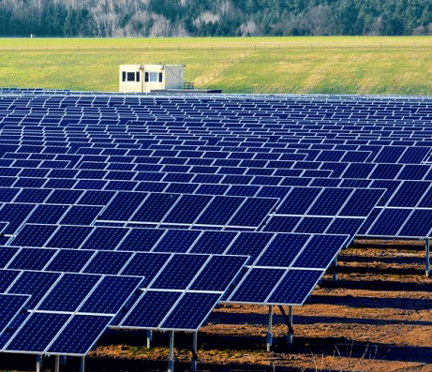 WA, UK team announce $200m big solar pipeline for Australia, REneweconomy, By Sophie Vorrath on 13 June 2017 Western Australian large-scale solar start-up Stellata Energy has joined forces with UK based renewables investment specialist, Ingenious, to build what they say is a $200 million pipeline of solar farms across Australia, starting with a flagship 120MW ground-mounted project in their home state.
The companies said in a join announcement on Tuesday that they were seeking approval to build a 120MW ground-mounted solar plant in the regional town of Merredin, roughly half way between Perth and Kalgoorlie.
The partnership signals the arrival of yet another European investor into the Australian market, in the rush to meet the remainder of the 2020 renewable energy target as technology costs continue to fall.
Stellata, which has been around for roughly one year, says it is well placed to deliver large-scale solar in Western Australia, with an executive team with extensive previous experience developing more than 600MW of ground-mounted and rooftop solar across Europe.
Ingenious, meanwhile, has raised and deployed more than £9 billion, including £500 million in renewables projects across the UK and Ireland, the companies said……http://reneweconomy.com.au/wa-uk-team-announce-200m-big-solar-pipeline-for-australia-58923/
Adani could be looking for an excuse to back out of unviable Carmichael coal project
As Adani continues to find multiple reasons to delay progress on Carmichael, one might argue that perhaps it is looking to holdbacks on a hoped-for string of royalty/loan/water subsidies as the excuse it needs to withdraw from the project.
 Adani’s ‘pit-to-plug strategy’ is fraying at both ends http://reneweconomy.com.au/adanis-pit-plug-strategy-fraying-ends-86291/ By Tim Buckley on 13 June 2017 Gautam Adani, the chairman of the Indian conglomerate Adani Group, has long argued that the Carmichael coal proposal in the Galilee Basin of Australia is a key part of his company’s “integrated pit-to-plug strategy.”
The Adani logic for the Carmichael project assumes that the traded price of seaborne thermal coal is irrelevant to the commercial viability of Carmichael because the coal would be used within the Adani family group of companies.
The company line is that Carmichael venture needs to be viewed, in other words, strictly in the context of the overall profitability of the pit-to-plug strategy.
It’s a shaky foundation on which to proceed, however. Last week Adani Power reported that its core asset —the 4.6 GW 100 percent import-coal-fired power plant at Mundra—is no longer viable, news that brings what was an already questionable argument for Carmichael into further question.
In IEEFA’s view, any decision to walk away from Carmichael would require a A$1.4 billion (US$1.05billion) write-off for Adani Enterprises (AEL), a very unpalatable outcome for Adani Group bankers owed a collective US$15 billion, particularly if Adani Power (APL) were forced to also take a US$1 billion write-down on Mundra on top of the US$954 million net loss just reported.
- Adani Power’s financial distress is growing, which is why it has just recorded that US $954 million loss, Continue reading
Senator Scott Ludlam probes the Australian government’s plan to dump Lucas Heights’ nuclear waste on rural South Australia
 Assuming that the long-lived intermediate-level stuff does go to the sites that you are busy characterising at the moment, how long is it envisaged that it actually stays there before it gets taken somewhere else?
Mr B Wilson: We cannot give a definitive answer on that because we have not commenced a process to identify a permanent disposal solution for the long-lived intermediate-level waste—
Senator LUDLAM: Ouch!
if the really dangerous intermediate-level stuff is to be stored there you cannot tell them how long it is meant to be there for
so we kind of do not really know what is going on there or how long it is meant to be there for.
 ECONOMICS LEGISLATION COMMITTEE, Department of Industry – RADIOACTIVE WASTE 1st June 2017
Full Transcript here: http://parlinfo.aph.gov.au/parlInfo/download/committees/estimate/e3ddf88b-3e9c-4546-9d90-8f646689a98c/toc_pdf/Economics%20Legislation%20Committee_2017_06_01_5134.pdf;fileType=application%2Fpdf
Senator Canavan: I have been to Hawker and I am going there again tomorrow, and I would like to put on record my thanks to many in the Hawker community who engage in this process. Some have certainly changed their mind as they have come to have more understanding of it. I think you have probably been to Lucas Heights, and it I think it makes a big difference to people when they see it. There is a lot of misinformation spread about this, and we are trying to engage with people in a genuine way in good faith to give them the information to make informed decisions.
Senator LUDLAM: Who is spreading this information, Senator Canavan?
Senator Canavan: I hear it from time to time. I do not have any particular allegations to make about individual groups here, but you do hear lots of information from time to time about the potential danger of this material. But, of course, as you would probably know, much of the low-level waste is stored safely at Lucas Heights, a place where people go to and from work every day.
Senator LUDLAM: That begs the question of why it needs to move. ……
Senator LUDLAM: Staying in South Australia: has there been any consideration at all—this is for the department or the minister, whoever wants to take this one on—of the tension between the proposed national radioactive waste facility and the existing South Australian legislation, which would be the Nuclear Waste Storage Facility (Prohibition) Act 2000? The tension between the fact that your entire project is presently illegal under South Australian law: what is being done about that?
Mr B Wilson: We are certainly aware of the South Australian prohibition under their law. However, the National Radioactive Waste Management Act that we operate under overrides South Australian law.
Senator LUDLAM: And that is it? You are just going to squash them? Or are there discussions progressing with the South Australian government?….
Senator LUDLAM: Is the department, or you, Senator Canavan, or any of the federal agencies or other actors in communication with the South Australian government environment or heritage departments, or representatives of any body, actually, in relation to the tension between the two acts?
Senator Canavan: I have raised it with the South Australian government. They have indicated that they may seek to make changes. I am not aware of the status of that at the moment. Obviously, they have their own process, which is a separate to ours, on radioactive waste. Certainly, the issue has been raised. Mr Wilson is also right that we are confident that is not a barrier to this project. But Mr Wilson will be giving you that.
Mr B Wilson: We engage—I would have to characterise it as infrequently—with the South Australian government. It is more in the line of updating where we are. We have not had any recent engagements. They are certainly very well aware of the prohibitions under their law about what the South Australian government and its officials can do in this space….
When I said that the National Radioactive Waste Management Act overrides South Australian law, that is the fact. But what we are trying to do in the development of this project is to develop it and act in a way that is consistent with requirements under other South Australian legislation. For instance, in terms of Indigenous heritage protection and other aspects. While we are not necessarily bound by those laws we want to act in a way that is consistent with them.
Senator LUDLAM: With waste that is as dangerous as this, I am very glad to hear it! Is the department still accepting site nominations?
Senator Canavan: The government remains open to further nominations, as we announced on selecting the Hawker site last year. But the ones we have announced are those that we are proceeding with at this stage.
Senator LUDLAM: Wallerberdina and two at Kimba. Continue reading
Marcia Langton “poorly informed” on Adani coal mine, says leading native title lawyer
 Leading Indigenous lawyer hits back at Marcia Langton over Adani Tony McAvoy says traditional owners are ‘proud and independent’ and are not being used by anti-mining activists to block the $16bn mine, Guardian, Joshua Robertson, 9 June 17, One of Australia’s leading native title lawyers has spoken publicly for the first time as a traditional owner fighting to stop the Adani mine, a campaign he said was driven by “proud and independent people” who were among the best-informed Indigenous litigants in the country.
Tony McAvoy SC, who became Australia’s first Indigenous silk in 2015, said the Wangan and Jagalingou people were keenly aware of how their priorities differed from environmentalist allies in a battle to preserve their Queensland country from one of the world’s largest proposed coalmines.
McAvoy dismissed claims by the prominent Indigenous academic Marcia Langton that Indigenous people had become “collateral damage” as the “environmental industry” hijacked the Adani issue.
He said the rhetoric of Langton and Warren Mundine, who likened anti-Adani campaigners to colonial oppressors running roughshod over Indigenous self-determination, “serves a purpose for them but is just so inaccurate”.
The barrister said to suggest that “the greens are puppet masters pulling the strings and we’re somehow puppets” was wildly off the mark and disrespectful to the many families opposing the mine, including his.
The W&J are the only Indigenous group in Australia to have, in McAvoy, a senior counsel with expertise in native title law within their ranks.
“We are likely to be one of the best informed claimant groups in the country, we have many people who are experienced in native title, including my own input, and representation by an extraordinary team of lawyers,” he said.
McAvoy is part of a contingent within W&J who have mounted legal challenges to an Indigenous land use agreement (Ilua) with Adani, contesting the right of pro-Adani representatives to approve a deal previously spurned by their claim group. The miner resurrected an Ilua last year with majority support in the W&J native title applicant, then sought to register it with the native title tribunal.
But the W&J opponents challenged the deal in the federal court, on grounds including that the pro-Adani applicant members were voted out in a claim group meeting, and that a rival meeting that endorsed the Adani deal was not legitimate.
Then Adani’s hopes suffered a blow with the McGlade native title case, which found that an Ilua was invalid because not all Indigenous representatives had signed it.
The shock precedent prompted the government to put up a bill changing native title legislation to safeguard what it argued were hundreds of Iluas thrown into doubt because they had a majority but not all the signatures of claimants.
The bill also contains amendments that would pave the way for Adani’s unregistered, contested Ilua.
McAvoy said Langton was “very poorly informed” on the Adani issue.
He and a swathe of the W&J argue there should be no rush to pass law changes dealing with critical issues around Indigenous property rights through future land access deals.
McAvoy argues for “splitting the bill” to validate Iluas already registered with the National Native Title Tribunal, but not those unregistered, such as Adani’s. McAvoy said he hoped this proposal would find favour with Labor and crossbench senators, with the bill due for voting as early as next week.
But the group raises its own funds for its legal challenges.
“And more than that, we are very, very aware that our interests of preserving our country are not entirely aligned with the green interests,” he said……..
A land access deal is crucial to Adani gaining finance for the mine, initially needing $3.3bn.
The miner last week cited the end of this year as its deadline for finance. But the federal court this week signalled a trial to decide the fate of Adani’s deal with the W&J would take place in March 2018.
McAvoy said that even if the Senate “amends the Native Title Act in the way proposed [by the government], that proceeding is still to run its course”. https://www.theguardian.com/environment/2017/jun/09/leading-indigenous-lawyer-hits-back-at-marcia-langton-over-adani
Professor Marcia Langton used to support Aboriginal empowerment, not the power of mining companies
In regards to mining on Aboriginal land, there are two primary concerns. Firstly, are the economic benefits as good as they sound? And secondly, what power do Aboriginal communities have in the agreement-making process?
While Prof. Langton has convincingly argued for many years that Aboriginal communities are not receiving their fair share of mining revenues, in the Boyer Lectures her proposed solutions to this economic vulnerability are largely to maintain the power of the mining industry
Responses to Marcia Langton’s Boyer Lectures http://www.foe.org.au/langton
Prof. Langton used to sit on the Australian Uranium Association’s so-called ‘Indigenous Dialogue Group’. Other mining companies support her work as discussed below.
[ I’m thinking that Marcia Langton might now have to be be included in the hierarchy of Australia’s nuclear spinners? – C.M. ]

Indigenous communities, conservation and the resource boom Friends of the Earth Australia, Nick McClean and Dawn Wells Chain Reaction #117, April 2013 In the recent Boyer Lectures, Prof. Marcia Langton argued that mining is providing Indigenous communities with an opportunity to move out of the economic margins and grow into a new middle class of wealth and opportunity.
But is mining the only way forward for Indigenous communities seeking to develop economically sustainable futures? And are supporters of conservation committing an act of racism, as she suggests?
We can begin by looking to Prof. Langton’s own publications. In an article published in the Journal of Political Ecology in 2005, Prof. Langton and her colleagues brought together research from across Australia, the Middle-East, Indonesia and the United Nation’s chief conservation agency, the International Union for the Conservation of Nature. Assessing the benefits and pitfalls of developing community-based conservation programs in partnership with Indigenous peoples, the conclusions were clear − Australia is currently one of the few countries where Indigenous led conservation programs are proving successful.
To quote: “Australia has in relation to certain key national parks, taken a lead role in the development of joint management agreements with Indigenous groups” (p.35) and “we also argue, in contrast to many critiques of community-based conservation elsewhere, that community-oriented protected areas are delivering significant benefits to Indigenous peoples in Australia” (p.24).
Based on a number of detailed examples, Prof. Langton and her colleagues argued that Australia’s Indigenous Protected Area (IPA) program in particular provides significant potential for Indigenous communities to develop livelihoods that are economically sustainable and culturally relevant. Continue reading
Energy report sparks coal debate in Federal Parliament
Federal Labor warns negotiations over a new proposed clean energy target will fail if the government insists on fresh coal generation.
http://www.theaustralian.com.au/national-affairs/climate/western-sydney-mp-craig-kelly-calls-for-fresh-review-of-finkel-reports-effects-on-economy/news-story/d9ecbbaeeda47e69d8355e32acd4e2c2
Power firms offer Finkel support
The nation’s biggest power generators have given cautious support to the landmark Finkel Report into the nation’s power market.
http://www.theaustralian.com.au/business/mining-energy/power-generators-give-finkel-report-cautious-support/news-story/dc63b9b852bb5797165cd0dacac49dd9
False promises about Adani coal project have sucked in Queensland Premier and Townsville Mayor
 the myriad companies that make up the Adani conglomerate make it nearly impossible to follow the money. What tax on profits will be paid in Australia? How much will be siphoned off to Adani’s “marketing hub” in Singapore and the Adani family company in the Cayman Islands?
It was December 2016 when Gautam Adani flew into Townsville to meet Queensland Premier Annastacia Palaszczuk and the city’s mayor, Jenny Hill. Yes, there was some animosity: a couple of hundred people gathered on the foreshore to protest against Adani’s proposed coal mega-mine, and two native-title owners, Carol Prior and Ken Dodd, were also on his trail.
Senator Scott Ludlam asks inconvenient questions about Australia’s role in nuclear weapons ban negotiations
Senator LUDLAM: …I want to turn to the opening day of the nuclear weapons ban treaty negotiations, 27 March this year. Having failed to prevent these negotiations occurring, the Trump administration’s ambassador to the UN held a protest outside the UN General Assembly Hall. Did Australia participate in the protest?
Senator LUDLAM: So we just stood there in mute solidarity with the Trump administration? As 130 UN member states started serious work on negotiating a nuclear weapons ban treaty, we were outside the room in a protest?
It is a shame that there will be no Australian representatives at the UN because these talks are scheduled to conclude at the end of June or early July
 FOREIGN AFFAIRS, DEFENCE AND TRADE LEGISLATION COMMITTEE, UN – Nuclear Weapons Ban, 31st May 2017 http://parlinfo.aph.gov.au/parlInfo/download/committees/estimate/0a6ef7dd-2f88-423a-a01b-23b5c5b4e4c0/toc_pdf/Foreign%20Affairs,%20Defence%20and%20Trade%20Legislation%20Committee_2017_05_31_5055.pdf;fileType=application/pdf
Pg- 20
Senator LUDLAM: Can I speak to someone on the UN Conference to Negotiate a Legally Binding Instrument to Prohibit Nuclear Weapons?
Senator LUDLAM: Can I speak to someone on the UN Conference to Negotiate a Legally Binding Instrument to Prohibit Nuclear Weapons?
Mr Sadleir: Yes, Senator.
Senator LUDLAM: It is good that you are here, Mr Sadleir, because I want to ask a couple of questions about a meeting that occurred between 4 and 8 July 2016 that I understand you were present at. You and Ms Jane Hardy travelled to Washington, DC to meet with a range of, I understand, quite senior State Department and National
Pg – 21
Security Council people to discuss what was then referred to as the UN open-ended working group on nuclear disarmament. Can you confirm for us on the record that that meeting occurred and that you were in attendance?
[Here it took an extraordinarily long time for Mr Sadleir to admit that he was at this meeting]
‘……..Senator LUDLAM: I have not asked what you discussed yet. Were you in attendance at that meeting? Mr Sadleir
? Mr Sadleir: I was certainly in Washington. I would need to check my diary to get the precise dates but I was certainly there around that time.
Senator LUDLAM: I think that what will happen when you check the dates is that you will come back and confirm that you were in fact there. I will let you check the record. I would appreciate that. What was the purpose of those meetings? Continue reading
1 This month



Help Aunty Sue Protect Her Land and Sacred Sites From Destructive Rocket Testing.
.

Australians deserve the truth
about
AUKUS – https://aukuspublicinquiry.com/

PETITION – To: Prime Minister Anthony Albanese and the Australian Labor Government

of the week – Australians for War Powers Reform (AWPR)
To see nuclear-related stories in greater depth and intensity

