“With the solar potential of Port Augusta being similar to that of the Negev Desert, this project can provide a number of valuable lessons for ARENA as they consider proposals for Australia’s first solar thermal plant.” ARENA is evaluating a solar thermal plant in Port Augusta in SA to replace the closure of two coal-fired power stations in recent years……….http://www.afr.com/news/politics/frydenberg-backs-negevstyle-solar-thermal-plant-for-port-augusta-20170425-gvrs8u
Electricity network transformation roadmap: final report
 http://apo.org.au/node/76068
Energy Networks Australia, Commonwealth Scientific and Industrial Research Organisation 27 April 2017 Source: Energy Networks Australia Australia’s national science agency, CSIRO, and the peak national body representing gas distribution and electricity transmission and distribution businesses in Australia, Energy Networks Australia, have partnered to develop an Electricity Network Transformation Roadmap (the Roadmap).
The Roadmap Final Report is the product of more than two years of collaborative work carried out by Energy Networks Australia and CSIRO. More than 200 different industry representatives contributed at over 14 workshops and webinars held as part of the public consultation process. Information on the Roadmap has been viewed more than 30,000 times during the development process.
The Roadmap Final Report identifies integrated measures which can achieve a positive energy future for Australian energy customers – enabling choice, lower emissions, lower costs and high security and reliability.
Households and small businesses will be at the centre of Australia’s dramatic energy transition
 Households will be at centre of Australia’s transition to 100% renewables, REneweconomy, By Giles Parkinson on 28 April 2017 Australia’s households and small businesses will be at the centre of the dramatic energy transition occurring around us, and will play a critical role in the switch to 100 per cent renewable energy, and saving around $100 billion in costs from the business-as-usual fossil fuel scenario.
That dramatic outline is the key takeaway from the final draft of the report of the Electricity Network Transformation Roadmap that has been painstakingly put together over the last three years by the government’s premier research body, the CSIRO, and Energy Networks Australia, which represents the grid owners across the country.
The key conclusion is that Australia can and should reach 100 per cent renewable energy for its electricity by 2050, and therefor zero emissions. It can, because the technology is there to do it. It should, because of climate change and the economics.
As it concluded in its earlier report in December, this consumer led transition to a grid centred around distributed generation, solar and storage, will save a heap of money in network investment ($16 billion), and network costs to consumers ($100 billion) by 2050.
Consumers will play a critical role and lead this transition. The report suggests that by 2050, households and businesses will have installed a phenomenal 80GW of rooftop solar, accompanied by some 97GWh of battery storage.
The 10 million households who have distributed energy resources like solar, storage, smart homes and electric vehicles by 2050 will play a critical role in how Australia manages its grid, which will no longer be based around a scenario of centralised baseload and peaking plants.
Instead,it will be based around wind, solar, storage and other flexible generation. And the key to providing that flexibility lies in the distributed nature of the grid, and taking advantage of the consumer investment in solar and storage, which will provide half of all the power needed and much of the storage.
But the stunning falls in the cost of renewable energy technologies, solar in particular, and of battery storage, means that Australia not only needs to get its transition policies and roadmaps into place, it is running out of time to do so.
The risks, the report says, is that without significant market reform and long term climate policy, the transition will be uncontrolled.
“We thought we had about 10 years to change pricing incentives,” CSIRO chief energy economist Paul Graham says. “We don’t, and if we leave it too late, we will get more customers buying distributed energy systems in places where isn’t such a need, or they are calibrated wrongly.”
That, he says, is about ensuring that consumers are reacting to signals of not just how much electricity they are using, but when they are using it. And ensuring that their assets – solar and storage – can be accessed to help manage the entire grid.
The big risk, the networks say, is that without the right pricing signals, many customers (at least 10 per cent will simply leave the grid.
The key measures, the report says, are having a stable, bipartisan, and ambitious climate policy (40 per cent reduction in 2005 emissions by 2030), cost reflective network pricing (to ensure that peak demand is addressed) and clear transition plans at state level for the local networks.
These need to be in place by 2020 or 2021. The CSIRO and ENA are hopeful that the Finkel Review will lay much of the groundwork, although it is fairly obvious to RenewEconomy that if these policies are to be delivered it is going to require a complete change in the nature of political rhetoric around energy policy and energy supply.
That means a change in the politics as well as the policy. There is not a snowflake’s chance of hell of setting the path towards a 100 per cent renewable energy grid if politicians are still saying stupid things about wind and solar.
Interestingly, the network transformation report goes into details about the 100 per cent renewable energy grid would work, and its implications for individual states.
It notes that each state grid can comfortably reach around 40 per cent penetration of variable wind and solar without much problem: from that point on, battery storage and technologies such as synchronous condensers need to be considered.
But it is only in the latter stages of the transition that new wind and solar has to be backed up like for like with storage. And that is based on assumptions that each state grid is distinct from the others.
In reality, the variability of supply will mean less back-up is needed, and the greatest need for backup will not come from those hot summer peaks, because there will be plenty of solar and storage to address that – but in the mild winters after days of cloudy weather.
But that also means that the back-up simply need not be as great, and will likely come from gas peakers that transition to biogas or a similar technology. We go into those assumptions in a separate story…….
This is what Audrey Zibelman of the Australian Energy Market Operator describes as the “consumer-led” transition, that will result in a grid that is cheaper, cleaner, faster and more reliable than the current one.
AEMO understands this, the networks understand this, most other energy insiders understand this too. Bradley says in the consultations held since the last version of the report was released in December has been positive.
“There has been a surprising strong level of support for the et of measures for roadmap,” he said. “The need for a clear transition plan seems to be widely endorsed.”
So, what’s the delay? http://reneweconomy.com.au/households-will-be-at-centre-of-australias-transition-to-100-renewables-55080/
Not all that much back-up is actually needed for high renewable grids
How much storage and back-up do high renewable grids need? REneweconomy By Giles Parkinson on 28 April 2017 Exactly how much storage and back-up does renewable energy need? It’s a question at the heart of electricity planning and the subject of many of the myths peddled by vested interests in the fossil fuel lobby and the gullible media. The answer is: not nearly as much as the naysayers would have you think.
According to the CSIRO and Energy Networks Australia, which own the local and interstate grids, a level of between 30 and 50 per cent share of variable renewable energy sources such as wind and solar can be easily accommodated without any further back-up.
That’s because there is so much back-up built into the system already to support coal and gas-fired generation, either to meet peaks in demand, or to fill in gaps when coal and gas plants fail, as they do quite regularly, particularly in hot weather.
The estimate also reflects the changing view of technologies and how grids are managed. It was not so long ago that most engineers would have thought 10 per cent was the absolute maximum. The Murdoch media has been misquoting an old report saying that 20 per cent is the level at which problems occur. Some network operators think 60 per cent is the level.
The CSIRO and ENA says the amount of storage needed beyond that 30 to 50 per cent continues to be minimal until much greater levels of renewable energy are introduced, and then the extent of that back-up is largely dependent on local weather and climate, and their natural renewable energy sources.
The roadmap released by CSIRO and ENA on Friday, following nearly three years of work, includes an appendix on the levels of storage and/or peaking plant back-up needed, and how this might affect individual states.
By their own admission, the estimates are on the conservative side – because they have not allowed for greater network links between the states, and because some of the estimates do not include a mix of options. …….http://reneweconomy.com.au/much-storage-back-high-renewable-grids-need-60710/
Greens pleased at renewable energy boom in deputy prime minister Barnaby Joyce’s electorate
Greens delight in inserting more wind turbines into Barnaby’s seat, REneweconomy,
By Giles Parkinson on 28 April 2017 It is one of the great ironies of Australia’s latest renewable energy boom that the New England electorate of deputy prime minister Barnaby Joyce – one of the most ardent and misinformed opponents of renewables in the current government – should be one of the country’s key renewable energy hubs.
And The Greens, the most ardent supporters of a very rapid transition to 100 per cent renewable energy (a goal that the CSIRO and the networks agree is quite attainable), delight in pointing this out.
This week, Shane Rattenbury, the ACT minister for climate change and the only Green to hold such a portfolio, and NSW Greens energy and resources spokesman Jeremy Buckingham went to Joyce’s seat to inspect the early construction work on the new Sapphire wind farm, a 100MW facility that is being built thanks to a contract signed by the ACT as part of its program to secure wind and solar for the equivalent of 100 per cent of its electricity needs by 2020.
They took particular delight in mocking Joyce’s description of a transition to renewables as “crazy”, while at the same time playing host to some of the biggest wind and solar projects in the state. Apart from Sapphire, New England also plays host to the White Rock wind farm and the new solar farm that is being built nearby, and other projects in the pipeline………
Rattenbury, who is also leader of the ACT Greens and now responsible for ensuring that the contracts with the 10 wind and solar farms in NSW, Victoria and South Australia are delivered, and that the state meets its 100 per cent target, says Sapphire will create 200 local jobs and generate up to $10 million in economic benefits within the local New England economy.
“It’s disappointing that the Deputy Prime Minister Barnaby Joyce describes the ACT’s 100% renewable electricity target as ‘crazy’, while his electorate reaps the benefits of a clean energy future,” he said.
“The fact is, the contracts are in place, the projects are getting built and the ACT target will be met on time, at prices that aren’t exposed to the fluctuations of coal and gas.”
Indeed, the ACT may be a net beneficiary. It has locked much of its renewable energy generation at prices around $80/MWh, while wholesale prices across the nation have soared well beyond that. When the prices do jump above the fixed price negotiated by the ACT, the ACT consumers receive the difference……..http://reneweconomy.com.au/greens-delight-in-inserting-more-wind-turbines-into-barnabys-seat-48035/
Australia’s nuclear fool cycle – regurgitating pro-nuclear submissions made to the SA Royal Commission
Dennis Matthews, 28 Apr 17 Recently, some organisations with impressive sounding names held a symposium at the Australian National University.
The symposium of engineers and scientists was on the nuclear fuel cycle comprised of “mining and fuel processing, nuclear power and waste storage”. The fact that this is a linear process rather than a cycle doesn’t seem to have bothered the participants. The nuclear spin cycle however is real.
 The symposium appears to have regurgitated pro-nuclear submissions made to the SA Royal Commission on the nuclear industry and ended up generally agreeing, “that a social licence to operate will not be achieved quickly”. This is an understatement. It has been six decades since Australia got involved in the nuclear industry and sent uranium mined in South Australia and the Northern Territory to the UK for processing and for making nuclear weapons, which were then “tested” in South Australia.
The symposium ended up recommending, “that expertise in the humanities and social sciences be engaged to study the evolution and determining factors for public opinion on nuclear issues in Australia.” Hopefully, these experts will teach the scientists and engineers how to be objective and how to tell the difference between a cycle and spin.
Australia’s nuclear lobby never gives up
 Despite the resounding defeat of the shonky South Australian Nuclear Fuel Chain Royal Commission last year, a few zealous lobbyists continue to put across the incorrect story that expansion of the nuclear industry in that State is a viable option.
They organised a symposium.
Cambridge Dictionary describes a symposium as : an occasion at which people who have great knowledge of a particular subject meet in order to discuss a matter of interest
That’s interesting, as the communique from this symposium did not name the experts who were present. I am suspecting that their “great knowledge” was on how to spin pro nuclear propaganda.
The meeting was co-ordinated by the pro nuclear physicist Professor Ken Baldwin. He apparently still believes in the goal of the NFCRC. He had this to say on the NFCRC goals
A further step could be to immediately establish a nuclear regulatory framework, in parallel with community consultation. This would reduce the lead time for nuclear to perhaps ten years if there is public acceptance
The symposium sounded so important, held at the ANU, hosted by The Australian National University (ANU) Energy Change Institute in collaboration with Engineers Australia, the Australian Academy of Science and the Australian Academy of Technology and Engineering.
It all sounds so awfully academic and gee-whiz important. Apart from Mr Baldwin, no other experts were named. Anyway, surprise surprise. They concluded that Nuclear options need to be in the energy mix. I’d just like to know – how many scientists actually were present? Who put up the arguments for nuclear? What were those arguments?
Australia’s solar rooftop hotspot – South Australia
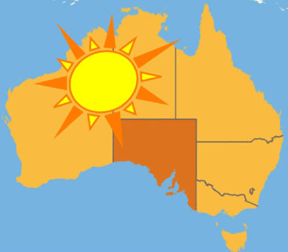 South Australian households and businesses are installing solar panels as rising electricity prices and blackouts take their toll http://www.adelaidenow.com.au/business/jobs/south-australian-households-and-businesses-are-installing-solar-panels-as-rising-electricity-prices-and-blackouts-take-their-toll/news-story/4bda132bfbd5532d68ec9c13a2d6e8ec, Jade Gailberger, The Advertiser, 26 Apr 17
SOLAR uptake has reached new records across the nation, as South Australian households and businesses put in solar installations at almost double the rate of last year.
Solar analysts say the industry has experienced one of its strongest quarters, driven by increased knowledge, high electricity prices, and fear the Federal Government will cut incentives in the future.There is now six gigawatts of solar power installed across Australia — enough to meet the needs of 1.3 million average households — figures released today by the Australian Photovoltaic Institute show.“Solar power now makes up 11 per cent of our country’s total electricity generation capacity,” Australian Photovoltaic Institute chair Dr Renate Egan said.
South Australia has the highest penetration among dwellings at 32 per cent, with Aberfoyle Park identified as the state’s “solar rooftop hotspot”. More than 22,618 new solar installations have been made in SA as of April — 7000 more than the same time last year.
SunWiz managing director Warwick Johnston said small-scale residential and commercial solar installations will continue to grow because of an increased awareness of renewable energy.
“Particularly in SA given the context of all the blackouts that happened … people are moving towards being independent of the grid.”
He expects another 800MW will be installed across Australia this year, and said a boost from solar farm projects will equate to another gigawatt added to the grid. Continue reading
New South Wales wind farm to power 49,000 ACT homes
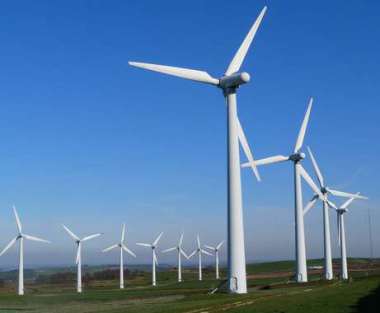 NSW’s Sapphire Wind Farm to power 49,000 ACT homes, Canberra Times, Georgina Connery, 27 Apr 17, It is a regional NSW project closer to the Queensland border than to Canberra, but within months the Sapphire Wind Farm will generate power for around 49,000 ACT homes. After a flight to Armidale and long car ride west of Glen Innes, climate change minster Shane Rattenbury toured the facility on Thursday.
The wind farm will be NSW’s largest once it is completed.
It is owned by CWP Renewables, a joint venture between two European renewable energy companies, and was one of two successful projects in the ACT’s 2015 second wind auction.
The farm entered into a 20 year contract to supply 100 megawatts of its 270 megawatt output to the ACT government and by mid next year 32 wind turbines will come online to supply energy for the territory.
“Construction commenced in January 2017 on the 100 megawatt Sapphire 1 wind farm, which is another significant step in progress towards the ACT’s 100 per cent renewable energy by 2020 target,” Mr Rattenbury said.
“The ACT supported part of the wind farm will generate 349,703 megawatt-hours per year.”
The ACT government’s reverse auctions have secured generating capacities of 40 megawatts from large-scale solar and 600 megawatts from wind farms over the past few years…… http://www.canberratimes.com.au/act-news/nsws-sapphire-wind-farm-to-power-49000-act-homes-20170426-gvtejh.html
Dennis Mattews reviews Senate Committee report on Electricity Stability and Affordability
Dennis Matthews April 2017 Comments on The Senate Select Committee into the Resilience of Electricity Infrastructure in a Warming World. Stability and Affordability: Forging a path to Australia’s renewable energy future.Senator Sarah Hanson-Young April 2017
The report by Sarah Hanson-Young is understandably critical of Liberal-National Coalition policy. It is no surprise that the committee’s Coalition Senators issued a dissenting report. It is also no surprise that the committee’s One Nation Senator, who has publically claimed that there is no evidence for global climate change, rejected the Hanson-Young report.
Both the Committee’s ALP Senators and Senator Xenophon issued dissenting reports, which however add very little to the Hanson-Young report.
The following comments will therefore concentrate on the Committee report by Senator Hanson-Young. Headings used are the same as those in the Committee report.
Executive summary In the last two decades, natural gas was widely accepted as the obvious substitute for coal during the transition from fossil to renewable energy. In 2017 the validity of this assumption has been cast into doubt by the sudden increase in price of natural gas in Australia and “there are serious questions about whether gas can adequately fill this transitional role.”
In the sense that this problem has been induced by unregulated market forces dominated by the private, rather than the public, interest then the problem is in principle solvable. So far, however Federal Governments have shown very little appetite for regulating markets and it is therefore wise to assume that the gas shortage and resulting exorbitant prices will be a permanent fixture of energy supply and demand.
As with many energy issues, decades of inaction may well mean that we have missed the chance of a smooth transition from fossil to renewable energy and that a more abrupt transition is unavoidable. Continue reading
Australia’s rapidly increasing solar energy capacity
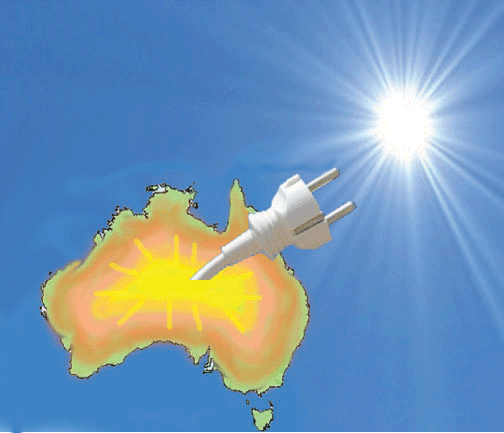 Australian solar capacity now 6GW, to double again by 2020, REneweconomy, By Giles Parkinson on 27 April 2017 Australia’s total solar power capacity has reached 6GW and is expected to double over the next few years as Australian households continue to invest in rooftop panels to reduce electricity bills, and the large-scale solar sector takes off after years of promise.
The latest industry analysis on installed capacity – released by the Australian Photovoltaic Institute – shows that rooftop solar capacity has now reached 5.6GW and large-scale solar capacity is now at 496MW, and growing fast.
The leading state in rooftop solar remains Queensland, with 1.72GW of rooftop solar – that makes it, as we reported here, bigger than the state’s largest coal generator. NSW and Victoria also have more than 1GW of rooftop solar capacity, with South Australia having the highest penetration (32 per cent) among residential dwellings.
As of April 2017, there was a total of 1.67 million PV installations in Australia, covering 21 per cent of suitable rooftops, which is the highest penetration of rooftop solar in the world. In total, these solar installations collectively generate 8,400 gigawatt hours of electricity each year, which meets approximately 3.3 per cent of Australian demand.
The data suggests that the rate of installation of rooftop solar is also accelerating. After establishing a record March quarter, the rate of installations for the year to date is up significantly in all the major states.
Interestingly, the biggest growth is coming from Western Australia, which has installed 43MW so far this year, outstripping Victoria, as locals prepare for the likely imminent removal of the state-based subsidy that has hidden the true cost of electricity from consumers……..
by 2040 the nature of the grid will have changed dramatically, and will have become more “distributed” – as predicted by the new head of the Australian Energy Market Operator Audrey Zibelman.
The key features will be localised and flexible generation. Batteries – and BNEF predicts there will be at least 15GW of them – will provide a large amount of flexibility, but so too will other forms of flexible generation, including demand response……… http://reneweconomy.com.au/australian-solar-capacity-now-6gw-to-double-again-by-2020-2020/
Obvious to all, except the Australian govt, that the nation needs a clear energy market policy
A string of peak bodies have used the review to call for the adoption of a market mechanism, including the National Farmers’ Federation, the Investor Group on Climate Change and the Business Council of Australia, which explicitly called for an emissions intensity scheme.
Three years ago some of the same groups urged the parliament to get out of the way so that Tony Abbott could repeal the Gillard government’s “carbon tax”.
 Australians could save $100bn on electricity ‘if government had clear policy’ https://www.theguardian.com/australia-news/2017/apr/28/australians-could-save-100bn-on-electricity-if-government-had-clear-policy Energy transmission industry ramps up call for market mechanism and says clear regulation could lead to zero net emissions by 2050, Guardian, Katharine Murphy, Australia’s electricity and gas transmission industry has intensified a call for a market mechanism to drive orderly transformation in the energy sector, warning a lack of clear regulation will result in higher prices for consumers and a less secure grid.
Energy Networks Australia (ENA) says clear policy settings could ultimately save Australian energy customers $100bn, and allow a smooth transition, where large-scale variable renewable energy can be integrated securely, creating the prospect of Australia’s electricity sector achieving zero net carbon emissions by 2050.
A new roadmap from the ENA to be released on Friday says the energy market is in the middle of a profound transformation that will only intensify over the next two decades.
Modelling produced for the report suggests that by 2050, up to 45% of Australia’s electricity supply could be provided by millions of distributed, privately owned generators, in homes and businesses.
The report notes the trend towards decentralisation of power generation creates “profound adaptation challenges for the system’s architecture, stability and efficiency given it was originally designed for almost 100% of generation at the transmission end of the system”.
The report’s estimated $100bn in cost savings is a function of governments rolling out nationally consistent policies that would encourage the two parts of the system to work harmoniously together – the current poles and wires of the national market, and the virtual grids in homes and businesses.
Allowing efficient co-optimisation would prevent overinvestment in poles and wires. Continue reading
Victoria aims for two 20MW large scale batteries to be installed by January,
Victoria seeks two 20MW large scale batteries to be installed by January, REneweconomy, By Giles Parkinson on 27 April 2017 Victoria has announced that it is seeking two 20MW battery storage installations – with a total of 100MWH of storage – to be located in the western part of the state where network strength is low.
The announcement came following an exceptionally strong market response to its call for expressions of interest – that attracted more than 100 enquiries – and as it prepares to ramp up its state-based target of reaching 40 per cent renewable energy by 2025.
Earlier this year the Andrews Labor Government announced $25 million to support large-scale energy storage, and a total of 100MW of battery storage, to enhance the reliability of its grid and unlock economic growth in areas experiencing network constraints.
It ran two expressions of interest processes – one specifically for a 20MW/80MWh facility in western Victoria and another more general one for up to 100MW of energy storage.
It has now refined its needs and is now formally looking for two large scale battery storage installations – both of 20MW, with a total of 100MWh – to be in place by January next year, when the summer peak is expected……..
Acting minister for energy, environment and climate change Lisa Neville said the government was looking to support projects that integrated both existing and new renewable energy generation, with storage, distribution and management technologies.
“Large scale energy battery storage will improve the reliability of Victoria’s energy grid and enhance energy security. We are encouraging significant local and international investment opportunities for businesses to work together in modernising our energy system.”
Full guidelines for applicants will be available on 1 May 2017 here. http://reneweconomy.com.au/victoria-seeks-two-20mw-large-scale-batteries-installed-january-79103/
Australia’s Minister for Environment and Energy, Josh Frydenberg, backs Port Augusta solar thermal plan

Frydenberg backs Negev-style solar thermal plant for Port Augusta AFR 27 Apr 17
“……..Mr Frydenberg, who is on a trip to Israel and visited the 121 megawatt Ashalim solar thermal power project in the Negev desert, said Australia could learn from the collaboration between the Californian-based BrightSource Energy, General Electric and NOY Infrastructure and Energy Investment Fund.
“The Ashalim solar plant is impressive in scope and scale. When it is operational it will be the tallest and fifth largest solar thermal plant in the world,” Mr Frydenberg said from Israel.
Gas generators ordered on as South Australia’s wind production peaked
SA power: Gas generators ordered on as South Australia’s wind production peaked http://www.abc.net.au/news/2017-04-26/gas-generators-ordered-to-turn-on-in-sa/8474188 By political reporter Nick Harmsen The Australian Energy Market Operator (AEMO) was forced to intervene in South Australia’s electricity market on Anzac Day to guarantee security of the grid as the state recorded record levels of wind energy production.
Wind power peaked at a new high of 1,540 megawatts close to midnight on Tuesday, more than meeting the state’s public holiday electricity demand.
The wind production was so high that earlier in the day AEMO took steps to ensure two gas generators remained on.
“A combination of high wind generation and low demand had resulted in the de-commitment of synchronous plants below the required levels,” an AEMO spokeswoman said.
AEMO would not confirm which gas generators were subject to AEMO’s directions, but the ABC understands they were AGL’s Hallett Power Station and one unit at Torrens Island.
A requirement for two large synchronous power stations to remain online at all times was put in place in the aftermath of the September 28 statewide blackout.
In that instance, when South Australia unexpectedly separated from the rest of the National Electricity Market, there were too few synchronous generators operating to keep the grid frequency in balance, forcing lights out across the state.
Synchronous generation is typically provided by gas, coal and hydro power plants. None of the wind farms currently operating in South Australia provide synchronous characteristics.
AEMO’s decision to order on two gas generators means their owners will be compensated under special rules, as opposed to taking the prevailing wholesale price for the electricity produced.
The direction for one of the generators remained in place until midday today.
The decision meant AEMO was also forced to constrain the output of two other generators to keep supply and demand in balance. The market operator would not reveal whether those constrained generators were wind farms.
Turnbull’s dishonest spin about his Snowy Hydro energy plan
Turnbull fibbed about Snowy Hydro 2.0 https://independentaustralia.net/environment/environment-display/turnbull-fibbed-about-snowy-hydro-20,10235 Mark Hipgrave 26 April 2017, Far from being the solution to Australia’s energy crisis, bureaucrats have confirmed the upgrade to Snowy Hydro may never even go ahead, reports Mark Hipgrave.
RECENT TURNBULL GOVERNMENT announcements about renaming the 457 Visa system, toughening the citizenship test, and the one from Fiona Nash about decentralising Govt Departments, made me think about last month’s big announcement – the Snowy Hydro Scheme Expansion.
You will recall that, on March 16, the PM announced plans for a $2 billion expansion of the Snowy Hydro scheme that could add up to 50% to its capacity.
In his media statement, Turnbull outlined the basics of the project — a plan to ‘supercharge the Snowy Hydro precinct’, with the Australian Renewable Energy Agency (ARENA), charged to
‘… examine several sites, which could support large scale pumped hydroelectric energy storage in the precinct. These sites would involve new tunnels and power stations, connecting existing storages.’
In a speech in front of the penstocks feeding the Tumut 3 Power Station, he sounded positively Churchillian puffing out his chest, malsplaining to us all that the new Snowy Hydro scheme was the
‘… result of the vision and the courage of the generation that won the Second World War … they defended our freedoms …. and they came home and built this …. these are big dreams in these mountains, real courage…’
(He ignored the reality that around two thirds of the workforce employed in the construction of the scheme were immigrant workers, originating from over 30 countries. Not the winners of WWII, they were mostly the losers — displaced persons from Germany, Italy, Yugoslavia and other parts of Eastern Europe. They came with little English and no knowledge at all of Australian values. The work was largely managed by U.S. engineering contractors and, while an engineering triumph, it was achieved with what we would now regard as a shocking safety record). Continue reading
1 This month



Help Aunty Sue Protect Her Land and Sacred Sites From Destructive Rocket Testing.
.

Australians deserve the truth
about
AUKUS – https://aukuspublicinquiry.com/

PETITION – To: Prime Minister Anthony Albanese and the Australian Labor Government

of the week – Australians for War Powers Reform (AWPR)
To see nuclear-related stories in greater depth and intensity

