Turnbull government wants to subsidise fossil fuel transport
Turnbull wants to subsidise coal AND gas transport, REneweconomy, By Sophie Vorrath on 27 April 2017 Prime minister Malcolm Turnbull has again declared his support for all things fossil fuel, after suggesting his government could use public money to sponsor both new coal and gas production facilities in Australia, via the Northern Australia Infrastructure Fund.
In his latest concession to the nation’s powerful fossil fuel lobby, Turnbull told Brisbane Radio that the fund could be used both to subsidise gas pipelines in northern Australia and to underwrite the plans of Indian coal giant Adani to build a rail line from its proposed Carmichael mine………
Activist group GetUp said Turnbull’s plan to use public monies to underwrite gas pipelines was “another white elephant”.
“Not content with handing over a billion dollars to prop up Adani’s doomed coal project, Turnbull now wants to spend public money on an expensive and unviable gas pipeline as well.” said GetUp’s Miriam Lyons.
“Spending public money on white elephants in waiting is a betrayal of everyday Australians who pay their taxes to fund public services and public-interest infrastructure.
“As with Adani’s doomed Carmichael project, a gas pipeline from the Northern Territory to Queensland doesn’t stack up economically,” Lyons said.
“It will also do nothing to stop price-gouging by greedy gas generators who have a stranglehold on the market for supplying power to meet demand spikes caused by heatwaves and cold snaps.
“The best thing we can do to break the power of greedy gas companies is to back the competition: cleaner, cheaper, fracking-free energy from solar and storage, as well as energy efficiency,” she said. http://reneweconomy.com.au/turnbull-wants-to-subsidise-coal-and-gas-transport-61896/
Pine Gap and Northwest Cape- Australia’s very obvious nuclear targets
Pine Gap is more than a giant electronic vacuum cleaner. The facility is also involved in tactical warfare, through programs like “The Red Dot Express”.
More controversial is Pine Gap’s role in drone strikes.
Instead of trying to pump up hysteria over a non-existent North Korean missile strike, The Turnbull Government should take a hard look at the very real threat that Pine Gap and Northwest Cape pose to Australia.
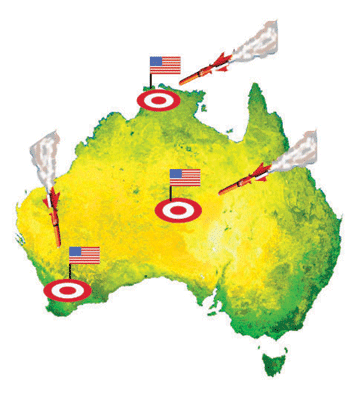
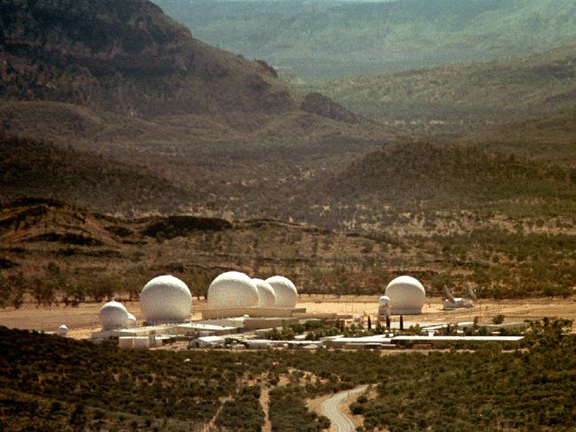 Pine Gap is still there — bigger and badder than ever, Independent Australia Norm Sanders 25 April 2017 With Donald Trump putting a blowtorch to the Cold War, it is time to take another look at all the U.S. bases in Australia, including Pine Gap, writes Dr Norm Sanders.
PINE GAP, Northwest Cape and Nurrungar were the focus of the Australian Peace Movement in the 1980’s. Then the Bulletin of Atomic Scientists Doomsday Clock crept slowly away from midnight and the removal of the bases didn’t seem so urgent. The clamour to close the bases died down………
I actually knew quite a bit about what Pine Gap was up to at the time, but it was child’s play compared to what they are doing at present. A simple place to start is Pine Gap’s assumption of the function of Nurrungar in 1999. Nurrungar was located at Island Lagoon, Woomera and was crucial to America’s defenses during the Cold War. Nurrungar furnished “Launch on Warning” surveillance of ICBM or other rocket launches anywhere on the globe. Analysts regarded it as one of the USSR’s top ten targets.
Now, Pine Gap has probably surpassed Nurrungar in the rankings. It is one of the largest satellite ground stations in the world, with over 33 satellite antennas. Pine Gap houses a number of U.S. Government agencies, such as the National Reconnaissance Office (spy satellites,) the National Security Agency, the CIA, and the Geospatial-intelligence Agency. In addition, all branches of the U.S. Military are represented. Continue reading
America’s deployment of 1250 marines to Darwin rattles North Korea
North Korea highlights 1250 US marines in Darwin to claim America is preparing for nuclear war, SMH, Kirsty Needham, James Massola, 25 Apr 17,
North Korea’s state newspaper has singled out the United States’ deployment of 1250 marines to Darwin to claim America is preparing for nuclear war.
And as regional tensions escalate and a US carrier strike group approaches the Korean peninsula, Australian Foreign Minister Julie Bishop said the secretive regime “must be stopped” as it represented a threat to the region and, potentially, globally.
In a phone call with US president Donald Trump, Chinese president Xi Jinping said China opposed any actions that went against UN security council resolutions, as Japan confirmed it was joining drills with the strike group led by the USS Carl Vinson that is headed to Korean waters.
Pusan National University associate professor Robert Kelly told Fairfax Media North Korea’s missiles might have the range to reach northern Australia, but played down the threat as “the question is guidance, not range”.
Rodong Sinmun, the official paper of the Worker’s Party of North Korea, highlighted the US marines’ arrival in northern Australia on April 18. The marines will be joined by 12 military helicopters including five Cobra helicopters and four Osprey carriers.
“This is the largest scale US military presence in Australia after World War 2,” the newspaper reported on Monday. “America is fanatically, crazily trying to optimise its nuclear war readiness,” it claimed.
The story, on page six of the North Korean newspaper, was headlined: America prepares for nuclear war in different overseas military deployments. Darwin was the only city named…….
Australia-based defence experts believe it is unlikely North Korea has the capacity to strike Australia yet, though they may do within the next three years. The nation’s most recent missile test, earlier this month, failed just seconds after launch…….
The deployment of 1250 marines is the largest to Darwin since the former prime minister Julia Gillard and former president Barack Obama struck a deal back in 2011 to undertake the yearly rotation of troops.
with Sanghee Liu, AAP http://www.smh.com.au/federal-politics/political-news/north-korea-highlights-1250-us-marines-in-darwin-to-claim-america-is-preparing-for-nuclear-war-20170424-gvrbzl.html
North Korea developing missiles in 3 years time, that could reach Australia, esp Pine Gap
‘In three years’: N Korea making missiles which ‘could hit Australia’ on April 24, 2017, North Korea could potentially hit Australia with one of its under-development intercontinental ballistic missiles (ICBM) within the next three years, according to military experts………
Wangan and Jagalingou rebut the pro mining spiel of industry puppet Warren Mundine
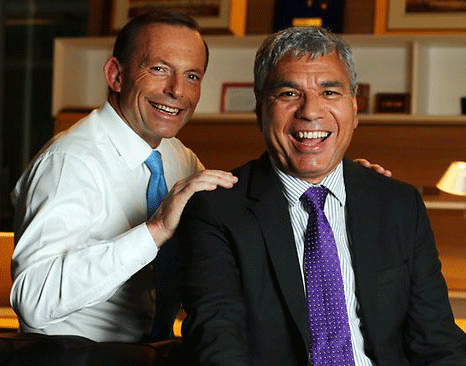 Mundine reduces Aboriginal land rights and First Nations treaties to ‘a fantasy business transaction’ Wangan and Jagalingou http://wanganjagalingou.com.au/mundine-reduces-aboriginal-land-rights-and-first-nations-treaties/ 24 April 2017:
“In his opinion piece [1], “Activists undermine principles of self-determination”, 20 April 2017,
Warren Mundine makes exaggerated, false and misleading comments.
As his views still gain considerable national attention as the former head of the Prime Minister’s Indigenous Advisory Council [2], it is necessary for us to respond.
“While we agree that “making your own decisions and controlling your own destiny… is something for which Indigenous people long campaigned” – he does much to undermine this premise in his article.
His uninformed characterisations of the Wangan and Jagalingou situation regarding the proposed Adani Carmichael mine do us and our campaign for self-determination a great disservice.
“Our forebears, like many others, pursued “sources of self-determination, like land rights”. We too celebrate Koiki Eddie Mabo’s achievement to gain “recognition of his people’s fundamental and original right to the land and seas on which they’d lived and subsisted since time immemorial”.
“But to then build an argument on Mabo’s legacy, as Mundine does, and say that the Native Title Act in its present form is fostering “Indigenous economic participation by allowing traditional owners to use land as an economic asset”, is ludicrous. He fails to position the importance of traditional lands in the full spectrum of Indigenous values and uses (not just economic and extractive relations to resources), alongside the manifest failures of the Native Title Act to deliver anything remotely like land rights for most Aboriginal people.
“His elevation of the role of businesses in empowering Traditional Owners through Indigenous Land Use Agreements (ILUAs) compounds the folly. And to go further and state that there’s “little difference in substance between a treaty and an ILUA entered into with a government” reaches the height of absurdity. …
“As Deakin University’s Emeritus Professor Dr Jon Altman states [4], “Warren Mundine is poorly informed about the workings of the Native Title Act. His views run contrary to three Federal Court Judges. He confuses correlation with causation. In other words, just because key Traditional Owners and some ‘greenies’ agree, doesn’t mean one caused the other. It just means they share a similar view on Adani’s Carmichael mine proposal.” …
“We will argue our case to the Australian public. These are the people who support us, morally and financially. We welcome the many thousands of contributions that assist with our legal and other actions.
“We make no apologies for taking a stand, like so many Aboriginal rights campaigners,
against a dubious company intent on overriding our decisions, destroying our heritage, dividing our people and offering an insulting pittance in return.
“Mundine can characterise it however he likes, but we have no doubt that our stand is exactly an assertion of Indigenous self-determination. We don’t need his approval, or care about his disapproval.
“Though we’re sure his mates in the mining sector [5] and the halls of Government will welcome his opinions.”
North Korea: By opposing UN we have increased insecurity
 http://www.theage.com.au/comment/the-age-letters/north-korea-by-opposing-un-we-have-increased-insecurity-20170425-gvs00p.html Tim Wright, Asia-Pacific director, International Campaign to Abolish Nuclear Weapons Foreign Minister Julie Bishop has excoriated North Korea for squandering vast resources on weapons of mass destruction instead of meeting the basic needs of its citizens. Yet in recent years, Ms Bishop has argued stridently against the global prohibition on nuclear weapons, believing that US nuclear forces are essential for Australia’s security and prosperity.
It is on this basis that she decided to boycott a major UN nuclear disarmament process that began in March – potentially violating Australia’s obligations under the Nuclear Non-Proliferation Treaty. More than 130 nations are part of these historic negotiations, the success of which is vital to our collective security. While this process will not result immediately in a denuclearised Korean Peninsula, that goal will be more readily achieved in a world moving towards disarmament. By opposing this UN effort and encouraging the US to bolster its nuclear arsenal, Australia has very much contributed to the global insecurity we now face.
Mini hydro electric scheme could revive historic hydro power in Warburton, Victoria
 Push for a mini hydro-electric scheme in Yarra Valley town of Warburton, The Age Darren Gray, 25 Apr 17, Up to 120 homes could be powered by a mini hydro-electric scheme that’s been proposed by locals for Warburton, in the upper reaches of the Yarra Valley.
The hydro project, which would involve using water from the fast-flowing Ythan Creek as it flows through the local golf course, would produce year-round power to be fed into the electricity grid.
The proposed scheme would also restore some of the picturesque town’s early 20th century heritage, by reviving hydro power at the site of an old hydro scheme that operated at the property from 1919 onwards.
The historic hydro plant powered the old Parbury Timber Mill during the daytime, while at night it powered local street lights and part of the town for years, before Warburton was connected to the electricity grid.
The modern hydro project, expected to cost close to $1 million, is the brainchild of Warburton residents Luke Whiteside and Nick Killey…….http://www.theage.com.au/victoria/push-for-a-mini-hydroelectric-scheme-in-yarra-valley-town-of-warburton-20170424-gvrf2d.html
Renewable energy leader South Australia could lead some more, with pumped hydro storage
Could South Australia be the nation’s hydrogen state, too? REneweconomy, By Valdis Dunis on 24 April 2017 South Australia is already tops for solar and wind use in Australia, crossing over its 50 per cent generation goal from these clean renewable sources last year – eight years ahead of schedule.
Soon the state is will be Australia’s (and a world) leader in battery storage, led by its government’s new tender for a 100MW/100MWh battery system for the state’s grid, plus the other private initiatives from the Lyon Group, AGL’s 1,000 battery virtual power plant in Adelaide, and other companies building large storage systems in the state.
It also is likely to become a leader in new large scale pumped hydro storage thanks to Energy Australia’s detailed work now being done on the feasibility of building a 100MW version near Whyalla in the state’s North, thanks to support funding from ARENA.
Finally, the most high-profile and long-fought-for renewable project in the state – the 24/7 despatchable solar thermal plant near Port Augusta – will now hopefully get over the line, thanks to a new $110M low-cost loan that SA Senator Nick Xenophon was able to wrench out of the federal government last month.
However, South Australia might soon have a new clean feather to add to its cap:
Last Friday, the state’s Energy Minister Tom Koutsantonis surprised most at a CEDA lunch to announce the state will also now go heavily in to implementing a hydrogen industry, leveraging the state’s increasing supply of clean and low cost- renewable energy to power the creation of this fuel from water.
Hydrogen is well known as a clean way to power transport – from cars to trucks to trains and eventually planes potentially, and for driving power turbines and other equipment needing large amounts of power quickly on demand. Best of all is that it does it all without the pollution (assuming water vapour from the tailpipe noone considers pollution!).
The Minister presented a set of slides on this new goal, with the “aim to capitalise on our abundance of renewable resources to become the green hydrogen capital of Australia”.
The hydrogen fuel would not just be for local state use, but as a new export industry both to other states and internationally. The Minister conceded Victoria was currently ahead of South Australia, but said the state will be able to leverage its existing strong engineering expertise in gas processing, pipelines and storage. He also said Asia, in particular Korea and Japan, are large potential markets for hydrogen. …….http://reneweconomy.com.au/could-south-australia-be-the-nations-hydrogen-state-too-11243/
North Korea lashes out at Julie Bishop, with nuclear warning.
 North Korea issues nuclear warning to Australia, Camden Narellan Advertiser ,23 Apr 2017 Beijing: North Korea’s foreign ministry has lashed out at Foreign Minister Julie Bishop and warned Australia was “coming within the range of the nuclear strike”. The threats were reported by the North Korean state news agency KCNA as being made on Friday, in response to a radio interview given by Ms Bishop.
According to a translation of the KCNA report, which was dated Friday, the same day US Vice-President Mike Pence arrived in Australia, Ms Bishop had said in the radio interview that North Korea seriously threatens regional peace and she supports the US policy that “all options are on the table”.
A spokesman for the Foreign Ministry of North Korea – officially the Democratic People’s Republic of Korea (DPRK) – was quoted as saying: “The present government of Australia is blindly and zealously toeing the US line. It is hard to expect good words from the foreign minister of such government.”….
“If Australia persists in following the US moves to isolate and stifle the DPRK and remains a shock brigade of the US master, this will be a suicidal act of coming within the range of the nuclear strike of the strategic force of the DPRK.”….
The KCNA report continued: “The Australian foreign minister had better think twice about the consequences to be entailed by her reckless tongue-lashing before flattering the US.”
Prime Minister Malcolm Turnbull on Saturday pledged support for the US policy on North Korea and again urged China to do more to place economic pressure on North Korea.
China has turned back coal shipments to North Korea in recent weeks, one of the regime’s few sources of funding. Chinese media have speculated the Chinese government is also considering cutting oil supplies.
There are renewed concerns that North Korea may conduct its sixth nuclear test on Tuesday, the 85th anniversary of its military, and China said this week it was “gravely concerned”.
China’s official People’s Daily newspaper on Saturday evening reported online that new satellite images of the North Korean nuclear test site had shown probable new trailer activity, citing US research website 38 North. http://www.camdenadvertiser.com.au/story/4614177/north-korea-issues-nuclear-warning-to-australia/?cs=5
Taxpayer loan for railway to Adani mine “not in the interests of NSW”: report
http://www.smh.com.au/nsw/taxpayer-loan-for-railway-to-adani-mine-not-in-the-interests-of-nsw-report-20170423-gvqr1r.html ~ Matt Wade @MattWadeSMH http://www.smh.com.au/nsw/by/Matt-Wade-hvejy 24 April 2017:
“The fairness of a proposed Commonwealth loan of nearly $1 billion to fund a rail link to the giant Adani coal mine in Queensland’s Galilee Basin has been called into question by economic modelling showing
it may cost NSW hundreds of millions of dollars a year.
“Adani’s Carmichael mine will increase the global supply of coal by about 6 per cent, putting downward pressure on prices received by NSW coal exporters and slashing mining royalties paid to the state government, the report by the Australia Institute says. … “
Communities of battery users could create a virtual power plant.
 New power generation: Home battery sharing could build virtual public utilities, The Age, Brian Robins, 23 Apr 17 It was one of the disasters of recent energy policy: the boom in sales of air conditioners without taking into account the impact their mass sale would have in forcing up power prices for all.
Those without air conditioners have had thousands of dollars added to their electricity bill to pay for the network upgrades to cope with air conditioners, since much of the extra “poles and wires” are used only a few hours a year, when the weather is very hot or very cold.
Now, mass adoption of battery storage systems poses the same risk for those who don’t install them. Their adoption will allow households to slash their use of the grid which will leave fewer users faced with higher bills to maintain the network.
Communities of battery users But for German battery challenger Sonnen, batteries are only part of the energy equation. More fundamental is creating “communities” of connected battery users to create virtual power plant. Continue reading
North Korea warns of nuclear strike against Australia: Turnbull tight-lipped about joining any USA military action.
Key points:
- N Korean accuses Australia of “spouting a string of rubbish” about isolated regime
- Spokesman said Julie Bishop could “never be pardoned” for saying North Korea’s nukes were a threat to Australia
- Comments coincide with Mike Pence’s visit to Australia
The comments came after Foreign Minister Julie Bishop earlier this week said on the ABC’s AM program that North Korea’s nuclear weapons program posed a “serious threat” to Australia unless it was stopped by the international community.
A spokesman for the North Korean Foreign Ministry accused Australia of “spouting a string of rubbish” about the isolated regime, and warned against following the US.
“The present Government of Australia is blindly and zealously toeing the US line,” the spokesman said. “If Australia persists in following the US’ moves to isolate and stifle North Korea … this will be a suicidal act of coming within the range of the nuclear strike of the strategic force of North Korea.”
The North Korean Foreign Ministry also directly addressed Ms Bishop’s interview, warning she had “better think twice about the consequences to be entailed by her reckless tongue-lashing before flattering the US”. What she uttered can never be pardoned,” the spokesman said. “It is hard to expect good words from the Foreign Minister of such a government. But if she is the Foreign Minister of a country, she should speak with elementary common sense about the essence of the situation.”
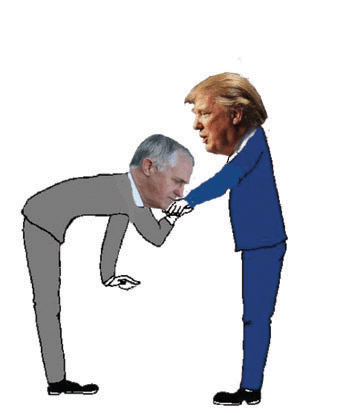 Mr Pence also thanked Australia for calling on China to exert greater economic and diplomatic pressure on North Korea. “As President Trump made clear a few days ago, if China is unable to deal with North Korea, the United States and our allies will,” he said, following a meeting with Prime Minister Malcolm Turnbull.
“Mr Prime Minister, know that President Trump and I are truly grateful to you for calling on China even this week to play an even more active and constructive role in addressing the North Korean threat.”
Mr Pence would not rule out the use of military force in North Korea, repeating “all options are on the table”, but stressed the US was focused on diplomacy at this stage.
Mr Turnbull meanwhile said it was “self-evident” China had the capacity to bring more pressure to bear on North Korea.
But he brushed off questions about whether Australia would join any military strike on the regime in the future..….http://www.abc.net.au/news/2017-04-22/north-korea-accuses-australia-of-blindly-following-the-us/8464252
Effusive (?nauseating) meeting as Trump’s Vice President visits Australia, seeks support for attack on North Korea
Mike Pence in Australia says US and allies ready to tackle North Korea Vice-president and Australian prime minister Malcolm Turnbull call on China to apply pressure but stress regime’s nuclear aims cannot be tolerated, Guardian, Ben Doherty, 22 Apr 17, All options including military action are “on the table” to deal with the threat of North Korean nuclear weapons, Mike Pence has said during a trip to Australia. But the US vice-president stressed he expects China to bring its influence to bear against the regime’s nuclear ambitions.
Pence said three times during a press conference with the Australian prime minister, Malcolm Turnbull, that “all options are on the table” and refused to rule out military action against the recalcitrant nuclear-armed regime.
“While all options are on the table, let me assure you the US will continue to work closely with Australian and our other allies in the region, and with China, to bring economic and diplomatic pressure to bear on the regime in Pyongyang until they abandon their nuclear and ballistic missile program,” Pence said.
“But if China is unable to deal with North Korea, the United States and our allies will.”
Pence’s rhetoric was a continuation of the bombastic line he has run throughout his swing through the Asia-Pacific, visiting South Korea, Japan, Indonesia and finally, Australia.
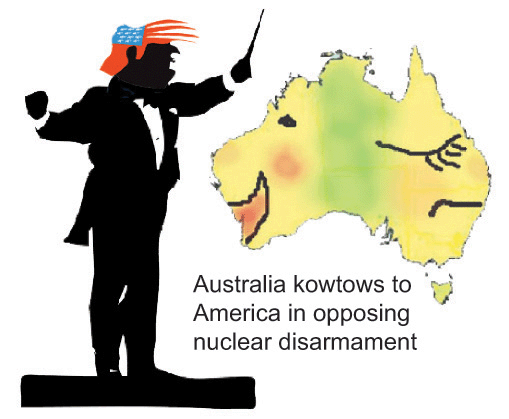
He said a generation of “strategic patience” with the North Korean regime, under Kim Jong-Il and then his son, Kim Jong-un, had failed utterly and the Trump administration was determined to pressure North Korea to stop developing nuclear weapons.
“The era of strategic patience is over,” he reiterated.
North Korea has accused the US of warmongering on the Korean peninsula, saying the Trump administration was creating “a dangerous situation in which a thermonuclear war may break out at any moment”……
The White House suffered acute embarrassment this week after Donald Trump boasted he had sent an “armada” to the Sea of Japan as a warning to North Korea.
The USS Carl Vinson strike group was in fact more than 5,000km from the Korean peninsula and headed in the opposite direction. The ships were hastily turned around.
Pence said the group was now headed for waters off the Korean peninsula and would be in the Sea of Japan within days, “before the end of the month”.
The issue of North Korea dominated Pence’s meeting with Turnbull and the foreign minister, Julie Bishop……..
Pence also hinted at a presidential visit this year, saying he expected Trump to visit the Asia-Pacific “in the fall”, Australia’s spring.
A visit by the US president to the region could be reasonably expected to include a stopover at its closest and most steadfast ally in the region.
The joint press conference between Turnbull and Pence was full of the usual lavish bilateral praise that accompanies a US leader’s visit to Australia. Turnbull praised the “Pax Americana” provided by long-standing US interest and intervention in the Pacific.
“And the US understand that they have no stronger, more committed, more loyal partner, ally than Australia.”
Pence said the US had no more steadfast ally than Australia, particularly in conflict, noting that Australia had fought alongside the US in every major war of the last century. “From the Coral Sea to Kandahar our friendship has been forged in the fires of sacrifice.” https://www.theguardian.com/us-news/2017/apr/22/mike-pence-in-australia-says-us-and-allies-ready-to-tackle-north-korea
Australia all too ready to join America in fighting World War 3
China is Australia’s largest trading partner in terms of imports and exports and Australia is fifth on China’s trade league table, so some stability in the relationship is – you might think – important to both sides.
So why then is the Australian government so willing to back the US in its containment and encirclement strategy when it comes to China?
The Australian media has been full of alarming – and alarmist – stories about China’s military expansion into the South China Sea and the base-building in the Spratly Islands. However, there is little news and even less analysis about the forward bases that the U.S. has in the region, all with nuclear and non-nuclear missile capability and all within close striking distance of every major Chinese city.
Why would Australia want to be militarily aggressive towards such an important regional neighbour?
Are we already fighting World War 3? https://independentaustralia.net/article-display/are-we-already-fighting-world-war-3,10220
‘The fear of war hangs over society. This is almost literally true, for it is not the invader in the streets but the warhead exploding on us which dominates our nightmares.’
~ Martin Shaw, Dialectics of War, 1988
THIS IS A SERIES that looks at global flashpoints and their potential to blast the world into a nuclear nightmare. It was once unthinkable that strategic nuclear weapons might be used in a world-wide war, but now we need to start thinking it is more likely than not.
And just this month, Donald J Trump caused the “Mother of all bombs” to be dropped in Afghanistan to explode over… we may never know what exactly.
Are we already inside World War Three?
In this series, I will look at Asia, the Middle East and Europe as places where potential nuclear trigger points might occur and then, on a brighter note, I’ll offer some suggestions about how we might stop it.
Let’s begin on our own doorstep.
We are not neutral
We are not neutral and we never have been. Australia is a willing and active partner in many of today’s global conflicts. Despite contrary propaganda, this does not make us safer, it increases the risk that we will be a target too.
Pine Gap makes us a target for Chinese and possibly North Korean and Russian nukes. I’m more worried about China and Russia because they both have nuclear-capable submarines that can reach us almost undetected.
When 1,250 US marines flew into Darwin this week, the NewsCorpse rag that dominates Northern Territory journalism, the NT News, could hardly contain its jingoistic excitement, declaring on page one that they are “ready to fight” against “our” common enemies. Continue reading
19 big South Australian industrial users join to buy electricity in bulk: a path to more wind and solar projects?
 Industrial bulk-buy could open path for more wind and solar projects, REneweconomy
The South Australian Chamber of Mines and Energy (SACOME) this week won approval from the Australian Competition and Consumer Commission for 19 big industrial users to band together to negotiate long-term electricity contracts, having grown tired of the soaring prices and short-term contracts being offered by the state’s retail oligopoly.
The companies – which include Nyrstar, Arrium, Oz Minerals, and a collection of high profile auto groups, food companies, retailers, wineries and universities (see full list below) – account for 15 per cent of the state’s electricity demand.
Most have been hit with electricity price rises of between 30 and 80 per cent in the last year, and are now paying between 8c/kWh and 15c/kWh for their electricity, and are unable to get any long-term contracts.
SACOME’s Rebecca Knol says the tender is not designed to favour one technology or another, and they would welcome either renewables or gas. “We are not predicting the outcome,” she told RenewEconomy. “We don’t have a preference.”
The move, she says, is more about challenging the pricing power of the retail oligopoly. “By aggregating their load, they will improve their individual bargaining position and be able to establish more cost-competitive supply contracts,” Knol said.
But a quick glance at prices for new wind and solar farms, and for gas generation, puts renewables in the driving seat.
Wind and solar farms are being delivered for around 7c/kWh, but even the short-run marginal cost of gas generators (i.e.. the fuel and maintenance cost) ranges from 7c/kWh to more than 12c/kWh………
The total load of 19 industrial users (19 companies, 24 installations) is 246MW at peak, and represents annual demand of 1,957GWh. Most interestingly for the wind and solar plants, the businesses are offering an 11 year contract – a length of contract that has been all but impossible to secure from large retailers.
“We are looking for opportunities to improve the electricity price so our businesses can stay competitive,” Knol says. “What we are hoping is that they do see this as opportunity to change the wholesale market. It could bring on a new generator, or it could be with an existing generator.”
Australian corporates have been slow to engage with renewable energy developers – possibly given the fact that the fall in wind and solar costs below the prevailing wholesale price of electricity is only very recent.
Queensland zinc refiner Sun Metals, that state’s largest single energy user, is one exception, having decided to build its own 116MW solar farm, rather than commission a third party. The Sunshine Coast Council is also building its own 15MW solar farm in south-east Queensland…..
The original application included: Nyrstar, Arrium, OZ Minerals, Hillgrove Resources, Rex Minerals, Seeley International, SMR Automotive, Thomas Foods and Intercast & Forge.
Since the application was made in January 2017, Peregrine Corporation, Foodland, Independent Grocers of Australia (IGA), Pernod Ricard Winemakers, Orora Glass, Brickworks, Flinders University and the University of South Australia have also come on board. http://reneweconomy.com.au/industrial-bulk-buy-could-open-path-for-more-wind-and-solar-projects-22023/
1 This month


Help Aunty Sue Protect Her Land and Sacred Sites From Destructive Rocket Testing.
.

Australians deserve the truth
about
AUKUS – https://aukuspublicinquiry.com/

PETITION – To: Prime Minister Anthony Albanese and the Australian Labor Government

of the week – Australians for War Powers Reform (AWPR)
To see nuclear-related stories in greater depth and intensity

