EnergyAustralia outlines plans for 100MW pumped hydro plant in SA http://reneweconomy.com.au/energyaustralia-outlines-plans-for-100mw-pumped-hydro-plant-in-sa-68973/ By Sophie Vorrath on 21 February 2017 Having chalked up three major solar power purchase agreements in as many months, EnergyAustralia is talking large-scale energy storage this week, in a briefing with the federal government on the potential for a massive pumped hydro project in the renewables rich state of South Australia.
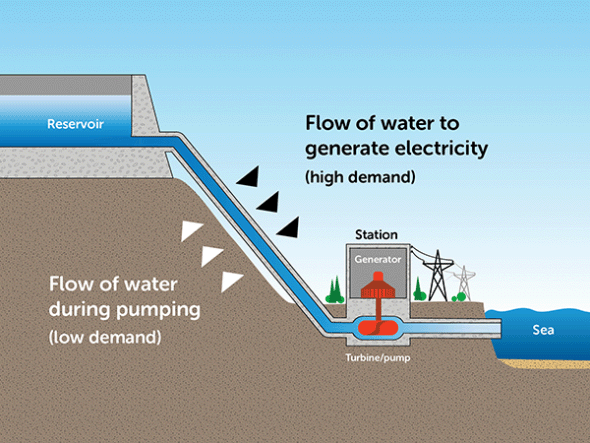
EnergyAustralia managing director Catherine Tanna, along with the company’s executive for energy, Mark Collette, were in Sydney on Tuesday updating the Cabinet Energy Committee on the progress they have made, along with their research partners Melbourne Energy Institute and Arup Group, investigating the viability of a pumped hydro energy storage plant using seawater.
In a statement on Tuesday, Arup Group said that the proposed South Australia project would have the capacity to produce around 100MW of electricity with six-to-eight hours of storage – the equivalent of 60,000 home battery systems, EnergyAustralia says, but at “one-third of the cost.”
Pumped hydro, one of the oldest and most basic and low-cost forms of energy storage, converts electrical energy into potential energy by pumping water up to the top of a hill, storing it there in a reservoir, and then using it when needed to generate electricity at very high efficiency.
Most recently in Australia, it has been linked with a ground-breaking project being developed by Genex Power, which proposes to convert an old gold mine into a 330MWh pumped hydro storage project, to go alongside a 150MW solar PV array.
But its potential for Australia has come into sharper focus in recent months, as governments and electricity market operators grapple with the problem of how to support the smooth transition of electricity networks to renewable energy generation. Continue reading →
February 22, 2017
Posted by Christina Macpherson |
South Australia, storage |
Leave a comment
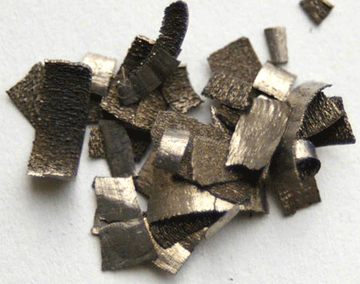
February 22, 2017 A SUPPLEMENTARY environmental report for a $1.19 billion rare earths mine north of Alice Springs has been lodged with the NT Environment Protection Authority.
The lodgement represents a significant milestone in Arafura Resource’s Nolans Project.
Arafura plans to mine, concentrate and chemically process rare earths at the Nolans site, 135km north-northwest of Alice Springs.The project is estimated to create up to 500 jobs in the two-to-three year construction phase, and employ a peak workforce of 300 in the operation phase, which is expected to exceed 40 years.
Construction is estimated to cost $866 million at Nolans, including an estimated $145 million in the Territory and $70 million in Central Australia. It is expected to cost $188 million a year to operate.
The draft EIS and associated specialist studies were on public exhibition for eight weeks last year and attracted 21 submissions, mostly from government departments.
Arafura’s NT general manager Brian Fowler said they were hoping to complete the environmental part of the project this year.
“All matters raised in these submissions were provided to Arafura for consideration and are responded to in the EIS supplement,” he said.
“We look forward to completing the approvals process for the environmental component of the project later this year.”
Rare earths are a collection of 15 elements in the periodic table that are relatively abundant in the earth’s crust, but uncommon to find in quantities that can be recovered economically, Mr Fowler said.
“They are essential to products with significant growth potential in markets associated with the electronics and technology industries, energy efficiency and greenhouse gas reduction,” he said.
Until recently, rare earths were mostly mined, processed and refined in China and, along with Japan and the USA, China accounts for most of the world’s demand for rare earths. Continue reading →
February 22, 2017
Posted by Christina Macpherson |
Northern Territory, rare earths |
Leave a comment
More than 70% believe Coalition not doing enough on energy – poll
Guardian Essential survey shows a clear majority supports Labor’s goal of sourcing 50% of energy from renewables by 2030, Guardian,
A majority of voters surveyed in the latest Guardian Essential poll supports Labor’s renewable goal, suggesting Coalition attacks are not working. Guardian, Katharine Murphy, 21 Feb 17, More than 70% of voters think the Turnbull government is not doing enough to ensure affordable, reliable and clean energy for Australian households and businesses – and a clear majority also supports Labor’s goal of sourcing 50% of energy from renewable sources by 2030.
The latest Guardian Essential poll suggests that the Turnbull government’s relentless partisan attacks on Labor’s 50% renewable energy policy, and its concerted efforts early in the new political year to position itself as the party of cheaper and more secure power, haven’t yielded the desired result.
The poll shows 71% of the sample think the federal government is not doing enough to ensure affordable, reliable and clean energy – and only 12% rate the current effort as satisfactory.
Even among their own constituency, Liberal and National voters, 62% of the sample said the government was not doing enough.
When asked about the ALP’s aspirational goal to source 50% of energy from renewable sources by 2030, 65% of voters registered their approval of the concept.
The policy – which has been repeatedly branded reckless and ideological by the prime minister – won strong majority approval from both Labor and Green voters. Coalition voters were also more likely to approve of the target than disapprove.
The political campaign by the government hasn’t moved the dial in any significant way. Attitudes to the policy have changed little since it was unveiled by Bill Shorten in 2015.
Voters were also divided about whether or not Australia should build new coal-fired power stations but a clear majority opposed the idea. Forty-five per cent of the sample said it was a bad idea and 31% supported building new coal-fired power stations.
The people positive about the idea of building new coal-fired power stations were Liberal/National voters (47%),men (39%) and people aged 65 and over (53%)……
Most voters are also attributing power blackouts in South Australia to failures of the energy market in responding to extreme weather events (45%), rather than to problems with too many windfarms……https://www.theguardian.com/australia-news/2017/feb/21/more-than-70-believe-coalition-not-doing-enough-on-energy-poll
February 22, 2017
Posted by Christina Macpherson |
AUSTRALIA - NATIONAL, energy, politics |
Leave a comment
Climate scepticism is a far-right badge of honour – even in sweltering Australia, Guardian, Paul Mason It’s up to progressives to fight back against this idiocy-promoting rhetoric and save the Earth Tuesday 21 February 2017
It hits you in the face and clings to you. It makes tall buildings whine as their air conditioning plants struggle to cope. It makes the streets deserted and the ice-cold salons of corner pubs get crowded with people who don’t like beer. It is the Aussie heatwave: and it is no joke.

Temperatures in the western suburbs of Sydney, far from the upmarket beachside glamour, reached 47C (117F) last week, topping the 44C I experienced there the week before. For reference, if it reached 47C in the middle of the Sahara desert, that would be an unusually hot day.
For Sydney, 2017 was the hottest January on record. This after 2016 was declared the world’s hottest year on record. Climate change, even in some developed societies, is becoming climate disruption – and according to a UN report, one of the biggest disruptions may only now be getting under way.
El Niño, a temperature change in the Pacific ocean that happens cyclically, may have begun interacting with the long-term process of global warming, with catastrophic results…….
What cannot be disputed is that the most recent El Niño in 2015/16 contributed to the extreme weather patterns of the past 18 months, hiking global temperatures that were already setting records. (Although, such is the level of rising, both 2015 and 2016 would have still been the hottest ever without El Niño.) Sixty million people were “severely affected” according to the UN, while 23 countries – some of which no longer aid recipients – had to call for urgent humanitarian aid. The catastrophe prompted the head of the World Meteorological Association to warn: “This naturally occurring El Niño event and human-induced climate change may interact and modify each other in ways that we have never before experienced.”
The warning was enough to prompt the UN to issue a global action plan, with early warning systems, beefed-up aid networks and disaster relief preparation, and calls for developing countries to “climate proof” their economic plans.
Compare all this – the science, the modelling, the economic foresight and the attempt to design multilateral blueprint – with the actions of the jackass who runs Australia’s finance ministry.
Scott Morrison barged into the parliament chamber to wave a lump of coal at the Labor and Green opposition benches, taunting them: “Don’t be afraid, don’t be scared. It’s coal. It was dug up by men and women who work in the electorate of those who sit opposite.” Coal, argues the Australian conservative government, has given the economy “competitive energy advantage for more than 100 years”. Labor and the Greens had called, after the Paris climate accord, for an orderly shutdown of the coal-fired power stations that produce 60% of the country’s energy.
The Aussie culture war over coal is being fuelled by the resurgence of the white-supremacist One Nation party, led by Pauline Hanson, which is pressuring mainstream conservatives to drop commitments to the Paris accord and, instead, launch a “royal commission into the corruption of climate science”, which its members believe is a money-making scam.
All over the world, know-nothing xenophobes are claiming – without evidence – that climate science is rigged. Their goal is to defend coal-burning energy, promote fracking, suppress the development of renewable energies and shatter the multilateral Paris agreement of 2015.
Opposition to climate science has become not just the badge of honour for far-right politicians like Ukip’s Paul Nuttall. It has become the central tenet of their appeal to unreason…….https://www.theguardian.com/commentisfree/2017/feb/20/sweltering-aussies-rightwing-climate-of-fear
February 22, 2017
Posted by Christina Macpherson |
AUSTRALIA - NATIONAL, climate change - global warming |
Leave a comment
 Why new coal? Solar towers + storage beats it on all counts http://reneweconomy.com.au/why-new-coal-solar-towers-storage-beats-it-on-all-counts-16080/ By Giles Parkinson on 21 February 2017
The US-based developers of the world’s leading solar tower and storage technologies has expressed surprise that Australia’s federal government is pursuing “new coal” plants, saying that solar towers with storage beats coal on just about all fronts.
Tom Georgis, the head of international development for SolarReserve, says solar towers and storage can match and beat coal on capability – providing baseload and flexible generation – and match new coal on cost, and provide zero emissions output as a bonus.
“This is just not a direction that financial markets are heading in,” Georgis told RenewEconomy in an interview on Tuesday, during a visit to Australia, where the company is hoping to build a $700 million, 110MW solar tower and storage facility in Port Augusta, and in other states too.
“In our opinion it is almost backward looking,” Georgis said, adding that carbon capture and storage in electricity generation is unproven and not cost-effective, and coal generation needs to take account of the impact of mining, and of emissions.
The Australian energy industry, including fossil fuel generators, have reacted to the Coalition’s push for new coal plants with a mixture of surprise and disbelief, saying any such plant is “uninvestable”.
Bloomberg New Energy Finance has estimated costs at between $138/MWh and more than $200/MWh, and significantly higher with CCS. It and others say estimate emissions reductions are grossly over-estimated.
SolarReserve says its own technology costs are “well under ” coal, even without CCS. It has been coy about its costs in Australia, having never built a plant here before, although CEFC executive director Simon Brooker told a Senate inquiry this month that a cost of around $150/MWh was being talked about for a first of its kind plant. Costs would then fall quickly as others are built.
SolarReserve is believed to be participating in a South Australian government tender for 75 per cent of its electricity needs, competing mostly with new gas stations and existing mothballed ones. It has talked with both the CEFC and ARENA.
Interestingly, Engie, the owner of the mothballed Pelican Point gas station near Adelaide considered to be its biggest rival in the tender, reportedly told the same inquiry on Monday that running the generator would not be economic, even with a government contract, because of the cost and availability of gas.
This may have prompted S.A. energy minister Tom Koutsantonis to say some positive things about solar towers and storage last week. Both the federal Coalition and Labor have promised to help promote solar towers, but have done nothing since the election.
Georgis says SolarReserve has already beaten gas generators on price in a tender in Chile last year, and is confident it can beat new gas generation in Australia too. Its main issue lies in the length of a contract, which will be crucial in its ability to secure finance.
Georgis again underlined the capability of solar towers and storage, and its ability to provide baseload power, power on demand, bulk storage, and use its steam turbines to provide the ancillary services normally delivered by fossil fuel generation.
He says battery storage will make sense for short-period needs, and as a cheaper option to network upgrades and for accompanying solar in distributed generation, but battery storage could not deliver or compete on price for bulk storage.
Pumped hydro was also unlikely to provide a “baseload” option, and was reliant on arbitrage opportunities (pumping water up hill while prices were low, and generating power when prices were high) to make it economic. Solar towers, on the other hand, had zero fuel costs.
February 22, 2017
Posted by Christina Macpherson |
AUSTRALIA - NATIONAL, solar |
Leave a comment
Frydenberg on blackouts: No mention of failing network, gas, software, REneweconomy, By Giles Parkinson on 21 February 2017 Federal energy minister Josh Frydenberg has put the blame for recent blackouts in South Australia directly on the state’s high penetration of wind and solar, and attributed no blame to network faults, storms or failing gas plants.
In a speech on energy security to the right-leaning Sydney Institute on Monday night, Frydenberg listed four black-out events that had hit South Australia since and including the “unprecedented” state-wide outage on September 28.
 He made no mention of the fierce storms, the falling power lines, the network faults that caused outages in December and February, or the role of gas plants that sat idle, or had to shed capacity because of the heat and other technical faults.
Nor did he mention the software glitch that meant 90,000 households, rather than 30,000, suffered power cuts in South Australia earlier this month when demand hit record highs.
Instead, Frydenberg pointed only to the roles of wind and solar, both of which he said were producing at a fraction of their capacity when the rolling blackouts were implemented.
“This means that the days of easily forecastable supply are over,” he said. “Nowhere was this more clear than during the last South Australian blackout, when 90,000 consumers lost power.”
An Australian Energy Market Operator report last week said the cause of the problem was bad forecasting, not just of supply, but of demand. It was caught short when demand spiked and could not wake a gas generator from its slumber.
Another 300MW of gas capacity was unavailable because it was broken – with half of it failing in the hours before the blackout. Wind energy was producing twice as much power as had been forecast a day earlier. Solar was the only local generation that produced exactly as predicted.
As AEMO told the Senate inquiry last week: “It is going back to the unforced and unplanned outages that eroded our reserves at that time in such a short period of time.
“Yes, we knew the wind would drop-off and we knew the solar would drop-off at a particular time, but our reserves were fine up until the point when we had forced outages.” i.e. the gas plants.
Frydenberg also spoke of South Australia’s price spikes, but made no mention of similar price spikes in Queensland and South Australia.
Indeed, average wholesale electricity prices in coal-dependent Queensland so far this month have average $301/MWh, nearly 50 per cent more than South Australia last July ($201/MWh), when network supplies from Victoria were restricted by an upgrade and which helped trigger the Coalition’s anti-renewable campaign.
In February this year, NSW has averaged $214/MWh while South Australia has averaged $210/MWh. In January, average wholesale prices in Queensland were at $197/MWh, while in South Australia they averaged just $84/MWh.
AEMO, in its report, has insisted that it is not the nature of wind energy or solar that have contributed to the various blackouts. Frydenberg, however, is having none of it….http://reneweconomy.com.au/frydenberg-on-blackouts-no-mention-of-failing-network-gas-software-19688/
February 22, 2017
Posted by Christina Macpherson |
AUSTRALIA - NATIONAL, energy, politics |
Leave a comment
 SA power bills rose less in past decade than coal states, REneweconomy By Sophie Vorrath on 21 February 2017 A new report charting Australia’s rising power prices over the past decade has undermined claims that South Australia’s high electricity prices have been driven by the state’s uptake wind and solar, showing that its rises have been less than in coal dependent states.
The argument that South Australia’s high electricity prices are a result of its pursuit of wind and solar is an argument prosecuted by conservative media and politicians alike, but the new report from the Australian National University underlines the fact that its prices have always been high, but have moderated since its investment in renewable energy.
The ANU report, commissioned by News Limited, but available here, shows that average household electricity bills have increased less in the renewables-rich state of South Australia over the past 10 years than they have in Australia’s eastern states, which are predominantly powered by coal and gas-fired generation…….. http://reneweconomy.com.au/sa-power-bills-rose-less-past-decade-coal-states-95588/
February 22, 2017
Posted by Christina Macpherson |
energy, South Australia |
Leave a comment
Solar power battery storage would solve SA’s electricity problems, company says, ABC News, By Claire Campbell, 21 Feb 17, The company behind a $100-million solar plant with battery storage says its project could solve South Australia’s energy woes as the Federal Government announces a $445,000 investment into a pumped hydro-station for the state.
South Australia’s power supply has been scrutinised since the state was plunged into darkness last September, and was forced to “load shed” during a recent heatwave.
South Australian-based renewable energy company Zen Energy is working to build a $100-million solar power plant with 100 megawatts of battery storage in the region.
Chairman Professor Ross Garnaut said the battery would “solve most” of the state’s energy problems and if increased by a further 50MW it would solve “all” energy issues.
“The blackouts of the past year would not have happened if this was in place,” he said.
“We think that it can make a major contribution both to grid stability and also to provide a buffer for when peak demand for power exceeds supply from other sources.”…… http://www.abc.net.au/news/2017-02-21/solar-power-battery-storage-could-have-prevented-sa-blackout/8290304
February 22, 2017
Posted by Christina Macpherson |
South Australia, storage |
Leave a comment
Pre-election coal advertising funded by money meant for clean coal research, ABC News, By Stephen Long 21 Feb 17 The coal industry’s multi-million-dollar advertising and lobbying campaign in the run-up to the last federal election was bankrolled by money deducted from state mining royalty payments and meant to fund research into “clean coal”.
Key points:
- Coal21 fund launched in 2004, aiming to create $1 billion to research “clean coal technologies”
- Fund’s coal levy was suspended from mid-2012 to mid-2016
- In 2013 coal lobby changed mandate of Coal21 to allow its funds to be used for “coal promotion”
The mining industry spent $2.5 million pushing the case for lower-emissions, coal-fired power plants in the run-up to last year’s election — a cause the Federal Government has since taken up with gusto.
The source of the funds was a voluntary levy on coal companies, originally intended to fund research into “clean coal” technologies, which coal producers could deduct from state mining royalties.
Instead, some of the money raised paid for phone polling, literature and TV ads that declared “coal — it’s an amazing thing”.
The funds were channelled through the Australian Coal Association Low Emissions Technology Limited (ACALET), formerly owned by the Australian Coal Association and now part of the Minerals Council for Australia.
Queensland Government documents list “the COAL21 levy payable to Australian Coal Association Low Emissions Technologies Ltd (ACALET)” as an eligible deduction against royalty payments in the state.
A “coal research” levy in NSW is also deductible against coal mining royalty payments, under a deal signed off by the disgraced former NSW Labor minister Ian Macdonald, who was charged with criminal offences after an ICAC inquiry.
But it was not clear from the ABC’s research whether the NSW money funded the body behind the coal industry’s campaign.
Coal21 was launched more than a decade ago, with the aim of creating a $1 billion fund for research into “clean coal” technologies like carbon capture and storage (CCS), but only a fraction of the money was raised or spent.
With a lack of research projects to finance, the levy was suspended in 2012. In 2013, the coal lobby changed the mandate of Coal21 to downplay research and allow its funds to be used for “coal promotion”.
Critics ‘outraged’ by industry’s use of funding
Funding the industry campaign from money that otherwise would have been paid to state governments as mining royalties has outraged the Federal Opposition and the coal industry’s critics.
“It is a huge shame that Coal21 funding, which was mean to go into genuine CCS research, is now being used to finance advertising and political campaigns,” Labor’s environment spokesman Mark Butler said.
Australia Institute chief economist Richard Denniss said it was “scandalous”.
“Every dollar spent on advertising as part of the coal industry campaign was a dollar that should have gone into consolidated revenue,” he said.
“Citizens funded a propaganda campaign with money that would otherwise have gone into public revenue to fund schools and hospitals.”
February 22, 2017
Posted by Christina Macpherson |
AUSTRALIA - NATIONAL, climate change - global warming, secrets and lies |
Leave a comment
We have now reached a time where an overwhelming majority of the world’s nations are ready to outlaw nuclear weapons, just as the world outlawed chemical and biological weapons and land mines.
There is no reason why we should not be providing leadership in the effort to ban nuclear weapons.
Australia must play our part. Malcolm Turnbull should commit to attending the 2017 negotiating conference. If Australia fails to participate, this will tarnish our international reputation as a disarmament supporter and, in doing so, fail to act to promote safety in our world.
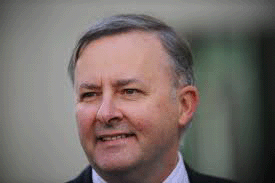 AUSTRALIA MUST PLAY ITS PART IN ABOLISHING NUCLEAR WEAPONS , ANTHONY ALBANESE MP, SPEECH TO THE TOM UREN MEMORIAL FOUNDATION FOR THE INTERNATIONAL CAMPAIGN TO ABOLISH NUCLEAR WEAPONS , 12 Feb 17
 In 1961 John F Kennedy told the United Nations:
Today, every inhabitant of this planet must contemplate the day when this planet may no longer be habitable. Every man, woman and child lives under a nuclear sword of Damocles, hanging by the slenderest of threads, capable of being cut at any moment by accident or miscalculation or by madness. The weapons of war must be abolished before they abolish us.
It is incredible to think that almost six decades on, this threat still exists. We must continue to dedicate ourselves to eliminating this threat. Every nation has a responsibility to work for a world free of nuclear weapons.
Australia is no exception.
That is why the work of ICAN in Australia and around the world, in helping to progress the disarmament agenda, is so important.
I come to this debate with the benefit of the testimony of a man who saw the horror of nuclear weapons first hand. Tom Uren was imprisoned in a POW camp on the island of Omuta on 9 August 1945. Just after 11am, the US detonated an atomic bomb over the city of Nagasaki about 80km away. Estimates of the death toll ranged between 40,000 and 80,000. That’s men, women and children. Nuclear weapons don’t discriminate.
Continue reading →
February 20, 2017
Posted by Christina Macpherson |
AUSTRALIA - NATIONAL, politics, weapons and war |
Leave a comment
Tim Wright, the Asia-Pacific director of the International Campaign to Abolish Nuclear Weapons, said Australia was turning its back on the UN at a time when multilateral cooperation was more important than ever. He accused Australia of “taking orders from the Trump administration”.
“Every country in south-east Asia and nearly all countries in the Pacific have declared their strong support for the upcoming UN negotiations. Australia will be sitting in self-imposed exile from one of the biggest and most important international treaty-making initiatives in recent history.
“This will be the first time that Australia has ever boycotted disarmament negotiations.
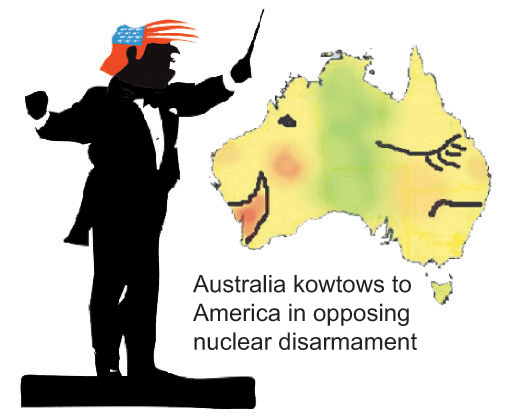
Australia to boycott global summit on treaty to ban nuclear weapons https://www.theguardian.com/world/2017/feb/17/australia-to-boycott-global-summit-on-treaty-to-ban-nuclear-weapons
Anti-nuclear campaigners accuse Australia of turning its back on the UN and ‘taking orders from the Trump administration’, Ben Doherty, Australia will boycott global negotiations on a treaty to ban nuclear weapons at the United Nations next month.
The global summit, to be held in New York on 27 March, will go ahead with Australia out of the room. Continue reading →
February 20, 2017
Posted by Christina Macpherson |
AUSTRALIA - NATIONAL, politics international, weapons and war |
Leave a comment
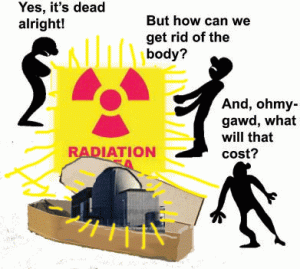 Tim Bickmore , Fight to stop Nuclear Waste Dump in South Australia February 18 There is also another elephant in the room which is yet to rate a mention. At Lucas heights there are 2 reactors – OPAL & HIFAR. OPAL is the working reactor, whilst HIFAR is the old one now undergoing de-commissioning – which includes dealing with more radioactive waste. Is the HIFAR waste
  (= old reactor parts) also destined for the dump? Considering the decommission schedule, this seems highly probable & where else would it go……
“HIFAR is currently being decommissioned and will be totally decommissioned by 2018.” HTTPS://WWW.FACEBOOK.COM/GROUPS/344452605899556/
February 20, 2017
Posted by Christina Macpherson |
Federal nuclear waste dump, New South Wales, South Australia |
Leave a comment
Josh Frydenberg flags changes to allow CEFC to invest in carbon capture and storage, ABC News, AM By Eliza Borrello, 20 Feb 17, Federal Energy Minister Josh Frydenberg has revealed the Government is considering lifting a ban on allowing the Clean Energy Finance Corporation (CEFC) to invest in carbon capture and storage……At the moment the CEFC, the Government’s green bank, is not allowed to invest in it.
But amid the Coalition’s renewed support for coal-fired power, Mr Frydenberg said that could change…..
Shadow Energy Minister Mark Butler said it would require the kind of legislation Labor would strongly oppose. “This would be an outrageous act of vandalism against a successful financing mechanism for renewable energy, for energy efficiency projects and for genuine low-carbon technology,” he said.”It’s no real surprise, I guess, because the Liberal Party has never really supported the CEFC. “It tried to abolish it for three years and now seems committed to making it a finance mechanism for the coal industry, which is unable to attract finance from the private sector.”
Government interested in low-emission coal-fired plants Mr Frydenberg said he was also interested in investment in high-efficiency, low-emission coal-fired plants.
Currently they are not green enough for the CEFC to invest in, but Mr Frydenberg has flagged changing the rules. “The Government could issue a new mandate to the CEFC which would then inform its guidelines and would make possible an investment in a high-efficiency low-emission power plant,” he said……
But Mr Butler said the market was not interested in the kind of plants Mr Frydenberg was suggesting.
“It doesn’t reflect the reality in the electricity industry. No-one in the industry is talking about the reality of building new coal-fired power stations,” he said. http://www.abc.net.au/news/2017-02-20/government-interested-in-carbon-capture-tech-frydenberg-says/8284682
February 20, 2017
Posted by Christina Macpherson |
AUSTRALIA - NATIONAL, energy, politics |
Leave a comment
 Climate change could threaten entire financial system, APRA warns, ABC News, 17 Feb 17, By Stephen Long Climate change could threaten the stability of the entire financial system, the prudential regulator has warned, as it prepares to apply climate change “stress tests” to the nation’s financial institutions.
In its first major speech on climate change, the Australian Prudential Regulation Authority chastised companies for a lack of action on the risks it poses.
“While climate risks have been broadly recognised, they have often been seen as a future problem or a non-financial problem,” APRA executive board member Geoff Summerhayes told an Insurance Council conference in Sydney.
“Many of these risks are foreseeable, material and actionable now.
The speech comes as the Government and the Opposition bicker about renewable energy targets amid dismay among industry leaders about a lack of certainty on climate change policy.
The Climate Institute’s CEO John Connor described the speech as a “huge” development.
“APRA has never gone out there like this before,” he said.
“It’s an antidote to the hyper partisan political culture war on climate policy; our regulator’s moved to the front foot in managing climate risks.”
The Climate Institute and the Investor Group on Climate Change wrote jointly to the Council of Financial Regulators two years calling for regulatory action on the financial risks from climate change.
Lack of policy ‘could greatly increase financial risks’
APRA warned in the speech that lack of policy and regulatory action could make the financial risks posed by climate change “greater and more abrupt”.
“There could be either sharper, more significant policy changes and market adjustments down the track, or the physical impacts of climate change could become more severe, more likely and more unpredictable,” Mr Summerhayes said.
“Like all risks, it is better they are explicitly considered and managed as appropriate, rather than simply ignored or neglected.
“So what can you expect to see from us? A greater emphasis on stress testing for organisational and systemic resilience in the face of adverse shocks.
“Just as we would expect to see more sophisticated scenario-based analysis of climate risks at the firm level, we look at these risks as part of our system-wide stress testing.”
APRA’s intervention follows a similar though more pointed warning two years ago by the head of the Bank of England about the threats climate change posed to financial stability…….http://www.abc.net.au/news/2017-02-17/climate-change-could-threaten-entire-financial-system-apra/8281436?pfmredir=sm
February 20, 2017
Posted by Christina Macpherson |
AUSTRALIA - NATIONAL, business, climate change - global warming |
Leave a comment
most of the Mineral Council’s biggest members are multinationals, listed on Australian and overseas stock exchanges. Could their membership fees or fighting fund donations be used for the MCA’s political campaigns if foreign donations were banned? Should their individual contributions be revealed?
Deep-pocketed miners don’t like it when those with different views wield clout, Guardian, Lenore Taylor @lenoretaylor 18 February 2017 In 2010 the mining industry’s $22m campaign against Kevin Rudd’s resources tax helped bring down a prime minister. For years it has spent huge sums on donations and advertising and lobbying to exert enormous political influence. But the deep-pocketed miners really don’t like it when those with different views find the cash and the smarts to wield some clout.

February 20, 2017
Posted by Christina Macpherson |
AUSTRALIA - NATIONAL, politics |
Leave a comment