About Seed http://www.seedmob.org.au/about_seed
“Seed is Australia’s first Indigenous youth climate network.
We are building a movement of Aboriginal and Torres Strait Islander young people for climate justice with the Australian Youth Climate Coalition.
“Our vision is for a just and sustainable future with strong cultures and communities, powered by renewable energy.
“Climate change is one of the greatest threats facing humanity, but we also know it is an opportunity to create a more just and sustainable world.”
February 20, 2017
Posted by Christina Macpherson |
aboriginal issues, AUSTRALIA - NATIONAL, climate change - global warming |
Leave a comment
 The Adani Brief: our summary https://www.acf.org.au/adani_brief_summary
https://groups.google.com/forum/#!topic/wgar-news/QkXUYq11cmQ 15 February 2017:
“Background
The brief is the result of months of international investigation by Environmental Justice Australia and
USA-based environmental law non-profit EarthJustice into the global legal compliance record of the Adani Group.
It puts governments and private stakeholders on notice that backing Adani’s Carmichael
coal mine and rail project in Queensland’s Galilee Basin
may expose them to financial and reputational risks.
“Key findings
“Environmental destruction:
Adani Group companies have a record of environmental destruction and non-compliance with environmental regulations.
Some examples are: …
“‘Black money’: …
“Bribery and illegal exports: …
“Confusing and opaque corporate structures: …
“This is a company the government is entrusting: … ”
The Adani Brief:
What governments and financiers need to know
about the Adani Group’s record overseas
https://groups.google.com/forum/#!topic/wgar-news/QkXUYq11cmQ
https://envirojustice.org.au/sites/default/files/files/Submissions%20and%20reports/The_Adani_Brief_by_Environmental_Justice_Australia.pdf
February 20, 2017
Posted by Christina Macpherson |
business, environment, politics, Queensland, secrets and lies |
Leave a comment
Artists paint the truth of SA nuclear la la land https://www.eurekastreet.com.au/article.aspx?aeid=50616#.WKpGiNJ97Gg Michele Madigan | 12 February 2017
‘It will be your artists: the poets, painters, actors, dancers, musicians, orators — they will be the ones to lead the changes.’ It was one of the many international invited guests, a Maori woman speaker, who made this prediction to the huge 40,000 strong crowd; to the 30,000 First Nations people from across the nation and 10,000 of us non-Aboriginal supporters who had joined them enroute to Hyde Park, Sydney, on 26 January 1988.
In South Australia almost 30 years later, this prophecy continues to unfold in the ongoing high-stakes battle for country that surrounds the proposed nuclear waste dump.
The orators have been long leading the way. ‘We can’t sell that country — we can’t sell it. Just like selling your own kid, own grandmother, own grandfather,’ said Arabunna Elder Kevin Buzzacott at the 1998 Global Survival and Indigenous Rights Conference in Melbourne 1998.
Tjunmutja Myra Watson told the Olympic Games international media, Botany Bay, 2000: ‘We already lost everything at Maralinga’ — the site of the 1950s and 1960s British nuclear tests.
‘We thought that Maralinga would be the last one … We love our land … We got the Dreaming, we got the songs and we got the culture. We’re going to fight to keep it. Let’s keep it, let’s keep the country, not this man coming in and digging up our spirit and our land and all our songs. They’re spoiling it when they put the poison in. They’re taking everything and they did it before.’
They are joined in the struggle by other artists: painters Eileen Wani Wingfield and Eileen Unkari Crombie; dancers Eileen Kampakuta Brown, Edie Nyimpula King and other Kupa Piti Kungka Tjuta, dancing for protection of country in the bush; singers like Ivy Makinti Stewart, whose astonishing voice filled the Adelaide Town Hall with the lament of the Seven Sisters: Irati Wanti — the poison — leave it! Continue reading →
February 20, 2017
Posted by Christina Macpherson |
art and culture, South Australia |
Leave a comment
 Why is Labor so hopeless at defending renewables policy? REneweconomy By Giles Parkinson on 16 February 2017 Federal Labor has effectively abandoned its 50 per cent renewable energy target after its leaders failed hopelessly to identify the obvious arguments to defend the policy.
Instead – less than a week after the Coalition made idiots of themselves by bringing a lump of coal into Question Time, Labor appears to have thrown its lot in to a new scheme that could mean little new wind and solar over the coming decade.
The feeble backsliding was revealed by climate and clean energy spokesman Mark Butler on Thursday, trying to cover the tracks of a pathetic performance from his leader, Bill Shorten, on the ABC Radio “AM” program a day earlier.
And by defending him, Labor appears to have thrown the renewables industry under a bus. Butler effectively admitted there would be no stand-alone renewable energy target, instead of relying on an emissions trading scheme to bring on wind and solar.
And what do the architects of that EIS expect will happen under such a scheme? As we pointed out in detail late last year, no growth at all in large-scale wind and solar between 2020 and 2030. The EIS has been designed to support gas, not wind and solar.
According to the modelling commissioned by the Australian Energy Market Commission, under an EIS fossil fuels will thrive and still make up 80 per cent of the country’s electricity mix by 2030. By adopting that policy, Labor could be killing wind and solar in its tracks, or at least after the end of the current target in 2020.
Let’s go back one step: The only thing more frustrating about the Coalition government’s attack on renewable energy in Australia has been the hopeless effort put up by Labor in defending its 50 per cent renewable energy target for 2030.
Prime Minister Malcolm Turnbull and his ministers, despite operating in a debate almost devoid of facts, is running rings around Labor by accusing it of risking both surging electricity prices and regular blackouts. Labor’s response has been ordinary at best.
Leader Bill Shorten gave the impression of being a rabbit in the headlights when interviewed on ABC Radio’s AM program on Wednesday, when asked four times about the potential cost of the target……
One thing that we’ve learned from the rise of Trump, Brexit and One Nation is that even without facts, clarity wins votes. Labor had the advantage of having facts on its side, but now it looks like they’ve gone and thrown it away.
As The Greens Adam Bandt noted, this is a capitulation, a betrayal and an act of cowardice. And everyone has a right to be angry. http://reneweconomy.com.au/why-is-labor-so-hopeless-at-defending-renewables-policy-67678/
February 20, 2017
Posted by Christina Macpherson |
AUSTRALIA - NATIONAL, politics |
Leave a comment
 It is extraordinary that some French wine producers are accompanying the Australian and French nuclear promoters spruiking the benefits of nuclear waste dumping to the community in the Barndioota region of South Australia. Not only are many vital questions unanswered as ENuFF SA (Everyone for a Nuclear Free Future SA) has shown, but this propaganda campaign completely ignores both the opposition to nuclear waste dumping, in France and the radioactive danger to France’s Champagne vineyards
“The Champagne producers are facing two nuclear timebombs – one already leaking at Soulaine, and one planned at Bure. The wine producers in the Rhone region stood up to the nuclear state in France and won. The Champagne region needs to act fast before it’s too late,” said Fred Marillier of Greenpeace France. “The French Government must stop this madness. The new facility must not accept any more waste, and an immediate investigation launched into how to stop further contamination of ground water.”
Radioactive waste leaking into Champagne Water Supply, Levels set to rise warns Greenpeace, Greenpeace 30 May, 2006 Greenpeace today revealed that France’s iconic sparkling wine, Champagne, is threatened by radioactive contamination leaking from a nuclear waste dumpsite in the region. Low levels of radioactivity have already been found in underground water less than 10 km from the famous Champagne vineyards.
Problems at the dumpsite, including water migration leading to fissures in the storage cells have been reported to French nuclear safety agency in recent weeks (1). Greenpeace has written to the Comita des Producteur de Champagne to warn them that their production risks contamination, as experienced by dairy farmers in la Hague, Normandy.
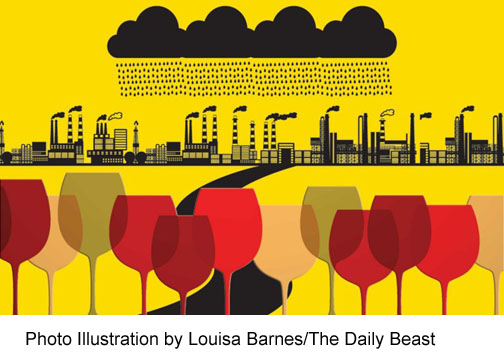
The waste dump, Centre Stockage l’Aube (CSA) in Soulaine eastern France, contains mostly waste from Electricite de France (EdF) and AREVA, but also includes foreign nuclear waste disposed of illegally under French law (2). Every week nuclear waste is trucked across France to the Champagne site. Once full, the dumpsite will be one of the world’s largest with over 1 million cubic meters of waste, including plutonium and other radionuclides.
ANDRA, the national nuclear waste agency operating the site, stated that it would not release any radioactivity into the environment when given permission for the dumpsite in the late 1980’s. Greenpeace research released last week showed levels of radioactivity leaking from another dumpsite run by ANDRA in Normandy were up to 90 times above European safety limits in underground water used by farmers, and that the contamination was spreading into the countryside Continue reading →
February 10, 2017
Posted by Christina Macpherson |
Federal nuclear waste dump, South Australia |
Leave a comment

 To ANSTO, ARPANSA & the DEPARTMENT OF INDUSTRY, INNOVATION and SCIENCE
From ENuFF SA (Everyone for a Nuclear Free Future SA) , Pt. Augusta February 8, 2017
We would like some straight answers to the following questions:
The current National Radioactive Waste Management Facility (NRWMF) is the third attempt in a decade to locate a site for a national radioactive waste dump:
Question: Are any designs for a dump planned? The last shipment of nuclear waste returned to Australia following reprocessing in France, in late 2015. It was categorised by the French authorities as high-level waste (HLW). The SA Nuclear Fuel Cycle Royal Commission Report (May 2016) states on page 95 that reprocessed waste is high level. But ANSTO classifies this highly hazardous material as intermediate-level waste (ILW).
Question: Why do the Australian agencies responsible for nuclear waste mislead the public about radiation levels?
Question: Why is spent fuel from both the retired HIFAR and currently operating OPAL reactor not classified HLW? Is it the only spent fuel in the world to be classified ILW?
Question: Would ANSTO explain how the radioisotopes in spent fuel from its research reactors differ from that of nuclear power reactors? When nuclear waste is reprocessed, waste from other countries is mixed together in the reprocessing liquor. Returning material would, therefore, come from other reactors in France (or the UK) or other client country’s reactors, as well as Australia’s.
Question: When will this be explained to the public? Reprocessing of spent fuel cannot remove ALL of the fissile material: Plutonium and Uranium.
Question: Why, then, does information provided by ANSTO state that there is no fissile material remaining in the returned reprocessed waste? And, when will the agency correct this misinformation?
Question: For how long is spent fuel stored at Lucas Heights before transporting it overseas?
Question: What quantity of spent fuel is currently stored at Lucas Heights, and how is it stored?
Question: Is it the case that the Lucas Heights facility holds about 50% of Australia’s nuclear waste, the remainder being held by the Defence Department and CSIRO?
Question: Therefore, where is it intended to dispose of the remainder of Australia’s waste not currently held at Lucas Heights?
Question: What type of research is conducted at the Lucas Heights OPAL reactor?
Question: Is food irradiation occurring in Australia?
ANSTO plans a significant increase in its production of medical isotopes (in particular Molybdenum-99 MO- 99) at the OPAL reactor.
Question: When will ANSTO, and other agencies, explain how much the OPAL waste stream would grow as a result of this production of isotopes for export to other countries? ANSTO is reported to be planning to build a Synroc facility.
Question: Where would a Synroc facility be located; at Lucas Heights or elsewhere?
Question: Does such a project indicate that Australia would no longer transport spent fuel overseas forreprocessing? Or, is it for repackaging already returned reprocessed waste?
Question: When will ANSTO, ARPANSA and the Department of Industry etc. clarify exactly what waste isplanned for permanent disposal at a proposed NRWMF and what is planned for storage at such a facility?
Question: Furthermore, when will ANSTO et al clarify for how long any stored waste would be locatedat, or nearby, such a facility?
Question: Are licences for disposal/storage of any of the national waste time-limited or not? (e.g. 100, 1,000 or 10,000 years)
Question: Will ANSTO and ARPANSA or the government explain to the SA people, particularly those in the Flinders Ranges and Eyre Peninsular, that the community nearby Lucas Heights, when consulted, rejected permanent disposal of waste at that site?
Question: Do the agencies responsible for the nation’s radioactive waste not agree that it is a pointless and unnecessarily hazardous exercise to transport HLW (called ILW in Australia) to temporarily store it for up to 100 years, when it could remain at its present site?
To relocate this waste for an indefinite period is the height of irresponsibility when the Regulatory Guide for Licensing a Radioactive Waste Storage and Disposal Facility (ARPANSA) states that such waste, “must not be less than 10,000 years for disposal of ILW.”
STOP PRODUCING THE WASTE, THEN WE WILL TALK ABOUT DISPOSAL
February 10, 2017
Posted by Christina Macpherson |
AUSTRALIA - NATIONAL, Federal nuclear waste dump |
Leave a comment
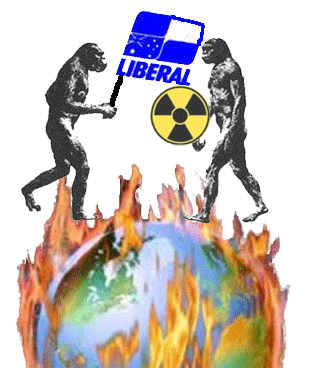 SA power cuts: Nuclear energy should be considered as solution, state Liberals say, ABC News 9 Feb 17 Despite opposing a high-level nuclear waste dump in South Australia, state Liberal leader Steven Marshall is now proposing nuclear power as a potential solution to the state’s energy reliability issues….
A citizens’ jury rejected high-level nuclear waste storage in November, prompting Mr Marshall to declare plans of “turning South Australia into a nuclear waste dump” were “now dead”. But today he said that did not mean he or his party were against the production of high-level nuclear waste in South Australia, via nuclear energy generation.
“We’ve never ruled out the nuclear opportunity for energy. We made it very clear that we were not in the slightest bit interested in continuing to pour money into the hopeless case which was a nuclear repository in South Australia,” he said.
“The royal commissioner ruled out nuclear energy in South Australia but there will be a time when it may become viable, and desperate times call for desperate solutions, and we are in a desperate situation.”
Mr Marshall denied the policy was hypocritical, but did not offer an explanation as to what would become of the highly radioactive spent fuel rods if a nuclear reactor was built in South Australia….. http://www.abc.net.au/news/2017-02-09/sa-power-cuts-could-be-solved-by-nuclear-energy-say-liberals/8256814
February 10, 2017
Posted by Christina Macpherson |
politics, South Australia |
Leave a comment
The number of high-priced events in Queensland so far this year are 40 (yes, forty) times more common than in renewables-strong South Australia. Did we hear a peep of protest from the Coalition about this? No.
There is no doubt that more renewables, and more competition, will reduce that pricing power. That is a given.
But the Coalition and many in the mainstream media simply don’t want to know. They have barely reported on the high-priced events in Queensland and NSW, or on the real cause of those events in South Australia.
They don’t want to know: politics and ideology are at play.
High energy prices? Blame fossil fuel generators, not renewables, REneweconomy, By Giles Parkinson on 8 February 2017 It seems that you can ask the Coalition government a question about pretty much anything – plunging polls, Donald Trump, Cory Bernardi or even the weather – and the answer will always be the same: “We’re focused on electricity prices.”
Great. But what exactly is the Coalition doing about it? On the evidence to date, not a whole lot, apart from blaming renewables for soaring wholesale electricity costs and promoting something called “clean coal,” despite all the evidence pointing to the fact that coal generation it is not very clean, and not cheap.
They are chasing the wrong target. Australia has experienced some extraordinary high wholesale electricity prices this summer, and most of these price surges have come in states with little large-scale wind or solar.
It is the activities of the fossil fuel generators that are to blame. This is about competition, or the lack of it, and the fossil fuel generators have been going to extraordinary lengths to get rid of competition.
The Australian Energy Regulator has been investigating more than half a dozen “high priced” events, as it is required to do when prices jump above $5,000/MWh. Some of the reports it has already completed make astonishing reading. Continue reading →
February 10, 2017
Posted by Christina Macpherson |
AUSTRALIA - NATIONAL, energy, Queensland |
1 Comment
 SA power woes to spread nation-wide, starting with Victoria, Australian Energy Council warns, ABC News 9 Feb 17 By Claire Campbell The Federal Government needs to take urgent action to improve its energy policies before the rest of Australia falls victim to the type of large-scale blackouts experienced in South Australia, the Australian Energy Council has warned.
About 90,000 South Australian homes and businesses were blacked out Wednesday when the Australian Energy Market Operator (AEMO) issued a load-shedding order to avoid potential damage to the network equipment due to supply deficiency.
It asked for more power generators to be switched on but did not receive “sufficient bids” and said it did not have enough time to turn on the second unit at Pelican Point. AEC chief executive officer Matthew Warren said there was no shortage of electrons and available power, but it was not dispatched when required.
He said the entire nation’s system needed upgrading quickly because energy reliability was not just a state issue…….
AEMO has warned that load-shedding is possible in New South Wales on Friday. http://www.abc.net.au/news/2017-02-09/sa-power-woes-to-spread-through-rest-of-australia-aec-warns/8257032
February 10, 2017
Posted by Christina Macpherson |
AUSTRALIA - NATIONAL, energy, New South Wales |
Leave a comment
 Heatwaves to be hotter, longer and more frequent, climate change report says, ABC News 9 Feb 17 By Lexy Hamilton-Smith Heatwaves are becoming hotter, lasting longer and occurring more often, the Climate Council’s latest report card on climate change says.
The Cranking Up The Intensity: Climate Change and Extreme Weather Events report has found 2016 was the hottest year on record globally.
Climate scientist Professor Will Steffen warned extreme weather events were projected to worsen across Australia as the climate warmed further. He said the extreme heat had to be “taken really seriously, first and foremost”. “It is a risk for human health, particularly for the most vulnerable — the elderly, very young people, and exposed outdoor workers,” he said.
“It is obviously a risk for the agricultural industry, it is a risk for natural ecosystems.
“We saw an underwater heatwave about a year ago wipe out a large part of the Great Barrier Reef.”A lot of these impacts we are seeing occurring now are occurring earlier than we had projected a few years ago.
“It is giving us some cause for concern that the climate system may be shifting a bit faster than we originally thought.”
Impact varies for each state Continue reading →
February 10, 2017
Posted by Christina Macpherson |
AUSTRALIA - NATIONAL, climate change - global warming |
Leave a comment
 Powershop reveals cash for renewable projects from customers who paid more https://www.theguardian.com/environment/2017/feb/09/powershop-reveals-cash-for-renewable-projects-from-customers-who-paid-more
Energy retailer raised $100,000 from customers, which will be given out as grants to community-owned energy projects, Guardian, Michael Slezak, 9 Feb 17, Amid fresh attacks on renewable energy targets from the federal government and large energy retailer ERM Power, smaller electricity retailer Powershop has raised $100,000 from its customers to be given out as grants to 10 community-owned projects around the country.
Three months ago Powershop launched the Your Community Energy initiative, where they gave customers the opportunity to pay higher rates, which it said would then be distributed to renewable energy projects that were community-owned.
Powershop aimed to raise $20,000 by the end of 2016 but, as of February 2017, it had raised $100,000.
One project – rooftop solar on the Centre for Education and Research in Environmental Strategies (Ceres) centre in Melbourne – has already received $10,000 from the initiative and used that to complete their 15 KW solar installation.
A spokeswoman for Ceres, Judy Glick, said the installation would save the community group $2,000 each year and reduce their yearly emissions by almost 16 tonnes of CO2. “Ceres is on a mission to achieve zero emissions by 2025,” she said.
Five other projects were also announced as recipients of a share of the money. Continue reading →
February 10, 2017
Posted by Christina Macpherson |
AUSTRALIA - NATIONAL, solar, Victoria |
Leave a comment
 Why coal-fired power handouts would be an attack on climate and common sense
The evidence suggests the push for government help is an attempt to squeeze money out of unwise investments made at the end of the mining boom, Guardian, 9 Feb 17, Michael Slezak, The recent coordinated push for new coal-powered electricity generators in Australia comes as the industry is on its last legs.
The intensified push for government handouts can be seen as a last-ditch attempt for the coal industry to squeeze some money out of the unwise investments it made at the end of the mining boom.
Here are the facts and figures that point towards that conclusion.
The coal industry knows that to stop runaway climate change all coal-powered generators need to close
Australia joined 174 countries and the European Union in 2015, signing the Paris agreement. In doing so, Australia agreed to do its part in keeping the global temperature rise “well below” 2C.
It also commits countries to achieving net-zero emissions “in the second half of this century”.
That agreement, designed to stop runaway climate change, requires that all of Australia’s coal-fired generators close.
According to the International Energy Agency, OECD countries such as Australia need to shut down almost all of their coal-fired power stations by about 2035.
And the rest of the world will need to phase out coal power by 2050, it says. [excellent graph on original] With coal-fired power stations taking up to a decade to build, and designed to last 30 or 40 years, building new ones now is obviously inconsistent with those commitments.
In particular, Australia has committed to reducing its emissions by 26% below 2005 levels by 2030 – a commitment that is not strong enough to limit global warming at 2C and will need to be “ratcheted up”.
But the Australian government recently released projections of the country’s carbon emissions showing that current policies are going to cause emissions to rise to 2030, not drop, leaving Australia overshooting that commitment by a long way. [graph on original] …….
New coal is the most expensive form of energy
While the proponents of coal talk about coal power being “cheap and reliable”, they are wrong on both fronts. Coal is now the most expensive form of new power. According to Bloomberg New Energy Finance, the cost of energy from a new coal power plant would be $134-$203/MWh.
That’s more expensive than wind, solar or highly efficient combined-cycle gas (costing $61-$118/MWh, $78-$140/MWh and $74-$90/MWh, respectively)………
The global coal industry recently saw its biggest player, Peabody, go bankrupt in the US. If companies are forced to take write-downs for these projects by admitting they will never go ahead, it could mean the end for some of the companies.
At his National Press Club address last week, Malcolm Turnbull appeared to point to this as the reason he is now looking to subsidise the most expensive and dirtiest form of energy, saying that it could help our mining industry. He said: “As the world’s largest coal exporter, we have a vested interest in showing that we can provide both lower emissions and reliable baseload power with state-of-the-art, clean, coal-fired technology.” https://www.theguardian.com/environment/2017/feb/07/why-coal-fired-power-handouts-would-be-an-attack-on-climate-and-common-sense
February 10, 2017
Posted by Christina Macpherson |
AUSTRALIA - NATIONAL, climate change - global warming, politics |
Leave a comment
Carmichael mine jobs need ’21 times the subsidies’ of renewables, says lobby group
Federal funding for Adani project amounts to $683,060 a job, compared with $32,191 a worker in Queensland’s clean energy sector, 350.org says, Guardian, Joshua Robertson, 8 Feb 17, Clean energy projects in Queensland are already on track to create more employment than Australia’s largest proposed coalmine, which if funded federally would cost taxpayers 21 times more per job, according to new study.
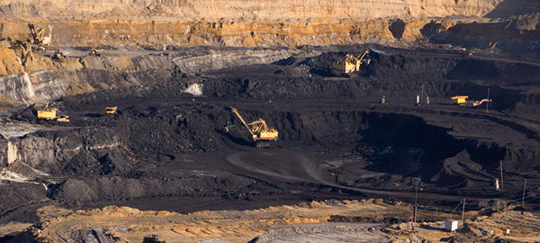
Federal government agencies are investing $71.4m in seven solar farms and a windfarm in Queensland, which are set to deliver a total of 2,218 jobs, according to analysis by climate advocacy group 350.org.
Adani’s proposed Carmichael coal project in central Queensland, which has obtained conditional approval for a $1bn federal infrastructure loan, is predicted to deliver 1,464 jobs.
The level of federal subsidy for Adani would amount to $683,060 a job, compared with $32,191 a worker in Queensland’s clean energy sector.
The Queensland government has accused the federal government of misrepresenting key data while talking up coal in an ideological attack on renewable energy. Continue reading →
February 10, 2017
Posted by Christina Macpherson |
AUSTRALIA - NATIONAL, energy, politics, Queensland |
Leave a comment
 Solar battery rebate scheme pushed by Greens in WA election pitch, ABC News , 9 Feb 17 By Laura Gartry More than 100,000 WA households could be entirely powered by their own solar energy using battery storage within five years under a 50 per cent tax rebate proposed by the Greens.
In one of first major election commitments by the party, Upper House candidate Tim Clifford said the cost of battery units were currently out of reach for a lot of people.
The Greens’ proposed rebate would allow individuals to get up to half the cost of their storage system covered to a maximum of $5,000 in the first year and tapering off to $1,500 in five years.
The $290 million scheme would also provide a $5,000 upfront grant to install solar for families earning less than $80,000. Households with solar panels in WA are looking to batteries as a way to offset the sharp fall in rebates Synergy pays them for their electricity.
It is hoped the scheme would kick-start the industry and drive down the cost of units and power bills.
Energy Minister Mike Nahan said a possible battery subsidy was discussed, but would not be implemented by the Government…..
Mr Clifford said up to 3,000 WA businesses could also benefit, allowing their battery storage assets to be depreciated over three years rather than 15, which could pay off their battery storage unit within 10 years.
The scheme would be co-funded from the removal of federal fossil fuel and mining subsidies……http://www.abc.net.au/news/2017-02-08/solar-rebates-mooted-by-greens-wa-election/8252706
February 10, 2017
Posted by Christina Macpherson |
energy, politics, Western Australia |
Leave a comment
 7 Feb 17 Selling Australian uranium to Ukraine would increase the risks of war, civil unrest and corruption in the eastern European country, the Australian Conservation Foundation said today.
The Joint Standing Committee on Treaties today recommended the conditional ratification of the nuclear co-operation agreement with Ukraine even though the committee’s own investigation conceded existing safeguards were ‘not sufficient’ and there was a risk Australian nuclear material would disappear off the radar in Ukraine.
“Australia, the nation that fuelled Fukushima should not sell uranium to the country that gave us Chernobyl,” said ACF’s Dave Sweeney.
“The treaties committee’s report found ‘Australian nuclear material should never be placed in a situation where there is a risk that regulatory control of the material will be lost’ (2.53), yet that is exactly what could happen under the inadequate checks and balances that apply to exported Australian uranium.
“The committee’s report clearly states the Australian government must undertake a detailed and proper risk assessment and develop an effective contingency plan for the removal of ‘at risk’ Australian nuclear material.
“There can be no justification for seeking to fast-track uranium sales based on this report.
“Australia should be very cautious about contributing nuclear fuel to an already tense geo-political situation in eastern Europe. Tensions recently flared again in Ukraine.
“Ukraine’s nuclear sector is plagued by serious and unresolved safety, security and governance issues.
“Two-thirds of Ukraine’s aging fleet of 15 nuclear reactors will be past its design lifetime use-by date in just four years.
“This is an insecure and unsafe sector and a risky sales plan.
“ACF calls on the federal government to be a responsible global citizen and not to advance uranium sales to Ukraine.”
February 8, 2017
Posted by Christina Macpherson |
AUSTRALIA - NATIONAL, politics international, uranium |
Leave a comment