At last, Dutton spells out his nuclear power play – 12 more years of coal (if it lasts)
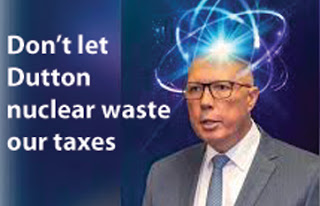
Opposition leader Peter Dutton has revealed the Coalition’s nuclear energy plan relies on many of Australia’s coal-fired power stations running for at least another 12 years – far beyond the time frame officials expect the ageing facilities to last.
The claim has set off a new round of speculation over the Coalition’s plans – the viability of which has already been widely questioned by energy analysts.
Dutton offered up limited detail in a speech on Monday. He also revealed the plan relies on ramping up Australia’s gas production.
It seems increasingly clear the Coalition’s nuclear policy would prolong Australia’s reliance on coal, at a time when the world is rapidly moving to cleaner sources of power.
The Coalition wants to build nuclear reactors on the sites of closed coal plants. It says the first reactors could come online by the mid-2030s. However, independent analysis shows the earliest they could be built is the 2040s.
Now it appears the Coalition’s plan involves relying on coal to provide electricity while nuclear reactors are being built. On Monday, Dutton suggested coal-fired electricity would be available into the 2030s and ‘40s.
But this is an overly optimistic reading of coal’s trajectory. The Australian Energy Market Operator says 90% of coal-fired power in the National Electricity Market will close by 2035.
All this suggests the Coalition plans to extend the life of existing coal plants. But this is likely to cost money. Australia’s coal-fired power stations are old and unreliable – that’s why their owners want to shut them down. To keep plants open means potentially operating them at a loss, while having to invest in repairs and upgrades.
This is why coal plant owners sought, and received, payments from state governments to delay exits when the renewables rollout began falling behind schedule.
So who would wear the cost of delaying coal’s retirement? It might be energy consumers if state governments decide to recoup the costs via electricity bills. Or it could be taxpayers, through higher taxes, reduced services or increased government borrowing. In other words, we will all have to pay, just from different parts of our personal budgets.
Labor’s energy plan also relies on continued use of coal. Dutton pointed to moves by the New South Wales and Victorian governments to extend the life of coal assets in those states. For example, the NSW Labor government struck a deal with Origin to keep the Eraring coal station open for an extra two years, to 2027.
However, this is a temporary measure to keep the electricity system reliable because the renewables build is behind schedule. It is not a defining feature of the plan.
Dutton claims Labor’s renewable energy transition will require a massive upgrade to transmission infrastructure. The transmission network largely involves high-voltage lines and towers, and transformers.
He claims the Coalition can circumvent this cost by building nuclear power plants on seven sites of old coal-fired power stations, and thus use existing transmission infrastructure.
Labor’s shift to renewable energy does require new transmission infrastructure, to get electricity from far-flung wind and solar farms to towns and cities. It’s also true that building nuclear power stations at the site of former coal plants would, in theory, make use of existing transmission lines, although the owners of some of these sites have firmly declined the opportunity.
But even if the Coalition’s nuclear plan became a reality, new transmission infrastructure would be needed.
Australia’s electricity demand is set to surge in coming decades as we move to electrify our homes, transport and heavy industry. This will require upgrades to transmission infrastructure, because it will have to carry more electricity. Many areas of the network are already at capacity.
So in reality, both Labor’s and the Coalition’s policies are likely to require substantial spending on transmission.
Both Labor and the Coalition acknowledge a big role for gas in their respective plans.
Climate Change and Energy Minister Chris Bowen says gas, along with storage, is needed to help back up to the grid, when solar and wind farms are not producing electricity.
Dutton spoke of plans “to ramp up domestic gas production” in the short term, “to get power prices down and restore stability to our grid” – presumably until nuclear comes online.
But the issue isn’t a lack of gas. It’s that the gas is in the wrong places. There’s a gas shortage because southern reserves are declining and all the gas production is in the north of the continent.
An increased role for gas means getting someone to pay for new infrastructure, such as pipelines or LNG terminals. That will make for expensive gas, and expensive gas means expensive electricity.
It’s now three months since the Coalition released its nuclear strategy. Detail was thin then – and Monday’s speech shed little light.
Many unanswered questions remain – chief among them, costings of the nuclear plan, and how much of that will be born by government. CSIRO says a nuclear reactor would cost at least A$8.6 billion.
We also don’t know how the Coalition would acquire the sites, or get around nuclear bans in Queensland, NSW and Victoria.
We still don’t know how the Coalition plans to keep the lights on in the coming decade, as coal exits.
And crucially, we don’t know what it will cost households and businesses. It is unlikely to be cheap.
On the contrary, Mr Dutton, nuclear generated electricity is not “emissions free”.

Helen Caldicott, 7 Oct 24
On the contrary, Mr Dutton, nuclear generated electricity is not “emissions free”.
Large quantities of CO2 are emitted during the mining, milling and enrichment of the uranium ore, and during the construction of the concrete reactor, nuclear fuel rods, and the transport and storage of radioactive waste for 240,000 years
Mutagenic radioactive gases are also routinely released during reactor operations including tritium – radioactive hydrogen which enters the body through the skin and lung, carbon 14 and noble gases – xenon, krypton and argon. These carcinogenic elements are inhaled and also bioconcentrate in the food chain near the reactors thereby exposing the surrounding population to the development of cancer and leukemia.
It is important to note that children are 10 to 20 times more susceptible to radiation induced cancer than adults.
Reference – Nuclear Power is Not the – Helen Caldicott – The New Press – 2011.
What nuclear power in the United States tells us about the Coalition’s controversial energy policy

“If nuclear power were a person, it would be weeping with its head in its hands over the Vogtle story. Vogtle is clear proof that large nuclear construction is not an economic way to go.”
ABC News, By Eric Campbell, 7 Oct 24
“…………………………………It’s been touted as the start of a new era for the US’s flagging nuclear power industry. Vogtle’s newest reactors are among the first built in the US in decades.
“Thank you for your service to our nation in providing this arsenal of clean power,” Energy Department Secretary Jennifer Granholm said at the May opening ceremony for Vogtle’s latest reactor.
“Now let’s draw up some battle plans for new reactors. I don’t know about you but I for one am reporting for duty!” she said, saluting.
Peter Dutton is ready to enlist Australia. If he wins next year’s election, he plans to build seven nuclear power stations at retiring coal-fired plants.

Mr Dutton has flagged the AP1000 reactor used at Vogtle could be one of the models used to power homes and businesses in Australia.
“We don’t want to be the purchaser of the first in class or have an Australian-made technology, we want to rely on the Westinghouse AP1000,” he said in June. Beyond this, he’s given little detail about how exactly the plan would work.
Four Corners travelled around the US to examine the Coalition claims that developing nuclear power plants was the best way to replace coal power.
It has cited the US, which remains the world’s largest producer of nuclear energy, as one of the places to see the benefits it could bring Australia. Before launching the policy, Coalition MPs accompanied two groups of engineers and environmentalists around the US and to Ontario in Canada to see the potential first-hand.
In our experience, the reality was more complex.
Cost blowout
The Coalition’s pitch for nuclear is that it’s reliable, clean and cheap. And Vogtle certainly ticks two of those boxes. The plant almost never stops running and it produces no [greenhouse] emissions. But here’s the problem. It was expensive to build.
The giant AP1000 reactors designed by Westinghouse opened seven years late at more than twice the budgeted cost. The final bill of around $US35 billion ($50 billion) makes them among the most expensive nuclear generators ever built.
Now, Georgia residents are paying the price for Vogtle’s overruns in their electricity bills.
Community organiser Kimberley Scott said people have been struggling to keep up.
“Power bills have gone up hundreds of dollars for consumers including myself,” she said.
Georgia ratepayer Anna Hamer said she now has had to ration air conditioning in the Atlanta summer as her bills rise. In July she was hit with her highest power bill ever: $US618 for one month.
“They were telling us everything was going to be OK with this plant, that it would be on time and it would be on budget. It’s over budget and we are paying for that. That seems wrong to me.”
It’s very different to what the Coalition has been suggesting in media interviews and energy speeches since it launched its nuclear policy over three months ago.
At the nuclear policy launch in June, Mr Dutton said: “Electricity is cheaper where there is a presence of nuclear energy. That is a fact. So we can rely on that international experience.”
The Coalition often cites the Canadian province of Ontario as a model, saying its three nuclear plants contribute to much lower power bills than Australia. The plants are owned and subsidised by the provincial government…………….
Peter Bradford, a former member of the US Nuclear Regulatory Commission, which licences commercial reactors, told Four Corners building nuclear plants was always the most expensive option.
“It’s an unbroken string of economic disappointment,” he said.
“If nuclear power were a person, it would be weeping with its head in its hands over the Vogtle story. Vogtle is clear proof that large nuclear construction is not an economic way to go.”
………………………….Ted O’Brien said the Coalition’s policy has been shaped by the lessons learned by other countries.
“If you look at the Vogtle example, one of the lessons we need to learn in Australia is we should not be adopting first of a kind technology. We should only be adopting what’s referred to as next-of a kind proven technology.”
He said a Coalition government would spend two-and-a-half years studying the sites and consulting communities before an independent authority chooses the most appropriate reactor design.
The SMR conundrum
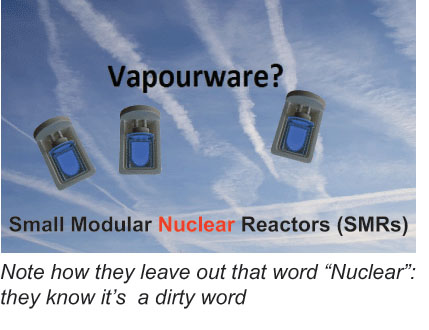
The other type of reactor the Coalition wants in its nuclear power arsenal has been promoted as a game changer for the industry…………………………
The Coalition wants SMRs operating in Australia from 2035. There’s just one problem.
They don’t exist yet, at least not commercially.
Billions of dollars are being spent to make them a reality. But so far, all attempts are years from completion or have already failed.
The only project that won approval from the US Nuclear Regulatory Commission was abandoned last November because of rising costs, even after the US Department of Energy pledged more than $US500 million in grants.
Four Corners went to the latest place where there’s a concerted attempt to break this conundrum. It’s a sleepy coal town in south-west Wyoming called Kemmerer, with a population of nearly 3,000.
……Enter Bill Gates. In June the billionaire climate change activist came to town and turned a sod on his project to construct a working SMR, declaring: “This is a big step towards safe, abundant, zero carbon energy.”
He’s putting $US1 billion of his own money into trying to make it a success, with the federal government pledging another $US2 billion.
…………………………………………….. Fortunately for the project, the town administration welcomes the prospect of anything that might bring work.
“Essentially, the town was going to lose a couple of hundred jobs or more,” Mayor Bill Thek said.
“We’re hoping that the people that work for the power plant, the current coal burning power plant will be able to transition, or at least some of them, into the nuclear plant.”
For now, all that’s being constructed are the bits around the reactor, while the project waits for approval from the Nuclear Regulatory Commission (NRC). Project spokesman Jeff Navin said they still hoped to finish construction by 2030………..
SMRs face a challenge. They’re small, producing far less power. Any power they produce would therefore be more expensive, unless the modules can be mass produced to make them cheaper to construct to offset the generation cost.
But nobody is going to mass produce anything until there is a working model that promises to produce power economically that attracts lots of eager customers. Which takes you back to square one.
Peter Bradford has seen promised breakthroughs like SMRs come and go.
“In this industry, vendor claims about cheaper nuclear costs have a long, well-documented and very sad history — they just don’t come true.
“There is no basis for believing that this utterly unproven technology is going to sweep in and make a success of a field that up to now has been an unmitigated economic failure.”
Even in the Gates-backed project’s most optimistic scenario, it’s unlikely SMRs would be mass produced to bring down costs before Australia plans to install them.
When asked about this, Ted O’Brien did not appear fazed…………..
Getting it done
The uncertainty around SMRs, and the cost blowout in Georgia, point to the practical difficulties Australia would face in trying to build reactors cheaper than countries with decades of experience, when we’ve never built a nuclear energy plant before.
The US is not the only nuclear country struggling to build new plants.
- France’s latest reactor opened 12 years behind schedule and around 10 billion euros over budget.
- Britain’s Hinkley Point plant is running six years late and facing a 20 billion British pound overrun.
- A South Korean consortium was able to build four reactors in the United Arab Emirates over 12 years. Even under an authoritarian regime, each reactor was connected to the grid around three years later than expected.
US journalist and nuclear historian Stephanie Cooke has been covering the industry since 1980.
“I have never seen a project come in on time or budget. They’ve come in way, way over budget and way over time. It amazes me that there’s so much hype about something that’s been such an abject failure in my opinion.
“I mean, yeah, it’s produced electricity, but at what cost? I don’t think that we should be wasting our money on it plain and simple.”
……………………………………………. The finer points of how the Coalition plans to overcome the challenges it will confront are still unclear.
It’s yet to reveal how much its plan will cost or how it will overturn federal state bans on nuclear energy.
It says SMR plants could be operating by 2035, or 2037 if it starts with larger reactors. But the timing beyond that is unclear…………………. more https://www.abc.net.au/news/2024-10-07/nuclear-power-us-coalition-energy-policy-australia-four-corners/104432870
Finally Free, Assange Receives a Measure of Justice From the Council of Europe

In the U.S., “the concept of state secrets is used to shield executive officials from criminal prosecution for crimes such as kidnapping and torture, or to prevent victims from claiming damages,” the resolution notes. But “the responsibility of State agents for war crimes or serious human rights violations, such as assassinations, enforced disappearances, torture or abductions, does not constitute a secret that must be protected.”
In his first public statement since his release, Assange said, “I’m free today … because I pled guilty to journalism.”
By Marjorie Cohn , Truthout, October 4, 2024
he Parliamentary Assembly of the Council of Europe (PACE), Europe’s foremost human rights body, overwhelmingly adopted a resolution on October 2 formally declaring WikiLeaks founder Julian Assange a political prisoner. The Council of Europe, which represents 64 nations, expressed deep concern at the harsh treatment suffered by Assange, which has had a “chilling effect” on journalists and whistleblowers around the world.
In the resolution, PACE notes that many of the leaked files WikiLeaks published “provide credible evidence of war crimes, human rights abuses, and government misconduct.” The revelations also “confirmed the existence of secret prisons, kidnappings and illegal transfers of prisoners by the United States on European soil.”
According to the terms of a plea deal with the U.S. Department of Justice, Assange pled guilty on June 25 to one count of conspiracy to obtain documents, writings and notes connected with the national defense under the U.S. Espionage Act. Without the deal, he was facing 175 years in prison for 18 charges in an indictment filed by the Trump administration and pursued by the Biden administration, stemming from WikiLeaks’ publication of evidence of war crimes committed by the U.S. in Iraq, Afghanistan and Guantánamo Bay. After his plea, Assange was released from custody with credit for the five years he had spent in London’s maximum-security Belmarsh Prison.
The day before PACE passed its resolution, Assange delivered a powerful testimony to the Council of Europe’s Committee on Legal Affairs and Human Rights. This was his first public statement since his release from custody four months ago, after 14 years in confinement – nine in the Ecuadorian Embassy in London and five in Belmarsh. “Freedom of expression and all that flows from it is at a dark crossroads,” Assange told the parliamentarians.
A “Chilling Effect and a Climate of Self-Censorship”
The resolution says that “the disproportionately harsh charges” the U.S. filed against Assange under the Espionage Act, “which expose him to a risk of de facto life imprisonment,” together with his conviction “for — what was essentially — the gathering and publication of information,” justify classifying him as a political prisoner, under the definition set forth in a PACE resolution from 2012 defining the term. Assange’s five-year incarceration in Belmarsh Prison was “disproportionate to the alleged offence.”
Noting that Assange is “the first publisher to be prosecuted under [the Espionage Act] for leaking classified information obtained from a whistleblower,” the resolution expresses concern about the “chilling effect and a climate of self-censorship for all journalists, editors and others who raise the alarm on issues that are essential to the functioning of democratic societies.” The resolution also notes that “information gathering is an essential preparatory step in journalism” which is protected by the right to freedom of expression guaranteed by the European Court of Human Rights.
The resolution cites the conclusion of Nils Melzer, UN Special Rapporteur on torture and other cruel, inhuman or degrading treatment or punishment, that Assange had been exposed to “increasingly severe forms of cruel, inhuman or degrading treatment or punishment, the cumulative effects of which can only be described as psychological torture.”
Condemning “transnational repression,” PACE was “alarmed by reports that the CIA was discreetly monitoring Mr. Assange in the Ecuadorian embassy in London and that it was allegedly planning to poison or even assassinate him on British soil.” The CIA has raised the “state secrets” privilege in a civil lawsuit filed by two attorneys and two journalists over that illegal surveillance.
In the U.S., “the concept of state secrets is used to shield executive officials from criminal prosecution for crimes such as kidnapping and torture, or to prevent victims from claiming damages,” the resolution notes. But “the responsibility of State agents for war crimes or serious human rights violations, such as assassinations, enforced disappearances, torture or abductions, does not constitute a secret that must be protected.”
Moreover, the resolution expresses deep concern that, according to publicly available evidence, no one has been held to account for the war crimes and human rights violations committed by U.S. state agents and decries the “culture of impunity.”
The resolution says there is no evidence anyone has been harmed by WikiLeaks’ publications and “regrets that despite Mr Assange’s disclosure of thousands of confirmed — previously unreported — deaths by U.S. and coalition forces in Iraq and Afghanistan, he has been the one accused of endangering lives.”
Assange’s Testimony
The testimony Assange provided to the committee was poignant. “I eventually chose freedom over realizable justice … Justice for me is now precluded,” Assange testified. “I am not free today because the system worked. I am free today after years of incarceration because I pled guilty to journalism.” He added, “I pled guilty to seeking information from a source. I pled guilty to obtaining information from a source. And I pled guilty to informing the public what that information was.” His source was whistleblower Chelsea Manning, who provided the documents and reports to WikiLeaks. “Journalism is not a crime,” Assange said. “It is a pillar of a free and informed society.”………………………………………………………………………………
PACE Urges US to Investigate War Crimes
The resolution calls on the U.S., the U.K., the member and observer States of the Council of Europe, and media outlets to take actions to address its concerns.
It calls on the U.S., an observer State, to reform the Espionage Act of 1917 to exclude from its operation journalists, editors and whistleblowers who disclose classified information with the aim of informing the public of serious crimes, such as torture or murder. In order to obtain a conviction for violation of the Act, the government should be required to prove a malicious intent to harm national security. It also calls on the U.S. to investigate the allegations of war crimes and other human rights violations exposed by Assange and Wikileaks.
PACE called on the U.K. to review its extradition laws to exclude extradition for political offenses, as well as conduct an independent review of the conditions of Assange’s treatment while at Belmarsh, to see if it constituted torture, or inhuman or degrading treatment.
In addition, the resolution urges the States of the Council of Europe to further improve their protections for whistleblowers, and to adopt strict guidelines to prevent governments from classifying documents as defense secrets when not warranted.
Finally, the resolution urges media outlets to establish rigorous protocols for handling and verifying classified information, to ensure responsible reporting and avoid any risk to national security and the safety of informants and sources.
Although PACE doesn’t have the authority to make laws, it can urge the States of the Council of Europe to take action. Since Assange never had the opportunity to litigate the denial of his right to freedom of expression, the resolution of the Council of Europe is particularly significant as he seeks a pardon from U.S. President Joe Biden. https://truthout.org/articles/finally-free-assange-receives-a-measure-of-justice-from-the-council-of-europe/
Dutton at odds with Queensland LNP over nuclear plans
Federal Liberal leader joined the state’s election campaign on Friday as David Crisafulli reiterated his objection to nuclear sites at Tarong and Callide
Andrew Messenger, Fri 4 Oct 2024, https://www.theguardian.com/australia-news/2024/oct/04/queensland-election-liberal-national-party-nuclear-plan-peter-dutton?fbclid=IwY2xjawFsifVleHRuA2FlbQIxMQABHatRzSolvCpDyme9yMGAFlBbI6wl6H_xHENLi2ILNvm4yPKbJbAux77dWQ_aem_EASDYfMnhAhutdbQArg8oA
The federal opposition leader, Peter Dutton, has dismissed the Queensland LNP’s rejection of his nuclear power plan as just a “difference of opinion” between friends as he joined the state’s election campaign on Friday.
At their first joint press conference since the controversial plan was announced, Queensland LNP leader David Crisafulli reiterated his defiance of Dutton’s plan for two nuclear plants in Queensland. Crisafulli said he would oppose them if elected at the 26 October poll.
It was their first joint appearance since June, when the federal leader announced plans for seven nuclear sites across Australia.
“Friends can have differences of opinion, that’s healthy,” Crisafulli said. Dutton agreed.
Dutton said he would have a “respectful” conversation with Crisafulli if he was elected.
“We can have that conversation,” Dutton said.
“The first step is to get David elected as premier. When the prime minister stops running scared, he’ll hold an election, and I intend to be prime minister after the next election, and we can have that conversation.
“In the end, we want the same thing, and that is cheaper electricity for Queenslanders.”
Crisafulli said he would not change his mind.
He has repeatedly ruled out repealing the state’s nuclear ban under any circumstances.
Dutton has previously suggested overriding state legislation.
“Commonwealth laws override state laws even to the level of the inconsistency. So support or opposition at a state level won’t stop us rolling out our new energy system,” he said in June.
Labor has repeatedly accused Crisafulli of secretly supporting the nuclear plan.
“He’ll have to roll over when it comes to nuclear power, because his entire state party, all of those state LNP MPs in the federal party, all of those state LNP senators in the federal Senate and all of his grassroots members, they want nuclear power, and he’ll have to roll over,” the deputy premier, Cameron Dick, said.
The LNP is widely tipped to win the election.
The prime minister, Anthony Albanese, is yet to appear alongside the premier, Steven Miles, on the campaign trail.
The associate director of research at the ANU’s initiative on zero carbon energy for the Asia Pacific Institute, Emma Aisbett, said having major policy differences between federal and state governments raised investment risk.
“It means that investors in energy will face higher policy uncertainty, which is also known as political risk,” she said. “It has a particularly strong depressing effect on investment for long-lived assets, which have high upfront costs, and both nuclear and renewables, either PV or wind, really fit into that category.”
She said having a dispute between governments could bring back the “energy wars”.
“What that does is slow and delay the net zero transition, and we do not have decades more to waste, slowing and delaying the transition away from fossil based energy.”
after newsletter promotion
“He’ll have to roll over when it comes to nuclear power, because his entire state party, all of those state LNP MPs in the federal party, all of those state LNP senators in the federal Senate and all of his grassroots members, they want nuclear power, and he’ll have to roll over,” the deputy premier, Cameron Dick, said.
The LNP is widely tipped to win the election.
The prime minister, Anthony Albanese, is yet to appear alongside the premier, Steven Miles, on the campaign trail.
The associate director of research at the ANU’s initiative on zero carbon energy for the Asia Pacific Institute, Emma Aisbett, said having major policy differences between federal and state governments raised investment risk.
“It means that investors in energy will face higher policy uncertainty, which is also known as political risk,” she said.
“It has a particularly strong depressing effect on investment for long-lived assets, which have high upfront costs, and both nuclear and renewables, either PV or wind, really fit into that category.”
She said having a dispute between governments could bring back the “energy wars”.
“What that does is slow and delay the net zero transition, and we do not have decades more to waste, slowing and delaying the transition away from fossil based energy.”
If Peter Dutton has a better understanding of the cost of building nuclear, then let’s see it
Johanna Bowyer & Tristan Edis, l Oct 4, 2024, https://reneweconomy.com.au/if-peter-dutton-has-a-better-understanding-of-the-cost-of-building-nuclear-then-lets-see-it/
Two weeks ago, the Institute for Energy Economics and Financial Analysis released a report analysing how much electricity prices and Australian household energy bills would need to rise to make nuclear power plants financially viable.
The report found that household energy bills across the four states analysed would rise by an average of $665 a year relative to existing prices.
Federal opposition energy spokesperson Ted O’Brien claimed the report’s analysis was based on a “cherry-picked” sample of nuclear power projects. Opposition treasury spokesperson Angus Taylor described the analysis as “nonsense.”
The leader of the opposition Peter Dutton had the opportunity to provide a detailed response to our research in a speech he gave on nuclear power several days later. Yet his speech contained no alternative economic analysis or costing to support the opposition’s claims our research is incorrect.
Our analysis was informed by the actual construction costs of all nuclear power projects that have been committed to construction in the past 20 years across the European Union and North America.
In addition, we also considered two projects that had reached the tender contract pricing stage. A sample of six projects may appear small but the lack of a significant number of projects committed to construction is a warning bell in itself.
The limit of 20 years was chosen because projects from any earlier would have employed reactor technologies that lacked critical safety features now deemed essential by EU and US regulators.
The EU and North America were chosen for the following reasons:
– Those regions have relatively similar labour market conditions to Australia, particularly wages and rights to collectively bargain and strike;
– Similar systems of government – liberal democracies with a free press;
– The reactor technologies they certify as safe are likely to be the only technologies Australia will be willing to adopt, and;
– Regulatory structures that ensure transparent and reliable cost data such as investor disclosure or competition law requirements.
It is important to note that within our sample, we included the agreed price Korea Hydro & Nuclear Power Company has bid to build two reactors in Dukovany in Czechia.
History suggests that a tender bid price is highly likely to be an underestimate of the actual construction cost of a nuclear reactor. Nonetheless, we included this project in the study as the Korean APR reactor technology is mentioned as an option in the Coalition’s nuclear policy statements.
Our report explains in further detail that Korea’s experience in building reactors in its own country is highly unlikely to be replicable in Australia. This is because the scale of their nuclear reactor build program is vastly larger than the Coalition’s plans.
Instead, the Dukovany project is a better representation of the costs the Koreans might be able to achieve outside their home base, in a developed, democratic nation.
O’Brien also cited the exclusion Japanese projects from our sample. The only two projects to have been committed to construction in Japan in the past 20 years were halted by regulatory authorities due to safety concerns. We would also note that investigations following the Fukushima Reactor explosion in 2011 uncovered serious problems with the rigour and independence of Japan’s nuclear regulatory safety regime.
The fact that the Japanese regulator had a tendency to overlook or ignore safety issues puts into serious question the applicability of Japanese nuclear construction experience as one Australia would wish to replicate.
It is more than decade since the Fukushima accident prompted the suspension of Japan’s reactor operations pending safety reviews. Since that safety review, only 12 reactors have restarted operations, with 21 units remaining mothballed and a further 21 reactors decommissioned.
China, Russia and the Middle East are often cited by nuclear power lobbyists as better representing reactor construction costs than the EU or North America. However, conditions in these markets vary significantly from Australia, such as:
– Vastly lower wages for construction workers;
– Outlawing of collective bargaining and strikes;
– Severe penalties including jail terms for people peacefully protesting or publicly criticising government authorities;
– The use of nuclear reactor technologies not certified as safe by EU or North American nuclear regulatory authorities, and;
– Reliance on Russian suppliers that are subject to trade sanctions in Australia.
Our research is detailed and extensively referenced, with the methods laid out transparently for others to review. If the federal Coalition has a better understanding of the cost of a nuclear build in Australia than the real-world experience of the EU and North America, we look forward to seeing their analysis.
In the absence of that, expect household power bills to rise by about $665 a year if and when nuclear power plants are built in Australia.
Johanna Bowyer is the Lead Analyst in the Australian Electricity Program at the Institute of Energy Economics and Financial Analysis, Tristan Edis is Director of Analysis and Advisory at Green Energy Markets. They are co-authors of the report, Nuclear in Australia would increase household power bills.
Australia’s mining lobby is running a pro-nuclear campaign using Liberal Party-linked ad firm
Topham Guerin, best known for its role in helping global conservative political campaigns and a number of other controversial clients, has been enlisted to promote nuclear energy in Australia.
Crikey, Cam Wilson, Oct 03, 2024
Australia’s mining industry has launched a pro-nuclear influence campaign powered by the digital advertising firm credited for its role in Scott Morrison and Boris Johnson’s surprise election victories.
At the end of August, the Get Clear on Nuclear campaign kicked off with the creation of social media posts and advertisements run on platforms on Facebook, Instagram, TikTok and YouTube; as well as its own website.
The campaign, which urges “Australia to rethink nuclear as part of our sustainable future”, is only identified on its website as being backed by the Mineral Councils of Australia at the bottom of its terms and conditions page.
Get Clear on Nuclear’s social media accounts feature a political authorisation mentioning the council, too. (Although its social media advertisements on Meta’s platforms have not been tagged as content about social, political or election issues, limiting the amount of information that be seen about them).
A review of the website’s registration reveals the involvement of Topham Guerin, a New Zealand-founded advertising agency best known for its involvement with Australia’s Liberal Party and the UK’s Conservative Party’s election victories in 2019.
The website itself is registered to Topham Guerin Pty Ltd and its registrant is the firm’s global tech director Andrew Macfarlane…………………….
The firm has attracted controversy for its reported involvement in running a “large-scale professional disinformation network on behalf of paying clients including major polluters, the Saudi Arabian government, anti-cycling groups and various foreign political campaigns”, as well as its efforts to pay influencers to attack a critic of one of its clients, Palantir.
While playing down its links to conservative politics, the firm has promoted its ability to shift elections through social media strategy. In 2019, Guerin spoke about how its harnessing of “boomer memes” helped Morrison’s come-from-behind victory over Bill Shorten.
This meme-savviness can be seen in its content for the Mineral Council of Australia campaign. Its TikTok account posts videos of parodies of the popular video game Fortnite and faked text messages purportedly sent to the account’s “girlfriend”, all promoting nuclear energy.
Minerals Council of Australia CEO Tania Constable did not answer Crikey’s questions, instead giving a general statement about the campaign.
“This campaign, entirely apolitical, is about educating and informing Australians about the unique benefits and advantages of nuclear energy, dispelling myths and misconceptions that are being used to denigrate an energy source that the developed world has long embraced,” she said.
Topham Guerin did not respond to a request for comment. https://www.crikey.com.au/2024/10/03/minerals-council-nuclear-campaign-scott-morrison/
Big Super is still investing in nuclear weapons: report

| Quit Nukes / The Australia Institute, 1 October 24 https://theaimn.com/big-super-is-still-investing-in-nuclear-weapons-report/ |
A new report has found that despite claiming not to invest in ‘controversial weapons’ 13 of the top 14 Australian super funds are still investing in nuclear weapons companies, in some cases even in an option described as ‘responsible’.
One of the 14, Hostplus, has excluded nuclear weapons companies across its portfolio since December 2021.
At least $3.4 billion of Australian retirement savings are invested by these funds in companies involved in making nuclear weapons, according to the new research conducted by Quit Nukes in collaboration with The Australia Institute.
The report analyses financial returns and finds that the exclusion of nuclear weapon companies from portfolios has an immaterial impact on returns.
Rosemary Kelly, Director, Quit Nukes:
“It’s frankly unconscionable to sell super fund members a responsible investment option and then use their money to invest in nuclear proliferation.
“The thing that makes this baffling is that investing in nuclear weapon companies is just completely unnecessary in the broader scheme of things..
“Superannuation funds should divest immediately from weapons manufacturers who produce nuclear weapons. If you’re a member of 13 of these 14 leading funds you can request that your fund divest or threaten to take your savings elsewhere.
“Super funds are being sneaky by boasting of policies to exclude “controversial weapons” but not counting nuclear weapons as “controversial.” That’s pretty hard to swallow when you consider that most ESG advisers now consider nuclear weapons as controversial weapons, given the UN Treaty on the Prohibition of Nuclear Weapons that came into force in 2021.
Alice Grundy, Research Manager, The Australia Institute
“The most frustrating thing about the lack of process in this area is that excluding nuclear weapon companies from super portfolios is so easy. Divesting has an immaterial impact on investment returns.
“Your super fund could divest your money from nuclear weapon companies without materially impacting your returns.
“So long as nuclear weapons exist, nuclear war is an ever-present risk. Its impacts would be catastrophic. Even a limited nuclear war, involving say 250 of the over 12,000 nuclear weapons in the world, would kill 120 million people outright and cause nuclear famine, putting 2 billion lives at risk. There would be massive impacts on global supply chains and manufacturing.
“The long-term financial implications should be factored into decisions about where to invest Australian super.”
The full report Media contacts: Anil Lambert 0416 426 722
South Australia sets spectacular new records for wind, solar and negative demand
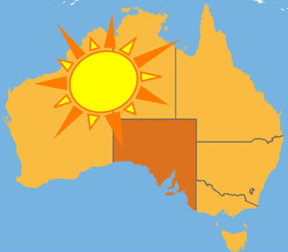
Giles Parkinson, Sep 30, 2024, https://reneweconomy.com.au/south-australia-sets-spectacular-new-records-for-wind-solar-and-negative-demand/
Records continue to tumble across Australia’s main grids as the spring weather boosts the output of wind and solar and mild weather moderates demand, but none are as spectacular as those being set in South Australia.
The state’s unique end-of-the-line grid already leads the country, and arguably the globe, in the integration of variable wind and solar, with an average of more than 70 per cent of its demand over the last year and a world-first target of 100 per cent net renewables by 2027.
On Sunday, at 9.35 am, the state set a new milestone, setting a new record share of wind and solar (as a percentage of state electricity demand) of 150.7 per cent, beating a record set on Christmas Day last year, when – for obvious reasons – there was little electricity demand.
As Geoff Eldridge, from GPE NEMLog, notes, this means that the rooftop PV, along with large scale wind and solar farms, were generating 50.7 per cent more power than the state’s total electricity demand at the time.
The scale of excess output was further crystallised later in the day with a new minimum record for instantaneous residual demand, which hit minus 927 megawatts at 12.35pm.
Eldridge says residual demand is what’s left for other generators to supply after wind and solar have met a share of the demand. A negative residual demand means wind and solar were producing more electricity than SA needed, resulting in excess renewable generation which can be managed by exporting and battery charging. The remainder is curtailed.
Of the surplus 927 MW, the state was exporting 685 MW to Victoria, while another 163 MW was being soaked up by the state’s growing fleet of battery storage projects, and 730 MW of output was curtailed. Prices at the time were minus $47/MWh, a good opportunity for batteries to charge.
A further 84 MW was being produced by a couple of gas generators – not because their power output was needed, but because the state, at least for the moment, relies on them for essential grid services such as system strength and fault current.
That will be reduced considerably when the new link to NSW is completed in a few years, and it will allow the state to both export more, and import more when needs be.
“Balancing the system with such high renewable penetration is challenging but necessary as the energy transition progresses,” Eldridge says. “Managing excess generation through exports, storage, and curtailment is critical to keeping the grid stable and efficient.”
It wasn’t the only record to fall over the weekend. In Queensland, the country’s most coal dependent state in terms of annual share of demand and generation, large scale solar hit a record share of 34 per cent, and coal output – in megawatt terms – hit a record low of 2,882 MW.
The Queensland coal fleet capacity is more than 8,000 MW, so that is about as low as it can run until more units are closed down.
In Victoria on Saturday, just before the AFL grand final, rooftop solar also hit a new record output of 3,164 MW – although it did not push operational demand down low enough for the market operator to enact Minimum System Load protocols and possibly switch off some rooftop solar panels to maintain grid stability.
It had flagged a potential MSL event on Friday but cancelled it in the morning. Those events will likely occur at other times in spring and over the summer holidays, although the market operator is now working on new rules for big batteries to avoid a potentially unpopular and unwieldy solar switch off.
‘Cheaper with nuclear’: What will Dutton’s nuclear plan really cost?

The Age, Mike Foley, September 27, 2024
Opposition Leader Peter Dutton is refusing to release the costings of his nuclear energy policy, despite claiming a national fleet of reactors would slash power bills.
But enough work has been done by independent agencies to give us some idea of the potential price tag.
What Dutton said
“We can have cheaper, cleaner and consistent energy if we adopt nuclear power,” Dutton said last week, adding that nuclear plants did not require the thousands of kilometres of transmission lines that link renewables to the grid, and took up less space than wind and solar farms.
A Coalition government would build seven nuclear plants on the sites of existing coal plants, including two small modular reactors and five large-scale plants, and plans to have the first operating by 2037.
Dutton says residents of Ontario, Canada enjoy cheaper power prices – 18¢ a kilowatt-hour (kWh) – courtesy of the province’s eight nuclear reactors generating about 60 per cent of the electricity supply.
He told Nine’s Today program on September 20 that Ontarians were “paying one-third the cost of electricity that we are here”. In July, he said they were “paying about a quarter of the price for electricity that we are here in Australia”.
These claims are overstated.
Power prices
Victoria pays about 28¢ a kWh, NSW 33¢ and Queensland 30¢. So rather than prices being three to four times higher, they are a bit less than twice the 18¢ figure. South Australians pay more than the other states at 45¢, but still less than Dutton’s claim.
However, this comparison is questionable because Australian prices include a range of costs that Ontarians must pay on top of their kWh charge. Network charges – the cost of building, running and maintaining power poles and wires across the grid – are listed separately on Ontario’s bills and can run into hundreds of dollars a year.
Construction costs
The CSIRO’s latest energy cost report card estimated a large-scale nuclear reactor in Australia would cost $16 billion, based on the low-cost construction of plants in South Korea, and take nearly two decades to build. It calculated that cost could fall to about $8 billion per reactor as efficiencies of scale were achieved after at least five and possibly 10 reactors were built.
Britain’s Hinkley Point C plant, which was announced in 2007 with an estimated $18 billion price tag, is set to be completed 13 years late at a cost of $90 billion.
If a Dutton government built reactors in Australia, that cost would have to be repaid, which could come via consumers’ electricity bills……………………………………………………………. more https://www.theage.com.au/politics/federal/cheaper-with-nuclear-what-will-dutton-s-nuclear-plan-really-cost-20240920-p5kc8z.html
AustralianSuper ESG option invested in nuclear weapons: report.

Hannah Wootton, 1 Oct 24 https://www.afr.com/wealth/superannuation/australiansuper-esg-option-invested-in-nuclear-weapons-report-20240926-p5kdpp .
Australia’s 14 biggest superannuation funds are investing about $3.4 billion of workers’ retirement savings in nuclear weapons despite many promising to avoid controversial arms, new research shows.
Industry fund gorilla AustralianSuper alone had $1.5 billion in nuclear weapons companies, while UniSuper, Aware Super and HESTA invested more than $200 million each.
Hostplus was the only major fund on the Australian market to exclude nuclear weapons, according to the study by Quit Nukes and the Australia Institute.
It comes as members ramp up engagement with super funds over concerns about unethical or environmental investments and regulators crack down on companies making false promises to consumers about their social good.
It also follows Treasurer Jim Chalmers saying there was an opportunity for super funds to “think more strategically” about how institutional capital flows into the defence industry as part of his push last year to tap $3.9 trillion for nation building investments, which funds and experts pushed back on.
Looking at funds’ default MySuper options, which account for the bulk of their members and funds under management, the report found Aware Super was the most exposed to nuclear weapons.
About 0.91 per cent of its total funds in the option were in nuclear weapons, outstripping AustralianSuper with 0.7 per cent and UniSuper and HESTA with just under 0.5 per cent.
Nuclear weapons ‘excluded’
Quit Nukes director and report co-author Rosemary Kelly said if funds wanted to keep pace with international law, global investment norms and members’ expectations and make the best risk-adjusted financial decisions, they would exclude atomic weapons.
“Super funds are being sneaky by boasting of policies to exclude ‘controversial weapons’ but not counting nuclear weapons as ‘controversial’,” she said.
“That’s pretty hard to swallow when you consider that the United Nations now considers nuclear weapons as controversial weapons.”
The report was based on portfolio holdings at December 31, 2023, and termed nuclear weapons companies as those which have a meaningful stake in the manufacture, maintenance, detonation or development of nuclear warheads and missiles or components exclusively used in them.
AustralianSuper and Spirit Super’s ESG options invested in them to the tune of $20.1 million and $400,000 respectively, despite targeting ethical investors and promising to exclude controversial (but not nuclear) weapons.
“That was a big surprise and it’s unacceptable. People read the headlines of funds’ websites and don’t have the tools to drill down into what’s actually happening – so if a fund says it excludes controversial weapons, a normal punter would think that includes nuclear,” Dr Kelly said.
Only Hostplus excluded nuclear weapons from its MySuper offering, while nine more funds ruled out controversial weapons but not atomic ones. AustralianSuper, Brighter Super, UniSuper and Care Super did not exclude any arms.
Financial sting
Dr Kelly, who is a former Aware Super director and headed its investment committee, said super funds needed to take the long-term economic implications of nuclear war seriously given their legal obligation to always act in the best financial interests of members.
“Any nuclear war, started intentionally or by accident, will be disastrous for global financial markets. This is clearly not in anyone’s best financial interest,” she said.
Even a “limited nuclear war”, which some conflict strategists view as a tactical alternative to full nuclear war should deterrence ever be deemed necessary, involving just 250 of the 12,000-plus atomic weapons in the world would kill 120 million people outright.
It would then risk a further 2 billion lives through a nuclear famine and have significant consequences for global supply chains and manufacturing.
Modelling included in the report showed there was no meaningful change in super fund returns when nuclear weapon companies were excluded from portfolios compared to when they were included.
An Aware Super spokeswoman said the fund’s investments in nuclear were only in companies where the weapons component was “a very small part of their overall business”, and its controversial weapons policy more broadly was under review.
A HESTA spokesman said only a small portion, 0.15 per cent, of the fund’s total assets were in nuclear weapons and that Quit Nukes’ data was outdated.
But the report acknowledged the fund had reduced its holdings since the data collection and sold out of four of the five companies it had previously held in breach of its own commitment to exclude companies earning more than 5 per cent of revenue from nuclear weapons.
An AustralianSuper spokesman said the fund’s members had “diverse values, preferences and attitudes when it comes to investing”, with any exclusions and screens communicated to them on its website.
Spirit Super planned to review its ESG and nuclear weapons positions after its current merger with Care Super completed.
Indonesia, Solomon Islands join countries banning nuclear weapons, putting Australia at odds with neighbours
ABC, By Lachlan Bennett and Erwin Renaldi, 29 Sept 24.
Indonesia, a country of 275 million and one of Australia’s closest neighbours, is stepping up efforts to enforce a global ban on nuclear weapons.
This week, it officially joined the United Nations Treaty on the Prohibition of Nuclear Weapons — confirming its ratification of the pact along with Solomon Islands and Sierra Leone.
Indonesia’s Ministry of Foreign Affairs said in a statement it would put “moral and political pressure on nuclear weapon states to stop their development”.
The treaty, which came into force in 2021, now boasts almost 100 signatories.
But it has thus far failed to secure Australia or the big nuclear powers: China, the US, Russia, India, the UK and France.
Amid rising tensions in the Asia-Pacific, many smaller nations want the bomb banned before it’s too late.
Why hasn’t Australia signed the new prohibition treaty?
Australia has a long history of supporting anti-nuclear weapons initiatives.
This includes helping to establish the 1996 Comprehensive Nuclear Test Ban Treaty and the 2010 Non-Proliferation and Disarmament Initiative.
Most importantly, Australia’s efforts are underpinned by the Treaty on the Non-Proliferation of Nuclear Weapons — which it signed in 1970.
That treaty has 191 signatories, more than any other arms disarmament agreement in history, and has overseen a decline in global stockpiles and countries including South Africa and Ukraine agreeing to relinquish their arsenals.
But international relations lecturer Muhadi Sugiono, from Gadjah Mada University in Indonesia, said non-proliferation alone had failed to force nuclear powers to abandon their weapons programs.
“It is impossible, in fact, to expect the Non-Proliferation of Nuclear Weapons Treaty will achieve this goal,” he said.
“There is no legal framework which demands them to do so.”………………………………………………………………………
Is Australia really serious about banning nukes?
Despite Australia’s strong anti-nuclear activities, its alliance and reliance on nuclear superpower the US has raised eyebrows among advocates.
Dr Sugiono said Indonesian authorities recognised Australia’s “very, very strong” opposition to nuclear proliferation.
“But at the same time, the position is very ambiguous because Australia is very close to the US,” he said.
These concerns were brought into focus during a Senate hearing in 2023, when the Defence Department was grilled about Australia’s commitment to the South Pacific Nuclear Free Zone.
That treaty prohibits the stationing of nuclear explosives on Australian territory.
However, the United States’ policy of “neither confirming or denying” the presence of its weapons raised suspicions about what might be onboard visiting US aircraft…………………………………………………..
University of Sydney international relations professor Justin Hastings said that explains why most signatories of the new prohibition treaty were “non-aligned states” — in other words, countries that are neither allied with Western powers or their strategic rivals like China and Russia.
“Australia and many other countries want to have their cake and eat it too,” he said.
“They don’t have nuclear weapons, but they do want to benefit from the extended deterrence that comes from other countries having nuclear weapons.”
What does AUKUS have to do with it?
The optics were further clouded by the signing of the AUKUS defence pact with the US and UK, even though it will bring nuclear-powered submarines and not nuclear weapons to Australian shores.
The Indonesian government said it was blindsided by the announcement, forcing Australian diplomats to rush to calm the anxieties in South-East Asia and emphasise that Australia has no desire to obtain nuclear weapons.
International Campaign to Abolish Nuclear Weapons coordinator Tim Wright said signing the prohibition treaty would help Australia allay the concerns of its Pacific neighbours and “create additional guardrails against nuclear weapons”.
And Australia wouldn’t have to end its alliance with the US, given other allies like the Philippines have already signed.
“There would clearly be issues that arise in relation to the alliance that would need to be dealt with,” Mr Wright said.
“But there are precedents that we can point to that suggests that this wouldn’t spell an end to the alliance, as some people have feared.”
Why is there a new treaty, when we’ve already got one?
The prohibition treaty is designed to work in conjunction with existing non-proliferation agreements and fill a “legal gap” to ensure nuclear nations eliminate their weapons……………………………………………………
The new treaty also contains provisions to people and places impacted by nuclear testing, such as the Pacific, which saw hundreds of bombs denoted over several decades.
“It’s not just a treaty about disarmament, it’s also a treaty for nuclear justice,” Mr Wright said.
“There’s a real strong sense of regional solidarity in advancing disarmament, this understanding that people in the region have suffered.”
So what does this mean for Australia’s relations in the region?…………………………………. https://www.abc.net.au/news/2024-09-29/indonesia-ratifying-nuclear-pact-what-it-means-for-australia/104401610—
In the Woomera Manual, International Law Meets Military Space Activities
by David A. Koplow, September 12, 2024, https://www.justsecurity.org/100043/woomera-manual-international-law-military-space/
The law of outer space, like so much else about the exoatmospheric realm, is under stress. The prodigious growth in private-sector space activities (exemplified by SpaceX’s proliferating Starlink constellation, and other corporations following only shortly behind) is matched by an ominous surge in military space activities – most vividly, the creation of the U.S. Space Force and counterpart combat entities in rival States, the threat of Russia placing a nuclear weapon in orbit, and China and others continuing to experiment with anti-satellite weapons and potential techniques. The world is on the precipice of several new types of space races, as countries and companies bid for first-mover advantages in the highest of high ground.
The law of outer space, in contrast, is old, incomplete, and untested. A family of foundational treaties dating to the 1960s and 1970s retains vitality, but provides only partial guidance. Space is decidedly not a “law-free zone,” but many of the necessary guard rails are obscure, and few analysts or operators have ventured into this sector.
A new treatise, the Woomera Manual on the International Law of Military Space Activities and Operations, has just been published by Oxford University Press to provide the first comprehensive, detailed analysis of the existing legal regime of space. As one of the editors of the Manual, I can testify to the long, winding, and arduous – but fascinating – journey to produce it, and the hope that it will provide much-needed clarity and precision about this fast-moving legal domain.
Military Manuals
This Manual follows a grand tradition of prior efforts to articulate the applicable international military law in contested realms, including the 1994 San Remo Manual on Naval Warfare, Harvard’s 2013 Humanitarian Policy and Conflict Research Manual on Air and Missile Warfare, and the 2013 and 2017 Tallinn Manuals on Cyber Operations. The Woomera Manual was produced by a diverse team of legal and technical experts drawn from academia, practice, government, and other sectors in several countries (all acting in their personal capacities, not as representatives of their home governments or organizations). The process consumed six years (slowed considerably by the Covid-19 pandemic, which arrested the sequence of face-to-face drafting sessions).
The Manual is co-sponsored by four universities, among other participants: the University of Nebraska College of Law (home of Professor Jack Beard, the editor-in-chief), the University of Adelaide (with Professor Dale Stephens on the editorial board), the University of New South Wales—Canberra, and the University of Exeter (U.K.) The name “Woomera” was chosen in recognition of the small town of Woomera, South Australia, which was the site of the country’s first space missions, and in acknowledgement of the Aboriginal word for a remarkable spear-throwing device that enables greater accuracy and distance.
Comprehensive Coverage of a Broad Field
Three features of the Woomera Manual stand out. The first is the comprehensive nature of the undertaking. The Manual presents 48 rules, spanning the three critical time frames: ordinary peace time, periods of tension and crisis, and during an armed conflict. There may be a natural tendency to focus on that last frame, given the high stakes and the inherent drama of warfare, but the editors were keen to address the full spectrum, devoting due attention and analysis to the background rules that apply both to quotidian military space activities and to everyone else in space.
Complicating the legal analysis is the fragmentation of the international legal regime. In addition to “general” international law – which article III of the Outer Space Treaty declares is fully applicable in space – two “special” areas of law are implicated here. One, the law of armed conflict (also known as international humanitarian law) provides particularized jus in bello rules applicable between States engaged in war, including wars that begin in, or extend to, space. But the law of outer space is also recognized as another lex specialis, and it accordingly provides unique rules that supersede at least some aspects of the general international law regime. What should be done when two “special” areas of international law overlap and provide incompatible rules? The Woomera Manual is the first comprehensive effort to unravel that riddle.
The Law as It Is
A second defining characteristic of this Manual is the persistent, rigid focus on lex lata, the law as it currently is, rather than lex ferenda, the law as it may (or should) become. The authors, of course, each have their own policy preferences, and in their other works they freely opine about how the international space law regime should evolve (or be abruptly changed) to accommodate modern dangers and opportunities. But in this Manual, they have focused exclusively on describing the current legal structure, concentrating on treaties, customary international law, and other indicia of State practice. This is not the sort of manual in which the assembled experts “vote” on their competing concepts of the legal regime; instead, Woomera addresses what States (the sources and subjects of international law) say, do, and write. The authors have assembled a monumental library of State behaviors (including words as well as deeds, and silences as well as public pronouncements), while recognizing that diplomacy (and national security classification restrictions) often impede States explaining exactly why they did, or did not, act in a particular way in response to some other State’s provocations.
One feature that enormously facilitated the work on the Manual was a phase of “State engagement.” In early 2022, the Ministries of Foreign Affairs and Defense of the government of the Netherlands circulated a preliminary draft of the Woomera Manual to interested national governments and invited them to a June 2022 conference in The Hague to discuss it. Remarkably, two dozen of the States most active in space attended, providing two days of sustained, thoughtful, constructive commentary. The States were not asked to “approve” the document, but their input was enormously valuable (and resulted in an additional several months of painstaking work in finalizing the manuscript, as the editors scrambled to take into account the States’ voluminous comments and the new information they provided).
Space as a Dynamic Domain
Third, a manual on space law must acknowledge the rapidly-changing nature and scope of human activities in this environment, and the great likelihood that even more dramatic alterations are likely in the future. Existing patterns of behavior may alter abruptly, as new technologies and new economic opportunities emerge. The Manual attempts to peer into the future, addressing plausible scenarios that might foreseeably arise, but it resists the temptation to play with far-distant “Star Wars” fantasies.
The unfortunate reality here is that although the early years of the Space Age were remarkably productive for space law, the process stultified shortly thereafter. Within only a decade after Sputnik’s first orbit, the world had negotiated and put into place the 1967 Outer Space Treaty, which still provides the cardinal principles guiding space operations today. And within only another decade, three additional widely-accepted treaties were crafted: the 1968 astronaut Rescue Agreement, the 1971 Liability Convention, and the 1975 Registration Convention, as well as the 1979 Moon Convention (which has not attracted nearly the same level of global support and participation). But the articulation of additional necessary increments of international space law has been constipated since then – no new multilateral space-specific treaties have been implemented in the past four decades, and none is on the horizon today.
Sources and Shortcomings of International Space Law
The corpus of international space law is not obsolete, but it is under-developed. We have the essential principles and some of the specific corollaries, but we are lacking the detailed infrastructure that would completely flesh out all those general principles. Some important guidance may, however, be found in State practice, including the understudied negotiating history of the framework treaties for space law, particularly the Outer Space Treaty. The Manual provides important insights in this area, notably with respect to several ambiguous terms embedded in the treaties.
The authors of the Woomera Manual, therefore, were able to start their legal analysis with the framework treaties – unlike, for example, the authors of the Tallinn Manuals, covering international law applicable to cyber warfare, who had to begin without such a structured starting point. Still, the Woomera analysis confronted numerous lacunae, where the existing law and practice leave puzzling gaps. The persistent failure of the usual law-making institutions to craft additional increments of space arms control is all the more alarming as the United States, NATO, and others have declared space to be an operational or war-fighting domain.
Conclusion
It is hoped that the process of articulating the existing rules – and identifying the interstices between them – can provide useful day-to-day guidance for space law practitioners in government, academia, non-governmental organizations, the private sector, and elsewhere. The prospect of arms races and armed conflict in space unfortunately appears to be growing, and clarity about the prevailing rules has never been more important. It is a fascinating, dynamic, and fraught field.
Marles, with all pretension, flogging a dead seahorse

By Paul Keating, Sep 28, 2024, https://johnmenadue.com/marles-with-all-pretention-flogging-a-dead-seahorse/
Richard Marles and his mate, the US defence secretary, are beginning to wilt under the weight of sustained comment in Australia critical of the AUKUS arrangement.
Marles, unable to sustain a cogent argument himself, has his US friend propping him up in London to throw a 10,000-mile punch at me – and as usual, failing to materially respond to legitimate and particular criticisms made of the AUKUS arrangement.
The US Defence Secretary, Lloyd Austin, claims AUKUS would not compromise Australia’s ability to decide its own sovereign defence issues, a claim made earlier by Richard Marles and the prime minister.
But this would only be true until the prime minister and Marles got their phone call from the president, seeking to mobilise Australian military assets – wherein, both would click their heels in alacrity and agreement. The rest of us would read about it in some self-serving media statement afterwards. As my colleague, Gareth Evans, recently put it, “it defies credibility that Washington will ever go ahead with the sale of Virginias to us in the absence of an understanding that they will join the US in any fight in which it chooses to engage anywhere in our region, particularly over Taiwan”.
In London, Marles claimed that the logic behind AUKUS matched my policy as prime minister, in committing to the Collins class submarine program. This is completely untrue.
The Collins class submarine, at 3,400 tonnes, was designed specifically for the defence of Australia – in the shallow waters off the Australian continental shelf.
The US Virginia class boats at 10,000 tonnes, are attack submarines designed to stay and stand on far away station, in this case, principally to wait and sink Chinese nuclear weapon submarines as they exit the Chinese coast.
At 10,000 tonnes, the Virginias are too large for the shallow waters of the Australian coast – their facility is not in the defence of Australia, rather, it is to use their distance and stand-off capability to sink Chinese submarines. They are attack-class boats.
When Marles wilfully says “AUKUS matches the Collins class logic” during the Keating government years, he knows that statement to be utterly untrue. Factually untrue. The Collins is and was a “defensive” submarine – designed to keep an enemy off the Australian coast. It was never designed to operate as far away as China or to sit and lie in wait for submarine conquests.
And as Evans also recently made clear, eight Virginia class boats delivered in the 2040s-50s would only ever see two submarines at sea at any one time. Yet Marles argues that just two boats of this kind in the vast oceans surrounding us, materially alters our defensive capability and the military judgment of an enemy. This is argument unbecoming of any defence minister.
As I said at the National Press Club two years ago, two submarines aimed at China would be akin to throwing toothpicks at a mountain. That remains the position.
The fact is, the Albanese Government, through this program and the ambitious basing of American military forces on Australian soil, is doing nothing other than abrogating Australia’s sovereign right to command its own continent and its military forces.
Marles says “there has been demonstrable support for AUKUS within the Labor Party”. This may be true at some factionally, highly-managed national conference — like the last one — but it is utterly untrue of the Labor Party’s membership at large – which he knows.
The membership abhors AUKUS and everything that smacks of national sublimation. It does not expect these policies from a Labor Government.
Memo to Dutton: It’s the final quarter, you’d better start kicking

David Crowe, Chief political correspondent, September 26, 2024
The game plan that turned Anthony Albanese from an opposition leader to a prime minister is known by a simple phrase he used for three years before he gained the top job. “I said that we had a plan: kick with the wind in the fourth quarter, outline our policies close to the election,” he said in the weeks after Labor took power.
Albanese tends not to use the phrase these days. No prime minister can tell voters they will only bother with big policies when the election comes. That is true even if it is a plain fact that Labor is working on new measures for the campaign ahead – and that changes to negative gearing may end up in the surprise package.
Peter Dutton, by contrast, lives the Albanese motto every single day. The opposition leader is holding back on every policy that would normally shape an Australian election: on the economy, the cost of living, housing and defence.
Even the glaring exception to that statement – his proposal for seven nuclear power stations – confirms the flimsiness of the Liberal policy platform. Dutton and his energy spokesman, Ted O’Brien, are incredibly coy about how this policy might work. What would it cost? How long would it take? What replaces our ageing coal-fired power stations while we wait for nuclear?
“We will release our costings in due course – at a time of our choosing,” Dutton said in a speech to a business audience on Monday. Sure, it is common for opposition leaders to reveal their full costings shortly before the election. But they tend to put their big-picture policies on the agenda well before that final stage.
Dutton is running out of time. He is acting as if the last phase of this term of parliament is still months away. In fact, the final quarter is already upon us. It started last month, assuming the election is as late as May. And Dutton is yet to prove he can kick when it counts.
Liberals make a fair point about how to judge their policies: they may not have that many, but the ones they have are big and bold. This is absolutely true of the nuclear policy. No matter how many voters were alarmed at the Labor plans for negative gearing in 2019, the prospect of a nuclear accident may frighten a few more. It is a big idea and a huge political risk.
Dutton has leapt ahead of Albanese on a few fronts. He called in May last year for a ban on advertising sports betting during game broadcasts – an idea on which federal cabinet is yet to decide. He backed an age ban on social media earlier this year, months before Labor, thanks to early work by Coalition communications spokesman David Coleman…………………………………………………………………………..
Nothing ventured, nothing gained. Dutton has the wind behind him in the opinion polls but looks reluctant to risk this good fortune by telling Australians what he would do with power. ……………………………………….
There is very little pressure on Dutton to move any faster because he has a disciplined frontbench and party room that waits for him to make the big calls on policy timing, as well as a supportive conservative media that tells him he is outsmarting Albanese at every turn. He avoids press conferences in Parliament House, so the press gallery gets relatively few opportunities to question him. He has a narrow list of preferred TV and radio spots. The media strategy spares him any exposure to long interviews that might test him on what he would do if he was running the country.
………………….. This is not proof that voters are buying what Dutton is selling, they say. After all, nobody is sure what he is selling just yet.
The Labor tacticians could be totally wrong, but the Liberals are certainly taking their time. If Dutton wants to kick with the wind in the final quarter, he will need to run a little faster. https://www.smh.com.au/politics/federal/memo-to-dutton-it-s-the-final-quarter-you-d-better-start-kicking-20240926-p5kdn5.html?fbclid=IwY2xjawFi2ChleHRuA2FlbQIxMQABHeggdYlx-0-WJO5vDD_9NYYsmgvm4WRwBII811EpOipDFB_gAdNsefsDnA_aem_h6jj8XixlRUr13A9QS0T-Q
1 This month

of the week – Australians for War Powers Reform (AWPR)
To see nuclear-related stories in greater depth and intensity
 Antinuclear