El Tío – a new and worrying twist in the causes of global warnming

 Meet El Niño’s cranky uncle that could send global warming into hyperdrive, The Conversation, Research Fellow in Climate and Water Resources, University of Melbourne, Climate Extremes Research Fellow, University of Melbourne Professor of Atmospheric Science, University of MelbourneSenior Research Scientist, CSIRO, PhD student, University of Melbourne February 6, 2017
You’ve probably heard about El Niño, the climate system that brings dry and often hotter weather to Australia over summer.
You might also know that climate change is likely to intensify drought conditions, which is one of the reasons climate scientists keep talking about the desperate need to reduce greenhouse gas emissions, and the damaging consequences if we don’t.
El Niño is driven by changes in the Pacific Ocean, and shifts around with its opposite, La Niña, every 2-7 years, in a cycle known as the El Niño Southern Oscillation or ENSO.
But that’s only part of the story. There’s another important piece of nature’s puzzle in the Pacific Ocean that isn’t often discussed.
It’s called the Interdecadal Pacific Oscillation, or IPO, a name coined by a study which examined how Australia’s rainfall, temperature, river flow and crop yields changed over decades.
Since El Niño means “the boy” in Spanish, and La Niña “the girl”, we could call the warm phase of the IPO “El Tío” (the uncle) and the negative phase “La Tía” (the auntie).
These erratic relatives are hard to predict. El Tío and La Tía phases have been compared to a stumbling drunk. And honestly, can anyone predict what a drunk uncle will say at a family gathering?
What is El Tío? Continue reading
Australian universities need to divest from fossil fuels
We all need to divest from fossil fuels now – especially Australian universities, Guardian
John Quiggin, 2 Feb 17 The end of coal is inevitable but divestment will help accelerate the process, especially as we can’t rely on government to stabilise the environment. T
The movement to divest from the fossil fuel industry has grown rapidly over recent years in tandem with the urgent need to decarbonise the global economy. In Australia, divestment commitments have been made by local councils, charitable trusts, super funds and the Australian Capital Territory.
Universities have been a central focus of the campaign. Leading global universities such as Yale, Stanford and Stockholm have undertaken partial or complete divestment. In Australia, La Trobe and the Queensland University of Technology have made comprehensive divestment commitments, while others including the Australian National University, Monash and Sydney have taken substantial steps towards this goal. Continue reading
Response to Ben Heard’s misinformation on the proposed nuclear waste importing plan
 The only way to avoid gambling hundreds of millions or billions of SA taxpayers’ dollars would be in the wildly improbable scenario that potential client countries would take that gamble.
Taipower clearly states that it would not consider sending waste to another country unless and until that country has developed a repository. Yet the economic case developed by Jacobs and MCM collapses if revenue (and waste) is not received before construction of a repository.
Finally, Mr Heard’s promotion of fast breeder reactors is beyond stupid….. Most of the countries that invested in fast breeder reactors have given up, deciding not to throw good money after bad. Last year, Japan decided to give up on the Monju fast breeder reactor, a fiasco that will cost Japanese taxpayers A$17.3 billion in construction, operation and decommissioning costs despite the fact that the reactor rarely operated.
The Royal Commission completely rejected proposals advanced by Heard and others for ‘advanced fast reactors’, noting in its final report that such reactors are unlikely to be feasible or viable in the foreseeable future; that the development of such a first-of-a-kind project would have high commercial and technical risk
Friends of the Earth Australia has today written to all Members of the SA House of Assembly and Legislative Council, and SA political representatives in the Federal Parliament, responding to the latest round of misinformation from those proposing to turn SA into the world’s high-level nuclear waste dump.
——————————————————————————–
To: Members of the SA House of Assembly and Legislative Council
From: Jim Green
National nuclear campaigner
Friends of the Earth, Australia Feb. 3, 2017
EXPOSING THE LATEST MISINFORMATION FROM THE NUCLEAR WASTE DUMP LOBBY
Dear Members of the SA House of Assembly and Legislative Council,
 The Advertiser has today run an article including false claims from nuclear lobbyist / uranium industry consultant / PhD student Ben Heard that Jay Weatherill’s plan to turn SA into the world’s high-level nuclear waste dump could be pursued without the need to gamble hundreds of millions or billions of dollars with no guarantee of any return on the investment.
Mr Heard is quoted saying that the “notion of high upfront cost to South Australia is a persistent and deliberate lie first peddled by deceitful environmental groups and now, sadly, taken up by the Liberal Party.”
In fact, the necessity of gambling hundreds of millions or billions of dollars ‒ without the slightest guarantee of any return on the investment ‒ is clearly spelt out by Jacobs, the economics consulting firm commissioned by the Nuclear Fuel Cycle Royal Commission.
Jacobs Project Manager / Consultant Tim Johnson told the SA Joint Select Committee that “total expenditure prior to the decision to proceed” is likely to be from around A$300 million to in excess of A$600 million, depending on the timing of the decision to proceed. (Letter to Joint Standing Committee, 5 July 2016.)
Dr Johnson told the Joint Select Committee that the project entails very significant economic risks: “It isn’t a risk-free process to go into this. There is a very significant risk.” Yet the nuclear waste dump lobby persist with the fabrication that the project can be pursued without economic risks. Continue reading
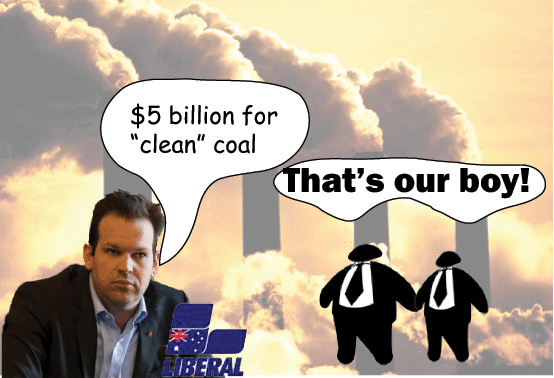
$5 billion infrastructure fund for clean-coal – announces Resources Minister Matt Canavan
Resources Minister Matt Canavan opens $5 billion infrastructure fund for clean-coal power stations, ABC News, 3 Feb 17 By political reporter Henry Belot Resources Minister Matt Canavan has opened the $5 billion Northern Australia Infrastructure Fund to fund new so-called clean-coal power stations.
Key points:
- The Federal Government has invested close to $590 million in clean-coal technology since 2009
- Australia does not have a high-efficiency, low-emission power station
- Prime Minister Turnbull announced the push for more clean-coal technology earlier this week
Senator Canavan’s comments come days after Prime Minister Malcolm Turnbull said Australian industry had an obligation to be at the forefront of coal technology.
Treasurer Scott Morrison has also not ruled out using money set aside in the Clean Energy Finance Corporation to pay for new generation power stations.
Mr Canavan said he had received interest from energy generators to tap into the billion-dollar investment fund and explore North Queensland. “I’ve received some interest over the past week associated with our commitment to build base load power stations, including to support clean coal options,” he told ABC AM. Mr Canavan would not say which companies had expressed interest but said there were viable options near the Galilee Basin and other parts of the state’s north.
The Federal Government has invested close to $590 million in clean-coal technology since 2009 but Australia does not have a high-efficiency, low-emission power station. The Resources Minister cited a 2012 report by industry consultants GHD, which indicated clean-coal power stations could be commercially viable in Australia’s north.
Mr Canavan dismissed comments by some Australia’s energy generators — including AGL and Energy Australia — saying new power stations would be expensive to build and require significant public funds……
Bloomberg New Energy finance researcher Leonard Quong said new coal would be the most expensive form of energy supply. “New coal is made particularly expensive due to the substantial carbon, reputation, trading and construction risks the technology presents to an investor,” he said.
The renewed focus on clean-coal has drawn criticism from Labor and the Greens, who have accused the Government of trying to protect “the coal club”.
Opposition spokesman for climate change and energy Mark Butler said a preference for coal over renewables would mean higher power bills for Australians. Greens leader Richard Di Natale said the cleanest form of electricity would remain wind and solar, while raising concerns about the cost of new base-load coal plants. http://www.abc.net.au/news/2017-02-03/infrastructure-fund-opened-for-clean-coal-power-stations/8237866
Community survey shows strong local opposition to Federal nuclear waste dump at Barndioota, South Australia
 Flinders Local Action Group ( FLAG ) Community Survey Results Do You Want a National Radioactive Waste Management Facility established at Wallerberdina Station / Barndioota ? December 2016
A survey of residents living within a 50km radius of the proposed National Radioactive Waste Management Facility of Barndioota, and the remainder of the Flinders Ranges Council Area, South Australia……….
Conclusion FLAG employed two separate survey methodologies to gauge community support for the proposed waste facility.
The first opportunistically sampled interested &/or concerned community members attending the Quorn Town Hall Meeting of 21st September 2016 and the Quorn Agricultural Show on 25th September 2016. Respondents elected to fill out a questionnaire at the FLAG booth.
Whilst there is a possibility of some response bias the method does offer a measure of community support or opposition to the development.
The second mail out/postal survey represents a more systematic attempt to survey the entire towns of Quorn, Hawker and Craddock. Although there is still the possibility of some response bias (as in any survey), these methods provide an improved estimate of regional community sentiment.
Both surveys indicate considerable community opposition to the waste facility and when taken together demonstrate that Department of Industry, Innovation & Science does not have the majority community support it requires.
In both surveys, a clear majority voted “no” to the establishment of a National Radioactive Waste Management Facility in the area, with 92% voting against it in Survey 1 and 79% in Survey 2.
In the Hawker/Cradock region, which is closer to the proposed site, the support for the proposal was slightly higher, presumably due to the perceived economic benefits. Further away in Quorn, support for the proposal was lower, as the benefits would be minimal and outweighed by loss to other industries such as tourism.
Both surveys indicate majority disapproval for the proposal.
Australian government seeks to deceive the public on the definition of “High Level Nuclear Wastes”
 Steve Dale Nuclear Fuel Cycle Watch South Australia, 4 Feb 17 Seems like Australia put a lot of effort to get other nations to call “High Level Waste” intermediate level. It didn’t work. USA, Canada, France, Japan and UK still call Vitrified reprocessed waste “High Level”.
 Prof. Garnett – America is the one that is different. America has not yet adopted the internationally agreed definitions. Dr Cameron is on the committee. He is also involved in the International Atomic Energy Agency. My director of materials, Dr Jostsons, whom you met, is also on relevant committees, and at this stage America is not conforming with the internationally agreed definitions.” Joint Committee on Public Works 14/05/99
Turnbull’s powerful taskforce to promote the coal industry
 Push for coal-fired power Malcolm Turnbull has formed a new, powerful cabinet committee to oversee national energy policy.
Turnbull taskforce to push coal-fired power for north The Australian February 4, 2017 DENNIS SHANAHAN Political Editor Canberra MICHAEL OWEN, Malcolm Turnbull has formed a new, powerful cabinet committee to oversee national energy policy as the government proposes to use some of the $5 billion Northern Australia Fund to help build a new, commercially viable coal-fired power station in northern Queensland……
As parliament resumes next week the Prime Minister is putting energy security and lower power prices at the heart of the Coalition’s policy and political campaign with the new cabinet sub-committee — including Mr Turnbull, Barnaby Joyce, Julie Bishop, Scott Morrison, Mathias Cormann, Josh Frydenberg, Matt Canavan and Arthur Sinodinos — starting to co-ordinate and develop a national energy policy…….
Mr Turnbull and the Treasurer have flagged using funds from the Clean Energy Development Fund for modern coal-powered generators the government has convinced the $100 billion Asia Infrastructure Investment Bank to lend for coal-fired electricity generation in Asia. Senator Canavan, the Minister for Northern Australia, yesterday suggested the government help fund a coal-fired power station in the Galilee Basin in Queensland……
“We back clean-coal options in the north and I want to make clear that we will back investment in clean coal through our $5bn Northern Australia Infrastructure Facility. We set up that facility to build infrastructure in the north, to build specific infrastructure like power stations,” Senator Canavan said….
The minister said Mr Turnbull had announced that the “Australian government would look at encouraging the development of a clean coal-fired power station in Australia”. “This will be a clear difference between us and the Labor Party. We support coal…….. http://www.theaustralian.com.au/business/mining-energy/turnbull-taskforce-to-push-coalfired-power-for-north/news-story/e15cbb9f03c1922f909780ccbffd41cb
Federal govt embarrassed over backlash to its plan to expand Shoalwater Bay military training area
Defence told to look elsewhere as plan to seize Queensland cattle country sparks outcry
PM tells defence to find other sites to train foreign troops amid anger at plan to expand Shoalwater Bay training area, Guardian, Joshua Robertson, 2 Feb 17, Malcolm Turnbull has ordered the Department of Defence to find alternative sites for foreign military training in Queensland after uproar over plans to take over as many as 60 grazing properties in prime cattle country.
The state opposition leader, Tim Nicholls, on Thursday said the prime minister intervened after a growing backlash over the prospect of compulsory acquisitions, revealed months after an election campaign in which the federal government trumpeted a $2.2bn training deal with Singapore.
The controversy prompted Nicholls to write to Turnbull imploring him to step in after what he said was defence’s mishandling of the proposed training site expansion at Shoalwater Bay and near Townsville.
The federal opposition leader, Bill Shorten, wrote to Turnbull on Wednesday calling for him to urgently review the matter and explain what “alternatives to acquiring prime grazing land” had been considered.
Nicholls’ statement raised doubts about what other options defence, which has compulsory land acquisition powers, had explored to date for expanding training bases to host 14,000 Singapore troops a year………
The LNP this week joined state and federal Labor, Katter’s Australian party and One Nation in publicly criticising the process for the land expansion, after the federal government signed the deal with Singapore in May last year to train 14,000 of its troops.
The parties all warned the loss of drought-resistant grazing land in areas that contain up to 100,000 head of cattle would have a dramatic and harmful impact on the beef industry.
In November landholders in the Marlborough and Charters Towers regions first learned of the possibility their properties would be acquired in letters from defence, which had planned an expansion of about 170,000 hectares.
Defence is yet to decide which properties it will target but the defence minister, Marise Payne, recently ordered the process be sped up with those plans to be revealed next month.
Those under pressure include federal backbencher Michelle Landry, whose central Queensland seat of Capricornia is one of the nation’s most marginal……….https://www.theguardian.com/australia-news/2017/feb/02/defence-shoalwater-bay-queensland-compulsory-acquisition?CMP=share_btn_fb
Shell’s solar plant plans – with gas as backup
Shell plans Australian solar plants that can switch to gas The Anglo-Dutch oil giant is looking to invest in Australian solar plants that can switch to gas when needed. THE AUSTRALIAN, MATT CHAMBERS, 4 Feb 17
Anglo-Dutch oil giant Shell is looking to invest in Australian solar plants that can switch to gas when needed to deliver baseload power supply as debate rages over renewable energy security in the wake of South Australia’s crippling power outages.
Shell, which is Australia’s biggest LNG exporter and one of the world’s largest oil companies, has revealed that Australia was one of three global locations, along with Oman and Brunei, where it was studying pairing renewable energy with gas, after last year flagging “new energies” would be a potential major source of growth for the fossil fuel company beyond 2020.
“We believe we are in the middle of an energy transition that is unstoppable and we want to be in the vanguard of that,” Shell’s global chief Ben van Beurden said after the company’s fourth-quarter earnings release in Britain on Thursday.
He said renewables alone would not be enough to provide the world with cleaner power.
“An integrated offering of gas and renewables, which cannot only deal with interruptibility and everything else of renewables but also give that second leg that a growing economy needs, is a sensible offering,” Mr van Beurden said.
Chief financial officer Simon Henry confirmed Australia was one of the regions where combined gas and renewables were being studied……..
Shell’s plan, to develop economically viable renewable power stations where a gas switch could be flicked when needed, could reduce the need for both coal-baseload power and expensive gas-only peaking plants…….
While Shell’s renewables focus has been on wind farms so far —,it won a bid in December to build a 700MW wind farm off the coast of Holland — it is understood Shell is investigating solar power, paired with gas, in Australia……. http://www.theaustralian.com.au/business/mining-energy/shell-plans-australian-solar-plants-that-can-switch-to-gas/news-story/1ea4416426893074645c45215d3781ea
Kimba Mayor wants a referendum first, before any decision on nuclear waste dump
Kimba wants to take nuke waste, Peter Jean, The Advertiser. p.6 of print version. “…….Kimba mayor Dean Johnson said a referendum of residents should be held before a final decision was made to build a waste dump in the district ….”
S Aust property owners offer land for nuclear waste – at Napandee and Lyndhurst, near Kimba
 SA landowners offer up two more properties as sites for federal nuclear dump http://www.abc.net.au/news/2017-02-02/new-properties-nominated-as-nuclear-dump-sites/8236894 Another two properties near Kimba in South Australia have been put forward as potential sites for the nation’s first nuclear waste dump.
Six sites around Australia, including two others near Kimba, were previously shortlisted by the federal government to store low- and intermediate-level waste.
Wallerberdina station near Barndioota in the Flinders Ranges was the only one to reach a formal consultation phase, which remains ongoing.
The nomination of the previous sites caused significant divisions within the Kimba community, but two other local landowners have since offered up their properties, called Napandee and Lyndhurst.
Bruce Wilson from the federal resources department said Industry Minister Matt Canavan had not decided on whether to take the proposals forward. “By no means has there been any decision to accept the nominations at this point,” Mr Wilson said. “We are hopeful that in the next few weeks there will be a decision made.”
Mr Wilson said a French nuclear delegation would visit the region, as well as the Flinders Ranges, next week to discuss storage of radioactive waste with locals.
“The French delegation has been invited by the Kimba Council to come down,” he said.”It’s an opportunity for them to ask questions about the issues they’re concerned about.”
Napandee is about 25 kilometres west of Kimba, while Lyndhurst is about 20km north-east of the town.
Kimba mayor Dean Johnson said he was not surprised other local landowners had nominated their properties for nuclear waste storage, and welcomed the chance to meet with the delegation.
“The more information we can get the better, so hopefully this will provide some real answers,” he said.
“The entire question remains around community consent.”
The Federal Government’s selection of Wallerberdina station for further consideration has proved highly controversial and generated a backlash within the local community.
Ben Heard, of nuclear front group “Bright New World” in unfair attack on S Aust Liberals
In his latest pro nuclear spiel, on his front group “Bright New World” Ben Heard attacks South Australia’s Liberal Party. He attacks them for ignoring the evidence of (so-called) “Independent” experts.
Those experts are in fact, highly biased pro nuclear lobbyists. Dr Tim Johnson of Jacob Consulting, a leading advocate for underground nuclear storage in S.A. Jim Voss the ex-MD of Pangea Resources – a failed joint venture attempt to bring High Level nuclear waste to Australia in the late 1990s. Voss has global links in the nuclear industry at the highest level. Through UCL he lectured South Australians on the glories of nuclear.
Nuclear propaganda group to visit Port Augusta
 French nuclear delegation to visit Port Augusta, The Transcontinental
  @MattCarcich 1 Feb 2017 Port Augusta will host French radioactive waste experts and those who have lived next to a radioactive waste management facility to share their experiences.
The discussion will be held at the Standpipe Golf Motor Inn on Wednesday February 8, from 11am – 12pm (presentation) and 12pm – 2pm (lunch).
The group will also visit Hawker, Quorn and Kimba.
The delegation from France’s radioactive waste management organisation, Andra, and surrounds, was organised after discussions with the Hawker community and after a specific invitation from Working for Kimba’s Future, who are supporting new land nominations from their area.
The four person delegation will comprise of the following:
- Mayor of Fresnay and champagne producer, Pierre Jobard.
- Mayor of Soulaines and local tourism board member, Philippe Dallemagne.
- Director of the Aube Disposal Facility, Patrice Torres.
- Andra International Business Manager, Jelena Bolia.
The group will hold a number of community presentations that are open to the public.
Staff from the Department of Industry, Innovation and Science, the Australian Nuclear Science and Technology Organisation (ANSTO) and Geoscience Australia will also be available for questions.
Head of the Resources Division in the Department of Industry, Innovation and Science Bruce Wilson, said the group will be spending a number of days within the area, including visiting the nominated site at Barndioota………
The proposed site,160 kilometres north of Port Augusta, will store low-level and some intermediate-level nuclear waste.
The low level purpose-built repository would be about the size of four Olympic size swimming pools with a 60 hectare buffer on the 25,000 hectare property.
Designs have not been prepared for the national repository but it will be modelled on above-ground storage and disposal facilities overseas.
The 95-hectare Aube facility in Northern France manages low and intermediate level radioactive waste….. http://www.transcontinental.com.au/story/4441222/french-delegation-to-visit/
Chief Scientist Alan Finkel – an intelligent voice for Australia’s energy future
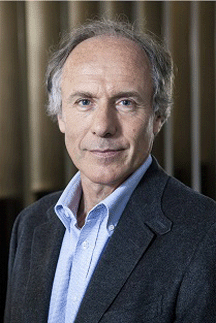 Eight reasons why Dr Finkel is great news for Australia’s energy future http://reneweconomy.com.au/eight-reasons-why-dr-finkel-is-great-news-for-australias-energy-future-70270/ By Valdis Dunis on 1 February 2017
1. Dr Finkel and SA’s Chief Scientist Leanna Read both see the grid becoming 100% renewable powered as the end point. Continue reading
Turnbull govt wants to use Clean Energy Finance Corporation to finance new coal power stations
“The stranded asset risks of investing in new coal-fired power plants are clear to almost all,” Buckley said. “At some point a carbon tax or ETS is inevitable and would need to be priced in.”
Buckley said if that happened, the CEFC could well be stranded with any loan it’s given to coal power stations.
How Malcolm Turnbull could ignore the facts and fund the myth of ‘clean’ coal, Guardian, Michael Slezak 2 Feb 17 The Coalition could use the Clean Energy Finance Corporation to finance new coal power stations but it wouldn’t be cheaper than renewables Just a few months ago, the idea that a new coal power station would ever be built in Australia seemed laughable. Banks, energy companies and even the Turnbull government seemed to accept the inevitable decline of the coal industry.
But, since then, the Turnbull government has been furiously talking up the idea of “clean” coal. And while no bank is likely to finance the building of a new coal-fired power station here, Turnbull and his ministers have been indicating the government might themselves fund them.
There’s been a lot of spin in this debate, so here are some facts……..
The Clean Energy Finance Corporation cannot currently fund coal (but the government could change the rules) Continue reading
1 This month


Help Aunty Sue Protect Her Land and Sacred Sites From Destructive Rocket Testing.
.

Australians deserve the truth
about
AUKUS – https://aukuspublicinquiry.com/

PETITION – To: Prime Minister Anthony Albanese and the Australian Labor Government

of the week – Australians for War Powers Reform (AWPR)
To see nuclear-related stories in greater depth and intensity

